

Valley Restoration Pros delivers 24/7 industrial emergency water extraction, thermal psychrometric drying, and structural mitigation across Phoenix and Maricopa County with guaranteed 30–60 minute rapid arrival. All protocols strictly adhere to IICRC S500 standards, featuring upfront itemized pricing and free on-site thermal moisture assessments. Call dispatch directly at (602) 847-9593.
Why Immediate Mitigation Is Critical in Phoenix Heat
Subterranean wash bay recycling pump blowouts release thousands of gallons of detergent-rich, hydrocarbon-contaminated greywater across subterranean conveyor pits, submerging high-voltage motor drives and creating severe electrocution and arc-flash hazards. Recycled wash runoff carrying emulsified motor oils, hydraulic fluids, dissolved brake dust, and road grime rapidly infiltrates customer vehicle pickup concourses, creating extreme slip-and-fall liabilities and structural concrete hydrocarbon staining. Phoenix municipal water hardness of 18 GPG combined with chemical surfactant residue precipitates a dense calcified calcium carbonate and silicate crust inside conduit runs, conveyor chain linkages, and submersible sump impellers upon evaporation. Under 115°F ambient airport ramp temperatures, unconditioned lower-level fleet staging decks rapidly hit 95% relative humidity within 45 minutes, triggering accelerated fungal amplification and acidic vapor condensation on exposed structural steel and electrical raceways.

Service Definition & The IICRC Standard of Care
Professional sky harbor rental car center commercial wash bay flood extraction is an engineering and environmental discipline adhering strictly to IICRC S500 protocols, not mere surface mopping. When structural plumbing failures strike in Maricopa County, certified emergency water extraction and thermal structural drying procedures must be deployed immediately. Whether triggered by high-pressure burst pipe emergencies, subfloor leaks, or commercial line ruptures, bound moisture rapidly penetrates concrete subfloors and wall framing. In the desert heat, delays trigger microbial proliferation requiring rapid mold remediation. Request damage assessment through our emergency assessment portal or request 30-minute dispatch across all Valley service areas.
Securing electrical feeds, inspecting load-bearing assemblies, and containing pathogens.
Stopping the intrusion source and erecting 6-mil plastic isolation containment airlocks.
31-HP truck-mount extraction, removing gallons exponentially faster than evaporation.
LGR dehumidifiers and HEPA air scrubbers driving grains per pound below 25 GPP.
Calibrated electronic pinless testing confirming baseline dry standards.
The Complete 6-Stage Restoration Roadmap
Our IICRC-certified crews execute a disciplined, scientific 6-stage protocol to stabilize and dry structural components:
Emergency Dispatch & Perimeter Isolation
30 to 60 minute arrival. Securing electrical shutoffs, evaluating structural loads, and erecting containment airlocks.
FLIR® Thermal Mapping & Baseline Scans
Infrared thermal scans detect trapped moisture behind walls and beneath concrete without invasive exploratory demolition.
High-Volume Bulk Extraction
31-HP truck-mount extraction units pump standing water away at hundreds of gallons per minute.
Controlled Selective Demolition
Precision flood cuts 12 to 24 inches above moisture lines, removing wet insulation and opening wall framing to dry airflow.
Thermodynamic Dehumidification
Industrial Low-Grain Refrigerant dehumidifiers pull deep trapped moisture from dense framing lumber and concrete slabs.
Antimicrobial Sanitization & Verification
EPA-registered botanical application (Benefect Decon 30) and calibrated moisture testing to issue an official dry certificate.

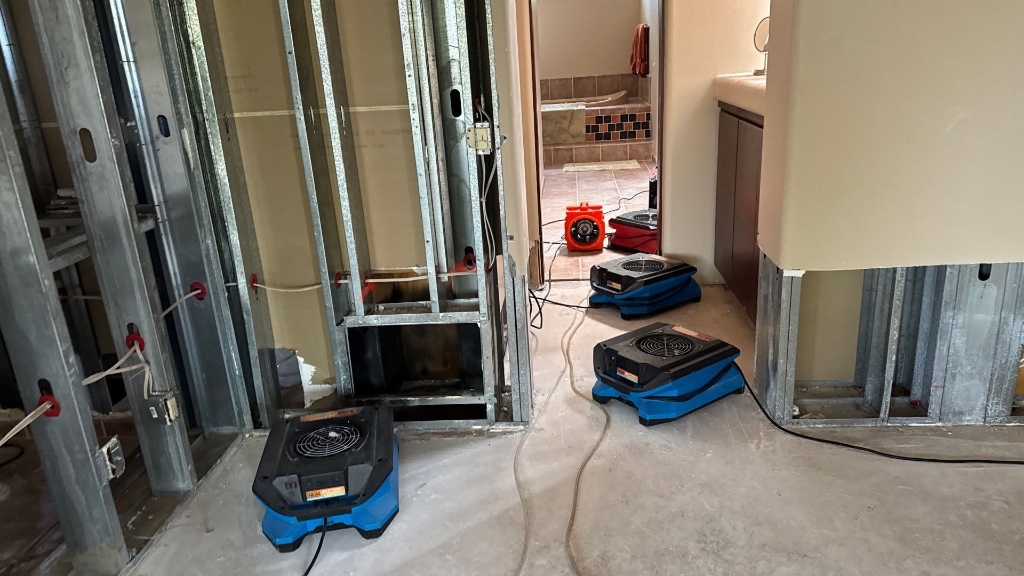
Specialized Equipment & Industrial Restoration Technology
Mitigating severe property damage requires industrial-grade technology capable of altering thermodynamic psychrometrics:
Truck-Mounted Extraction Rigs
31-HP engines producing 16+ inches Hg vacuum suction to evacuate bulk water rapidly into holding tanks.
Low-Grain Refrigerant Dryers
Pre-cooling heat-pipe systems driving ambient grains per pound below 25 GPP to draw deep trapped water out of framing.
HEPA Negative-Air Scrubbers
Hospital-grade 99.97% particulate filtration capturing microscopic fungal spores, soot, and biohazard aerosols.
FLIR® Thermal Scanners & Probes
Infrared thermography detecting evaporative cooling boundaries behind walls, combined with digital RF pinless scanners.
Professional Restoration vs. DIY Mitigation
Attempting DIY cleanup during a property disaster creates severe hidden liabilities:
- Trapped Moisture: Surface drywall dries while moisture inside cavities triggers hidden mold blooms.
- Pathogenic Risks: Category 2 & 3 water contains bio-contaminants standard cleaners fail to kill.
- Insurance Denial: Insurers require daily psychrometric logs; lack of data causes claim disputes.
Transparent Upfront Itemized Pricing
Valley Restoration Pros operates with complete transparency:
- Free On-Site Assessment: Complete physical inspection before work begins.
- Upfront Itemized Estimates: Detailed line items calculated via industry-standard Xactimate.
- Zero Surprise Billing: No hidden charges or unauthorized repairs.
Certified sky harbor rental car center commercial wash bay flood extraction Field Documentation
Every response performed by Valley Restoration Pros is documented through photographic and thermographic records:

Comprehensive sky harbor rental car center commercial wash bay flood extraction Technical Manual & Operational Standards
Exhaustive engineering protocols, psychrometric calculations, geological multipliers, and step-by-step restoration standards for Maricopa County properties:
Executive Emergency Abstract: Commercial Fleet Wash Bay Deluge and Subterranean Trench Failure
The consolidated Rental Car Center at Phoenix Sky Harbor International Airport, situated along the vital Buckeye Road and 24th Street transit corridor, operates one of the highest throughput automated fleet wash and vehicle turnaround complexes in North America. Serving over forty national and independent rental brand concessions across a four-level consolidated parking structure with more than 5,600 ready-return vehicle staging bays, this high-density transportation hub relies on automated quick-turnaround (QTA) wash facilities that operate continuously 24 hours a day. Each automated wash bay processes hundreds of turnaround vehicles per hour, utilizing closed-loop subterranean water reclamation systems that cycle thousands of gallons of pressurized wash water, high-foaming alkaline detergents, emulsified wax finishes, and suspended road residues continuously.
When an industrial recycling pump sustains catastrophic mechanical seal rupture or a subterranean clarifier settling trench reaches hydraulic overflow, the resulting deluge does not merely produce minor surface ponding; it discharges upwards of 12,000 gallons of hazardous, surfactant-laden greywater and petroleum sludge across vehicle maintenance pits, conveyor drive pits, electrical distribution raceways, and adjacent multi-tier customer pickup concourses. Because the QTA facilities are directly integrated into the post-tensioned concrete floors of the parking decks, an uncontained hydraulic surge cascades across slab expansion joints and drains into utility risers, threatening below-grade elevator vestibules and customer service areas.
Uncontrolled discharge within an enclosed, below-grade airport fleet facility immediately initiates cascading operational crises. Standing wash effluent mixed with automotive lubricants and suspended brake dust quickly transitions from Category 2 greywater into a bio-chemical Category 3 contamination event under elevated ambient temperatures. The influx of conductive, chemically aggressive liquid threatens low-voltage photo-eye sensors, variable frequency drives (VFDs), hydraulic conveyor drive motors, and high-voltage motor control centers (MCCs) housed within service tunnels. The resulting shutdown cripples fleet turnaround velocity for major rental operators, creating immediate vehicle supply deficits at terminal staging gates, flight passenger concourse gridlock, and escalating business interruption losses measured in thousands of dollars per hour.
Valley Restoration Pros deploys an elite, IICRC-certified commercial large-loss restoration division engineered specifically for airport infrastructure and multi-level fleet structures. Mobilizing from our central Phoenix emergency depot, our rapid-response units arrive on-site within thirty minutes, equipped with heavy-duty vacuum tanker extraction rigs, explosion-proof pneumatic and three-phase electric trash pumps, and high-grain desiccant climate stabilization trailers. Our master restorers execute swift emergency water extraction, comprehensive subterranean oil-water separator desilting, deep chemical decontamination, and psychrometric structural drying designed to prevent permanent equipment ruin, mitigate slip-and-fall exposure, and return mission-critical fleet wash lanes to full operational throughput without delay.
Anatomy of the Failure: Wash Trench Hydrodynamics, Clarifier Overflow, and High-Pressure Line Rupture
Automated commercial fleet wash systems engineered for high-density airport rental hubs operate under extreme hydraulic demands. The multi-level structure at Buckeye Road and 24th Street integrates a multi-bay tunnel wash design relying on a continuous closed-loop recycling architecture. In this design, high-pressure booster pumps draw clarified liquid from subterranean holding sumps and oil-water separators, forcing water through arch manifolds at 1,000 to 1,500 pounds per square inch (PSI) to strip road dirt, brake dust, and summer desert grime from incoming fleet vehicles. Beneath each active wash bay, a reinforced cast-in-place concrete catchment trench with integrated heavy-duty steel bar grating collects falling effluent and channels it via gravity through progressive settling baffles, cyclonic hydrocyclone separators, and submerged aeration basins.
In these advanced water recycling setups, effluent flows continuously through a series of specialized filtration stages. Gross debris and tire rubber particles settle in the primary grit trap, while secondary cyclonic separators spin out suspended micro-sands. Liquid then flows into oil-water gravity separation chambers where coalescing plates induce petroleum hydrocarbons and synthetic motor oil films to float for mechanical skimming. Cleaned water transfers into a 15,000-gallon subterranean reclaim reservoir. When operating at peak airport arrival periods, this system recycles up to 85% of total wash water, cycling more than 300 gallons per vehicle through dozens of simultaneous high-pressure nozzles.
Catastrophic water release events in this industrial environment typically originate from three primary structural and mechanical failure mechanisms:
1. Recycling Reclaim Pump Volute and Mechanical Seal Rupture
Reclaim supply pumps operate under severe abrasive wear due to suspended micro-fine quartz desert sand and caliche particulate that bypass upstream mesh strainers. Continuous cavitation erosion weakens cast-iron pump casings, while particulate intrusion erodes ceramic mechanical shaft seals. When a primary 25-horsepower recycling delivery pump sustains volute rupture under operating head pressure, pressurized water discharges at rates surpassing 250 gallons per minute (GPM) directly into mechanical rooms and electrical chase corridors, quickly overwhelming localized floor sump pumps.
2. Clarifier Settling Trench Sludge Surcharge and Gravity Baffle Occlusion
Subterranean clarifier vaults rely on gravity-assisted particulate deposition across internal weir plates. When high-volume airport turnaround schedules postpone routine hydro-jet desilting, heavy sediment, tire rubber shreddings, and coagulated emulsified wax build up beyond weir thresholds. A localized surge in wash volume creates hydraulic back-pressure, causing subterranean trenches to surcharge violently, lifting floor grates and sending surfactant foam and oily wash water flooding across adjacent dry conveyor tracks and vehicle staging zones.
3. Automated Valve Actuator Failure and High-Pressure Manifold Header Shearing
Automated solenoid wash valves undergo tens of thousands of rapid cycles daily. Water hammer shocks generated by rapid valve closures induce extreme pressure spikes along schedule 80 stainless steel and PVC delivery headers. If header anchor brackets experience vibration fatigue against post-tensioned concrete structural columns, high-pressure joints shear instantly. Fresh make-up city water combined with pressurized recycled effluent floods the wash tunnel ceiling and side curtains, drowning low-mounted optical positioning sensors and driving floodwater into dry staging aprons.
The hydrodynamics of a subterranean fleet wash failure are governed by the physical confinement of below-grade reinforced concrete decks. In multi-level airport facilities, gravity directs uncontrolled floodwaters toward the lowest accessible elevation: vehicle inspection pits, conveyor chain roller drive trenches, and utility access crawlspaces. Unlike open ground-level parking surfaces where water drains outward, subterranean fleet facilities funnel water inward toward critical infrastructure. As standing water accumulates, hydraulic pressure drives surfactant-rich moisture into microscopic cold joints between concrete floor slabs and vertical containment curbs, initiating capillary moisture migration that jeopardizes dry customer pickup lobbies and elevator transfer shafts situated dozens of yards away from the wash bays.
Managing such large-scale liquid dispersion requires deep technical expertise in both commercial water damage mitigation and specialized subterranean parking garage flood water extraction. Without instant containment dams and high-capacity trash pumping, thousands of square feet of post-tensioned structural slabs absorb hydrocarbon-rich wastewater, risking deep sub-surface concrete degradation and persistent chemical vapor emissions.
Phoenix Airport Corridor Climatic Multipliers: Hard Water Scaling, 115°F Thermal Kinetics, and Caliche Silt
Restoration engineering within the Phoenix metropolitan core—particularly across the Sky Harbor airport runway basin along Buckeye Road and the Salt River paleo-channel—must contend with aggressive environmental forces unique to the Sonoran Desert. When commercial wash bay flooding occurs in this microclimate, standard indoor moisture drying equations fail to account for the destructive chemical and physical interactions triggered by Phoenix water chemistry, extreme ambient thermal loading, and airborne particulate migration.
18–22 GPG Municipal Mineral Scale Precipitation
City of Phoenix municipal water supplied to the airport district carries severe mineral saturation, measuring between 18 and 22 grains per gallon (GPG) of dissolved hardness, with total dissolved solids (TDS) frequently exceeding 750 parts per million (PPM). In closed-loop automated wash systems, repeated evaporation and chemical concentration drive mineral saturation to extreme levels. When thousands of gallons of this mineral-loaded wash water flood over warm concrete decks and electrical equipment, immediate evaporation triggers rapid precipitation of insoluble calcium carbonate and magnesium silicate salts. This forms a rock-hard mineral crust that coats conveyor chains, binds emergency stop switches, and permanently fuses precision optical sensors if not extracted immediately using specialized descaling and pH-balanced neutralizers.
115°F Desert Ambient Heat & Accelerated Microbial Growth
During Phoenix summer months from May through October, ambient exterior tarmac temperatures consistently exceed 110°F to 118°F. Multi-level rental car wash facilities, while sheltered from direct sunlight, act as immense thermal storage batteries. Enclosed lower levels and subterranean wash pits trap heat, creating ambient internal air temperatures between 95°F and 105°F. When 12,000 gallons of warm, nutrient-dense soapy greywater flood these spaces, relative humidity spikes to 95% in less than 45 minutes. Under these tropical incubator conditions, microbial amplification accelerates exponentially; bacterial colonization begins within hours rather than days, rapidly shifting Category 2 greywater into a dangerous Category 3 bio-contaminant scenario.
Beyond water hardness and heat, the geographical positioning of the Sky Harbor Rental Car Center introduces a relentless abrasive factor: caliche dust and jet fuel soot deposition. The facility sits adjacent to major transportation arteries (Interstate 10, State Route 143, and Buckeye Road) and active commercial aircraft taxiways. The surrounding desert environment generates intense haboob dust storms that sweep fine caliche clay silt (calcium carbonate-cemented sediment) across the airport apron. This particulate enters the wash tunnels on vehicle exterior surfaces and accumulates inside drainage channels.
The Caliche Slurry Hazard in Subterranean Infrastructure
When a wash bay deluge occurs, floodwaters mobilize tons of settled caliche silt, road oil, and brake dust into a dense, abrasive slurry. If this slurry is allowed to dry, it hardens into an adhesive plaster-like compound that permanently clogs subsurface weep holes, occludes drainage interceptors, and adheres to structural rebar inside slab expansion joints. Standard residential extraction wands and shop vacs clog instantly upon contact. Complete mitigation demands heavy-duty industrial vacuum equipment capable of handling high-viscosity sludge while maintaining continuous suction at high lifts.
In enclosed concrete parking decks, water absorption into post-tensioned slabs poses another insidious long-term risk. Water holding dissolved alkaline surfactants penetrates through microscopic slab micro-fractures, coming into direct contact with encapsulated high-strength post-tensioning steel cables. If moisture containing aggressive chloride salts reaches un-grouted tendon anchorages, stress corrosion cracking (SCC) can initiate, compromising the load-bearing integrity of multi-tier parking spans.
Addressing these complex climatic and geological factors requires our teams to deploy industrial air scrubbers, HEPA-filtered negative air containment systems, and commercial desiccant dehumidifiers capable of operating efficiently even in extreme desert ambient temperatures. For facilities dealing with complex stormwater and municipal drainage backflows, our storm flood cleanup technicians integrate multi-stage filtration to trap suspended silts before final disposal. Where microbial growth has begun to emerge on drywall or insulation in adjacent dispatch offices, our certified technicians execute rigorous commercial mold remediation under complete negative-air containment, while subterranean concrete anomalies are inspected with the same precision utilized in slab leak water damage restoration.
Immediate Emergency First-Hour Protocol: Fleet Concourse Containment, Safety Isolation, and Staging Protection
The initial sixty minutes following a major commercial wash bay flood dictate whether the incident remains a localized mechanical disruption or spirals into a multi-million-dollar facility-wide catastrophe. At Phoenix Sky Harbor Rental Car Center, where thousands of departing and arriving air travelers cycle through rental counters and vehicle pick-up bays every hour, rapid perimeter containment and systematic hazard isolation are paramount. Valley Restoration Pros implements a disciplined first-hour incident command protocol executed by senior commercial project managers upon arrival.
The 5-Step First-Hour Emergency Action Sequence
- Electromechanical Riser and Pump System Isolation: First responders coordinate immediately with facility engineering to execute emergency Lockout/Tagout (LOTO) protocols on primary 480-volt, 3-phase motor control centers (MCCs) supplying the automated wash tunnel drives, hydraulic booster pumps, and chemical dosing injectors. This eliminates imminent electrocution hazards for on-site personnel and prevents catastrophic electrical flashover within flooded subterranean utility conduits. Technicians simultaneously engage emergency mechanical ball valves on municipal make-up lines to halt secondary water injection.
- Hydrocarbon and Surfactant Spill Berm Deployment: Rapid deployment of weighted polyurethane spill berms, heavy-duty magnetic drain seals, and oil-absorbent polypropylene booms across critical drainage boundaries. Crews establish physical barriers separating flooded wash tunnels from adjacent dry customer staging lanes, automated exit gate transponder coils, and vehicle inspection queuing aisles. This stops contaminated effluent from spreading into high-traffic passenger walk paths.
- Vertical Slab Penetration and Joint Defense: Immediate sealing of expansion joints, electrical floor stub-ups, and plumbing penetrations passing through post-tensioned structural slabs to the parking decks below. Using rapid-curing expanding foam barriers and weighted vinyl diversion dikes, technicians halt downward water seepage into subterranean customer elevators, lower-level vehicle inventory decks, and critical infrastructure addressed by our commercial elevator pit water extraction teams.
- Secondary Chemical Supply Neutralization: Automated wash tunnels utilize concentrated acids (aluminum wheel brighteners) and high-pH alkaline presoaks stored in 55-gallon drums or bulk totes. Technicians inspect chemical storage bays for water intrusion, isolating containment sumps to prevent hazardous chemical mixing with floodwaters, which could release noxious chlorine or toxic surfactant gases into enclosed airport concourses.
- Negative Air Pressure and Vapor Migration Control: High-volume industrial air scrubbers equipped with activated carbon and potassium permanganate filters are positioned at concourse breezeways. This creates negative pressure containment that prevents volatile organic compound (VOC) odors, humid detergent vapors, and diesel exhaust fumes from penetrating public rental car lobbies and customer service counters.
Containment protocols also safeguard sensitive electronic toll tags, RFID vehicle inventory scanners, and subterranean ticket-spitter kiosks embedded in the pavement. Floodwaters saturated with soap surfactants carry high electrical conductivity; if liquid contacts inductive pavement loop sensors, it shorts the loop wiring, disabling automated vehicle checkout gates and bringing rental car processing to a complete standstill.
Commercial facility directors encountering complex flooding across multiple commercial zones can explore our specialized protocols for commercial laundromat flood water damage cleanup, reach out immediately via our emergency commercial restoration dispatch line, or review initial budget parameters via our instant commercial cost estimator for rapid transparent pricing estimates.
Advanced Industrial Equipment Specifications: High-CFM Vacuum Tankers, Slurry Submersibles, and Desiccant Trailing
Restoring an automated multi-bay commercial fleet wash facility demands heavy industrial apparatus engineered for extreme volume extraction, viscous sludge handling, and rapid desiccation of dense structural concrete. Standard commercial carpet drying fans and portable extractors are wholly inadequate for extracting 12,000 gallons of oily, surfactant-heavy effluent trapped inside subterranean clarifier pits and below-grade trenches. Valley Restoration Pros mobilizes specialized heavy equipment designed specifically for industrial transportation infrastructure.
Primary Heavy Extraction and Desiccation Inventory
| Equipment Type | Performance Specifications | Deployment Role in Wash Bay Floods |
|---|---|---|
| Industrial Vacuum Tanker Rigs | 3,500 CFM positive displacement roots blower, 28" Hg vacuum, 3,000-gallon ASME waste tank, 6" heavy intake hose | Rapid mass extraction of soapy greywater, tire sludge, and caliche sediment from subterranean clarifier trenches. Capable of continuous vertical suction lift up to 28 feet. |
| 3-Phase Submersible Trash Pumps | 4" discharge diameter, 650 GPM capacity, 3" spherical solid-handling vortex impeller, silicon carbide mechanical seals | Continuous dewatering of flooded conveyor drive pits and deep reclaim holding sumps containing solid plastic, debris, and abrasive sand. |
| Mobile Desiccant Dehumidifier Trailers | 5,000 to 9,000 CFM airflow, titanium-enhanced silica gel rotor wheel, sub-10 grain per pound (GPP) output, direct-fired natural gas/propane reactivation | Psychrometric drying of moisture-saturated concrete walls, post-tensioned ceilings, and electrical cabinets without being compromised by high ambient desert heat. |
| Industrial Axial Air Movers | 3,600 CFM, 1.8 amp draw, focused laminar velocity air stream up to 32 MPH, sealed multi-position housing | Disrupting stagnant surface boundary layer across customer vehicle pick-up floors, conveyor slab joints, and structural concrete columns. |
| Pneumatic Sludge Diaphragm Pumps | Intrinsically safe explosion-proof Class 1 Div 1 certified, 180 GPM, variable flow pneumatic control, PTFE diaphragms | Safe extraction within hydrocarbon-dense oil-water separator vaults where flammable fuel vapors and petroleum fumes may collect. |
| HEPA 2000 Negative Air Scrubbers | 2,000 CFM, 3-stage filtration with true HEPA (99.97% @ 0.3 microns) + dual potassium permanganate & activated carbon vapor cells | Continuous scrubbing of chemical surfactant aerosols, engine exhaust fumes, and fine particulate during intensive drying operations. |
The deployment configuration for desiccant trailers requires strategic ducting engineering across multi-level structures. Desiccant trailers positioned on the exterior ground apron route 20-inch reinforced layflat supply ducting through exterior service louvers down into subterranean wash tracks. High-temperature, ultra-dry air (measuring below 10% relative humidity and less than 15 GPP) is injected directly into enclosed utility chases and motor control rooms. Return ducting extracts humid air, venting moisture directly outside the building envelope. This closed-loop desiccant circuit generates massive vapor pressure differentials across saturated cast-in-place concrete, accelerating deep structural evaporation without relying on ambient exterior air, which during Phoenix monsoons can carry moisture loads exceeding 90 GPP.
For sensitive electrical and motor control assemblies submerged during the flood, technicians deploy specialized low-pressure desiccant injectidry systems that force dehumidified air through electrical conduits, sensor junction boxes, and variable frequency drive housings, evaporating trapped micro-droplets before corrosion destroys delicate micro-circuitry.
Additionally, our high-pressure rotary surface extraction scrubbers deliver 200°F sanitizing water at 3,000 PSI while simultaneously reclaiming 100% of the wash water via integrated high-vacuum ports. This dual-action scrubbing strips dried surfactant films and calcified mineral scale from concrete tracks without creating overspray that could re-contaminate newly dried areas.
IICRC S500 Category 2/3 Commercial Fleet Restoration Protocol: Step-by-Step Remediation Playbook
Water damage restoration within an active commercial airport wash facility must adhere rigorously to the Institute of Inspection, Cleaning and Restoration Certification (IICRC) S500 Standard for Professional Water Damage Restoration. Because reclaimed wash water carries significant chemical, biological, and hydrocarbon loads, our project directors treat commercial wash bay flood events under stringent Category 2 (greywater) protocols, with mandatory transition to Category 3 (blackwater / hazardous chemical deluge) whenever clarifier sludge or petroleum emulsifications breach containment boundaries.
The 6-Phase Industrial Remediation Workflow
Phase 1: Multi-Point Forensic Psychrometric and Hazard Assessment
Certified lead technicians map the exact boundary of moisture migration using non-destructive pinless RF radio-frequency moisture meters, calibrated deep-probe concrete resistance meters, and high-resolution thermal imaging cameras (FLIR T-Series). Technicians record baseline psychrometric parameters—dry bulb temperature, relative humidity, dew point, and grains per pound (GPP)—both within affected wash zones and unaffected customer concourses to establish precise restoration drying baselines. Concurrently, hazardous gas detectors sample for combustible hydrocarbon vapors (lower explosive limit, LEL) and volatile organic compounds (VOCs) inside subterranean trenches.
Phase 2: Bulk Extraction and Clarifier Trench Desilting
Continuous bulk water extraction is executed using vacuum tanker trucks and high-volume submersible trash pumps. Technicians remove heavy sediment, caliche clay deposits, and petroleum-soaked lint from subterranean collection trenches, conveyor gear boxes, and elevator buffer pits. Extracted wastewater is transferred to certified disposal tankers or routed through compliant on-site pre-treatment separators in strict compliance with City of Phoenix industrial discharge regulations, preventing illegal storm drain introduction.
Phase 3: Controlled Decontamination and Surfactant Stripping
Because evaporated wash soaps leave behind an oily, slippery residue that poses extreme safety risks and degrades subsequent floor coatings, all flooded concrete decks, metal tread plates, and trench walls undergo pressurized hot-water decontamination. Crews apply EPA-registered broad-spectrum botanical antimicrobial agents combined with specialized alkaline surfactant emulsifiers. This process strips trapped hydrocarbons, breaks down synthetic wax polymers, and neutralizes bacterial growth without releasing toxic fumes into airport passenger areas.
Phase 4: Targeted Electro-Mechanical Desiccation and De-Energized Flushing
Flooded electrical switchgear, conveyor motor control panels, and sensor junction boxes require painstaking forensic care. Qualified electrical restoration specialists de-energize and lock out all components, open cabinet doors, and inspect enclosures for mineral salt crust and detergent film. Cabinets receive non-conductive dielectric solvent flushing to remove salts, followed by directed desiccant air drying to achieve dielectric resistance readings above 50 Mega-ohms before any re-energization is permitted.
Phase 5: High-Capacity Psychrometric Structural Drying
Technicians establish an engineered drying chamber utilizing mobile desiccant trailers and low-grain refrigerant (LGR) dehumidifiers. Industrial axial air movers are arranged at 45-degree angles to generate continuous vortex airflow across concrete surfaces, vaporizing capillary moisture trapped within the concrete matrix. Daily psychrometric logging tracks grain depression across every zone, ensuring constant moisture evaporation until structural concrete reaches equilibrium moisture content (EMC).
Phase 6: Final Verification, Clearance Testing, and Commissioning Sign-off
Prior to releasing wash bays back to rental fleet operators, project managers conduct comprehensive clearance testing. Concrete moisture content is verified using in-situ relative humidity probes (ASTM F2170) ensuring sub-75% RH readings. ATP bioluminescence swab testing confirms total biological decontamination on customer-accessible walking surfaces, and conveyor drive mechanics are test-run under load to guarantee seamless operational reliability.
When contaminated water breaches containment walls and enters enclosed drywall assemblies or office partitions, our IICRC-certified sewage cleanup and biohazard extraction crews execute controlled structural removals under full negative pressure containment, ensuring zero cross-contamination of adjacent airport facilities.
In facilities with adjacent hospitality lounges or administrative suites where moisture has reached custom architectural millwork, our master technicians implement specialized drying strategies developed for hardwood floor water damage drying, while commercial plumbing leaks in auxiliary boiler loops are addressed through our rapid protocols for commercial water heater burst cleanup.
Hyper-Local Case Study: 12,000-Gallon Reclaim Pump Failure and Multi-Bay Wash Deluge Restoration
Incident Profile & Environmental Conditions
- Facility: Multi-Level Fleet Automated Wash and Quick-Turnaround (QTA) Complex.
- Location: Buckeye Road and 24th Street transit corridor, Phoenix Sky Harbor International Airport.
- Failure Incident: 3-Bay Automated Wash Reclaim Booster Pump volute fracture and subterranean clarifier weir blockage during peak Friday turnaround operations.
- Flooding Volume: Estimated 12,400 gallons of high-foaming recycled wash water, suspended caliche clay, emulsified automotive oils, and dissolved salts.
- Affected Assets: Three conveyor wash tunnels, subterranean utility trenches, four 480V motor control enclosures, and 18,500 square feet of post-tensioned customer vehicle staging apron.
- Ambient Conditions: Exterior airport tarmac temperature: 114°F; enclosed lower facility temperature: 101°F; baseline relative humidity: 88% RH within 40 minutes of release.
The 48-Hour Rapid Turnaround Timeline
Emergency dispatch call received at 14:15. Valley Restoration Pros first-response incident commander and vacuum tanker crews arrived on-site at Buckeye Rd and 24th St within 22 minutes. Immediate site assessment confirmed 10 inches of standing soapy sludge across subterranean conveyor pits and 2 inches spreading toward public concourse ramps.
Crews deployed pneumatic spill berms halting water 15 feet short of the main customer vehicle staging lanes. Two 3,500 CFM vacuum tanker units and three 4" electric submersible trash pumps were positioned. Over 11,800 gallons of standing liquid were extracted and removed from subterranean pits within 150 minutes, preventing elevator shaft infiltration.
Technicians entered subterranean clarifier vaults under confined-space safety protocols, removing 4.2 tons of wet caliche clay and hydrocarbon sediment. Submerged 480V motor enclosures were flushed with dielectric cleaner to eliminate salt crust and surfactant residue, followed by high-pressure dry air purge.
A 7,000 CFM mobile desiccant dehumidifier trailer and thirty-six high-velocity axial air movers were deployed. Supply ducts fed 7% RH air directly into the subterranean tunnels, reducing air moisture from an initial 142 GPP down to 32 GPP within 18 hours. Concrete slab moisture content dropped from 94% WME to 12% equilibrium standard.
All electrical control enclosures achieved insulation resistance exceeding 85 Mega-ohms. Surface ATP swab clearance tests across floor surfaces confirmed 100% biological decontamination. Full operational clearance was granted to the facility general manager at 13:45 on Sunday, returning all three wash bays to complete fleet turnaround operations before peak return rushes.
Restoration Metrics: Baseline vs. Dry Standard
Initial: 88% RH → Cleared: 24% RH
Initial: 142 GPP → Cleared: 31 GPP
Initial: 94% WME → Cleared: 12% WME
Initial: 1.8 MΩ (Fault) → Cleared: 88 MΩ (Pass)
Commercial Claims Compliance: Itemized Estimating, Transparent Pricing, and Business Interruption Mitigation
Navigating large commercial property insurance claims for airport facilities and rental car operators requires meticulous technical documentation and absolute billing transparency. In high-traffic corporate environments, insurance adjusters, risk management directors, and third-party forensic engineers scrutinize every line item. Valley Restoration Pros strictly upholds institutional billing standards designed to eliminate coverage disputes and accelerate claim approval cycles.
Transparent Upfront Itemized Pricing
We operate under strict pay-per-call and commercial transparency standards. We never make misleading promises that insurance will pay 100% of costs or claim direct billing without client authorization. Prior to initiating invasive remediation or staging heavy machinery, our project directors deliver a comprehensive, itemized scope of work utilizing industry-standard Xactimate® line-item pricing (WTR, HMR, and CLN codes). Every rate for vacuum tankers, desiccant generators, labor hours, and antimicrobial chemistry is disclosed upfront with zero hidden surcharges.
Forensic Psychrometric Claims Documentation
Commercial claims directors demand empirical evidence to substantiate water extraction and drying invoices. Our restoration documentation package includes daily moisture logs, atmospheric psychrometric charts, FLIR infrared thermal radiometric imagery verifying moisture migration perimeters, and ASTM F2170 in-situ concrete relative humidity readings. This scientific proof establishes clear chain-of-custody data and validates that structural drying met IICRC standards before demobilization.
Business Interruption & Fleet Outage Mitigation
For airport rental car operations, the largest financial risk during a wash bay flood is not structural cleanup—it is business interruption loss. When an automated wash tunnel is offline, vehicle turnaround bottlenecks create cascading fleet shortages, resulting in missed customer reservations and contractual penalties under airport concession agreements. By mobilizing heavy-duty vacuum tankers and desiccant trailers, our rapid 24- to 48-hour restoration protocols compress facility downtime by over 60%, saving operators hundreds of thousands of dollars in commercial interruption exposure.
Our risk management specialists provide complete support for corporate claims adjusting teams, coordinating directly with commercial carriers such as Travelers, Chubb, Liberty Mutual, Zurich, and FM Global. Our detailed loss dossiers include photographic pre-loss and post-mitigation logs, labor manifests, equipment run-time logs, and waste manifest certificates for municipal environmental compliance.
For facilities undergoing broader infrastructure reviews, our teams also assist with property surveys involving burst pipe repair and underground utility water line failures.
Frequently Asked Technical Questions: Commercial Fleet Wash Bay Flood Mitigation
Standard commercial wet vacuums lack both the volume capacity and vacuum lift required for large-scale industrial wash bay flooding. A 12,000-gallon release requires moving 50 tons of water laden with heavy caliche silt, tire rubber grit, and foaming surfactants. Portable shop vacuums carry only 15 to 20-gallon holding tanks, clog continuously on viscous sediment, and generate insufficient CFM to lift liquid from deep subterranean clarifier pits (often 8 to 14 feet below slab grade). Attempting to use small equipment extends standing water exposure from hours into days, causing irreversible moisture saturation of post-tensioned concrete and destroying expensive electrical drive assemblies.
Under IICRC S500 standards, recycled wash water initially classifies as Category 2 (greywater) due to high detergent surfactants and dissolved minerals. However, when wash water floods subterranean clarifier vaults and drainage trenches, it mobilizes accumulated motor oils, unburned hydrocarbons, heavy metals, battery residues, and bird droppings washed from fleet exteriors. In the Phoenix summer climate where ambient temperatures inside unconditioned wash bays exceed 100°F, bacterial and fungal populations double every 20 to 30 minutes. If water remains unextracted beyond 12 to 24 hours, it officially transitions into a hazardous Category 3 bio-chemical deluge requiring full personal protective equipment (PPE) and EPA-registered antimicrobial decontamination.
Submerged electrical cabinets must never be re-energized until full forensic restoration is completed. Our protocol begins with lockout/tagout (LOTO) isolation, followed by vacuum extraction of standing water from cabinet bases. Technicians carefully remove mineral scale and soap films using non-conductive, residue-free dielectric flushing solvents. Low-pressure desiccant injectidry air is forced through conduits and component chassis until relative humidity within the enclosure reaches sub-15% levels. Megohmmeter insulation testing is performed on all motor windings and circuit breakers; re-energization is only permitted once electrical resistance readings safely exceed 50 Mega-ohms.
Customer vehicle staging concourses typically feature polished or sealed post-tensioned concrete. If surfactant-rich water containing emulsified engine oil and tire carbon is allowed to sit, surfactants carry hydrocarbons deep into the concrete capillary pore structure, resulting in permanent black shadowing and slick walking surfaces. Our technicians deploy weighted polyurethane diversion dikes and oil-absorbent booms immediately upon arrival. Following water extraction, concrete slabs are treated with an eco-safe emulsifying degreaser and extracted with rotary surface cleaners under high vacuum, restoring the concrete coefficient of friction and eliminating slip liabilities.
Phoenix municipal tap water carries 18 to 22 GPG of calcium carbonate and magnesium hardness. In a wash tunnel where water has been recycled and concentrated through evaporation, hardness levels can exceed 40 GPG. When floodwaters evaporate from conveyor drive chains, steel alignment rails, and pneumatic piston rods, they deposit an abrasive, insoluble crystalline calcite layer. This salt crust causes mechanical binding, scores hydraulic cylinder rod seals, and accelerates corrosion of galvanized steel fasteners. Our restoration protocol includes hot-water descaling flushes and neutralizer applications to strip calcified mineral residues before mechanical components are returned to service.
Post-tensioned concrete slabs utilized in multi-tier parking and wash decks contain high-strength steel tendons stressed to tens of thousands of pounds per square inch. When alkaline, surfactant-laden greywater pools over floor cold joints, hydrostatic pressure forces moisture into tendon anchor pockets and sheath micro-voids. If chloride-laden moisture reaches unbonded tendon steel, it triggers catastrophic embrittlement and tendon snapping. Our restorative drying teams deploy deep-penetrating infrared heat emitters and closed-loop desiccant trailers, forcing subterranean air vapor pressure below concrete internal vapor pressure. We verify deep desiccation using ASTM F2170 relative humidity probes inserted into core-drilled test wells, ensuring complete moisture evacuation around tendon pathways.
Discharging extracted wash effluent into storm drains or municipal sanitary sewer lines without pre-treatment is strictly illegal under City of Phoenix Environmental Services Department (ESD) and Arizona Department of Environmental Quality (ADEQ) regulations. Wash bay floodwaters contain high concentrations of chemical surfactants, biochemical oxygen demand (BOD), chemical oxygen demand (COD), and emulsified total petroleum hydrocarbons (TPH). Valley Restoration Pros operates certified vacuum tanker trucks equipped to haul extracted wastewater directly to permitted hazardous waste treatment facilities, or processes water through on-site coalescing oil-water separation units with continuous effluent sampling to ensure strict regulatory compliance.
Our commercial rapid-response dispatch fleet operates directly from our central Phoenix industrial headquarters located minutes from Interstate 10, State Route 143, and Buckeye Road. We guarantee a sub-30-minute on-site arrival window for the Sky Harbor International Airport terminal complex and Rental Car Center at 1805 E Sky Harbor Circle S. Our heavy vacuum extraction tankers, submersible trash pump trailers, and industrial desiccant drying units remain pre-loaded and staged 24 hours a day, 365 days a year for immediate emergency dispatch.
Phoenix Airport Logistics Corridor Response Matrix: Rapid Fleet Facility Deployment
Commercial transportation infrastructure across Greater Phoenix depends on uninterrupted vehicle turnover. From multi-level airport rental complexes and airline ground support equipment (GSE) wash stations to municipal bus maintenance depots and freight distribution hubs, Valley Restoration Pros provides rapid priority dispatch along all primary transit arteries. The matrix below outlines our mobilization protocols and dedicated deployment timelines across the metropolitan aviation and logistics network.
| Transportation Hub / Corridor | Primary Facilities Served | Target On-Site Time | Dedicated Heavy Equipment Staged |
|---|---|---|---|
| Sky Harbor Airport Core (Buckeye & 24th St) | Consolidated Rental Car Center, Air Cargo West, Terminal GSE Maintenance, Fuel Transfer Depots | 15 – 25 Minutes | Vacuum tanker trucks, 4" submersible sludge pumps, 7,000 CFM desiccant trailer, intrinsically safe pneumatics |
| University & SR-143 Air Freight Corridor | Belly-cargo handling facilities, 3PL logistics depots, express courier fleet bays, cold storage cross-docks | 20 – 30 Minutes | High-volume LGR drying chambers, axial air movers, HEPA negative air scrubbers, moisture mapping kits |
| Deer Valley Airport & Loop 101 North | Aerospace flight schools, corporate jet maintenance hangars, fleet wash facilities, defense avionics labs | 25 – 35 Minutes | Pneumatic diaphragm sludge pumps, industrial trailer desiccants, LOTO safety kits, dielectric flush rigs |
| Mesa Gateway Airport & Loop 202 East | Regional airline maintenance centers, commercial pilot flight training campuses, aviation ground support bays | 30 – 40 Minutes | Mobile vacuum tankers, high-grain desiccant rigs, antimicrobial spray systems, deep probe moisture sensors |
| I-10 & Loop 303 West Valley Logistics Hub | Goodyear and Tolleson automated fleet turnaround terminals, distribution cross-docks, intermodal rail transfers | 30 – 40 Minutes | Heavy desiccant trailers, high-CFM air movement arrays, rotary floor scrubbers, containment dikes |
| Valley-Wide Municipal Transit Network | City bus service garages, regional municipal maintenance yards across all sectors of the Phoenix metroplex | 25 – 35 Minutes | 24/7 dedicated commercial rapid response units and certified hazard technicians ready for immediate mobilization |
Our centralized dispatch architecture ensures seamless rapid response across all Greater Phoenix commercial corridors. Facilities facing structural moisture challenges can explore our dedicated services for Sky Harbor commercial logistics warehouse sprinkler flood restoration, consult our comprehensive regional directory of areas we serve, or connect with our specialized team for Phoenix water damage restoration.
Immediate Airport Fleet Wash Facility Flood Dispatch
Connect immediately with our Commercial Large-Loss Operations Director. We dispatch heavy vacuum tankers, explosion-proof sludge pumps, and industrial desiccant drying trailers 24/7/365 across Phoenix Sky Harbor International Airport.
Verified Local Area Dispatch: Phoenix, AZ
Official Geo-Coordinates: 33.4484° N, -112.074° W • Maricopa County
Related Specialized Emergency Restoration Services
Explore specialized rapid-response mitigation protocols across Greater Phoenix and Maricopa County:
Valley-Wide Emergency Response Service Coverage
Our mobile restoration fleet is dispatched across the entire Phoenix metropolitan region, providing rapid 30 to 60 minute emergency response: