
Valley Restoration Pros delivers 24/7 industrial emergency water extraction, thermal psychrometric drying, and structural mitigation across Phoenix and Maricopa County with guaranteed 30–60 minute rapid arrival. All protocols strictly adhere to IICRC S500 standards, featuring upfront itemized pricing and free on-site thermal moisture assessments. Call dispatch directly at (602) 847-9593.
Why Immediate Mitigation Is Critical in Phoenix Heat
Pneumatic Optical Breadboard Internal Honeycomb Flooding: Closed-loop chiller ruptures force pressurized fluid into thousands of threaded mounting apertures on precision optical tables, trapping water within hermetically confined stainless honeycomb cells and permanently destroying acoustic dampening and modal stiffness. Sub-Micron Calibration Warping of Metrology Granite Surface Plates: Grade AA and Grade A black granite inspection tables absorb water non-uniformly through lithic micro-pores, establishing severe hygroscopic strain differentials that induce micro-inch planarity distortion, thermal inertia shock, and permanent calibration loss. Condensation Bridging Across Glass Optical Linear Encoders: High ambient humidity and liquid inundation past gantry seal lips deposit conductive moisture droplets across 20-micron pitch chrome-on-glass scales, triggering phase-quadrature signal loss, digital drive faults, and catastrophic gantry collision. Mesa 18 GPG Municipal Hard Water Calcite Precipitation on Motion Tracks: As high-hardness municipal and cooling water evaporates, rock-hard calcium carbonate and gypsum crystals (Mohs 3-4) precipitate on ground ballscrews and linear bearing tracks, causing severe abrasive scoring and bearing raceway destruction.

Service Definition & The IICRC Standard of Care
Professional mesa commercial precision optics laser cutting bay flood dewatering is an engineering and environmental discipline adhering strictly to IICRC S500 protocols, not mere surface mopping. When structural plumbing failures strike in Maricopa County, certified emergency water extraction and thermal structural drying procedures must be deployed immediately. Whether triggered by high-pressure burst pipe emergencies, subfloor leaks, or commercial line ruptures, bound moisture rapidly penetrates concrete subfloors and wall framing. In the desert heat, delays trigger microbial proliferation requiring rapid mold remediation. Request damage assessment through our emergency assessment portal or request 30-minute dispatch across all Valley service areas.
Securing electrical feeds, inspecting load-bearing assemblies, and containing pathogens.
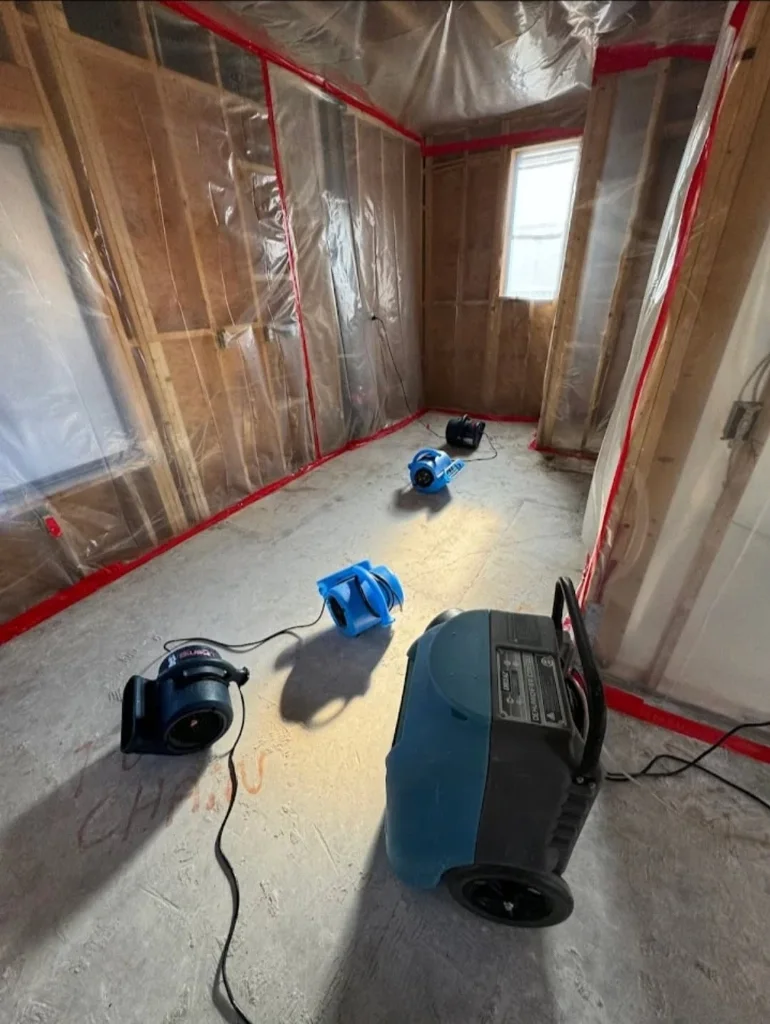
Stopping the intrusion source and erecting 6-mil plastic isolation containment airlocks.
31-HP truck-mount extraction, removing gallons exponentially faster than evaporation.
LGR dehumidifiers and HEPA air scrubbers driving grains per pound below 25 GPP.
Calibrated electronic pinless testing confirming baseline dry standards.
The Complete 6-Stage Restoration Roadmap
Our IICRC-certified crews execute a disciplined, scientific 6-stage protocol to stabilize and dry structural components:
Emergency Dispatch & Perimeter Isolation
30 to 60 minute arrival. Securing electrical shutoffs, evaluating structural loads, and erecting containment airlocks.
FLIR® Thermal Mapping & Baseline Scans
Infrared thermal scans detect trapped moisture behind walls and beneath concrete without invasive exploratory demolition.
High-Volume Bulk Extraction
31-HP truck-mount extraction units pump standing water away at hundreds of gallons per minute.
Controlled Selective Demolition
Precision flood cuts 12 to 24 inches above moisture lines, removing wet insulation and opening wall framing to dry airflow.
Thermodynamic Dehumidification
Industrial Low-Grain Refrigerant dehumidifiers pull deep trapped moisture from dense framing lumber and concrete slabs.
Antimicrobial Sanitization & Verification
EPA-registered botanical application (Benefect Decon 30) and calibrated moisture testing to issue an official dry certificate.

Specialized Equipment & Industrial Restoration Technology
Mitigating severe property damage requires industrial-grade technology capable of altering thermodynamic psychrometrics:
Truck-Mounted Extraction Rigs
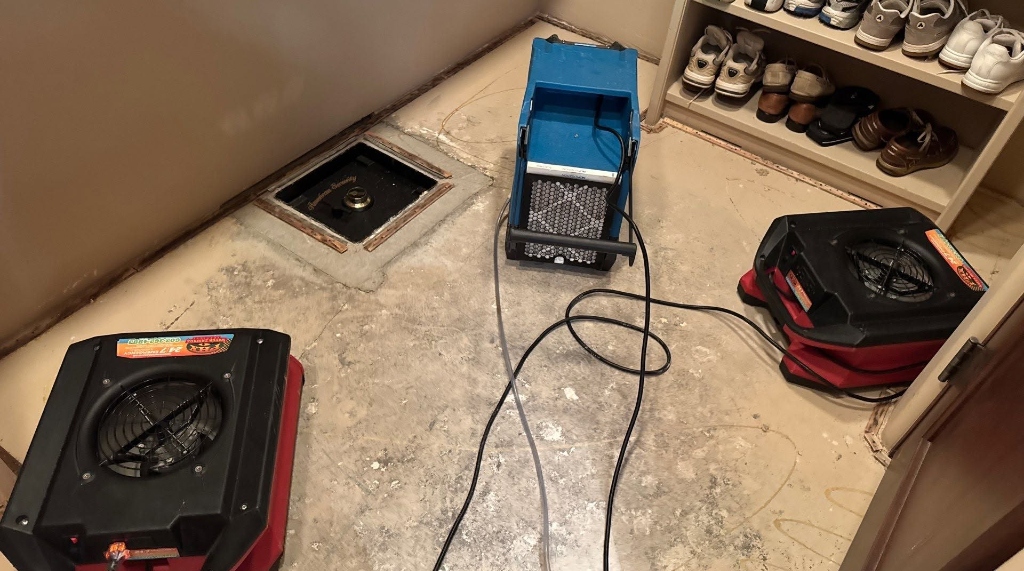
31-HP engines producing 16+ inches Hg vacuum suction to evacuate bulk water rapidly into holding tanks.
Low-Grain Refrigerant Dryers
Pre-cooling heat-pipe systems driving ambient grains per pound below 25 GPP to draw deep trapped water out of framing.
HEPA Negative-Air Scrubbers
Hospital-grade 99.97% particulate filtration capturing microscopic fungal spores, soot, and biohazard aerosols.
FLIR® Thermal Scanners & Probes
Infrared thermography detecting evaporative cooling boundaries behind walls, combined with digital RF pinless scanners.

Professional Restoration vs. DIY Mitigation
Attempting DIY cleanup during a property disaster creates severe hidden liabilities:
- Trapped Moisture: Surface drywall dries while moisture inside cavities triggers hidden mold blooms.
- Pathogenic Risks: Category 2 & 3 water contains bio-contaminants standard cleaners fail to kill.
- Insurance Denial: Insurers require daily psychrometric logs; lack of data causes claim disputes.
Transparent Upfront Itemized Pricing
Valley Restoration Pros operates with complete transparency:
- Free On-Site Assessment: Complete physical inspection before work begins.
- Upfront Itemized Estimates: Detailed line items calculated via industry-standard Xactimate.
- Zero Surprise Billing: No hidden charges or unauthorized repairs.
Certified mesa commercial precision optics laser cutting bay flood dewatering Field Documentation
Every response performed by Valley Restoration Pros is documented through photographic and thermographic records:
Comprehensive mesa commercial precision optics laser cutting bay flood dewatering Technical Manual & Operational Standards
Exhaustive engineering protocols, psychrometric calculations, geological multipliers, and step-by-step restoration standards for Maricopa County properties:
Executive Emergency Abstract: Commercial Precision Optics & Multi-Kilowatt Laser Cutting Bay Flood Dewatering in Mesa, Arizona
The Falcon Field Aerospace and Advanced Industrial Technology Corridor in Mesa, Arizona—centered around North Greenfield Road, East McKellips Road, and the Loop 202 Red Mountain Freeway—represents one of the most concentrated hubs of defense photonics manufacturing, precision optical fabrication, and multi-kilowatt CNC laser cutting operations in the Western United States. These high-tech facilities operate multi-million-dollar capital machinery, including high-power continuous-wave (CW) fiber laser resonators ranging from 6kW to 30kW, carbon dioxide (CO2) laser systems, ultra-short pulse femtosecond research lasers, Grade AA granite surface metrology inspection plates, and pneumatic vibration-isolated optical breadboard tables. Operating under unforgiving defense manufacturing standards governed by MIL-PRF-13830B, ISO 10110, and AS9100 aerospace quality systems, even the slightest environmental contamination, moisture film, or thermal perturbation compromises sub-micron component fabrication and multi-axis kinematic motion repeatability.
When high-pressure closed-loop chiller supply manifolds, heat exchanger circulation loops, or facility chilled water lines rupture within a precision laser cutting bay, the resulting flood scenario is categorically distinct from standard commercial water intrusions. Multi-kilowatt laser resonators require continuous heat dissipation exceeding 100,000 to 350,000 BTU per hour, demanding high-flow circulation of deionized, treated cooling water under operating pressures of 60 to 85 pounds per square inch (PSI). A catastrophic manifold failure, flange separation, or brazed plate heat exchanger rupture unleashes thousands of gallons of pressurized fluid across the operational envelope within minutes. Floodwaters rapidly submerge subterranean concrete machine pits, under-chassis cable raceways, high-voltage 480-volt 3-phase power distribution drops, IGUS energy chain wireways, and precision motion components.
The immediate threat extends far beyond surface moisture. Liquid floodwater and rapid evaporative humidity directly assault the core precision components of laser cutting machinery. Pneumatic vibration-isolation optical tables feature internal stainless steel honeycomb cores enclosed between ferromagnetic stainless steel top skins and carbon steel bottom plates; capillary action draws moisture into the internal cells through threaded mounting holes, triggering subterranean oxidation and destroying damping resonance characteristics. Precision Grade AA black granite surface plates absorb moisture non-uniformly across their crystal matrices, inducing micro-inch planarity distortion, thermal inertia imbalances, and irreversible calibration drift. Simultaneously, optical glass linear scale encoders mounted along high-speed linear motor axes suffer condensation bridging across 20-micron pitch chrome-on-glass optical gratings, causing catastrophic phase-quadrature signal loss, encoder interpolation errors, and electrical short circuits.
Valley Restoration Pros deploys an elite, IICRC-certified commercial industrial disaster response unit engineered specifically for aerospace, defense, and high-precision photonics facilities across Mesa and the East Valley. Utilizing trailer-mounted desiccant dehumidification systems delivering deep grain depression down to sub-5 grains per pound (GPP), non-conductive explosion-proof extraction systems, class-100 cleanroom HEPA negative-air scrubbing arrays, and calibrated FLIR thermal imaging radiometers, our technical teams execute rapid dewatering and psychrometric stabilization without introducing particulate or thermal shock to delicate optical and electronic systems. When disaster strikes your Falcon Field facility, immediate mobilization is accessible via our 24/7 commercial emergency dispatch hotline to initiate high-velocity mitigation before precision assets suffer permanent structural or optical degradation.
Anatomy of the Laser Chiller Fluid Loop Rupture & Sub-Micron Precision Dynamics
Modern multi-kilowatt fiber and disk laser cutting platforms—such as high-efficiency 12kW, 15kW, and 20kW resonators manufactured by industry leaders—exhibit electrical-to-optical conversion efficiencies between 35% and 45%. The remaining 55% to 65% of input electrical energy converts directly into waste thermal energy that must be continuously extracted from the laser diode modules, combiner blocks, feeding fibers, and cutting head optics. This thermal management relies on dual-circuit closed-loop industrial chillers circulating deionized or low-conductivity glycol-water solutions. Circuit 1 circulates high-volume fluid (often 40 to 90 gallons per minute at 70 PSI) at tight temperature tolerances (typically 22°C ± 0.5°C) through the active resonator diodes. Circuit 2 circulates secondary fluid at elevated temperatures (typically 28°C to 34°C) through the collimation and focusing optics to prevent ambient condensation from forming on optical surfaces during operation.
The mechanical failure of a laser chiller fluid loop typically originates from one of four primary catastrophic failure modes: hydraulic water hammer during emergency stops, high-cycle vibrational fatigue on brazed manifold joints adjacent to high-flow recirculation pumps, galvanic corrosion between dissimilar metal fittings (such as copper piping interfacing with aluminum heat exchange blocks), or excessive internal head pressure induced by thermal overload during Phoenix peak summer operations. When a 2-inch or 3-inch schedule 80 PVC, copper, or reinforced braided elastomeric chiller supply manifold ruptures under 75 PSI, it discharges between 800 and 2,500 gallons of pressurized fluid within fifteen minutes before emergency shutoff valves can be manually or automatically isolated.
Once released, the catastrophic floodwater cascades across the laser cutting bay, initiating rapid degradation across several hyper-sensitive sub-assemblies:
- Pneumatic Vibration-Isolation Optical Breadboards: Optical research tables and precision laser alignment benches rely on thick ferromagnetic stainless steel top surfaces bonded over internal steel honeycomb matrices, mounted atop active pneumatic isolator legs charged with nitrogen or clean dry air (CDA). Floodwater reaching table tops or splashing upward penetrates the thousands of M6 or 1/4-20 threaded mounting holes. Because these holes penetrate into the hollow honeycomb cells, capillary suction pulls contaminated water deep into the core. Moisture trapped within hermetically restricted cells triggers rapid oxidation of the internal structural core, permanently altering structural stiffness, dampening ratios, and natural vibrational resonance modes. Furthermore, flooded pneumatic isolator diaphragms and rolling lobe air springs suffer elastomeric softening and valve corrosion, destroying sub-hertz ground vibration isolation.
- Precision Metrology Granite Surface Plates: Laboratory Grade AA and Grade A granite surface plates—used for calibrating laser beam profiles, optic focal lengths, and mechanical squareness—are micro-porous natural lithic structures. When flooded, granite absorbs water non-uniformly through capillary action. Natural quartz, feldspar, and mica minerals expand at disparate rates when saturated, causing warping, crowning, and twisting of the working surface. A surface plate calibrated to a flatness tolerance of 0.000050 inches (50 micro-inches) can distort by 0.000300 inches or more within hours of partial liquid submersion. Rapid evaporative drying from the upper surface while the underside remains saturated establishes severe hygroscopic strain gradients, resulting in micro-fracturing and irreversible planar distortion.
- Optical Glass Linear Scale Encoders & Readheads: Modern high-speed CNC laser gantries utilize non-contact optical linear encoders with sub-micron resolution (0.1 µm to 1 nm). These systems comprise precision vacuum-deposited chrome-on-glass grating scales housed within semi-sealed aluminum extrusion spars with rubber lip seals. High-pressure floodwater or aerosolized humidity forces moisture past the sealing lips. Water droplets forming on the glass grating disrupt the optical reflection and transmission of the infrared scanning beam. The photo-detector array fails to resolve the sinusoidal moiré fringes, causing complete interpolation failure, high-voltage drive faults, gantry racking, and severe mechanical collision if the axis is in motion.
- Subfloor Cable Raceways, Energy Chains & Servo Amplifiers: Laser cutting machinery routes high-voltage 480V 3-phase power, 600V DC bus cables, multi-axis resolver wiring, and sensitive fiber optic patch cords through recessed subfloor concrete trenches and IGUS nylon energy chains. Floodwaters submerge these conduits completely. Water entering multi-conductor polyurethane-jacketed cables propagates along internal stranded copper wire via hydrostatic wicking, corroding crimp pins, degrading insulation resistance, and inducing phase-to-ground leakage that destroys expensive digital servo drives and digital signal processors (DSPs).
- High-Purity Laser Delivery Optics & Antireflective Coatings: Industrial fiber laser cutting heads feature precision fused silica collimation and focusing lenses, protective cover slides, and multilayer dielectric thin-film coatings. High ambient relative humidity exceeding 70% RH creates surface moisture films that attract airborne particulates, cutting dust, and vaporized metal oxides. When moisture condenses on transmissive optical surfaces, the microscopic liquid film alters the refractive index and promotes chemical etching of sensitive antireflective (AR) coatings (such as magnesium fluoride or zinc selenide coatings). If laser power is applied before molecular desorption is complete, localized thermal blooming occurs, instantly shattering or crazing multi-thousand-dollar optical lenses.
Executing successful mitigation in such an ultra-precise manufacturing environment demands specialized emergency water extraction protocols that account for mechanical calibration, electrostatic sensitivity, and psychrometric vapor pressures at every stage of the recovery operation.
Phoenix & Mesa-Specific Climatic, Geological & Infrastructure Multipliers
Commercial restoration within the Phoenix East Valley, and specifically throughout Mesa's industrial hubs, requires deep technical comprehension of local environmental realities. Mesa's geographic position within the Sonoran Desert introduces extreme thermodynamic, chemical, and geological variables that drastically amplify the destructive velocity of a commercial laser bay flood. When mitigating industrial water damage at facilities along North Greenfield Road, McKellips Road, or Higley Road near Falcon Field Airport, restoration teams must immediately confront three destructive regional multipliers:
1. Extreme Sonoran Ambient Heat (115°F+) and Chiller Head Pressure Spikes
During the extended Phoenix summer season spanning May through October, ambient daytime temperatures frequently surpass 110°F to 118°F, while commercial rooftop and industrial exterior slab temperatures routinely exceed 150°F. Exterior air-cooled chillers and industrial cooling towers supporting indoor laser resonators operate under extreme thermodynamic stress. As condensing temperatures escalate, compressor discharge pressures (head pressures) skyrocket to upper operational thresholds. When a high-power 15kW laser cutting bay operates under maximum production load, the chiller's closed-loop heat exchangers experience severe thermal cycling and high internal fluid pressures.
When an unpredicted line rupture or pump seal failure occurs, ambient desert heat entering through industrial rollup doors transforms standing floodwaters into an indoor vapor chamber. Evaporative rates explode; ambient relative humidity inside an enclosed 20,000-square-foot manufacturing bay can spike from a controlled 35% RH to 90%+ RH in less than two hours. Under these elevated temperatures, biological amplification accelerates at an alarming rate; bacterial biofilms and fungal spores germinate within 24 to 36 hours, threatening clean manufacturing certification and requiring aggressive commercial water damage restoration intervention before structural and optical cross-contamination becomes irreversible.
2. Municipal Water Hardness (18 to 22 GPG) & Conductive Calcite Precipitation
Mesa's municipal water infrastructure draws from the Salt River Project (SRP) canal system, Central Arizona Project (CAP) Colorado River allocations, and deep aquifer municipal wells. Across the Falcon Field and Loop 202 manufacturing sectors, raw municipal water exhibits extreme mineral hardness ranging from 18 to 22 grains per gallon (GPP) (equivalent to 310 to 380 parts per million of dissolved calcium carbonate, CaCO3, and magnesium ions). While closed-loop laser chillers utilize deionized or distilled water, backup municipal makeup water lines, facility domestic water feeds, fire suppression systems, and cooling tower makeup loops are charged directly with this mineral-saturated municipal water.
In a manifold rupture involving municipal makeup lines or dual-fluid heat exchangers, standing floodwaters carry heavy ionic mineral loads. As unmitigated water evaporates from polished steel motion tracks, ball screws, optical breadboards, and electronic circuit boards, it precipitates rock-hard calcite and gypsum crystals. These crystalline deposits possess high abrasive hardness (Mohs 3 to 4) and strong electrical conductivity when damp. If allowed to dry naturally on precision linear motion rails or granite surface plates, the resulting scale deposits cause severe micro-gouging, destroy bearing raceways, and establish conductive bridge shorts across surface-mount electronics. Standard wiping spreads these abrasive minerals; specialized chemical chelation, deionized water rinsing, and controlled extraction are mandatory.
3. Alluvial Caliche Clay Soil Foundation Shifting & Subterranean Trench Inundation
The geological substrate beneath Mesa's Falcon Field industrial district consists of ancient alluvial flood deposits interwoven with thick, cemented calcium carbonate hardpan known regionally as caliche. Caliche formations are dense and relatively impermeable, but the surrounding quaternary clay-silt soils exhibit intense shrink-swell potential. Precision laser cutting machinery and large-format gantry systems require monolithic concrete foundation pads—often 10 to 18 inches thick with reinforced rebar cages—isolated from exterior building footings to eliminate ambient factory vibrations.
When hundreds or thousands of gallons of floodwater escape into subfloor cable trenches, foundation expansion joints, or perimeter drainage channels, the water bypasses top-level concrete vapor barriers and saturates the sub-slab soil. As clay soils hydrate, they exert uneven hydraulic swelling pressures against the bottom of machine foundation slabs. A differential foundation heave of merely 0.015 inches across a 30-foot gantry span induces twist in the machine frame, binding precision linear bearings, distorting laser beam delivery alignment over long travel distances, and throwing multi-axis cutting nozzles out of perpendicularity. Rapid deep-trench extraction and specialized commercial structural drying of subterranean concrete are critical to prevent long-term kinematic foundation deformation.
Immediate Emergency First-Hour Protocol & High-Voltage Optical Isolation
The initial sixty minutes following a major laser chiller rupture within a precision photonics or laser cutting facility dictate whether multi-million-dollar capital assets are preserved or condemned. The combination of high-voltage electrical infrastructure (480V 3-phase feeds and 600V+ DC capacitor banks), sensitive Class 4 laser radiation sources, pressurized fluid lines, and delicate optical surfaces introduces severe life-safety hazards and asset vulnerabilities. Plant engineers, maintenance personnel, and emergency responders must execute the following structured first-hour operational playbook:
Critical Safety Warning: Electrocution & Optical Hazard Quarantine
Never step into standing floodwater inside an active laser cutting bay until all 480V 3-phase master disconnects and uninterruptible power supply (UPS) banks have been physically locked out and tagged out (LOTO). Industrial fiber laser resonators store lethal electrical energy within high-capacitance DC bus links for several minutes after primary AC power disconnection. Furthermore, pressurized chiller lines may continue spraying fluid onto energized electrical cabinets, creating severe arc-flash risks. Technicians must wear ASTM F2413 dielectric footwear and Class 00 electrical insulating gloves during initial electrical isolation.
- High-Voltage Power Isolation & Energy Discharge Verification: Immediately trip the main circuit breakers supplying the laser resonators, chillers, CNC gantry drives, and auxiliary hydraulic or pneumatic units. Execute formal OSHA Lockout/Tagout (LOTO) protocols at the primary distribution panelboard. Verify that all external capacitor banks, DC power supplies, and high-frequency RF excitation modules have discharged completely using calibrated, insulated voltage probes before permitting technicians to approach submerged equipment bases. Secure all backup emergency generators to prevent unexpected auto-transfer backfeeds into submerged electrical conduits.
- Pressurized Chiller Fluid Containment: Close manual isolation quarter-turn ball valves on the chiller supply and return manifolds immediately upstream and downstream of the rupture point. If municipal makeup water lines or facility loop pumps are active, de-energize circulation pumps and close the primary facility water shutoff. If a burst plumbing feed is suspected within adjacent facility walls, contact professional technicians for emergency burst pipe repair to arrest incoming water volumes. Tag and depressurize any auxiliary nitrogen or assist gas delivery lines that cross the flooded floor area.
- Pneumatic Vibration Table & Optical Enclosure Protection: For pneumatic optical breadboard tables, immediately shut off incoming compressed dry air (CDA) or nitrogen feeds to prevent pneumatic regulators from pumping contaminated ambient air or water into isolator bladders. Deploy heavy non-static polyethylene plastic sheeting over optical breadboard surfaces, laser cutting heads, beam delivery tubes, and metrology granite surface plates to shield them from overhead dripping and elevated ambient humidity. Secure sheeting with cleanroom-approved vinyl tape, ensuring activated desiccant packets are placed beneath the plastic enclosures to absorb localized vapor and maintain sub-30% micro-climates.
- Cleanroom Airflow & HVAC Damper Reconfiguration: In facilities operating ISO Class 7 or Class 8 cleanrooms or enclosed environmental bays, adjust the HVAC building management system (BMS) to bypass standard economizer modes. Do not draw in moist outside monsoon air. If the flood involves biological or non-potable grey water from facility drains, shut down recirculating cleanroom fan filter units (FFUs) immediately to prevent aerosolized water droplets and bacteria from saturating ultra-low particulate air (ULPA) or HEPA ceiling filters. In situations where drain backflow has occurred, specialized biohazard sewage cleanup measures must be implemented to sanitize the workspace before optical restoration commences.
- Perimeter Containment & Sump Pump Deployment: Place water-diverting weighted dams, absorbent booms, and magnetic drain covers around floor penetrations, subfloor wireways, and subterranean machine pits. Deploy explosion-proof, non-sparking submersible dewatering pumps into low points and pit sumps to stop rising water levels from contacting sub-chassis linear motors, encoder readheads, and ballscrews. Elevate trailing cables, portable testing electronics, and laser chiller control panels above the water line using non-conductive phenolic risers.
- Immediate Mobilization of Industrial Dewatering Response: Contact Valley Restoration Pros at . Our commercial rapid-response dispatch units deploy trailer-mounted desiccant systems, high-volume extractors, and certified thermographers directly to your Falcon Field facility within 30 minutes to arrest progressive moisture migration.
Advanced Industrial Equipment Specifications & Setup
Restoring high-precision laser cutting bays and photonics research facilities requires industrial-grade machinery specifically configured for clean manufacturing environments. Standard commercial water damage drying equipment is completely inadequate in these settings; traditional open-cage air movers stir up cutting dust, slag, and conductive metal particulates, while consumer dehumidifiers cannot achieve the ultra-low grain depression necessary to pull trapped moisture from micro-porous granite plates and hermetically sealed optical honeycomb structures. Valley Restoration Pros deploys advanced technology arrays engineered to meet cleanroom standards and precision psychrometric demands:
1. Trailer-Mounted Industrial Desiccant Dehumidification Systems (CD-5000 & CD-9000)
Our primary drying force for precision laser bays consists of mobile, trailer-mounted industrial desiccant dehumidifiers (such as the CD-5000 and CD-9000 units, rated from 5,000 to 9,000 cubic feet per minute [CFM]). Unlike refrigerant dehumidifiers that lose efficiency when relative humidity drops below 40%, desiccant rotors utilize active silica gel honeycombs that continuously adsorb moisture even under single-digit relative humidity conditions. The rotating desiccant wheel continuously passes through a process air sector to extract water vapor, followed by a reactivation sector heated by indirect-fired propane or electric heaters that expels the moisture outside the building envelope.
These desiccant systems deliver processed dry air at sub-5 grains per pound (GPP) with dew points well below 0°F (-18°C). We route 20-inch reinforced, food-grade non-off-gassing layflat ducting into the facility, establishing a closed-loop ultra-dry airflow envelope. This extreme vapor pressure differential drives deep capillary moisture out from beneath concrete foundation pads, internal honeycomb optical table cores, and insulated laser resonator cabinetry without introducing damaging thermal spikes or excessive heat that could alter machine geometry. Process air temperatures are maintained within ±2°F of the ambient cleanroom setpoint to prevent thermal expansion of structural metal frames.
2. Low-Grain Refrigerant (LGR) Dehumidifiers & Micro-Zoning Arrays
For isolated electrical control rooms, CAD/CAM programming stations, and cleanroom gowning vestibules, we deploy high-capacity commercial Low-Grain Refrigerant (LGR) dehumidifiers (including Dri-Eaz LGR 7000XLi and Phoenix DryMAX XL units). Each unit removes up to 135 to 175 pints of water per day at AHAM conditions (80°F / 60% RH) and continues extracting moisture down to 28 GPP. These units utilize internal air-to-air heat exchangers to pre-cool incoming air before it reaches the evaporator coil, allowing moisture condensation to continue even in cooler, drier ambient rooms.
By establishing micro-zoning arrays with these portable LGR units, we isolate ancillary electrical rooms from the main production floor. Automatic onboard condensate pumps route extracted water through high-pressure braided lines directly to exterior facility drainage points, preventing accidental secondary spillover inside sensitive programming environments.
3. Cleanroom-Grade HEPA Negative-Air Scrubbing & Laminar Flow Filtration
Standard air movement in a machine shop can be catastrophic to optical lenses, spreading microscopic airborne metal particulates, slag debris, and silica dust. We install negative-air HEPA scrubbers equipped with three-stage filtration: MERV 8 coarse pre-filters, MERV 13 carbon odor/chemical adsorbers, and true DOP-tested 99.97% HEPA final filters capturing particulates down to 0.3 microns. By establishing continuous air filtration and controlled air changes per hour (ACH 20+), we maintain cleanroom air quality specifications throughout the entire structural drying lifecycle.
All HEPA air scrubbers are equipped with Magnehelic differential pressure gauges to ensure filters operate within optimal static pressure parameters. Units are exhausted through custom sealed window penetrations or exterior duct chases to maintain continuous negative pressure (-0.025 to -0.040 in. w.g.) within the flood zone, preventing any airborne particulates from escaping into adjoining ISO Class 7 optical assembly areas.
4. FLIR T865 High-Resolution Thermal Imaging & Psychrometric Radiometry
Locating concealed moisture within complex laser cutting chassis and subterranean wireways requires advanced diagnostics. We utilize FLIR T865 research-grade thermal imaging cameras (featuring 640 x 480 true infrared resolution, 30 mK thermal sensitivity, and 7.5 to 14 µm spectral range) combined with FLIR MR277 moisture meters with integrated IGM (Infrared Thermal Imaging Measurement). These instruments detect subtle evaporative cooling thermal anomalies, pinpointing moisture trapped inside double-walled resonator housings, granite slab undersides, subfloor conduit elbows, and pneumatic isolator assemblies without invasive disassembly.
Non-destructive dielectric pinless capacitive moisture meters (Tramex ME5 and Delmhorst ProScan) verify moisture levels across epoxy-coated concrete slabs, resin-bonded composite breadboards, and acoustic paneling without scratching precision-ground machine surfaces. Deep in-situ relative humidity probes conforming to ASTM F2170 measure internal slab equilibrium, ensuring foundation concrete is thoroughly desiccated.
5. Non-Conductive Industrial Extraction & Micro-Suction Manifolds
To safely extract standing water from narrow subterranean wireways, CNC machine bases, and around sensitive electronics, our teams deploy stainless-steel industrial wet vacuum extractors equipped with antistatic hoses, spark-free induction motors, and carbon-impregnated grounding straps. Specialized micro-suction manifolds and vacuum injection adapters are coupled directly to optical breadboard mounting holes and cable raceways, withdrawing liquid water from confined geometries via controlled negative pressure without mechanical vibration or physical impact.
All extraction units feature secondary high-efficiency particulate air exhausts to eliminate aerosolization of contaminated sump water. Liquid waste containing residual chiller glycol or machine lubricants is collected into dedicated containment drums for environmentally compliant, certified disposal in accordance with Arizona Department of Environmental Quality (ADEQ) standards.
For complex facilities requiring broad-scale contamination control and structural sanitization across connected production buildings, our teams seamlessly integrate pharmaceutical cleanroom flood restoration standards to safeguard sterile manufacturing zones.
IICRC S500 / S520 Step-by-Step Commercial Restoration Protocol
Valley Restoration Pros executes industrial dewatering and environmental restoration under strict compliance with the Institute of Inspection, Cleaning and Restoration Certification (IICRC) S500 Standard for Professional Water Damage Restoration, the IICRC S520 Standard for Mold Remediation, and ISO 9001 / AS9100 quality documentation requirements. When addressing a commercial precision optics and laser cutting bay flood, our certified Master Water Restorers follow a rigorous six-stage scientific protocol:
Phase 1: Thermal Moisture Mapping, Electrical Safety & Atmospheric Baselines
Upon arrival, lead industrial hygienists and restoration supervisors coordinate with facility plant engineers to verify complete electrical LOTO across all 480V distribution feeds and uninterruptible power systems. Technicians deploy FLIR T865 infrared cameras and calibrated hygrometers to establish baseline atmospheric psychrometric metrics: ambient air temperature, relative humidity (RH), dew point, and grain depression (GPP). Moisture mapping documents the precise liquid boundary line across the concrete floor, subfloor machine pits, optical tables, granite metrology plates, and surrounding gypsum drywall assemblies. All data points are indexed in a comprehensive initial psychrometric moisture log.
Technicians perform conductivity tests on the standing water using calibrated TDS (Total Dissolved Solids) meters to determine if municipal makeup water or pure deionized closed-loop water was the primary flood contributor. Water samples are sealed for laboratory analysis to screen for bacterial amplification, glycol additives, or chemical contaminants that could impact electronics or optical glass. Psychrometric baselines are mathematically evaluated to calculate the exact vapor pressure differential required to initiate deep moisture desorption without inducing condensation on cold optical lenses. Detailed psychrometric mixing ratios are plotted on digital charts, defining the exact cubic feet per minute of dry air and grain depression required to drive moisture out of structural cavities.
Phase 2: Bulk Floodwater Extraction & Subfloor Trench Dewatering
Industrial extraction technicians deploy heavy-duty truck-mounted and electric submersible extraction units to remove standing water from the laser cutting bay floor, subterranean chip conveyor trenches, and machine foundation vaults. Antistatic extraction wands and weighted squeegee attachments extract surface water from sealed concrete slabs. Specialized narrow-diameter suction probes are inserted into subfloor wireways and energy chains, removing standing water from around high-voltage cables and fiber optic lines before capillary action draws moisture into electrical connector boots.
Sub-chassis sumps beneath high-power fiber laser gantries are purged of all standing liquid. Technicians deploy squeegees along concrete expansion joints, ensuring zero pooled water remains in recessed foundation channels that could wick beneath machine baseplates. Extracted water is metered and directed into industrial containment tanks to measure the total volume removed against facility estimates. Diaphragm pumps equipped with oil-separating coalescing elements capture hydraulic oils and tramp lubricants, preventing municipal sewer contamination and complying fully with Maricopa County environmental discharge regulations.
Phase 3: Cleanroom Negative-Air Containment & Environmental Isolation
To prevent cross-contamination into adjoining photonics labs, optical coating rooms, or administrative offices, technicians erect temporary antistatic flame-retardant polyethylene containment barriers (minimum 6-mil thickness). Dual-chamber decontamination airlocks with zippered entry ports are established for technician ingress and egress. Commercial HEPA air filtration devices are vented through exterior wall ports or ducted to non-critical exhaust chases, establishing a continuous negative pressure gradient (-0.020 to -0.035 inches of water column) that contains aerosolized contaminants and maintains cleanroom particulate counts.
Differential pressure manometers monitor barrier integrity around the clock, triggering audible alerts if pressure drops below -0.020 in. w.g. Sticky contamination mats are placed at all entry airlocks to capture particulate transfer, ensuring full compliance with cleanroom cleanliness protocols throughout the drying process. Air velocity meters audit airflow directionality across all containment thresholds to ensure zero backdrafting of humid air into pristine production suites.
Phase 4: Targeted Micro-Dewatering of Optical Breadboards & Precision Motion Encoders
Specialized attention is directed to delicate optical and motion equipment. For pneumatic optical breadboards, positive-pressure desiccant air manifolds are connected to selected perimeter mounting ports, gently forcing dry air (sub-5 GPP) through the internal honeycomb core while vacuum extraction manifolds draw moisture from opposing ports. Metrology granite surface plates are wrapped in controlled breathable desiccant membranes that regulate moisture desorption rates, preventing rapid differential shrinkage and surface micro-cracking. CNC optical linear scale spars are opened by factory-certified technicians, wiped with ultra-pure anhydrous isopropyl alcohol (99.9% IPA), and desiccated with low-pressure clean dry air to eliminate moisture from glass optical gratings and readheads.
Ballscrews and linear profile bearing carriages are inspected for mineral scale or moisture ingress, flushed with specialized solvent displaced with moisture-inhibiting synthetic lubricants, and sealed to prevent atmospheric corrosion. Optical mirror mounts and zinc selenide (ZnSe) or fused silica focusing lenses are inspected under high-intensity ultraviolet illumination to ensure zero moisture films or mineral spotting remain on AR coatings. High-resolution digital micrometers audit linear scale alignment brackets to confirm that mechanical thermal relief mechanisms were not distorted during emergency extraction maneuvers.
Phase 5: Deep Desiccant Structural Drying & Concrete Vapor Pressure Management
High-output desiccant dehumidification ductwork is deployed across the facility. Dry processed air is ducted directly into machine foundation pits, subterranean cable trenches, and along the perimeter of thick concrete foundation slabs. High-velocity low-profile centrifugal air movers are arranged in continuous circular vortex patterns across the slab, maintaining boundary layer disruption without stirring floor dust into the air. Daily psychrometric readings track humidity ratios, temperature, and dew points across all micro-zones. Drying continues until concrete slabs meet baseline relative humidity thresholds (below 75% internal RH per ASTM F2170) and foundation moisture content returns to dry standard equilibrium (below 3.0% on Tramex moisture encounter meters).
Sub-slab relative humidity probes monitor the concrete core to verify that deep hydrostatic moisture will not migrate upward once HVAC systems return to standard setpoints, preventing future adhesive delamination of cleanroom floor coatings or foundation heave from underlying caliche clay layers. Vapor permeance testing of perimeter foundation seams confirms that moisture vapor emission rates (MVER) drop below 3.0 lbs per 1,000 square feet per 24 hours per ASTM F1869 specifications before desiccant equipment demobilization begins.
Phase 6: Laser Re-Calibration Verification & Certified Microbial Clearance
Once structural materials meet certified dry standards, comprehensive post-remediation verification is performed. Independent third-party industrial hygienists conduct air-o-cell cassette sampling and surface ATP swabs to confirm zero microbial amplification or mold proliferation per IICRC S520 standards. Facility quality technicians perform laser interferometry alignment checks, autocollimator flatness tests on granite plates, and optical power meter verification on the restored laser resonators. We deliver a complete IICRC Certificate of Completion, full psychrometric drying logs, and asset documentation for insurance claim validation. If any microbial hazards are detected in wall cavities or subfloor materials, our certified mold remediation protocols are immediately executed to achieve complete clean clearance.
The entire facility environment is surveyed for airborne particulates using a calibrated laser particle counter conforming to ISO 14644-1 Class 7 specifications. Only when particle counts, surface moisture equilibrium, and mechanical calibration standards are fully reconciled is the laser cutting bay formally released back to plant production operations. Complete engineering sign-off sheets are archived to support defense audit reviews and maintain AS9100 manufacturing continuity.
Hyper-Local Mesa Case Study: 22,000 Sq Ft Defense Photonics Facility at Greenfield & McKellips Roads
In mid-July, during the peak of the Phoenix summer monsoon season with exterior temperatures hovering at 114°F and outdoor relative humidity spiking after an afternoon desert dust storm, a major emergency occurred at a premier 22,000-square-foot defense photonics and precision laser cutting facility located near North Greenfield Road and East McKellips Road, directly south of Falcon Field Airport in Mesa. The plant houses two 15kW fiber laser flat-sheet cutting systems, an ultra-precision 5-axis laser tube processing center, an optical thin-film coating cleanroom, and a dimensional metrology lab containing four Grade AA black granite inspection tables.
Incident Scenario & Initial Physical Damage Profile
At 2:15 AM on a Saturday, a 3-inch flanged PVC supply manifold on the primary exterior laser chiller ruptured under 78 PSI of operating head pressure following an unexpected water hammer event. Because the automated makeup water valve remained open, an estimated 3,800 gallons of high-hardness municipal and chiller fluid surged through the facility's utility trench system and flooded into the main laser cutting bays. By 4:30 AM, water had submerged 14,500 square feet of production space to a depth of 2.5 inches, filling subterranean machine pits, flooding IGUS energy chains, and rising past the lower sub-chassis linear encoder readheads on both 15kW fiber cutting tables.
Mobilization & Psychrometric Intervention Timeline
- 04:45 AM (Initial Dispatch): Facility security detected standing water and activated Valley Restoration Pros' 24/7 commercial emergency response line. Our industrial response team was dispatched from our East Valley operations hub.
- 05:15 AM (On-Site Arrival & Safety Lockout): Response crews arrived on site within 30 minutes. Lead restorers verified complete 480V 3-phase electrical LOTO with the plant facilities director and completed atmospheric safety testing.
- 05:40 AM (Baseline Psychrometrics): Initial atmospheric readings recorded 78°F ambient temperature, 82% relative humidity, and an extreme moisture load of 118 grains per pound (GPP). Concrete slab surface moisture registered 99% relative humidity (saturation).
- 06:00 AM (Bulk Water Extraction): Deployed two commercial extraction units and four high-capacity submersible trash pumps. Over 3,500 gallons of standing water were extracted from the main floor, machine trenches, and subfloor wireways by 08:30 AM.
- 09:00 AM (Desiccant Dehumidification Setup): Mobilized a trailer-mounted 7,000 CFM industrial desiccant dehumidifier. Routed 20-inch supply ducting into the laser cutting bay and cleanroom vestibules, establishing a continuous dry air exchange delivering processed air at sub-5 GPP and -10°F dew point. Installed twelve cleanroom HEPA scrubbers to capture airborne particulate matter.
- Hour 24 Progress Check: Bulk water completely removed; ambient conditions stabilized to 74°F, 22% RH, and 28 GPP. Focused micro-suction manifolds successfully evacuated trapped water from optical table honeycomb cells and CNC cable conduits.
- Hour 68 Psychrometric Dry Standard Achievement: Internal concrete relative humidity dropped to 72% RH (below 75% ASTM F2170 threshold). Granite surface plates exhibited zero micro-fracturing and returned to certified 0.000050-inch flatness tolerances. CNC linear glass scale encoders were cleaned, dried, and tested with zero quadrature signal loss.
Final Outcome & Capital Preservation Metrics
Through immediate high-velocity desiccant dewatering, both 15kW fiber laser cutting gantries, four Grade AA granite surface plates, and all optical resonators were fully preserved without requiring complete equipment replacement. Total business interruption was restricted to 3.5 days versus an estimated 8-week shutdown for factory rebuilds, saving the defense contractor over $1.8 million in potential equipment write-offs and liquidated delivery delay damages.
For similar advanced manufacturing facilities operating across the Phoenix metropolitan area, we provide identical industrial response capabilities, including specialized Mesa Gateway commercial avionics test bay flood dewatering and Deer Valley CNC machining coolant flood dewatering services.
Pay-Per-Call Financial & Defense Manufacturing Insurance Documentation Breakdown
Commercial flood mitigation in defense manufacturing, photonics, and aerospace environments involves intricate financial, legal, and regulatory considerations. Defense contractors operating under Federal Acquisition Regulation (FAR) supplements, ITAR (International Traffic in Arms Regulations), and AS9100 quality management standards cannot afford documentation ambiguities or questionable billing practices. Valley Restoration Pros adheres strictly to transparent, compliant commercial operations that simplify insurance claims adjudication while safeguarding client confidentiality and regulatory compliance:
Mandatory Commercial Transparency & PPC Compliance Principles
- Free Comprehensive On-Site Damage Assessment: We provide commercial facility managers, plant directors, and property owners with a thorough, no-obligation technical assessment including thermal imaging surveys, atmospheric moisture readings, and structural damage mapping before any formal commitment.
- Transparent Upfront Itemized Pricing Before Work Begins: Every deployment scope is explicitly detailed using standardized industrial rate schedules. There are no surprise fees, hidden equipment surcharges, or ambiguous lump sums.
- Assistance with Detailed Claims Documentation & Psychrometric Moisture Logs: Our administrative and technical teams prepare exhaustive claims packages, complete with daily psychrometric dry-down charts, equipment run logs, thermal radiometry photographs, and calibration records ready for insurance adjusters and corporate risk auditors.
- Zero Billing Promises: In strict compliance with professional insurance restoration standards, we never make false promises that insurance carriers will cover 100% of remediation costs or claim to bill insurance directly without client authorization. The policyholder remains the authorizing client, and we provide the forensic documentation necessary to substantiate every penny of legitimate claim entitlement.
Xactimate Commercial Line Items & Forensic Audit Defense
Our billing documentation is generated directly through industry-standard Xactimate commercial restoration software, utilizing exact regional pricing benchmarks for the Phoenix-Mesa-Scottsdale market. Primary line items typically utilized during a high-precision laser cutting bay flood restoration include:
- WTR EXT>H: Water extraction from hard surfaces, heavy industrial extraction equipment, per square foot.
- WTR DHMD>>>: Large-capacity industrial desiccant dehumidifier deployment (5,000+ CFM trailer-mounted units), per day.
- WTR DHM: Low-grain refrigerant (LGR) dehumidifier placement in auxiliary control rooms, per day.
- WTR HEPA: Cleanroom negative-air HEPA filtration and air scrubbing units, per day.
- WTR CONT: Antistatic polyethylene containment barrier installation and zipper airlock entry portals, per square foot.
- WTR INM: Infrared thermal imaging inspection, psychrometric moisture mapping, and forensic documentation, per hour.
- ELE DCN: High-voltage electrical disconnect, safety isolation, and cord de-energizing verification, per technician hour.
- WTR DRY: Specialized sub-surface cavity drying and micro-manifold injection air distribution, per setup.
- HMR BARR: Cleanroom critical boundary maintenance and differential pressure log tracking, per 24-hour shift.
- INM LAB: Specialized environmental particulate sampling and independent laboratory verification, per sample set.
ITAR Compliance & Classified Defense Information Preservation
For defense photonics contractors manufacturing components for precision-targeted defense munitions, laser rangefinders, night-vision optical systems, or classified aerospace assemblies under ITAR jurisdiction, our technical personnel comply with all facility security clearances, badging protocols, and non-disclosure agreements (NDAs). Photographic documentation is strictly partitioned to show restoration equipment setup and structural damage without capturing proprietary optical tooling, CAD drawings, or sensitive defense geometries. All digital field logs, psychrometric telemetry, and customer communications are encrypted using FIPS 140-2 validated protocols.
To evaluate expected restoration expenditures for your commercial facility, utilize our instant commercial cost estimator or connect directly with our engineering triage specialists.
Exhaustive Technical Frequently Asked Questions: Precision Laser Bay Flood Dewatering
1. Why can precision granite surface plates not be dried rapidly with heat or direct air movers?
Precision metrology granite surface plates (such as Grade AA or Grade A plates) are composed of natural quartz, feldspar, and dark ferromagnesian minerals that exhibit micro-porosity and hygroscopic expansion properties. When exposed to liquid floodwater, the plate absorbs water non-uniformly through capillary action. If high-temperature direct heat or high-velocity heated air movers are applied directly to the top surface, the exposed surface undergoes rapid evaporative cooling followed by rapid thermal expansion, while the saturated underside remains cool and wet. This intense thermal and hygroscopic strain gradient induces differential internal shear stresses, resulting in permanent warping, micro-cracking, and loss of sub-micron planarity. Instead, granite plates must be stabilized using controlled desiccant dehumidification that lowers ambient vapor pressure uniformly at moderate temperatures (68°F to 72°F) to allow gradual, balanced moisture desorption across all crystal matrices without inducing micro-fracturing or planar distortion.
Metrology technicians must verify surface flatness post-drying using dual-axis electronic levels or optical autocollimators following the Moody method or ASME B89.3.7 standards. Applying forced convective heat alters the granite's internal molecular crystalline structure and can permanently void the manufacturer's calibration certificate, requiring factory lapping at immense expense.
2. How do you remove water that has penetrated the internal honeycomb core of an optical breadboard table?
Pneumatic vibration-isolation optical tables utilize an internal stainless steel or carbon steel honeycomb structure bonded with structural epoxy between top and bottom metal skins. Liquid water enters through the grid of tapped mounting holes (1/4-20 or M6). Removing this internal moisture cannot be achieved by surface extraction alone. Our technicians connect specialized micro-manifold positive-pressure injection adapters to perimeter mounting holes, feeding ultra-dry desiccant air (sub-5 GPP) at low pressure (1 to 2 PSI) into the internal structure. Concurrently, high-vacuum negative pressure manifolds are attached to diagonal exit ports to evacuate liquid droplets and saturated vapor. Continuous moisture monitoring of the exhaust air stream determines when all internal honeycomb cells have returned to dry equilibrium without damaging delicate epoxy bonding.
This dual-circuit airflow purges trapped water from dead-end cells before internal rust or structural debonding can alter the table's tuned vibration damping characteristics. If liquid remains trapped, the water creates deadweight mass imbalances and corrosion cells that permanently destroy the table's dynamic compliance and natural resonance suppression.
3. Can flooded optical glass linear scale encoders be salvaged, or is replacement mandatory?
In many instances, high-value optical linear encoders (such as Heidenhain or Renishaw glass scale systems) can be completely salvaged if power was disconnected before short circuits occurred and if decontamination begins within the first 12 to 24 hours. The primary threat is mineral deposition from evaporated floodwater, which leaves conductive and abrasive calcite bridges across the sub-micron chrome gratings. Our specialists open the protective scale enclosures, flush the glass scales with ultra-pure deionized water followed by electronic-grade 99.9% anhydrous isopropyl alcohol (IPA) to displace moisture, and dry the components using oil-free clean dry nitrogen. If optical coatings or scanning reticles exhibit corrosion or physical etching from prolonged standing water, component replacement is documented for insurance claim recovery.
In all salvage operations, encoder signal quality is verified using an oscilloscope to confirm proper 1Vpp phase-quadrature signal amplitude and zero phase offset. Optical readhead scanning sensors are inspected under stereo zoom microscopes to confirm that the index grating and photovoltaic silicon cells are completely free of microscopic drying rings or mineral residues.
4. Why is desiccant dehumidification preferred over refrigerant dehumidifiers for laser bay dewatering?
Refrigerant dehumidifiers (even advanced LGR units) operate by condensing water vapor on chilled refrigeration coils. Their efficiency drops substantially when ambient relative humidity falls below 35% to 40% RH, and they cannot produce grain levels below 28 to 32 GPP. In contrast, precision optical cutting facilities require deep grain depression down to single digits (3 to 8 GPP) to pull deeply bound water molecules out from porous concrete foundations, optical coatings, and enclosed equipment chassis. Industrial desiccant dehumidifiers utilize active silica gel rotors that chemically adsorb moisture regardless of low ambient humidity or low dew points, establishing the extreme vapor pressure differential needed for deep industrial drying.
This extreme vapor pressure depression forces deep capillary moisture to desorb without requiring elevated air temperatures that could distort thermal alignment in sensitive laser cavities. Furthermore, desiccant systems allow ducting ultra-dry air directly into sealed machine enclosures, achieving targeted micro-environment drying that refrigerant units cannot match.
5. What specific risks does Mesa's 18 GPG municipal water hardness pose to flooded laser systems?
City of Mesa municipal tap water carries an extraordinarily high concentration of dissolved minerals—averaging 18 to 22 grains per gallon of calcium and magnesium salts. When a chiller rupture involves makeup water or facility plumbing, standing water evaporates rapidly under Phoenix desert heat, depositing crystalline calcium carbonate (calcite) and calcium sulfate. These deposits form hard, ceramic-like scale with a Mohs hardness of 3.0 to 4.0. If deposited on ground ball screws, linear profile bearing tracks, or laser optics, these crystals cause severe mechanical abrasion and gouging when moving components are actuated. Furthermore, damp mineral scale is electrically conductive, creating high-resistance short circuits across circuit board traces and terminal strips.
Complete deionized chemical flushing is necessary to dissolve and eliminate these salts before mechanical components are re-energized. Standard wiping with shop towels simply grinds these sharp microscopic calcite particles into precision-ground raceways, accelerating machine failure; specialized chemical dissolution and controlled vacuum extraction are essential.
6. How does sub-slab caliche clay soil shifting affect multi-axis laser cutting accuracy after a flood?
The soils throughout Mesa's Falcon Field industrial sector consist of alluvial silt mixed with expansive caliche clay layers. When thousands of gallons of floodwater escape into subfloor wire trenches or foundation expansion seams, the moisture saturates the sub-grade soils beneath monolithic machine pads. Expansive clay soils undergo significant volumetric expansion when saturated, exerting immense upward hydraulic force against the concrete slab. Even a minute foundation deflection of 0.010 to 0.020 inches across a machine base causes angular distortion of the gantry bridge, twisting precision linear rails and throwing laser focus heads out of squareness.
Early deep-trench water evacuation, sub-slab vapor extraction, and precision structural leveling audits are essential to ensure the machine returns to certified aerospace cutting tolerances. If subterranean structural seepage is detected, our specialized sub-slab leak water damage restoration teams address foundation moisture stabilization before soil swelling forces crack the concrete pad.
Commercial Water Damage Response Across Mesa & the East Valley
Valley Restoration Pros provides dedicated industrial disaster recovery throughout the entire East Valley, including Mesa emergency water damage restoration, Gilbert commercial flood mitigation, and comprehensive East Valley service areas. When precision industrial assets are compromised by pressurized chiller failures, plumbing ruptures, or structural water intrusions, call our emergency dispatch center at for immediate on-site technical deployment.
Verified Local Area Dispatch: Mesa, AZ
Official Geo-Coordinates: 33.4152° N, -111.8315° W • Maricopa County
Related Specialized Emergency Restoration Services
Explore specialized rapid-response mitigation protocols across Greater Phoenix and Maricopa County:
Valley-Wide Emergency Response Service Coverage
Our mobile restoration fleet is dispatched across the entire Phoenix metropolitan region, providing rapid 30 to 60 minute emergency response: