

Valley Restoration Pros delivers 24/7 industrial emergency water extraction, thermal psychrometric drying, and structural mitigation across Phoenix and Maricopa County with guaranteed 30–60 minute rapid arrival. All protocols strictly adhere to IICRC S500 standards, featuring upfront itemized pricing and free on-site thermal moisture assessments. Call dispatch directly at (602) 847-9593.
Why Immediate Mitigation Is Critical in Phoenix Heat
A ruptured fire sprinkler head, catastrophic flat roof failure during a monsoon downpour, or commercial HVAC hydronic line burst discharges thousands of gallons into high-ceiling sanctuaries. Soaring 30-foot cathedral nave heights trap humid thermal vapor, rotting structural timber trusses, warping priceless solid oak pews, ruining pipe organ bellows, and triggering hazardous mold blooms within 24 to 36 hours.
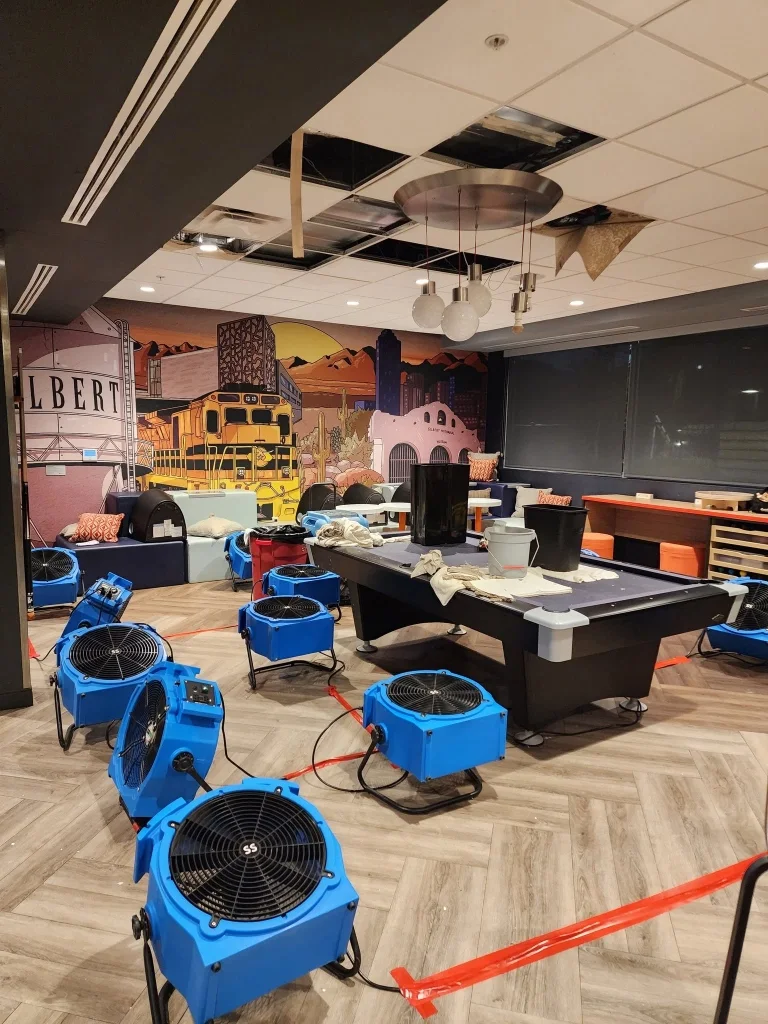
Service Definition & The IICRC Standard of Care
Professional church sanctuary water damage phoenix is an engineering and environmental discipline adhering strictly to IICRC S500 protocols, not mere surface mopping. When structural plumbing failures strike in Maricopa County, certified emergency water extraction and thermal structural drying procedures must be deployed immediately. Whether triggered by high-pressure burst pipe emergencies, subfloor leaks, or commercial line ruptures, bound moisture rapidly penetrates concrete subfloors and wall framing. In the desert heat, delays trigger microbial proliferation requiring rapid mold remediation. Request damage assessment through our emergency assessment portal or request 30-minute dispatch across all Valley service areas.
Securing electrical feeds, inspecting load-bearing assemblies, and containing pathogens.
Stopping the intrusion source and erecting 6-mil plastic isolation containment airlocks.
31-HP truck-mount extraction, removing gallons exponentially faster than evaporation.
LGR dehumidifiers and HEPA air scrubbers driving grains per pound below 25 GPP.
Calibrated electronic pinless testing confirming baseline dry standards.
The Complete 6-Stage Restoration Roadmap
Our IICRC-certified crews execute a disciplined, scientific 6-stage protocol to stabilize and dry structural components:
Emergency Dispatch & Perimeter Isolation
30 to 60 minute arrival. Securing electrical shutoffs, evaluating structural loads, and erecting containment airlocks.
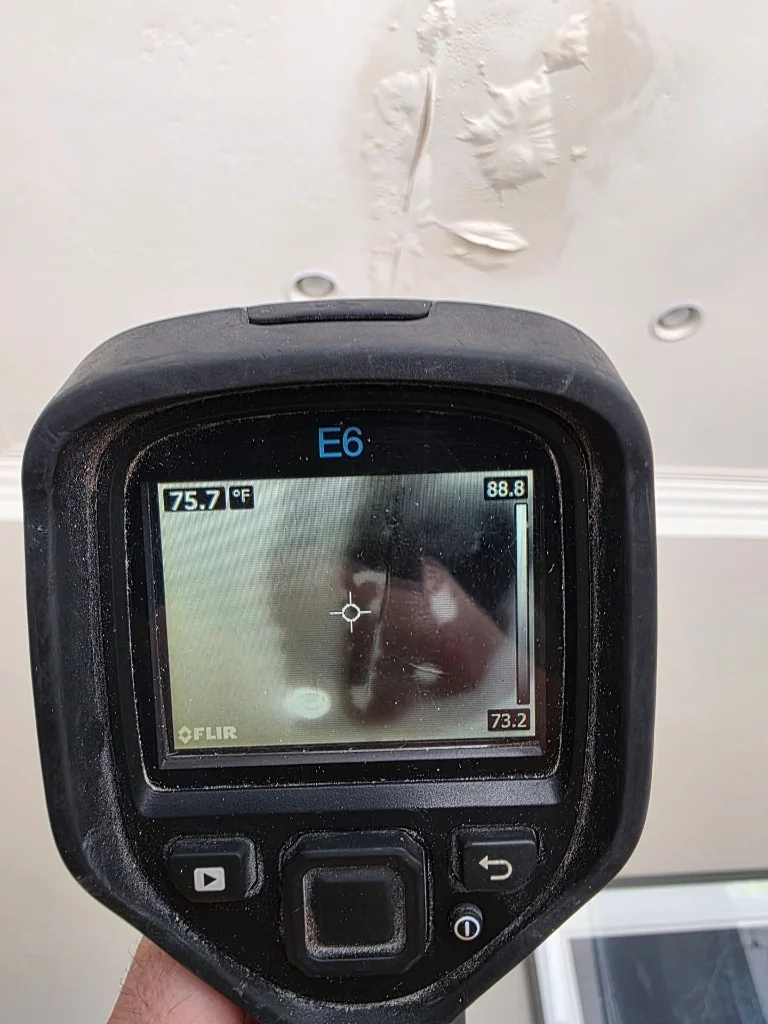
FLIR® Thermal Mapping & Baseline Scans
Infrared thermal scans detect trapped moisture behind walls and beneath concrete without invasive exploratory demolition.
High-Volume Bulk Extraction
31-HP truck-mount extraction units pump standing water away at hundreds of gallons per minute.
Controlled Selective Demolition
Precision flood cuts 12 to 24 inches above moisture lines, removing wet insulation and opening wall framing to dry airflow.
Thermodynamic Dehumidification
Industrial Low-Grain Refrigerant dehumidifiers pull deep trapped moisture from dense framing lumber and concrete slabs.
Antimicrobial Sanitization & Verification
EPA-registered botanical application (Benefect Decon 30) and calibrated moisture testing to issue an official dry certificate.
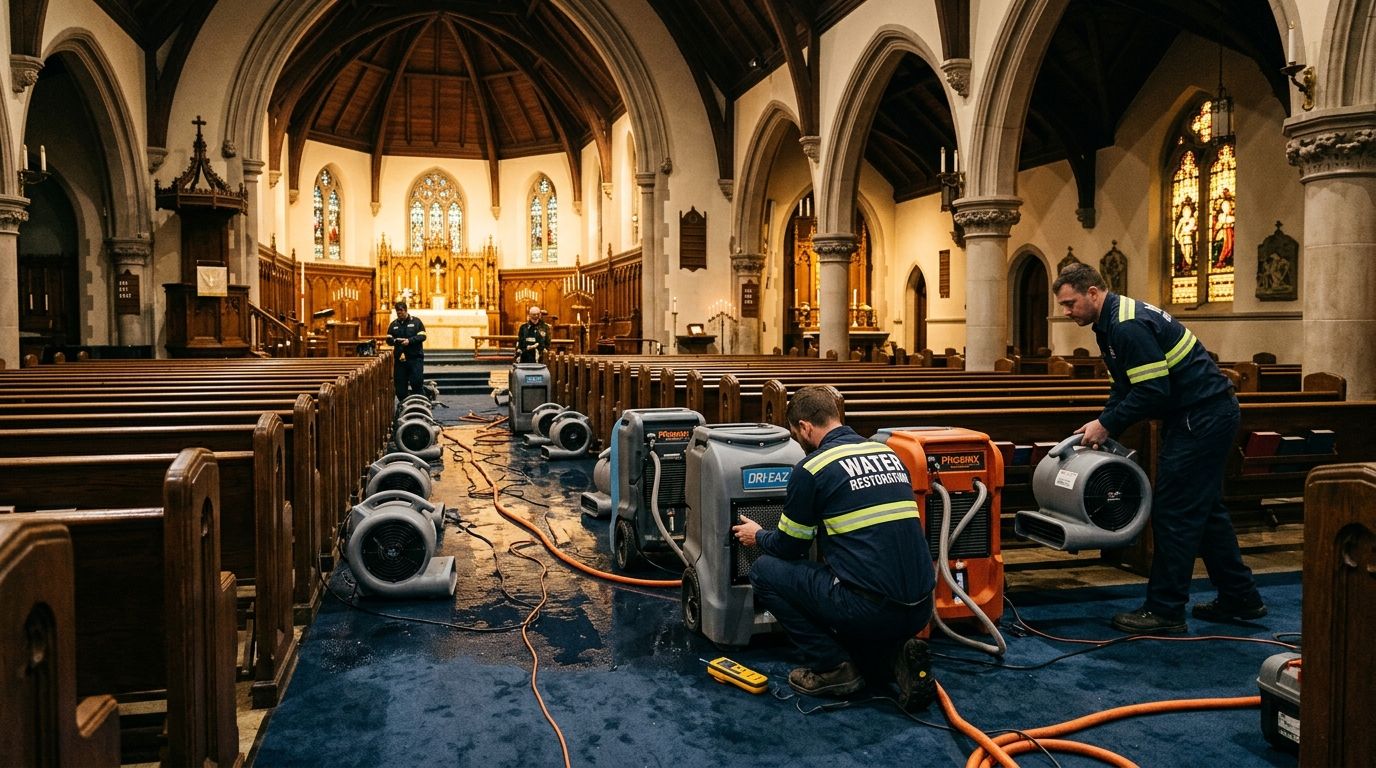
Specialized Equipment & Industrial Restoration Technology
Mitigating severe property damage requires industrial-grade technology capable of altering thermodynamic psychrometrics:
Truck-Mounted Extraction Rigs
31-HP engines producing 16+ inches Hg vacuum suction to evacuate bulk water rapidly into holding tanks.
Low-Grain Refrigerant Dryers
Pre-cooling heat-pipe systems driving ambient grains per pound below 25 GPP to draw deep trapped water out of framing.
HEPA Negative-Air Scrubbers
Hospital-grade 99.97% particulate filtration capturing microscopic fungal spores, soot, and biohazard aerosols.
FLIR® Thermal Scanners & Probes
Infrared thermography detecting evaporative cooling boundaries behind walls, combined with digital RF pinless scanners.
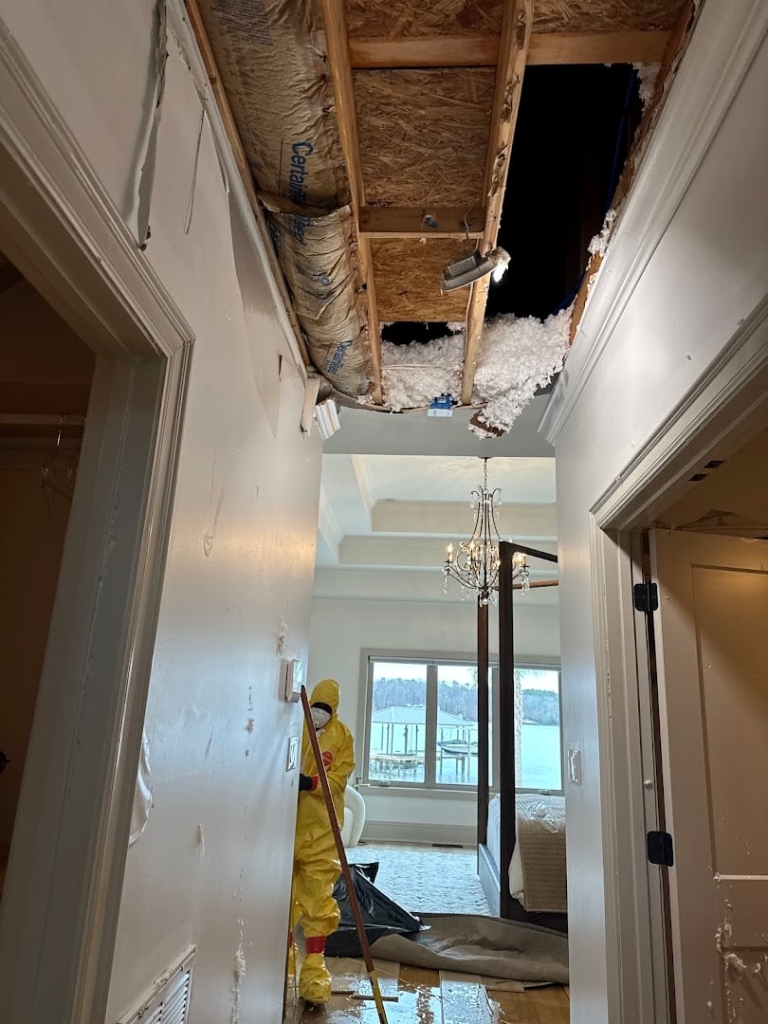

Professional Restoration vs. DIY Mitigation
Attempting DIY cleanup during a property disaster creates severe hidden liabilities:
- Trapped Moisture: Surface drywall dries while moisture inside cavities triggers hidden mold blooms.
- Pathogenic Risks: Category 2 & 3 water contains bio-contaminants standard cleaners fail to kill.
- Insurance Denial: Insurers require daily psychrometric logs; lack of data causes claim disputes.
Transparent Upfront Itemized Pricing
Valley Restoration Pros operates with complete transparency:
- Free On-Site Assessment: Complete physical inspection before work begins.
- Upfront Itemized Estimates: Detailed line items calculated via industry-standard Xactimate.
- Zero Surprise Billing: No hidden charges or unauthorized repairs.
Certified Church Sanctuary Water Damage Phoenix Field Documentation
Every response performed by Valley Restoration Pros is documented through photographic and thermographic records:

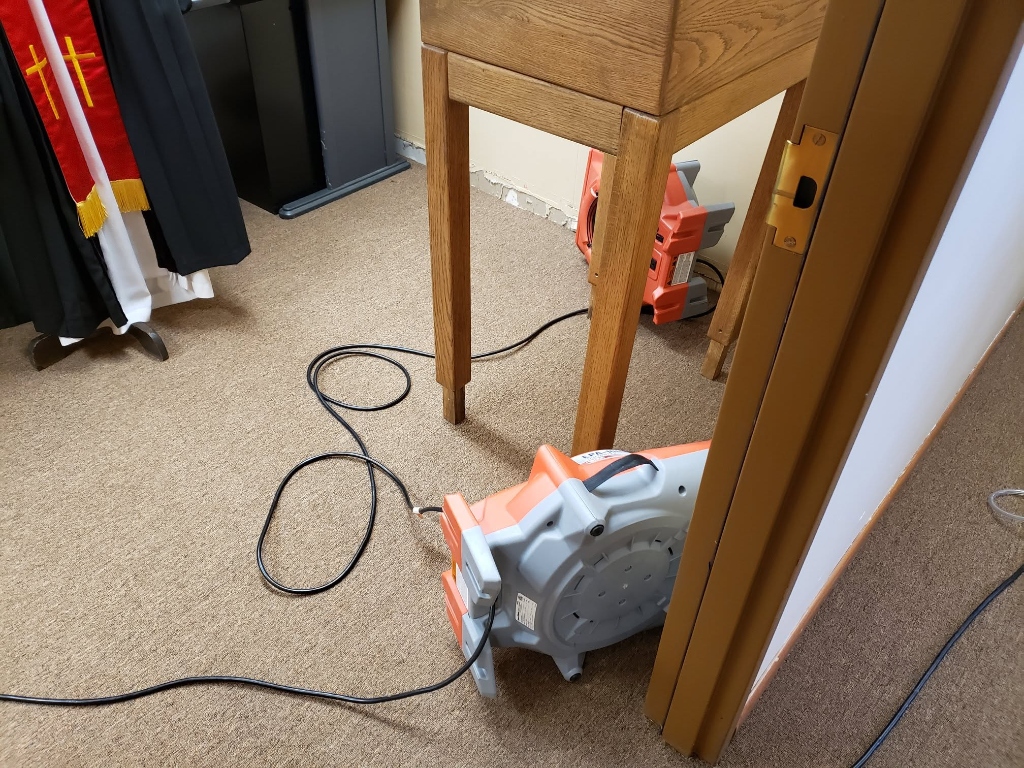
Comprehensive Church Sanctuary Water Damage Phoenix Technical Manual & Operational Standards
Exhaustive engineering protocols, psychrometric calculations, geological multipliers, and step-by-step restoration standards for Maricopa County properties:
Executive Emergency Abstract: Commercial Sanctuary Large-Loss Inundation Recovery
Houses of worship throughout Greater Phoenix, Scottsdale, Paradise Valley, Tempe, Mesa, Chandler, Glendale, and Peoria represent magnificent architectural achievements, historical treasuries, and community spiritual homes. Characterized by soaring cathedral ceilings ranging from twenty to forty-five feet in height, expansive open naves spanning ten thousand to twenty-five thousand square feet without load-bearing interior partition walls, historic solid oak woodwork, custom pipe organs, and elevated chancel platforms, these commercial properties present immense structural drying complexities when catastrophic water intrusions occur.
Unlike standard commercial office suites with uniform eight-foot drop ceilings and modular cubicles, church sanctuaries contain hundreds of thousands of cubic feet of continuous, interconnected airspace. When a commercial fire sprinkler line ruptures overhead, a flat parapet roof fails during an intense July monsoon storm, or an aged hydronic heating loop cracks, tens of thousands of gallons of municipal water saturate the nave in minutes. In Phoenix, where municipal tap water carries an aggressive mineral hardness of 18 to 25 grains per gallon (GPG), pooling water leaves caustic, abrasive calcium carbonate residues that degrade historic varnishes, corrode audio wiring, and destroy specialized electronic sound engineering consoles.
Compounding the disaster, ambient summer temperatures across Maricopa County frequently hover between 110°F and 118°F. Combined with high interior relative humidity from thousands of gallons of pooling floodwaters, this extreme heat creates an indoor tropical terrarium effect. Saturated acoustic ceiling tiles dissolve and collapse, massive glulam timber trusses absorb thousands of pounds of moisture, solid oak pews cup and warp along their floor mounting anchors, and hazardous mold spores germinate within 24 to 36 hours across wall cavities, fabric choir seats, and liturgical vestments.
Valley Restoration Pros mobilizes a dedicated Commercial Large-Loss Response Division equipped with multi-ton industrial desiccant dehumidifiers, high-volume trailer-mounted extraction units, industrial HEPA air scrubbers, and specialized FLIR thermal imaging cameras. Deploying on-site in thirty minutes across the Valley, our IICRC-certified master restorers execute non-destructive structural drying to safeguard sacred artifacts, restore congregation safety, and prepare thorough, indisputable claims documentation for board trustees and commercial insurance adjusters.
Immediate Sanctuary Emergency Directives for Church Leadership & Facility Staff
- Isolate the Building Water Main: Locate the primary commercial backflow preventer assembly or commercial water meter near the street curb and close the primary OS&Y (outside stem and yoke) valve to halt incoming flow immediately.
- Shut Down Main Power to Sanctuary & Sound Systems: Soaring ceiling floods frequently penetrate line-array sound speaker clusters, motorized projection screens, and stage lighting dimmer racks. De-energize primary breaker panels in the mechanical room to avoid electrocution risks.
- Elevate Liturgical Artifacts & Sacred Vestments: Relocate communion silver, historic pulpits, commemorative bibles, clergy vestments, and electronic mixing consoles to dry auxiliary wings or educational classrooms.
- Mobilize Industrial Large-Loss Dispatch: Contact our 24/7 Priority Commercial Emergency Line at (602) 847-9593. Our heavy extraction fleet and structural engineers deploy instantly to preserve your sacred facility.
Anatomy of Sanctuary Water Intrusions: Mechanical Failure Dynamics & Large-Loss Physics
Church sanctuaries incorporate specialized structural engineering with expansive open spans unsupported by interior load-bearing partition walls. This vast geometric layout fundamentally alters how liquid distributes across flooring and building envelopes:
Overhead Fire Sprinkler System Ruptures
Cathedral sanctuary sprinkler lines are suspended thirty feet above the nave floor. Thermal cycling in high attic plenums, mechanical vibration, or corrosion along threaded fittings can shear a sprinkler head, discharging 250 to 500 gallons of stagnant, pressurized blackish pipe water per minute directly onto velvet seating and custom carpet. Review our complete fire sprinkler water damage solutions.
Monsoon Flat Roof Parapet & Scupper Overflows
Sanctuary roof designs often incorporate expansive flat roofs bordered by high decorative parapets. During Phoenix monsoons, intense rainfall deposits four inches of rain in sixty minutes. When rooftop scuppers and drain baskets become clogged with desert pigeon debris, water ponds several feet deep until breaching flashing seams and collapsing acoustic ceiling assemblies into the narthex.
Rooftop Chiller & Air Handler Condensate Floods
Multi-ton commercial package air conditioners cooling large sanctuaries produce gallons of condensation hourly. Phoenix hard water scale blocks drain pans and float switches, forcing chilled water back into supply trunks where it drips through duct joints directly onto worship stages. For comprehensive HVAC systems mitigation, see our commercial chiller pipe flood restoration services.
Baptistry Pool Drainage & Valve Failures
Elevated baptismal fonts and immersion baptistries hold 800 to 1,500 gallons of water directly behind the choir loft or pulpit. Defective autofill float valves, degraded fiberglass basin liners, or cracked drain assemblies release high-volume floods into hidden subfloor utility chases, saturating stage framing and sound insulation unnoticed for days.
Whenever large commercial facilities suffer overhead or floor-level flooding, rapid intervention under our commercial water damage protocols stops water migration into adjacent educational wings and administrative suites.
Phoenix Climatic & Architectural Multipliers: 115°F Heat, Extreme Mineral Hardness & Caliche Foundation Dynamics
Sanctuaries in Phoenix face environmental forces unlike any other region in North America. These environmental parameters dramatically compress the timeline available to save delicate church property:
1. 18 to 25 GPG Hard Water Mineral Encrustation on Organ Pipes and Sound Equipment
Water distributed throughout Phoenix and Maricopa County contains extraordinary levels of calcium carbonate and dissolved magnesium. When thousands of gallons of municipal water flood across sanctuary carpets and pews, rapid evaporation driven by dry air leaves dense white efflorescence and calcified deposits.
If this hard water reaches delicate lead-tin alloy organ pipes, electronic mixer boards, or under-floor power tracks, the mineral salts chemically corrode metal connectors and ruin acoustic voicing. For related mineral mitigation procedures, review our work on tile efflorescence sub-slab moisture drying in commercial facilities.
2. 115°F Summer Thermal Acceleration & Toxic Fungal Incubation
During Phoenix summer heatwaves, attic ceiling cavities and unconditioned upper sanctuary naves easily exceed 130°F. When high humidity from standing water mixes with elevated indoor temperatures, biological activity accelerates exponentially.
Microbial spores including Aspergillus, Penicillium, and Chaetomium germinate on cellulose ceiling panels and hymn books within twenty-four hours. Rapid deployment of commercial LGR and desiccant units is critical. Learn more about biological containment in our specialized mold remediation overview.
3. Monsoon Haboob Silt Contamination Through Parapet Roof Breaches
Phoenix summer monsoons generate massive dust storms (haboobs) followed by violent torrential downpours. When roof membranes tear under hurricane-force wind shear, rainwater carries fine alkaline desert clay and bird waste directly into ceiling plenums.
This storm water is classified under IICRC standards as Category 3 blackwater. It cannot be dried in place without hospital-grade decontamination. Review our certified protocols for storm flood cleanup across commercial roofs.
4. Expansive Caliche Soil Heave Beneath Sanctuary Post-Tensioned Slabs
Maricopa County soils consist of cement-like caliche clay that expands when saturated with water. When church water lines rupture underground or floods pour out exterior emergency doors into foundation footings, the underlying soil expands with immense hydraulic pressure.
This soil swelling can heave concrete foundation slabs, cracking chancel tile work and misaligning load-bearing steel columns. For sub-slab diagnostics, explore our slab leak water damage restoration engineering procedures.
Immediate First-Hour Sanctuary Emergency Protocol & Safety Isolation
The initial sixty minutes of a sanctuary large-loss event dictate whether million-dollar pipe organs, acoustic ceilings, and historic hardwood pews can be completely salvaged:
Electrical De-Energization & LOTO Protocol
Sanctuary lighting dimmer racks, audio amplifiers, and motorized stage winches run high-amperage 480V/208V power. Our technicians immediately execute OSHA Lockout/Tagout (LOTO) procedures on sub-panels to prevent electrocution in flooded carpet areas.
Structural Ceiling Shoring & Water Relief
High drywall ceilings and acoustic plaster hold thousands of pounds of trapped roof water. We erect temporary heavy-duty aluminum scaffolding and install controlled relief punctures to drain pooling water safely into plastic containment reservoirs without collapsing.
Pipe Organ & Altar Barrier Enclosure
Pipe organs, gilded altars, and pulpits require immediate protection from airborne humidity spikes. We construct 6-mil poly containment barriers around chancel casework and deploy specialized desiccant drying tubes to hold local relative humidity below 45%.
Continuous Truckmount Vacuum Extraction
Industrial extraction wands connected to twin-engine truckmounted extractors pull standing water from glue-down commercial carpet and oak pew bases at rates exceeding 1,200 gallons per hour. Review our rapid emergency water extraction deployment.
For facilities with water migration entering basement choir rehearsal rooms or fellowship halls, see our specialized basement water damage mitigation protocols.
Advanced Equipment Fleet: Trailer Desiccants & Soaring Sanctuary Microclimate Systems
Standard residential drying machines are completely inadequate for drying high-volume commercial sanctuaries containing 250,000+ cubic feet of space. Church naves require high-capacity industrial equipment engineered to manipulate large volumes of air under severe thermal conditions:
Trailer-Mounted Desiccant Dehumidifiers
Model: Arid-Dry MS-5000 / CDI 5,000 CFM Industrial Desiccant
Desiccant technology utilizes honeycomb silica gel chemical rotors to produce ultra-dry air with specific humidity levels below 15 grains per pound (GPP). This extreme vapor pressure differential pulls trapped moisture out of thick timber trusses, historic organ casework, and concrete slabs beneath sanctuary carpets.
- Air Delivery: 5,000 CFM pressurized process air
- Water Removal: Over 3,000 pints (375 gallons) per 24 hours
- Ducting Capacity: 20-inch lay-flat ducting routed 50 feet high
- Reactivation Heat: Indirect-fired diesel burners maintaining independent thermal balance
High-Volume LGR Dehumidifiers & Axial Fans
Model: Phoenix 250 MAX LGR / Dri-Eaz Stealth AV3000
Placed strategically along side aisles, chancel risers, and sound booths, these units generate continuous laminar airflow across floor assemblies while condensing hundreds of gallons of moisture daily, preventing secondary humidity damage to padded pew fabrics.
- Air Velocity: 3,000 CFM per axial air mover
- LGR Water Removal: 145 pints/day at AHAM per machine
- Electrical Supply: Temporary diesel mobile generators eliminating load on church electrical panels
- Sound Attenuation: Low-decibel operation to maintain quiet during emergency board meetings
Our mobile equipment trailers carry complete independent power generation, fuel reserves, and heavy industrial distribution panels, guaranteeing that even if municipal power is disconnected due to flooding, our desiccant drying systems operate without disruption around the clock.
IICRC S500 & S520 Commercial Sanctuary Large-Loss Systematic Restoration Roadmap
Every large-loss project executed by Valley Restoration Pros adheres strictly to the ANSI/IICRC S500 Standard for Professional Water Damage Restoration and S520 Standard for Mold Remediation:
Phase 1: Psychrometric Baseline & Calibrated Thermal Moisture Mapping
Using FLIR T-Series thermal imaging cameras and Protimeter non-penetrating moisture meters, we map wet perimeters across dry-standard building assemblies. We record baseline wet-bulb temperatures, dew points, and grains per pound (GPP) to calculate precise equipment capacity required to establish negative vapor pressure across the entire building envelope.
Phase 2: High-Volume Deep Extraction & Cushion Delamination Prevention
Multiple extraction teams deploy self-propelled high-extraction rovers across sanctuary carpets, extracting 90% of trapped liquid before it breaks down latex carpet backing adhesives. Saturated underlayment is carefully evaluated for preservation or surgical removal, avoiding costly full broadloom carpet teardowns whenever structurally possible.
Phase 3: High-Altitude Thermal Scaffolding & Ceiling Cavity Drying
To address ceiling assemblies 30+ feet overhead, our crews erect OSHA-certified mobile scaffolding towers. We duct positive-pressure desiccant heated air directly into ceiling trusses and open joist bays, driving trapped moisture down toward extraction pathways and preventing dangerous attic moisture condensation.
Phase 4: Botanical Antimicrobial Decontamination & HEPA Filtration
We mist EPA-registered botanical biocides (Benefect Decon 30) across affected floor assemblies, wall bases, and pew surfaces. Industrial HEPA 500 air scrubbers run continuously, scrubbing dust, fiberglass, and microbial particulates from congregational air at 99.97% efficiency down to 0.3 microns.
Phase 5: Daily Psychrometric Monitoring & Clearance Certification
Technicians log temperature, relative humidity, and structural wood moisture content twice daily. Equipment operates continuously until all materials reach validated dry-standard equilibrium, concluding with a comprehensive signed IICRC drying dossier delivered to church trustees.
For comprehensive building desiccation benchmarks and thermodynamic drying curves, review our dedicated structural drying protocols and engineering parameters.
Hyper-Local Case Study: Central Phoenix Historic Church Sanctuary Monsoon Roof Collapse
Incident Breakdown: Torrential Monsoon Inundation Threatens Historic Pipe Organ
During a severe August monsoon storm packing 65 MPH winds and dumping 2.8 inches of rain over Midtown Phoenix within forty-five minutes, storm debris blocked two critical commercial scupper drains on the sanctuary flat gravel-surfaced roof near N Central Ave and E Osborn Rd. Water accumulated to a depth of fourteen inches behind the north parapet wall, exceeding structural load limits and creating over forty thousand pounds of standing hydrostatic force.
The asphalt roof membrane ruptured along an expansion joint, unleashing an estimated 3,800 gallons of storm runoff through the attic. A 20-foot section of 5/8-inch acoustic plaster ceiling collapsed directly over the choir loft and north pews, soaking fifty-two solid oak pews and threatening a 1968 custom Möller pipe organ console valued at over $350,000.
Rapid Restoration Timeline & Architectural Preservation Metrics
- Minute 28: Initial Commercial Dispatch Arrival: Valley Restoration Pros deployed two commercial response trailers, ten technicians, and a structural supervisor on-site within twenty-eight minutes, immediately establishing safety cordons and isolating power.
- Hour 2 to 6: Pipe Organ Containment & Extraction: Crews constructed a hermetically sealed 6-mil poly containment chamber around the organ console and chancel chambers, deploying low-grain desiccant drying air to hold relative humidity at 40%, preventing leather bellows rupture. Truckmount extractors pulled 2,400 gallons from nave carpets.
- Hour 8 to 24: Scaffolding Erection & Ceiling Stabilization: Mobile scaffolding was erected to reach the 32-foot ceiling peak. Technicians extracted waterlogged fiberglass insulation, cut back fractured plaster safely, and secured compromised timber trusses.
- Hour 26 to 84: High-Volume Desiccant Drying: A 5,000 CFM Arid-Dry industrial desiccant trailer ducted dry air into the nave while eight Phoenix 250 MAX LGR units dried the lower seating areas, dropping ambient moisture from 110 GPP to 34 GPP.
- Hour 96: Dry Clearance & Sunday Service Preserved: Moisture content across oak pews stabilized at 8.2% (dry standard baseline), the organ organist confirmed flawless acoustic voicing, and Sunday worship services proceeded without interruption in the south nave.
Verified Church Trustee Testimonial:
"When our ceiling gave way and water flooded the sanctuary right over our historic pews and pipe organ, we were terrified our church would be closed for months. Valley Restoration Pros arrived in under thirty minutes on a torrential monsoon night. Their team contained the organ chamber, brought massive drying trailers, and worked around the clock. Their itemized documentation made board approval and our insurance claim completely straightforward. They saved our church!"
— Pastor Robert M. & Board of Trustees, Midtown Phoenix AZ
Transparent Upfront Itemized Pricing & Commercial Insurance Dossier
Church leadership boards, pastoral committees, and denominational financial councils require absolute clarity, fiscal stewardship, and documentation accuracy when managing catastrophic water losses. Valley Restoration Pros operates under strict institutional transparency:
Free On-Site Damage Assessment
Our master restorers perform an exhaustive physical inspection of your sanctuary, choir loft, attic spaces, and narthex at zero cost or obligation to the church board before any work is authorized.
Transparent Upfront Itemized Pricing
We utilize Xactimate® pricing software—the recognized industry benchmark used by church denominational insurance pools and major commercial underwriters—delivering clear line-item scopes.
Zero Misleading Direct Billing Promises
We maintain complete integrity by never falsely claiming your insurance policy will cover 100% of costs without policy review. We explain deductibles, policy limits, and endorsements openly.
Comprehensive Board & Adjuster Dossier
We provide church finance committees and insurance adjusters with timestamped FLIR infrared photos, psychrometric drying curves, scope logs, and clear documentation to expedite claim approval.
To calculate preliminary restoration ranges for your facility, use our interactive free on-site assessment. To confirm service availability in your area, view our regional coverage zones across areas we serve, or submit details through our contact us portal.
Frequently Asked Technical Questions: Church Sanctuary Water Damage Mitigation
Yes, provided professional desorption begins within twenty-four to forty-eight hours. Saturated hardwood pews absorb water through floor anchor bolts and end-grain joints, causing cupping and warping. We install specialized floor drying mats and controlled desiccant dehumidification to extract water gradually without splitting wood fibers. Learn more about wood preservation in our hardwood floor water damage drying technical resource.
We deploy OSHA-compliant interior rolling scaffolding towers and scissor lifts along nave side aisles. We route flexible 20-inch lay-flat ducting from trailer-mounted desiccant units directly to upper ceiling cavities, using positive air pressure to purge saturated trapped air without damaging delicate lighting or stained glass framing.
In many situations, no. Valley Restoration Pros prioritizes congregational continuity. We construct airtight zipper poly containment barriers to isolate affected nave quadrants or side chapels, allowing congregations to hold services safely in unaffected sanctuary zones while drying proceeds behind sound-attenuating barriers.
Pipe organs contain sensitive materials including thin wood slider chests, sheepskin reservoir bellows, and lead-antimony pipes. Rapid changes in relative humidity cause tuning instability and leather cracking. We establish an independent microclimate chamber around the organ, holding relative humidity between 40% and 45% using calibrated environmental controllers.
Sanctuary flooring often rests over subterranean crawlspaces housing plumbing, electrical wiring, and HVAC trunk lines. Water ponding in these crawlspaces elevates sanctuary floor humidity. We pump standing water and deploy negative air fans to prevent mold wicking upward. Review our crawl space water damage restoration protocols.
Most commercial church policies cover sudden and accidental water discharges, such as sprinkler pipe bursts or supply line failures. Storm roof leaks are generally covered if caused by wind or hail perforation. We work directly alongside denominational insurance adjusters, supplying all required thermal imaging and moisture readings for claim approval.
Yes. We utilize EPA-registered botanical antimicrobials formulated with botanical thyme oil (Benefect Decon 30). These botanical solutions kill 99.99% of bacteria and fungal pathogens without leaving synthetic chemical fumes, volatile organic compounds, or toxic residues, ensuring complete safety for congregants of all ages.
Cathedral Ceiling Heights & High-Altitude Air Cavity Psychrometric Control
Drying a church sanctuary is governed by structural air buoyancy physics. In buildings with twenty to forty-foot ceilings, warm moisture-laden air naturally ascends toward the roof peak—a phenomenon known as thermal stratification. This creates distinct microclimates within the same room:
Upper Cavity Thermal Inversion & Moisture Trapping
While ground-level floor temperatures in air-conditioned sanctuaries may register at 74°F, temperatures at the cathedral ceiling peak routinely exceed 105°F during Phoenix summers. When water floods the nave, high rates of surface evaporation send humid air upward. Upon reaching cooler roof decking or metal ductwork at night, this water vapor condenses, creating secondary "indoor rain" that drips back onto altar platforms and pews below.
To conquer thermal stratification, our technicians establish positive-pressure desiccant airflow loops. We suspend flexible ducts from ceiling purlins to extract high-moisture air directly from the apex, while injecting super-dry desiccant air at floor level. For multi-story commercial buildings suffering upper-level water migration, review our ceiling water damage restoration structural procedures.
This continuous convective cycle accelerates moisture transfer from porous timber trusses, structural steel purlins, and gypsum roof decking down to ground-level extraction manifolds, reducing overall drying time by forty percent compared to conventional ground-only air movement setups.
Acoustical Ceiling Plaster & Decorative Ceiling Truss Preservation
Historic sanctuaries often feature decorative wood beams or plaster medallions suspended beneath the primary roof trusses. Saturated acoustic plaster loses its tensile bond when moisture content exceeds 1.5%, threatening sudden structural detachment.
Our specialists employ non-destructive drying techniques, using infrared thermometers and low-grain dehumidification to dry structural plaster without drilling invasive holes. Where roof leaks originate from degraded membranes, explore our comprehensive roof leak water damage restoration protocols.
Preserving Historic Solid Oak Pews, Altars, Pulpits & Liturgical Art
Sanctuary pews represent substantial architectural and financial investments. Constructed from solid white oak, red oak, walnut, or mahogany, these long wooden benches are exceptionally vulnerable to moisture imbalances:
End-Grain Capillary Suction
Pew support legs sit directly on sanctuary subfloors. Saturated carpeting acts like a continuous wet sponge, drawing liquid upward through the unsealed end grain of the wood. This capillary action causes bottom edges to swell, split, and crack within forty-eight hours if not rapidly elevated onto protective foam isolation blocks.
Controlled Desorption Curves
Drying dense oak too rapidly results in case-hardening—a defect where the outer surface shrinks and checks while the core remains saturated. Our technicians carefully regulate the psychrometric drying rate, lowering wood moisture content gradually from 25% down to an equilibrium moisture content (EMC) of 7% to 9%.
Fabric Cushion Decontamination
Upholstered pews feature high-density polyurethane foam padding wrapped in woven velvet or synthetic fabrics. Stagnant floodwater breeds bacterial odors deep inside foam cores. We utilize sub-surface extraction wands and botanical sanitizers to restore cushions without damaging delicate fabrics or historic dyes.
By preventing catastrophic wood warping and veneer delamination through scientifically controlled drying chambers, our team has preserved millions of dollars in heirloom liturgical appointments throughout historical Valley chapels and cathedrals.
Pipe Organ Bellows, Reed Chambers & Chancel Acoustical Physics
A pipe organ is both a musical instrument and an intricate structural installation. Often housing thousands of individual pipes made of wood and tin-lead alloys, its mechanical windchests and pneumatic action are acutely sensitive to humidity fluctuations:
Windchest Delamination & Sheepskin Bellows Rupture Prevention
Windchests are constructed from multi-layered wood laminates bound with water-soluble animal hide glues. When exposed to relative humidity levels above 70%, these glues re-hydrate and lose adhesion, creating internal wind leaks that render ranks of pipes unplayable. Simultaneously, the flexible leather gussets on air reservoir bellows stiffen and crack when drying out after water contact.
Our commercial mitigation teams construct sealed environmental containment surrounding the pipe chambers immediately upon arrival. We deploy constant-temperature desiccant drying units monitored by dataloggers to maintain 45% relative humidity, preserving glue joints and leather membranes while structural drying occurs in the nave.
Acoustical Chancel Reflectors & Sound Absorption Panels
Chancel stages feature sound-diffusing panels, fabric-wrapped fiberglass acoustic baffles, and curved wooden reflectors designed to balance choral voices and public address clarity. Water saturation destroys the acoustic rating of these panels and promotes rapid fungal growth within porous fiberglass batts.
We test acoustic wall assemblies with non-invasive radio-frequency moisture meters. Saturated fabric covers are gently treated with botanical antimicrobials while backing materials are dried to dry standard baselines, saving tens of thousands of dollars in custom acoustic retrofits and eliminating the need for complex sound re-engineering.
Fellowship Halls, Narthex Entries & Commercial Kitchen Inundations
Sanctuary flooding rarely remains confined to the nave. Water spreads rapidly through adjoining doorways into high-traffic narthex vestibules, fellowship banqueting halls, and commercial church kitchens:
Narthex Welcome Center & Tile Sub-Slabs
Heavy ceramic tile or travertine floors in church entryways conceal moisture trapped beneath unsealed grout joints. If not extracted, trapped water degrades mortar beds and creates efflorescence blooms that lift floor tiles, creating trip hazards for churchgoers.
Commercial Kitchen Stainless Assemblies
Church fellowship kitchens feature commercial dishwashers, walk-in coolers, and grease traps. Water entering electrical conduit chases or pooling beneath stainless counters requires complete sanitization to meet Maricopa County Environmental Services Department health standards.
Sunday School Classrooms & Daycare Wings
Educational wings housing nursery children require the strictest air quality standards. We establish negative-pressure air containment barriers with HEPA air scrubbers to guarantee zero cross-contamination of dust or spores into child-occupied zones.
For commercial properties experiencing sanitary sewer backups or commercial line blockages, see our certified sewage cleanup and biohazard extraction protocols.
Emergency Action Protocol for Church Trustees, Facilities Directors & Clergy
When sanctuary water disasters strike, immediate coordinated action by church facilities personnel prevents secondary damage and facilitates insurance approvals:
Crucial Immediate Action Directives
- Document Everything with Video & Timestamped Photos: Before moving waterlogged hymnals, choir robes, or sound gear, capture panoramic video and detailed photos showing standing water depths and affected fixtures for the insurance committee.
- Elevate Liturgical Artifacts on Synthetic Foam Blocks: Place waterproof foam risers beneath communion tables, pulpit legs, and choir risers to halt continuous capillary moisture absorption.
- Cover Sound Consoles & Speaker Stacks with Poly Sheeting: Tape plastic sheeting over front-of-house audio boards, lighting controllers, and amplifier racks to shield sensitive microcircuitry from dripping ceiling condensation.
- Notify Commercial Insurance Carrier Immediately: Open a formal claim number with your commercial church underwriter or denominational risk pool, specifying that an IICRC-certified commercial large-loss restoration contractor is mobilizing.
Critical Actions to Avoid
- Do Not Turn on Sanctuary HVAC Units: Operating air handlers circulates mold spores, dust, and humidity throughout unaffected classrooms and administrative offices.
- Do Not Use Household Vacuum Cleaners: Domestic vacuums risk electrical fire when extracting water and exhaust airborne mold spores directly into the breathing zone.
- Do Not Enter Areas with Sagging Ceilings: Waterlogged drywall weighing hundreds of pounds presents catastrophic crush hazards until properly shored by restoration technicians.
Material Moisture Physics: Historic Stained Glass Support Trusses vs. Engineered Glulam Beams
Historic sanctuaries blend delicate artisan craftsmanship with heavy structural framing. Understanding how varying building materials respond to prolonged water exposure is vital for successful preservation:
Stained Glass Lead Cames & Wooden Window Tracery
Stained glass windows are secured by flexible lead cames set into heavy wooden or stone tracery frames. Water entering window framing causes wood sills to swell, applying lateral crushing pressure against brittle antique glass. We apply low-velocity dehumidified air to window surrounds, drying wood frames without inducing glass cracking.
Engineered Glued-Laminated (Glulam) Arch Beams
Modern sanctuaries frequently span wide naves with soaring glulam arches. While adhesives in modern glulams are water-resistant, prolonged saturation causes dimensional expansion and shear strain along outer lamination lines. We track beam core moisture with deep-probe resistance meters until readings drop safely below 15% wood moisture equivalent.
Heavy Solid Timber Trusses (Douglas Fir & Ponderosa Pine)
Found in historic Southwestern mission and chapel architecture, massive solid timber trusses retain enormous moisture loads. If dried improperly in dry desert air, rapid surface desiccation triggers deep structural checking and split fractures. Our desiccant psychrometric controls prevent rapid checking while achieving complete moisture extraction.
Our technicians coordinate closely with historical preservation consultants and structural engineers to ensure that every phase of large-loss drying honors the architectural legacy of the sanctuary while meeting strict commercial drying codes.
Commercial Sanctuary Carpet Extraction vs. Stage Wood Underlayment Desorption
Sanctuary flooring assemblies present layered challenges: high-durability commercial broadloom carpets or carpet tiles glued to concrete slabs, flanked by elevated wooden worship platforms and choral risers:
Glue-Down Carpet & Vapor Emitting Concrete Slabs
Direct-glue commercial carpets installed across sanctuary concrete floors trap water between the carpet backing and the concrete slab. In Phoenix, where concrete foundation slabs are exposed to high ground heat, trapped water dissolves adhesive latex compounds, producing a foul ammoniacal odor and bubbling carpet seams.
We utilize high-efficiency weighted extraction units that extract water from the carpet pile and concrete surface without delaminating the backing. Following extraction, industrial desiccant air streams force vapor release from the slab, allowing carpet adhesives to re-cure without expensive replacement.
Elevated Stage Riser Cavities & Wood Framing Desorption
Worship stages and altar platforms are commonly framed with 2x10 wood joists topped with double-layered plywood subfloors and finished hardwood or carpet. Water pooling in enclosed stage cavities cannot evaporate naturally through dense flooring layers.
Our technicians inject pressurized heated dry air directly into stage joist cavities using precision vent injection systems (Injectidry), extracting vapor through dedicated perimeter exhaust points. This technique saves expensive custom altar stages from demolition while eliminating hidden mold colonization risks.
By drying enclosed stage sub-structures in place, we protect high-value stage finishes, concealed microphone cable conduits, and under-stage subwoofer enclosures from persistent moisture rot.
Seasonal Liturgical Calendar Risk: Holiday Deluges & Summer Desert Monsoons
Sanctuary water emergencies across the Valley follow distinct cyclical patterns linked to seasonal weather shifts and high-occupancy church calendar peaks:
July - September Monsoon Storm Overwhelms
Violent summer convective thunderstorms generate microburst winds that tear flat roof perimeter flashings, unseat commercial HVAC units, and drop massive quantities of rain in minutes. Water enters through ceiling drops, flooding sanctuaries during church summer hiatuses when buildings are lightly staffed.
December - January Winter Freeze & Christmas Deluges
Sub-freezing nighttime temperatures in Phoenix freeze uninsulated copper fire sprinkler lines in unconditioned sanctuary attic spaces. The pipe splits, thawing during daytime hours to discharge thousands of gallons right before Christmas Eve candlelit services. For burst pipe emergencies, review our burst pipe repair protocols.
Easter & Spring Startup Pressure Surges
Re-activating aged commercial cooling equipment ahead of Easter celebrations triggers sudden hydronic line bursts and pan overflows. Mineral scale fractures brass shutoff valves, inundating administrative corridors and church vestibules unexpectedly.
Valley Restoration Pros maintains 24/7/365 commercial priority teams ready to respond during holidays, weekends, and seasonal emergencies throughout Greater Phoenix.
Post-Remediation Indoor Air Quality & Congregational Health Clearance Certification
Houses of worship welcome diverse congregations, including elderly seniors, young infants, and individuals with respiratory conditions. Ensuring certified indoor air quality following a large-loss water intrusion is an absolute moral and operational imperative:
Independent Third-Party Post-Remediation Verification (PRV) Testing
To eliminate conflicts of interest and satisfy denominational liability carriers, Valley Restoration Pros facilitates third-party Post-Remediation Verification (PRV) testing conducted by independent Certified Indoor Environmentalists (CIEs). Testing includes calibrated Spore Trap air sampling (Air-O-Cell cassettes) collected throughout the sanctuary nave, choir loft, and balcony, directly compared against outdoor Phoenix control baselines.
Clearance requires indoor airborne spore counts to be equal to or lower than outdoor background desert levels, with zero presence of toxic marker molds such as Stachybotrys chartarum, Chaetomium, or Memnoniella. Full laboratory analytical certificates are delivered directly to the church board of trustees.
Botanical Sanitation & Microbial Barrier Misting
Following structural drying, all affected structural wood framing, ceiling joists, and floor substrates are misted with Benefect Decon 30—an EPA-registered botanical disinfectant formulated from natural thyme oil. This non-toxic treatment penetrates wood pores to eliminate microbial residues without leaving synthetic chemical odors or volatile organic compounds (VOCs).
Congregants returning to worship experience crisp, fresh, and biologically pure indoor air, giving pastoral staff and worship leaders full confidence that the facility is clean, safe, and welcoming for community fellowship.
Verified Local Area Dispatch: Phoenix, AZ
Official Geo-Coordinates: 33.4484° N, -112.074° W • Maricopa County
Related Specialized Emergency Restoration Services
Explore specialized rapid-response mitigation protocols across Greater Phoenix and Maricopa County:
Valley-Wide Emergency Response Service Coverage
Our mobile restoration fleet is dispatched across the entire Phoenix metropolitan region, providing rapid 30 to 60 minute emergency response: