

Valley Restoration Pros delivers 24/7 industrial emergency water extraction, thermal psychrometric drying, and structural mitigation across Phoenix and Maricopa County with guaranteed 30–60 minute rapid arrival. All protocols strictly adhere to IICRC S500 standards, featuring upfront itemized pricing and free on-site thermal moisture assessments. Call dispatch directly at (602) 847-9593.
Why Immediate Mitigation Is Critical in Phoenix Heat
Subterranean 1,000V DC busway trenches, charging power distribution cabinets (PDCs), and liquid-cooled dispenser conduits submerged under monsoonal floodwaters create extreme arc-flash explosion hazards, high-voltage ground faults, and rapid electrolytic destruction of copper conductor assemblies. Floodwaters carrying Chandler expansive caliche clay silt and 18 GPG municipal dissolved mineral solids coat precision optical alignment targets, floor-embedded LiDAR calibration transponders, and ultrasonic sensor verification rigs, blinding autonomous driving compute stacks upon restart. Under Chandler summer ambient temperatures exceeding 115°F, standing water and trapped humidity in below-grade maintenance pits and battery charging pads accelerate thermal stress and vapor pressure, threatening lithium-ion traction battery containment envelopes with moisture-induced dendrite shorting and runaway chemical decomposition. Monsoonal stormwater cloudbursts backing up through municipal drainage mains along South Dobson Road and West Germann Road inundate subterranean service trenches and fleet staging aprons, paralyzing commercial autonomous robotaxi and delivery operations at financial losses exceeding $120,000 per hour.

Service Definition & The IICRC Standard of Care
Professional chandler commercial autonomous vehicle fleet depot flood dewatering is an engineering and environmental discipline adhering strictly to IICRC S500 protocols, not mere surface mopping. When structural plumbing failures strike in Maricopa County, certified emergency water extraction and thermal structural drying procedures must be deployed immediately. Whether triggered by high-pressure burst pipe emergencies, subfloor leaks, or commercial line ruptures, bound moisture rapidly penetrates concrete subfloors and wall framing. In the desert heat, delays trigger microbial proliferation requiring rapid mold remediation. Request damage assessment through our emergency assessment portal or request 30-minute dispatch across all Valley service areas.
Securing electrical feeds, inspecting load-bearing assemblies, and containing pathogens.
Stopping the intrusion source and erecting 6-mil plastic isolation containment airlocks.
31-HP truck-mount extraction, removing gallons exponentially faster than evaporation.
LGR dehumidifiers and HEPA air scrubbers driving grains per pound below 25 GPP.
Calibrated electronic pinless testing confirming baseline dry standards.
The Complete 6-Stage Restoration Roadmap
Our IICRC-certified crews execute a disciplined, scientific 6-stage protocol to stabilize and dry structural components:
Emergency Dispatch & Perimeter Isolation
30 to 60 minute arrival. Securing electrical shutoffs, evaluating structural loads, and erecting containment airlocks.
FLIR® Thermal Mapping & Baseline Scans
Infrared thermal scans detect trapped moisture behind walls and beneath concrete without invasive exploratory demolition.
High-Volume Bulk Extraction
31-HP truck-mount extraction units pump standing water away at hundreds of gallons per minute.
Controlled Selective Demolition
Precision flood cuts 12 to 24 inches above moisture lines, removing wet insulation and opening wall framing to dry airflow.
Thermodynamic Dehumidification
Industrial Low-Grain Refrigerant dehumidifiers pull deep trapped moisture from dense framing lumber and concrete slabs.
Antimicrobial Sanitization & Verification
EPA-registered botanical application (Benefect Decon 30) and calibrated moisture testing to issue an official dry certificate.
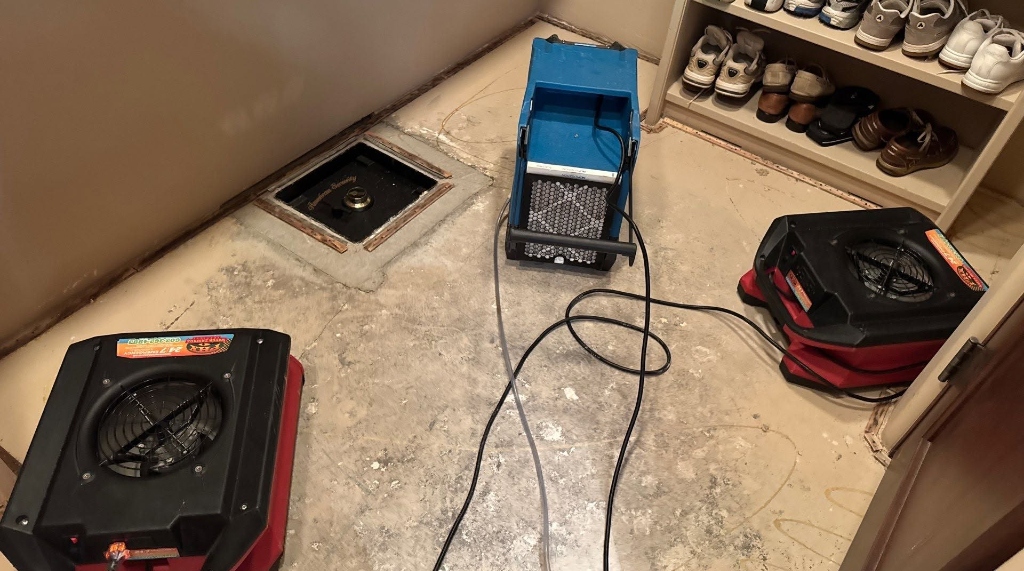

Specialized Equipment & Industrial Restoration Technology
Mitigating severe property damage requires industrial-grade technology capable of altering thermodynamic psychrometrics:
Truck-Mounted Extraction Rigs
31-HP engines producing 16+ inches Hg vacuum suction to evacuate bulk water rapidly into holding tanks.
Low-Grain Refrigerant Dryers
Pre-cooling heat-pipe systems driving ambient grains per pound below 25 GPP to draw deep trapped water out of framing.
HEPA Negative-Air Scrubbers
Hospital-grade 99.97% particulate filtration capturing microscopic fungal spores, soot, and biohazard aerosols.
FLIR® Thermal Scanners & Probes
Infrared thermography detecting evaporative cooling boundaries behind walls, combined with digital RF pinless scanners.
Professional Restoration vs. DIY Mitigation
Attempting DIY cleanup during a property disaster creates severe hidden liabilities:
- Trapped Moisture: Surface drywall dries while moisture inside cavities triggers hidden mold blooms.
- Pathogenic Risks: Category 2 & 3 water contains bio-contaminants standard cleaners fail to kill.
- Insurance Denial: Insurers require daily psychrometric logs; lack of data causes claim disputes.
Transparent Upfront Itemized Pricing
Valley Restoration Pros operates with complete transparency:
- Free On-Site Assessment: Complete physical inspection before work begins.
- Upfront Itemized Estimates: Detailed line items calculated via industry-standard Xactimate.
- Zero Surprise Billing: No hidden charges or unauthorized repairs.
Certified chandler commercial autonomous vehicle fleet depot flood dewatering Field Documentation
Every response performed by Valley Restoration Pros is documented through photographic and thermographic records:

Comprehensive chandler commercial autonomous vehicle fleet depot flood dewatering Technical Manual & Operational Standards
Exhaustive engineering protocols, psychrometric calculations, geological multipliers, and step-by-step restoration standards for Maricopa County properties:
Stage 1: Executive Emergency Abstract & Incident Overview: Chandler Autonomous Vehicle Fleet Depot Flood Dewatering
In the epicenter of autonomous transportation innovation across the American Southwest—the Chandler Price Innovation Corridor, anchored along South Dobson Road, West Germann Road, and the Loop 202 Santan Freeway—commercial autonomous vehicle (AV) fleet depots operate as high-density, mission-critical mobility infrastructure. These continuous operations hubs house multi-acre electric vehicle staging aprons, mega-watt direct current fast-charging (DCFC) transformer yards, subterranean high-voltage power distribution trenches, automated drive-through wash tunnels, and millimeter-precision sensor calibration clean bays. Housing autonomous robotaxis, commercial electric delivery vans, and autonomous class 6-8 transport tractors, these facilities represent massive capital investments where utility power density routinely exceeds 10 to 25 megawatts per campus.
When an unpredicted Sonoran Desert monsoonal cloudburst dumps two to three inches of rainfall within forty-five minutes over the East Valley, the volume of sheet runoff rapidly outstrips municipal storm sewer conveyance capacities. Surface stormwater mixed with abrasive desert soil silts and roadway chemical residues courses into subterranean trench drains, below-grade utility busway tunnels, service pits, and electrical distribution basements. In an autonomous vehicle depot, inundation is never a benign drainage issue; it represents an acute, catastrophic multi-hazard event. Subterranean 1,000-volt DC busbars, liquid-cooled charging cables, automated power delivery cabinets, and vehicle battery management systems face immediate water submersion, initiating violent galvanic decomposition, short circuits, high-energy arc-flash hazards, and potential lithium-ion traction battery thermal runaway scenarios.
Simultaneously, secondary floodwater contamination invades specialized indoor calibration labs. Precision optical target boards, LiDAR ground-truth positioning fixtures, and multi-axis wheel alignment sensor rigs suffer rapid micro-corrosion and particulate contamination from airborne silt and evaporated mineral residues. Autonomous software compute units calibrated to millimeter margins cannot deploy vehicles whose physical sensor mountings and optical references have been displaced or coated with conductive water deposits. Paralyzing an autonomous fleet depot triggers cascading operational losses exceeding $120,000 per hour across ride-hailing networks, dedicated delivery contracts, and centralized dispatch algorithms.
Executing rapid emergency water extraction across a flooded autonomous vehicle fleet depot requires specialized industrial technical capability far beyond conventional flood pumping services. Operations demand compliance with NFPA 70E Standard for Electrical Safety in the Workplace, OSHA 29 CFR 1910 hazardous energy control standards, and IICRC S500 restoration procedures. Every gallon of standing water must be treated as electrically energized until systematic lockout/tagout isolation and electrical verification are executed. Furthermore, dewatering subterranean charging raceways without creating catastrophic arc paths requires specialized non-conductive suction infrastructure, intrinsically safe submersible pumps, explosion-proof positive-displacement diaphragm extraction systems, and multi-ton desiccant dehumidification systems capable of bringing structural concrete and enclosed busbars below critical vapor thresholds.
Valley Restoration Pros maintains dedicated commercial large-loss restoration units strategically pre-positioned throughout the East Valley. Our master-certified industrial restoration specialists deploy 24/7 with rapid response times across Chandler, Gilbert, and Tempe, mobilizing mobile high-volume extraction units, industrial desiccant trailers, Class 1 Division 1 extraction hardware, and advanced FLIR thermal diagnostics. We isolate, dewater, decontaminate, and desiccate flooded autonomous vehicle fleet depots to restore full mission capability, safeguard multi-million-dollar DC fast-charging assets, and get commercial mobility operations back online safely.
Immediate First-Hour High-Voltage Depot Safety Directives
- Strict Exclusion Perimeter & Arc-Flash Zone Enforcement: Immediately establish a 75-foot exclusion boundary around all flooded outdoor DC charging pads, switchgear pads, and subterranean utility vaults. Personnel must not enter standing water in contact with energized charging dispensers or subterranean conduits under any circumstances.
- Emergency Power Off (EPO) & Grid Disconnection: Trigger the primary master facility Emergency Power Off (EPO) station to isolate medium-voltage utility feeds (12.47 kV or 480V three-phase step-down transformers) from the main substation switchgear before technicians enter wet zones. Verify complete absence of residual stored DC voltage across charging capacitor banks using calibrated high-voltage probes.
- Traction Battery & Service Trench Inspection: If autonomous vehicles in service bays or charging pads have battery enclosures partially or fully submerged, institute mandatory 24-hour thermal imaging surveillance with FLIR cameras to monitor for runaway cell overheating, electrolyte leakage, or hydrogen off-gassing.
- Engage Industrial Emergency Extraction Command: Contact Valley Restoration Pros Industrial Large-Loss Command immediately at (602) 847-9593 or mobilize our team via Emergency Phone Dispatch for immediate on-site deployment to the Chandler Price Innovation Corridor.
Stage 2: Anatomy of the AV Depot Subterranean Infrastructure Failure & DC Electrical Water Dynamics
Autonomous vehicle fleet depots are engineered around intense electrical and digital architectures that differ fundamentally from traditional commercial parking garages or fleet maintenance shops. The core charging yard consists of a high-power distribution grid where 480-volt alternating current (AC) three-phase commercial utility power is stepped down, conditioned, and fed through banks of massive AC-to-DC converters. These central power cabinets feed direct current across high-amperage copper busbars and liquid-cooled conduit networks at 400 to 1,000 volts DC directly to charging dispensers delivering up to 350 kW to 1 MW per vehicle stall.
To maintain efficient cable routing and vehicle maneuverability, high-voltage conduits, coolant supply and return piping, Ethernet communication fiber, and sensor telemetry lines are routed through cast-in-place concrete subterranean utility trenches and below-grade maintenance pits. When a sudden flood inundates these subterranean cavities, the interaction between standing water, dissolved chemical electrolytes, and high-voltage DC electricity triggers catastrophic failure dynamics across several physical fronts:
Galvanic Electrolysis & Busbar Destruction
Unlike alternating current, which reverses polarity 60 times per second, continuous direct current in conductive floodwater acts as a powerful electroplating and electrolysis cell. When 800V to 1,000V DC busbars are submerged, immediate electrolytic dissociation of water generates explosive hydrogen and oxygen gases while aggressively stripping copper ions from positive conductors. Busbars, terminal lugs, and silver-plated contact surfaces corrode and dissolve within minutes, leaving porous, structurally weakened metal incapable of carrying operational current.
Dielectric Breakdown of Coolant Loops
Mega-watt fast charging dispensers rely on closed-loop dielectric liquid cooling systems circulating specialized glycol-water or synthetic ester mixtures through charging cables and transformer inductors. Submersion forces silt-laden floodwater past quick-disconnect fittings, pressure relief valves, and cable strain reliefs. Contamination destroys the dielectric resistance of the coolant, turning non-conductive cooling pathways into lethal paths for internal phase-to-ground faults that destroy internal inverter modules.
Capillary Migration in Shielded Fiber & CAN Bus
Subterranean communication raceways carry critical CAN bus wiring, Ethernet cables, and optical fiber interconnects linking charging dispensers with facility energy management computers. Floodwater under hydrostatic pressure exploits jacket micro-fissures, migrating hundreds of feet down shielded conduit runs via capillary action. Dissolved minerals degrade signal attenuation, corrupt data packets, and destroy sensitive optical transceivers, crippling fleet charge sequencing.
Vehicle Service Trench & Lift Pit Flooding
Maintenance bays feature subterranean service trenches and hydraulic vehicle lifts allowing technicians and robotic inspection systems to access vehicle underbodies. When trench drainage sumps fail or storm mains backflow, these pits become contaminated reservoirs holding thousands of gallons of water laden with automotive lubricants, glycol, and silt. Inundation submerges hydraulic pumps, linear transducers, and safety interlock switches, halting all vehicle inspection workflows.
In high-voltage direct current systems, an arc fault does not cross a zero-voltage threshold sixty times per second as alternating current does. Once an electric arc is initiated in a submerged or damp DC busway, the plasma discharge sustains continuously until upstream circuit protective devices trip or the physical conductors vaporize completely. When floodwaters bridge energized busbars, current densities exceed tens of thousands of amperes, generating plasma temperatures surpassing 20,000°F. The resulting arc blast produces massive pressure waves that rupture concrete trench covers, blow steel enclosure doors off their hinges, and shower surrounding equipment in molten copper droplets.
Furthermore, high-voltage battery storage banks and internal DC converter filtering capacitors hold lethal residual charges for hours after utility power disconnection. If water floods the capacitor bank enclosures, the sudden discharge of stored electrostatic energy through conductive liquid can cause explosive capacitor rupture, spraying corrosive electrolyte salts across structural steel and sensitive printed circuit boards. Restoring these high-energy assets requires meticulous contact decontamination, ultrasonic cleaning, and dielectric isolation testing before any re-energization can be contemplated.
To remediate these complex electrical and mechanical damages, our technicians utilize specialized restoration protocols. We do not simply pump the bulk water; our engineers deploy chemical de-oxidation washes, precision contact cleanings, dielectric testing, and complete desiccation procedures. If structural water has migrated into adjacent facility foundation elements or commercial offices, we integrate our proven industrial structural drying techniques to ensure every moisture reservoir is thoroughly eradicated.
Stage 3: Phoenix & Chandler-Specific Climatic, Geological & Infrastructure Multipliers
Restoring industrial and commercial facilities in the Sonoran Desert requires an advanced understanding of localized environmental, climatic, and geological dynamics. Chandler, Arizona, while an international hub for semiconductor manufacturing and autonomous vehicle engineering, presents unique hydrogeological challenges that dramatically intensify flood damage severity and accelerate degradation of electrical infrastructure:
Critical Regional Environmental Multipliers in the Price Innovation Corridor
1. 18 to 22 GPG Municipal Water Hardness & Conductive Mineral Slurry Formation
The municipal water supply throughout Chandler and surrounding East Valley municipalities carries extreme mineral hardness ranging from 18 to 22 grains per gallon (300 to 380 mg/L of dissolved calcium carbonate, magnesium bicarbonate, and silica). When external floodwaters penetrate subterranean trenches, the water dissolves alkaline desert caliche minerals, creating a dense, highly conductive electrolyte slurry with electrical conductivities exceeding 1,200 microSiemens/cm. When this liquid evaporates naturally, it leaves behind rock-hard crystalline crusts on copper busbars, circuit breakers, and relay contacts. Unlike soft rainwater, this conductive mineral residue bridges insulation gaps, triggering catastrophic phase-to-phase short circuits and ground faults long after standing liquid has been removed.
2. Expansive Smectite Clay & Subterranean Caliche Upheaval
The subsurface geological soil profile of Chandler consists of deep alluvial deposits interspersed with calcium carbonate-cemented hardpan layers (caliche) and highly expansive smectite clays. Under prolonged dry conditions, these soils contract and form subterranean fissure networks. When torrential monsoonal rains saturate the ground around commercial charging yards, expansive clays absorb moisture and expand by up to 12% in volume, exerting immense lateral hydraulic pressures reaching 8,000 to 12,000 pounds per square foot against cast concrete utility trenches, subterranean pull boxes, and basement walls. This hydraulic heave shears PVC and rigid steel conduit seals, cracking watertight penetrations and channeling pressurized groundwater directly into subterranean high-voltage distribution vaults.
3. Extreme 115°F Summer Heat & Accelerated Fungal/Bacterial Incubation Window
During the peak Arizona monsoon season (July through September), ambient exterior temperatures routinely hover between 105°F and 118°F, with asphalt surface temperatures on vehicle charging staging pads exceeding 150°F. When standing water accumulates in unventilated subterranean pits, ambient relative humidity spikes to 95-100%, transforming enclosed maintenance spaces into high-temperature thermal incubators. Under these conditions, the biological microbial incubation window accelerates from the conventional 48-72 hour timeline down to 18-24 hours. Category 1 clean water incursions rapidly degrade into Category 3 biohazard conditions as sewage backups, road pathogens, and airborne fungal spores proliferate aggressively across sub-grade drywall, gypsum, and cellulose insulation materials.
4. Monsoonal Flash Runoff & Civil Storm Sewer Inversion along Dobson & Germann Roads
Autonomous vehicle fleet depots in the Chandler Price Innovation Corridor occupy expansive acreage characterized by wide impervious asphalt pads and massive metal roof surfaces. When regional monsoons deliver flash storm cloudbursts delivering rainfall rates in excess of 3 inches per hour, municipal storm sewer mains along South Dobson Road, West Germann Road, and Queen Creek Road become hydraulically gorged to 100% capacity within 20 minutes. Unable to discharge through gravity outfalls, stormwater reverses flow, surcharging depot catch basins and backfeeding into subterranean vehicle service trenches, oil-water separators, and underground utility vaults.
Historically, the Chandler agricultural landscape relied on extensive lateral irrigation canals, such as the Consolidated Canal and Western Canal systems. While urban development has paved over agricultural fields, subterranean relic gravel beds and shallow perched water aquifers remain active beneath the industrial parks. During heavy monsoonal recharge, these perched aquifers elevate hydrostatic head pressure against sub-slab utilities, forcing water upward through floor joints, electrical stub-ups, and vehicle inspection pit sumps.
Addressing these complex desert multipliers requires specialized environmental decontamination. If blackwater backflow or organic contaminants have entered the facility through stormwater catch basins, our certified technicians immediately deploy comprehensive commercial sewage cleanup procedures to sanitize concrete slabs, neutralize biological pathogens, and eliminate foul odors. Furthermore, to combat runaway microbial growth triggered by extreme desert heat, we execute rigorous industrial mold remediation protocols that ensure full containment and permanent indoor air quality clearance.
Stage 4: Immediate Emergency First-Hour Protocol & High-Voltage Electrical Isolation
The initial sixty minutes following a major flood event within an autonomous vehicle charging depot are critical in preventing fatal electrocution incidents, catastrophic arc-blast explosions, and unrecoverable capital equipment destruction. Fleet directors, facility safety engineers, and emergency response teams must execute a synchronized, disciplined action sequence designed to neutralize active physical and electrical perils before any dewatering operations commence.
During the initial stabilization phase, facility personnel must also secure all autonomous driving software servers, telemetry data archives, and edge compute nodes. While vehicle compute units on customer cars are sealed to IP67/IP69K standards, depot data management racks and ground-station calibration transceivers located in lower subgrade IT rooms are vulnerable to water migration through underfloor cable plenums. Our technicians establish physical containment dams and deploy portable dry-air injection tubes to protect server plinths before bulk extraction commences.
For commercial properties experiencing complex pipe network breaches or plumbing riser collapses coinciding with exterior storm events, review our specialized commercial burst pipe repair and high-pressure water mitigation procedures.
Stage 5: Advanced Industrial Equipment Specifications & Setup: Autonomous Depot Restoration Matrix
Restoring an autonomous vehicle fleet depot and mega-watt DC charging yard requires an industrial-grade equipment inventory engineered for hazardous locations, high-volume fluid extraction, and extreme psychrometric desiccation. Standard commercial restoration tools cannot deliver the suction lift, dielectric safety, or moisture-vapor depression required to salvage subterranean busways, power cabinets, and calibration suites. Valley Restoration Pros deploys the following dedicated technological arsenal:
| Equipment Category | Model / Specification | Operational Capacity | Depot Deployment Target |
|---|---|---|---|
| Industrial Desiccant Dehumidifiers | Munters / CDI 5,000 to 9,000 CFM Trailer-Mounted Units | Extracts 2,800+ pints/day; achieves <10% RH and <15 GPP ultra-deep dry air | Subterranean 1,000V DC busbar trenches, power distribution cabinets, and charging vaults. |
| Low-Grain Refrigerant (LGR) Dehumidifiers | Dri-Eaz Revolution LGR / Phoenix DryMAX XL Units | 140 to 185 pints/day per unit @ AHAM (80°F/60% RH) | Indoor vehicle service bays, technician command centers, and administrative server suites. |
| Explosion-Proof Submersible Slurry Pumps | Tsurumi 3-Phase Hazardous Location Slurry Pumps | Up to 850 GPM; handles 2.5-inch solids, abrasive caliche silt, and automotive fluids | Flooded vehicle maintenance trenches, exterior storm detention sumps, and elevator lift pits. |
| Pneumatic Double-Diaphragm Extraction Pumps | ARO Pro Series 2-Inch ATEX / Class 1 Div 1 Pneumatic | 160 GPM; powered by external diesel air compressor; 100% non-electric spark-free | Confined electrical pull boxes, submerged conduit raceways, and liquid-cooled bus ducts. |
| HEPA Negative-Air Filtration Scrubbers | DefendAir HEPA 500 & Omnitec 2000 CFM Air Scrubbers | 99.97% capture down to 0.3 microns; 4-stage carbon chemisorption filtration | Sensor calibration clean bays, LiDAR optical alignment labs, and vehicle compute racks. |
| High-Velocity Centrifugal & Axial Air Movers | Phoenix Focus II & Gale Force Centrifugal Blowers | 1,000 to 3,500 CFM laminar airflow @ 1.8 to 2.5 amps | High-rate surface evaporation across poured concrete depot slabs and charging pads. |
| Radiometric Infrared & Diagnostic Instruments | FLIR T865 Thermal Imaging Cameras & Tramex Dec Scanner | 640x480 true radiometric resolution; sub-surface moisture penetration imaging | Lithium battery pack thermal screening, concrete slab moisture mapping, and busbar testing. |
To dry complex below-grade concrete slabs and enclosed subterranean cavities without structural demolition, we set up continuous positive-pressure desiccated airflow loops. Massive trailer-mounted desiccant dehumidifiers park on dry perimeter aprons, feeding food-grade reinforced lay-flat ducting down into utility tunnels. By pumping thousands of cubic feet per minute of ultra-low humidity air (dew points down to -20°F and grains per pound below 15 GPP) into one end of a utility trench while pulling exhaust air out the opposite end via negative-pressure blowers, we create a continuous vapor-pressure gradient that forces bound water molecules out of saturated concrete, busbar insulation, and conduit joints.
In sizing the industrial desiccant dehumidification setup for subterranean utility vaults and vehicle service trenches, our lead disaster engineer utilizes the psychrometric formula: CFM = (Volume × ACH) / 60, where the internal volume of the subterranean trench and service pits is calculated at 48,000 cubic feet. Under IICRC S500 Class 4 drying conditions where bound water must be forced out of low-evaporation materials like poured concrete and electrical raceways, a minimum exchange rate of 8 to 10 air changes per hour is required. This dictates a continuous process dry airflow requirement of 6,400 to 8,000 CFM, precisely matched by deploying our twin 5,000 CFM trailer-mounted desiccant systems operating in a synchronized dual-manifold configuration.
The psychrometric performance of these desiccant systems relies on an indirect-fired reactivation process. While standard refrigerant dehumidifiers become functionally inert in air below 40% RH, our desiccant rotors absorb moisture chemically across a rotating honeycomb matrix coated with high-grade synthetic silica gel. The reactivation circuit exhausts moist air externally at temperatures up to 180°F, ensuring continuous high-efficiency extraction independent of ambient desert conditions. This produces processed supply air capable of vaporizing moisture trapped deep within concrete capillary pores twelve to eighteen inches below the surface slab.
To verify electrical safety throughout the drying progression, our technical teams deploy specialized Megger MIT515 5-kilovolt insulation resistance analyzers and Fluke multi-channel data acquisition units. These instruments allow continuous recording of insulation resistance across busbar mounting insulators, verifying that moisture drying curves achieve the required steep logarithmic ascent toward infinity before full utility voltage is re-introduced.
Furthermore, our deployment architecture includes self-contained mobile 250 kW diesel generator units equipped with automated synchronizing switchgear. Because depot medium-voltage substations are de-energized during flooding, our entire restoration fleet operates completely off-grid. High-capacity distribution panels step down generator power to feed three-phase 480V and single-phase 120V circuits to desiccant blowers, HEPA air filtration scrubbers, and diagnostic testing rigs without imposing any electrical demand or ground current on the facility submerged utility feeds.
Static pressure within enclosed subterranean trenches is strictly controlled between 0.5 and 1.2 inches of water column. Maintaining controlled positive pressure prevents unconditioned desert air from infiltrating the drying zone through unsealed conduit penetrations, ensuring that every cubic foot of air circulating through the busways consists of ultra-pure, moisture-starved desiccant process air.
Where floodwaters cross into complex manufacturing cleanrooms or specialized industrial process zones, facility managers can review our comprehensive procedures for semiconductor chemical distribution vault water extraction and advanced cleanroom environmental recovery.
Stage 6: IICRC S500 / S520 Step-by-Step Commercial Restoration Protocol for Autonomous Vehicle Depots
Valley Restoration Pros executes industrial recovery following a rigorous, six-phase technical protocol engineered in strict accordance with the ANSI/IICRC S500 Standard for Professional Water Damage Restoration and the ANSI/IICRC S520 Standard for Professional Mold Remediation, modified specifically for high-voltage DC automotive charging infrastructure:
Phase 1: Multi-Vector Hazard Characterization & Psychrometric Baseline Mapping
Upon arrival at the Chandler depot, our industrial lead hygienist and master restoration technicians conduct an immediate forensic site audit. Water samples are extracted from subterranean trenches and analyzed on-site for electrical conductivity, pH, and microbiological classification under IICRC standards (typically classified as Category 3 blackwater due to surface roadway runoff, petrochemicals, and desert soil bacteria). Using calibrated Protimeter penetrating probes and FLIR radiometric thermal cameras, technicians map the full boundary of moisture intrusion across cast-concrete trenches, vehicle service pits, and drywall partitions in administrative corridors.
Baseline psychrometric readings—ambient dry-bulb temperature, relative humidity, dew point, and humidity ratio in grains per pound (GPP)—are recorded inside the vehicle bays, subterranean vaults, sensor calibration suites, and exterior ambient air to calculate the initial Moisture Load Index and determine precise dehumidification CFM requirements.
Phase 2: High-Volume Bulk Dewatering & Non-Conductive Slurry Extraction
With high-voltage electrical circuits fully de-energized, locked out, and verified at zero potential, our crews deploy heavy-duty pumping infrastructure. High-capacity, explosion-proof submersible slurry pumps are lowered into exterior stormwater retention sumps and submerged vehicle pits to evacuate bulk standing water at rates up to 1,500 GPM.
For delicate electrical trenches, pull boxes, and charging cabinet foundations containing submerged DC busbars, technicians employ pneumatic double-diaphragm pumps and truck-mounted vacuum recovery units equipped with non-conductive antistatic vacuum hoses. Suction wands fitted with soft polymer tips extract water without scratching conductor insulation or disturbing fiber optic lines. Extracted effluent containing petroleum residues and hydraulic fluids is directed into mobile coalescing plate oil-water separators and holding bladders for compliant environmental manifest disposal.
Phase 3: Caliche Silt Removal & Precision De-Oxidation of Electrical Assemblies
Once bulk water is evacuated, thick deposits of alkaline desert silt, caliche mud, and road grime coat busbars, cable trays, and concrete floors. Leaving this silt in place guarantees future electrical tracking, corrosion, and catastrophic failure. Restoration teams utilize HEPA-filtered wet/dry extractors to remove all physical silt beds down to 0.3 microns.
Submerged DC busbars, disconnect switches, and charging dispenser terminal boards undergo precision chemical de-oxidation cleaning. Technicians apply specialized fast-evaporating, non-conductive dielectric cleaning solvents (dielectric strength >35 kV) and lint-free microfiber swabs to dissolve surface oxidation, mineral scale, and salt bridges without degrading thermoplastic insulation. Disassembled copper busbar connector plates are treated in ultrasonic cleaning tanks to remove microscopic mineral deposits from mating surfaces.
Phase 4: Sensor Calibration Bay Containment & Air Quality Stabilization
Simultaneously, autonomous sensor calibration labs are sealed under negative-pressure engineering controls. Commercial air scrubbers equipped with true 99.97% HEPA filters and activated carbon chemisorption stages run continuously to achieve a minimum of 8 to 12 air changes per hour (ACH). This scrubbing envelope captures airborne caliche dust, aerosolized moisture droplets, and volatile organic compounds before they can settle on optical camera target arrays, radar transponders, and laser-directed wheel alignment sensors.
All optical surfaces and precision reference targets are inspected under oblique ultraviolet lighting, cleaned with optical-grade reagent solutions, and certified particulate-free prior to depot re-commissioning.
Phase 5: Deep Industrial Desiccation & Concrete Vapor Pressure Depression
Thick poured concrete slabs, utility trench floors, and masonry structural footings retain massive volumes of bound capillary moisture that continue off-gassing into electrical enclosures for weeks if left to ambient drying. To achieve complete desiccation, Valley Restoration Pros deploys trailer-mounted industrial desiccant dehumidifiers delivering ultra-dry air (<15 GPP) directly into enclosed trench networks via sealed manifold ducting.
Complementing the desiccants, high-velocity commercial centrifugal air movers create turbulent boundary-layer air shear across concrete floors, maximizing evaporation rates. Technicians maintain a continuous vapor pressure differential exceeding 0.50 psi, tracking psychrometric progress every six hours. Concrete moisture levels are monitored using ASTM F2170 in-situ relative humidity probes until readings fall below 75% internal relative humidity (well within manufacturer dry standards).
Phase 6: Dielectric Testing, Insulation Resistance Verification & Re-Energization Clearance
Prior to re-energizing any high-voltage charging circuit, master electrical contractors and Valley Restoration Pros technicians perform comprehensive insulation resistance testing using calibrated 1,000V/5,000V Megohmmeter testing units (Megger testing). Every submerged busbar phase, feeder cable, and disconnect switch must demonstrate insulation resistance exceeding 100 Megaohms to ground and between phases under stepped voltage profiles (500V, 1000V, and 2500V ramp testing). Polarization Index (PI) tests over 10-minute intervals must achieve ratios above 2.0 to confirm zero moisture absorption inside conductor dielectric materials.
A certified clearance report detailing final psychrometric logs, megohmmeter insulation resistance certifications, and air quality particle counts is delivered to facility management and insurance adjusters, clearing the depot for safe operational re-energization and fleet dispatch.
For commercial facilities confronting manufacturing floor water damage or CNC machine pit inundations, review our specialized industrial procedures for CNC machining coolant flood dewatering. When deep foundation breaches or structural slab cracks allow exterior groundwater intrusion, our commercial water damage restoration teams deliver comprehensive structural remediation.
Stage 7: Hyper-Local Chandler Case Study: 35,000 Sq Ft Autonomous Fleet Depot Inundation Recovery
Incident Background: Monsoon Cloudburst & Subterranean Busway Inundation
In late August, a severe monsoonal supercell stalled over the Chandler Price Innovation Corridor, depositing 2.85 inches of torrential rain within 40 minutes across the Loop 202 and Dobson Road interchange. Civil drainage mains along West Germann Road became completely pressurized, surcharging municipal storm manholes. Surface runoff carrying abrasive desert caliche silt, asphalt bitumen, and engine residues breached the facility perimeter drainage berms, cascading directly into the depot outdoor charging yard and indoor maintenance bays.
Within minutes, stormwater submerged four subterranean high-voltage concrete busway trenches housing 800V DC distribution headers supplying 24 DC fast-charging dispensers (350 kW each). Inundation filled two below-grade vehicle inspection pits with three feet of contaminated water, threatening twelve autonomous electric passenger vehicles parked in adjacent stalls. Water backed up into the facility primary sensor calibration lab, where optical alignment targets and laser radar calibration towers were exposed to surging ambient humidity (92% RH) and airborne silt particulate.
Rapid Emergency Mobilization & Engineering Intervention
Valley Restoration Pros Industrial Emergency Response Team arrived on-site in 24 minutes with three heavy-loss emergency response trailers, two trailer-mounted 5,000 CFM industrial desiccant dehumidifiers, four explosion-proof pneumatic diaphragm pumps, and twenty commercial LGR dehumidifiers. Incident Command established immediate unified command with the fleet facility director, SRP electric emergency dispatchers, and corporate environmental safety engineers.
Once SRP confirmed upstream medium-voltage isolation and our technicians certified zero residual voltage on the DC busbars, our dewatering crews engaged pneumatic diaphragm pumps and high-volume trash pumps. Over 145,000 gallons of silt-laden floodwater were extracted from subterranean trenches, inspection pits, and charging dispenser vaults within four hours. Extracted water was routed through mobile particulate filters and oil-water separators into certified holding bladders.
Psychrometric Drying Progression & Milestone Metrics
| Restoration Stage | Elapsed Time | Ambient Temp / RH | Humidity Ratio (GPP) | Trench Concrete Moisture | Electrical Status |
|---|---|---|---|---|---|
| Initial Baseline | Hour 0 | 88°F / 94% RH | 188 GPP | 100% Saturation (WME >99) | Complete Utility LOTO / Submerged |
| Bulk Extraction Complete | Hour 6 | 86°F / 78% RH | 142 GPP | Surface Water Gone, Pores Wet | Zero Voltage Confirmed / Silt Cleaned |
| Desiccant Desorption | Hour 24 | 84°F / 38% RH | 66 GPP | In-situ RH 82% | Dielectric Wash & De-Oxidation Applied |
| Deep Vapor Extraction | Hour 48 | 82°F / 22% RH | 35 GPP | In-situ RH 74% | Preliminary Megger: 45 Megohms |
| Final Clearance Goal | Hour 64 | 78°F / 14% RH | 19 GPP | Dry Standard Met (<70% RH) | Final Megger: >250 Megohms (PASSED) |
Project Outcome & Commercial Financial Savings
Through synchronized high-capacity desiccant dehumidification, specialized busbar de-oxidation, and precision calibration lab containment, 100% of the submerged high-voltage DC fast-charging infrastructure was salvaged without requiring replacement of the multi-million-dollar converter cabinets. Megger insulation resistance testing confirmed exceptional dielectric values exceeding 250 Megohms across all 24 charging dispensers. The autonomous vehicle fleet resumed operational dispatch in just 68 hours post-incident, averting an estimated $1.8 million in vehicle downtime and capital infrastructure replacement losses.
For commercial properties located in adjacent East Valley industrial centers, explore our dedicated Chandler water damage restoration services or examine our specialized services in nearby communities via our Gilbert flood recovery services portal.
Stage 8: Pay-Per-Call Financial & Commercial Fleet Insurance Documentation Breakdown
In the aftermath of catastrophic commercial property inundation, navigating complex commercial insurance policies, multi-layered industrial fleet endorsements, and business interruption claims requires absolute transparency, forensic detail, and rigorous compliance documentation. At Valley Restoration Pros, we operate under uncompromising integrity and commercial clarity. We do not make misleading direct-billing promises or claim that insurance will automatically cover 100% of restoration expenditures. Instead, we provide our commercial clients with complete, upfront financial transparency and ironclad evidentiary documentation to support seamless claims recovery:
Free Comprehensive On-Site Assessment
Our master commercial estimators conduct an exhaustive, zero-obligation inspection of your flooded autonomous vehicle depot, providing full infrared thermographic moisture mapping, water categorization analysis, and immediate hazard containment evaluations at zero initial cost.
Transparent Upfront Itemized Pricing Before Work Begins
Before deploying industrial desiccant trailers, heavy submersible pumps, or containment chambers, we provide detailed, line-item itemized written estimates. You review and authorize all equipment deployments, hourly rates, and chemical decontamination protocols prior to commencement.
Assistance with Detailed Claims Documentation & Psychrometric Logs
We equip your risk management team with court-defensible evidentiary packages: 360-degree high-resolution Matterport photo tours, ASTM-compliant psychrometric drying logs, FLIR thermal imaging reports, and Megger insulation resistance test certificates.
Standardized Xactimate Line-Item Coding
All emergency services are billed utilizing nationally standardized industrial restoration pricing databases (Xactimate Commercial and Symbility). Our billing seamlessly aligns with commercial insurance carrier adjusters, expediting claim approvals and eliminating dispute delays.
Standard Commercial Large-Loss Xactimate Billing Code Matrix
- WTR EXT>> (Water Extraction - Heavy Commercial): Applied for high-volume diesel trash pumping and heavy slurry dewatering from subterranean utility trenches and vehicle pits.
- WTR DHMTRL (Trailer-Mounted Desiccant Dehumidifier): Covers the deployment, fuel, and monitoring of 5,000+ CFM mobile desiccant dehumidification systems delivering deep vapor depression.
- WTR AFS (Air Filtration Device / HEPA Scrubber - Commercial): Billing code for continuous negative-air HEPA scrubbing envelopes in sensitive LiDAR calibration and compute server labs.
- WTR DRY+ (Specialized Drying Systems - Injectidry / Positive Pressure): Dedicated line items for positive-pressure lay-flat ducting manifold networks drying enclosed subterranean electrical busways.
- HAZ DECON (Hazardous Materials Decontamination & Disposal): Authorized billing for certified handling, filtration, and manifest disposal of effluent contaminated with motor oils, battery electrolytes, and roadway hydrocarbons.
Commercial insurance coverage for autonomous vehicle operations typically involves overlapping property casualty, equipment breakdown, and business interruption policies. In commercial charging depots, utility electric rate tariffs include substantial monthly peak demand charges. If flood remediation is prolonged, facility operators risk incurring tens of thousands of dollars in utility demand penalties while systems are re-energized improperly. Our engineering clearance reports provide insurance adjusters with the exact forensic evidence needed to substantiate both physical asset restoration and utility-related business interruption losses.
To calculate projected commercial disaster mitigation and recovery expenses for your corporate risk assessments, utilize our online commercial restoration cost estimator tool.
When specialized subterranean concrete vaults or high-density parking garages face severe water intrusion, explore our dedicated engineering manual for subterranean parking garage flood extraction. In complex pharmaceutical or cleanroom manufacturing environments, reference our specialized procedures for pharmaceutical cleanroom flood restoration.
Stage 9: Exhaustive Technical FAQ Section: Commercial Autonomous Fleet Depot Dewatering
Submerged DC fast-charging busbars and power distribution cabinets can be fully salvaged if non-sparking, certified dewatering and de-oxidation protocols are initiated within the first 12 to 24 hours. Because direct current promotes aggressive galvanic electrolysis, delaying restoration results in irreversible metal loss across copper conductors and silver-plated contact points. Our process includes immediate water evacuation, high-pressure dielectric chemical flushing to remove conductive caliche salts, and prolonged deep desiccant desiccation (<15 GPP) to extract microscopic moisture from structural insulators. Only when precision Megger insulation resistance testing demonstrates values exceeding 100 Megaohms at 1,000V DC is the equipment certified safe for re-energization, saving hundreds of thousands of dollars in replacement hardware.
Dewatering subterranean utility trenches begins with strict adherence to NFPA 70E electrical safety standards. Upstream utility disconnects (LOTO) are executed by certified electrical personnel, followed by calibrated high-voltage multimeter testing to confirm the complete discharge of capacitor banks. For extraction, Valley Restoration Pros deploys 100% non-electric, pneumatic double-diaphragm pumps powered by external diesel air compressors positioned 100 feet outside the hazard envelope. Suction hoses are constructed from non-conductive, antistatic polyurethane with polymer strainer nozzles to prevent spark generation or mechanical abrasion against conductor jackets. Technicians operate in certified dielectric footwear and arc-flash protective apparel.
Autonomous sensor calibration bays require Class 10,000 / ISO 7 cleanroom environmental controls. During a flood incident, technicians immediately construct negative-air polyethylene containment barriers around calibration suites to isolate them from adjacent wet maintenance bays. HEPA air filtration scrubbers equipped with activated carbon chemisorption filters run continuously, providing 8 to 12 air changes per hour to capture airborne caliche dust and VOCs. High-precision optical target arrays, laser measurement stands, and camera alignment targets are inspected under oblique UV lighting and sanitized using optical-grade lint-free solvents. Dehumidifiers maintain relative humidity between 40% and 45% to prevent thermal or hygroscopic expansion of calibrated target mounts.
When extreme ambient temperatures (110°F to 118°F) combine with floodwater pooling around electric vehicle traction batteries, the risk of catastrophic battery failure escalates exponentially. Floodwater ingress through pressure-equalization vents or damaged pack seals can bridge high-voltage cell terminals, while external ambient heat impairs the battery passive thermal dissipation. This scenario can trigger internal short-circuiting, rapid dendrite formation, and exothermic runaway reactions that lead to battery fires. Our protocol mandates immediate radiometric FLIR infrared scanning of all submerged or partially submerged vehicles, towing to an outdoor thermal quarantine pad with a minimum 50-foot clear radius, and continuous thermal monitoring.
Standard commercial refrigerant dehumidifiers (and even low-grain refrigerant units) lose drying efficiency when indoor relative humidity drops below 40% or when ambient temperatures fluctuate outside optimal ranges. In contrast, subterranean concrete trenches require ultra-deep vapor depression to pull hygroscopically bound water from dense cast concrete and electrical busbar insulation. Trailer-mounted industrial desiccant dehumidifiers utilize chemical adsorption (silica gel rotors) to produce process air with dew points below -20°F and humidity ratios below 15 GPP. This extreme dry air creates a massive vapor pressure differential that forces deep moisture out of microscopic concrete pores and enclosed conduits far beyond the physical capability of refrigerant systems.
Valley Restoration Pros provides an exhaustive, audit-ready evidentiary package formatted to commercial insurance adjuster standards. This includes full 3D Matterport spatial scans with date-and-time stamps of initial inundation and daily progress, ASTM-compliant psychrometric drying logs (recording dry bulb, RH, dew point, and GPP across all drying zones), FLIR infrared thermal moisture and electrical maps, certified Megger insulation resistance test logs signed by licensed electricians, hazardous waste disposal manifests for contaminated effluent, and fully itemized Xactimate commercial estimates using approved regional pricing codes.
Verified Local Area Dispatch: Chandler, AZ
Official Geo-Coordinates: 33.3062° N, -111.8413° W • Maricopa County
Related Specialized Emergency Restoration Services
Explore specialized rapid-response mitigation protocols across Greater Phoenix and Maricopa County:
Valley-Wide Emergency Response Service Coverage
Our mobile restoration fleet is dispatched across the entire Phoenix metropolitan region, providing rapid 30 to 60 minute emergency response: