

Valley Restoration Pros delivers 24/7 industrial emergency water extraction, thermal psychrometric drying, and structural mitigation across Phoenix and Maricopa County with guaranteed 30–60 minute rapid arrival. All protocols strictly adhere to IICRC S500 standards, featuring upfront itemized pricing and free on-site thermal moisture assessments. Call dispatch directly at (602) 847-9593.
Why Immediate Mitigation Is Critical in Phoenix Heat
Catastrophic commercial fire pump room inundation causes immediate life-safety emergencies across Greater Phoenix commercial properties. Flooding from casing shears, relief valve failures, or municipal backflow ruptures submerges 480V three-phase controllers, electric motor drivers, and diesel engines. Under NFPA 25 and local municipal fire codes, fire protection impairment triggers mandatory round-the-clock emergency fire watch at exorbitant costs or immediate building evacuation and red-tagging. In Phoenix 115°F desert heat, high-mineral floodwaters accelerate galvanic corrosion on wet switchgear within 24 hours.

Service Definition & The IICRC Standard of Care
Professional commercial fire pump room flood water extraction phoenix is an engineering and environmental discipline adhering strictly to IICRC S500 protocols, not mere surface mopping. When structural plumbing failures strike in Maricopa County, certified emergency water extraction and thermal structural drying procedures must be deployed immediately. Whether triggered by high-pressure burst pipe emergencies, subfloor leaks, or commercial line ruptures, bound moisture rapidly penetrates concrete subfloors and wall framing. In the desert heat, delays trigger microbial proliferation requiring rapid mold remediation. Request damage assessment through our emergency assessment portal or request 30-minute dispatch across all Valley service areas.
Securing electrical feeds, inspecting load-bearing assemblies, and containing pathogens.
Stopping the intrusion source and erecting 6-mil plastic isolation containment airlocks.
31-HP truck-mount extraction, removing gallons exponentially faster than evaporation.
LGR dehumidifiers and HEPA air scrubbers driving grains per pound below 25 GPP.
Calibrated electronic pinless testing confirming baseline dry standards.
The Complete 6-Stage Restoration Roadmap
Our IICRC-certified crews execute a disciplined, scientific 6-stage protocol to stabilize and dry structural components:
Emergency Dispatch & Perimeter Isolation
30 to 60 minute arrival. Securing electrical shutoffs, evaluating structural loads, and erecting containment airlocks.
FLIR® Thermal Mapping & Baseline Scans
Infrared thermal scans detect trapped moisture behind walls and beneath concrete without invasive exploratory demolition.
High-Volume Bulk Extraction
31-HP truck-mount extraction units pump standing water away at hundreds of gallons per minute.
Controlled Selective Demolition
Precision flood cuts 12 to 24 inches above moisture lines, removing wet insulation and opening wall framing to dry airflow.
Thermodynamic Dehumidification
Industrial Low-Grain Refrigerant dehumidifiers pull deep trapped moisture from dense framing lumber and concrete slabs.
Antimicrobial Sanitization & Verification
EPA-registered botanical application (Benefect Decon 30) and calibrated moisture testing to issue an official dry certificate.

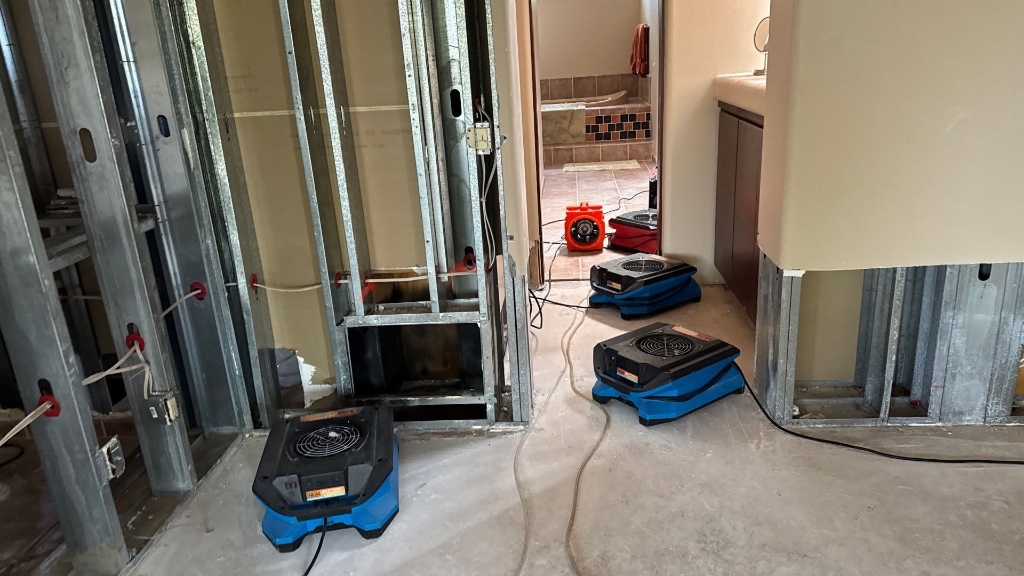
Specialized Equipment & Industrial Restoration Technology
Mitigating severe property damage requires industrial-grade technology capable of altering thermodynamic psychrometrics:
Truck-Mounted Extraction Rigs
31-HP engines producing 16+ inches Hg vacuum suction to evacuate bulk water rapidly into holding tanks.
Low-Grain Refrigerant Dryers
Pre-cooling heat-pipe systems driving ambient grains per pound below 25 GPP to draw deep trapped water out of framing.
HEPA Negative-Air Scrubbers
Hospital-grade 99.97% particulate filtration capturing microscopic fungal spores, soot, and biohazard aerosols.
FLIR® Thermal Scanners & Probes
Infrared thermography detecting evaporative cooling boundaries behind walls, combined with digital RF pinless scanners.
Professional Restoration vs. DIY Mitigation
Attempting DIY cleanup during a property disaster creates severe hidden liabilities:
- Trapped Moisture: Surface drywall dries while moisture inside cavities triggers hidden mold blooms.
- Pathogenic Risks: Category 2 & 3 water contains bio-contaminants standard cleaners fail to kill.
- Insurance Denial: Insurers require daily psychrometric logs; lack of data causes claim disputes.
Transparent Upfront Itemized Pricing
Valley Restoration Pros operates with complete transparency:
- Free On-Site Assessment: Complete physical inspection before work begins.
- Upfront Itemized Estimates: Detailed line items calculated via industry-standard Xactimate.
- Zero Surprise Billing: No hidden charges or unauthorized repairs.
Certified commercial fire pump room flood water extraction phoenix Field Documentation
Every response performed by Valley Restoration Pros is documented through photographic and thermographic records:

Comprehensive commercial fire pump room flood water extraction phoenix Technical Manual & Operational Standards
Exhaustive engineering protocols, psychrometric calculations, geological multipliers, and step-by-step restoration standards for Maricopa County properties:
Executive Emergency Abstract: Commercial Fire Pump Room Deluge & Critical Life-Safety Mitigation
Across the expansive commercial and industrial landscape of Greater Phoenix—from the premier high-rise corporate towers lining the Central Avenue Corridor and Camelback Esplanade to the sprawling multi-million-square-foot logistics centers of the Southwest Valley and high-density semiconductor fabrication campuses in Chandler and North Phoenix—the commercial fire pump room serves as the indispensable cardiovascular core of structural life-safety infrastructure. Engineered and installed under stringent NFPA 20 (Standard for the Installation of Stationary Pumps for Fire Protection) standards, stationary fire pumps are designed to boost hydrostatic pressure and discharge colossal water volumes—routinely ranging from 750 to upwards of 3,500 gallons per minute (GPM) at pressures between 150 and 320 pounds per square inch (PSI)—into building automatic fire sprinkler arrays, interior standpipe risers, and deluge systems.
Because stationary fire pumps operate under extreme hydraulic force and continuous static pressure from municipal supply mains, any physical or mechanical failure within the fire pump room unleashes an immediate, catastrophic deluge. When high-pressure flanged spool pieces separate, circulation relief valves freeze shut during churn testing, sensing lines fracture, or backflow preventers blow out under pressure surges, thousands of gallons of pressurized water erupt within enclosed subterranean mechanical rooms, sub-grade parking vaults, and ground-level utility spaces. Within minutes, rising floodwaters overwhelm room gravity drains, submerging high-voltage electric drive motors, 480-volt digital fire pump controllers, automatic transfer switches (ATS), and diesel driver engine assemblies.
The immediate consequences of a flooded fire pump room extend far beyond structural moisture damage. Under Chapter 15 of NFPA 25 (Standard for the Inspection, Testing, and Maintenance of Water-Based Fire Protection Systems) and municipal ordinances enforced by the Phoenix Fire Department Fire Prevention Division, the submersion or electrical impairment of a stationary fire pump constitutes a mandatory, immediate system impairment. Building owners and facility directors are legally required to establish an immediate 24/7 roving emergency fire watch or face immediate municipal red-tagging, tenant evacuation, and total commercial facility closure. A single day of mandated commercial fire watch across an occupied 30-story tower or large hospital complex can cost between $6,000 and $15,000 in dedicated staffing, while commercial business interruption claims escalate exponentially.
Resolving a flooded commercial fire pump room requires an elite, technically rigorous response that far exceeds the capabilities of standard commercial cleaners. Valley Restoration Pros maintains dedicated heavy commercial disaster recovery divisions equipped with high-GPM industrial submersible trash pumps, positive-displacement truck-mounted extractors, low-grain trailer-mounted desiccant dehumidifiers, and IEEE 43 megohmmeter diagnostic testing apparatus. Our Master Commercial Restorers arrive on site in 30 minutes, deploying high-volume dewatering apparatus, establishing structural containment, descaling mineralized switchgear, executing controlled motor winding bake-outs, and delivering certified psychrometric documentation. When sudden utility room flooding threatens your facility operations, our rapid emergency water extraction teams are staged across Maricopa County for immediate deployment.
Furthermore, our technical management team directly coordinates with the City of Phoenix Planning and Development Department, Maricopa County Environmental Services, and your designated fire protection engineering contractor to ensure full code alignment throughout the recovery process. We understand that in commercial facilities, business continuity and life-safety integrity are indivisible. By accelerating structural drying and salvaging high-value electrical switchgear on site, we help property owners avoid replacement lead times that currently exceed 16 to 26 weeks for customized commercial fire pump drivers and digital controller panels.
Commercial Fire Pump Room Flooded or Submerged?
Our IICRC certified Master Commercial Restorers arrive on site in 30 minutes with high-volume dewatering pumps, desiccant drying trailers, and IEEE 43 motor winding megohmmeter testing units.
Anatomy of Commercial Fire Pump Room Flooding: Mechanical Breakdown & Hydraulic Surges
Stationary fire pumps are massive mechanical installations engineered to convert electrical or diesel kinetic energy into immense hydraulic pressure. In Phoenix commercial properties, these assemblies typically feature horizontal split-case centrifugal pumps, vertical turbine pumps drawing from sub-slab suction tanks, or end-suction booster pumps connected to municipal suction mains. Operating under high static and dynamic pressures, a mechanical component failure releases catastrophic volumes of water into enclosed mechanical vaults. Understanding the precise physical mechanisms of failure is critical for executing an effective, safe mitigation response.
Circulation Relief Valve Sticking & Churn Overheating
During weekly automated churn testing or prolonged operation against a closed discharge valve, a fire pump impeller spins continuously without water discharging through sprinkler heads. Under NFPA 20, a calibrated 3/4-inch or 1-inch circulation relief valve must open to bleed a small volume of water, preventing kinetic friction from overheating the casing. In Phoenix, heavy calcium carbonate scale accumulation regularly freezes the relief valve piston. Within 15 minutes of churn operation, trapped water boils into high-pressure steam. The resulting steam expansion blows out packing glands, destroys mechanical seals, and causes brittle casing fractures that release up to 1,500 GPM into the room.
Water Hammer Surges & Grooved Coupling Shear
Fire pump suction and discharge manifolds connect to 6-inch, 8-inch, or 10-inch flanged and grooved piping assemblies rated for immense hydrostatic force. Rapid closure of backflow preventer check valves, quick-closing zone control valves, or municipal water main pressure spikes generate violent hydraulic shockwaves (water hammer). In accordance with the Joukowsky equation, instantaneous fluid deceleration generates transient pressure spikes exceeding 500 PSI. These shockwaves exert tens of thousands of pounds of axial force, shearing victaulic grooved couplings, snapping flange bolts, and cracking cast-iron fittings, necessitating immediate burst pipe repair isolation procedures.
Jockey Pump Sensing Line Rupture & Uncontrolled Runaway
Auxiliary pressure maintenance (jockey) pumps maintain normal system static pressure (typically 120 to 160 PSI) to prevent unnecessary starting of the main fire pump. Pressure sensing lines, typically constructed of 1/2-inch brass or copper tubing, run from the discharge piping to pressure switches inside the controllers. High-frequency pump vibration combined with corrosive municipal water minerals induces fatigue cracking along tube flared connections. When a sensing line ruptures, continuous water discharges while the pressure switch falsely registers a total system pressure collapse. The primary fire pump controller automatically fires the main 200 HP motor, generating maximum churn pressure that accelerates room flooding.
480V Controller Submersion & Arc-Flash Vulnerability
Fire pump controllers are floor-mounted or wall-mounted NEMA 2, 3R, or 12 steel enclosures supplied by dedicated 480-volt, 3-phase electrical services connected ahead of the building main service disconnect. These cabinets contain high-ampacity circuit breakers, magnetic contactors, automatic transfer switches (ATS), and sensitive digital microprocessor control motherboards. When standing water rises into the lower 12 to 24 inches of the cabinet or high-pressure spray enters cabinet cooling louvers, water bridges phase-to-phase and phase-to-ground potentials. Highly conductive municipal water causes explosive arc flashes, vaporizing copper busbars and permanently destroying control electronics.
In addition to the primary pumping components, subterranean mechanical rooms house critical ancillary piping assemblies that are equally susceptible to catastrophic mechanical failure. Backflow preventer relief valves (Reduced Pressure Zone / RPZ devices) can stick in full open positions when municipal water supplies carry coarse silt or caliche sediment into the valve seat, discharging continuous streams of 400 to 600 GPM directly into mechanical spaces. Similarly, suction line spool pieces subjected to long-term pipe hanger deflection develop intense bending moments at cast flanged connections, resulting in sudden fatigue fractures across the pipe body.
When high-velocity water escapes fire pump containment in multi-level structures, hydraulic pressure forces floodwaters down subterranean utility corridors, pipe chases, and elevator hoistways. Saturated hoistway shafts rapidly fill lower subterranean elevator pits, requiring immediate specialized elevator pit water extraction and oil-water separation to prevent catastrophic traction machine and traveling cable destruction.
Phoenix Climatic & Geological Multipliers: Hard Water Scale, Heat & Caliche Soil Stress
Operating commercial fire suppression systems within the Sonoran Desert presents harsh environmental challenges found in few other metropolitan markets. In Phoenix, Scottsdale, Mesa, and Glendale, local geological characteristics, extreme municipal water chemistry, and fierce desert climate patterns combine to multiply the probability and severity of commercial fire pump room inundation. Commercial building engineers must understand how these local environmental factors accelerate mechanical degradation and complicate emergency water extraction operations.
Key Environmental Stressors Impacting Phoenix Commercial Fire Pump Rooms:
- 18 to 22 GPG Municipal Water Hardness & Calcite Encrustation: Municipal water delivered across Greater Phoenix by the Central Arizona Project (CAP) canal and Salt River Project (SRP) reservoirs carries extreme dissolved mineral loads, averaging 18 to 22 grains per gallon (GPG) of dissolved calcium carbonate, magnesium sulfate, and silica (equivalent to 310 to 380+ PPM Total Dissolved Solids). In static fire sprinkler lines and stationary pump casings where water remains stagnant for months between required tests, these dissolved minerals precipitate rapidly out of solution. Calcite encrustation coats internal bronze valve seats, circulation relief valve pistons, and 1/2-inch sensing line orifices. When calcium deposits reach critical thickness, relief valves fail to cycle open during automated churn runs, causing instant hydraulic over-pressurization.
- 115°F Ambient Heat & Subterranean Micro-Climate Incubation: During Phoenix summer months, surface ambient temperatures regularly exceed 115°F, driving subterranean mechanical room temperatures above 125°F with minimal natural air circulation. Saturated electric motor windings, cable insulation, and transformer coils trapped in this intense thermal envelope experience rapid thermal breakdown. High temperatures accelerate galvanic oxidation on wet electrical contacts by up to 300% compared to temperate regions, turning salvageable switchgear into unrecoverable scrap within 24 to 48 hours. Furthermore, humid desert air accelerates microbial proliferation on wet acoustic insulation within 24 hours.
- Expansive Caliche Clay Soil Heave & Lateral Vault Shear: The Phoenix Valley floor consists of dense, carbonate-cemented sedimentary layers known locally as caliche. Caliche exhibits significant volumetric expansion and contraction when subsurface moisture levels fluctuate. Seasonal monsoon moisture followed by deep drought creates lateral ground movements that exert immense shear forces on underground fire service mains entering concrete vault foundation penetrations. This soil heave shears flanged spool pieces right at the wall sleeve, venting municipal main volume directly into the room. When subsurface movement threatens your building slab, our certified slab leak water damage restoration specialists utilize non-destructive acoustic sensors to verify structural piping integrity.
- Monsoon Haboob Inundation & Subterranean Storm Runoff: Summer monsoon storms (July through September) generate intense microburst downpours and haboob dust storms across Phoenix. Subterranean fire pump vaults located in underground parking structures or exterior yard vaults are frequently overwhelmed when municipal storm sewers back up. Heavy stormwater containing abrasive silts and desert organic matter rushes down vault access stairwells and ventilation shafts, drowning fire pumps in Category 3 contaminated blackwater that requires specialized dewatering and antimicrobial treatment.
The chemical nature of Phoenix municipal water also creates severe galvanic corrosion when standing floodwaters touch dissimilar metals. Fire pump rooms contain a dense concentration of interconnected metals: ductile iron pump casings, carbon steel Schedule 40 risers, bronze trim valves, copper sensing lines, and zinc-plated conduit fittings. Submerged under mineral-rich, conductive water at 100°F+ ambient temperatures, these metals form active galvanic couples that rapidly pit valve shafts and degrade motor bearing races within hours of exposure.
When high-mineral floodwaters evaporate inside hot Phoenix mechanical spaces, they leave behind dense calcified salts and corrosive deposits that coat motor windings and busbars. Standard drying without immediate chemical descaling and dielectric decontamination ensures catastrophic short circuits upon re-energization. Our technical mitigation protocols are customized specifically for the aggressive water chemistry and thermal conditions of phoenix water damage emergencies.
First-Hour Emergency Protocol: Life-Safety Isolation & Fire Watch Avoidance
When a commercial fire pump room breaches, building management and on-duty engineering personnel must execute precise, rapid operational actions during the first sixty minutes. Inappropriate actions—such as wading into electrified standing water or failing to notify the municipal fire department—can lead to fatal arc-flash explosions, criminal liability, or immediate commercial building condemnation. Follow this verified first-hour emergency protocol:
MANDATORY FIRST-HOUR PROTOCOL FOR FACILITY MANAGERS:
- De-Energize High-Voltage Power Upstream (Lockout/Tagout): NEVER enter a flooded fire pump room while utility power is active. Fire pump controllers are energized by 480-volt, 3-phase feeds with high short-circuit current ratings (often 50,000 to 100,000 AIC). De-energize the fire pump service disconnect located at the primary building electrical distribution board or emergency generator transfer switch. Verify zero voltage potential with an insulated high-voltage probe before entering standing water. In accordance with NFPA 70E arc-flash safety standards, technicians must don appropriate Level 4 arc-flash personal protective equipment during initial electrical isolation.
- Isolate Water Ingress at Sectional Control Valves: If safe to access, close the outside screw and yoke (OS&Y) suction gate valve or butterfly indicating valve feeding the fire pump from the municipal city main. If the breach is upstream of the suction valve, immediately locate and shut the exterior Post Indicator Valve (PIV) or contact the Phoenix Water Services Department emergency dispatch to isolate the street tap. Never attempt to force a scaled valve with cheater bars, as brittle bronze stems can shear under torque.
- Officially Declare System Impairment Under NFPA 25: Notify the Phoenix Fire Department Fire Prevention Division, the building property insurance underwriter, and the central monitoring station that the water-based fire protection system is impaired. Under Chapter 15 of NFPA 25, an impairment coordinator must be designated immediately, and formal impairment tags must be affixed to all affected control valves.
- Implement Qualified Emergency Fire Watch: If the building remains occupied, immediately assign trained personnel to perform continuous, documented roving patrols of all building corridors, utility shafts, and high-hazard areas. Fire watch personnel must be equipped with portable two-way communications, flashlights, and immediate access to manual pull stations. Failure to maintain an active, timestamped fire watch log can result in immediate building closure by the municipal Fire Marshal.
- Mobilize Valley Restoration Pros Commercial Emergency Dispatch: Immediately contact our 24/7 commercial command desk at (602) 847-9593 or reach out through our contact us portal. Our heavy commercial disaster response units arrive on site in 30 minutes equipped with high-GPM submersible trash pumps, industrial mobile desiccant dehumidifiers, and IICRC Master Commercial Restorers.
Documenting the initial incident scene with clear photographic and video evidence is also vital during this critical first hour. Capture the water height lines against equipment baseplates, controller cabinets, and perimeter walls. Note the exact pressure readings displayed on suction and discharge gauges if legible before de-energization. This documentation provides critical forensic evidence for your insurance adjuster and helps establish whether water hammer or component defect initiated the breach.
Rapid isolation of high-voltage feeds and municipal intake lines protects human life and halts escalating structural damage. Once safe access is established, commercial extraction teams can begin dewatering immediately, minimizing moisture migration into adjacent elevator pits, telecommunication utility shafts, and surrounding tenant suites.
Advanced Industrial Equipment Specifications: High-GPM Extraction & Desiccant Desorption
Extracting tens of thousands of gallons of standing water from a submerged commercial fire pump room and rehabilitating flooded 480-volt electrical gear demands heavy industrial machinery far beyond standard residential drying equipment. Valley Restoration Pros maintains a dedicated fleet of commercial emergency mitigation apparatus designed specifically for large-loss mechanical room disasters across Greater Phoenix.
| Equipment Class | Technical Specifications | Operational Function in Fire Pump Recovery |
|---|---|---|
| Industrial Submersible Trash Pumps | 3-inch to 4-inch discharge, 350 to 550 GPM continuous flow, solid handling up to 2 inches | Rapid mass evacuation of high-volume standing water from submerged vaults and deep sump pits. |
| Heavy-Duty Truck-Mount Extractors | Positive displacement vacuum blowers (16-18 in Hg, 650 CFM), dual extraction lines | Deep vacuum removal of water pockets beneath pump baseplates, pipe trenches, and cable trays. |
| Trailer-Mounted Desiccant Dehumidifiers | 2,500 to 5,000 CFM dry air delivery, silica gel rotor, static pressure up to 4.5 in wg | Supplies ultra-low vapor pressure air (<15 GPP) directly into controller cabinets and motor housings. |
| High-Static Radial & Axial Air Movers | 1.5 HP sealed motors, 3,200 CFM focused laminar velocity, variable speed controls | Drives turbulent airflow across wet concrete foundations, flanged fittings, and mechanical casings. |
| Precision Insulation Resistance Testers | Fluke 1587 / Megger MIT515, selectable test voltages 50V to 1,000V DC, 0.01 MΩ to 10 GΩ | Performs IEEE 43 motor winding insulation resistance and dielectric absorption testing during bake-out. |
| Radiometric Infrared Thermography | FLIR T-Series thermal imaging (640×480 resolution, ±1°C sensitivity) | Non-destructive mapping of hidden moisture migration behind vault concrete walls and within conduits. |
To achieve rapid dielectric recovery of submerged electric motors and control cabinets, our industrial drying trailers utilize high-capacity reactivation heaters that regenerate the silica gel desiccant wheel continuously. This creates a massive grain depression differential: while the ambient subterranean vault may linger at 95% relative humidity and 180 grains per pound (GPP), our supply air delivers 12 to 18 GPP at temperatures up to 110°F. This intense vapor pressure differential forces bound moisture molecules to desorb from dense copper winding insulation and laminated stator cores without causing thermal insulation stress.
Deploying commercial desiccant dehumidifiers is critical for salvaging submerged electrical equipment. Unlike conventional refrigerant units that lose efficiency when room temperatures rise or grains fall, our industrial desiccant trailers deliver continuous streams of sub-dew-point air. When coupled with our scientific structural drying protocols, moisture bound deep within motor insulation is vaporized without thermal stress or winding damage.
IICRC S500 / S520 Restoration Protocol: 6-Stage Mechanical Decontamination Standards
Restoring an inundated commercial fire pump room requires rigorous adherence to the IICRC S500 Standard for Professional Water Damage Restoration and S520 Standard for Microbial Remediation, aligned seamlessly with NFPA 20 and NFPA 25 compliance criteria. Our commercial restoration procedures follow an unbending six-stage execution framework:
Stage 1: Atmospheric Safety Audit, Confined-Space Entry & Hazard Containment
Subterranean fire pump vaults qualify as OSHA permit-required confined spaces. Before entry, certified safety personnel perform four-gas atmospheric testing (oxygen concentration, carbon monoxide, combustible gases, and hydrogen sulfide). Lockout/tagout (LOTO) protocols are verified on all electrical feeds. Containment berms are deployed to isolate any fuel or oil leaks from diesel drivers, preventing hazardous fluid discharge into municipal storm or sewer networks. Positive-pressure fresh air blowers are staged to maintain continuous mechanical room air exchange throughout initial assessment.
Stage 2: High-Volume Hydraulic Extraction & Silt Evacuation
Deploying multiple 3-inch submersible trash pumps, technicians evacuate standing water at rates up to 1,000 GPM. As water depth drops below 3 inches, high-vacuum truck-mounted extractors remove residual pooling from pipe trenches, sump pits, and perimeter troughs. Heavy silt, rust flakes, and desert caliche particulates are cleared using wet-vacuum HEPA filtration to eliminate abrasives that could damage pump rotating assemblies. When water carries sewage or biological pathogens, our technicians immediately apply sewage cleanup decontamination agents.
Stage 3: Electrical Switchgear Decontamination & Dielectric Flushing
Fire pump controllers, transfer switches, and junction boxes undergo immediate disassembly by certified restoration technicians. Submerged circuit breakers, digital relays, and contactor blocks are flushed with non-conductive dielectric cleaning solvents and high-purity deionized washes to dissolve conductive mineral salts deposited by Phoenix hard water. Contacts are hand-cleaned and dried using oil-free dry compressed nitrogen. Terminal lugs are inspected for signs of galvanic pitting, and sacrificial corrosion inhibitor films are micro-misted across bare conductive surfaces.
Stage 4: Controlled Desiccant Micro-Climate Desorption & Enclosure Bake-Out
Specialized temporary containment tents are erected directly over the fire pump controller, electric motor driver, and jockey pump assembly. High-volume desiccant ducting introduces ultra-dry air (<10% relative humidity, <15 GPP) under positive pressure. This dry air creates a massive vapor pressure differential, rapidly vaporizing capillary moisture trapped within stator windings, terminal blocks, and conduit runs without exceeding motor thermal limits. Temperatures within the drying chamber are regulated to stay strictly below 120°F to preserve winding varnish and Class F/H insulation ratings.
Stage 5: Megohmmeter Motor Testing & Dielectric Polarization Index Certification
Throughout the drying cycle, motor insulation resistance is tracked using a calibrated megohmmeter in accordance with IEEE 43 standards. Technicians record 1-minute insulation resistance and 10-minute Polarization Index (PI) readings at 500V or 1,000V DC. All recorded values are normalized to a 40°C reference temperature using IEEE temperature correction coefficients. Stator windings must achieve a minimum resistance of 100 Megohms and a PI ratio exceeding 2.0 before electrical re-energization can be authorized, preventing costly stator burnout.
Stage 6: EPA Antimicrobial Application & NFPA Return-to-Service Documentation
Following complete desiccation to dry standard baselines, vault concrete walls, floors, and pipe structural brackets receive an application of EPA-registered botanical antimicrobials to eliminate microbial spores. Where moisture has compromised drywall partitions or acoustic insulation, comprehensive mold remediation protocols ensure complete containment and air clearance. Detailed psychrometric moisture logs and megger certification reports are delivered to building engineers, the fire protection contractor, and the municipal Fire Marshal for official impairment clearance.
Specialized Equipment Rehabilitation: Controllers, Electric Drivers & Diesel Engines
Commercial fire pump installations comprise three highly sophisticated mechanical and electrical sub-systems, each requiring specialized decontamination protocols following water submersion. Attempting a generic drying process on high-voltage electrical equipment or diesel internal combustion assemblies guarantees premature component breakdown or catastrophic equipment loss during an actual structural fire emergency.
480V Fire Pump Controllers & ATS
Fire pump controllers house heavy-duty contactors, emergency start mechanisms, circuit breakers, and microprocessor boards. Ingress of hard Phoenix municipal water deposits calcium and magnesium crystals across delicate micro-relays. Our technicians perform:
- Dielectric flushing of contactor arcs and magnetic trip units using rapid-evaporating safety solvents.
- Ultrasonic bath cleaning of solid-state control boards to dissolve microscopic mineral scale bridges.
- Replacement of waterlogged digital pressure transducers and sensing lines.
- High-temperature desiccant purge of enclosure conduits to prevent condensation wicking across raceways.
Electric Motor Drivers (Horizontal Split Case)
Submerged electric motors suffer winding moisture absorption and bearing lubrication washout. Salvaging these multi-hundred-horsepower motors requires strict procedural execution:
- Drainage of motor bell housings and bearing reservoirs through low-point weep plugs.
- Solvent flush to strip water-contaminated grease from ball or roller bearings followed by synthetic re-greasing.
- Continuous forced dry-air heating through motor cooling louvers using low-grain desiccant ducting.
- IEEE 43 megohmmeter insulation resistance verification until 100+ Megohm dry baseline is confirmed.
Diesel Engine Drivers & Fuel Storage
In facilities where diesel engines provide backup fire pump motive power, floodwaters threaten internal engine systems:
- Crankcase oil inspection and multi-stage flushing to remove emulsified moisture before engine startup.
- Air intake and turbocharger desiccation to prevent hydrostatic lockup during emergency cranking.
- Emergency replacement of 24V starter solenoids, alternators, and battery charger banks.
- Diesel fuel day tank bottom-water testing, fuel-water separator drainage, and centrifugal fuel polishing.
In facilities utilizing diesel-driven fire pumps (such as Clarke or Cummins fire pump packages), floodwaters frequently contaminate primary and auxiliary fuel lines. Diesel fuel storage tanks located in sub-grade vaults can take on groundwater through atmospheric vent pipes if exterior floodwaters rise above grade. Our teams perform chemical water paste tests on diesel storage bottoms and utilize portable high-coalescence fuel filtration carts to remove suspended water down to less than 50 parts per million (PPM), ensuring diesel injectors do not seize during critical emergency fire operation.
When fire pump room floods coincide with wider building utility disruptions, commercial fire protection lines and standpipes across upper floors may also suffer secondary damage. In complex commercial losses, our commercial fire standpipe burst water damage phoenix and dedicated fire damage restoration phoenix teams integrate multi-floor extraction and industrial drying operations seamlessly.
Hyper-Local Phoenix Case Study: 30-Story Midtown Commercial Tower Fire Pump Failure
Class-A Office Tower – Central Avenue & Thomas Road, Midtown Phoenix AZ
Full Restoration in 28 Hours – $48,000 Fire Watch AvoidedIncident Profile: At 2:15 AM on a Tuesday in July, a sheared 8-inch grooved coupling on the discharge manifold of a 1,500 GPM Peerless horizontal split-case electric fire pump inundated the subterranean P-2 mechanical vault of a premier 30-story commercial office tower in Midtown Phoenix. With municipal static pressure surging at 85 PSI, water inundated the 1,400-square-foot pump room to a depth of 38 inches within 25 minutes before automated supervisory water-flow alarms alerted property security. Standing water submerged the lower halves of the 200-horsepower Marathon electric motor and the 480V Metron digital fire pump controller.
Operational Crisis: The Phoenix Fire Marshal dispatched to the scene immediately issued a formal Notice of Impairment under NFPA 25 and mandated an emergency 24/7 roving fire watch requiring four trained guards at $85/hour per guard ($8,160 per day). If the fire pump system could not pass a full flow test within 48 hours, the city threatened mandatory evacuation of all 30 commercial tenant floors, risking over $350,000 in tenant displacement claims.
Valley Restoration Pros Deployment & Timeline:
Hour 00:32 – Arrival & Extraction: Heavy commercial units arrived on site. Confined space entry protocols were established, and two 4-inch submersible hydraulic trash pumps evacuated over 28,000 gallons of standing water in 110 minutes.
Hour 02:45 – Controller Rehabilitation: Technicians disassembled the submerged 480V Metron controller, flushed calcium deposits with dielectric solvent, replaced water-damaged pressure transducers, and sealed the enclosure with dry-nitrogen purges.
Hour 04:15 – Containment & Desiccant Bake-Out: A thermal containment chamber was erected around the 200 HP electric driver. A trailer-mounted 3,000 CFM desiccant dehumidifier introduced sub-5-grain dry air heated to 110°F, creating rapid vapor migration out of the stator coils.
Hour 22:00 – Megger Testing & Full Recertification: Stator insulation resistance reached 165 Megohms (far exceeding the 100 MΩ standard). The mechanical coupling was rebuilt by the licensed fire contractor. At Hour 26:30, the Phoenix Fire Marshal witnessed a 150% rated flow test. The impairment was officially lifted, saving the property over $48,000 in fire watch expenses and averting tenant evacuation.
| Psychrometric / Electrical Metric | Initial Flood Inundation | Restored Dry Standard Baseline |
|---|---|---|
| Ambient Air Relative Humidity | 94% RH @ 102°F (275 GPP) | 18% RH @ 84°F (32 GPP) |
| Motor Stator Insulation Resistance | 0.18 Megohms (Zero Isolation) | 165.0 Megohms (Certified Safe) |
| Polarization Index (PI 10min/1min) | 0.85 (Severe Ground Fault Risk) | 2.45 (Optimal Dielectric Baseline) |
| Concrete Vault Sub-Slab Moisture | 99.9% Relative Humidity | <75% Relative Humidity |
Similar commercial fire pump and utility emergencies occur regularly in surrounding municipalities, including high-tech manufacturing corridors in scottsdale water damage facilities, distribution hubs requiring glendale water damage response, and commercial centers across mesa water damage corridors.
Commercial Financial Transparency: Clear Pricing, Claims Logs & True Cost Control
During a major commercial mechanical inundation, property managers and asset owners face intense financial scrutiny from corporate risk officers, facility asset managers, and commercial insurance adjusters. Misleading billing promises, ambiguous scope descriptions, or uncoordinated documentation can delay claims approvals, lead to costly coverage disputes, and leave property owners facing unexpected out-of-pocket expenses.
Valley Restoration Pros operates under strict Pay-Per-Call ethical standards and commercial billing transparency. We maintain an open, collaborative partnership with building management and insurance carriers, ensuring every line item is verified, reasonable, and fully justified under industry-standard commercial restoration pricing databases.
Our Commercial Restoration Financial & Documentation Commitments:
Free On-Site Damage Assessment
We provide an immediate, comprehensive on-site commercial damage evaluation with non-destructive thermal imaging, moisture mapping, and scope definition at zero upfront assessment cost.
Transparent Itemized Estimates
Before work begins, facility managers receive a detailed, itemized estimate utilizing standard Xactimate commercial codes, ensuring complete price clarity with zero hidden surcharges.
Comprehensive Claims Documentation
Our project managers generate daily psychrometric dry logs, equipment utilization records, megger test certificates, and photo portfolios for seamless insurance adjuster package approval.
Zero Direct Billing Promises
We never make false claims that insurance will pay 100% without policyholder involvement. We work directly alongside your risk management team to navigate commercial deductible allocations.
To provide complete fiscal predictability, our itemized commercial estimates categorize restoration activities under standard insurance billing codes: extraction volume per gallon, heavy equipment mobilization, desiccant dehumidifier run-hours, temporary power distribution, and hazardous confined-space operations. This level of granular documentation ensures that your commercial property and casualty adjuster can process the claim without contentious line-item audits or administrative hold-backs.
Beyond physical drying, our rapid mitigation directly curtails secondary financial losses. Every hour shaved from fire pump system restoration eliminates tens of thousands of dollars in mandated municipal fire watch fees, prevents commercial lease penalty assessments, and eliminates catastrophic tenant displacement liabilities. For broader commercial water loss solutions, review our comprehensive commercial water damage program.
Exhaustive Commercial FAQ: Fire Pump Room Flooding & NFPA Compliance
The absolute first priority is life-safety electrical isolation. Do not enter standing water until the 480V, 3-phase utility service feed and emergency generator feeds to the fire pump controller are locked out upstream. Once safe, isolate the water source at the exterior Post Indicator Valve (PIV) or sectional control valves. Immediately notify the Phoenix Fire Department Fire Prevention Division and your property insurance carrier of the fire protection impairment. Finally, dispatch a certified commercial restoration team with high-capacity submersible pumps and desiccant dehumidifiers by calling our 24/7 hotline at (602) 847-9593.
Under NFPA 25 and Phoenix Fire Code, a building with an impaired fire pump must maintain a continuous, documented roving fire watch until full operational certification is restored. Fire watch costs regularly exceed $75 to $100 per guard hour, compounding rapidly into thousands of dollars per day. The only way to eliminate fire watch mandates is to execute aggressive, around-the-clock water evacuation, electrical bake-out, and IEEE 43 motor megger testing, followed by an immediate witnessed flow test with a licensed fire protection contractor and the municipal Fire Marshal.
Electric fire pump motors can frequently be successfully rehabilitated and recertified without full replacement, provided they were de-energized prior to water contact and dried using scientific desiccant procedures. If high-voltage arcing did not burn the stator windings, technicians drain the bearing cavities, flush foreign silts, and subject the motor to deep desiccant bake-out. Once the windings achieve insulation resistance exceeding 100 Megohms and pass a Polarization Index test per IEEE 43 standards, the motor can be safely returned to service with licensed engineering sign-off.
Phoenix municipal tap water carries an extreme mineral load (18 to 22 GPG of calcium carbonate and dissolved salts). When this mineral-rich water enters 480V controller cabinets and evaporates, it leaves behind an electrically conductive crystalline crust across circuit breakers, contactors, and digital busbars. If re-energized without specialized chemical decontamination, these mineral bridges create catastrophic phase-to-phase short circuits. Our technicians utilize specialized dielectric solvents and ultrasonic cleaning to remove every trace of calcified mineral scale before re-powering.
Megger testing (insulation resistance testing) applies a controlled DC voltage (typically 500V or 1,000V) between the motor windings and the motor frame to measure the electrical integrity of the wire insulation. Saturated insulation allows leakage current to flow to ground. Energizing a motor with compromised insulation resistance causes instant, catastrophic stator coil burnout. Under IEEE 43 standards, a flooded motor must achieve a minimum of 100 Megohms of insulation resistance before utility power can be safely reapplied.
While fire pump room floods involve massive volumes of pressurized municipal water under hydrostatic head pressure, commercial kitchen suppression incidents involve highly caustic chemical agents. In restaurant emergencies, pre-engineered liquid systems discharge potassium salts that saponify cooking oils into slippery soap blankets, requiring our specialized ansul system discharge cleanup phoenix procedures. Both scenarios represent urgent commercial emergencies requiring master-level chemical and mechanical decontamination.
Diesel fire pump drivers require immediate engine mechanical preservation. Technicians must verify whether floodwaters penetrated the crankcase dipstick tube or exhaust manifold. If water entered the crankcase, engine oil must be drained, the crankcase flushed with light preservative oil, and oil filters replaced before cranking. The starter motor, 24V alternator, battery charger, and engine instrument panel must be removed, flushed with dielectric solvent, and dried. In addition, the fuel tank must be tested for water contamination using paste detection, and water bottom layers drained through water-separator filters.
Under standard ambient conditions, thick structural concrete vaults and motor windings require 48 to 72 hours of industrial desiccant drying. However, by establishing targeted thermal containment enclosures over the motor and controller and introducing sub-15-grain dry air heated to 105°F to 110°F, Valley Restoration Pros frequently achieves certified dry standards and passes IEEE 43 megohmmeter tests within 24 to 36 hours. Daily psychrometric monitoring verifies continuous grain depression until equilibrium baseline is certified.
Valley-Wide Commercial Emergency Dispatch: Staged Across Key Phoenix Corridors
Commercial fire pump failures and utility room deluges demand immediate on-site response. A thirty-minute delay in water extraction can mean the difference between salvaging a $45,000 electric motor or facing a six-month equipment lead time and hundreds of thousands in tenant business interruption claims. Valley Restoration Pros maintains strategically deployed commercial disaster response units staged across Greater Phoenix, delivering thirty-minute rapid dispatch to all primary commercial and industrial corridors:
Downtown & Midtown High-Rise Corridors
Central Ave Class-A towers, Camelback Esplanade financial district, Thomas Rd healthcare campuses, Arizona State Capitol complex, and downtown hospitality centers (ZIPs 85003, 85004, 85012, 85016).
Deer Valley & North Phoenix Industrial
Deer Valley Airport commercial aviation hangars, TSMC semiconductor supplier corridor, Norterra corporate centers, I-17 industrial manufacturing parks (ZIPs 85027, 85085, 85086).
Scottsdale Airpark & Kierland Hubs
High-tech corporate headquarters, outpatient surgical clinics, luxury resort central mechanical plants, and North Scottsdale commercial complexes (ZIPs 85254, 85260, 85255).
Tempe Tech Basin & Broadway Corridor
University biotechnology research centers, data processing centers, semiconductor wafer fabrication supply corridors along Loop 202 and US-60 (ZIPs 85281, 85282, 85283).
Chandler Price Road Tech Corridor
Silicon desert cleanroom manufacturing, automated distribution hubs, pharmaceutical compounding centers, and high-density office campuses (ZIPs 85226, 85286, 85248).
Glendale & West Valley Logistics Hubs
Westgate entertainment complexes, cold storage distribution centers, massive fulfillment warehouses along Loop 303, and Luke AFB industrial buffer zones (ZIPs 85301, 85305, 85307).
To review all municipal service hubs and emergency dispatch stations throughout Maricopa County, visit our regional areas we serve directory for comprehensive local commercial coverage details.
24/7 Commercial Emergency Command Desk
Do not let a flooded fire pump room jeopardize life-safety compliance or cripple your commercial property with emergency fire watch mandates. Connect directly with our Master Commercial Restorers now.
DISPATCH COMMERCIAL CREW: (602) 847-9593Verified Local Area Dispatch: Phoenix, AZ
Official Geo-Coordinates: 33.4484° N, -112.074° W • Maricopa County
Related Specialized Emergency Restoration Services
Explore specialized rapid-response mitigation protocols across Greater Phoenix and Maricopa County:
Valley-Wide Emergency Response Service Coverage
Our mobile restoration fleet is dispatched across the entire Phoenix metropolitan region, providing rapid 30 to 60 minute emergency response: