
Valley Restoration Pros delivers 24/7 industrial emergency water extraction, thermal psychrometric drying, and structural mitigation across Phoenix and Maricopa County with guaranteed 30–60 minute rapid arrival. All protocols strictly adhere to IICRC S500 standards, featuring upfront itemized pricing and free on-site thermal moisture assessments. Call dispatch directly at (602) 847-9593.
Why Immediate Mitigation Is Critical in Phoenix Heat
High-pressure steam boiler failures in commercial laundries release thousands of gallons of superheated water, caustic chemical scaling inhibitors, and scalding vapor clouds across plant floors. In extreme Phoenix ambient heat, scalding boiler discharge rapidly damages continuous batch tunnel washers, destroys sensitive 480V PLC electrical automation, triggers expansive caliche slab heave, and initiates accelerated fungal amplification across damp commercial linen inventory within 24 hours.
Service Definition & The IICRC Standard of Care
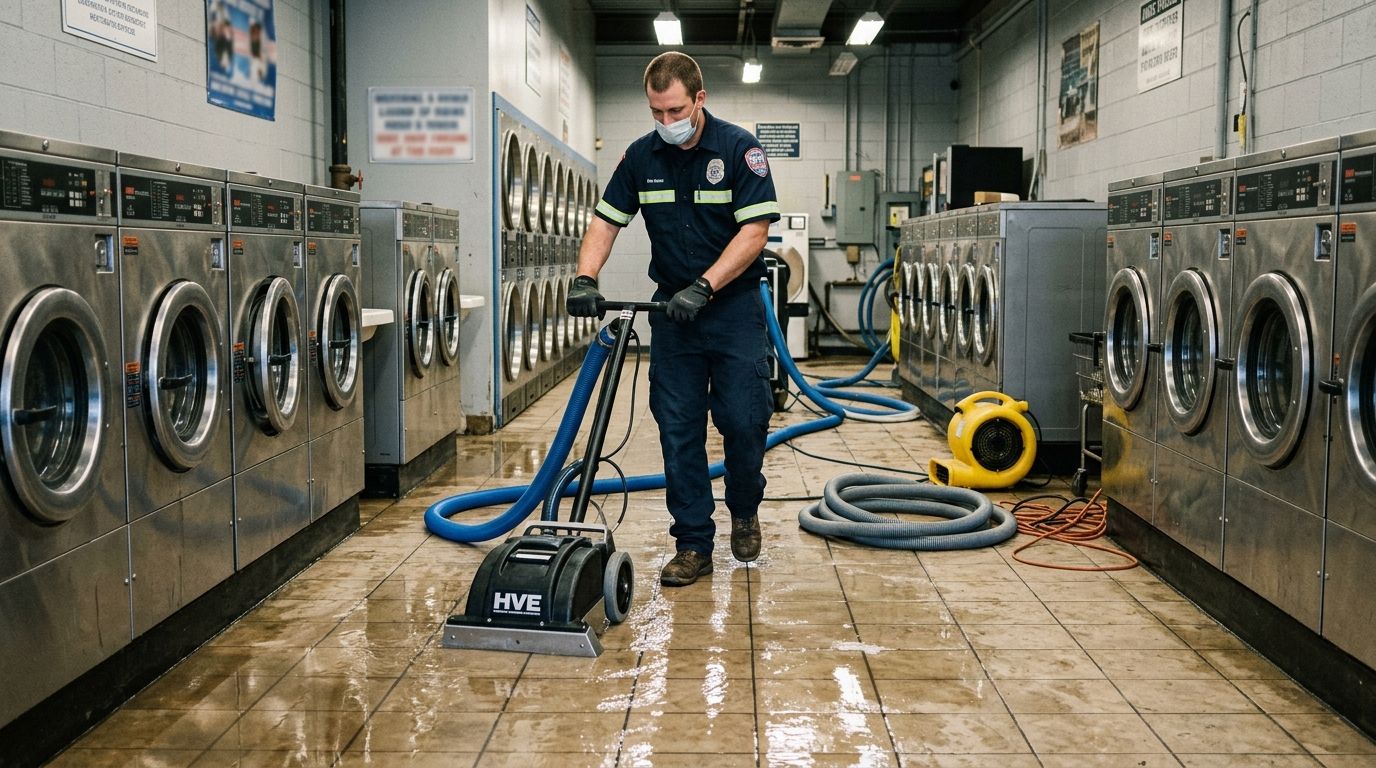
Professional commercial laundry steam boiler leak water damage phoenix is an engineering and environmental discipline adhering strictly to IICRC S500 protocols, not mere surface mopping. When structural plumbing failures strike in Maricopa County, certified emergency water extraction and thermal structural drying procedures must be deployed immediately. Whether triggered by high-pressure burst pipe emergencies, subfloor leaks, or commercial line ruptures, bound moisture rapidly penetrates concrete subfloors and wall framing. In the desert heat, delays trigger microbial proliferation requiring rapid mold remediation. Request damage assessment through our emergency assessment portal or request 30-minute dispatch across all Valley service areas.
Securing electrical feeds, inspecting load-bearing assemblies, and containing pathogens.
Stopping the intrusion source and erecting 6-mil plastic isolation containment airlocks.
31-HP truck-mount extraction, removing gallons exponentially faster than evaporation.
LGR dehumidifiers and HEPA air scrubbers driving grains per pound below 25 GPP.
Calibrated electronic pinless testing confirming baseline dry standards.
The Complete 6-Stage Restoration Roadmap
Our IICRC-certified crews execute a disciplined, scientific 6-stage protocol to stabilize and dry structural components:
Emergency Dispatch & Perimeter Isolation
30 to 60 minute arrival. Securing electrical shutoffs, evaluating structural loads, and erecting containment airlocks.
FLIR® Thermal Mapping & Baseline Scans
Infrared thermal scans detect trapped moisture behind walls and beneath concrete without invasive exploratory demolition.
High-Volume Bulk Extraction
31-HP truck-mount extraction units pump standing water away at hundreds of gallons per minute.
Controlled Selective Demolition
Precision flood cuts 12 to 24 inches above moisture lines, removing wet insulation and opening wall framing to dry airflow.
Thermodynamic Dehumidification
Industrial Low-Grain Refrigerant dehumidifiers pull deep trapped moisture from dense framing lumber and concrete slabs.
Antimicrobial Sanitization & Verification
EPA-registered botanical application (Benefect Decon 30) and calibrated moisture testing to issue an official dry certificate.
Specialized Equipment & Industrial Restoration Technology
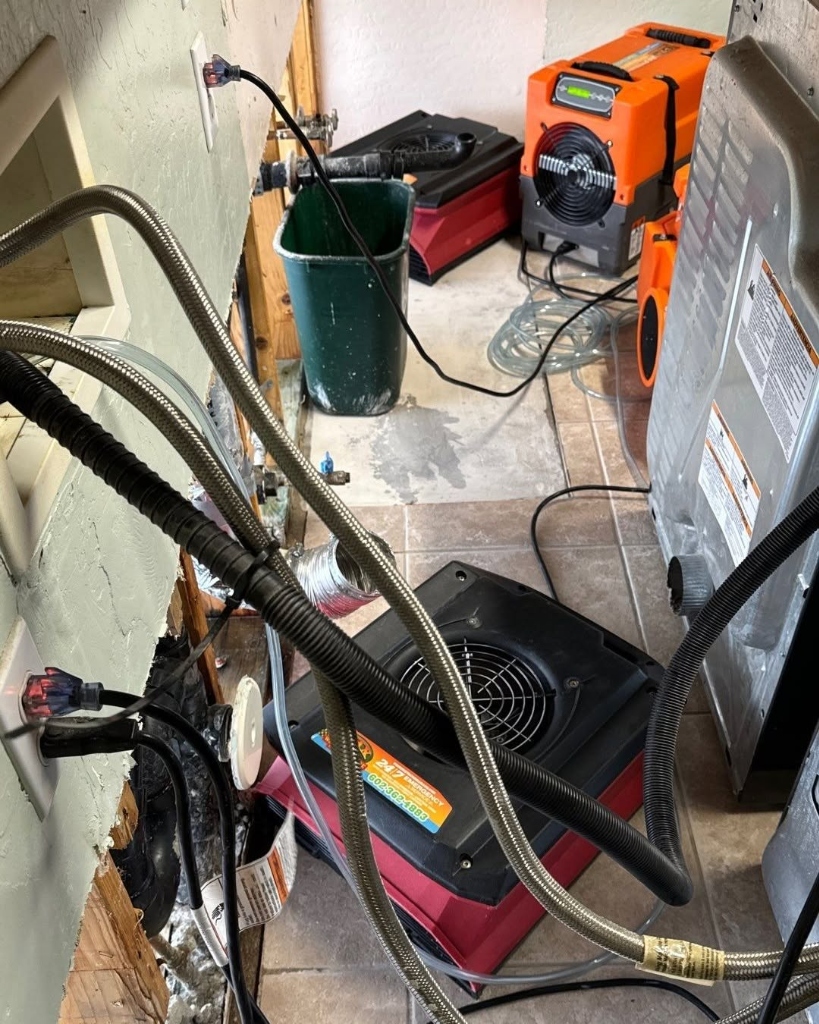
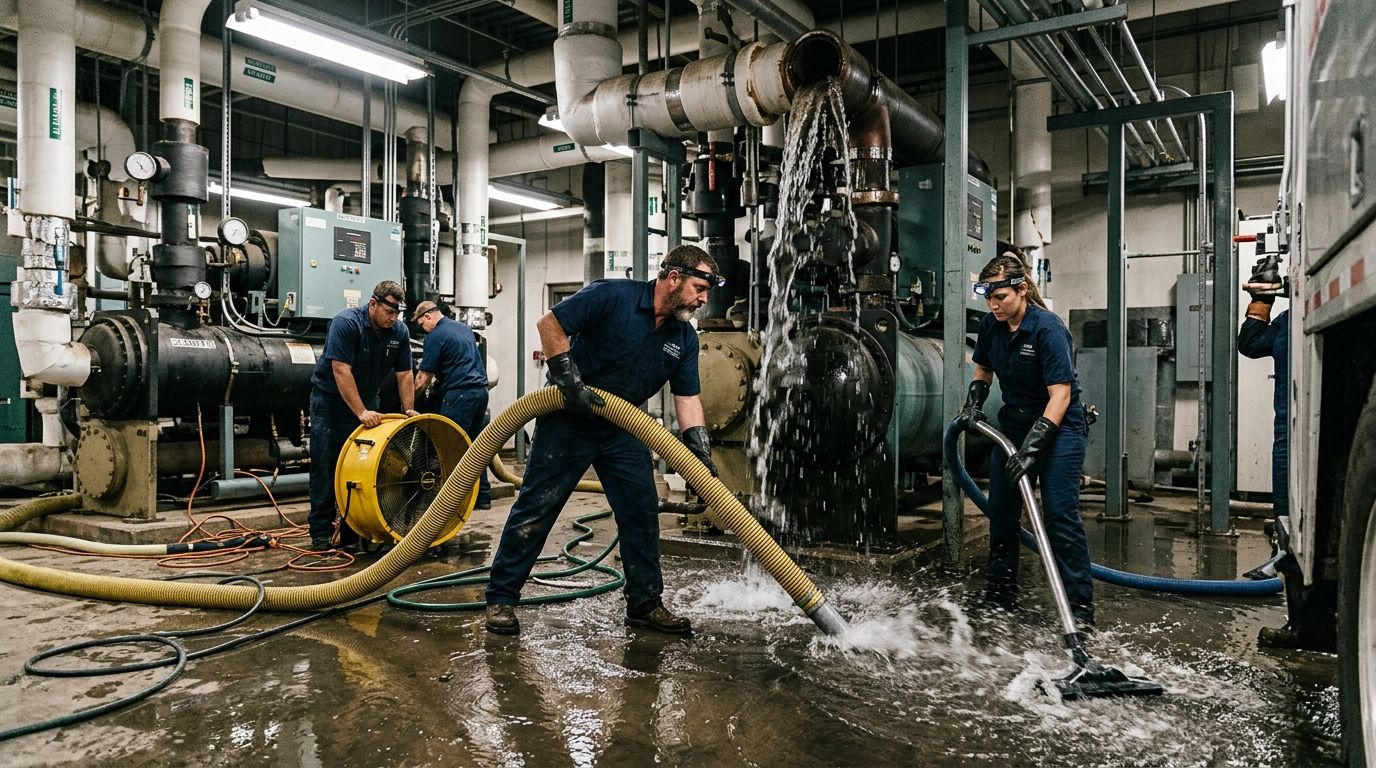
Mitigating severe property damage requires industrial-grade technology capable of altering thermodynamic psychrometrics:
Truck-Mounted Extraction Rigs
31-HP engines producing 16+ inches Hg vacuum suction to evacuate bulk water rapidly into holding tanks.
Low-Grain Refrigerant Dryers
Pre-cooling heat-pipe systems driving ambient grains per pound below 25 GPP to draw deep trapped water out of framing.
HEPA Negative-Air Scrubbers
Hospital-grade 99.97% particulate filtration capturing microscopic fungal spores, soot, and biohazard aerosols.
FLIR® Thermal Scanners & Probes
Infrared thermography detecting evaporative cooling boundaries behind walls, combined with digital RF pinless scanners.
Professional Restoration vs. DIY Mitigation
Attempting DIY cleanup during a property disaster creates severe hidden liabilities:
- Trapped Moisture: Surface drywall dries while moisture inside cavities triggers hidden mold blooms.
- Pathogenic Risks: Category 2 & 3 water contains bio-contaminants standard cleaners fail to kill.
- Insurance Denial: Insurers require daily psychrometric logs; lack of data causes claim disputes.
Transparent Upfront Itemized Pricing
Valley Restoration Pros operates with complete transparency:
- Free On-Site Assessment: Complete physical inspection before work begins.
- Upfront Itemized Estimates: Detailed line items calculated via industry-standard Xactimate.
- Zero Surprise Billing: No hidden charges or unauthorized repairs.
Certified commercial laundry steam boiler leak water damage phoenix Field Documentation
Every response performed by Valley Restoration Pros is documented through photographic and thermographic records:

Comprehensive commercial laundry steam boiler leak water damage phoenix Technical Manual & Operational Standards
Exhaustive engineering protocols, psychrometric calculations, geological multipliers, and step-by-step restoration standards for Maricopa County properties:
Executive Emergency Abstract: Commercial Laundry Steam Boiler Failure & Scald Inundation
Across the sprawling industrial sectors and hospitality logistics networks of Greater Phoenix—stretching from the high-capacity linen processing corridors near Phoenix Sky Harbor International Airport to regional resort laundries in Scottsdale and institutional healthcare plants in Tempe and Mesa—commercial laundry operations depend entirely upon high-pressure steam boilers. Industrial laundry plants utilize heavy-duty firetube and watertube steam boilers operating between 100 and 150 pounds per square inch (PSI) to generate continuous saturated steam at temperatures ranging from 338 to 366 degrees Fahrenheit. This intense thermal energy drives continuous batch tunnel washers (CBWs), industrial multi-roll ironers, automated steam presses, and large-capacity tumble dryers.
When a mechanical rupture strikes a commercial steam boiler, mud leg assembly, high-pressure condensate return manifold, or steam blowdown heat exchanger, the consequences are immediate, violent, and devastating. Pressurized water held well above atmospheric boiling temperatures instantaneously flashes into massive clouds of expanding steam, rapidly condensing into thousands of gallons of boiling, mineral-laden water. Within minutes, boiler room sumps and industrial trench drains are overwhelmed, cascading scalding floodwaters across production concrete slabs, mechanical equipment bays, automated electrical control panels, and surrounding bulk textile storage warehouses.
Unlike clean domestic plumbing failures, commercial laundry steam boiler water constitutes an aggressive Category 2 or Category 3 chemical inundation under IICRC S500 standards. Commercial boiler feed systems utilize heavy chemical treatment regimens to suppress oxygen pitting and scale accumulation. The resulting floodwater is heavily saturated with caustic soda (sodium hydroxide), sodium sulfite, polyphosphates, and neutralizing filming amines such as cyclohexylamine and diethylaminoethanol (DEAE). At alkaline pH levels ranging from 10.5 to 12.0, this scalding chemical discharge attacks equipment paint, strips electrical wire insulation, dissolves machinery lubricants, corrodes aluminum conveyor components, and creates severe respiratory and thermal burn hazards for on-site personnel.
In the hyper-arid desert climate of Phoenix, where summertime ambient factory temperatures routinely reach 115 degrees Fahrenheit, the addition of thousands of gallons of boiling water sends relative humidity soaring from a baseline of 15 percent to total saturation at 98 percent. This tropical microclimate triggers thermal moisture condensation on cold inventory, accelerates microbial growth across organic cotton and poly-blend linens, and damages sensitive microprocessor programmable logic controllers (PLCs). Immediate dispatch of certified commercial water damage specialists equipped for high-temperature chemical dewatering is essential to halt structural degradation, preserve multi-million-dollar automated machinery, and avoid permanent operational shutdown.
Immediate Commercial Laundry Boiler Room Emergency Action Directives
- Execute Remote Boiler Emergency Fuel Trip: Immediately strike the external remote ASME CSD-1 emergency boiler shutoff switch located outside the mechanical room. Never enter a steam-filled room to reach boiler-mounted valves; verify that main natural gas or fuel oil supply solenoids have snapped completely closed.
- Isolate 480V 3-Phase Main Power Feeds: From a remote, dry motor control center (MCC), de-energize electrical switchgear supplying boiler circulation pumps, tunnel washer drives, ironers, and subfloor sump pumps to eliminate arc-flash and electrocution hazards in standing scalding water.
- Evacuate & Establish Scald Hazard Perimeter: Clear all production workers from the mechanical room and adjacent wash aisles. Superheated steam clouds cause severe respiratory airway burns, and floor surfaces flooded with 180°F to 210°F chemical water will melt standard footwear and cause third-degree burns through clothing.
- Mobilize Industrial Rapid Decontamination Crews: Contact commercial project manager Marcus Vance at the Valley Restoration Pros 24/7 Rapid Commercial Dispatch Center at (602) 847-9593. Our heavy industrial response units arrive on-site in 30 minutes with high-temperature extraction hardware, trailer-mounted desiccant systems, and chemical neutralization equipment.
When sudden boiler failures threaten business continuity, our rapid-response teams provide instant high-volume emergency water extraction to stabilize industrial plant conditions, contain moisture migration, and safeguard irreplaceable plant infrastructure.
Anatomy of Steam Boiler Failure: Thermodynamics, Cavitation & Hydraulic Propagation
A high-pressure industrial boiler in a commercial laundry is a complex thermodynamic vessel storing immense mechanical and thermal energy. Understanding the precise engineering failure vectors that produce massive flood events is essential for executing a methodical structural and mechanical recovery protocol. High-pressure steam systems operate under continuous cycle loading, where fluctuating demand from continuous batch washers and steam ironers induces severe stress across piping metallurgy, gaskets, valves, and vessel welds.
Thermodynamic Steam Flashing (Phase Expansion)
Water inside a boiler operating at 125 PSI remains liquid at 353 degrees Fahrenheit only because of internal pressure. The moment a mechanical rupture occurs—such as a blown handhole gasket, split firetube, or sheared steam header—pressure instantly collapses to atmospheric levels (14.7 PSI). At atmospheric pressure, water cannot exist as a liquid above 212 degrees Fahrenheit. The excess enthalpy causes a significant fraction of the liquid to flash instantaneously into steam, expanding in volume by approximately 1,600 times. This explosive volumetric expansion propels scalding water droplets, corrosive steam plumes, and chemical aerosols throughout the building envelope.
Water Hammer & Header Shearing
Steam headers and distribution lines that supply high-volume flatwork ironers and tunnel washers are susceptible to severe hydraulic shock, commonly known as water hammer. When steam traps malfunction or lines are inadequately pitched, subcooled condensate pools inside high-velocity steam piping. High-velocity steam traveling at 80 to 100 feet per second sweeps these liquid slugs forward, slamming them into cast-iron elbows, control valves, and flange connections with hydraulic pressures exceeding 1,000 PSI. This shock fractures metal castings, shears pipe hangers, and causes catastrophic steam pipe blowouts requiring specialized burst pipe repair protocols.
Mud Leg Blistering & Bottom Blowdown Failure
In industrial firetube boilers, the lowest section of the vessel shell is the mud leg, where precipitating water treatment chemicals and mineral scale accumulate. If bottom blowdown procedures are neglected or automated blowdown valves jam from scale fragments, this sludge forms a dense thermal barrier against the steel shell. Deprived of convective cooling from internal water circulation, the steel shell overheats, softens, and blisters under operating pressure. Eventually, the blister thins to failure, releasing the boiler vessel contents—often 2,000 to 5,000 gallons of scalding, high-pH chemical sludge—directly onto the mechanical room slab.
Deaerator Tank & Condensate Return Ruptures
Commercial laundry facilities recycle up to 80 percent of their steam condensate to conserve water and thermal energy. However, dissolved carbon dioxide gas in the steam dissolves into the condensing water, forming aggressive carbonic acid (H2CO3) that corrodes condensate return lines from the inside out. When combined with mechanical vibration from heavy centrifugal extractors, thin-walled condensate pipes and pressurized deaerator feedwater storage vessels rupture without warning, spilling hundreds of gallons per minute of 200°F water across subfloor utility trenches.
Once released, superheated water propagates rapidly across industrial concrete floors. Heavy commercial laundry plants are engineered with sloped floors directing wash water toward internal trench drains. However, during a catastrophic boiler rupture, the instantaneous discharge rate (often exceeding 400 to 800 gallons per minute) quickly surcharges trench drain grates, lifting metal plates and flooding into sub-slab utility raceways, motor pits, and chemical storage staging areas.
Similar catastrophic fluid dynamics occur across large-scale commercial central utility plants. Facility managers seeking insights on pressurized thermal pipe failures across industrial complexes should also review our specialized procedures for commercial chiller pipe flood restoration.
Phoenix Climatic & Geological Multipliers: 18–24 GPG Scale, Caliche Heave & 115°F Heat
Remediating a commercial laundry steam boiler rupture in the Greater Phoenix metropolitan area requires navigating distinct environmental and geological factors native to the Sonoran Desert. The combination of hyper-mineralized municipal water, expansive sub-slab caliche clay soils, extreme summertime heat, and intense monsoon barometric pressure swings creates severe operational complications:
1. 18 to 24 GPG Municipal Water Hardness & Severe Scale Precipitation
Greater Phoenix municipal water—drawn from the Salt River, Verde River, Central Arizona Project (Colorado River), and deep municipal groundwater wells—carries extreme mineral hardness averaging between 18 and 24 grains per gallon (GPG), equivalent to 310 to 410 parts per million (PPM) of total dissolved solids (TDS). High concentrations of dissolved calcium bicarbonate, magnesium sulfate, and silica enter commercial laundry makeup water supplies continuously.
Inside industrial steam boilers, water evaporates continuously while dissolved mineral salts remain behind in the vessel water. Even with industrial reverse osmosis (RO) systems and twin-alternating water softeners, any slight chemical imbalance causes calcium carbonate to precipitate onto boiler tubes as an impenetrable scale layer. Calcium scale acts as a severe thermal insulator: just one-sixteenth of an inch of scale increases tube wall temperatures by over 300 degrees Fahrenheit to maintain steam generation. This localized overheating leads to metallurgical embrittlement, blistering, and tube blowout. When a leak occurs, the scalding water carries high concentrations of abrasive scale crystals that coat production equipment, scratch polished stainless ironer chests, and seize wash drum bearings.
2. Expansive Caliche Sub-Slab Soils & Structural Foundation Upheaval
The geological subsurface of the Phoenix metropolitan basin contains dense deposits of caliche—a hardpan layer of sedimentary gravel and sand naturally cemented by calcium carbonate—interspersed with highly active smectite and montmorillonite expansive clays. In normal conditions, these soils remain desiccated and rigid beneath heavy industrial concrete slabs.
When thousands of gallons of boiling boiler water discharge into subfloor utility trenches, plumbing penetrations, or unsealed expansion joints, the superheated water percolates rapidly into the underlying subsoil. Upon absorbing water, dry caliche and expansive clays swell with hydraulic uplift pressures exceeding 8,000 pounds per square foot. This severe sub-slab expansion heaves industrial concrete foundations, cracks reinforced equipment pads, and misaligns the precision track rails of continuous batch tunnel washers and high-speed automated shuttle conveyors. For deep sub-slab soil saturation mitigation, property owners rely on our specialized procedures for slab leak water damage restoration.
3. 115°F Desert Ambient Heat & Accelerated 24-Hour Microbial Incubation
Phoenix summer temperatures regularly hover between 110 and 118 degrees Fahrenheit between late May and early October. Industrial laundry plants—loaded with high-heat commercial dryers and steam ironers—often experience internal ambient temperatures between 100°F and 125°F in mechanical and processing bays.
When a major boiler leak releases hot water into this high-temperature ambient environment, the facility transforms into a high-humidity incubator. Saturated cotton, poly-blend hospital linens, cardboard packaging, and structural sheetrock provide an abundant organic food source. At temperatures between 85°F and 105°F and relative humidity above 75 percent, pathogenic fungi (such as Aspergillus niger and Penicillium) and environmental bacteria (such as Pseudomonas aeruginosa and Bacillus cereus) begin exponential colonization in as little as 18 to 24 hours. Without immediate industrial extraction, structural drying, and EPA-registered antimicrobial application, entire inventories of commercial healthcare linens become hazardous waste. Facilities facing biological contamination require certified mold remediation and sanitization.
4. Sonoran Monsoon Runoff & Municipal Drainage Surcharge
During the Arizona monsoon season from July through September, severe convective dust storms (haboobs) are followed by sudden, violent cloudbursts that dump two to three inches of rain within forty-five minutes. These downpours overwhelm municipal storm sewers and industrial pretreatment drainage mains across Phoenix, Tempe, and Scottsdale.
If a commercial laundry boiler failure coincides with monsoon runoff, gravity drainage through plant trench drains stalls completely due to hydraulic backpressure from flooded municipal mains. Sump pits in depressed boiler rooms overflow backward, forcing an intractable mixture of boiler chemical effluent, outdoor desert silt, and storm runoff onto the production floor. Our emergency response fleet in Phoenix water damage dispatch centers is strategically positioned to navigate monsoon flash flood zones and restore plant drainage within minutes.
Immediate First-Hour Emergency Protocol: Steam Isolation, Lockout & Hazard Containment
The initial sixty minutes following a commercial laundry steam boiler rupture represent a high-stakes emergency window. Plant engineers, operations directors, and safety managers must take swift, systematic measures to safeguard human life, isolate dangerous thermal and electrical energy, and limit catastrophic property loss before specialized industrial restoration units arrive on the scene:
Phase 1: Personnel Evacuation & Atmospheric Steam Venting (Minutes 0–15)
Sound the plant evacuation alarm to immediately clear all personnel from the boiler room, wash aisle, ironer lines, and adjoining maintenance shops. Scalding steam clouds rapidly displace atmospheric oxygen and cause fatal thermal airway burns upon inhalation. Activate roof-mounted emergency mechanical exhaust louvers and industrial smoke ventilators to purge scalding vapor and lower ambient temperatures. Never permit staff to enter the boiler room without full NFPA-rated thermal protective gear, face shields, and vapor respirators.
Phase 2: Remote ASME CSD-1 Fuel Trip & 480V Electrical Lockout (Minutes 15–30)
Locate the external ASME CSD-1 emergency shutdown switch mounted outside the boiler room access door and trip the circuit. This instantaneously cuts electric power to the boiler burner controls, causing automatic safety shutoff valves (SSVs) on the main natural gas or fuel oil train to slam shut. Simultaneously, trip main breakers in the dry electrical switchgear room serving 480V 3-phase machinery in the flooded zone: continuous batch washer drives, hydraulic press extractors, and automated flatwork feeders. Water conducts electricity; preventing arc-flash incidents protects personnel and saves expensive variable frequency drives (VFDs).
Phase 3: Caustic Chemical Berming & Municipal Sewer Protection (Minutes 30–45)
Deploy heavy polyurethane containment berms, weighted neoprene drain covers, or silicone magnetic dikes across secondary floor drains and exterior plant doorways. Boiler water contains concentrated sodium hydroxide and filming amines with a pH of 10.5 to 12.0. Discharging raw alkaline boiler blowdown into the City of Phoenix or Maricopa County municipal sewer system violates Title 49 of the Arizona Revised Statutes and municipal industrial pretreatment permits, triggering heavy environmental fines. Contain all chemical discharge within the facility perimeter until certified industrial extraction teams arrive.
Phase 4: Clean Linen Stock Quarantine & Emergency Mobilization (Minutes 45–60)
Immediately erect polyethylene sheeting curtains to seal off clean finished linen storage staging areas and cart distribution bays from moisture migration. High relative humidity and airborne chemical amines will rapidly contaminate sterilized healthcare textiles, hotel bedding, and table linens. Preserve all damaged boiler components, failed gaskets, and split piping for forensic engineering inspection. Finally, contact our 24/7 industrial dispatch team via our contact us emergency dispatch portal.
CRITICAL NOTICE: Never introduce cold municipal tap water directly into an overheated, dry, or damaged steam boiler vessel. Injecting cold water into a compromised boiler causes sudden thermal shock, creating instantaneous localized vacuum or catastrophic mechanical rupture of the pressure vessel shell.
Advanced Industrial Equipment Specifications & Structural Drying Engineering
Remediating high-temperature chemical flood events across large industrial laundry facilities requires specialized heavy-duty restoration technology far exceeding standard domestic equipment capabilities. Valley Restoration Pros maintains a multi-million-dollar fleet of industrial-grade extraction, desiccant dehumidification, and air quality equipment ready for rapid mobilization across Greater Phoenix:
High-Temperature Liquid Extraction Systems
Units: Industrial Truck-Mounted Hydro-Force Extraction & Heated Slurry Extractors
Equipped with thermal-resistant viton seals, positive displacement vacuum blowers (up to 650 CFM at 15 inches of mercury), and specialized heat-tolerant submersible pumps, these units extract scalding 200°F water and caustic mineral sludge directly from boiler pits and concrete floors into self-contained chemical recovery tanks without pump cavitation.
Trailer-Mounted Desiccant Dehumidifiers
Units: Aggreko & Phoenix 5,000 to 10,000 CFM Industrial Desiccant Trailers
Large-scale industrial laundry facilities feature 30-foot clear-height ceilings and massive air volumes. Our industrial desiccant trailers utilize silica-gel desiccant wheels and direct-fired reactivation heaters to deliver ultra-dry process air below 10 percent relative humidity and dew points below 20 degrees Fahrenheit. This extreme vapor pressure differential pulls moisture out of deep concrete slabs and structural framing.
Low-Grain Refrigerant (LGR) Dehumidifiers
Units: Phoenix DryMAX XL & Dri-Eaz LGR 7000XLi Units
For localized equipment bays, electrical motor control rooms, and parts storage areas, we deploy high-efficiency LGR dehumidifiers capable of removing up to 235 pints of moisture per day at AHAM conditions (80°F/60% RH). These units continue extracting water vapor even in ambient humidity down to 30 grains per pound (GPP).
HEPA Negative Air Filtration & Chemisorption
Units: Phoenix Guardian 2000 & DefendAir HEPA 500 Air Scrubbers
Configured with 99.97 percent HEPA efficiency at 0.3 microns and multi-stage potassium permanganate impregnated virgin coconut shell carbon filters, these units capture aerosolized chemical amines, caustic scaling dust, and airborne boiler soot, exhausting scrubbed air to protect plant air quality.
| Equipment Category | Technical Model | Performance Specification | Restoration Target |
|---|---|---|---|
| Industrial Extraction | Hydro-Force Truck Mount Series | 650 CFM, 220°F Thermal Tolerance | High-temp scalding chemical extraction |
| Desiccant Trailer | Aggreko 6,000 CFM Desiccant System | 6,000 CFM at <15 GPP Process Dew Point | Large plant warehouse deep drying |
| LGR Dehumidifier | Phoenix DryMAX XL Mobile Units | 140 PPD at AHAM, 310 CFM Airflow | PLC motor rooms & electrical vaults |
| Axial Air Movers | Phoenix Focus II High-Velocity Fans | 1,015 CFM at 1.1 Amps, Laminar Flow | Subfloor boundary layer evaporation |
| Thermal Imaging | FLIR T-Series High-Res Infrared | 320x240 Sensor, ±1°C Thermal Sensitivity | Hidden sub-slab & conduit mapping |
For comprehensive facility-wide evaporation and engineered psychrometric stabilization, discover our advanced protocols for structural drying across commercial structures.
IICRC S500 / S520 Step-by-Step Restoration Protocol: 6-Stage Industrial Recovery
Restoring an industrial laundry facility following a catastrophic steam boiler failure demands rigorous adherence to the ANSI/IICRC S500 Standard for Professional Water Damage Restoration and S520 Standard for Professional Mold Remediation. Our certified Master Water Restorers execute a proven six-stage restoration process engineered to eliminate chemical hazards, protect structural integrity, and accelerate production re-commissioning:
Stage 1: Psychrometric Triage, Safety Hazard Audit & Thermal Mapping
Upon arrival, our IICRC-certified incident commander establishes a command post and conducts a multi-vector hazard assessment. Using FLIR T-series infrared thermography, technicians map the thermal boundary of the scalding flood plume through concrete slabs, beneath equipment mounting pads, and inside electrical conduit banks. Atmospheric readings—including ambient temperature, relative humidity (RH), dew point, and grains per pound (GPP)—are recorded across affected production zones and unaffected control baselines.
Non-invasive Tramex CME5 concrete impedance meters and Protimeter MMS3 hammer probes determine the moisture saturation level of concrete slabs, gypsum walls, and structural columns. Air samples are analyzed for volatile chemical amines to establish required Personal Protective Equipment (PPE) standards before personnel deployment.
Stage 2: Critical Containment Engineering & Chemical Negative Air Isolation
To prevent cross-contamination of clean linen inventory and front-of-house administrative offices, technicians erect heavy 6-mil flame-retardant poly-containment barriers supported by heavy aluminum spring poles. Pressure differentials are maintained using industrial HEPA air filtration scrubbers equipped with activated carbon chemisorption cells, pulling a minimum of negative 0.02 inches of water column pressure inside the affected boiler and wash zones.
Exhaust ducts are routed safely to the building exterior, capturing caustic aerosols, steam vapor, and boiler combustion particulates before they can circulate through plant return air systems. Where floodwaters have mixed with wash water or sewer cleanouts, technicians implement containment measures consistent with our sewage cleanup protocols.
Stage 3: High-Temperature Liquid Extraction & Chemical Sludge Evacuation
Technicians deploy heavy-duty truck-mounted extraction platforms and heat-resistant submersible trash pumps to dewater the boiler room pit, subfloor trenches, and production slabs. Extracting high-temperature liquid rapidly removes vast amounts of thermal and moisture energy from the structure, arresting the runaway evaporation that damages ceiling-level electrical conduits.
Extracted chemical floodwater containing concentrated boiler additives (pH > 10.5) is transferred directly into industrial containment bladders or holding tanks. The water is tested, buffered to neutral pH, and treated in compliance with Maricopa County industrial wastewater discharge standards before permitted release.
Stage 4: Alkaline Chemical Neutralization, Surface Descaling & Decontamination
Boiler water residues leave caustic crystalline deposits of sodium hydroxide, calcium carbonates, and silica salts across concrete slabs, equipment bases, and machinery motors. If left untreated, these deposits rapidly corrode electrical contacts, seize motor bearings, and etch polished concrete sealers.
Technicians apply buffered, mild acidic neutralizing wash solutions formulated to break down alkaline salts without damaging machinery metals. Following neutralization, industrial rotary scrubbers agitate the floor surfaces, followed by high-vacuum extraction. All exposed surfaces are then treated with EPA-registered broad-spectrum botanical antimicrobials to eliminate bacterial and fungal spores, conforming to the highest hygiene benchmarks.
Stage 5: High-Capacity Desiccant Dehumidification & Boundary Layer Evaporation
Industrial concrete slabs beneath heavy laundry machinery absorb massive quantities of water through capillary suction. To extract deep moisture from 8-to-12-inch reinforced concrete foundations, technicians deploy our 6,000 to 10,000 CFM trailer-mounted desiccant systems via flexible 20-inch lay-flat ducting networks.
High-velocity axial air movers are arranged in aerodynamic vortex patterns at 45-degree angles to sweep away the stagnant boundary layer of high-humidity air clinging to the concrete floor. Desiccant supply air enters at under 10 percent RH, continuously pulling moisture from the slab core via psychrometric vapor pressure differential. Moisture levels are tracked every 12 hours on digital psychrometric charting software.
Stage 6: Post-Remediation Verification (PRV) & Mechanical Re-Commissioning
The restoration project is declared complete only after achieving verifiable, documented engineering targets. In-situ relative humidity probes embedded in the concrete slab must confirm readings below 75 percent RH according to ASTM F2170 standards. Structural framing and gypsum components must register below 12 percent moisture content (dry standard baseline).
ATP bioluminescence swab tests across machinery surfaces verify that relative light unit (RLU) readings are below industrial clean room thresholds (< 30 RLU), confirming zero microbial contamination. Full psychrometric logs, thermal infrared scans, and chemical clearance certificates are compiled into an insurance-compliant documentation binder, allowing plant maintenance personnel to safely re-fire boilers and resume commercial laundering operations.
Regulatory Compliance, ASME CSD-1 Codes & Healthcare Textile Hygiene
Commercial laundry facilities operate at the intersection of complex mechanical codes, environmental discharge regulations, and stringent healthcare hygiene mandates. A steam boiler failure touches multiple regulatory jurisdictions across Greater Phoenix. Operating in compliance with these authorities is vital to avoid punitive fines, regulatory closure, or catastrophic liability:
ASME CSD-1 & Arizona Boiler Safety Rules
The Industrial Commission of Arizona (ICA) Boiler Safety Section enforces the American Society of Mechanical Engineers (ASME) Boiler and Pressure Vessel Code and ASME CSD-1. Following a pressure boundary rupture, the boiler may not be re-fired until an authorized National Board (NBIC) commission inspector performs a thorough internal and external inspection, hydrostatically tests repaired piping, and recertifies the pressure relief valves. Valley Restoration Pros coordinates directly with certified boiler contractors to ensure rapid, compliant re-inspections.
City of Phoenix Pretreatment Industrial Discharge
Under City of Phoenix Environmental Services Department Wastewater Pretreatment Program (City Code Chapter 28), commercial laundry operators must strictly control effluent discharge into municipal sewer mains. Discharging water exceeding 140 degrees Fahrenheit or possessing a pH outside 5.5 to 10.5 is a Class 1 misdemeanor subject to daily fines up to $25,000. Our technicians utilize closed-loop extraction bladders and mobile buffering systems to ensure zero non-compliant runoff enters public infrastructure.
Healthcare Laundry Accreditation Council (HLAC)
Facilities processing hospital, surgical, and clinic linens must comply with HLAC and CDC standards for clean healthcare textiles. When scalding steam and high humidity permeate clean staging bays, barrier separation is compromised. Our negative-air containment protocols, antimicrobial surface decontamination, and independent particulate clearance tests ensure your facility satisfies HLAC bio-burden audit criteria without risking loss of hospital processing contracts.
OSHA 1910.264 & 1910.120 (HAZWOPER)
Federal and Arizona OSHA regulations govern commercial laundry machinery and chemical cleanup operations. Under OSHA 1910.264, machinery cannot be re-energized until interlocks and electrical controls are certified free of moisture and corrosion. Our technicians hold HAZWOPER (Hazardous Waste Operations and Emergency Response) certifications, ensuring chemical handling, atmospheric monitoring, and lockout/tagout protocols meet federal worker safety requirements.
For commercial laundromat owners dealing with drain overflows or sewage backups rather than high-pressure boiler failures, review our dedicated procedures for commercial laundromat sewer backup flood restoration.
Additionally, commercial food and baking production facilities utilizing industrial steam boilers should explore our specialized protocols for commercial bakery steam boiler leak water damage restoration in Mesa.
Hyper-Local Phoenix Case Study: 45,000 Sq Ft Industrial Laundry Steam Boiler Blowout
24th St & University Dr, Phoenix, AZ 85034
45,000 Sq Ft Regional Commercial Laundry
250 HP Cleaver-Brooks Firetube Steam Boiler
July 18 (Peak Sonoran Summer Heatwave, 116°F)
Incident Breakdown: Mud Leg Blowout & High-Pressure Condensate Header Shear
At 3:15 AM during a critical overnight production shift processing surgical linens for twelve Valley hospital networks, a 250-horsepower Cleaver-Brooks firetube steam boiler suffered a catastrophic mud leg gasket failure and condensate manifold shear. The failure released approximately 4,800 gallons of 230°F chemically treated water saturated with caustic soda, polyphosphates, and volatile amines. Scalding liquid filled the subterranean boiler pit to a depth of four feet and cascaded across 18,000 square feet of the primary wash hall, threatening two 12-module Milnor continuous batch tunnel washers and three high-speed flatwork ironer lanes.
With outdoor ambient temperatures already reaching 96°F before dawn, the internal factory atmosphere rapidly reached 102°F with 96 percent relative humidity (a dew point exceeding 98°F and moisture content of 248 GPP). Thermal moisture condensed rapidly on structural steel roof bar joists, dripping scalding droplets onto packaged sterile surgical linen packs and electronic variable frequency drive (VFD) enclosures.
Valley Restoration Pros Emergency Response & Engineered Mitigation
Valley Restoration Pros received the commercial emergency call at 3:28 AM. Our Phoenix heavy disaster response division deployed immediately, arriving at the 24th Street facility at 3:55 AM (a 27-minute response time). Technicians immediately confirmed remote ASME CSD-1 fuel shutoff and locked out 480V MCC panels feeding submerged trenches.
Three truck-mounted extraction platforms equipped with high-temperature heat exchangers mobilized suction lines into the boiler pit and machine trenches, extracting 4,800 gallons of scalding chemical water in under two hours. The caustic effluent was pumped into 2,000-gallon containment bladders on-site, neutralized to pH 7.2 using buffered acidic balancing agents, and safely discharged in strict compliance with City of Phoenix industrial pretreatment permits.
| Psychrometric Metric | Initial Baseline (Hour 1) | 24 Hours Post-Deployment | Final Dry Standard (Hour 66) |
|---|---|---|---|
| Wash Hall Air Temp | 102°F | 84°F | 76°F |
| Relative Humidity (RH) | 96% | 42% | 28% |
| Moisture Content (GPP) | 248 GPP | 74 GPP | 38 GPP |
| Concrete In-Situ RH | 99% (Saturated) | 82% | 71% (Standard Achieved) |
| Surface ATP Bio-Load | 640 RLU (Failed) | 85 RLU | 14 RLU (Hospital Grade) |
Measurable Project Outcome & Business Recovery
To achieve rapid desiccation across the 45,000 sq ft facility, two 6,000 CFM trailer-mounted desiccant dehumidifiers were connected via 20-inch lay-flat ducting, delivering 12,000 CFM of dry process air at 32 GPP. Forty-four industrial axial air movers established boundary layer evaporation, while eight HEPA air scrubbers equipped with potassium permanganate carbon cells scrubbed volatile amines from the breathing air.
The facility achieved complete structural dry standard in just 66 hours. Zero continuous batch washer PLC boards sustained permanent damage due to immediate climate control stabilization; $485,000 in electronic hardware replacement was avoided; no clean surgical textile stock was condemned; and the commercial plant resumed full hospital linen delivery schedules within 72 hours with full HLAC compliance recertification.
Commercial Insurance Documentation, Xactimate Estimating & Upfront Pricing
Navigating a commercial property damage claim resulting from an industrial steam boiler failure requires detailed engineering documentation and complete financial transparency. Large commercial property and boiler & machinery (equipment breakdown) insurance policies involve complex coverage divisions between structural property, machinery equipment, business interruption (BI), and extra expense:
Transparent Upfront Itemized Pricing
Before any work commences on site, our commercial project supervisors provide a transparent, itemized scope of work and pricing estimate. We do not make false direct-billing promises or claim that insurance will cover 100 percent of costs without client responsibility. Every equipment mobilization rate, labor category, chemical neutralization process, and disposal cost is presented with clarity, giving facility directors full budgetary control.
Xactimate Industry-Standard Billing
Our billing packages are compiled using the latest commercial restoration price indexes within Xactimate, the industry-standard software utilized by major commercial insurers (such as FM Global, Travelers, Hartford, and Zurich). Line items for industrial extraction (WTR), high-capacity desiccant dehumidification (DRY), HEPA filtration (HMR), and hazardous waste disposal (CLN) align directly with adjuster audit criteria.
Psychrometric & Thermal Documentation Binders
To justify every piece of equipment on site, our team maintains continuous digital psychrometric logs tracking chamber temperatures, grains per pound (GPP), relative humidity, and moisture removal rates every twelve hours. High-resolution FLIR thermal imaging reports show before, during, and after moisture boundaries, providing indisputable evidence that accelerates commercial claims processing.
Business Interruption Claim Support
Every hour of commercial laundry downtime equals thousands of pounds of lost production capacity and severe delivery penalties. We provide comprehensive timeline verification logs, machinery outage records, and temporary power and drying documentation that commercial adjusters and forensic accountants require to substantiate your business interruption and extra expense claim settlements.
Free Comprehensive On-Site Commercial Damage Assessment
Valley Restoration Pros delivers a complimentary on-site commercial damage assessment for industrial facility managers, plant directors, and property owners across Greater Phoenix. Our certified restoration coordinators inspect structural moisture boundaries, survey electrical panel intrusion, test concrete slab moisture levels, and provide a clear, itemized recovery roadmap before any commitments are made.
To schedule an immediate on-site commercial audit or review regional coverage boundaries, explore our dedicated areas we serve service directory or call our direct emergency dispatch line at (602) 847-9593.
Exhaustive Commercial Laundry Steam Boiler Restoration FAQ
Under ANSI/IICRC S500 standards, commercial laundry boiler leak water is categorized as Category 2 (Significant Contamination) or Category 3 (Grossly Contaminated / Blackwater). Although the initial boiler feedwater originates from municipal potable lines, boiler water is concentrated multiple cycles through continuous evaporation. It contains heavy doses of caustic alkaline chemicals (sodium hydroxide), oxygen scavengers (sodium sulfite), polyphosphates, and volatile filming amines (cyclohexylamine, morpholine, or DEAE) yielding an aggressive pH of 10.5 to 12.0. If the scalding discharge travels through floor trench drains, contacts soiled linen wash aisles, or remains unextracted for over 24 hours in Phoenix summer ambient heat (surpassing 100°F), it rapidly degrades into Category 3 water requiring full biohazard extraction protocols and antimicrobial decontamination.
Municipal water supplies across Greater Phoenix (Phoenix, Scottsdale, Tempe, and Mesa) possess extreme mineral hardness measuring 18 to 24 grains per gallon (GPG) with dissolved solids exceeding 400 PPM. Calcium carbonate, magnesium, and silica precipitate inside boiler tubes at high operating temperatures, forming dense insulating scale layers. A calcium scale layer just 1/16th of an inch thick acts as a severe thermal insulator, preventing boiler water from absorbing heat away from the steel tube walls. To maintain 125 PSI steam output, burner firing temperatures must increase substantially, elevating tube wall temperatures from normal 450°F levels to over 800°F. This thermal stress causes metallurgical blistering, tube sagging, weld fatigue, and sudden tube blowouts.
Salvageability depends on the nature of exposure and linen certification standards. Hospital surgical packs and healthcare textiles governed by Healthcare Laundry Accreditation Council (HLAC) and CDC protocols cannot tolerate chemical contamination. Volatile neutralizing amines (such as cyclohexylamine) atomized in boiler steam readily absorb into dry cotton and poly-blend fibers, creating skin irritation risks for patients. If packaged linens are subjected to condensing chemical steam or elevated moisture (> 15% moisture content), they lose sterility and must be fully re-laundered, decontaminated, and re-packaged. For hospitality and commercial hotel linens, rapid deployment of negative air HEPA filtration with activated carbon and industrial desiccant drying can prevent fiber damage, permitting re-washing rather than total inventory condemnation.
Continuous batch tunnel washers (CBWs) and automated shuttle systems rely on sophisticated programmable logic controllers (PLCs), variable frequency drives (VFDs), touchscreens, and photoelectric sensors mounted along machinery frames. When a steam boiler fails, the sudden expansion of 100% relative humidity air penetrates standard NEMA 12 industrial electrical enclosures. As air cools inside cabinets, moisture condenses on circuit boards, microprocessor pins, and terminal strips. Chemical salts in the steam condensate create conductive bridges between circuit traces, causing catastrophic short-circuit arc faults when powered. Our technicians immediately isolate panels, apply clean desiccant dehumidification streams into enclosures, and utilize non-conductive electronic contact cleaners to dissolve chemical residues before re-energizing.
Commercial insurance carriers require a bifurcated documentation structure. Property damage adjusters evaluate structural drywall, flooring, and containment, while Boiler & Machinery (Equipment Breakdown) specialists audit the boiler vessel itself. Mandatory documentation includes: (1) Initial forensic failure causation report identifying the exact pipe, tube, or gasket rupture; (2) Daily psychrometric moisture logs showing chamber temperatures, GPP, and RH reductions; (3) Thermal imaging surveys showing moisture boundaries; (4) Itemized Xactimate estimates categorized by WTR, DRY, and HMR line items; (5) Water chemical analysis testing pH and amine levels; and (6) Post-remediation verification certificates, ASTM F2170 concrete relative humidity readings, and ATP swab test results.
Entering an active steam-flooded boiler room poses life-threatening hazards including steam scald burns, electrocution, toxic atmospheric gases, and structural collapse. Mandatory safety protocol dictates: (1) Verified lockout/tagout of 480V 3-phase power from remote motor control centers; (2) Confirmation that remote ASME CSD-1 fuel shutoff solenoids have sealed natural gas feeds; (3) Multi-gas atmospheric monitoring verifying oxygen levels are between 19.5% and 23.5% and carbon monoxide is below 35 PPM; (4) Use of Level C or Level B PPE including thermal steam suits, rubber chemical-resistant boots, heavy nitrile gloves, and full-face respirators equipped with organic vapor/acid gas/HEPA cartridges; and (5) Temperature verification that standing water has cooled below 120°F before deep wading extraction.
Valley-Wide Regional Commercial Dispatch Directory & Industrial Corridor Coverage
Industrial steam boiler emergencies demand immediate, decisive action. Valley Restoration Pros maintains strategically positioned commercial rapid-response dispatch centers across Greater Phoenix. Our heavy industrial extraction trucks, mobile desiccant trailers, and certified Master Water Restorers are on active standby 24 hours a day, 365 days a year, providing an average 30-minute on-site arrival window along all major Valley transportation corridors:
| Commercial Corridor | Target Industrial Zones | Arterial Access | Response Guarantee |
|---|---|---|---|
| Central Phoenix Industrial | Sky Harbor Logistics, University Dr, 24th St | I-10, SR-143, Loop 202 | 30-Minute Rapid Arrival |
| Scottsdale Hospitality Hub | Airpark Industrial, Resort Corridor, Old Town | Loop 101, Shea Blvd, Frank Lloyd Wright | 30-Minute Rapid Arrival |
| Tempe Industrial Basin | Broadway Tech Corridor, ASU Research Park | US-60, Loop 202, I-10 | 30-Minute Rapid Arrival |
| Mesa Manufacturing Sector | Falcon Field Industrial, Fiesta District, Superstition | Loop 202 Red Mountain, US-60 | 30-Minute Rapid Arrival |
| North Phoenix & Deer Valley | Deer Valley Airport Airpark, Pinnacle Peak Industrial | I-17, Loop 101 North | 30-Minute Rapid Arrival |
| West Valley Logistics Hub | Tolleson Industrial, Glendale Loop 303 Corridor | I-10 West, Loop 303, Northern Pkwy | 35-Minute Rapid Arrival |
For location-specific commercial restoration capabilities across municipal service districts, visit our regional landing pages:
- Phoenix Commercial Water Damage Restoration: Serving Downtown Phoenix, Sky Harbor logistics, Deer Valley, and Camelback corridor.
- Scottsdale Commercial Water Damage Restoration: Serving luxury resort laundries, Scottsdale Airpark, and healthcare facilities.
- Tempe Commercial Water Damage Restoration: Rapid support across Broadway industrial corridor, technology parks, and university logistics.
- Mesa Commercial Water Damage Restoration: Covering Falcon Field manufacturing, aerospace facilities, and East Valley uniform plants.
Commercial Laundry Steam Boiler Emergency? Immediate 24/7 Dispatch
Connect directly with commercial project director Marcus Vance. Our heavy industrial extraction fleet arrives in thirty minutes with high-temperature chemical pumping systems, trailer-mounted desiccant units, and certified Master Water Restorers.
Call 24/7 Emergency Dispatch: (602) 847-9593Verified Local Area Dispatch: Phoenix, AZ
Official Geo-Coordinates: 33.4484° N, -112.074° W • Maricopa County
Related Specialized Emergency Restoration Services
Explore specialized rapid-response mitigation protocols across Greater Phoenix and Maricopa County:
Valley-Wide Emergency Response Service Coverage
Our mobile restoration fleet is dispatched across the entire Phoenix metropolitan region, providing rapid 30 to 60 minute emergency response: