

Valley Restoration Pros delivers 24/7 industrial emergency water extraction, thermal psychrometric drying, and structural mitigation across Phoenix and Maricopa County with guaranteed 30–60 minute rapid arrival. All protocols strictly adhere to IICRC S500 standards, featuring upfront itemized pricing and free on-site thermal moisture assessments. Call dispatch directly at (602) 847-9593.
Why Immediate Mitigation Is Critical in Phoenix Heat
A catastrophic 5,000-gallon hydroponic nutrient reservoir breach or fertigation manifold rupture unleashes thousands of gallons of salt-saturated brine across commercial vertical farm slabs. Under high-output LED lighting banks, relative humidity surges past 95% within 45 minutes, inducing Vapor Pressure Deficit collapse, foliar guttation, and explosive fungal outbreaks (Botrytis cinerea grey mold and Pythium root rot) within 12 to 24 hours, while high electrical conductivity brine inundates 480V 3-phase switchgear and PLC automation control rooms.

Service Definition & The IICRC Standard of Care
Professional commercial vertical farm hydroponic nutrient reservoir breach cleanup peoria is an engineering and environmental discipline adhering strictly to IICRC S500 protocols, not mere surface mopping. When structural plumbing failures strike in Maricopa County, certified emergency water extraction and thermal structural drying procedures must be deployed immediately. Whether triggered by high-pressure burst pipe emergencies, subfloor leaks, or commercial line ruptures, bound moisture rapidly penetrates concrete subfloors and wall framing. In the desert heat, delays trigger microbial proliferation requiring rapid mold remediation. Request damage assessment through our emergency assessment portal or request 30-minute dispatch across all Valley service areas.
Securing electrical feeds, inspecting load-bearing assemblies, and containing pathogens.
Stopping the intrusion source and erecting 6-mil plastic isolation containment airlocks.
31-HP truck-mount extraction, removing gallons exponentially faster than evaporation.
LGR dehumidifiers and HEPA air scrubbers driving grains per pound below 25 GPP.
Calibrated electronic pinless testing confirming baseline dry standards.
The Complete 6-Stage Restoration Roadmap
Our IICRC-certified crews execute a disciplined, scientific 6-stage protocol to stabilize and dry structural components:
Emergency Dispatch & Perimeter Isolation
30 to 60 minute arrival. Securing electrical shutoffs, evaluating structural loads, and erecting containment airlocks.
FLIR® Thermal Mapping & Baseline Scans
Infrared thermal scans detect trapped moisture behind walls and beneath concrete without invasive exploratory demolition.
High-Volume Bulk Extraction
31-HP truck-mount extraction units pump standing water away at hundreds of gallons per minute.
Controlled Selective Demolition
Precision flood cuts 12 to 24 inches above moisture lines, removing wet insulation and opening wall framing to dry airflow.
Thermodynamic Dehumidification
Industrial Low-Grain Refrigerant dehumidifiers pull deep trapped moisture from dense framing lumber and concrete slabs.
Antimicrobial Sanitization & Verification
EPA-registered botanical application (Benefect Decon 30) and calibrated moisture testing to issue an official dry certificate.

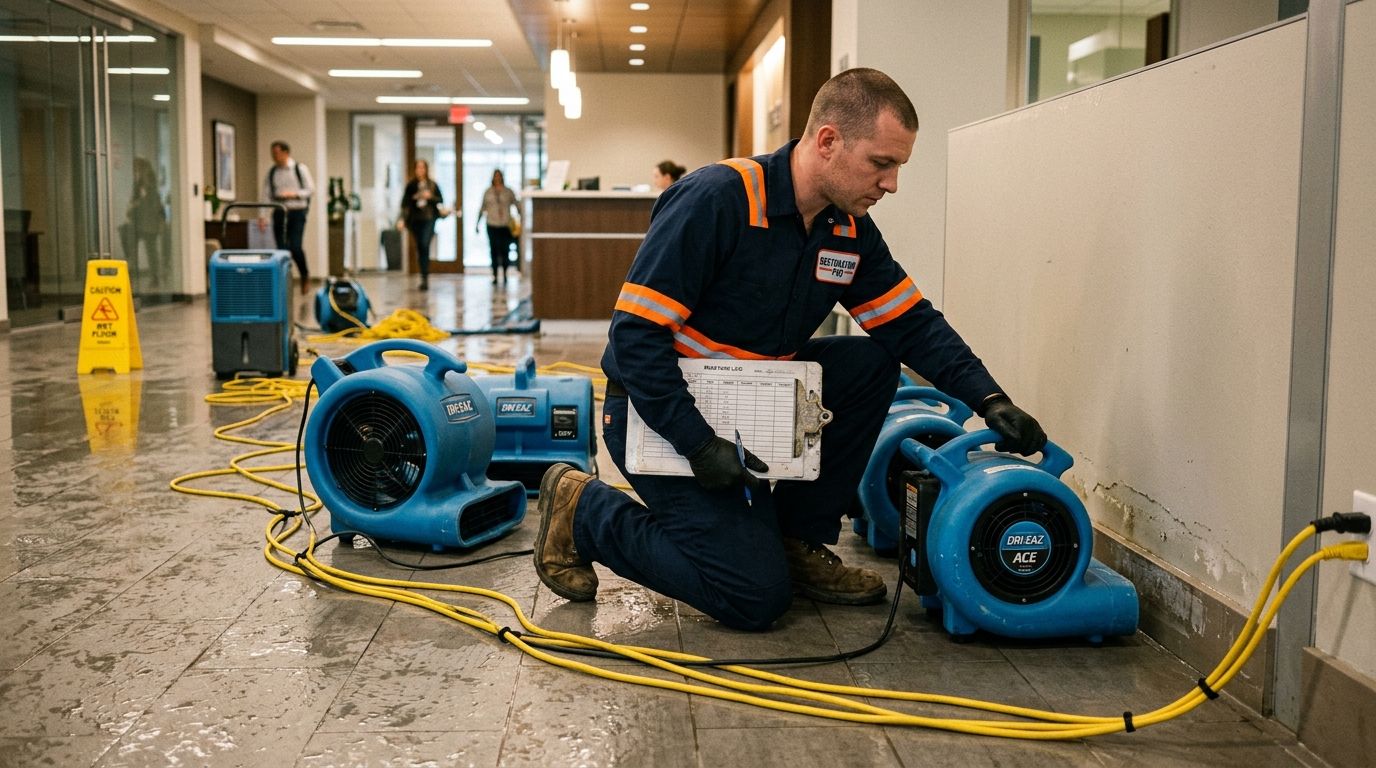
Specialized Equipment & Industrial Restoration Technology
Mitigating severe property damage requires industrial-grade technology capable of altering thermodynamic psychrometrics:
Truck-Mounted Extraction Rigs
31-HP engines producing 16+ inches Hg vacuum suction to evacuate bulk water rapidly into holding tanks.
Low-Grain Refrigerant Dryers
Pre-cooling heat-pipe systems driving ambient grains per pound below 25 GPP to draw deep trapped water out of framing.
HEPA Negative-Air Scrubbers
Hospital-grade 99.97% particulate filtration capturing microscopic fungal spores, soot, and biohazard aerosols.
FLIR® Thermal Scanners & Probes
Infrared thermography detecting evaporative cooling boundaries behind walls, combined with digital RF pinless scanners.
Professional Restoration vs. DIY Mitigation
Attempting DIY cleanup during a property disaster creates severe hidden liabilities:
- Trapped Moisture: Surface drywall dries while moisture inside cavities triggers hidden mold blooms.
- Pathogenic Risks: Category 2 & 3 water contains bio-contaminants standard cleaners fail to kill.
- Insurance Denial: Insurers require daily psychrometric logs; lack of data causes claim disputes.
Transparent Upfront Itemized Pricing
Valley Restoration Pros operates with complete transparency:
- Free On-Site Assessment: Complete physical inspection before work begins.
- Upfront Itemized Estimates: Detailed line items calculated via industry-standard Xactimate.
- Zero Surprise Billing: No hidden charges or unauthorized repairs.
Certified Commercial Vertical Farm Hydroponic Nutrient Reservoir Breach Cleanup Peoria Field Documentation
Every response performed by Valley Restoration Pros is documented through photographic and thermographic records:

Comprehensive Commercial Vertical Farm Hydroponic Nutrient Reservoir Breach Cleanup Peoria Technical Manual & Operational Standards
Exhaustive engineering protocols, psychrometric calculations, geological multipliers, and step-by-step restoration standards for Maricopa County properties:
Executive Emergency Abstract: Commercial Vertical Farm Hydroponic Reservoir Inundation in Peoria
Along the high-tech logistics and advanced agricultural corridors of Peoria, Arizona—specifically centered within the Vistancia Tech Basin, the Northern Valley AgTech corridor, and the industrial developments fronting the Lake Pleasant Parkway and Loop 303 commercial spine—commercial indoor vertical farming facilities represent millions of dollars in precision agricultural technology. These enterprise Controlled Environment Agriculture (CEA) facilities cultivate hundreds of thousands of living crop plants, including culinary herbs, baby leafy greens, microgreens, and specialty fruiting cultivars. They operate within high-density, multi-tier vertical automated racking systems standing up to thirty-five feet tall, sustained by continuous-loop fertigation systems, high-intensity LED luminaire arrays, pressurized reverse osmosis purification skids, and automated central nutrient storage reservoirs containing between 3,000 and 10,000 gallons of concentrated liquid fertilizer solution.
When a primary 5,000-gallon rotationally molded polyethylene nutrient reservoir tank suffers catastrophic structural failure—whether triggered by hydrodynamic shock waves, mechanical bulkhead fracture, or automated dosing valve shear—the resulting deluge releases thousands of gallons of warm, electrically conductive fertigation brine across sealed concrete floor slabs in a matter of minutes. Unlike standard commercial office or retail flooding, a major hydroponic reservoir breach inside an active vertical farm introduces complex physical, electrical, and biological emergencies simultaneously. The inundation submerges floor-level automation tracks, penetrates structural vertical racking channels, surges through low-voltage electrical raceways, and floods adjacent electrical control rooms housing 480-volt 3-phase switchgear and programmable logic controller (PLC) motor control panels.
Operating under high-output horticultural lighting banks with massive sensible heat loads, standing floodwater immediately destabilizes room thermodynamics. Relative humidity (RH) skyrockets from optimal 55% or 60% setpoints to complete atmospheric saturation exceeding 95% in less than 45 minutes. Under intense indoor lighting and elevated temperatures, this vapor deluge triggers severe Vapor Pressure Deficit (VPD) collapse, arresting plant transpiration and inducing severe foliar guttation. Within twelve to twenty-four hours, opportunistic fungal pathogens including Botrytis cinerea (grey mold), powdery mildew, and destructive waterborne oomycetes such as Pythium ultimum germinate across dense vegetative canopies. Without immediate, certified industrial cleanroom restoration, an entire multi-tier commercial harvest cycle faces total biological contamination and financial condemnation.
Immediate Commercial Hydroponic Inundation Directives
- Emergency Reservoir & Fertigation Loop Isolation: Immediately trip manual isolation valves on primary reverse osmosis supply headers, cone-bottom batch tanks, and automated chemical dosing manifolds. De-energize high-pressure variable frequency drive (VFD) circulation pumps at the master control automation terminal.
- Electrical Hazard De-Energization: If standing nutrient solution reaches automated racking gantry rails, floor raceways, or electrical control room thresholds, trip the main breaker supplying the cultivation bay. Never enter standing fertigation solution until certified zero-energy electrical verification has been confirmed.
- Mechanical HVAC Dehumidification Overdrive: Force industrial environmental air handling units into 100% mechanical dehumidification mode. Close isolation dampers connecting the flooded bay to adjoining vegetative rooms, germination nurseries, or packaging cleanrooms.
- Mobilize Industrial Disaster Mitigation: Deploy Valley Restoration Pros 24/7 commercial emergency response by calling (602) 847-9593. Our Peoria rapid response crews arrive on site within 30 minutes equipped with truck-mounted high-volume vacuum extractors, mobile desiccant dehumidification trailers, and certified cleanroom restoration teams.
For commercial agricultural enterprises facing sudden structural plumbing failures, deploying certified emergency water extraction teams within the initial sixty minutes is paramount to preventing irreversible crop canopy loss, electrical switchgear destruction, and concrete foundation contamination.
Anatomy of the Hydroponic Reservoir Breach: Mechanical Stress, Bulkhead Rupture & Hydraulic Shock
Commercial indoor vertical farming facilities in Peoria operate closed-loop fertigation systems engineered to deliver precisely dosed nutrient cocktails to thousands of vertical crop tiers simultaneously. Unlike residential or light commercial water systems, vertical farm reservoirs contain multi-thousand-gallon batch volumes holding dense concentrations of mineral salts, acidic chemical adjusters, and micro-nutrients operating under continuous dynamic pressure. The interaction of hydrostatic head forces, repetitive hydraulic shock, mechanical vibration, and aggressive chemical solutions creates severe structural vulnerability across agricultural plumbing networks:
Bottom Bulkhead & Fitting Shear
Commercial vertical farm batch tanks utilize rotationally molded high-density polyethylene (HDPE) or cross-linked polyethylene (XLPE) cone-bottom vessels holding 3,000 to 10,000 gallons. A 5,000-gallon tank exerts over 41,700 pounds of downward hydrostatic deadweight onto bottom discharge bulkheads. Over months of thermal expansion cycles and continuous agitation from internal eductor nozzles, bottom flange gaskets degrade and heavy Schedule 80 PVC true-union ball valves suffer shear failure, releasing the entire reservoir contents in minutes across the facility slab.
Solenoid Valve Water Hammer Shock
Automated vertical farm fertigation skids rely on fast-acting pneumatic or electric solenoid valves that actuate dozens of times every hour to dose discrete racking zones. Rapid shutoff of high-velocity liquid streams generates extreme hydraulic water hammer, creating transient pressure spikes reaching 250 to 350 PSI. These shockwaves travel through rigid distribution headers, fracturing solvent-welded PVC elbow joints, fatiguing unreinforced pipe saddles, and splitting automated dosing manifolds.
Chemical Stress Corrosion Cracking
Hydroponic stock nutrient concentrates contain aggressive formulations including calcium nitrate, monopotassium phosphate, magnesium sulfate, and concentrated nitric or phosphoric acid used for automated pH adjustment. These acidic and saline solutions accelerate environmental stress cracking (ESC) in standard PVC and polypropylene pipe fittings, degrading fluorocarbon and EPDM seal elasticity until catastrophic tensile rupture occurs under normal system operating pressures.
Automated Refill Float Switch Failure
Reverse osmosis replenishment lines continuously top off commercial mixing reservoirs via electronic float level sensors, ultrasonic transducers, and mechanical float valves. When mineral scale encrusts sensor contacts or float assemblies stick in the open position during unmonitored overnight mixing cycles, continuous high-volume RO water pours through the reservoir, overtopping tank rims and inundating the facility continuously for hours.
Hydraulic Dynamics of Multi-Thousand Gallon Rapid Deluges
When a bottom 4-inch discharge bulkhead shears completely from a 5,000-gallon vertical reservoir under full static head pressure, fluid release follows Torricelli's Law of fluid dynamics: v = √(2gh). With an initial liquid head height of 12 feet, fluid exits the ruptured port at a velocity exceeding 27 feet per second, discharging over 1,000 gallons per minute during the initial three minutes of failure.
This high-velocity hydrodynamic surge overwhelms secondary containment curbs, cascades over floor barriers, and spreads across thousands of square feet of concrete floor slab in moments. The sudden lateral hydraulic impact dislodges temporary utility lines, floats sub-bench electrical junction boxes, and inundates perimeter floor expansion seams, carrying salt concentrates deep into structural building foundations.
When high-pressure plumbing breaks occur in high-bay agricultural warehouses, prompt containment and specialized burst pipe repair protocols must be initiated alongside industrial vacuum extraction. The corrosive nature of nutrient brine accelerates the deterioration of structural slab anchors, steel racking bases, and concrete expansion joint compounds.
For comprehensive facility-wide restoration standards across complex manufacturing and agricultural processing centers, review our full technical spectrum of commercial water damage mitigation services.
Peoria & Northern Valley Environmental Multipliers: 18 GPG Mineral Scale, Caliche Soil Heave & Desert Heat
Operating an advanced Controlled Environment Agriculture facility in Peoria, Arizona exposes indoor farming infrastructure to extreme Sonoran Desert environmental conditions. While vertical farms maintain tightly regulated internal microclimates, the harsh exterior geology, aggressive municipal water chemistry, and scorching desert climate interact directly with building envelopes and mechanical systems:
1. 18 to 24 GPG Municipal Water Hardness & Solenoid Seizure Mechanics
Peoria municipal water infrastructure draws heavy allocations from the Central Arizona Project (CAP) canal and surface storage in Lake Pleasant, delivering municipal water containing extreme concentrations of dissolved calcium, magnesium, and bicarbonate minerals. Raw water hardness routinely tests between 18 and 24 grains per gallon (GPG), with Total Dissolved Solids (TDS) exceeding 650 parts per million (PPM).
Even with extensive pre-treatment systems, high-temperature desert conditions cause rapid calcite precipitation across plumbing valves, automated backflow preventers, RO membrane discharge lines, and electronic tank level sensors. Mineral scaling creates abrasive friction inside solenoid valve pilot orifices, jamming valves in partially open positions and causing continuous reservoir overflow that bypasses standard automated PLC shutoff thresholds.
2. Expansive Caliche Soil Heave & Concrete Foundation Upheaval
The geological foundation of Northern Peoria, extending through Vistancia, Lake Pleasant Parkway, and the Loop 303 industrial corridor, is characterized by dense caliche sedimentary strata and high-plasticity montmorillonite clay soils. Caliche forms rock-hard, impermeable subsurface calcium carbonate hardpan layers that block natural downward water percolation.
During monsoon storm surges, rainwater pools above subterranean caliche beds, hydrating expansive clay soils that swell with uplift pressures exceeding 8,000 pounds per square foot. This severe hydraulic upheaval induces concrete slab differential settlement, shearing sub-slab plumbing stubs, cracking perimeter containment curbs, and misaligning vertical racking anchor bolts, creating immense structural tension on rigid PVC fertigation manifold connections.
3. 115°F Sonoran Desert Summer Heat & Supercharged Microbial Blooms
Summer in Peoria brings sustained ambient temperatures exceeding 115°F (115°F), pushing rooftop commercial chillers and HVAC air handling compressors to absolute thermodynamic limits. Vertical farm cultivation bays generate immense additional internal heat from thousands of high-output LED fixtures and circulation fans. When thousands of gallons of nutrient solution discharge across the concrete slab, the warm water evaporates rapidly, injecting millions of grains of moisture into the indoor air volume.
This high-temperature, high-humidity environment transforms the cultivation bay into a supercharged biological incubator. Airborne fungal spores of Botrytis cinerea and bacterial colonies of Salmonella and Listeria proliferate exponentially in the 78°F to 84°F indoor microclimate. If humidity is not brought under control through industrial desiccant extraction within twelve hours, condensation coats crop canopies, destroying delicate leafy greens and triggering total crop condemnation.
Electrical Control Room Inundation: 480V 3-Phase Switchgear, VFD Skids & Arc Flash Hazards
Commercial indoor vertical farms are among the most power-dense agricultural operations in existence. Facilities operate high-voltage electrical services—typically 480-volt 3-phase power distribution networks feeding step-down transformers, motorized gantry tracks, commercial HVAC chillers, and central automation Motor Control Centers (MCC). When thousands of gallons of nutrient solution breach primary containment and flow into electrical mechanical rooms, catastrophic life-safety hazards and infrastructure losses emerge:
High Electrical Conductivity of Fertigation Brine: Immediate Life-Safety Alert
Unlike pure municipal water, commercial hydroponic nutrient solution is packed with dissolved mineral salts (calcium nitrate, potassium sulfate, magnesium phosphate), giving it an exceptionally high electrical conductivity (EC ranging from 2.2 to 3.8 milliSiemens per centimeter). This mineral density turns floodwater into an extremely efficient electrical conductor.
If energized 480V switchgear, floor-level distribution raceways, or variable frequency drive pump skids come into contact with standing nutrient solution, the liquid becomes electrified over hundreds of square feet. Severe arc flash explosions, phase-to-phase short circuits, and fatal electrocution hazards exist. Personnel must never enter flooded electrical control areas until certified zero-energy Lockout/Tagout (LOTO) protocols have been verified.
PLC Motor Control Centers (MCC)
Main automation cabinets house programmable logic controllers, input/output terminal blocks, and digital sensor communication cards. Liquid entry or sustained high relative humidity induces micro-arcing and rapid copper corrosion across printed circuit boards, wiping automation configurations and disabling climate management.
Variable Frequency Drive (VFD) Skids
High-pressure irrigation booster pumps rely on floor-mounted VFD inverter panels to modulate fluid flow. Submerging VFD heatsinks and internal capacitors in salt-rich fertigation brine causes explosive semiconductor breakdown and permanent inverter destruction upon re-energization.
Subterranean Floor Trench Raceways
Vertical farms route heavy power cables through covered in-slab wire trenches. When reservoir water inundates these channels, water remains trapped around cable jackets for weeks. Capillary wicking draws moisture into junction boxes, deteriorating cable insulation and creating long-term ground fault anomalies.
For specialized industrial recovery methodologies concerning electrical cleanroom isolation and high-density agricultural systems, consult our detailed case review on cannabis cultivation hydroponic flood cleanup mesa operations and electrical desiccation standards.
Multi-Tier Vertical Racking Structural Desiccation & Raceway Decontamination
Commercial vertical farms maximize canopy yield by engineering complex multi-tier racking structures spanning vertically from eight to twelve growing levels. These towering structural assemblies combine structural galvanized steel uprights, extruded aluminum bench framing, automated gantry rails, and polypropylene drainage trays. When a reservoir failure unleashes thousands of gallons of nutrient water, physical contamination penetrates deep into structural components:
Capillary Wicking in Hollow Uprights
Vertical racking uprights are manufactured from roll-formed structural steel tubing with internal reinforcement channels. When floodwaters submerge the lower two feet of racking uprights, surface tension and capillary action draw nutrient brine up through internal cavities and punch holes, trapping standing water inside hollow steel columns where ambient air movement cannot reach.
Corrosive Salt Saltation & Flange Degradation
As nutrient solution evaporates, concentrated fertilizer salts crystallize across structural baseplates, anchor bolts, and leveling shims. The high nitrate and chloride content of the solution strips protective zinc coatings from galvanized steel, initiating galvanic corrosion and weakening structural anchor bolts that secure towering 30-foot racking arrays against seismic and mechanical shifting.
Contamination of Integrated LED Wireways
Each tier of an automated vertical farm integrates hundreds of linear LED light bars fed by low-voltage DC power cables and environmental sensor wiring routed through internal frame chases. Floodwaters splashing or wicking into these wireways deposit conductive salts across quick-disconnect plugs, leading to ground fault errors, erratic lighting schedules, and LED driver failures.
Drainage Trough & Catchment Contamination
Runoff collection troughs running along racking levels trap stagnant nutrient liquid. Under intense light exposure, stagnant water fosters massive algal growth and slime-producing bacterial biofilms that clog drain lines, foul automated recirculating sumps, and release noxious volatile odors throughout the growing facility.
Automated Gantry Drive Motors & Precision Linear Encoder Recovery
Advanced CEA facilities in Peoria utilize automated robotic shuttles and motorized gantry cranes to transport growing trays along multi-tier racks. These robotic systems travel along precision-machined floor and mid-tier alignment rails driven by stepper motors and optical linear encoders requiring sub-millimeter positional tolerances (+/- 0.5 mm).
When nutrient brine floods floor tracks, abrasive calcium salts and suspended organic sediment contaminate sealed roller bearings, rail grooves, and optical glass scales. Valley Restoration Pros deploys precision micro-filtration flushing rigs, ultrasonic contact cleaner washes, and high-velocity desiccant drying arrays to purge salt encrustations from motorized gantry tracks without disturbing critical robotic calibration.
Valley Restoration Pros employs specialized positive-pressure structural cavity desiccation systems. Technicians couple industrial desiccant air streams to custom manifold adapters, injecting ultra-dry, low-grain air directly into hollow racking uprights, purging trapped liquid and desiccating internal metal channels before oxidation or microbial biofilms can establish.
Cleanroom Biosecurity & FSMA Produce Safety Rule Compliance Standards
Commercial vertical farms cultivating edible crops operate under rigorous federal and state statutory regulations governed by the Food Safety Modernization Act (FSMA) Produce Safety Rule (21 CFR Part 112) enforced by the U.S. Food and Drug Administration (FDA) and the Arizona Department of Agriculture. Because vertical farm crops such as leafy greens, culinary herbs, and microgreens are consumed raw without cooking, facility biosecurity requires absolute zero tolerance for microbial foodborne pathogens:
Critical Biological Pathogens in Hydroponic Flood Environments
| Target Microorganism | Pathogen Classification | Flood Inundation Threat Mechanism |
|---|---|---|
| Listeria monocytogenes | Human Foodborne Pathogen (Zero Tolerance) | Thrives in cool, damp floor crevices and forms tenacious biofilms along wet racking legs, transferring to crops via foot traffic and splashing. |
| Salmonella enterica | Human Foodborne Pathogen (Zero Tolerance) | Organic nutrients, drain backpressure, and municipal backflows introduce enteric bacteria, aerosolizing across lower crop tiers. |
| Pythium ultimum | Waterborne Oomycete (Crop Pathogen) | Flagellated zoospores swim through standing runoff, penetrating root cubes and causing catastrophic damping-off and vascular wilt. |
| Botrytis cinerea | Airborne Fungal Mold (Crop Pathogen) | Spikes in room relative humidity (>80% RH) trigger spore germination on damp leaf margins, rotting delicate leafy greens within 24 hours. |
Zero-Residue Sanitization: Organic Compliance Without Crop Adulteration
In commercial food production cleanrooms, conventional industrial restoration disinfectants cannot be utilized. Standard biocides containing quaternary ammonium compounds, chlorine bleach, or phenolic synthetic formulations leave long-lasting toxic chemical residues that deposit on plant foliage. Under FDA produce regulations, these residues constitute chemical adulteration, resulting in mandatory crop destruction.
Valley Restoration Pros strictly deploys EPA-registered food-contact sanitizers formulated from peracetic acid (PAA) and stabilized activated hydrogen peroxide. PAA is a potent oxidizing agent that destroys bacterial and fungal cell membranes in under sixty seconds. Following application, PAA breaks down completely into water, oxygen, and trace food-grade acetic acid (vinegar), leaving zero toxic chemical residues and fully preserving USDA Organic and FSMA biosecurity compliance.
For additional insights into commercial controlled environment decontamination protocols, explore our specialized procedures for commercial indoor vertical farm flood water extraction phoenix agricultural operations.
IICRC S500 / S520 Step-by-Step Restoration Protocol: Agricultural Cleanroom Decontamination
Remediating an enterprise agricultural cleanroom after a major reservoir rupture requires an exacting, clinical multi-stage methodology adhering strictly to the Institute of Inspection, Cleaning and Restoration Certification (IICRC) S500 Standard for Professional Water Damage Restoration and IICRC S520 Standard for Professional Mold Remediation:
Initial Damage Assessment, Moisture Mapping & Canopy Triage
Upon arrival, our IICRC-certified restoration supervisors conduct thermal infrared imaging and digital hygrometric mapping. We establish baseline psychrometric readings (temperature, RH, dew point, GPP) and categorize the water loss. Because hydroponic solution contains nitrogen, phosphorus, potassium salts, and organic additives, it is classified as Category 2 (Graywater), with imminent risk of degrading into Category 3 if microbial proliferation accelerates.
High-Volume Mechanical Extraction & Sub-Slab Dewatering
Deploying truck-mounted extractors producing deep vacuum lift, technicians execute immediate bulk water extraction across epoxy flooring, sub-bench catch pans, and floor expansion channels. Extracting liquid water mechanically is roughly 500 times faster and more energy-efficient than evaporative dehumidification, eliminating the source of runaway latent humidity.
Cleanroom HEPA Negative-Air Isolation & Spore Scrubbing
Before directing high-velocity air movers across floor surfaces, we install negative-air HEPA scrubbers to establish at least 15 to 18 air changes per hour (ACH). This creates a continuous filtration cycle, capturing microscopic airborne mold spores, fungal fragments, and aerosolized bacteria before air currents can deposit them onto living crop foliage.
Non-Chemical Biocidal Sanitization & Peracetic Acid Bio-Washing
Because toxic quaternary ammonium compounds leave hazardous chemical residues, we apply food-grade, zero-residue biocidal washes. Using EPA-registered peracetic acid (PAA) and stabilized hydrogen peroxide formulations, technicians sanitize epoxy slabs, vertical racking uprights, and drainage trenches, killing 99.999% of fungal and bacterial pathogens while breaking down harmlessly into water and oxygen.
Thermodynamic Desiccant Dehumidification & Controlled Airflow
We connect high-capacity mobile desiccant dehumidifiers ducted directly into the cleanroom envelope, driving ambient specific humidity down to targeted agricultural setpoints (40 to 45 GPP). Strategic low-angle air movers direct dry air across the concrete floor and behind wall perimeters, evacuating bound water from structural joints without directing desiccation air streams directly at delicate plant foliage.
Air Quality Clearance Testing & Post-Remediation Verification
Restoration operations conclude only after baseline equilibrium dry standards are verified with pin and pinless moisture meters. We perform viable and non-viable bioaerosol air sampling and surface ATP bioluminescence swab testing to verify zero elevated mold spore or bacterial concentrations. Full psychrometric logs, thermal scans, and Xactimate commercial documentation are provided for commercial property insurance claims.
When microbial colonization threatens agricultural yields or facility structures, review our full clinical decontamination standards for mold remediation and biosecure containment.
Advanced Industrial Restoration Technology Deployed for Agricultural Cleanrooms
Mitigating an enterprise vertical farm inundation requires industrial-grade disaster recovery machinery far beyond conventional commercial drying apparatus. Standard residential refrigerant dehumidifiers and axial air fans cannot generate the massive grain depression required to stabilize thousands of square feet of saturated concrete without cooking room air. Valley Restoration Pros deploys purpose-built industrial machinery:
Mobile Industrial Desiccant Dehumidifier Trailers
Our 5,000 to 9,000 CFM mobile desiccant trailers utilize silica gel honeycomb rotor wheels that adsorb moisture directly from the airstream via chemical sorption. Delivering reactivation air at single-digit grains per pound (GPP) with dew points below -20°F, desiccants pull moisture rapidly from dense concrete slabs without freezing up in cool growing environments.
Capacity: 5,000–9,000 CFM | Dew Point: -20°FDOP-Tested HEPA Negative Air Filtration Scrubbers
Dri-Eaz DefendAir HEPA 500 and high-volume Phoenix Guardian HEPA units capture 99.97% of airborne particulate matter down to 0.3 microns. By recirculating room air through medical-grade HEPA filters, we continuously scrub circulating fungal spores, bacterial aerosols, and fertilizer dust, maintaining cleanroom air purity standards.
Efficiency: 99.97% @ 0.3 Microns | DOP CertifiedTruck-Mounted Extreme High-Volume Vacuum Extractors
Driven by direct-drive PTO engines, our truck-mounted extraction platforms generate 16 to 18 inches of mercury vacuum lift. Connected to commercial weighted wand squeegees, our technicians extract thousands of gallons of standing nutrient brine from slab expansion joints and under-rack drainage troughs at rates exceeding 50 GPM.
Vacuum Lift: 16–18 In. Hg | Pumping Rate: 50+ GPMFLIR Radiometric Thermal Imaging & Psychrometric Sensors
High-resolution FLIR T-Series thermal imaging reveals sub-surface moisture migration trapped beneath insulated cleanroom wall panels and under vertical racking baseplates. Cloud-linked Bluetooth psychrometric data loggers track ambient temperature, relative humidity, GPP, and dew point continuously throughout drying operations.
Thermal Sensitivity: < 0.03°C | Real-Time LoggingTo explore the thermodynamic engineering principles underlying commercial desiccant recovery and psychrometric dehumidification, consult our detailed resource on structural drying science.
Vapor Pressure Deficit (VPD) Psychrometric Stabilization & Transpiration Management
In commercial controlled environment agriculture, moisture management extends beyond drying inanimate concrete slabs—it directly governs living plant physiology. Vapor Pressure Deficit (VPD) represents the difference between the saturation vapor pressure inside the leaf's substomatal cavities and the vapor pressure of the ambient room air. VPD dictates transpiration rate, nutrient transport, and stomatal conductance:
The Physics of Flood-Induced VPD Collapse
During vegetative and early flowering growth, leafy green canopies require a precise VPD range between 0.8 and 1.2 kilopascals (kPa). When an irrigation reservoir ruptures and unleashes thousands of gallons across the concrete floor, ambient relative humidity surges above 95%, causing VPD to crash toward 0.15 kPa or lower. Under collapsed VPD conditions, the surrounding air becomes completely saturated, preventing transpirational water vapor release from leaf stomata.
This triggers guttation, where internal hydraulic pressure forces liquid water out through leaf hydathodes, pooling microscopic moisture droplets along leaf margins. These stagnant water droplets provide the exact biological trigger required for dormant Botrytis cinerea spores and powdery mildew conidia to penetrate plant epidermal cells. Valley Restoration Pros uses computerized psychrometric formulas to coordinate desiccant dehumidifier extraction with facility HVAC chilled water coils, systematically restoring VPD to 1.05 kPa within hours without inducing foliar transpiration shock.
Psychrometric Thermodynamics & Enthalpy Balancing
Restoring an inundated 40,000-square-foot vertical farming envelope requires rigorous thermodynamic calculation. Technicians compute sensible heat ratios (SHR) and moisture grain loads across three distinct air masses: cultivation bay airspace, desiccant process air, and HVAC reactivation airstreams. Specific humidity is measured in grains per pound (GPP) of dry air, using calibrated psychrometric formulas: W = 7000 × (0.622 × e) / (P - e), where e is ambient vapor pressure and P is atmospheric pressure.
When 5,000 gallons of standing water evaporates, latent heat absorption drives room dew point temperatures toward coil freezing thresholds. Our restoration supervisors balance desiccant CFM outputs against sensible heat rejection from horticultural lighting arrays, maintaining ambient air temperatures at 76°F while driving specific humidity down from 144 GPP to 45 GPP without creating localized thermal gradients or microclimate cold spots.
For facilities operating large-scale pressurized membrane purification systems, explore our specialized technical breakdown on reverse osmosis water filter flood cleanup and high-pressure filtration line mitigation.
Seamless Epoxy & Polyurethane Floor Substrate Recovery & Osmotic Blistering Mitigation
Modern commercial vertical farms in Peoria install seamless, high-performance epoxy, polyurethane concrete, or polyaspartic floor coatings with 4-to-6-inch integral cove bases. These resinous surfaces provide an impermeable, sanitizable barrier meeting USDA and FDA food safety standards. However, when standing floodwaters remain across the floor for extended periods, severe subsurface structural issues develop:
Osmotic Blistering & Coating Delamination
When nutrient brine seeps beneath coating edges at floor drains, expansion joints, or racking anchor bolts, moisture dissolves soluble mineral salts in the concrete. The resulting osmotic concentration gradient pulls water beneath the coating, generating hydrostatic blister pressures exceeding 250 PSI that crack, bubble, and delaminate costly epoxy finishes.
Sub-Slab Moisture Vapor Transmission (MVT)
Concrete is a porous, capillary network. Unextracted floodwater enters microscopic pores, saturating the slab matrix. As the room surface dries, strong upward moisture vapor transmission (MVT) transports alkaline salts to the concrete-coating interface, destroying polymer adhesion unless deep desiccant drying draws moisture out from the slab base.
Cleanroom FRP Wall Panel Ingress
Vertical farm cultivation enclosures feature insulated cleanroom walls constructed of Fiber-Reinforced Plastic (FRP) laminated over expanded polystyrene (EPS) or polyisocyanurate foam cores. Standing water penetrating base silicone joints saturates inner foam cores, requiring non-destructive cavity desiccation to prevent concealed mold growth.
Scientific Slab Diagnostic Protocols: ASTM F2170 & ASTM F1869 Standards
Restoring flooded commercial slabs requires precise scientific diagnostic standards. Our restoration supervisors deploy in-situ electronic relative humidity probes drilled into 40% of the slab depth in strict compliance with ASTM F2170 Standard Test Method for Determining Relative Humidity in Concrete Floor Slabs. Baseline post-flood slab RH levels routinely exceed 92%, indicating extreme hydrostatic moisture pressure.
Concurrently, technicians conduct anhydrous calcium chloride testing pursuant to ASTM F1869 to quantify moisture vapor emission rates (MVER), often uncovering emissions exceeding 12 lbs per 1,000 sq ft per 24 hours. Without aggressive sub-slab desiccant drying, high alkalinity pore water (pH 11.5 to 13.0) undergoes chemical saponification, permanently dissolving epoxy adhesive primers. Our deep desiccant drying regimens reduce slab RH below 75% and MVER below 3 lbs, safeguarding valuable commercial floor investments.
For commercial food processing facilities facing high-temperature washdown and mechanical boiler flooding, review our technical standards for commercial bakery steam boiler leak water damage mesa restoration.
Root Zone Rhizosphere Protection & Anaerobic Pathogen Mitigation
When floodwaters accumulate beneath multi-tier automated vertical racking arrays, drainage sumps overflow back into lower catchment troughs. If standing wastewater reaches root containers or submerges rockwool plugs, polyurethane foam matrices, or coco coir slabs, root zone micro-ecology undergoes catastrophic oxygen depletion:
Anaerobic Root Zone Hypoxia
Submerged root systems lose access to dissolved oxygen in less than ninety minutes. Deprived of rhizosphere oxygen, cellular root tissue collapses, active nutrient uptake ceases, and roots produce ethanol and organic acids that attract opportunistic waterborne pathogens.
Pythium & Phytophthora Outbreaks
Pythium ultimum and Phytophthora cryptogea flagellated zoospores swim actively through standing stagnant irrigation runoff. Once in contact with stressed roots, they cause root rot, vascular browning, and irreversible plant death across affected bench levels.
Sub-Bench Mechanical Clearance
Our technicians deploy ultra-low clearance sub-surface extraction tools beneath racking frames to evacuate stagnant water pools before root-zone capillary wicking occurs, followed by zero-residue peracetic acid bio-washing of drain pans.
Hyper-Local Peoria Case Study: Vistancia Tech Basin 40,000 Sq Ft Commercial Vertical Farm Inundation
Vistancia AgTech Corridor: Vistancia Blvd & Loop 303, Peoria AZ
Facility: 40,000 Sq Ft Commercial Vertical Farm
Catastrophic Midnight Breach
At 1:15 AM on a Sunday, a 5,000-gallon rotationally molded HDPE cone-bottom nutrient reservoir tank suffered mechanical discharge bulkhead shear inside Bay 2 of an enterprise vertical farming facility near Vistancia Boulevard and Loop 303 in Peoria. Over 4,800 gallons of concentrated fertigation brine flooded across 18,500 square feet of seamless epoxy floor, submerging gantry motor rails and breaching the automated electrical control room housing 480V switchgear.
Diagnostic Moisture Mapping & Triage
Valley Restoration Pros arrived on site in 26 minutes. FLIR radiometric thermal cameras mapped standing nutrient liquid trapped beneath 10-tier automated vertical racking uprights and inside sub-floor cable trenches. Environmental sensors logged 82°F temperature, 96% RH, and a dangerous specific humidity reading of 144 GPP—a lethal incubation profile for Botrytis cinerea and root rot pathogens.
Mitigation Execution & Complete Salvage
Two direct-drive truck-mounted extractors removed standing water within 55 minutes. Crews erected HEPA negative-air containment scrubbers and connected a 7,000 CFM mobile desiccant trailer. Specific humidity plummeted from 144 GPP to 44 GPP in under seven hours. Following zero-residue peracetic acid bio-washing, 140,000 heads of butterhead lettuce were completely salvaged, passing third-party microbial laboratory testing with 100% compliance.
"When our primary 5,000-gallon nutrient reservoir sheared its main discharge bulkhead at 1:00 AM on a weekend, we were facing catastrophic electrical losses and the total destruction of over $480,000 in living butterhead lettuce canopy. Valley Restoration Pros arrived in Peoria in less than half an hour. Their high-capacity desiccant trailers and HEPA filtration arrays stabilized our room humidity before Botrytis could take hold. They saved our crop and got our automated facility fully operational with zero state food safety compliance citations."
— Sterling H., Director of Agricultural Operations, Peoria AZ
Transparent Commercial Financial Standards: Upfront Pricing & Insurance Adjustment Integrity
Commercial agricultural water losses involve complex commercial property, equipment breakdown, and living crop inventory insurance policies. Valley Restoration Pros upholds strict pricing transparency and ethical consumer protection standards:
Free Comprehensive On-Site Damage Assessment
Our industrial restoration supervisors perform complete on-site moisture mapping, thermal imaging, and psychrometric loss assessments with zero financial obligation.
Transparent Upfront Itemized Pricing Before Work Begins
Before any vacuum lines are deployed or desiccant trailers fired up, facility owners receive clear itemized pricing schedules detailing equipment, labor, and sanitization rates.
Assistance with Detailed Claims Documentation & Psychrometric Moisture Logs
We provide complete Assistance with Detailed Claims Documentation & Psychrometric Moisture Logs, furnishing commercial adjusters with comprehensive psychrometric drying curves, daily moisture migration logs, and Xactimate commercial restoration line-item records to accelerate claim processing.
Consumer Protection & Direct Billing Disclosure
Valley Restoration Pros does not make deceptive promises of "free deductible waivers" or false assurances that insurance will cover 100% of claims without commercial policyholder responsibility. Commercial agricultural policies feature distinct endorsements, equipment breakdown riders, and water damage exclusions. We coordinate directly with your commercial adjuster, providing continuous psychrometric logs, moisture logs, and thermal imagery to document sudden and accidental failure circumstances.
To calculate preliminary restoration equipment requirements and commercial loss parameters, use our interactive commercial restoration cost estimator or contact us for 24/7 emergency dispatch across the Northwest Valley.
Frequently Asked Technical Questions: Hydroponic Flood Mitigation & Cleanroom Restoration
In high-density vertical farm canopies operating under 1,000-watt equivalent LED lighting arrays at 75°F to 82°F, fungal spores of Botrytis cinerea require only 4 to 8 hours of sustained surface moisture and elevated relative humidity (>80% RH) to germinate and penetrate delicate plant cuticles. Waterborne Pythium zoospores in standing runoff colonize submerged root matrices within 90 minutes. Rapid mechanical extraction and industrial desiccant dehumidification must begin immediately to prevent widespread crop condemnation.
A concentrated hydroponic nutrient reservoir breach is classified initially as Category 2 (Graywater) because it carries substantial chemical salts, dissolved nitrates, phosphates, and organic microbial stimulants. If the water remains stagnant across an 80°F grow room slab for more than 24 hours, bacterial colonization elevates the condition to Category 3 (Blackwater), requiring full biocidal washing and aggressive bio-containment.
Technicians establish certified zero-energy Lockout/Tagout (LOTO) boundaries before entering flooded electrical rooms. Because fertigation brine is highly conductive (EC > 2.5 mS/cm), standing water is extracted using non-conductive suction wands. Variable frequency drive (VFD) enclosures and PLC cabinets undergo precision desiccation using positive-pressure dry air injection, followed by non-conductive electronic contact cleaning to remove corrosive fertilizer salt deposits before re-energization.
Never with Valley Restoration Pros. We strictly reject conventional restoration disinfectants like quaternary ammonium salts or chlorine bleaches. Instead, we use EPA-registered peracetic acid (PAA) and food-grade activated hydrogen peroxide. These compounds break down into pure water, oxygen, and trace acetic acid, leaving zero chemical residues, VOCs, or heavy metals that could cause produce safety or organic certification failures.
Standard Low-Grain Refrigerant (LGR) dehumidifiers lose efficiency when air temperatures drop below 70°F or when ambient relative humidity drops below 40%. Desiccant dehumidifiers utilize silica gel rotors that operate independently of temperature, producing ultra-dry airstreams with single-digit grains per pound (GPP). This extreme vapor pressure deficit draws moisture rapidly out of concrete expansion joints and sub-bench voids without re-condensing on cold surfaces.
Vertical racking columns feature hollow structural steel profiles that trap water drawn upward by capillary wicking. We connect high-pressure positive desiccant injection adapters directly to column punch holes. By forcing ultra-dry, low-grain air through the internal column cavities, we evaporate trapped moisture and purge residual salt deposits, protecting structural steel from galvanic corrosion.
During Peoria summers, outdoor ambient temperatures exceed 115°F, running facility chillers near full capacity. When an internal flood releases thousands of gallons of warm water, evaporation rates explode. The resulting combination of 80°F+ indoor air, high humidity, and intense grow lighting creates an optimal thermodynamic incubation environment, causing microbial populations to double every 20 minutes unless rapid industrial drying intervenes.
Standard commercial property policies cover physical damage to the building structure, concrete flooring, and fixed mechanical equipment resulting from sudden and accidental plumbing failure. However, living crop canopies require specialized "Living Plant Matter" or "Crop in Progress" inland marine endorsements. Valley Restoration Pros works closely with commercial adjusters, providing detailed failure documentation, environmental logs, and itemized structural mitigation records to maximize coverage.
Directing high-velocity air movers directly at living plant foliage causes severe wind burn, stomatal closure, and mechanical leaf tearing. Our restoration technicians utilize low-profile centrifugal air movers positioned beneath the lower racking tiers, directing laminar airflow exclusively across the epoxy slab and drainage troughs while ambient desiccant trailers pull moisture vapor from the upper airspace, safeguarding delicate crop canopies.
Peoria & Northwest Valley Emergency Response Corridors: 30-Minute Commercial Dispatch
Commercial hydroponic and vertical farm inundations demand immediate on-site mobilization. Valley Restoration Pros maintains dedicated emergency industrial response units strategically positioned along Northwest Valley transit arteries:
Peoria Vistancia & Loop 303 AgTech Basin
Serving Vistancia Boulevard, Lake Pleasant Parkway logistics centers, and Northern Peoria industrial zones. Connect directly with our dedicated Peoria water damage restoration rapid deployment unit.
Glendale & Luke Logistics Corridor
Serving Northern Avenue, Luke Air Force Base logistics hubs, and Westgate commercial developments. Access our field division for Glendale water damage mitigation.
Surprise & Sun City Commercial Hubs
Serving Bell Road, Grand Avenue, and Surprise City Center commercial properties. Explore our specialized team for Surprise water damage recovery.
Phoenix & Valley-Wide Emergency Dispatch
Coordinating multi-rig commercial deployments across all municipalities. Access our central Phoenix water damage dispatch center or browse our complete index on our areas we serve directory.
Verified Local Area Dispatch: Phoenix, AZ
Official Geo-Coordinates: 33.4484° N, -112.074° W • Maricopa County
Related Specialized Emergency Restoration Services
Explore specialized rapid-response mitigation protocols across Greater Phoenix and Maricopa County:
Valley-Wide Emergency Response Service Coverage
Our mobile restoration fleet is dispatched across the entire Phoenix metropolitan region, providing rapid 30 to 60 minute emergency response: