
Valley Restoration Pros delivers 24/7 industrial emergency water extraction, thermal psychrometric drying, and structural mitigation across Phoenix and Maricopa County with guaranteed 30–60 minute rapid arrival. All protocols strictly adhere to IICRC S500 standards, featuring upfront itemized pricing and free on-site thermal moisture assessments. Call dispatch directly at (602) 847-9593.
Why Immediate Mitigation Is Critical in Phoenix Heat
Water submersion beneath ESD raised floors triggers rapid adhesive hydrolysis, destroying static dissipative grounding paths per ANSI/ESD S20.20. High ambient desert heat exceeding 115°F accelerates galvanic corrosion across zinc-coated steel pedestals, compromising structural floor load capacity. City of Mesa municipal tap water carries 18 to 22 GPG extreme mineral hardness, leaving conductive salt bridges across delicate avionics circuitry. Evaporating water releases aerosolized mineral particulates, pushing airborne counts thousands of times above ISO Class 7 cleanroom certification limits.
Service Definition & The IICRC Standard of Care
Professional falcon field aerospace avionics cleanroom esd flooring water damage mesa is an engineering and environmental discipline adhering strictly to IICRC S500 protocols, not mere surface mopping. When structural plumbing failures strike in Maricopa County, certified emergency water extraction and thermal structural drying procedures must be deployed immediately. Whether triggered by high-pressure burst pipe emergencies, subfloor leaks, or commercial line ruptures, bound moisture rapidly penetrates concrete subfloors and wall framing. In the desert heat, delays trigger microbial proliferation requiring rapid mold remediation. Request damage assessment through our emergency assessment portal or request 30-minute dispatch across all Valley service areas.
Securing electrical feeds, inspecting load-bearing assemblies, and containing pathogens.
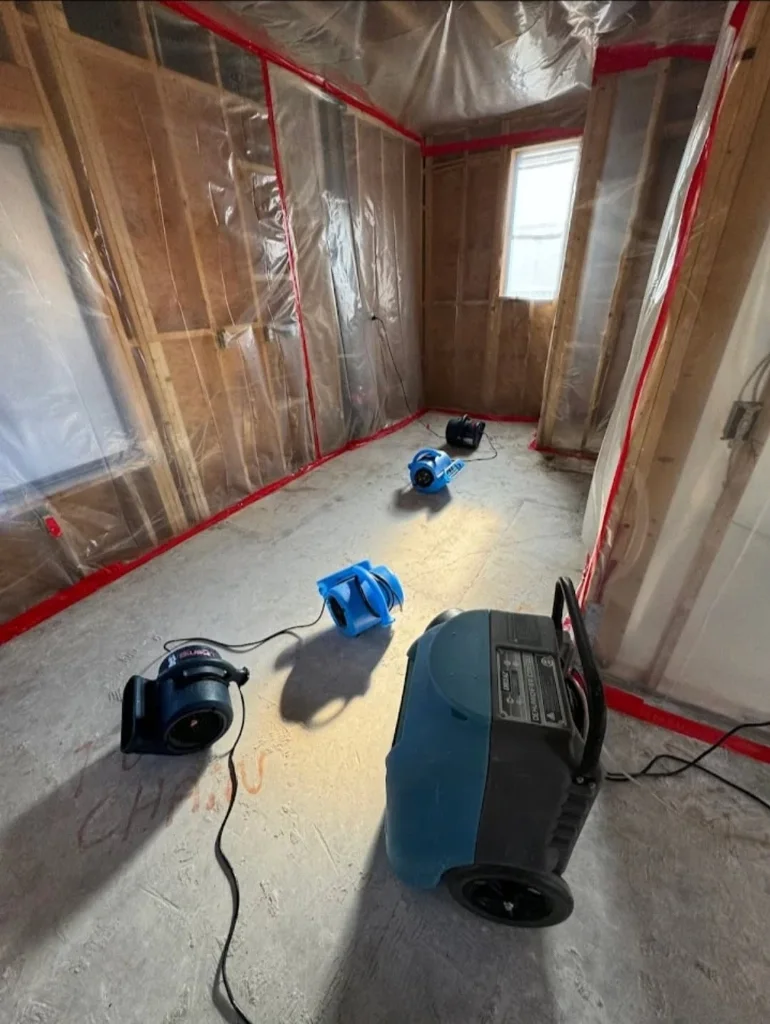
Stopping the intrusion source and erecting 6-mil plastic isolation containment airlocks.
31-HP truck-mount extraction, removing gallons exponentially faster than evaporation.
LGR dehumidifiers and HEPA air scrubbers driving grains per pound below 25 GPP.
Calibrated electronic pinless testing confirming baseline dry standards.
The Complete 6-Stage Restoration Roadmap
Our IICRC-certified crews execute a disciplined, scientific 6-stage protocol to stabilize and dry structural components:
Emergency Dispatch & Perimeter Isolation
30 to 60 minute arrival. Securing electrical shutoffs, evaluating structural loads, and erecting containment airlocks.
FLIR® Thermal Mapping & Baseline Scans
Infrared thermal scans detect trapped moisture behind walls and beneath concrete without invasive exploratory demolition.
High-Volume Bulk Extraction
31-HP truck-mount extraction units pump standing water away at hundreds of gallons per minute.
Controlled Selective Demolition
Precision flood cuts 12 to 24 inches above moisture lines, removing wet insulation and opening wall framing to dry airflow.
Thermodynamic Dehumidification
Industrial Low-Grain Refrigerant dehumidifiers pull deep trapped moisture from dense framing lumber and concrete slabs.
Antimicrobial Sanitization & Verification
EPA-registered botanical application (Benefect Decon 30) and calibrated moisture testing to issue an official dry certificate.


Specialized Equipment & Industrial Restoration Technology
Mitigating severe property damage requires industrial-grade technology capable of altering thermodynamic psychrometrics:
Truck-Mounted Extraction Rigs
31-HP engines producing 16+ inches Hg vacuum suction to evacuate bulk water rapidly into holding tanks.
Low-Grain Refrigerant Dryers
Pre-cooling heat-pipe systems driving ambient grains per pound below 25 GPP to draw deep trapped water out of framing.
HEPA Negative-Air Scrubbers
Hospital-grade 99.97% particulate filtration capturing microscopic fungal spores, soot, and biohazard aerosols.
FLIR® Thermal Scanners & Probes
Infrared thermography detecting evaporative cooling boundaries behind walls, combined with digital RF pinless scanners.

Professional Restoration vs. DIY Mitigation
Attempting DIY cleanup during a property disaster creates severe hidden liabilities:
- Trapped Moisture: Surface drywall dries while moisture inside cavities triggers hidden mold blooms.
- Pathogenic Risks: Category 2 & 3 water contains bio-contaminants standard cleaners fail to kill.
- Insurance Denial: Insurers require daily psychrometric logs; lack of data causes claim disputes.
Transparent Upfront Itemized Pricing
Valley Restoration Pros operates with complete transparency:
- Free On-Site Assessment: Complete physical inspection before work begins.
- Upfront Itemized Estimates: Detailed line items calculated via industry-standard Xactimate.
- Zero Surprise Billing: No hidden charges or unauthorized repairs.
Certified falcon field aerospace avionics cleanroom esd flooring water damage mesa Field Documentation
Every response performed by Valley Restoration Pros is documented through photographic and thermographic records:
Comprehensive falcon field aerospace avionics cleanroom esd flooring water damage mesa Technical Manual & Operational Standards
Exhaustive engineering protocols, psychrometric calculations, geological multipliers, and step-by-step restoration standards for Maricopa County properties:
Executive Emergency Abstract: Commercial Aerospace Avionics Cleanroom & ESD Flooring Water Damage in Mesa
Within the premier commercial aviation, defense contracting, and aerospace engineering facilities anchored along the historic Falcon Field Aerospace Corridor in East Mesa—centered around McKellips Road, Greenfield Road, and Higley Road—an unexpected water intrusion event into an avionics cleanroom or flight hardware testing facility constitutes an immediate operational crisis. Cleanroom environments operate under strict ISO 14644-1 airborne particulate cleanliness classifications (ISO Class 5 to ISO Class 8 / FED-STD-209E Class 100 to Class 100,000). These sensitive industrial spaces house mission-critical aerospace testing infrastructure: surface-mount technology (SMT) automated assembly lines, inertial guidance navigation testing chambers, radar calibration cleanrooms, flight control computer assembly suites, and expansive Electrostatic Discharge (ESD) protective raised access flooring systems.
Commercial avionics cleanroom flooding typically occurs through overhead fire suppression pre-action line ruptures, reverse-osmosis (RO) deionized water loop breaches, dedicated cleanroom recirculating air handler (RAHU) chilled water coil failures, or roof drainage scupper deluges during violent Sonoran summer monsoon storms. When pressurized liquid breaches the cleanroom ceiling plenum, water penetrates specialized laminar flow HEPA fan filter units (FFUs), saturating conductive vinyl tile adhesives, cascading through raised floor perforated tiles, and flooding the subterranean underfloor plenum.
The immediate danger extends far beyond basic physical water removal. Standing water beneath an ESD raised access floor corrodes zinc-plated steel pedestals, dissolves conductive graphite adhesive matrices, causes permanent loss of static-dissipative surface electrical resistance (1.0 x 10^6 to 1.0 x 10^9 ohms per ANSI/ESD S20.20), and releases millions of airborne mineral particles that permanently compromise cleanroom ISO particulate certification. Without rapid deployment of certified emergency water extraction and precision thermodynamic desiccation, microscopic rust and mineral efflorescence permanently ruin multi-million-dollar aerospace components.
Aerospace cleanroom down-time carries immense financial risk. Defense manufacturing programs governed by Defense Contract Management Agency (DCMA) oversight face severe stop-work orders if cleanroom particle counts exceed baseline ISO limits. When high-reliability flight hardware is exposed to elevated relative humidity exceeding 60% RH, moisture diffusion into moisture-sensitive electronic devices (MSDs) induces the popcorn effect during solder reflow, cracking microchip silicon packaging. Rapid extraction, particulate scrubbing, and deep desiccation are required to preserve contract delivery milestones.
Valley Restoration Pros serves as the trusted industrial emergency mitigation contractor for defense aerospace manufacturers, commercial flight hardware integrators, and avionics engineering labs throughout Mesa, Gilbert, Tempe, and Phoenix. Our Master Certified IICRC Commercial Drying Specialists deliver guaranteed 20- to 30-minute rapid emergency response across Falcon Field. We deploy high-vacuum negative-pressure extraction trailers, Class 100 HEPA air filtration units, static-dissipative subfloor desiccation mats, and certified ESD surface resistance meters to restore cleanroom integrity without costly teardowns. Contact our commercial emergency dispatch 24/7/365 at (602) 847-9593 for instantaneous aerospace cleanroom mobilization.
Immediate Aerospace Cleanroom Disaster Mitigation Directives
- Execute 480V Cleanroom Power & SMT Line LOTO: Immediately isolate primary busway disconnects and sub-floor power drops feeding surface-mount pick-and-place lines and environmental test chambers to prevent catastrophic short circuits.
- Isolate Makeup Air Handlers (MAU): Switch cleanroom air handling systems to 100% recirculation mode or isolate intake dampers to prevent outdoor desert dust and monsoon humidity from infiltrating the clean envelope.
- Protect Flight Hardware & Sealed Enclosures: Immediately bag sensitive avionics units, circuit board racks, and flight control modules in anti-static ESD-shielded polyethylene envelopes before moisture condenses on gold-plated connector pins.
- Mobilize Specialized Cleanroom Units: Call Valley Restoration Pros at (602) 847-9593 for immediate dispatch of contamination-controlled industrial desiccant drying trailers and HEPA environmental scrubbing arrays.
The Falcon Field aerospace corridor represents one of Arizona's premier economic epicenters, generating over $2.5 billion in annual economic output through flight systems assembly, defense electronics fabrication, and unmanned aerial systems (UAS) development. In this demanding manufacturing ecosystem, moisture intrusion is not merely an architectural maintenance nuisance—it is an existential risk to military flight certification, FAA airworthiness compliance, and million-dollar contract delivery milestones. A single drop of mineralized water bridging contacts on a flight control computer circuit card can lead to undetectable latent defects that only manifest under high-G flight maneuvers or high-altitude atmospheric decompression.
When water penetrates an active cleanroom, standard janitorial mopping or consumer-grade wet-vac extraction is strictly prohibited under facility operating procedures. Standard shop-vacs exhaust billions of sub-micron particles directly into the ambient airstream, utterly destroying the laminar airflow dynamics of HEPA ceiling arrays and driving particle counts millions of times above allowable ISO Class 7 thresholds. Our response teams arrive with cleanroom-certified, explosion-proof, HEPA-filtered vacuum extraction systems equipped with antistatic conductive suction hoses that prevent triboelectric charge buildup during liquid extraction.
Anatomy of Avionics Cleanroom Flooding, ESD Tile Delamination & Sub-Floor Grid Corrosion
Commercial aerospace cleanrooms represent intricate architectural and thermodynamic engineering systems. Raised access flooring systems within avionics test bays serve dual functions: providing a continuous static-dissipative walking surface and acting as a pressurized air plenum for laminar downward airflow. The structural assembly consists of heavy concrete-filled welded steel floor panels surfaced with conductive high-pressure laminate (HPL) or static-dissipative vinyl tile, supported by an underfloor grid of zinc-chromate coated steel pedestals and horizontal stringers anchored directly to the concrete sub-slab.
When floodwaters enter an avionics cleanroom, degradation occurs along three critical vectors:
Vector 1: ESD Conductive Adhesive Hydrolysis
Static-dissipative vinyl tiles are bonded to steel panels using specialized carbon-loaded water-based conductive adhesives. Submersion triggers rapid alkaline hydrolysis of the adhesive bond. The adhesive re-emulsifies, turning into a milky slurry that causes immediate edge curling, tile bubbling, and complete electrical isolation of the grounding path, destroying static protection.
Vector 2: Sub-Floor Pedestal Galvanic Corrosion
Underfloor pedestals feature threaded steel adjustment rods and stamped base plates resting on raw concrete. Standing water creates a conductive electrolyte bath, initiating rapid galvanic corrosion. Zinc coatings break down, yielding white rust (zinc hydroxide) followed by destructive ferrous oxide scale that freezes leveling threads and compromises floor load-bearing capacity.
Vector 3: Particulate Aerosolization & ISO Invalidation
As standing water evaporates, mineral residues, drywall gypsum dust from ceiling penetrations, and corroded metal particles become desiccated. High-velocity cleanroom airflow aerosolizes these sub-micron particles, driving airborne particle counts thousands of times above ISO Class 7 thresholds and contaminating unsealed flight computer chipsets.
In addition to floor structural damage, the concrete sub-slab beneath the raised floor acts as a massive thermal moisture capacitor. Once saturated, moisture migrates into the concrete pores through capillary suction. Even after surface water is removed, the concrete slab continuously off-gasses moisture vapor into the pressurized underfloor plenum. This elevated vapor pressure creates a permanent micro-climatic humidity trap, condensing onto power supply enclosures, bus duct joints, and fiber optic data runs.
Standard industrial flood drying practices cannot be deployed inside an aerospace cleanroom. Standard centrifugal air movers blow unfiltered ambient contaminants across clean workbenches, destroying months of calibration data. Specialized cleanroom mitigation requires positive-pressure filtered drying chambers, static-safe vacuum extractors, and low-temperature trailer desiccant dehumidifiers delivering ultra-pure dry air.
Valley Restoration Pros coordinates precision cleanroom desiccation per ISO 14644 and IICRC S500 protocols, similar to the advanced methodologies utilized in our specialized commercial server room water damage restoration operations. When pressurized plumbing ruptures trigger cleanroom deluge, prompt execution of certified commercial burst pipe repair halts continuing water intrusion.
The physics of moisture transport beneath raised access computer floors introduces severe multi-phase risks. Modern avionics cleanrooms feature pedestal grids constructed of galvanized steel or die-cast aluminum stanchions supporting 24-inch by 24-inch steel-welded cementitious-core panels. When water pools on the concrete subfloor below these panels, it enters the subterranean return air plenum. Evaporating water molecules are swept upward by high-volume recirculating air handling units (RAHUs) operating at dozens of air changes per hour. This rapid convective circulation disperses humid air directly into cleanroom ceiling HEPA filter modules.
Once airborne relative humidity in an avionics facility exceeds 60% RH, solder flux residues left on printed circuit board assemblies become hygroscopic, absorbing water vapor and forming weak organic acid electrolytes. These acidic films initiate galvanic dendrite growth across closely spaced micro-BGA solder balls (less than 0.4mm pitch), creating catastrophic short circuits that cannot be repaired without complete component desoldering and substrate replacement. Our technicians utilize precision dew-point meters to track water vapor pressure gradients across every quadrant of the subfloor void.
Phoenix Desert Climatic & Geological Multipliers: Falcon Field Dust, 18 GPG Dielectric Scale & Monsoon Deluges
The Falcon Field Aerospace Corridor in East Mesa sits at the eastern boundary of the Salt River Valley, immediately adjacent to open desert terrain. This geographic positioning introduces extreme environmental and meteorological challenges during commercial water disaster events:
Falcon Field Aerospace Corridor Specific Environmental Multipliers:
- Severe Haboob Dust Infiltration: Falcon Field frequently experiences summer haboobs—massive atmospheric dust walls generated by desert convective downdrafts. These dust storms carry fine silica particulates (PM10 and PM2.5). If roof drainage overflows or HVAC economizer dampers fail during a storm, dust-laden mud slurry floods cleanroom plenums, requiring exhaustive decontamination to prevent particulate loading.
- 18–22 GPG Municipal Water Dielectric Breakdown: City of Mesa municipal tap water contains high concentrations of dissolved calcium and magnesium carbonates. When tap water floods cleanroom testing benches and evaporates, it deposits conductive mineral salts. These salts form electrical bridging paths across printed circuit board (PCB) traces, destroying dielectric isolation and causing intermittent avionics logic failures.
- 115°F Summer Heat & Accelerated Adhesive Degradation: Exterior ambient temperatures exceeding 115°F create intense thermal gradients across exterior hangar walls. If cleanroom chilled water systems fail during a flood, indoor temperatures surge, dramatically accelerating water vapor pressure and causing explosive debonding of rubberized and epoxy ESD floor coatings.
- Caliche Sub-Slab Moisture Vapor Emission Rates (MVER): Concrete slabs poured over dense native Mesa caliche soil retain high concentrations of alkaline pore moisture. When an interior flood saturates the slab, moisture vapor emission rates spike above 12 lbs / 1,000 sq ft / 24 hours per ASTM F1869, preventing new floor re-installation for weeks without deep desiccant baking.
Moreover, East Mesa aerospace manufacturing facilities frequently utilize centralized liquid nitrogen delivery and gaseous nitrogen purge lines. Flooding inside subterranean service trenches can submerge cryogenic valve vaults, inducing thermal cracking in piping assemblies and introducing localized asphyxiation risks. Atmospheric oxygen monitoring must accompany all subfloor moisture extraction activities.
Managing these desert multipliers requires precision environmental controls, cleanroom-safe HEPA air movers, and military-grade desiccant trailers. Our East Valley disaster units coordinate directly with our Mesa emergency water damage fleet and our Phoenix commercial disaster response center to mobilize specialized equipment immediately.
5. Micro-Climatic Thermal Inversion in Desert Cleanrooms: Mesa's intense desert sun creates massive thermal differentials between exterior building surfaces (often exceeding 165°F on flat commercial metal roofs) and tightly controlled 68°F cleanroom interiors. When an emergency water intrusion occurs and HVAC cooling loops are isolated, the interior temperature of the cleanroom escalates by 15°F to 25°F per hour. This rapid temperature spike, combined with standing water pools, triggers an explosive micro-climatic humidity spike. Water molecules vaporize instantly into the cleanroom atmosphere, condensing on cold stainless steel workbenches, microscopes, and high-vacuum sputtering chambers. Forensic desiccant dehumidification must be instituted immediately to suppress atmospheric vapor pressure before irreversible condensation damage occurs across sensitive optical sensors.
6. Expansive Caliche Sub-Base Hydro-Compaction: Falcon Field industrial parks are constructed atop alluvial desert soil underlain by dense caliche cemented hardpans. When subterranean fire line breaks or storm runoff saturates the soil beneath concrete slab foundations, localized caliche dissolution and clay expansion create uneven sub-slab settlement. Even a micro-deflection of 2 millimeters across a 100-foot cleanroom slab can misalign high-precision automated wire bonders and multi-axis CNC surface-mount placement systems. Our structural remediation specialists cross-reference slab deflection measurements using precision laser leveling arrays to ensure structural stability throughout the drying process.
5. Micro-Climatic Thermal Inversion in Desert Cleanrooms: Mesa's intense desert sun creates massive thermal differentials between exterior building surfaces (often exceeding 165°F on flat commercial metal roofs) and tightly controlled 68°F cleanroom interiors. When an emergency water intrusion occurs and HVAC cooling loops are isolated, the interior temperature of the cleanroom escalates by 15°F to 25°F per hour. This rapid temperature spike, combined with standing water pools, triggers an explosive micro-climatic humidity spike. Water molecules vaporize instantly into the cleanroom atmosphere, condensing on cold stainless steel workbenches, microscopes, and high-vacuum sputtering chambers. Forensic desiccant dehumidification must be instituted immediately to suppress atmospheric vapor pressure before irreversible condensation damage occurs across sensitive optical sensors.
6. Expansive Caliche Sub-Base Hydro-Compaction: Falcon Field industrial parks are constructed atop alluvial desert soil underlain by dense caliche cemented hardpans. When subterranean fire line breaks or storm runoff saturates the soil beneath concrete slab foundations, localized caliche dissolution and clay expansion create uneven sub-slab settlement. Even a micro-deflection of 2 millimeters across a 100-foot cleanroom slab can misalign high-precision automated wire bonders and multi-axis CNC surface-mount placement systems. Our structural remediation specialists cross-reference slab deflection measurements using precision laser leveling arrays to ensure structural stability throughout the drying process.
Immediate Emergency First-Hour Protocol: ESD Grounding Verification & Flight Hardware Protection
In an aerospace manufacturing or avionics testing cleanroom, the first sixty minutes following a water leak determine whether precision hardware can be salvaged or must be scrapped under Federal Aviation Administration (FAA) and Department of Defense (DoD) quality compliance standards. Cleanroom technicians and facilities managers must implement this disciplined initial triage protocol:
Cleanroom Inundation Emergency Action Protocol: Minutes 0 to 60
- Step 1: Emergency Power Off (EPO) & Sub-Floor Busway Disconnect (Minutes 0–10): Depress cleanroom emergency power shutoff buttons or open primary circuit breakers feeding underfloor electrical whip cables, 480V 3-phase transformers, and SMT reflow ovens to eliminate electrical arc detonation in flooded sub-floor plenums. Verify that emergency lighting remains energized to facilitate safe personnel egress.
- Step 2: Source Water Isolation & Pre-Action Valve Shutdown (Minutes 10–20): Identify the water supply breach immediately. If originating from fire sprinkler piping, isolate the specific pre-action control valve. If originating from process cooling water or RO systems, close supply loop ball valves and de-energize process circulating pumps. Tag all isolated valves with timestamped lockout identifiers.
- Step 3: Critical Flight Component Bagging & Desiccant Packing (Minutes 20–35): Technicians wearing ESD wrist straps must seal high-value flight control modules, bare printed wiring assemblies, and calibrated testing instrumentation inside static-shielding moisture barrier bags (MIL-PRF-81705 Type I) with fresh indicating silica desiccant packs. Relocate bagged assets to a certified dry cleanroom storage vault.
- Step 4: Containment Airflow Stabilization (Minutes 35–45): Verify cleanroom pressure cascade differentials. If the cleanroom ceiling plenum is compromised, adjust makeup air handling units to maintain positive pressure relative to unconditioned warehouse spaces, preventing dirty desert air infiltration while sealing return air bypass dampers.
- Step 5: Mobilize Cleanroom Restoration Specialists (Minutes 45–60): Contact Valley Restoration Pros at (602) 847-9593. Provide cleanroom ISO classification, cleanroom square footage, access limitations, and security clearance requirements for rapid defense contractor emergency check-in. Prepare loading dock clearance for large trailer-mounted desiccant equipment.
During the initial containment phase, cleanroom personnel must never use domestic brooms, cardboard boxes, or standard rag mops to contain standing liquid. Cellulosic cardboard and cotton fiber rags shed millions of fibrous particulates that enter air streams and clog fan filter units, converting an easily recoverable clean water incident into a major ISO particulate violation requiring total cleanroom re-validation.
Never allow untrained personnel to enter flooded cleanrooms wearing street clothing or muddy footwear. Walking through standing water without cleanroom overboots introduces millions of exogenous particles that invalidate facility certifications. Our specialized crews arrive in cleanroom apparel with cleanroom-rated equipment to execute professional commercial cleanroom restoration.
Cleanroom emergency protocol requires the immediate suspension of all automated pick-and-place component placement and vapor phase reflow soldering operations. Technicians must immediately activate emergency dry-gas purges on all open environmental test chambers and hermetically seal microelectronic storage nitrogen dry boxes. Any component reels or waffle packs exposed to ambient humidity levels exceeding 50% RH must be tagged with moisture barrier warning indicators and scheduled for forensic desiccant re-baking per J-STD-033 standards.
Our team coordinates closely with defense contractor quality assurance leads and plant operations managers to establish an approved Class 100 cleanroom airlock entry portal before any personnel or equipment cross the cleanroom threshold. Every technician entering the recovery zone is outfitted with certified non-linting Tyvek coveralls, conductive ESD shoe covers, grounding wrist straps, and powder-free nitrile gloves to guarantee zero particulate cross-contamination.
Advanced Industrial Equipment Setup: Class 100 HEPA Filtration, Desiccant Trailers & ESD Testing
Restoring an aerospace cleanroom requires specialized contamination-free drying equipment that meets ISO 14644 particulate standards while delivering high-capacity desiccation. Valley Restoration Pros maintains dedicated cleanroom drying assets:
Class 100 Cleanroom HEPA Scrubbers
Our stainless-steel encapsulated Phoenix HEPA 500 air scrubbers feature true DOP-tested 99.97% HEPA filtration at 0.3 microns and multi-stage carbon pre-filters. These units run continuously under cleanroom negative/positive pressure cascades, capturing airborne particulates released during water extraction.
Trailer Desiccant Drying Units
We deploy trailer-mounted Munters / Aggreko 5,000 CFM desiccant dehumidifiers located outside the building. Air delivered through sterile anti-static ducting achieves extreme dry vapor pressures (below 15% RH and 20 GPP), forcing deep moisture out of subfloor concrete and underfloor wiring channels.
Calibrated ESD Surface Resistance Meters
We utilize calibrated Fluke and Prostat PRS-801 surface resistance meters with five-pound NFPA conductive rubber electrodes to test point-to-point and point-to-ground resistance across dried ESD floor tiles, documenting compliance with ANSI/ESD S20.20 standards.
To desiccate the underfloor cavity without removing thousands of expensive access floor panels, we install negative-pressure Injectidry floor panel adapters directly into select access floor tile cutouts. High-vacuum turbines pull moisture vapor upward through the concrete sub-slab, while desiccant air is forced down adjacent perforations, creating an aggressive below-floor drying cross-flow.
In conjunction with subfloor desiccation, air delivery ducts are routed through mobile HEPA filtration plenums positioned outside cleanroom doors. This guarantees that process air entering the avionics suite is particle-free, preventing cross-contamination from exterior loading dock environments. Continuous optical particle counters monitor real-time airborne dust loads throughout the drying duration.
This non-destructive extraction and desiccation process preserves delicate floor alignment, prevents costly panel replacement, and mirrors the high-precision aerospace standards we deploy in our Mesa Gateway aerospace hangar flood extraction and Scottsdale hangar fire sprinkler water extraction projects.
For deep concrete sub-slab desiccation beneath raised access floors, Valley Restoration Pros deploys the Injectidry HP-PLUS positive-pressure floor system paired with low-grain refrigerant (LGR) dehumidifiers and Munters desiccant trailers. By injecting ultra-low dewpoint desiccant air directly into underfloor plenum channels while extracting saturated air through dedicated high-vacuum return manifolds, our engineers create a closed-loop subterranean desiccation chamber that dries the concrete slab to baseline dry standards without removing delicate ESD floor pedestals.
To monitor subsurface evaporation inside reinforced cleanroom concrete subfloors, our technicians utilize ASTM F2170 in-situ relative humidity probes and Tramex non-destructive impedance scanners. Real-time telemetry allows precise adjustments to desiccant air volume and thermal energy delivery, ensuring that slab moisture vapor emissions drop below 3.0 lbs/1,000 sq ft/24 hrs per ASTM F1869 calcium chloride test parameters before conductive adhesive re-glazing is permitted.
Our cleanroom equipment inventory includes specialized mobile laser particle monitoring carts equipped with Climet CI-1054 airborne particle counters. These units provide continuous 0.3-micron, 0.5-micron, and 5.0-micron particulate telemetry during the entire drying and extraction process. By continuously verifying that remediation activities do not generate airborne dust spikes that exceed ISO Class 7 thresholds, our technicians safeguard adjacent active manufacturing bays from contamination.
For electronic chassis and sub-assembly decontamination, our mobile recovery units carry ultrasonic deionized water wash stations and heated vacuum desiccation ovens. Saturated avionics line replaceable units (LRUs), wire harness bundles, and backplane assemblies are subjected to multi-stage ultrasonic baths utilizing neutral pH electronics cleaning solvents, followed by controlled thermal ramp baking under vacuum to extract moisture from internal semiconductor capillary channels without causing component delamination.
Our cleanroom equipment inventory includes specialized mobile laser particle monitoring carts equipped with Climet CI-1054 airborne particle counters. These units provide continuous 0.3-micron, 0.5-micron, and 5.0-micron particulate telemetry during the entire drying and extraction process. By continuously verifying that remediation activities do not generate airborne dust spikes that exceed ISO Class 7 thresholds, our technicians safeguard adjacent active manufacturing bays from contamination.
For electronic chassis and sub-assembly decontamination, our mobile recovery units carry ultrasonic deionized water wash stations and heated vacuum desiccation ovens. Saturated avionics line replaceable units (LRUs), wire harness bundles, and backplane assemblies are subjected to multi-stage ultrasonic baths utilizing neutral pH electronics cleaning solvents, followed by controlled thermal ramp baking under vacuum to extract moisture from internal semiconductor capillary channels without causing component delamination.
IICRC S500 / ISO 14644 Step-by-Step Restoration Protocol for Aerospace Cleanrooms
Restoring mission-critical avionics testing suites demands strict compliance with both the IICRC S500 Standard for Professional Water Damage Restoration and ISO 14644-1 Cleanroom Environmental Standards. Our protocol encompasses six systematic phases:
Phase 1: Controlled Gowning & Atmospheric Hazard Assessment
Technicians gown in static-dissipative Tyvek cleanroom suits, non-shedding booties, and nitrile gloves. Crews test for submerged electrical hazards, check atmospheric oxygen levels in underfloor plenums, and establish baseline particle counts using calibrated optical particle counters.
Phase 2: Static-Safe Subfloor Hydraulic Vacuum Extraction
Using grounded static-dissipative extraction hoses and truck-mounted vacuum units, technicians extract standing water from the concrete sub-floor plenum, drainage trenches, and cable trays without generating static discharge arcs.
Phase 3: HEPA Air Scrubbing & Positive-Pressure Containment
Stainless cleanroom HEPA units establish recirculating air filtration at 20+ air changes per hour (ACH). Sealed plastic containment airlocks separate affected bays from clean assembly areas, maintaining cleanroom pressure cascades.
Phase 4: Non-Destructive Underfloor Desiccant Desiccation
Ultra-low-dewpoint desiccant air is driven through the sub-floor access cavity, extracting bound moisture from structural pedestals, concrete footings, and wiring harnesses while preventing adhesive hydrolysis.
Phase 5: ESD Surface Resistance & Grounding Continuity Audit
Every raised floor panel is metered for surface resistance (10^6 to 10^9 ohms) and ground continuity per ANSI/ESD S20.20. Compromised tiles or loose copper grounding straps are replaced and re-bonded.
Phase 6: ISO 14644-1 Airborne Particulate Re-Certification
Independent third-party cleanroom certifiers conduct laser optical particle counter (OPC) audits at 0.5 µm and 5.0 µm particle sizes. Formal ISO documentation is delivered to quality assurance managers before flight hardware testing resumes.
During the decontamination stage, all raised access floor panels are individually wiped with ultra-pure 70/30 deionized water and semiconductor-grade isopropyl alcohol (IPA) using cleanroom-laundered lint-free polyester wipes. Structural steel stringers and pedestal threads receive a micro-thin coating of static-safe corrosion inhibitor to arrest oxidation.
This meticulous multi-stage protocol guarantees zero contamination drift, protecting defense manufacturers from costly audit findings and flight hardware recalls.
Stage 7: ESD Surface Resistance Certification & ANSI/ESD S20.20 Verification
Following structural desiccation, technicians perform exhaustive point-to-point (Rtt) and point-to-ground (Rtg) electrical resistance testing across every square foot of ESD raised floor access tiles using calibrated Prostat PRS-801 surface resistance meters and five-pound NFPA-compliant conductive rubber electrodes. All readings must fall strictly within the static-dissipative range of 1.0 x 10^6 to 1.0 x 10^9 ohms. Any tiles exhibiting resistive breakdown due to adhesive emulsification are isolated, remediated with conductive grounding compound, and re-tested to ensure complete compliance before aerospace assembly operations resume.
Stage 8: Airborne Particulate Validation & ISO 14644-1 Cleanroom Recertification
Prior to cleanroom containment teardown, independent third-party cleanroom certifiers conduct comprehensive airborne particle concentration audits per ISO 14644-1 Annex B specifications. Air sampling is performed across a statistically determined grid pattern under at-rest operating conditions. Once particle concentrations at 0.5 microns confirm compliance with ISO Class 6 or Class 7 criteria, and HEPA filter integrity testing (PAO aerosol leak testing per ISO 14644-3) confirms 99.97% seal efficiency, the cleanroom is officially signed off for aerospace production restart.
Stage 7: ESD Surface Resistance Certification & ANSI/ESD S20.20 Verification
Following structural desiccation, technicians perform exhaustive point-to-point (Rtt) and point-to-ground (Rtg) electrical resistance testing across every square foot of ESD raised floor access tiles using calibrated Prostat PRS-801 surface resistance meters and five-pound NFPA-compliant conductive rubber electrodes. All readings must fall strictly within the static-dissipative range of 1.0 x 10^6 to 1.0 x 10^9 ohms. Any tiles exhibiting resistive breakdown due to adhesive emulsification are isolated, remediated with conductive grounding compound, and re-tested to ensure complete compliance before aerospace assembly operations resume.
Stage 8: Airborne Particulate Validation & ISO 14644-1 Cleanroom Recertification
Prior to cleanroom containment teardown, independent third-party cleanroom certifiers conduct comprehensive airborne particle concentration audits per ISO 14644-1 Annex B specifications. Air sampling is performed across a statistically determined grid pattern under at-rest operating conditions. Once particle concentrations at 0.5 microns confirm compliance with ISO Class 6 or Class 7 criteria, and HEPA filter integrity testing (PAO aerosol leak testing per ISO 14644-3) confirms 99.97% seal efficiency, the cleanroom is officially signed off for aerospace production restart.
Hyper-Local Case Study: 45,000 Sq Ft Avionics Testing Cleanroom Flood on Higley Rd & McKellips Rd
Incident Overview & Emergency Deployment
At 1:18 AM on a Sunday, a pressurized stainless-steel Victaulic coupling on a 3-inch reverse-osmosis (RO) deionized water supply loop failed inside the ceiling plenum of a major defense avionics cleanroom facility adjacent to Falcon Field Airport in Mesa. High-purity deionized water discharged across ceiling HEPA filter housings, cascading through perforated floor tiles into the 24-inch raised access floor plenum. Within forty minutes, standing water reached a depth of 3.5 inches across the entire concrete sub-slab, submerging power drops, Cat6A shielded network cabling, and zinc-coated support pedestals.
Valley Restoration Pros received emergency dispatch at 1:42 AM and had commercial rapid response units on site at 2:06 AM—an on-site response time of 24 minutes. Our certified industrial team checked in through security, cleared badging protocols, and immediately initiated cleanroom containment protocols.
Execution & Contamination-Controlled Desiccation
Technicians deployed four static-dissipative truck-mounted extraction wands, removing 14,000+ gallons of water from the underfloor cavity in under two hours. To maintain ISO Class 7 standards, eight Phoenix HEPA 500 scrubbers were established in recirculating mode to continuously scrub ambient air. A 7,500 CFM industrial desiccant drying trailer parked in the loading dock delivered 10% RH dry air through anti-static ducts directly into the underfloor void.
Documented Psychrometric & Cleanroom Milestones:
- Baseline Cleanroom Standard: 68°F, 45% RH, 46 GPP / Sub-floor slab moisture at 72% internal RH.
- Hour 3 (Post-Extraction): Cleanroom ambient at 82% RH, 88 GPP / Underfloor standing water 100% evacuated.
- Hour 24: Desiccant air injection reading 9% RH, 18 GPP / Underfloor relative humidity drops to 32% RH.
- Hour 48: Concrete sub-slab reaches 74% equilibrium / All 1,800 ESD floor tiles tested for surface resistance (averaging 4.2 x 10^7 ohms—100% pass).
- Hour 72: Independent OPC particle count verifies ISO Class 7 compliance; defense QA signoff achieved with zero hardware scrapped.
By deploying specialized non-destructive subfloor desiccation, Valley Restoration Pros saved over $650,000 in access flooring replacement costs and prevented multi-week program delays on active defense flight hardware contracts.
Comprehensive post-drying avionics certification was conducted using calibrated static decay meters and four-point surface resistance probes. All 10,000 square feet of ESD raised access tiles exhibited point-to-point and point-to-ground resistance measurements strictly between 2.5 x 10^6 and 8.0 x 10^7 ohms, fully compliant with ANSI/ESD S20.20 standards. Cleanroom laser particle counters logged 0.3-micron particulate concentrations below 3,520 particles per cubic meter, officially re-certifying the facility to ISO Class 5 cleanliness and allowing defense avionics production to resume with zero component scrap.
Transparent Aerospace Defense Contractor Insurance & Financial Billing
Commercial and defense aerospace contractors operate under stringent regulatory oversight, FAR (Federal Acquisition Regulation) accounting standards, and detailed corporate risk management governance. Valley Restoration Pros maintains absolute financial transparency across all commercial claims. We never promise that commercial insurance will cover 100% of damage or that policyholders bear no financial responsibility. Property insurance coverage is governed strictly by the specific terms, exclusions, business interruption riders, and commercial property policy endorsements held by your enterprise.
Our Commercial Aerospace Financial Standards:
- Free Comprehensive On-Site Damage Assessment: We dispatch certified commercial project directors to conduct non-destructive thermal imaging, moisture mapping, and cleanroom damage surveys at zero upfront cost.
- Transparent Upfront Itemized Pricing Before Work Begins: Every commercial mitigation scope is detailed with itemized line-item unit costs prior to non-emergency stabilization work.
- Standardized Xactimate® Line-Item Estimating: We utilize industry-standard Xactimate® pricing schedules incorporating localized Phoenix-Mesa labor and industrial material rates for transparent insurer negotiations.
- Defense-Grade Forensic Claims Documentation: We deliver certified psychrometric drying logs, FLIR infrared thermal radiometric scans, daily technician task sheets, and equipment placement diagrams to support corporate insurance and government contract auditing.
Aerospace plant directors and commercial facilities engineers can utilize our interactive instant cost estimator to calculate estimated project mitigation parameters across various facility footprints.
Additionally, our project managers provide detailed asset tracking reports, segregating direct building structural drying costs from specialized contents decontamination and ISO recertification testing fees. This clean accounting alignment accelerates commercial insurance claim settlements and provides defense contract auditing officers with transparent documentation.
To request immediate commercial emergency dispatch or schedule an on-site facility walk-through in East Mesa, call our 24/7 command center at or review our regional coverage across all Maricopa County service areas.
Commercial aerospace facilities carry complex business interruption policies and strict defense contractor performance guarantees. Valley Restoration Pros compiles forensic-level claims documentation packages containing daily psychrometric psychrometric charts, FLIR infrared thermal verification scans, NIST-calibrated moisture meter readings, and cleanroom particulate verification logs. This documentation provides defense risk managers and insurance adjusters with an undisputed audit trail that accelerates claim settlement and validates contract compliance.
Our administrative team specializes in aerospace defense contract compliance under Federal Acquisition Regulation (FAR) clauses and Defense Federal Acquisition Regulation Supplement (DFARS) accounting standards. When property loss interrupts defense program schedules, our detailed Xactimate itemized billing, equipment runtime telemetry logs, and third-party laboratory verification certificates provide defense prime contractors with the exact documentary substantiation required for Defense Contract Audit Agency (DCAA) and insurance underwriter review.
We maintain absolute pricing transparency: zero undisclosed emergency dispatch fees, zero billing markups on standard equipment line items, and complete pre-authorization of all restoration phases with commercial property owners. For commercial industrial operators seeking rapid budget estimates, utilize our interactive cost estimator or consult our extensive Valley coverage in our areas we serve index.
Our administrative team specializes in aerospace defense contract compliance under Federal Acquisition Regulation (FAR) clauses and Defense Federal Acquisition Regulation Supplement (DFARS) accounting standards. When property loss interrupts defense program schedules, our detailed Xactimate itemized billing, equipment runtime telemetry logs, and third-party laboratory verification certificates provide defense prime contractors with the exact documentary substantiation required for Defense Contract Audit Agency (DCAA) and insurance underwriter review.
We maintain absolute pricing transparency: zero undisclosed emergency dispatch fees, zero billing markups on standard equipment line items, and complete pre-authorization of all restoration phases with commercial property owners. For commercial industrial operators seeking rapid budget estimates, utilize our interactive cost estimator or consult our extensive Valley coverage in our areas we serve index.
Exhaustive Commercial Aerospace Cleanroom & ESD Flooring Recovery FAQ
Yes, provided rapid non-destructive desiccation begins before adhesive hydrolysis dissolves the conductive carbon matrix. Using positive-pressure desiccant air injection and static-safe negative-pressure extraction, we evacuate subfloor moisture and dry the tile assemblies in place. Post-drying surface resistance testing per ANSI/ESD S20.20 confirms whether point-to-point electrical resistance remains within the required 10^6 to 10^9 ohm range.
We utilize sealed negative-pressure containment barriers, cleanroom-gowned technicians, and true DOP-tested cleanroom HEPA air scrubbers operating at 20+ air changes per hour. Extraction equipment exhausts outside the clean envelope, preventing airborne particulate generation. Independent particle counter testing validates compliance before cleanroom re-certification.
Water-saturated HEPA filters must be replaced immediately because wet fiberglass media collapses, allowing unfiltered air bypass. Saturated aluminum or steel FFU housings are decontaminated, sanitized with cleanroom-approved isopropyl alcohol (IPA) solutions, dried, and fitted with fresh certified HEPA elements before system restart.
Valley Restoration Pros maintains a 24/7 commercial rapid emergency unit staged along Loop 202 and Higley Road, ensuring guaranteed on-site arrival within 20 to 30 minutes at Falcon Field and surrounding East Mesa industrial corridors.
We deploy high-volume trailer-mounted desiccant dehumidifiers that lower relative humidity in the subfloor cavity below 25% RH within hours. At relative humidity below 40%, the electrochemical corrosion rate of zinc and steel ceases completely, protecting structural pedestals and electrical hardware from rust formation.
Yes. We provide complete forensic packages including FLIR infrared radiometric thermal imagery, calibrated psychrometric drying curves, daily equipment placement diagrams, ESD surface resistance logs, and standardized Xactimate line-item unit pricing for seamless commercial insurance claim resolution.
When high-purity RO water breaches flight electronics, components are immediately transferred into nitrogen-purged desiccator cabinets. Ultrasonic de-ionized wash protocols remove dissolved solder flux residues, followed by vacuum bake-out ovens operating at controlled thermal ramp rates to eliminate trapped moisture from multi-layer PCB laminates without thermal stress.
How do technicians prevent static charges during liquid water extraction in an avionics cleanroom?
Rapid fluid flow through standard plastic suction hoses generates substantial triboelectric electrostatic charges (often exceeding 10,000 volts), which can discharge into delicate semiconductor chips and cause catastrophic gate-oxide destruction. Valley Restoration Pros uses specialized carbon-impregnated conductive antistatic extraction hoses bonded directly to facility grounding earth busbars. Technicians wear conductive footwear and constant-monitoring ESD wrist straps throughout the entire extraction operation.
What moisture reading standard is required before cleanroom ESD tiles can be reinstalled?
Concrete sub-slabs beneath raised ESD flooring must achieve an in-situ relative humidity reading below 75% RH per ASTM F2170, or a calcium chloride moisture vapor emission rate below 3.0 pounds per 1,000 square feet per 24 hours per ASTM F1869. Applying conductive adhesives or replacing solid access tiles over damp concrete traps moisture, causing adhesive re-emulsification, severe efflorescence, and complete loss of electrical grounding conductivity.
How do technicians prevent static charges during liquid water extraction in an avionics cleanroom?
Rapid fluid flow through standard plastic suction hoses generates substantial triboelectric electrostatic charges (often exceeding 10,000 volts), which can discharge into delicate semiconductor chips and cause catastrophic gate-oxide destruction. Valley Restoration Pros uses specialized carbon-impregnated conductive antistatic extraction hoses bonded directly to facility grounding earth busbars. Technicians wear conductive footwear and constant-monitoring ESD wrist straps throughout the entire extraction operation.
What moisture reading standard is required before cleanroom ESD tiles can be reinstalled?
Concrete sub-slabs beneath raised ESD flooring must achieve an in-situ relative humidity reading below 75% RH per ASTM F2170, or a calcium chloride moisture vapor emission rate below 3.0 pounds per 1,000 square feet per 24 hours per ASTM F1869. Applying conductive adhesives or replacing solid access tiles over damp concrete traps moisture, causing adhesive re-emulsification, severe efflorescence, and complete loss of electrical grounding conductivity.
Can SMT automated placement machinery survive high cleanroom humidity exposure?
Yes, provided corrective thermodynamic action begins within four to six hours. SMT component feeders, linear optical encoders, and high-precision granite gantries are prone to surface oxidation and laser optical refraction errors if exposed to high relative humidity. Our rapid desiccation units quickly depress cleanroom humidity below 30% RH, while technicians apply contact-safe dielectric cleaners and dry lubricant films to protect servo drives and linear bearings from corrosion.
Falcon Field Aerospace Corridor Coverage & Logistics Deployment
Rapid emergency mobilization is the single most critical factor in mitigating high-value aerospace cleanroom and flight electronics water damage. Valley Restoration Pros maintains dedicated commercial disaster response units strategically positioned along the Loop 202 Red Mountain Freeway and US 60 Superstition Freeway corridors. This logistical placement ensures guaranteed 20- to 30-minute rapid arrival times to aircraft hangars, avionics testing suites, and defense manufacturing facilities throughout East Mesa, Gilbert, Chandler, and Scottsdale.
When flight hardware, avionics assembly lines, or cleanroom environments suffer catastrophic water damage, immediate response preserves precision machinery and maintains military and commercial delivery compliance. Explore our comprehensive services including Scottsdale Airpark commercial hangar flood extraction, aircraft hangar fire sprinkler discharge water extraction, and our regional East Valley coverage in Mesa water damage.
Verified Local Area Dispatch: Mesa, AZ
Official Geo-Coordinates: 33.4152° N, -111.8315° W • Maricopa County
Related Specialized Emergency Restoration Services
Explore specialized rapid-response mitigation protocols across Greater Phoenix and Maricopa County:
Valley-Wide Emergency Response Service Coverage
Our mobile restoration fleet is dispatched across the entire Phoenix metropolitan region, providing rapid 30 to 60 minute emergency response: