
Valley Restoration Pros delivers 24/7 industrial emergency water extraction, thermal psychrometric drying, and structural mitigation across Phoenix and Maricopa County with guaranteed 30–60 minute rapid arrival. All protocols strictly adhere to IICRC S500 standards, featuring upfront itemized pricing and free on-site thermal moisture assessments. Call dispatch directly at (602) 847-9593.
Why Immediate Mitigation Is Critical in Phoenix Heat
Sub-fab ultra-pure water (UPW) and process cooling water (PCW) manifold failures discharge thousands of gallons beneath vibration-isolated cleanroom waffle slabs, threatening high-vacuum dry pumps and automated material handling tracks. North Phoenix municipal water carries extreme mineral concentrations of 18 to 22 grains per gallon (GPG) of dissolved calcium and magnesium, depositing conductive calcified residues on precision sub-nanometer tooling. Under North Phoenix summer temperatures exceeding 115°F, saturated cleanroom plenums and raised floor basements rapidly exceed 85% relative humidity, initiating explosive microbial proliferation and particulate blooms within 24 to 48 hours. Liquid migration across chemical delivery systems and acid waste neutralization channels risks mobilizing corrosive chemistries, requiring immediate SEMI S2 protocol isolation and certified hazardous containment.

Service Definition & The IICRC Standard of Care
Professional tsmc supplier park commercial cleanroom water damage restoration phoenix is an engineering and environmental discipline adhering strictly to IICRC S500 protocols, not mere surface mopping. When structural plumbing failures strike in Maricopa County, certified emergency water extraction and thermal structural drying procedures must be deployed immediately. Whether triggered by high-pressure burst pipe emergencies, subfloor leaks, or commercial line ruptures, bound moisture rapidly penetrates concrete subfloors and wall framing. In the desert heat, delays trigger microbial proliferation requiring rapid mold remediation. Request damage assessment through our emergency assessment portal or request 30-minute dispatch across all Valley service areas.
Securing electrical feeds, inspecting load-bearing assemblies, and containing pathogens.
Stopping the intrusion source and erecting 6-mil plastic isolation containment airlocks.
31-HP truck-mount extraction, removing gallons exponentially faster than evaporation.
LGR dehumidifiers and HEPA air scrubbers driving grains per pound below 25 GPP.
Calibrated electronic pinless testing confirming baseline dry standards.
The Complete 6-Stage Restoration Roadmap
Our IICRC-certified crews execute a disciplined, scientific 6-stage protocol to stabilize and dry structural components:
Emergency Dispatch & Perimeter Isolation
30 to 60 minute arrival. Securing electrical shutoffs, evaluating structural loads, and erecting containment airlocks.
FLIR® Thermal Mapping & Baseline Scans
Infrared thermal scans detect trapped moisture behind walls and beneath concrete without invasive exploratory demolition.
High-Volume Bulk Extraction
31-HP truck-mount extraction units pump standing water away at hundreds of gallons per minute.
Controlled Selective Demolition
Precision flood cuts 12 to 24 inches above moisture lines, removing wet insulation and opening wall framing to dry airflow.
Thermodynamic Dehumidification
Industrial Low-Grain Refrigerant dehumidifiers pull deep trapped moisture from dense framing lumber and concrete slabs.
Antimicrobial Sanitization & Verification
EPA-registered botanical application (Benefect Decon 30) and calibrated moisture testing to issue an official dry certificate.

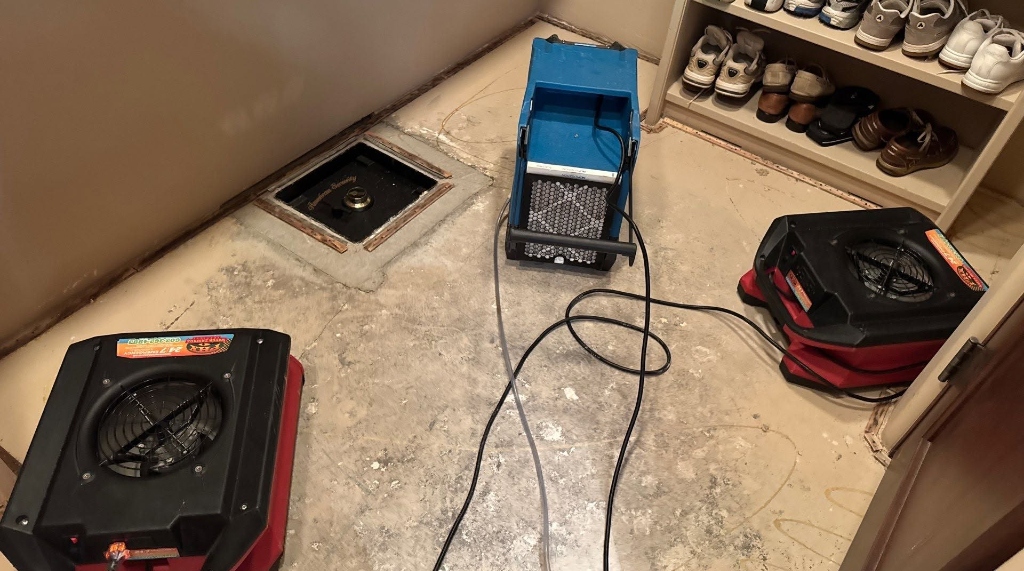
Specialized Equipment & Industrial Restoration Technology
Mitigating severe property damage requires industrial-grade technology capable of altering thermodynamic psychrometrics:
Truck-Mounted Extraction Rigs
31-HP engines producing 16+ inches Hg vacuum suction to evacuate bulk water rapidly into holding tanks.
Low-Grain Refrigerant Dryers
Pre-cooling heat-pipe systems driving ambient grains per pound below 25 GPP to draw deep trapped water out of framing.
HEPA Negative-Air Scrubbers
Hospital-grade 99.97% particulate filtration capturing microscopic fungal spores, soot, and biohazard aerosols.
FLIR® Thermal Scanners & Probes
Infrared thermography detecting evaporative cooling boundaries behind walls, combined with digital RF pinless scanners.
Professional Restoration vs. DIY Mitigation
Attempting DIY cleanup during a property disaster creates severe hidden liabilities:
- Trapped Moisture: Surface drywall dries while moisture inside cavities triggers hidden mold blooms.
- Pathogenic Risks: Category 2 & 3 water contains bio-contaminants standard cleaners fail to kill.
- Insurance Denial: Insurers require daily psychrometric logs; lack of data causes claim disputes.
Transparent Upfront Itemized Pricing
Valley Restoration Pros operates with complete transparency:
- Free On-Site Assessment: Complete physical inspection before work begins.
- Upfront Itemized Estimates: Detailed line items calculated via industry-standard Xactimate.
- Zero Surprise Billing: No hidden charges or unauthorized repairs.
Certified TSMC Supplier Park commercial cleanroom water damage restoration Phoenix Field Documentation
Every response performed by Valley Restoration Pros is documented through photographic and thermographic records:

Comprehensive TSMC Supplier Park commercial cleanroom water damage restoration Phoenix Technical Manual & Operational Standards
Exhaustive engineering protocols, psychrometric calculations, geological multipliers, and step-by-step restoration standards for Maricopa County properties:
Executive Emergency Abstract: TSMC Supplier Park Cleanroom Hydronic Inundation & Production Safeguard
The rapid expansion of the Arizona semiconductor manufacturing ecosystem around the Taiwan Semiconductor Manufacturing Company (TSMC) Fab 21 mega-complex in North Phoenix has established one of the world's most technologically sophisticated advanced manufacturing corridors. Situated immediately adjacent to the Loop 303 and Interstate 17 interchange, spanning Sonoran Desert Drive, Dove Valley Road, and the surrounding Sonoran Oasis technology parks within ZIP codes 85083 and 85085, the TSMC Supplier Park hosts elite tiers of international equipment manufacturers, ultra-pure chemical formulators, precision wet-bench fabricators, electronic specialty gas suppliers, and optical component packaging facilities. These mission-critical supplier facilities operate specialized cleanrooms ranging from ISO 14644-1 Class 1 down to Class 7 environments that supply, service, and integrate the sub-nanometer fabrication processes driving modern microprocessors.
Cleanrooms within the TSMC Supplier Park are extraordinarily sensitive micro-environments. A single particulate measuring larger than 0.1 microns, an uncontrolled relative humidity deviation above 45 percent, or the presence of microscopic chemical residues can destroy months of production, corrupt wafer packaging lines, and breach strict supplier quality agreements with the anchor mega-fab. When an unexpected hydronic catastrophe occurs—whether caused by a mechanical flange separation on a high-pressure Ultra-Pure Water (UPW) polishing loop, an overhead process cooling water (PCW) return line rupture, a chilled water loop HVAC coil rupture, or a chemical mechanical planarization (CMP) slurry flush backflow—the cleanroom is immediately plunged into an operational crisis.
Unlike standard commercial properties, cleanroom water damage cannot be mitigated through conventional drying methods. Water cascading across perforated raised floor tiles, saturating the plenum space beneath, or pooling around structural tool plinths initiates rapid aerodynamic vapor dispersion. The immense laminar airflow systems (recirculating hundreds of thousands of cubic feet per minute through ceiling-mounted Fan Filter Units and Ultra-Low Particulate Air filters) instantly aerosolize standing liquids, distributing elevated moisture and suspended airborne contaminants across multi-million-dollar optical lithography platforms, automated wafer transport tracks, and electrostatic chucks. Immediate mobilization of certified emergency water extraction teams within sixty minutes of the primary breach is mandatory to arrest particulate contamination and save cleanroom certifications.
Valley Restoration Pros maintains dedicated cleanroom disaster recovery task forces strategically staged to serve the North Phoenix semiconductor corridor. Operating under rigorous compliance with SEMI S2 environmental safety criteria and IICRC S500 / S520 restoration protocols, our Master Certified personnel stabilize water intrusions, erect negative-pressure anti-static containment envelopes, deploy oil-free explosion-proof vacuum systems, and implement high-volume desiccant psychrometric dehumidification to return cleanroom spaces to certified baseline specifications without particulate generation or structural degradation.
Immediate Cleanroom Crisis Directives: The Critical First 30 Minutes
- Automated Hydronic SCADA Isolation: Immediately actuate localized motorized shutoff valves on the affected UPW, PCW, or chilled water supply circuit to halt pressurized discharge without depressurizing unaffected cleanroom bays.
- Switch Cleanroom Air Handling to Scrub Mode: Transition cleanroom recirculation units from standard recirculating mode to isolated negative-draw or reduced-velocity bypass to prevent moisture plumes from entering ceiling ULPA filter banks.
- Isolate Underfloor Power Feeds: De-energize 480V three-phase busways and floor-mounted power distribution units (PDUs) supplying sub-fab vacuum pumps, wet benches, and RF generators to eliminate catastrophic arc flash and electrocution hazards.
- Dispatch Industrial Cleanroom Response Units: Contact Valley Restoration Pros at (602) 847-9593 or engage our direct line via Emergency Phone Dispatch for immediate mobilization to the Loop 303 & I-17 technology park.
Anatomy of the Failure & Physical Dynamics in Advanced Supplier Cleanrooms
To understand the catastrophic potential of a water release within a TSMC Supplier Park facility, one must examine the intricate structural and hydronic architecture of modern cleanrooms. Semiconductor supplier facilities in North Phoenix typically utilize a multi-tier structural design: a primary cleanroom floor constructed with raised perforated aluminum or composite access tiles resting on steel pedestals, elevated two to four feet above a monolithic structural concrete sub-slab, or positioned over a full sub-fab mechanical basement. Directly overhead hangs a heavy ceiling grid containing Fan Filter Units (FFUs), pressurized supply air plenums, high-purity chemical delivery lines, and pre-action double-interlock fire sprinkler systems.
The fluids circulating throughout these facilities operate under high hydraulic pressures and distinct physical properties that dictate the dynamics of a loss. In advanced supplier facilities, three primary fluid systems represent the greatest failure hazards:
- Ultra-Pure Water (UPW) Distribution Loops: Circulating through welded Polyvinylidene Fluoride (PVDF) or Perfluoroalkoxy (PFA) piping networks at pressures between 45 and 75 PSI, UPW is stripped of all ions, yielding an electrical resistivity of 18.2 Megaohm-centimeters. While pure UPW does not conduct electricity initially, it is an exceptionally aggressive solvent. The moment a mechanical joint splits or an automated valve housing fractures, the escaping UPW aggressively dissolves ambient carbon dioxide and surface minerals from the concrete floor or equipment chassis, transforming instantly into an electrolytic, highly conductive solution that attacks electronic circuit boards, short-circuits wireways, and corrodes grounding straps.
- Closed-Loop Process Cooling Water (PCW): Running through insulated 304 and 316 stainless steel or schedule 80 PVC piping at 60 to 90 PSI, PCW circulates chilled treated water to laser generators, turbomolecular vacuum backing pumps, etching chambers, and CMP platen coolers. A rupture in an 4-inch or 6-inch PCW manifold discharges between 300 and 800 gallons of chemically treated, biocide-stabilized water per minute, flooding subfloor plenums within seconds and inundating utility raceways.
- Acid Waste Neutralization (AWN) Drainage Runoff: Waste streams carrying diluted hydrofluoric, sulfuric, hydrochloric, or phosphoric acid residues from cleanroom wet benches flow through double-contained polypropylene pipe-in-pipe networks to specialized subterranean lift stations. A hydraulic surcharge or pipe seal displacement can discharge hazardous liquid into utility trenches, demanding immediate specialized decontamination protocols identical to our commercial semiconductor acid waste neutralization pit flood phoenix operational standards.
The physical dynamics of fluid dispersal within cleanrooms are violently accelerated by aerodynamic factors. Semiconductor cleanrooms maintain positive static pressure gradients (+0.05 to +0.08 inches of water column) relative to service chases, combined with continuous laminar down-flow velocities of 70 to 90 feet per minute. When thousands of gallons of water discharge under pressure, the jet impact generates micro-droplet atomization. The downward air currents force this fine moisture mist through raised floor perforations, into subterranean return air plenums, and across high-voltage cables.
As fluid accumulates on the sub-slab, it encounters structural pedestal bases, vibration-isolation inertia blocks, and heavy equipment anchor bolts. In facilities experiencing an unexpected burst pipe repair emergency, water rapidly migrates beneath chemical dispensing cabinets, robotic transfer cells, and metrology tooling. Capillary suction pulls standing liquid into porous elastomeric vibration dampers and expansion joints. If the moisture is not evacuated immediately, the relative humidity inside the cleanroom envelope spikes from its regulated 38% setpoint to near saturation (85% to 95% RH) within two to four hours.
This humidity spike triggers catastrophic secondary physical damage. Moisture condenses on cold surfaces, including chilled process lines, optical quartz windows, laser mirrors, and precision robotics. High humidity causes hygroscopic materials, such as photoresist polymers, chemical packaging liners, and fiber-optic couplers, to swell and degrade. Simultaneously, water pooled beneath raised floors begins to dissolve free lime from concrete slabs, creating alkaline vapor emissions that travel through the air stream, threatening to neutralize acidic chemical reagents and deposit micron-scale salts upon silicon wafer substrates.
The physical restoration protocol requires precise balancing of hydrodynamics and aerodynamics. Extracting standing liquids without disrupting cleanroom laminar flow demands specialized pneumatic fluid recovery, anti-static grounding, and continuous psychrometric control, mirroring the stringent engineering applied in semiconductor cleanroom water damage restoration phoenix facilities across the Valley.
Phoenix-Specific Climatic & Geological Multipliers: Sonoran Desert Realities
High-technology manufacturing in the northern reaches of Phoenix, particularly throughout the Upper Sonoran Desert perimeter along the Loop 303, Carefree Highway, and Interstate 17 corridor, encounters a unique convergence of severe environmental, geological, and hydrologic challenges. These regional factors act as aggressive multipliers during any cleanroom water loss, transforming what might be a routine pipe leak in a temperate climate into an immediate structural and contamination catastrophe.
The primary climatic and geological forces impacting the TSMC Supplier Park include:
18–22 GPG Municipal Water Hardness
Municipal raw water supplied from the Central Arizona Project (CAP) canal and Salt River Project (SRP) aquifers carries extreme total dissolved solids (TDS) exceeding 700 to 1,100 PPM and calcium hardness of 18 to 22 GPG. When municipal supply or facility fire suppression water discharges into a cleanroom, rapid desert evaporation leaves dense mineral crusts. These hard water scale residues coat conductive circuits, create galvanic corrosion cells on electrical connectors, and release airborne mineral dust during drying that violates ISO particulate limits.
115°F Summer Heat & Rapid Microbial Blooms
During Phoenix summer months from May through September, ambient outdoor temperatures consistently exceed 110°F to 118°F, creating immense thermal loads on facility chillers. When water floods a sub-fab or interstitial mechanical plenum, thermal transfer from concrete foundations and high-efficiency machinery drives localized wet temperatures into the ideal 85°F to 105°F incubation zone. In this environment, bacterial colonies and fungal spores proliferate within 24 to 36 hours—a timeframe twice as rapid as standard industrial buildings.
Expansive Caliche Soil Heave & Plinth Movement
The desert terrain surrounding Loop 303 and Sonoran Desert Drive consists of dense clay strata interbedded with caliche—a heavily cemented calcium carbonate geological hardpan. When subterranean pipe ruptures or large-volume cleanroom inundations saturate sub-grade soils beneath the slab, caliche-clay matrices exhibit massive volumetric swelling. This hydraulic heave can exert thousands of pounds per square foot of upward pressure, shifting deep vibration plinths out of alignment and cracking sub-fab slab joints.
Monsoon Flash Deluges & Haboob Particulate Infiltration
Between July and September, intense North American monsoon thunderstorms drop torrential rainfall on the Sonoran desert, frequently overwhelming exterior retention basins and stormwater drainage channels. Concurrently, severe haboob dust storms generate rolling atmospheric dust walls with PM10 concentrations exceeding 3,000 µg/m³. If exterior louvers or makeup air units intake humid, dust-laden air during an active cleanroom water extraction event, catastrophic airborne particulate breaches occur.
The interplay between North Phoenix hard water and semiconductor processing is particularly treacherous. Facilities operating high-purity reverse osmosis and electrodeionization systems maintain massive reject brine streams. When high-TDS reject lines fail, or when cooling tower blowdown lines rupture, the mineral-rich water cascades across equipment surfaces. In cleanrooms, where particulate counts must not exceed 10 particles per cubic foot at 0.5 microns (ISO Class 4), a single dried drop of 20 GPG hard water generates millions of sub-micron crystalline calcite particles upon evaporation. Once desiccated, normal cleanroom foot traffic or vibration crushes these crystals into airborne aerosols that bypass standard pre-filters and clog expensive ULPA banks.
Furthermore, soil hydration dynamics along Interstate 17 present extreme risks to advanced packaging facilities. Precision lithography steppers, wire-bonding machines, and wafer dicing saws require vibration isolation to VC-D and VC-E standards (micro-inch per second velocity limits). Sub-slab water saturation that infiltrates caliche layers causes uneven foundation displacement. Even a sub-millimeter foundation tilt across a 50-foot equipment bay can misalign laser metrology tracks and optical interferometers, resulting in weeks of costly tool recalibration.
Addressing these hyper-local multipliers requires deep regional engineering expertise. Valley Restoration Pros incorporates continuous sub-slab moisture monitoring, precision laser level verification, and multi-stage desiccant dehumidification tailored specifically to the geological realities of phoenix water damage mitigation and the extreme climate of the Sonoran Desert.
Immediate Emergency First-Hour Protocol & SEMI S2 Safety Isolation
The initial sixty minutes following a commercial cleanroom water inundation in the TSMC Supplier Park dictate whether the facility recovers within 48 to 72 hours or faces months of decertification, structural teardown, and crippling business interruption. Semiconductor cleanrooms contain an extraordinarily volatile combination of high-voltage electrical distribution, pressurized hazardous process chemicals, pyrophoric gases, and ultra-sensitive optical equipment. Restoration cannot begin as a haphazard cleanup; it must execute as a synchronized industrial engineering procedure adhering strictly to SEMI S2 (Environmental, Health, and Safety Standards for Semiconductor Manufacturing Equipment) and OSHA 29 CFR 1910 standards.
Prior to entering any submerged subfloor plenum or utility basement, technicians coordinate with facility environmental health and safety (EHS) officers to conduct continuous atmospheric air testing. In cleanroom environments supporting chemical vapor deposition (CVD) or wet chemical etching, standing water can interact with chemical residues on tool bases, generating toxic fumes or acidic aerosols. Technicians carry portable multigas photoionization detectors (PIDs) calibrated to detect volatile organosilicons, chlorine, and phosphine traces. If airborne toxic hazards or compromised chemical delivery valve manifolds (VMBs) are observed, Level B supplied-air respirators and chemical-resistant oversuits are immediately donned before mechanical extraction begins.
Upon arrival at the North Phoenix facility, Valley Restoration Pros emergency incident commanders establish a structured Unified Incident Command with facility operations, EHS directors, and facilities engineering. The following chronological protocol governs the first hour of emergency intervention:
During this critical first hour, maintaining electrostatic discharge (ESD) safety is paramount. All restoration technicians entering the cleanroom wear certified conductive Tyvek suits, grounded dissipative boot covers, and ESD wrist straps connected to verified building ground points. Conventional restoration tools made of ungrounded plastics generate static charges exceeding 5,000 to 10,000 volts—charges capable of destroying sensitive CMOS semiconductor chips, ruining reticles, and blowing microscopic gates within wafer transport robotics.
For facilities requiring specialized chemical biological safety protocols, our certified crews adapt workflows aligned with our pharmacy compounding cleanroom water damage decontamination phoenix and hazardous containment operations, ensuring complete regulatory protection across every phase of emergency intervention.
Advanced Industrial Equipment Specifications & Cleanroom Setup
Mitigating a large-scale commercial water disaster within the TSMC Supplier Park requires equipment that vastly exceeds the capabilities of standard residential or commercial restoration fleets. Cleanroom fabrication environments forbid the introduction of carbon-emitting combustion engines, unsealed electrical motors that throw carbon brush dust, non-HEPA-filtered exhausts, or standard plastic housings that outgas volatile organic compounds (VOCs).
Valley Restoration Pros maintains a multi-million-dollar fleet of advanced industrial drying, extraction, and diagnostic technologies specifically configured for cleanroom deployment:
| Restoration Asset | Technical Specifications | Cleanroom Application & Function | Compliance Standard |
|---|---|---|---|
| Industrial Desiccant Trailers | 5,000 to 15,000 CFM; silica gel active rotor; delivers <10% RH air at sub-zero dew points (<15°F); auxiliary electric reactivation. | External deployment delivering ultra-dry reactivation air through sealed cleanroom pass-throughs directly into subfloor plenums. | IICRC S500 Class 4 Deep Drying |
| DOP-Tested True HEPA Air Scrubbers | 2,000 CFM variable-speed; multi-stage carbon pre-filtration; 99.97% capture efficiency at 0.3 microns; zero carbon brush discharge. | Establishment of continuous negative-pressure containment fields to capture aerosolized droplets and particulates during drying. | ISO 14644-1 Class 1–5 Integrity |
| Pneumatic Explosion-Proof Extractors | Air-driven dual-diaphragm pumps; PTFE wetted parts; stainless steel housing; grounded dissipative suction wands; 80 GPM capacity. | Safe extraction of high-volume water from subfloor trenches and chemical drainage chases without electrical ignition hazards. | SEMI S2 / ATEX Zone 1 Compliant |
| Injectidry High-Pressure Systems | Positive/negative pressure airflow manifold; 120 PSI static lift; filtered air injection; low-decibel sound dampening. | Targeted desiccant air injection into enclosed tool support plinths, cable channelling, and double-walled cleanroom wall cavities. | Non-Destructive Cavity Drying |
| High-Resolution FLIR Thermal Cameras | 640x480 native thermal resolution; 0.03°C thermal sensitivity; calibrated for low-emissivity polished cleanroom metallic surfaces. | Non-invasive mapping of moisture plumes beneath raised floor pedestals, within insulated pipe chases, and behind modular walls. | ASTM E1934 Infrared Inspection |
| Met One Optical Particle Counters | 6-channel real-time laser counting (0.1, 0.3, 0.5, 1.0, 5.0, 10.0 µm); 1.0 CFM flow rate; automated data logging with audit trail. | Continuous atmospheric monitoring to confirm containment barrier integrity and verify that drying actions do not generate dust. | ISO 14644-1 / FS209E Certified |
The strategic deployment of desiccant dehumidifiers is critical when handling semiconductor cleanrooms. Standard Low-Grain Refrigerant (LGR) dehumidifiers condense water onto refrigerated coils, but their physical efficiency drops drastically when ambient relative humidity drops below 40% or when working in chilled cleanroom environments maintained at 68°F. Cleanrooms require Class 4 deep drying conditions, where the goal is to drive the dew point below 30°F and lower specific humidity below 25 grains per pound (GPP). Only desiccant units utilizing synthetic silica gel rotors can extract bound water molecules from dense concrete slabs and enclosed machinery housings under these conditions.
To prevent introducing exterior airborne particulates or diesel exhaust into the pristine North Phoenix facility, our massive desiccant trailers remain positioned outside the facility perimeter on dedicated industrial pads. Clean, ultra-dry reactivation air is transferred into the facility through flexible, antistatic lay-flat ducting that passes through sealed emergency airlocks, while humid exhaust air is vented directly to the exterior atmosphere.
Simultaneously, negative-air filtration engineering is tuned to preserve cleanroom aerodynamic balance. Standard air scrubbers create turbulent drafts that disturb settled floor dust. Valley Restoration Pros utilizes multi-point variable-frequency drive (VFD) air filtration systems equipped with primary pre-filters, secondary activated carbon matrices, and final true HEPA filters certified via dispersed oil particulate (DOP) aerosol challenges. Airflow discharge velocities are calibrated to maintain non-turbulent laminar wash across cleanroom floor grates, keeping air speeds within the optimal 60 to 80 feet per minute window.
For complex multi-tier equipment plinths supporting chemical mechanical polishing and automated wafer inspection stations, non-destructive moisture extraction is executed using positive-pressure desiccant injection grids. These systems inject heated dry air into blind structural cavities and hollow equipment framework through calibrated manifold ports, driving trapped moisture outward into negative-pressure capture envelopes. Constant telemetry from laser optical particle counters and thermal imaging cameras ensures that no moisture pocket remains undetected beneath heavy steel baseplates.
Industrial electrical distribution for cleanroom mitigation equipment requires isolated power management. Connecting high-load drying equipment to existing cleanroom utility circuits risks overloading sensitive uninterrupted power supplies (UPS) or introducing harmonic electrical noise into precision metrology networks. Valley Restoration Pros utilizes dedicated external mobile power generation units operating outside the cleanroom envelope. Power is distributed into the facility through isolated, heavy-gauge rubber-jacketed SOOW cables connected to portable spider distribution boxes with Class A Ground Fault Circuit Interrupters (GFCI). All power feeds, air scrubbers, and vacuum manifolds are bonded to facility master grounding buses with braided copper grounding straps, maintaining zero millivolt potential differences across the entire drying field.
To provide cleanroom managers with complete operational visibility, our equipment arrays interface with an encrypted wireless sensor telemetry network. Cloud-linked hygrometers, airflow anemometers, and differential pressure transducers take readings every five minutes, streaming live psychrometric trends directly to our mobile command centers and facility operations dashboards. This real-time data allows engineers to modulate desiccant airflow volumes and negative-air pressure setpoints remotely, maintaining optimal drying efficiency 24 hours a day without repeated cleanroom entries that could introduce outside contaminants.
For deep structural drying across large footprints, our protocols integrate seamless coordination with high-performance structural drying methodologies, ensuring complete moisture elimination from concrete sub-slabs without inducing thermal cracking or vibrational disturbances.
IICRC S500 / S520 Step-by-Step Cleanroom Restoration Protocol
Executing a comprehensive cleanroom restoration project within the TSMC Supplier Park demands exact adherence to the Institute of Inspection, Cleaning and Restoration Certification (IICRC) S500 Standard for Professional Water Damage Restoration and S520 Standard for Professional Mold Remediation, integrated with ISO 14644 cleanroom operational disciplines. Every phase of our restoration blueprint is engineered to achieve verifiable dry standards while maintaining strict particulate isolation.
Our technicians follow an eight-stage engineering procedure:
Stage 1: Multi-Spectrum Psychrometric & Thermal Mapping
Technicians establish baseline environmental readings across all impacted and unimpacted clean bays, recording ambient temperature, relative humidity, dew point, and grains per pound (GPP). High-resolution FLIR infrared thermal cameras scan modular wall panels, sub-fab utility penetrations, and ceiling plenum spaces to delineate the exact boundary of moisture migration. In-situ electrical resistance and non-invasive capacitance moisture meters record baseline moisture content across concrete sub-slabs and raised floor pedestals.
Stage 2: Critical Aerodynamic Containment & Airflow Management
To isolate the water intrusion zone from active wafer processing areas, technicians construct full-height anti-static containment chambers using flame-retardant (NFPA 701) polyethylene film supported by telescoping aluminum poles. Pressure differentials (-0.03 in. w.g.) are established using certified negative-air machines equipped with DOP-tested HEPA filtration. Real-time digital manometers continuously monitor and log containment pressure to guarantee zero outward particulate migration.
Stage 3: High-Volume Precision Fluid Extraction
Bulk standing water is extracted using explosion-proof pneumatic diaphragm pumps and ESD-grounded wet vacuum systems. Technicians systematically remove perforated access floor panels to gain direct access to the sub-slab, capturing pooled water from sunken utility trenches, acid collection sumps, and electrical conduits. Water is transferred into sealed containment drums or routed directly to facility waste neutralization systems in compliance with environmental regulations.
Stage 4: Decontamination of Residues & Calcite Scaling
Because Phoenix municipal water and industrial cooling water deposit aggressive calcium minerals and chemical residues upon drying, all impacted structural concrete, pedestals, and equipment plinths undergo precision surface wiping. Technicians utilize semiconductor-grade lint-free polyester wipes dampened with ultra-pure deionized water and approved non-volatile isopropyl alcohol (IPA) solutions to neutralize mineral efflorescence, remove heavy metals, and eliminate conductive paths.
Stage 5: Deep Desiccant Psychrometric Evaporation
High-capacity industrial desiccant dehumidifiers deliver ultra-dry air (<10% RH, dew point <15°F) into the enclosed containment space. Low-profile, high-velocity axial air movers are positioned beneath the raised floor to sweep laminar air across the sub-slab, accelerating the evaporation of bound moisture from dense concrete without generating excessive turbulence in the cleanroom breathing zone. Controlled drying curves are calibrated to prevent rapid moisture gradients that could cause concrete micro-cracking.
Stage 6: Target Cavity & Vibration Plinth Micro-Drying
Specialized equipment plinths supporting photolithography steppers, CMP polishers, and ion implanters contain complex internal voids and vibration-dampening elastomeric pads. High-pressure Injectidry systems deliver heated, dry desiccant air directly into these sealed cavities through non-destructive ports, ensuring that moisture trapped beneath machinery bases is completely extracted before corrosion can compromise bearings or electronics.
Stage 7: In-Situ Concrete Relative Humidity Verification (ASTM F2170)
To confirm that structural drying has achieved verifiable dry standards, technicians install in-situ relative humidity probes within the monolithic concrete sub-slab in accordance with ASTM F2170. Drying continues until internal slab relative humidity falls below 75% RH, ensuring that moisture will not wick upward through floor coatings or cause epoxy delamination when raised floor access panels are reinstalled.
Stage 8: Particulate Re-Certification & Commissioning Handoff
Prior to deconstructing containment barriers, the entire workspace undergoes a comprehensive cleanroom wipe-down from ceiling grid to sub-slab using ISO-compliant cleaning protocols. Real-time optical particle counters sample air quality across multiple spatial coordinates for 24 continuous hours. Once particle concentrations comply strictly with ISO 14644-1 parameters, the space is formally certified and handed over to facility production engineers.
Throughout this multi-stage execution, continuous monitoring ensures that microbial organisms do not take root in wet interstitial cavities. If biological indicators or Category 3 blackwater contamination is detected, certified remediation procedures aligned with our specialized sewage cleanup and industrial decontamination protocols are immediately integrated.
Psychrometric calculations dictate every adjustment to our industrial drying fleet. Technicians continuously compute vapor pressure differentials between saturated structural concrete (where surface vapor pressure frequently exceeds 0.85 inches of mercury) and ambient desiccant air streams maintained below 0.15 inches of mercury. This steep vapor pressure gradient forces trapped capillary moisture out of dense monolithic foundations without requiring excessive heat that could distort precision granite surface plates or misalign robotic conveyor tracks.
Before formal handoff, structural dynamic testing is conducted across all machinery foundation pedestals. High-precision triaxial accelerometers record ambient vibrational spectrums, confirming that sub-slab drying has not altered pedestal resonant frequencies or disturbed tool vibration isolation criteria (VC-D and VC-E velocity curves). This interdisciplinary verification guarantees that production tooling can resume sub-nanometer operations without risk of harmonic interference or wafer misregistration.
Furthermore, our certified microbiologists and industrial hygienists maintain continuous surveillance against mold spore germination, implementing protocols consistent with our dedicated mold remediation standards to protect wafer fabrication zones from biogenic particulate contamination.
Hyper-Local North Phoenix Case Study: TSMC Supplier Park Process Cooling Water Burst
High-Volume PCW Manifold Rupture: Advanced Wet-Bench Cleanroom Recovery
Location: Sonoran Desert Drive & Loop 303 Corridor, Phoenix, AZ 85085 | Facility: 45,000 Sq. Ft. Semiconductor Supplier Fabrication Facility
6-Inch PCW Header Shear Under 80 PSI
Approximately 14,000 Gallons
ISO Class 4 Sub-Fab & Class 5 Clean Bay
28 Minutes from Initial Emergency Call
Incident Summary & Initial Threat:
At 02:15 on a Tuesday morning during peak summer heat (outdoor ambient 98°F at night), a mechanical Victaulic coupling on a 6-inch closed-loop Process Cooling Water (PCW) manifold failed catastrophically above a raised floor wet-bench clean bay in a major semiconductor chemical supplier facility located near Sonoran Desert Drive and the Loop 303 in North Phoenix (ZIP 85085). Before automated SCADA pressure-drop interlocks tripped the primary isolation valves, an estimated 14,000 gallons of chilled treated cooling water cascaded across 12,000 square feet of cleanroom raised floor.
Standing water accumulated to a depth of 3.5 inches across the structural concrete sub-slab, submerging 480V power distribution conduits, dry vacuum pump skids, and automated chemical transfer manifolds. Water vapor immediately entered the cleanroom recirculating air stream, driving cleanroom relative humidity from 40% to 89% in under 45 minutes. The facility faced immediate loss of its ISO Class 5 certification, potential condensation damage to four state-of-the-art chemical blending tracks, and catastrophic electrical shorting across subterranean switchgear.
Emergency Response & Engineered Execution:
Valley Restoration Pros industrial emergency disaster teams were dispatched from our North Phoenix emergency depot, arriving on site within 28 minutes. After confirming electrical lockout/tagout with the facility EHS director, technicians established negative-pressure containment (-0.035 in. w.g.) between the flooded clean bay and adjoining packaging lines using anti-static poly barriers and two 2,000 CFM DOP-tested HEPA air scrubbers.
Four high-volume pneumatic diaphragm extractors were deployed into subfloor utility trenches, removing over 12,000 gallons of bulk liquid within 90 minutes. A trailer-mounted 10,000 CFM industrial desiccant dehumidifier was positioned outside the facility, with antistatic supply ducting routed into the subfloor plenum to deliver ultra-dry air (<10 GPP, dew point 12°F). High-velocity axial air movers positioned under the raised floor created non-turbulent laminar drying currents across the saturated concrete sub-slab.
Verifiable Psychrometric & Particulate Drying Milestones:
| Timeline Milestone | Cleanroom Temp | Relative Humidity | Humidity Ratio (GPP) | Concrete Slab RH (ASTM F2170) | ISO 14644 Particulate Status |
|---|---|---|---|---|---|
| Hour 0: Initial Arrival | 74°F | 89% | 114 GPP | 98% Internal Slab RH | Compromised (>ISO Class 7) |
| Hour 12: Bulk Extraction Complete | 71°F | 52% | 59 GPP | 92% Internal Slab RH | ISO Class 6 (Under Containment) |
| Hour 24: Deep Desiccant Operation | 69°F | 34% | 36 GPP | 81% Internal Slab RH | ISO Class 5 Achieved |
| Hour 42: Verified Dry Standard | 68°F | 22% | 21 GPP | 68% Internal Slab RH | Certified ISO Class 4 Re-Established |
Project Outcome & Commercial Impact:
Through rapid extraction and continuous desiccant dehumidification, Valley Restoration Pros achieved verified dry standards across all structural surfaces and concrete sub-slabs in exactly 42 hours—18 hours ahead of the facility insurer contingency model. Independent third-party laser particle counting confirmed that ISO Class 4 cleanroom cleanliness standards were fully restored. Zero chemical blending tools suffered electronic or optical corrosion, preventing an estimated $8.6 million in lost chemical production and tooling replacement costs.
Our proven capabilities in mission-critical high-tech facilities mirror the technical precision delivered across sister projects, including our price corridor commercial sub fab water damage restoration chandler operations and our work in specialized life science environments such as the scottsdale cure corridor commercial lab water damage corridor.
Commercial Cleanroom Business Interruption & Insurance Documentation
In the advanced semiconductor supply chain, business interruption (BI) and contingent business interruption (CBI) exposures dwarf standard physical property losses. Cleanroom facilities in the TSMC Supplier Park operate under strict contractual delivery schedules with tier-one semiconductor fabricators. A delay of several days in delivering high-purity chemical batches, specialty gases, or optical assemblies can trigger liquidated damages clauses and disrupt multi-billion-dollar fabrication schedules across the Valley.
Valley Restoration Pros operates with transparent commercial billing practices and comprehensive forensic documentation. In strict adherence to industry regulations and consumer protection standards, we emphasize our core commercial service commitments:
- Free Comprehensive On-Site Damage Assessment: Complete initial thermal infrared imaging, psychrometric evaluation, and particle count inspection conducted by Master Certified technicians with zero inspection fees.
- Transparent Upfront Itemized Pricing Before Work Begins: Comprehensive line-item scopes established using standardized industrial pricing formats (Xactimate commercial industrial codes and time-and-materials schedules) authorized before equipment deployment.
- Assistance with Detailed Claims Documentation & Psychrometric Moisture Logs: Ironclad forensic documentation packages, including hourly moisture logs, equipment run logs, calibration certificates, and thermal photographic evidence to streamline insurer claim processing.
We maintain a strict policy regarding financial transparency: we never promise that commercial insurance will cover 100 percent of costs without client review, nor do we claim to directly bill insurance without complete facility authorization and contractual clarity. Instead, we arm facility risk managers, corporate risk engineering directors, and forensic insurance adjusters with incontrovertible scientific evidence.
Our dedicated Forensic Documentation Binder includes:
- Hourly Psychrometric Drying Records: Ambient temperature, relative humidity, dew point, and humidity ratio (GPP) tracking curves that scientifically prove continuous drying progress.
- In-Situ Concrete Moisture Logs (ASTM F2170): Quantitative internal slab RH data verifying when sub-slabs reach equilibrium with manufacturer installation standards.
- Particle Count Verification Certificates: Multi-point laser optical particle counts benchmarked against ISO 14644-1 cleanliness classes before, during, and after mitigation.
- Equipment Operational Time-Tracking: Digital hour-meter logs, electrical consumption data, and fuel records for trailer-mounted desiccant generators.
- Contaminated Fluid Chain of Custody: Manifest documentation verifying the safe handling, testing, and disposal of industrial process wastewater in compliance with Maricopa County environmental regulations.
This meticulous forensic documentation eliminates claims disputes with major commercial property carriers (such as FM Global, Travelers, Chubb, and Zurich), accelerating reimbursement approvals and facilitating business interruption settlements. Forensic accountants representing underwriters require transparent, auditable tracking that correlates every piece of deployed equipment to specific psychrometric demand. By cataloging hourly grain depression rates and concrete moisture dissipation curves, we prove the objective necessity of every machine deployed on site.
Our itemized accounting framework incorporates standardized commercial industrial line items without vague blanket charges. Consumable assets—such as antistatic lay-flat ducting, HEPA filter cartridges, and chemical neutralization reagents—are invoiced with complete distributor back-up paperwork. Labor hours are categorized by specific skill levels, including Master Certified Water Restoration Technicians, Hazardous Materials Specialists, and Cleanroom Protocol Supervisors, matching regional prevailing rate structures.
By establishing transparent, verified records from the initial emergency dispatch through post-remediation particle certification, Valley Restoration Pros ensures that corporate risk officers, cleanroom directors, and insurance representatives maintain full alignment throughout the entire recovery lifecycle.
Facility financial controllers and risk managers seeking preliminary restoration cost modeling can explore our interactive online cost estimator tool to review equipment rates, labor classifications, and structural drying parameters.
Exhaustive Semiconductor Supplier Cleanroom Technical FAQ
1. How do you prevent water extraction and drying activities from generating airborne particulates inside an ISO Class 4 or 5 cleanroom?
All restoration operations within cleanroom environments follow non-turbulent aerodynamic protocols. We deploy DOP-tested true HEPA air scrubbers equipped with zero-carbon-brush motors, ducted outside the clean bay to maintain negative pressure (-0.02 to -0.04 in. w.g.). Technicians utilize antistatic, grounded extraction wands and lint-free polyester wipes. Desiccant supply air is delivered through filtered diffusers at controlled velocities (below 50 feet per minute) to ensure that settled micro-particulates are not re-aerosolized into cleanroom air pathways.
2. Can ultra-pure water (UPW) cause electrical shorts or equipment corrosion if it contains zero minerals?
Yes, rapidly and destructively. Although virgin UPW exhibits high electrical resistance (18.2 Megaohm-cm) when enclosed in sealed PVDF piping, it is chemically aggressive. As soon as UPW spills into a cleanroom or sub-fab, it dissolves carbon dioxide from the air to form carbonic acid and leaches ions from concrete slabs, metals, and dust residues. Within minutes, its resistivity drops precipitously, transforming the fluid into a conductive electrolyte that creates catastrophic arc faults, destroys circuit boards, and causes rapid galvanic corrosion across electrical contacts.
3. Why are trailer-mounted desiccant dehumidifiers mandatory instead of standard LGR units in cleanroom environments?
Standard Low-Grain Refrigerant (LGR) dehumidifiers function by chilling air below its dew point to condense liquid moisture. In cleanrooms maintained at 68°F and 35% to 45% relative humidity, LGR units lose physical efficiency because the dew point is already low. Furthermore, LGR units cannot reach the deep drying metrics (dew point <20°F, humidity ratio <20 GPP) necessary to pull capillary moisture from dense concrete sub-slabs and tool plinths. Industrial desiccant units use silica gel adsorption rotors that operate independently of temperature, continuously delivering supply air below 10% RH without generating water condensate or internal mold growth.
4. How do you address foundation heave or plinth misalignment caused by caliche soil hydration beneath the slab?
When large volumes of water penetrate sub-grade soils in North Phoenix, expansive caliche-clay strata swell, generating upward hydraulic pressures. We deploy high-precision digital optical levels and laser interferometers to establish baseline tool plinth elevation and planar levelness. Deep drying systems extract sub-slab moisture, and we collaborate directly with structural geotechnical engineers and tool metrology technicians to monitor plinth stabilization before sensitive lithography and wet-bench tooling are re-energized.
5. What safety protocols are followed if cooling tower loops or hydronic chiller pipes rupture into cleanroom plenums?
Cooling tower water and chilled water systems carry biocides, corrosion inhibitors, and biological contaminants such as Legionella pneumophila. When these lines rupture, we implement protocols matching our commercial chiller pipe flood restoration and commercial cooling tower basin overflow cleanup phoenix operations. The loss is classified as Category 2 or Category 3 water, requiring technician Level C PPE, sealed containment, antimicrobial neutralization, and full negative-air HEPA scrubbing before structural drying commences.
6. How is concrete sub-slab dryness verified prior to re-installing raised floor access panels and re-commissioning?
We verify sub-slab dryness using quantitative in-situ relative humidity testing following ASTM F2170 standards. Technicians drill test holes to 40% of the slab depth in non-critical areas, insert calibrated electronic RH probes, and allow them to equilibrate. The concrete is certified dry only when internal slab relative humidity drops below 75% RH and surface moisture meters indicate equilibrium with dry standard control areas, ensuring zero moisture entrapment beneath floor panels.
TSMC Supplier Park Logistics & Greater Phoenix High-Tech Coverage
The TSMC Supplier Park along the Loop 303, Sonoran Desert Drive, and Interstate 17 corridor represents the Northern anchor of Arizona's Silicon Desert. Operating in this high-security, fast-paced industrial environment requires rapid deployment capabilities and logistical readiness. Every minute of delay during an active hydronic failure increases cleanroom contamination risks and compounds operational downtime.
Valley Restoration Pros maintains fully equipped commercial disaster recovery mobile command units strategically positioned across the Valley. From our primary North Phoenix dispatch facility near Deer Valley and Interstate 17, our emergency teams achieve guaranteed 30-minute response times to any cleanroom, supplier plant, or advanced packaging campus along the Loop 303 corridor, Sonoran Oasis, and Dove Valley Road (ZIP codes 85083, 85085, and 85086).
Our industrial disaster response network extends comprehensive coverage across all major manufacturing, biotechnology, and semiconductor technology corridors throughout the metropolitan area. Facilities in need of regional emergency recovery can explore our coverage across areas we serve, including premier high-tech hubs in scottsdale water damage territories and throughout the East Valley.
Whether mitigating a sub-fab UPW line burst, cooling tower deluge, or sub-slab pipe fracture requiring advanced slab leak water damage restoration, our team brings unmatched technical depth and commercial large-loss restoration authority to every project. For facilities needing immediate dispatch, general commercial water disaster management, or dedicated consultation, our commercial water damage division is available 24 hours a day, 365 days a year.
Facility operations managers, EHS directors, and engineering leadership can schedule an on-site facility pre-emergency walkthrough or request immediate emergency support by visiting our contact us portal or calling our 24/7 commercial emergency dispatch operations center.
Immediate Cleanroom Emergency Dispatch: TSMC Supplier Park Hotline
When process cooling water shears, ultra-pure water loops burst, or cleanroom humidity spikes in the Loop 303 & I-17 semiconductor manufacturing corridor, our Master Certified industrial response units mobilize within minutes.
Verified Local Area Dispatch: Phoenix, AZ
Official Geo-Coordinates: 33.4484° N, -112.074° W • Maricopa County
Related Specialized Emergency Restoration Services
Explore specialized rapid-response mitigation protocols across Greater Phoenix and Maricopa County:
Valley-Wide Emergency Response Service Coverage
Our mobile restoration fleet is dispatched across the entire Phoenix metropolitan region, providing rapid 30 to 60 minute emergency response: