
Valley Restoration Pros delivers 24/7 industrial emergency water extraction, thermal psychrometric drying, and structural mitigation across Phoenix and Maricopa County with guaranteed 30–60 minute rapid arrival. All protocols strictly adhere to IICRC S500 standards, featuring upfront itemized pricing and free on-site thermal moisture assessments. Call dispatch directly at (602) 847-9593.

Immediate Incident Containment Protocol
- Shut off main water supply: Isolate mechanical riser valves, street curb meters, or supply manifolds immediately.
- Establish electrical safety: De-energize sub-floor circuits and submerged outlets before walking into affected zones.
- Avoid delay: 115°F desert summer ambient heat accelerates microbial spore incubation within 24 to 48 hours.
Free On-Site Assessment & Transparent Estimates
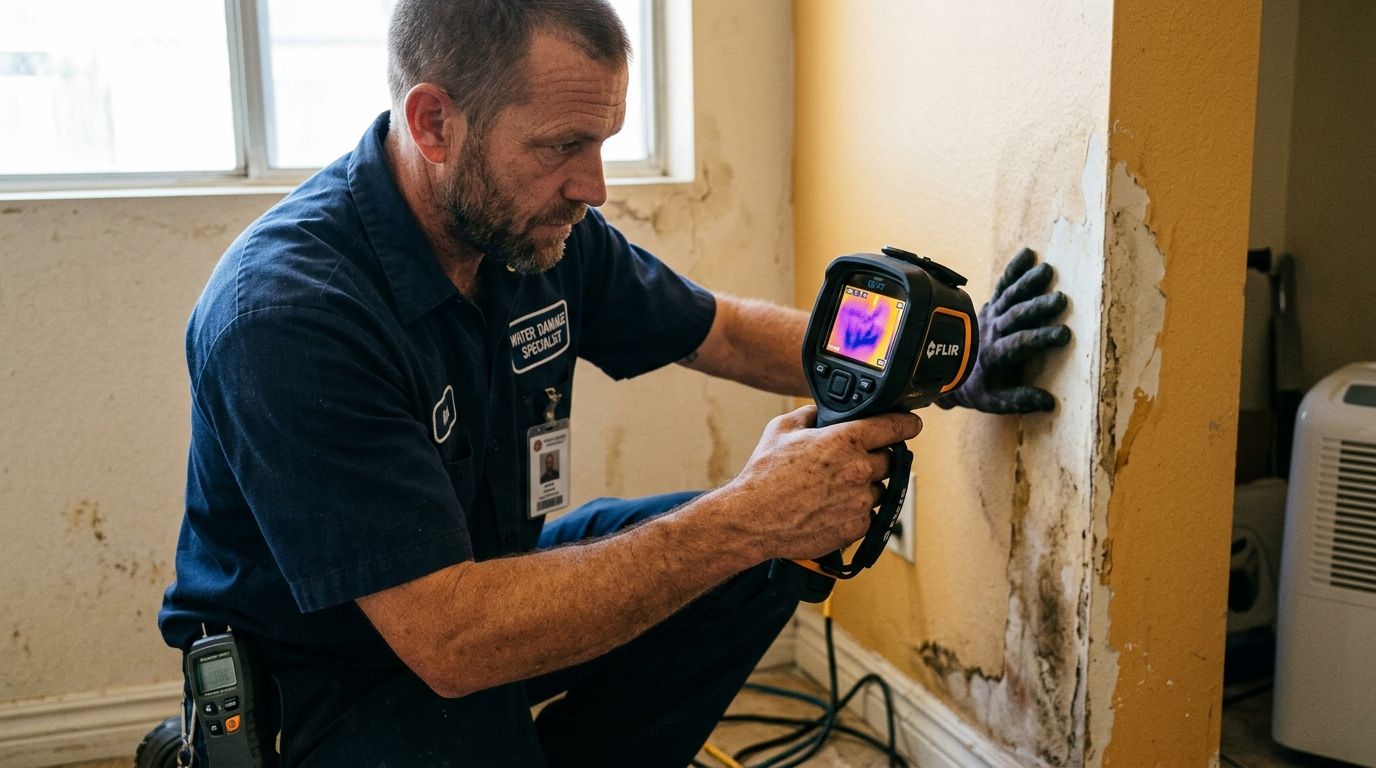
- Non-invasive thermal imaging: FLIR infrared scans map hidden water boundaries behind drywall and under concrete.
- Transparent itemized estimates: Industry-standard Xactimate line items prepared upfront with zero surprises.
- Rapid 30-to-60 minute dispatch: Mobile units fully equipped with heavy extraction pumps on active standby.
Direct Answer: Overturning Denied or Lowballed Water Claims in Phoenix policyholders
If your homeowners insurance carrier denied or severely underpaid your claim following a pipe rupture, detecting hidden slab leaks under concrete, or fixture overflow, you are not powerless. When facing a water damage insurance claim denied phoenix az property owners frequently encounter carrier adjusters who exploit vague policy language—most notably the bad-faith insurance adjuster gradual damage loophole, mislabeling sudden plumbing failures as “long-term seepage” or “maintenance neglect.” Under Arizona Revised Statutes (A.R.S. § 20-461) and Arizona Administrative Code (A.A.C. R20-6-801), policyholders possess clear statutory rights to challenge arbitrary denials, demand forensic re-inspections, submit comprehensive contractor-prepared Xactimate water damage estimate supplement contractor phoenix pricing audits, and pursue a formal Arizona Department of Insurance property claim appeal through the Arizona Department of Insurance and Financial Institutions (DIFI).
Never accept an adjuster’s initial denial letter or premature settlement check as final. By marshaling forensic IICRC S500 psychrometric drying records, calibrated forensic thermal infrared moisture mapping logs infrared imaging, and local Maricopa County reconstruction line-item pricing, you can systematically dismantle insurer pretexts, compel full policy benefits, and restore your home to pre-loss condition without absorbing catastrophic out-of-pocket costs.
60-Second Property Claim Protection Checklist: Arizona Homeowner Rights
Critical First Response Protocol
The moments immediately following discovery of water damage dictate whether your insurer pays your full restoration invoice or leaves you holding tens of thousands of dollars in unpaid repairs. Execute these six imperative defensive steps before allowing a field adjuster onto your property:
Never sign liability waivers, proof of loss forms with broad release clauses, or endorse checks bearing restrictive endorsements like “payment in full” or “final settlement.” You are entitled to deposit initial payments marked as partial undisputed payments without prejudice to ongoing supplement discussions.
Secure the burst supply line, cracked PEX fitting, pinhole copper elbow, or split washing machine hose in a clean container. Insurance carriers frequently attempt to claim “gradual wear and tear”; possessing the physical metallurgical artifact proves sudden catastrophic tensile or mechanical failure.
Under Arizona Administrative Code R20-6-801, property owners have the right to inspect the written basis of any denial or scope reduction. Request the unredacted field inspection notes, photo sheets, structural engineer reports, and draft scopes prepared by third-party adjusters.
Before the adjuster steps foot in your house, your restoration contractor must record quantitative moisture measurements from identical drywall, framing, and flooring in an adjacent unaffected room. This eliminates carrier arguments regarding ambient desert relative humidity or seasonal equilibrium.
Never rely on telephone assurances from desk adjusters. After every phone conversation, send a concise recap email: “Per our call today on Claim #[12345], you stated X. Please provide the policy citation within 10 days as required by Arizona insurance regulations.” This builds an unassailable bad-faith administrative record.
Arizona law prohibits insurers from dictating which contractor you hire. Do not rely solely on the carrier’s “preferred vendor” program. Retain an independent restoration general contractor who writes line-item Xactimate scopes and defends your policyholder rights during every site inspection.
The Anatomy of a Denied or Underpaid Water Damage Claim in Maricopa County
Water damage is the single most frequent and financially contentious property loss category in Phoenix, Scottsdale luxury property claims, Mesa homeowners, Chandler insurance disputes, and Glendale. Every year, thousands of homeowners experience catastrophic failures: pressurized hot-water copper tubing perforating beneath monolithic foundation slabs, braided stainless steel supply lines bursting under master bathroom vanities, or reverse-osmosis filtration units splitting open while families are away at work. In an instant, hundreds of gallons of pressurized municipal water migrate across living rooms, kitchen cabinetry, custom baseboards, and structural framing cavities.
When homeowners promptly notify their insurance carrier, they reasonably expect the comprehensive HO-3 or HO-5 policy they have paid premiums on for decades to honor its obligations. Instead, policyholders are routinely confronted with swift denials or shocking “lowball” preliminary settlement checks that cover barely a fraction of the actual demolition, certified psychrometric structural drying, and reconstruction expenses. In many cases, an independent contractor estimates comprehensive remediation and rebuild costs at $38,000, yet the insurance carrier issues an undisputed payment of only $6,200 accompanied by a multi-page denial citing vague policy exclusions.
To understand why this happens, you must recognize the business model of modern insurance claim processing. Property and casualty carriers operate under relentless loss-ratio pressures. Insurers increasingly delegate property inspections to overwhelmed third-party independent adjusting firms or remote desk adjusters sitting thousands of miles away who rely on generic, nationwide estimating metrics. These adjusters are incentivized to apply aggressive exclusionary doctrines, systematically omit essential restoration line items, and truncate the scope of loss before forensic moisture data can be fully compiled.
If you find yourself searching for how to dispute lowball insurance water damage claim arizona protocols, you must recognize that an adjuster’s denial letter is not a judicial verdict—it is merely an initial opening negotiation stance from a party that has a direct financial interest in limiting claim payouts. By understanding the specific legal doctrines governing Arizona property claims, enforcing IICRC S500 scientific standards of care, and preparing meticulous forensic evidence, property owners can overturn illegitimate claim decisions and recover their full, rightful compensation.
Insurance Defense Tactics
The 3 Most Common Bad-Faith Claim Traps in Arizona & How to Defeat Them
Insurance companies employ seasoned litigation defense attorneys and claims adjusters whose primary directive is to identify coverage exclusions buried deep within policy endorsements. In Arizona, property insurers rely predominantly on three calculated claim traps designed to shift tens of thousands of dollars in water mitigation and structural reconstruction costs onto unsuspecting policyholders.
Trap 1: The “14-Day Continuous or Repeated Seepage” Loophole
Top Carrier Denial Pretext
Standard ISO homeowners policies (including forms HO 00 03 and custom carrier variants) contain an exclusion for damages caused by: “Constant or repeated seepage or leakage of water or steam over a period of 14 days or more from within a plumbing, heating, air conditioning, or automatic fire protective sprinkler system.”
When an adjuster arrives at a Phoenix property and notices minor mold specks behind baseboards, rust on carpet tacks, or water staining ascending drywall beneath a kitchen cabinet, they frequently trigger the insurance adjuster gradual damage loophole. The adjuster writes in their file: “Evidence indicates continuous water migration occurring over weeks or months. Loss excluded under the 14-day continuous seepage limitation.” A formal denial letter follows days later, denying all water mitigation, drywall demolition, and cabinet reconstruction.
The critical legal distinction turns on inception vs. manifestation and the hidden nature of concealed pipe leaks. Arizona courts and standard contract construction principles enforce the doctrine of reasonable expectations. Water traveling unseen beneath a concrete slab foundation or inside an enclosed drywall chase is, by definition, undiscoverable by a homeowner through reasonable diligence.
Furthermore, in hot Sonoran desert climates, microbial growth (mold) does not require 14 days to incubate. Under ambient summer temperatures exceeding 100°F and relative humidity inside enclosed wet wall cavities surpassing 85%, fungal colonies flourish within 48 to 72 hours. Demonstrating through IICRC S520 mold science and time-stamped utility water meter data that moisture appeared suddenly refutes the insurer’s arbitrary claim that the leak was active for weeks.
Trap 2: The “Wear & Tear” / “Lack of Maintenance” Exclusion
Ensuing Loss Misinterpretation
In older Phoenix neighborhoods like Arcadia, Paradise Valley, Sun City, and Tempe, homes built between 1960 and 2000 feature copper plumbing lines that have endured decades of aggressive municipal mineral hardness (18 to 25 grains per gallon) and chloramine disinfection. When an under-slab pipe develops a pinhole perforation or an angle stop valve splits, adjusters often cite the policy exclusion for “wear, tear, deterioration, rust, or mechanical breakdown.” The adjuster then attempts to deny not just the failed pipe fitting, but the entire $40,000 in consequential water damage throughout the residence.
Every standard Arizona property policy contains an explicit exception to the wear-and-tear exclusion known as the Ensuing Loss Doctrine. The policy language clearly states: “We do not insure for loss caused by wear and tear… however, any ensuing loss to property described in Coverages A and B not precluded by any other provision in this policy is covered.”
While the insurance company is legally permitted to exclude the direct cost of replacing the $12 copper coupling or leaking valve that suffered wear and tear, they are contractually obligated to pay for all resulting water damage. That includes exploratory foundation access, slab tear-out, emergency emergency water extraction mitigation, commercial property damage claims dehumidification, drywall replacement, insulation, cabinetry repair, and luxury flooring reinstallation. Conflating the cause of the leak with the resulting structural water deluge is a violation of Arizona fair claims practices.
Trap 3: The Premature “Undisputed Settlement Check” Lowball Offer
Financial Coercion Strategy
When carriers recognize that a water damage claim cannot be outright denied under policy exclusions, they pivot to a strategy of severe scope minimization. Within 5 to 7 days of the loss—long before the property is structurally dry and before hidden moisture cavities inside insulated exterior walls have been fully evaluated—the insurer mails a check for $4,500 along with a brief, computer-generated estimate.
The adjuster assures the homeowner: “Here is our settlement check. You can have any contractor complete the repairs for this amount.” Homeowners assume this payment represents the final verdict. When licensed restoration general contractors inspect the property and submit accurate estimates of $28,000 for IICRC-compliant mitigation and code-compliant reconstruction, homeowners panic, believing they must pay the $23,500 shortfall out of pocket.
An initial insurance check in Arizona is legally considered an undisputed actual cash value (ACV) payment. You have the right to deposit this check to begin urgent stabilization work, provided you send a written letter via certified mail or email explicitly stating: “This payment is accepted as a partial undisputed disbursement only and does not constitute full settlement or satisfaction of the loss.”
Once initial funds are secured, your restoration general contractor submits a comprehensive Xactimate water damage estimate supplement detailing all omitted line items, regional Maricopa County labor pricing, containment controls, and structural repairs required to restore the property to pre-loss condition.
Zero Out-Of-Pocket Dispute Representation
Has Your Insurance Company Denied or Lowballed Your Water Loss?
Do not let desk adjusters bully you with arbitrary denials or cut-rate scopes. Our licensed IICRC Master Restorers and certified insurance estimating specialists provide complimentary on-site forensic re-inspections, compile courtroom-grade psychrometric documentation, and fight for every dollar your policy owes you.
Scientific Standard of Care
The Forensic Documentation Arsenal: Beating Adjuster Denials with Science
In insurance claim litigation and administrative appeals, carrier adjusters rely heavily on subjective opinions: “The drywall appears to have been wet for some time,” or “In my opinion, these baseboards could have been saved with floor fans.” Subjective opinions dissolve instantly when confronted with an unassailable wall of quantitative, scientific forensic evidence built strictly according to the IICRC S500 Standard and Reference manual for Professional comprehensive water damage restoration.
To successfully overturn a denied claim or compel an insurer to fund a comprehensive supplemental scope, your restoration partner must deploy four forensic diagnostic pillars:
FLIR® Thermal Infrared Scans
Calibrated radiometric infrared cameras record evaporative thermal signatures. While an adjuster’s flashlight sees dry surface paint, FLIR thermography reveals dark purple evaporative cooling plumes inside framing stud bays, under monolithic slabs, and behind multi-layered cabinetry backings.
Pin & Pinless Penetration Logs
Utilizing non-destructive dielectric capacitance meters (ASTM F2659) and deep-wall hammer probes, technicians record exact Wood Moisture Equivalent (%WME) percentages. Showing an adjuster that wall baseplates measure 34% WME against a dry baseline of 8% eliminates arguments over whether tear-out is necessary.
Psychrometric Chamber Records
Daily atmospheric calculations measuring specific humidity in Grains Per Pound (GPP), ambient temperature, relative humidity, and dew point across affected rooms, unaffected control baselines, and dehumidifier exhaust outputs prove continuous commercial drying compliance.
Time-Stamped Chain of Custody
High-definition digital photography embedding EXIF metadata, GPS latitude/longitude coordinates, and exact timestamp logs documenting the progression from initial standing water to structural demolition, containment barriers, antimicrobial application, and verified dry standards.
Phoenix Residential Pipe Rupture Loss
Adjusters frequently disallow dehumidifier rental days, claiming “the house should have dried in 48 hours.” The daily psychrometric log below demonstrates why continuous 4-day LGR dehumidification was thermodynamically mandatory to achieve equilibrium moisture content:
| Day & Timestamp | Chamber Zone | Temp (°F) | Relative Humidity | Specific Humidity (GPP) | Subfloor %WME | Status / Action |
|---|---|---|---|---|---|---|
| Day 1 (08:30 AM) | Affected Master Suite | 78°F | 86% RH | 122 GPP | 38.4% WME | Extraction & 3 LGRs Deployed |
| Day 2 (09:00 AM) | Affected Master Suite | 82°F | 58% RH | 92 GPP | 26.1% WME | Selective flood cuts executed |
| Day 3 (08:45 AM) | Affected Master Suite | 80°F | 41% RH | 61 GPP | 16.8% WME | Capillary drying continuing |
| Day 4 (09:15 AM) | Affected Master Suite | 76°F | 28% RH | 36 GPP | 8.4% WME | Verified Dry Standard Reached |
| Control Baseline | Unaffected Bedroom 2 | 75°F | 29% RH | 37 GPP | 8.2% WME | Contractual Target Baseline |
Pricing & Estimating Mechanics
Xactimate Line-Item Supplementing: Demanding True Phoenix Regional Replacement Costs
More than 90% of insurance carriers across the United States utilize Xactimate® (developed by Verisk Analytics) to generate repair estimates and calculate claims payments. While Xactimate is designed to update regional material and labor rates monthly based on actual market surveys, desk adjusters frequently employ subtle software manipulations to artificially suppress estimate totals:
- Selecting Outdated or Rural Price Lists: Applying the “AZFL” (Flagstaff) or rural Arizona price list rather than the active Maricopa County (“AZPHX”) metro database where skilled trade labor commands significantly higher hourly rates.
- Arbitrary Line-Item Stripping: Omitting critical secondary restoration tasks like content manipulation, floor protection masking, negative pressure containment barriers, EPA-registered botanical antimicrobials, and debris disposal fees.
- Deleting General Contractor Overhead & Profit (O&P): Falsely informing policyholders that the standard “10 and 10” (10% overhead and 10% profit) is only payable if four or more complex trades are involved—a claim thoroughly contradicted by established industry standards.
The Crucial Omitted Line Items You Must Supplement
When a certified restoration general contractor conducts a line-item audit of an initial insurance estimate, we consistently recover tens of thousands of dollars in missing line items that adjusters “overlooked.” The most common omissions include:
IICRC S500 standards mandate applying an EPA-registered broad-spectrum botanical disinfectant to framing studs, floor plates, and concrete slabs to prevent fungal sporulation during forced-air drying. Adjusters routinely omit this necessary bio-wash.
Isolating the wet drying chamber from clean living areas with 6-mil flame-retardant poly containment and zip-doors prevents heat loss, controls vapor pressure, and prevents particulate cross-contamination. Adjusters falsely claim this is “routine overhead.”
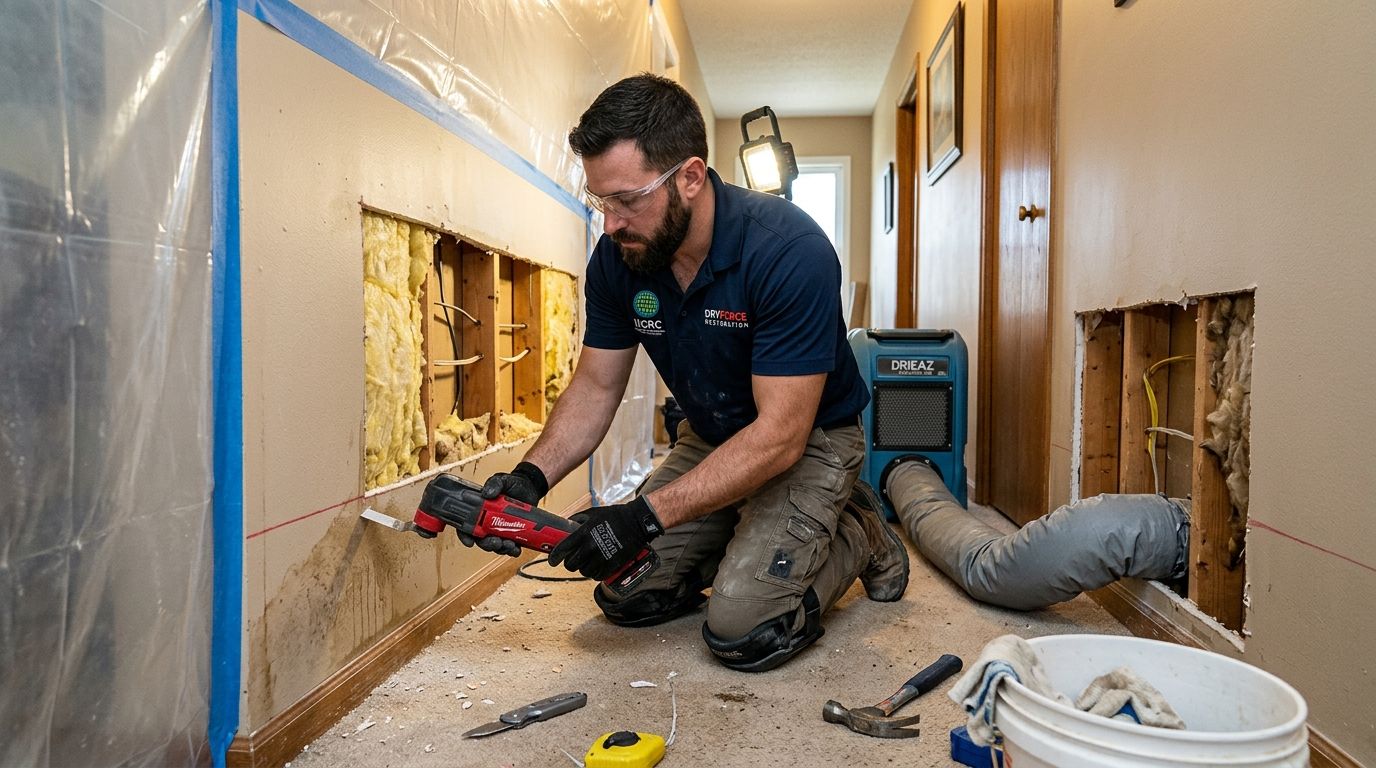
When water wicks up drywall, cutting drywall at the 24-inch or 48-inch height is required to remove saturated fiberglass insulation and expose framing cavities. Adjusters frequently price only a 12-inch cut, which cannot accommodate standard 4×8 drywall replacement sheets without excessive tape joints.
When custom flooring is damaged in an open-concept Arizona home, adjusters frequently price spot patching of 150 square feet. Under the Arizona Uniform Appearance doctrine, if discontinued tile or aged hardwood cannot be seamlessly matched without visual demarcation, the entire continuous contiguous floor plane must be replaced.
Financial Audit Analysis
Financial Reality: Initial Adjuster Estimate vs Contractor Supplemented Claim
To illustrate the profound financial disparity between an insurer’s initial lowball offer and the true cost of professional restoration, consider this actual claim audit from a residential hot water copper slab leak loss in a North Phoenix home:
| Scope Category / Item | Initial Adjuster Scope | Contractor Supplement | Adjuster Omission / Denial Rationale | IICRC Standard & Arizona Statutory Basis |
|---|---|---|---|---|
| Emergency Water Extraction & Pumping | $420.00 | $1,680.00 | Priced basic wand extraction; omitted submerged tile subfloor extraction and heavy debris handling. | IICRC S500 § 10.4: Deep multi-stage extraction required to prevent continuous slab saturation and hydraulic capillary wicking. |
| Selective Demolition & Flood Cuts | $850.00 | $3,450.00 | Limited demolition to 12″ drywall strip; excluded wet insulation extraction behind exterior shear walls. | IICRC S500 § 13.5.6: Minimum 24″ flood cut mandated to remove contaminated insulation and facilitate framing cavity drying. |
| Commercial Structural Drying Equipment | $1,100.00 | $4,890.00 | Approved only 48 hours drying with 2 residential dehumidifiers; disallowed monitoring technician hours. | Daily psychrometric calculation logs proved saturated slab required 96 hours of LGR operation to reach dry baseline of 8% WME. |
| Kitchen Cabinetry Removal & Reset | $0.00 (Denied) | $6,800.00 | Claimed cabinets could be dried in-place through toe-kick vent holes; ignored saturated particle board framing. | Thermal imaging revealed bound moisture behind upper and lower boxes. In-place drying would trigger toxic mold colonies. |
| Continuous Hardwood / Tile Flooring | $2,800.00 | $14,200.00 | Priced spot replacement of only 180 sq. ft. of wet floor; refused to address discontinued dye lots or adjoining living room. | Arizona Uniform Appearance Doctrine & Reasonable Expectations: Continuous open-concept flooring requires full plane replacement. |
| Drywall, Texture & Paint Matching | $1,650.00 | $4,650.00 | Priced spot paint patches on isolated walls; ignored continuous unbroken ceiling and walls. | Standard painting trade practices: Continuous drywall assemblies must be painted corner-to-corner to natural breaklines. |
| General Contractor Overhead & Profit (10/10) | $0.00 (Disallowed) | $7,134.00 | Falsely argued project was “simple single-trade repair” not justifying GC coordination. | Project required 5 distinct licensed sub-trades: plumber, mitigation technician, drywaller, tile setter, and painter. |
| TOTAL CLAIM VALUE | $6,820.00 | $42,804.00 | Net Recovery Increase: +$35,984.00 (+527%) secured through comprehensive contractor Xactimate supplementing without homeowner out-of-pocket shortfall. | |
Statutory Escalation Road Map
The Arizona Property Claim Dispute Process: Step-by-Step Escalation Protocol
Disputing an insurer’s lowball estimate or wrongful denial requires structured, disciplined escalation. Do not waste emotional energy arguing aimlessly on telephone customer service lines. Follow this proven five-phase statutory escalation road map designed specifically under Arizona insurance jurisprudence:
Phase 1: Demand a Joint Field Re-Inspection with Your Contractor
Immediately upon receiving a deficient estimate or partial denial, notify the claim representative in writing that their scope is incomplete. Request a formal joint re-inspection where your licensed restoration general contractor is physically present alongside the insurance adjuster.
During this walkthrough, your contractor uses calibrated pin probes and thermal imaging cameras to demonstrate moisture trapped behind cabinets, under tile, and inside wall cavities in real time, forcing the adjuster to document previously ignored damages directly into their revised field file.
Phase 2: Serve a Formal Notice of Dispute Citing A.R.S. § 20-461
If the carrier refuses to adjust the scope after re-inspection, serve a formal written Notice of Dispute. Cite the Arizona Unfair Claims Settlement Practices Act (A.R.S. § 20-461) and Arizona Administrative Code R20-6-801. These statutes mandate that insurers must:
- Acknowledge communications regarding claims within 10 working days.
- Conduct a prompt, reasonable, and objective investigation based upon all available information.
- Provide a written explanation quoting the specific policy provision or factual basis for any claim denial or compromise offer.
- Refrain from attempting to settle claims for an amount less than that which a reasonable person would believe the claimant was entitled to.
Phase 3: Invoke the Policy’s Mandatory Appraisal Clause
Nearly every residential property policy written in Arizona includes an Appraisal Clause in the Conditions section. Appraisal is an alternative dispute resolution mechanism designed specifically to resolve disputes regarding the amount of loss without filing a lawsuit:
Either party can make a written demand for appraisal. Each side selects a competent, disinterested independent appraiser. The two appraisers then select an impartial third-party umpire. If the two appraisers agree on the repair amount, that figure is binding. If they disagree, their differences are submitted to the umpire. An agreement signed by any two of the three sets the final binding award. This bypasses stubborn desk adjusters entirely.
Phase 4: Lodge a Formal Complaint with the Arizona DIFI
If the insurer exhibits bad faith, stonewalls communication, or issues pretextual denials, file an official Arizona Department of Insurance property claim appeal through the Consumer Assistance Division of the Arizona Department of Insurance and Financial Institutions (DIFI).
Once an official DIFI complaint is lodged, the state insurance commissioner assigns a regulatory investigator and orders the insurance carrier’s executive compliance department to provide a sworn, written response within 15 to 20 days. Carriers loathe regulatory scrutiny because repeated unfair claim settlement complaints can trigger market conduct examinations, state fines, and licensing suspension. This step frequently prompts the insurer to reassign the file to a senior claims supervisor authorized to settle.
Phase 5: First-Party Insurance Bad Faith Litigation
Under landmark Arizona Supreme Court precedent (including Rawlings v. Apodaca and Noble v. National American Life Ins. Co.), insurance policies contain an implied covenant of good faith and fair dealing. An insurer commits tortious bad faith when it intentionally denies, fails to process, or delays payment of a valid claim without a fairly debatable reasonable basis.
In bad-faith litigation, policyholders are not limited to just contract policy limits; they can recover emotional distress damages, economic consequential losses, mandatory statutory attorney fees under A.R.S. § 12-341.01, and substantial punitive damages designed to punish predatory insurer behavior.
Expert Answers
10 Detailed Arizona Homeowner Insurance Dispute FAQs
1. Can my insurance company force me to use their “preferred” restoration contractor in Arizona?
No, absolutely not. Under Arizona law and insurance consumer protection rules, policyholders have the absolute legal right to select any licensed, bonded, and insured contractor of their choosing. Insurance company “preferred vendors” (often managed through third-party networks) operate under strict contractual agreements with the insurer to minimize demolition, disallow equipment days, and cut costs to retain preferred network status. By hiring an independent restoration general contractor like Valley Restoration Pro, you ensure your representative’s sole fiduciary allegiance is to protecting your property and securing your full policy benefits.
2. What should I do if the adjuster claims my leak was gradual and denies the entire claim?
Do not accept the denial verbally. Demand a written denial letter specifying the exact policy exclusionary clause. Immediately contact an IICRC-certified restoration expert to conduct forensic psychrometric and thermal moisture mapping. Most gradual damage exclusions apply only to visible, continuous leaks known to the homeowner. Concealed pipe ruptures within walls or beneath concrete foundation slabs are classified as sudden and accidental occurrences upon discovery. Additionally, under the Ensuing Loss Doctrine, all consequential water damage resulting from the failure remains fully covered under Arizona policy standards.
3. Can I cash the insurance company’s preliminary settlement check without waiving my right to supplement?
Yes, with one critical precaution: Check the check itself and accompanying paperwork carefully. If the check or stub contains language such as “Full and Final Settlement,” “Release of All Claims,” or “Accord and Satisfaction,” do not cash it without consulting an expert. If it is an ordinary actual cash value (ACV) check, you may deposit it. As an added safeguard, write on the back above your endorsement: “Deposited as partial undisputed payment without prejudice to pending supplemental claim.” Accompany this with a formal email notifying the adjuster that you are preparing a comprehensive contractor supplement.
4. What is the Arizona “Uniform Appearance” or matching doctrine for damaged flooring?
Adjusters frequently attempt to settle flooring claims by estimating spot repairs on 100 square feet of continuous tile or engineered hardwood. Under Arizona property insurance principles and the doctrine of reasonable expectations, policyholders are entitled to be restored to a uniform and consistent aesthetic pre-loss condition. If the original tile, stone, or wood flooring is discontinued, weathered, or cannot be seamlessly matched to adjoining living spaces without a visually jarring border, the insurer is legally responsible for replacing all contiguous flooring throughout the visual sightline.
5. What is the difference between an independent adjuster, a company adjuster, and a public adjuster?
A Company Adjuster is a direct W-2 employee of the insurance company. An Independent Adjuster (IA) is an independent contractor hired by the insurer to inspect losses; despite the name, their loyalty lies with the insurance company that pays their fees. A Public Adjuster (PA) is a licensed professional hired exclusively by the policyholder who charges a percentage (typically 10% to 15%) of the gross claim payout. Working directly with a licensed restoration general contractor who writes line-item Xactimate scopes often provides identical technical dispute firepower without forfeiting 15% of your reconstruction settlement.
6. How long does an insurance company have to process a claim in Arizona?
Under Arizona Administrative Code R20-6-801, insurers must acknowledge notice of a claim within 10 working days. They must provide appropriate claim forms and instructions promptly. Once a completed proof of loss with all documentation is submitted, the insurer must accept or deny the claim within 30 days. If the carrier requires additional time, they must send written notice every 45 days stating specific reasons why additional time is necessary. Unreasonable delays violate the Unfair Claims Settlement Practices Act.
7. Will disputing my lowball claim cause my insurer to cancel my policy or raise my rates?
In Arizona, premium rate revisions are determined by actuarial underwriting filings approved by the Department of Insurance on a regional risk-pool basis, not as punitive retribution for exercising contractual supplement rights. Once a water damage claim is initially opened on your Comprehensive Loss Underwriting Exchange (C.L.U.E.) report, the claim is already on record. Disputing the scope to ensure repairs are properly funded does not create a separate negative underwriting surcharge.
8. What happens if toxic mold is discovered behind drywall during water damage demolition?
Most standard Arizona homeowners policies include a specific limited certified mold remediation and containment endorsement (typically capped at $5,000 or $10,000). However, if the mold growth was directly triggered by a sudden covered water loss (such as a burst supply pipe or slab leak), the cost of tearing out water-damaged drywall, structural framing drying, and negative pressure containment is classified under the primary Coverage A dwelling structural limits—not the restrictive mold sub-limit. Proper Xactimate line-item coding is essential to prevent carriers from improperly dumping structural repairs into a depleted mold cap.
9. Who pays for the contractor’s Xactimate supplement if the insurance company stalls?
Professional insurance restoration contractors work on an insurance-proceeds billing basis. At Valley Restoration Pro, we compile the necessary forensic engineering evidence, thermal mapping scans, and Xactimate supplemental packages as part of our comprehensive mitigation and reconstruction service. We communicate directly with your insurance adjuster, supervisor, and regional property claims team. You are responsible only for your agreed policy deductible on covered losses.
10. When does an insurance underpayment officially become “Insurance Bad Faith” in Arizona?
Under Arizona law (*Rawlings v. Apodaca*), bad faith occurs when an insurance company knowingly or recklessly acts without a fairly debatable reasonable basis when investigating, processing, or denying a claim. Examples include: ignoring objective psychrometric drying evidence, refusing to conduct a physical site inspection, altering field adjuster reports to eliminate covered scope items, misleading homeowners regarding policy coverage, or threatening policy cancellation if a supplement is submitted. When bad faith is established, the carrier becomes liable for tort damages far exceeding policy limits.
Why Arizona Homeowners Trust Valley Restoration Pro to Fight for Their Claims
When water damage strikes your home, the difference between recovering full policy benefits and suffering an enormous out-of-pocket loss comes down to the expertise of your restoration partner. Unlike standard franchise operations that accept cut-rate insurance scopes without objection, Valley Restoration Pro combines master-level technical restoration capabilities with deep forensic insurance claims proficiency.
Every technician on our response team holds active certifications from the Institute of Inspection, Cleaning and Restoration Certification (IICRC) in Water Damage Restoration (WRT), Applied Structural Drying (ASD), and Applied Microbial Remediation (AMRT). Our project managers are certified in Xactimate level 3 estimating and possess decades of combined experience interpreting Arizona property policies, navigating desk adjuster negotiations, and successfully resolving disputed property claims across the entire Phoenix metropolitan valley.
Rapid Emergency Dispatch Across Phoenix Metro
Direct Insurance Billing & Deductible Assistance
IICRC Master Restorers & FLIR Thermographers
Successfully Supplemented and Fully Settled
Take Immediate Control of Your Insurance Claim Today
An insurance adjuster’s denial or lowball check does not have to be the end of your story. Speak directly with our senior property insurance restoration specialists for a free, comprehensive claim review and forensic on-site moisture evaluation across Phoenix, Scottsdale, Paradise Valley, Mesa, Chandler, and Glendale.
✓ Licensed General Contractors ROC #341290 •
✓ Full IICRC S500 Forensic Compliance
November 2026 Technical Field Advisory & Operations Update
Verified by IICRC Master Water Restorer | Active Emergency Deployment
Greater Phoenix Seasonal Water Damage Dynamics & 2026 Rapid Response Protocol
As ambient desert temperatures decline in late autumn across Maricopa County, concrete slabs experience thermal contraction cycles, increasing structural stress on subterranean copper plumbing lines weakened by Phoenix’s extreme 18 GPG municipal hard water scale. Valley Restoration Pro maintains rapid 30-to-60 minute emergency staging across Phoenix, Scottsdale, Mesa, Chandler, Glendale, Gilbert, Tempe, Peoria, Surprise, and Goodyear. Our master crews deploy non-destructive FLIR thermal imaging and high-volume industrial LGR dehumidification trailers to achieve dry standard equilibrium without needless structural demolition.
Verified Local Area Dispatch: Phoenix, AZ
Official Geo-Coordinates: 33.4484° N, -112.074° W • Maricopa County
Verified Technical Standard & Engineering Quality Assurance
Every mitigation project executed by Valley Restoration Pros complies strictly with national standards established by the Institute of Inspection, Cleaning and Restoration Certification (IICRC S500 / S520) and OSHA safety regulations across Maricopa County.