

Valley Restoration Pros delivers 24/7 industrial emergency water extraction, thermal psychrometric drying, and structural mitigation across Phoenix and Maricopa County with guaranteed 30–60 minute rapid arrival. All protocols strictly adhere to IICRC S500 standards, featuring upfront itemized pricing and free on-site thermal moisture assessments. Call dispatch directly at (602) 847-9593.
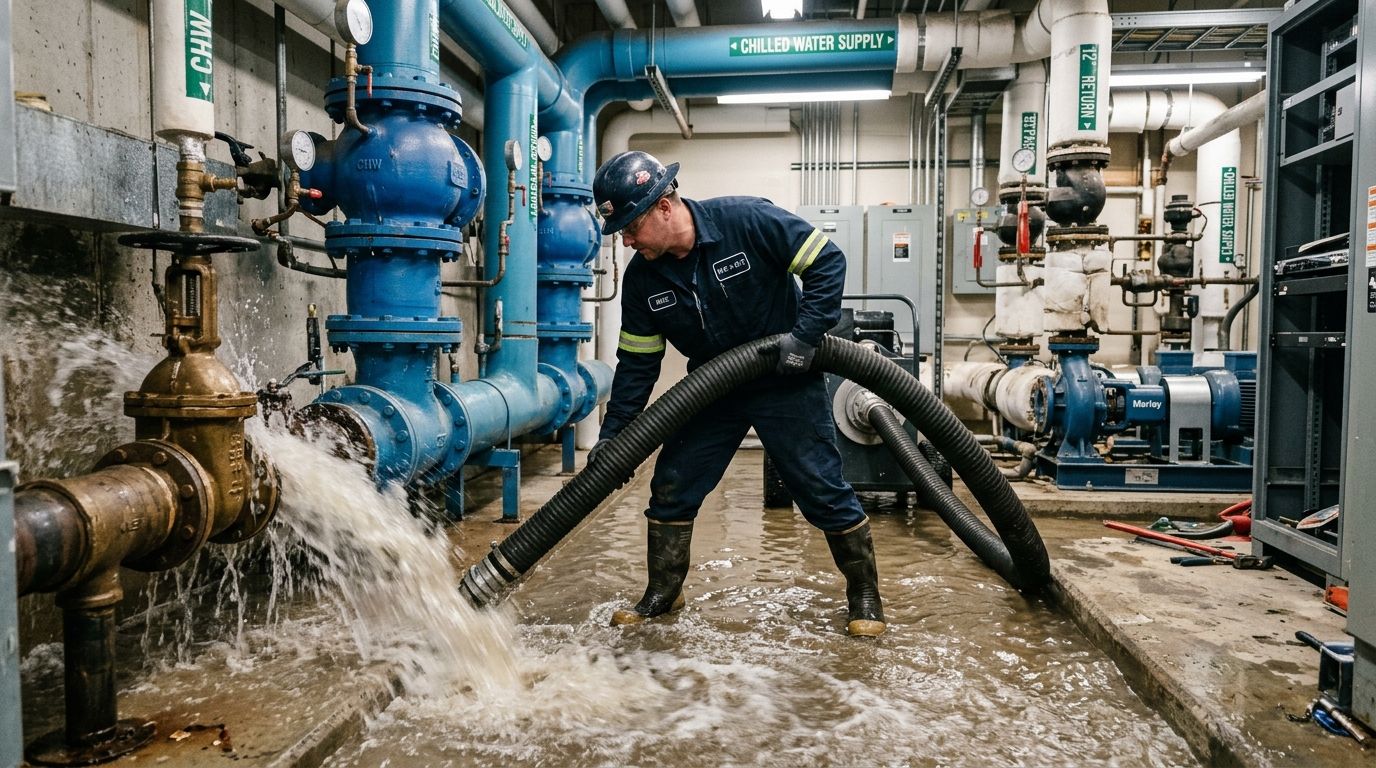
Immediate Incident Containment Protocol
- Shut off main water supply: Isolate mechanical riser valves, street curb meters, or supply manifolds immediately.
- Establish electrical safety: De-energize sub-floor circuits and submerged outlets before walking into affected zones.
- Avoid delay: 115°F desert summer ambient heat accelerates microbial spore incubation within 24 to 48 hours.
Free On-Site Assessment & Transparent Estimates
- Non-invasive thermal imaging: FLIR infrared scans map hidden water boundaries behind drywall and under concrete.
- Transparent itemized estimates: Industry-standard Xactimate line items prepared upfront with zero surprises.
- Rapid 30-to-60 minute dispatch: Mobile units fully equipped with heavy extraction pumps on active standby.
Direct Answer: Commercial Chiller Pipe Burst Water Damage in Phoenix High-Rises
When a pressurized 4-inch to 8-inch chilled water loop or cooling tower riser ruptures in a Phoenix commercial property, building operators face an immediate catastrophe. If your office tower, hospital, data center, resort, or educational campus is confronting commercial chiller pipe burst water damage phoenix, pressurized hydronic fluid escapes at rates exceeding 300 to 800 gallons per minute. Chilled water systems operate under continuous 60 to 125 PSI hydrostatic pressure; a mechanical failure in a roof penthouse or intermediate mechanical room rapidly saturates vertical utility chases, electrical bus ducts, structural elevator shafts, and multiple tenant floors below.
Chilled water floods are rarely clean water events. The closed hydronic loop contains chemical corrosion inhibitors, ethylene or propylene glycol antifreeze, biocides, and scale dispersants. This chemically treated water is classified as Category 2 (graywater) or Category 3 (blackwater/biohazard), requiring specialized environmental containment, PPE, and hazardous waste extraction. Valley Restoration Pros mobilizes heavy industrial extraction trailers, truck-mounted extraction wands, portable desiccant dehumidification systems, and negative-air HEPA scrubbers to isolate the mechanical penthouse, extract thousands of gallons of deluge water, and stabilize high-value commercial building assemblies.
1. Executive Emergency Abstract & Commercial Facility Incident Overview
Commercial chiller plants represent the operational heartbeat of multi-story infrastructure across the Valley of the Sun. In Phoenix, where exterior ambient temperatures remain above 100°F for more than one hundred consecutive days each summer, commercial HVAC chillers operate under relentless, non-stop thermal loads. Chilled water loops continuously circulate 42°F to 45°F water through extensive steel and copper pipe distribution networks to air handling units (AHUs), fan coil units (FCUs), and variable air volume (VAV) terminal boxes throughout the facility.
When a primary mechanical fitting, Victaulic coupling, expansion joint, or heat exchanger tube bundle fails under pressure, the consequences are immediate and catastrophic. Because commercial hydronic loops are directly connected to automatic municipal make-up water valves designed to maintain constant system pressure, the pipe burst does not bleed out and stop. The make-up water line continuously injects fresh city water into the ruptured loop, maintaining an unyielding high-volume indoor deluge that can discharge tens of thousands of gallons before facility personnel locate and isolate the primary motorized shutoff valves.
The downward trajectory of water in a multi-story commercial structure follows the path of least mechanical resistance. Water pooling on a concrete penthouse floor migrates into pipe penetrations, floor sleeves, expansion joints, electrical conduits, and elevator hoistways. It cascades across drywall ceiling assemblies, saturates acoustic mineral fiber tiles, destroys sub-floor electrical busway distribution systems, and soaks high-value commercial furnishings. In corporate headquarters and medical office complexes, a single penthouse chiller rupture routinely affects four to ten vertical floors simultaneously, triggering millions of dollars in structural damage and tenant displacement liabilities.
Valley Restoration Pros delivers rapid-deployment large-loss mitigation services across Phoenix, Scottsdale, Tempe, Chandler, and Deer Valley. Our Master Water Restorers operate with commercial-grade extraction fleets capable of evacuating thousands of gallons of water per hour. By deploying multi-tier structural drying chambers, high-capacity desiccant dehumidifiers, and thermal imaging diagnostics, we contain fluid migration, prevent secondary microbial contamination, and compress commercial restoration timelines from months into days.
In commercial multi-tenant properties, time is the single most critical financial metric. Every hour that chilled water sits within carpet cushion, drywall cavities, and concrete sub-floors increases restoration complexity exponentially. Within 24 hours of ambient desert exposure, structural wood framing begins warping, metal studs oxidize, and chemical additives within the chilled water volatilize, releasing irritating odors through return-air plenums. Rapid commercial intervention by our certified emergency response team prevents irreversible asset destruction.
2. Anatomy of Chiller Pipe Failure: Hydraulic Mechanics & Chemical Additives
Understanding why commercial chilled water lines rupture requires an examination of mechanical fluid dynamics, thermodynamic cycling, and chemical corrosion mechanisms in high-stress HVAC loops:
Primary Mechanical Failure Modes in Commercial Chiller Systems
- Hydraulic Water Hammer & Pressure Surges: When large two-way motorized control valves slam shut rapidly during a sudden building automation system (BAS) fault or electrical trip, the momentum of moving fluid creates an instantaneous shock wave known as water hammer. Kinetic energy transforms into hydrostatic pressure spikes exceeding 300 to 500 PSI, blowing apart mechanical grooved couplings (Victaulic), shearing flange bolts, and fracturing cast iron strainer bodies.
- Elastomeric Expansion Joint Degradation: Chiller supply and return headers utilize flexible rubber or stainless steel braided expansion joints to isolate pump vibration from building piping. Over years of continuous thermal expansion and contraction cycles under heavy desert cooling loads, elastomeric bellows harden, crack, and catastrophically rupture without visual warning.
- Oxygen Pitting & Chemical Under-Deposit Corrosion: While chilled loops are theoretically closed, micro-leaks and automatic make-up water additions introduce dissolved oxygen. Oxygen attacks carbon steel pipe walls, forming localized anodic pitting beneath iron oxide scale deposits. Pinhole breaches eventually coalesce into structural fractures along longitudinal pipe seams.
- Galvanic Dissimilar Metal Corrosion: Direct connections between carbon steel distribution mains and copper or bronze heat exchanger connections create galvanic couples. Without dielectric isolation unions or flanges, rapid galvanic electron transfer corrodes the less noble steel threads, leading to complete thread shear under operating pressure.
- Condensation Jacket Failure & Corrosion Under Insulation (CUI): Chilled water pipes operating at 42°F must be encased in vapor-sealed elastomeric cellular insulation (Armacell) to prevent condensation. If the vapor barrier tears, warm, humid ambient air contacts the cold bare pipe, condensing moisture continuously beneath the insulation. This creates aggressive Corrosion Under Insulation (CUI) that rusts pipe walls from the outside in, hidden from visual inspection until the pipe wall bursts.
Beyond pure water volume, commercial chiller floods introduce hazardous chemical contaminants. To prevent biological slime and pipe corrosion, chilled water is treated with sodium nitrite, molybdate inhibitors, glutaraldehyde biocides, and tolyltriazole copper protectants. Additionally, closed loops frequently contain 20% to 35% concentrations of industrial ethylene or propylene glycol for freeze protection during cold desert winter nights. When this fluid escapes, it leaves slippery, sticky chemical residues across flooring and drywall, posing acute respiratory and dermal health hazards to building occupants and requiring specialized hazardous waste remediation protocols under IICRC S500 standards.
3. Phoenix-Specific Climatic & Geological Multipliers
Operating central chilled water infrastructure in the Sonoran Desert presents unique environmental stressors that drastically multiply both the likelihood of chiller line failures and the severity of subsequent water damage:
Roof mechanical penthouses and chiller enclosures in Phoenix regularly reach ambient air temperatures of 130°F to 140°F due to direct solar radiation on flat membrane roofs. The thermal differential between 140°F ambient air and 42°F chilled loop water creates massive thermodynamic stress on pipe insulation, valve packing glands, and automated electronic actuators, accelerating seal brittleness and premature material failure.
Because municipal water across Phoenix, Scottsdale, and Tempe carries extreme mineral hardness (18 to 25 GPG), cooling tower open loops and automatic make-up water feeds suffer severe calcium carbonate scaling. Hard water deposits clog automatic relief valves, foul strainer baskets, and cause flow imbalances that trigger catastrophic hydraulic pressure spikes throughout secondary distribution loops.
Phoenix summer monsoons generate massive dust storms (haboobs) carrying airborne silica and alkaline caliche particulate. When this grit penetrates roof chiller penthouses, it contaminates open cooling tower sumps, acts as abrasive sandblasting compound within circulation pump impellers, and prematurely erodes mechanical pump seals, leading to sudden high-pressure shaft seal blowouts.
When cold chiller water leaks into vertical commercial pipe shafts and ceiling return plenums in summer, the ambient building heat rapidly warms the stagnant water. Combined with organic building dust and paper-faced gypsum drywall, this creates a high-velocity microbial incubator. Toxic mold spores (Aspergillus and Chaetomium) can begin germinating within 24 to 36 hours, transforming a mechanical water loss into an extensive biohazard containment operation.
4. Immediate Emergency First-Hour Protocol & Mechanical Isolation
When hundreds of gallons per minute are escaping from a ruptured commercial chiller header, immediate and decisive execution of this first-hour emergency protocol by building engineering personnel is critical to prevent multi-floor structural destruction:
CRITICAL FIRST-HOUR COMMERCIAL FACILITY ACTION STEPS
- Command Emergency Chiller Plant & Pump Shutdown: Access the primary Building Automation System (BAS) workstation or central mechanical room control panel. Immediately command all active chiller compressors, primary chilled water distribution pumps, and secondary variable frequency drive (VFD) circulation pumps to shut down. Terminating pump circulation instantly collapses dynamic operating pressure from 100+ PSI down to residual static head pressure.
- Close Primary Isolation Gate Valves & Make-Up Water Feeds: Manually turn the heavy mechanical butterfly or OS&Y gate valves immediately upstream and downstream of the ruptured pipe section. CRITICAL: Locate and manually shut the automatic municipal make-up water line backflow preventer. If the make-up water feed remains open, fresh city water will continuously refill and discharge through the ruptured pipe indefinitely.
- Isolate Electrical Busways & Switchgear Vertical Chases: Chilled water flowing through floor penetrations follows electrical conduit runs directly into vertical bus ducts, transformer vaults, and secondary electrical distribution closets. De-energize affected branch circuits and main switchboards in wet electrical rooms under formal OSHA Lockout/Tagout (LOTO) protocols to prevent catastrophic arc flash explosions and transformer destruction.
- Recall and Lock Out Commercial Elevator Banks: Elevators in adjacent shafts must be sent to the top terminal landing using independent service keys and powered down at machine room disconnects. Water descending hoistway walls creates lethal electrical shorts on traveling cables and destroys electronic door interlocks.
- Deploy Multi-Floor Fluid Diversion Containment: Position heavy-duty polyurethane fluid diversion tarps, magnetic floor-drain barriers, and quick-deploy water absorbent booms along the perimeter of the mechanical room floor and around floor sleeve penetrations to direct escaping water away from tenant office suites and computer server rooms.
- Contact Valley Restoration Pros Large-Loss Incident Command: Immediately telephone our 24/7 commercial emergency dispatch center at (602) 847-9593. Our dedicated large-loss disaster unit dispatches immediately with truck-mounted vacuum extractors, high-volume extraction wands, industrial desiccant drying trailers, and structural assessment teams.
5. Advanced Industrial Equipment Specifications & Large-Loss Setup
Mitigating a multi-story commercial chiller pipe burst requires high-capacity industrial equipment deployed in a coordinated psychrometric setup across multiple structural levels:
| Equipment Category | Industrial Model / Spec | Performance Capacity | Commercial Application |
|---|---|---|---|
| Trailer-Mounted Desiccants | Munters MX-9000 / Quest 5000 CFM | Delivers dry air at <10 GPP; 9,000 CFM airflow | Ducted into vertical utility chases, elevator shafts, and ceiling return plenums to extract trapped structural moisture. |
| High-Volume Truck-Mounts | Prochem Legend GT / Sapphire 870SS Rigs | 16 in. Hg vacuum; dual-wand 650 CFM lift | Rapid simultaneous extraction of water from commercial carpet, concrete floors, and mechanical trenches. |
| LGR Dehumidifier Arrays | Phoenix 250 Max / Dri-Eaz LGR 7000XLi | 235 pints/day at AHAM; 400 CFM | Distributed across individual tenant office floors to maintain ambient relative humidity between 30% and 38%. |
| Commercial Air Movers | Dri-Eaz Stealth AV3000 Axial Air Movers | 2,600 CFM at 2.7 amps draw | Engineered vortex airflow across wet concrete floors, demising walls, and ceiling grids to maximize evaporation rates. |
| HEPA Air Filtration | Phoenix Guardian HEPA 500 Scrubbers | 99.97% DOP efficiency at 0.3 microns | Continuous negative-air containment scrubbers filtering out glycol aerosols, mineral scale dust, and mold spores. |
| Thermal Diagnostic Scanners | FLIR E8-XT High-Res Infrared Camera | 320 x 240 IR sensor; -20°C to 550°C range | Detects evaporative thermal cooling patterns behind multi-layer commercial drywall and under raised computer flooring. |
To power this extensive restoration machinery without straining building electrical systems or overloading emergency life-safety generators, Valley Restoration Pros deploys self-contained mobile diesel power distribution units ranging from 100 kW to 250 kW. Heavy-duty 4/0 cam-lock temporary feeder cables distribute power directly to spider boxes stationed on every affected floor.
6. IICRC S500 / S520 Step-by-Step Large-Loss Restoration Protocol
Large-loss commercial water mitigation demands rigorous adherence to science-based engineering protocols. Our IICRC Master Water Restorers execute this systematic multi-phase restoration procedure:
Phase 1: Multi-Floor Forensic Moisture Mapping & Hazard Containment
Certified technicians walk every level of the facility utilizing FLIR infrared cameras and non-penetrating dielectric moisture meters to trace every vertical and horizontal water migration pathway. We isolate flooded zones from active tenant areas using 6-mil flame-retardant poly containment barriers fitted with magnetic zip doors, establishing continuous negative air pressure (-0.02 inches of water column) to prevent chemical glycol fumes from migrating into occupied offices.
Phase 2: High-Velocity Bulk Fluid Extraction & Chemical Recovery
Crews deploy high-performance weighted carpet extraction rovers (Hydro-X Xtreme) and truck-mount vacuum systems to evacuate bulk water from flooring substrates. Because chilled water contains chemical corrosion inhibitors, extracted fluid is sampled and tested for glycol and biocide concentrations. Hazardous slurry is routed through specialized recovery tanks for certified environmental disposal in strict compliance with City of Phoenix industrial discharge regulations.
Phase 3: Controlled Demolition of Compromised Building Materials
In accordance with IICRC S500 standards for Category 2/3 chemical water losses, porous materials that have absorbed contaminated hydronic fluid must be removed. Technicians execute precision horizontal flood cuts at 24 or 48 inches above the floor on wet drywall partitions, bag and dispose of wet batt insulation, and remove saturated acoustic ceiling tiles to expose concealed interstitial ceiling cavities for direct airflow drying.
Phase 4: Botanical Antimicrobial Decontamination & Neutralization
All exposed concrete floors, structural steel columns, metal studs, and mechanical chases are scrubbed and treated with EPA-registered botanical antimicrobials (Benefect Decon 30). This destroys fungal and bacterial pathogens on contact and neutralizes chemical residues without introducing toxic synthetic chemical off-gassing into the building’s central HVAC supply system.
Phase 5: High-Performance Closed-Chamber Psychrometric Drying
We engineer a comprehensive drying chamber across each floor. High-velocity axial air movers are positioned at 45-degree angles to generate laminar airflow across wet concrete and structural framing. Industrial LGR dehumidifiers and high-capacity desiccant trailers extract hundreds of gallons of moisture vapor daily, maintaining ambient grains per pound (GPP) below 32 to force deep evaporative moisture release from dense concrete slabs.
Phase 6: Daily Psychrometric Monitoring & Final Re-Occupancy Certification
Our Project Managers document temperature, relative humidity, GPP, and material moisture content twice daily. Once concrete slabs reach an equilibrium moisture level below 12% and wood materials test below 10%, we provide building ownership with a complete, certified psychrometric drying certificate, enabling tenant reconstruction to commence immediately.
7. Hyper-Local Phoenix Field Case Study: Camelback Corridor Corporate Tower
Incident Incident Report #PHX-CHL-8820
Incident Scenario: At 11:45 PM on a Sunday in July, during a 112°F Phoenix heat wave, a 6-inch Victaulic grooved mechanical coupling fractured on the secondary chilled water supply header in the 12th-floor roof mechanical penthouse of a premier financial center on Camelback Road. Pressurized treated water (containing 25% propylene glycol and sodium nitrite inhibitors) escaped at an estimated 650 gallons per minute under 90 PSI line pressure. Before building automation sensors triggered valve closure, approximately 28,000 gallons of chemical graywater inundated the penthouse, bypassed floor sleeves, and flooded downward through the 11th, 10th, 9th, and 8th floor tenant suites, saturating high-end executive law offices and financial trading desks.
Rapid Deployment & Containment: Valley Restoration Pros was dispatched immediately by the property management director. Our initial rapid-response team arrived on site within 22 minutes. Technicians coordinated with building engineers, confirmed main 480V electrical busway isolation on affected floors, and erected poly containment barriers with negative-air HEPA scrubbers to prevent glycol aerosol distribution through public air ducts.
Execution & Environmental Mitigation: We mobilized three high-volume truck-mounted extraction rigs and a 9,000-CFM trailer-mounted desiccant dehumidifier. Over 24,000 gallons of bulk chemical water were evacuated in the first 5 hours. Technicians executed surgical flood cuts, removed 14,000 square feet of saturated commercial broadloom carpet and vinyl baseboards, and treated all concrete slabs and structural metal framing with Benefect Decon 30 botanical antimicrobials.
Restoration Outcome & Re-Occupancy: By establishing multi-floor closed-chamber drying loops, concrete relative humidity dropped from 98% saturation down to pre-loss dry baseline equilibrium standards (10.2% moisture equivalent) in exactly 68 hours. Because drying was completed under negative pressure with desiccant psychrometrics, zero mold amplification occurred. The building reopened for full commercial tenant operations by Thursday morning, saving an estimated $1.2 million in tenant business interruption and lease abandonment penalties.
8. Pay-Per-Call Financial & Insurance Documentation Breakdown
Commercial insurance claims for multi-floor chiller line ruptures involve complex commercial property policy language, business interruption clauses, and third-party mechanical liability investigations. Adjusters require exhaustive forensic verification before issuing claim disbursements. Valley Restoration Pros protects commercial building owners with complete financial and diagnostic transparency:
Our Standard Commercial Pricing & Claims Support Commitments
- Free Comprehensive On-Site Damage Assessment: We deploy experienced Master Water Restorers to your facility to conduct immediate thermal imaging scans, water depth measurements, and contamination assessments at absolutely zero upfront obligation.
- Transparent Upfront Itemized Pricing: Before any extraction equipment is activated, we provide building management with a complete, transparent line-item estimate based on standard industry Xactimate commercial pricing codes (WTR, HMR, and DRY categories). We maintain zero hidden fees or unverified emergency surcharges.
- Zero Direct Billing Guarantees: In strict compliance with professional insurance ethics and consumer protection standards, we do not make false promises that insurance will cover 100% of costs or claim that clients have zero financial responsibility. Property owners are provided full pricing clarity prior to commencement.
- Comprehensive Claims Documentation Package: We furnish your commercial insurance adjuster with daily psychrometric moisture logs, thermal infrared temperature differential maps, atmospheric confined-space entry permits, and licensed environmental hazardous liquid disposal manifests. This undeniable documentation package accelerates claim approvals and prevents contentious settlement disputes.
9. Frequently Asked Technical Questions Regarding Commercial Chiller Pipe Floods
Q1: Why is water from a commercial chilled water pipe considered hazardous?
Closed commercial chilled water loops are treated with potent industrial chemical additives, including ethylene or propylene glycol antifreeze, sodium nitrite, tolyltriazole, and biocides to prevent internal pipe corrosion and bacterial slime. Under IICRC S500 restoration standards, this fluid is classified as Category 2 (graywater) or Category 3 (blackwater/hazardous) due to chemical toxicity. It cannot be extracted using standard residential tools and requires specialized PPE and legal hazardous waste disposal.
Q2: How do technicians dry interstitial ceiling cavities and vertical pipe chases?
Drying enclosed architectural cavities without massive demolition requires high-temperature desiccant dehumidification systems. We duct low-grain-depression dry air (below 15 GPP) directly into ceiling return plenums and vertical utility shafts. By pressurizing these cavities with dry air and establishing negative-air extraction points, moisture is pulled directly out of dense concrete and structural steel without removing all interior walls.
Q3: Can wet commercial carpet tiles be restored after a chilled water flood?
It depends on the contamination category and exposure duration. If the water was low-chemical Category 2 and extraction begins within 2 hours, commercial carpet tiles can frequently be salvaged using heavy weighted extraction rovers, antimicrobial washing, and rapid desiccant drying. However, if the water contained high concentrations of toxic glycol, biocides, or remained stagnant for over 48 hours in summer heat, IICRC standards mandate removal and replacement to protect indoor air quality.
Q4: What immediate steps prevent water from descending into tenant spaces below?
Building engineers must immediately isolate the chiller pumps and close the automatic make-up water line. On the flooded floor, deploy magnetic drain covers over floor sleeves, lay absorbent containment barriers around perimeter expansion joints, and construct temporary poly fluid diversion chutes to channel water into stairwell landings or service sinks while emergency extraction trucks are in transit.
Q5: How does Valley Restoration Pros handle electrical busways affected by floodwater?
Vertical electrical busway ducts are highly vulnerable to water penetration. When water enters a bus duct, it compromises internal dielectric phase insulation, creating catastrophic short-circuit risks. Our team works alongside licensed electrical contractors to verify complete LOTO de-energization, dismantle bus joint covers, deploy targeted warm-air desiccant drying, and perform megohmmeter insulation resistance testing before power is restored.
Q6: How long does multi-floor commercial drying take following a chiller pipe rupture?
While bulk standing water is extracted within 4 to 8 hours, complete structural psychrometric drying of concrete sub-floors, metal studs, and drywall partitions typically requires 3 to 5 days using high-capacity desiccant and LGR dehumidification arrays. We conduct daily electronic moisture logging to monitor drying progress and ensure materials reach baseline equilibrium standards before tenant reconstruction begins.
Q7: Does commercial property insurance cover chiller line pipe bursts?
Yes. Sudden and accidental physical damage caused by the rupture of HVAC piping, cooling equipment, or mechanical fittings is standard covered peril under commercial property all-risk policies. Insurance typically covers emergency mitigation, structural drying, tenant content restoration, and business interruption losses. Valley Restoration Pros provides detailed Xactimate line-item estimates and psychrometric logs to support claims processing.
Q8: How quickly can your commercial large-loss team arrive at our Phoenix facility?
Our emergency response teams maintain a 30 to 60 minute arrival window across Greater Phoenix, including the Camelback Corridor, Downtown Phoenix Core, Midtown Financial District, Scottsdale Airpark, Tempe Tech Basin, and Deer Valley Industrial Park. We arrive with industrial extraction trailers, mobile generators, and desiccant arrays ready for immediate action.
10. Chemical Glycol Remediation & Environmental Spill Containment Protocols
When an industrial chiller loop bursts, the escaping liquid is not standard municipal drinking water. Commercial hydronic loops in Arizona are heavily dosed with industrial heat transfer fluids, specifically inhibited propylene glycol or ethylene glycol solutions, combined with hazardous chemical rust inhibitors such as sodium nitrite, borates, silicates, and organic tolyltriazole azoles. Under OSHA Hazard Communication standards (29 CFR 1910.1200) and EPA Resource Conservation and Recovery Act (RCRA) regulations, this liquid constitutes an environmental hazardous chemical spill when released into indoor commercial spaces.
Ethylene glycol is toxic via ingestion, inhalation of vaporized mists, and dermal absorption, with metabolites capable of causing severe central nervous system depression and renal failure. Propylene glycol, while lower in acute oral toxicity, remains a severe mucosal irritant and produces dense, sticky, non-volatile chemical residues that do not evaporate under standard airflow drying. If left on concrete slabs or structural sub-flooring, glycol absorbs ambient atmospheric moisture continuously due to its hygroscopic molecular structure, creating a permanently damp, slippery floor substrate that prevents carpet adhesives, epoxy floor coatings, and vinyl tiles from bonding during reconstruction.
Valley Restoration Pros executes strict chemical spill containment protocols. Technicians wearing Level-C personal protective equipment (PPE)—including nitrile chemical gloves, Tyvek splash aprons, full-face respirators equipped with organic vapor/P100 cartridges, and chemical-resistant rubber safety boots—isolate the spill zone. Specialized neutral-pH surfactant cleaners and industrial emulsifiers are applied to break down sticky glycol residues on concrete and steel surfaces. The emulsified chemical slurry is extracted using dedicated hazardous liquid recovery extractors and transferred into certified UN-rated DOT salvage drums for manifesting and off-site disposal at licensed hazardous waste processing facilities.
Furthermore, municipal environmental regulations in Phoenix, Scottsdale, Tempe, and Mesa strictly prohibit the discharge of glycol-treated water into exterior storm drains or surface water retention basins. Discharging chemical chiller fluids into street gutters leads directly to storm retention basins or the Salt River bed, triggering immediate catastrophic municipal environmental fines, mandatory remediation consent decrees, and corporate liability lawsuits. Our mobile recovery units ensure 100% closed-loop fluid containment, protecting commercial property owners from regulatory penalties.
11. High-Rise Structural Drying Psychrometrics: Vertical Vapor Flow Dynamics
Drying a multi-story commercial structure following a penthouse chiller line rupture involves complex thermodynamic and psychrometric principles that differ dramatically from single-family residential water mitigation. In a high-rise tower, atmospheric conditions change across vertical elevations, driven by building stack effect, HVAC return-air pressurization, and ambient desert solar radiation heating roof decks while lower subterranean levels remain cool.
To achieve rapid structural equilibrium without secondary condensation, our Master Water Restorers calculate the specific humidity ratio, known as Grains Per Pound (GPP), across every affected floor. In a high-rise deluge, standard refrigerant dehumidifiers become inefficient because ambient temperatures in upper floors can rise above 90°F during HVAC shutdown, while concrete slabs on lower tenant levels remain cool at 68°F. Cold concrete slabs have a high vapor pressure threshold, meaning moisture does not evaporate readily into humid air.
We deploy trailer-mounted desiccant dehumidifiers (Munters MX Series) that utilize solid chemical silica gel wheels to absorb water vapor directly from the airstream through physical adsorption, rather than refrigeration condensation. Desiccant trailers deliver processed air with an ultra-low grain depression (less than 10 GPP and relative humidity under 8%). This super-dry air creates an extreme vapor pressure differential between the saturated concrete core (which has an internal vapor pressure exceeding 0.70 inches of mercury) and the surrounding desert micro-climate (vapor pressure below 0.15 inches of mercury).
This steep vapor pressure gradient forces trapped water molecules out of dense reinforced concrete sub-floors, multi-layer drywall partitions, and structural steel interstitial cavities at three times the speed of traditional drying equipment. By controlling vertical vapor airflow through positive pressurization of upper levels and negative-air exhaust on lower floors, we eliminate the vertical chimney effect, preventing humid air from condensing on un-affected tenant levels.
12. Commercial HVAC Ductwork & Ceiling Return Plenum Sanitization
In modern commercial architecture, the space between the suspended acoustic tile ceiling and the structural concrete floor slab above functions as an open return-air plenum. When a chiller pipe ruptures in a mechanical penthouse or upper service level, thousands of gallons of water cascade directly through this plenum space, soaking fiberglass thermal insulation wrap, flexible duct connectors, variable air volume (VAV) terminal dampers, and pneumatic control tubing.
Plenum contamination represents a severe threat to indoor air quality (IAQ) for the entire facility. Fiberglass insulation that absorbs water loses its thermal R-value permanently, and the warm, dark, nutrient-rich interstitial space rapidly accelerates fungal spore colonization. Under NADCA (National Air Duct Cleaners Association) ACR Standards and IICRC S520 microbial remediation protocols, wet porous acoustic duct liners and contaminated fiberglass wrap must be cleanly removed and replaced.
Valley Restoration Pros deploys specialized commercial HVAC restoration crews. Technicians isolate contaminated duct branches using pneumatic duct bladders, connect high-volume HEPA-filtered negative-air collectors providing 2,000 to 4,000 CFM of static draw, and utilize mechanical rotary whip agitation systems to clean interior duct surfaces. Metal sheet duct interiors are misted with EPA-registered botanical antimicrobials to eliminate residual bacterial and fungal spores, followed by comprehensive laser particle counter air quality testing before HVAC systems are re-energized.
13. Commercial Business Interruption Mitigation & Phased Tenant Re-Entry
For commercial asset managers and real estate investment trusts (REITs), the direct physical damage caused by a chiller pipe burst is often dwarfed by commercial business interruption losses. When professional tenants—including law firms, corporate accounting practices, medical clinics, and software engineering centers—are barred from their leased premises, financial liabilities accrue at thousands of dollars per tenant hour. Under standard commercial lease agreements in Arizona, tenants may trigger rent abatement clauses or demand lease termination if premises are rendered untenantable for more than 72 to 96 hours.
Valley Restoration Pros executes structured phased re-entry strategies designed to return unaffected and partially affected tenant suites to productive operation within the first 24 to 48 hours. By establishing air-tight poly containment chambers around wet corridors, pipe chases, and elevator lobbies, we isolate active drying equipment and structural demolition zones. We establish dedicated negative-air exhaust paths through exterior stairwell windows, ensuring that drying noise, construction dust, and chemical odors never penetrate active tenant office suites.
Our industrial hygienists and Master Water Restorers conduct continuous real-time indoor air quality (IAQ) monitoring across all occupied tenant floors. We measure total volatile organic compounds (TVOCs), particulate matter (PM2.5 and PM10), relative humidity, and airborne microbial bio-aerosols. Daily IAQ compliance certificates are delivered directly to property management and tenant corporate risk officers, verifying that occupied spaces maintain clean air standards exceeding OSHA and ASHRAE commercial occupancy requirements. This rigorous validation framework eliminates tenant panic, shields building ownership from constructive eviction claims, and preserves high-value commercial lease relationships.
14. Preventative Engineering Protocols: Ultrasonic Pipe Testing & Vibration Monitoring
Once emergency water extraction and structural drying operations conclude, forward-thinking commercial building operators must implement non-destructive preventative engineering testing to identify latent pipe weaknesses before another catastrophic deluge occurs. Chilled water loops operate in closed mechanical loops for decades; internal erosion and chemical corrosion can reduce Schedule 40 carbon steel pipe wall thickness from 0.280 inches down to less than 0.080 inches without showing any external warning signs beneath thick fiberglass or elastomeric insulation.
Our mechanical engineering partners utilize ultrasonic thickness gauges (such as Olympus 38DL PLUS) to perform non-destructive testing (NDT) across high-stress pipe elbows, pump discharge headers, Victaulic coupling grooves, and heat exchanger nozzles. High-frequency sound waves travel through the metal pipe wall and reflect back from the internal surface, calculating exact remaining wall thickness to within 0.001 inches. Any pipe section demonstrating wall loss exceeding 25% of nominal manufacturer specifications is flagged for scheduled bypass replacement before system repressurization.
Additionally, continuous tri-axial vibration analysis sensors are mounted to primary distribution pumps and compressor chiller frames. In desert facilities where chiller pumps cycle thousands of times annually under variable desert cooling demands, bearing wear, impeller cavitation, and shaft misalignment generate high-frequency harmonic vibrations that transmit directly into rigid building piping. Automated vibration monitoring systems integrate directly with your central Building Automation System (BAS), providing immediate early-warning alerts when vibration velocities exceed ISO 10816 standards, allowing building engineers to replace worn pump seals and flexible braided connectors during planned maintenance windows rather than responding to emergency midnight flood disasters.
Implementing scheduled annual psychrometric mechanical reviews and non-destructive ultrasonic pipe surveys ensures that your multi-story commercial infrastructure remains completely resilient against sudden high-pressure mechanical hydronic failures, protecting property investments, shielding tenant revenues, and maintaining flawless vertical operational integrity across the Valley. Our licensed mechanical restoration consultants provide free comprehensive structural baseline assessments to assist commercial engineering teams in maintaining peak facility safety.
Active Chiller Line Rupture Flooding Your Commercial Property?
Do not let thousands of gallons of treated hydronic fluid destroy multi-floor tenant assets. Our certified commercial large-loss disaster units are on standby 24/7 across Maricopa County.
November 2026 Technical Field Advisory & Operations Update
Verified by IICRC Master Water Restorer | Active Emergency Deployment
Greater Phoenix Seasonal Water Damage Dynamics & 2026 Rapid Response Protocol
As ambient desert temperatures decline in late autumn across Maricopa County, concrete slabs experience thermal contraction cycles, increasing structural stress on subterranean copper plumbing lines weakened by Phoenix’s extreme 18 GPG municipal hard water scale. Valley Restoration Pro maintains rapid 30-to-60 minute emergency staging across Phoenix, Scottsdale, Mesa, Chandler, Glendale, Gilbert, Tempe, Peoria, Surprise, and Goodyear. Our master crews deploy non-destructive FLIR thermal imaging and high-volume industrial LGR dehumidification trailers to achieve dry standard equilibrium without needless structural demolition.
Verified Local Area Dispatch: Phoenix, AZ
Official Geo-Coordinates: 33.4484° N, -112.074° W • Maricopa County
Verified Technical Standard & Engineering Quality Assurance
Every mitigation project executed by Valley Restoration Pros complies strictly with national standards established by the Institute of Inspection, Cleaning and Restoration Certification (IICRC S500 / S520) and OSHA safety regulations across Maricopa County.