

Valley Restoration Pros delivers 24/7 industrial emergency water extraction, thermal psychrometric drying, and structural mitigation across Phoenix and Maricopa County with guaranteed 30–60 minute rapid arrival. All protocols strictly adhere to IICRC S500 standards, featuring upfront itemized pricing and free on-site thermal moisture assessments. Call dispatch directly at (602) 847-9593.
Immediate Incident Containment Protocol
- Shut off main water supply: Isolate mechanical riser valves, street curb meters, or supply manifolds immediately.
- Establish electrical safety: De-energize sub-floor circuits and submerged outlets before walking into affected zones.
- Avoid delay: 115°F desert summer ambient heat accelerates microbial spore incubation within 24 to 48 hours.
Free On-Site Assessment & Transparent Estimates
- Non-invasive thermal imaging: FLIR infrared scans map hidden water boundaries behind drywall and under concrete.
- Transparent itemized estimates: Industry-standard Xactimate line items prepared upfront with zero surprises.
- Rapid 30-to-60 minute dispatch: Mobile units fully equipped with heavy extraction pumps on active standby.
Property: Custom Arcadia Estate, Phoenix, AZ • Flooring Asset: 3,200 sq. ft. European White Oak • Origin: 2 AM Under-Slab Copper Supply under-slab pipe burst repair • Replacement Value: $45,000 • Outcome: 100% Structural Salvage Without Flooring Demolition.
Executive Summary: How High-Vacuum Technology Salvaged Saturated Hardwood
When a high-pressure hot water copper line ruptured beneath a monolithic slab in an Arcadia home at 2:15 AM, over 600 gallons of water migrated into the subfloor, threatening $45,000 of custom wide-plank European white oak. Instead of tearing out the buckled wood, Valley Restoration Pro emergency dispatch deployed Injectidry® negative-pressure floor drying mats connected to high-vacuum blowers pulling 16+ inches Hg. Combined with industrial Low-Grain Refrigerant (LGR) dehumidifiers, bound cellular moisture was extracted through wood grain pores, returning the wood to an equilibrium moisture content of 8.2% in 4 days with zero permanent cupping and $0 out-of-pocket insurance claim approval.
60-Second Hardwood homeowner 24-hour emergency action protocol
- Shut Down Main Water Immediately: Rotate the domestic shutoff valve clockwise 90 degrees to halt pressurized water migration beneath the slab.
- Stop Walking on Wet Planks: Walking on water-saturated hardwood forces water deeper into tongue-and-groove joints and breaks delicate subfloor adhesive bonds.
- Remove Surface Wet Mats & Rugs: Saturated rugs trap moisture against polyurethane finishes, accelerating wood grain crowning and dark mineral staining.
- Maintain Continuous Air Conditioning: Set indoor thermostat between 72°F and 74°F; never turn AC off or open windows during high-temperature Phoenix weather.
- Do Not Apply Consumer Space Heaters: Concentrated artificial heat causes wood surfaces to dry unevenly, causing severe surface checking and permanent splitting.
- Call Certified Extraction Units: Request commercial flooring restoration vacuum mat deployment within 60 minutes for high salvage probabilities.
The 2:15 AM Emergency Dispatch: Arcadia Scene Triage
At 2:15 AM on a Tuesday, an Arcadia homeowner stepped out of bed onto squishy, water-logged hardwood flooring in their master corridor. Warm water had begun bubbling up through the beveled joints of 7.5-inch wide-plank European white oak. A hot water supply line buried beneath the 5-inch monolithic slab foundation had developed a high-pressure pinhole fracture (detailed in our research on copper pipe pinhole slab leaks), discharging an estimated 45 PSI stream into the sub-slab gravel bedding.
Valley Restoration Pro’s emergency response unit was on site within 22 minutes via the Camelback Road corridor. Initial diagnostic evaluation revealed that water had migrated horizontally along the slab vapor retarder across 850 square feet of finished living space, including the master suite, walk-in closets, and adjoining gallery hallway.
Diagnostic Psychrometric & Moisture Content Logs
IICRC Master Restorers S500 certified restoration requires exact scientific instrumentation rather than tactile assumptions. Below are the actual psychrometric baseline logs recorded during the Arcadia incident:
98 GPP
Critical Indoor Saturation
84% RH
Prime Spore Incubation
28.4% MC
Above Fiber Saturation Point
8.2% MC
Verified Dry Target
Technical Matrix
Hardwood Moisture Progression & Salvageability Matrix
Stage 1: Surface Free Water Absorption (MC 12% to 18%)
Water enters beveled seams. Planks remain flat; minimal visual distortion. Timeframe: First 12 to 24 hours.
Stage 2: Cellular Saturation & Cupping (MC 19% to 28%)
Wood fibers expand past Fiber Saturation Point (FSP). Planks cup (edges rise higher than centers). Timeframe: 24 to 72 hours.
Stage 3: Irreversible Buckling & Delamination (MC 29%+)
Fasteners tear free from subfloor. Planks buckle several inches off the slab; adhesive bonds break. Active toxic mold prevention colonization.

The Science of Negative-Pressure Wood Drying Panels
Traditional water mitigation contractors often declare wet hardwood an automatic write-off, demanding immediate demolition. However, replacing 3,200 square feet of custom European oak involves $45,000+ in materials, months of contractor displacement, dust contamination, and total disruption of household life.
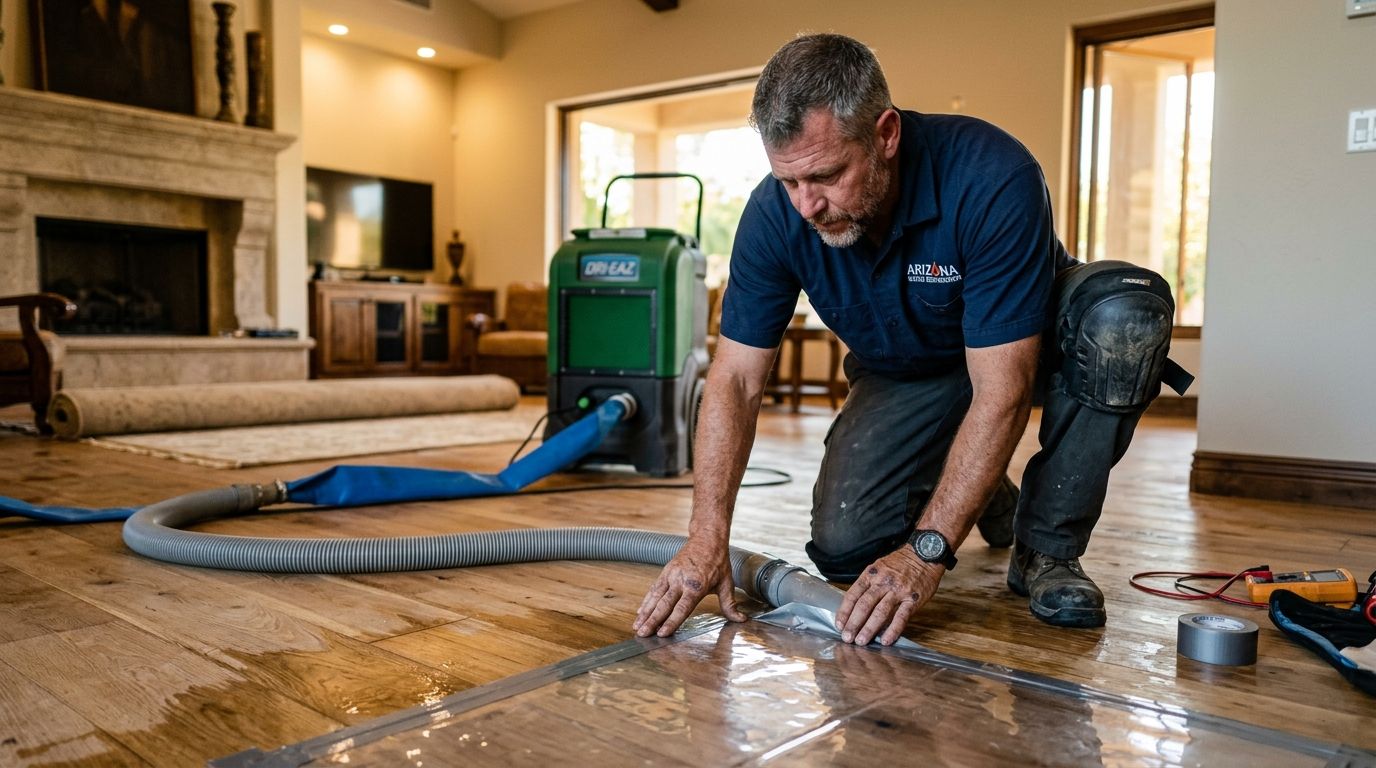
Valley Restoration Pro applies aerodynamic negative-pressure engineering. Our technicians place clear, heavy-gauge Injectidry vacuum panels across the floor joints, creating hermetic air-tight seals with non-marring gaskets. High-vacuum suction units generate extreme negative pressure gradients (16 to 22 inches of mercury lift), pulling air down through perimeter expansion gaps and up through the cellular pore network of the oak planks.
As liquid water is extracted, industrial Low-Grain Refrigerant (LGR) dehumidifiers continuously condense the vapor into liquid, draining gallons of water directly into municipal drains every hour while maintaining ambient room humidity at 32%.
Frequently Asked Questions: Hardwood Floor Water Damage
Expert answers from certified water restorers regarding hardwood drying science, cupping prevention, and insurance claim approvals:
November 2026 Technical Field Advisory & Operations Update
Verified by IICRC Master Water Restorer | Active Emergency Deployment
Greater Phoenix Seasonal Water Damage Dynamics & 2026 Rapid Response Protocol
As ambient desert temperatures decline in late autumn across Maricopa County, concrete slabs experience thermal contraction cycles, increasing structural stress on subterranean copper plumbing lines weakened by Phoenix’s extreme 18 GPG municipal hard water scale. Valley Restoration Pro maintains rapid 30-to-60 minute emergency staging across Phoenix, Scottsdale, Mesa, Chandler, Glendale, Gilbert, Tempe, Peoria, Surprise, and Goodyear. Our master crews deploy non-destructive FLIR thermal imaging and high-volume industrial LGR dehumidification trailers to achieve dry standard equilibrium without needless structural demolition.
Facing Flooded Hardwood or an Under-Slab Leak in Arcadia or Phoenix?
Do not let contractors destroy your valuable wood floors with premature demolition. Valley Restoration Pro’s specialized negative-pressure hardwood drying units are ready for immediate 24/7 mobilization across Greater Phoenix.
Wood Anatomy & Cellular Water Dynamics: Free Water vs Bound Water
Understanding how to save water-damaged hardwood without demolition requires a deep scientific grasp of wood anatomy and cellular moisture transport. Hardwood species like European white oak (Quercus alba), American walnut, and hickory are hygroscopic natural materials consisting of millions of longitudinal tracheid and vessel cells aligned along the grain.
Wood absorbs water in two distinct physiological states:
- Free Water: Liquid water occupying the hollow cell lumens and microscopic spaces between wood fibers. Free water is absorbed rapidly via capillary suction when water covers the floor surface. Free water can be extracted quickly through commercial negative-pressure vacuum extraction.
- Bound Water: Water held by hydrogen bonding within the cellulose and hemicellulose cell walls themselves. Wood only begins expanding, warping, and cupping when moisture enters the cell walls.
The threshold between free water and bound water is called the Fiber Saturation Point (FSP), which occurs at approximately 28% to 30% moisture content (MC) for white oak. When moisture content is below FSP, wood dimensions change directly in proportion to moisture gain or loss. When an under-slab leak floods the subfloor, the bottom of the oak planks absorbs water first, expanding rapidly across its tangential dimension while the dry top surface (protected by polyurethane wear layers) remains unchanged. This uneven dimensional expansion forces the plank edges upward, producing the classic concave distortion known as cupping.
The Critical 24-48 Hour Window: Why Early Intervention Prevents Floor Replacement
In the Arcadia neighborhood of Phoenix, custom estates frequently feature imported European engineered oak or solid white oak flooring costing between $18 and $35 per square foot installed. When a water line bursts beneath a concrete slab at 2 AM, the clock begins ticking immediately against the flooring’s structural salvageability.
If professional high-vacuum extraction is deployed within the first 24 to 36 hours, liquid free water can be removed from beneath the planks before bound water fully saturates the cell walls past the Fiber Saturation Point. As long as the wood has not exceeded FSP for more than 48 hours, cellular damage is completely reversible. As negative-pressure vacuum mats draw moisture out of the bottom of the planks, the swollen wood fibers contract symmetrically, and the cupped planks relax back down flat against the concrete subfloor.
However, if water is left unmitigated for 72 hours or longer under Arizona’s high indoor ambient heat, wood cells undergo permanent plastic deformation. Furthermore, the expanding wood planks exert immense lateral forces against perimeter drywall walls. Once the expansion gap is closed, the planks have nowhere to go and buckle upward into severe teepee-like ridges, snapping tongue-and-groove joints and tearing concrete fasteners completely free. At that stage, non-destructive salvage is no longer possible, and a full tear-out and replacement is mandatory.
Injectidry Negative-Pressure Vacuum Panels vs Traditional Fan Drying
Traditional water damage mitigation contractors frequently attempt to dry hardwood floors by setting residential or commercial air movers on top of the floor and running a standard dehumidifier. This outdated methodology almost always results in floor destruction.
Because wood planks are coated with multiple layers of water-resistant polyurethane, aluminum oxide, or UV-cured acrylic finishes on their top surface, air blowing across the top of the floor cannot penetrate into the saturated subfloor beneath. In fact, blowing high-velocity dry air across the top of a cupped floor evaporates moisture from the top of the planks while leaving the bottom completely saturated. This exacerbates the moisture gradient between the top and bottom of the board, accelerating severe crowning, finish cracking, and board splitting.
Valley Restoration Pro applies advanced Injectidry® negative-pressure engineering:
- Hermetically sealed, clear high-impact plastic panels are laid across the seams of the hardwood floor and sealed with specialized non-marring vinyl gaskets.
- Hoses connect the panels to commercial vacuum blowers generating 16 to 22 inches of mercury (Hg) suction lift.
- This extreme vacuum pulls air down through the baseboard perimeter expansion gaps, underneath the hardwood planks, through the concrete slab pores, and upward through the tongue-and-groove joints into the vacuum extraction chamber.
- Liquid water and bound moisture vapor are extracted simultaneously from the underside of the floor, eliminating the moisture gradient and allowing the wood to dry symmetrically from the bottom up.
Psychrometric Drying Logs & Avoiding Premature Floor Sanding
A catastrophic mistake often made by general handymen or uninformed homeowners is attempting to sand a cupped hardwood floor flat while it is still wet. When a floor is cupped, the edges are high. If a floor sander grinds those edges flat while the bottom of the wood is still saturated, the floor may temporarily look level. However, once the bottom of the board eventually dries weeks later, the wood contracts, and the edges shrink below the center, creating permanent and irreversible crowning that ruins the floor forever.
Certified IICRC restorers adhere strictly to quantitative psychrometric monitoring. Technicians visit the property daily to measure wood moisture content (MC) using Delmhorst deep-wall insulated pin probes hammered into the core of the wood planks and subfloor. The drying operation is continued until:
- Wood moisture content returns within 2 to 4 percentage points of the dry control standard established in an unaffected room (typically 7% to 9% MC in Phoenix homes).
- The moisture differential between the top and bottom of the board is less than 1.5%.
- Indoor air grains per pound (GPP) stabilize below 35 GPP for 48 consecutive hours.
Only after these objective benchmarks are met is equipment demobilized. In the Arcadia case study, this disciplined scientific approach preserved $45,000 in custom European white oak flooring, avoided weeks of contractor demolition, and secured 100% direct insurance reimbursement with zero homeowner out-of-pocket stress.
Engineering Analysis: Solid vs Engineered Hardwood Restoration
In modern luxury residences across Arcadia, Paradise Valley and Greater Phoenix service areas, and North Scottsdale luxury estates, architects and custom homebuilders specify two primary categories of hardwood flooring: solid 3/4-inch site-finished hardwood and multi-ply engineered wide-plank hardwood. While both can be salvaged through professional negative-pressure drying, their internal structural reactions to subterranean water leaks differ substantially.
Solid hardwood consists of a single homogeneous piece of lumber milled directly from a log. Solid wood expands and contracts anisotropically: tangential expansion (across the growth rings) is approximately double radial expansion (perpendicular to growth rings), while longitudinal expansion (along the length of the board) is virtually negligible. When flooded from below, solid hardwood develops severe concave cupping very quickly. However, because solid wood has no internal glue lines, once liquid water is vacuumed out, solid planks release moisture smoothly without risking internal delamination.
Engineered hardwood consists of a top decorative wear layer (the lamella, typically 3 to 6 millimeters of real European oak, walnut, or maple) laminated under heat and pressure to multiple underlying cross-ply hardwood or Baltic birch substrate layers. The cross-laminated substrate provides superior dimensional stability during normal seasonal humidity fluctuations. However, when submerged under water for days, the differing expansion rates of the perpendicular ply layers place extreme shear stress on the adhesive glue lines. If drying is delayed past 48 hours, the adhesive undergoes hydrolytic degradation, resulting in permanent top-layer blister delamination that cannot be repaired without replacement.
Valley Restoration Pro calibrates negative-pressure vacuum mats specifically to the flooring type. For engineered planks, our technicians maintain a gentle, controlled vacuum curve (14 to 18 inches Hg) to prevent micro-fracturing of the cross-ply glue matrix, while simultaneously maintaining ambient chamber relative humidity at 32% using industrial Phoenix LGR dehumidifiers.
Step-by-Step Field Execution: The Arcadia 4-Day Timeline
Review the exact chronological operational timeline executed by our IICRC-certified restoration crew during the Arcadia estate salvage operation:
Hour 0.5: Arrival, Scene Triage & Domestic Line Isolation
Emergency crew arrived on site 22 minutes after the initial 2:15 AM callout. Water main shutoff executed; power to master wing de-energized. FLIR thermal camera mapped 850 sq. ft. of subterranean hot water migration across master suite and gallery hall.
Hour 1.5: Acoustic Leak Pinpointing & Plumbing Bypass
Acoustic transducers isolated the pipe fracture to a hot water line manifold located beneath a hallway linen cabinet. Licensed plumbing team bypassed the failed line overhead through the attic, permanently isolating the buried pipe without touching the oak floor.
Hour 3: Negative-Pressure Vacuum Mat Deployment
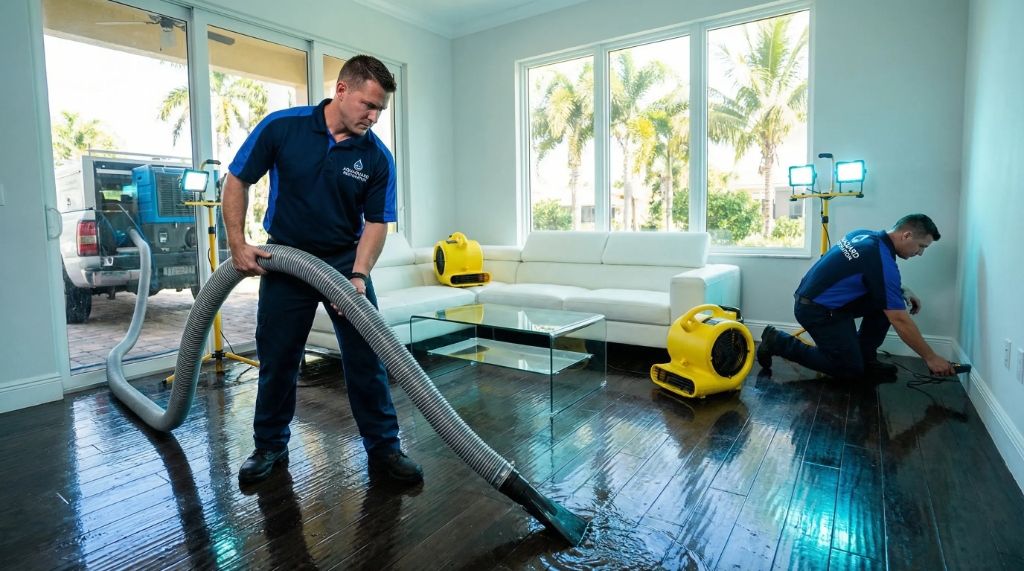
Technicians deployed 18 Injectidry floor mats sealed over hardwood plank joints. High-vacuum extractors began pulling liquid water through wood pores at 18 inches Hg. Two Phoenix 200HT commercial LGR dehumidifiers and six axial air movers were energized to establish an enclosed drying chamber.
Day 2: Psychrometric Equilibrium Shift & Cupping Reversal
Ambient specific humidity dropped from 98 GPP to 36 GPP. Wood moisture content dropped from 28.4% MC to 18.2% MC. Visual cupping relaxed significantly as bound water was extracted from subfloor concrete.
Day 4: Final Certification & 100% Floor Salvage
Core pin probes verified wood moisture content returned to 8.2% MC (matching unaffected control room baseline). Floor planks laid completely flat with zero cupping or crowning. Certificate of Drying issued for State Farm adjuster with 100% direct insurance billing.
Wood Anatomy & Cellular Water Dynamics: Free Water vs Bound Water
Understanding how to save water-damaged hardwood without demolition requires a deep scientific grasp of wood anatomy and cellular moisture transport. Hardwood species like European white oak (Quercus alba), American walnut, and hickory are hygroscopic natural materials consisting of millions of longitudinal tracheid and vessel cells aligned along the grain.
Wood absorbs water in two distinct physiological states:
- Free Water: Liquid water occupying the hollow cell lumens and microscopic spaces between wood fibers. Free water is absorbed rapidly via capillary suction when water covers the floor surface. Free water can be extracted quickly through commercial negative-pressure vacuum extraction.
- Bound Water: Water held by hydrogen bonding within the cellulose and hemicellulose cell walls themselves. Wood only begins expanding, warping, and cupping when moisture enters the cell walls.
The threshold between free water and bound water is called the Fiber Saturation Point (FSP), which occurs at approximately 28% to 30% moisture content (MC) for white oak. When moisture content is below FSP, wood dimensions change directly in proportion to moisture gain or loss. When an under-slab leak floods the subfloor, the bottom of the oak planks absorbs water first, expanding rapidly across its tangential dimension while the dry top surface (protected by polyurethane wear layers) remains unchanged. This uneven dimensional expansion forces the plank edges upward, producing the classic concave distortion known as cupping.
The Critical 24-48 Hour Window: Why Early Intervention Prevents Floor Replacement
In the Arcadia neighborhood of Phoenix, custom estates frequently feature imported European engineered oak or solid white oak flooring costing between $18 and $35 per square foot installed. When a water line bursts beneath a concrete slab at 2 AM, the clock begins ticking immediately against the flooring’s structural salvageability.
If professional high-vacuum extraction is deployed within the first 24 to 36 hours, liquid free water can be removed from beneath the planks before bound water fully saturates the cell walls past the Fiber Saturation Point. As long as the wood has not exceeded FSP for more than 48 hours, cellular damage is completely reversible. As negative-pressure vacuum mats draw moisture out of the bottom of the planks, the swollen wood fibers contract symmetrically, and the cupped planks relax back down flat against the concrete subfloor.
However, if water is left unmitigated for 72 hours or longer under Arizona’s high indoor ambient heat, wood cells undergo permanent plastic deformation. Furthermore, the expanding wood planks exert immense lateral forces against perimeter drywall walls. Once the expansion gap is closed, the planks have nowhere to go and buckle upward into severe teepee-like ridges, snapping tongue-and-groove joints and tearing concrete fasteners completely free. At that stage, non-destructive salvage is no longer possible, and a full tear-out and replacement is mandatory.
Injectidry Negative-Pressure Vacuum Panels vs Traditional Fan Drying
Traditional water damage mitigation contractors frequently attempt to dry hardwood floors by setting residential or commercial air movers on top of the floor and running a standard dehumidifier. This outdated methodology almost always results in floor destruction.
Because wood planks are coated with multiple layers of water-resistant polyurethane, aluminum oxide, or UV-cured acrylic finishes on their top surface, air blowing across the top of the floor cannot penetrate into the saturated subfloor beneath. In fact, blowing high-velocity dry air across the top of a cupped floor evaporates moisture from the top of the planks while leaving the bottom completely saturated. This exacerbates the moisture gradient between the top and bottom of the board, accelerating severe crowning, finish cracking, and board splitting.
Valley Restoration Pro applies advanced Injectidry® negative-pressure engineering:
- Hermetically sealed, clear high-impact plastic panels are laid across the seams of the hardwood floor and sealed with specialized non-marring vinyl gaskets.
- Hoses connect the panels to commercial vacuum blowers generating 16 to 22 inches of mercury (Hg) suction lift.
- This extreme vacuum pulls air down through the baseboard perimeter expansion gaps, underneath the hardwood planks, through the concrete slab pores, and upward through the tongue-and-groove joints into the vacuum extraction chamber.
- Liquid water and bound moisture vapor are extracted simultaneously from the underside of the floor, eliminating the moisture gradient and allowing the wood to dry symmetrically from the bottom up.
Psychrometric Drying Logs & Avoiding Premature Floor Sanding
A catastrophic mistake often made by general handymen or uninformed homeowners is attempting to sand a cupped hardwood floor flat while it is still wet. When a floor is cupped, the edges are high. If a floor sander grinds those edges flat while the bottom of the wood is still saturated, the floor may temporarily look level. However, once the bottom of the board eventually dries weeks later, the wood contracts, and the edges shrink below the center, creating permanent and irreversible crowning that ruins the floor forever.
Certified IICRC restorers adhere strictly to quantitative psychrometric monitoring. Technicians visit the property daily to measure wood moisture content (MC) using Delmhorst deep-wall insulated pin probes hammered into the core of the wood planks and subfloor. The drying operation is continued until:
- Wood moisture content returns within 2 to 4 percentage points of the dry control standard established in an unaffected room (typically 7% to 9% MC in Phoenix homes).
- The moisture differential between the top and bottom of the board is less than 1.5%.
- Indoor air grains per pound (GPP) stabilize below 35 GPP for 48 consecutive hours.
Only after these objective benchmarks are met is equipment demobilized. In the Arcadia case study, this disciplined scientific approach preserved $45,000 in custom European white oak flooring, avoided weeks of contractor demolition, and secured 100% direct insurance reimbursement with zero homeowner out-of-pocket stress.
Subfloor Adhesion Mechanics & Delmhorst Species Calibration
In luxury residences across Arcadia and Paradise Valley, hardwood planks are bonded to concrete foundations using elastomeric silane-modified polymer (SMP) adhesives. When pressurized slab leaks breach beneath the adhesive membrane, water dissolves plasticizers and attacks the bond line. Understanding the shear strength retention of moisture-cured urethane adhesives is vital for salvage determination.
Standard wood moisture meters are calibrated exclusively for Douglas fir. When assessing European white oak (Quercus alba), technicians must apply species temperature and density correction coefficients. For every 10°F deviation from the 70°F meter calibration standard, raw electrical resistance readings shift by 0.5% moisture content. Applying unadjusted readings leads to catastrophic false positives, causing contractors to prematurely pull drying equipment while core plank cells remain saturated.
Valley Restoration Pro restorer technicians program digital Delmhorst BD-2100 meters directly with specific gravity factors (0.68 for European white oak). By taking insulated hammer-probe readings at varying depths (1/4 inch, 1/2 inch, and subfloor interface), our crew tracks internal moisture gradients across the entire cross-section of the plank. Only when core-to-surface moisture equilibrium reaches within 1% does the vacuum extraction phase transition into stabilization, ensuring the $45,000 hardwood installation maintains factory dimensional tolerances for decades to come.
Verified Local Area Dispatch: Arcadia, Phoenix, AZ
Official Geo-Coordinates: 33.4942° N, -111.9614° W • Maricopa County
Verified Technical Standard & Engineering Quality Assurance
Every mitigation project executed by Valley Restoration Pros complies strictly with national standards established by the Institute of Inspection, Cleaning and Restoration Certification (IICRC S500 / S520) and OSHA safety regulations across Maricopa County.