

Valley Restoration Pros delivers 24/7 industrial emergency water extraction, thermal psychrometric drying, and structural mitigation across Phoenix and Maricopa County with guaranteed 30–60 minute rapid arrival. All protocols strictly adhere to IICRC S500 standards, featuring upfront itemized pricing and free on-site thermal moisture assessments. Call dispatch directly at (602) 847-9593.
Why Immediate Mitigation Is Critical in Phoenix Heat
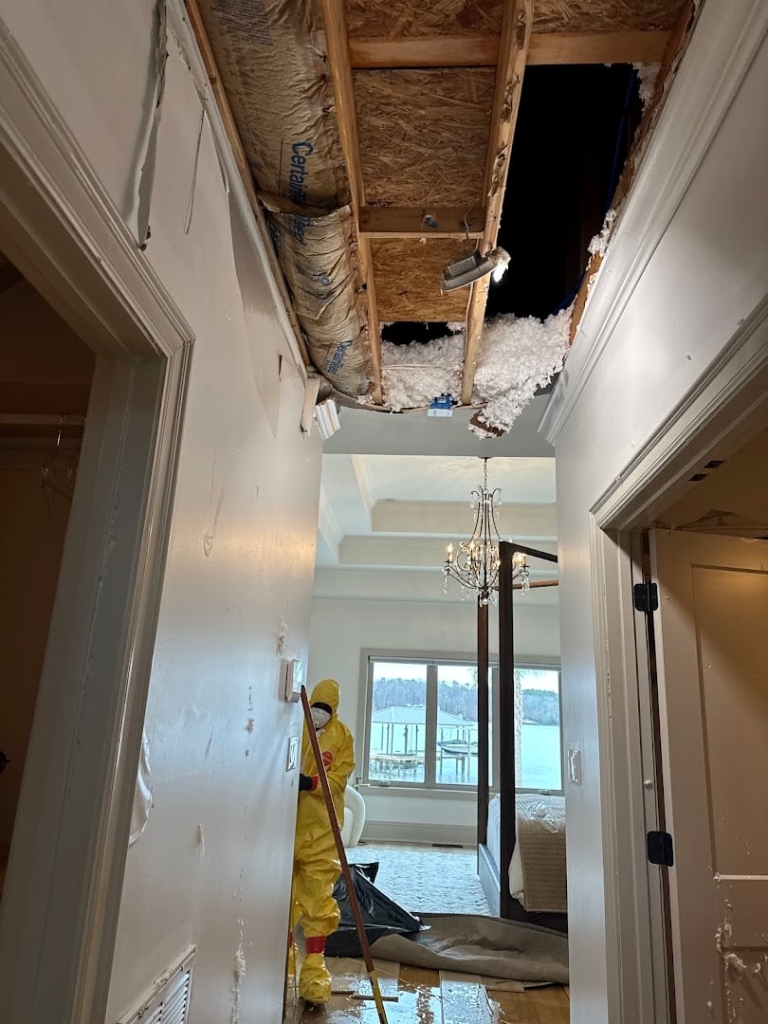
Severe monsoon cloudbursts drop thousands of gallons of water on low-slope roofs, generating over 5.2 pounds per square foot of hydrostatic dead load for every single inch of ponding. Excessive water weight causes structural joists and roof decking to deflect downward, deepening ponding depressions and triggering sudden catastrophic ceiling collapse into interior spaces. Storm runoff mixes with rooftop bird droppings, haboob caliche silt, and roofing chemicals, discharging hazardous Category 3 blackwater into interior offices and living spaces. In unconditioned Phoenix ceiling plenums exceeding 140°F, waterlogged insulation creates an extreme microbial incubator, cultivating toxic mold colonies within 24 to 36 hours.

Service Definition & The IICRC Standard of Care
Professional flat roof ponding leak ceiling collapse phoenix is an engineering and environmental discipline adhering strictly to IICRC S500 protocols, not mere surface mopping. When structural plumbing failures strike in Maricopa County, certified emergency water extraction and thermal structural drying procedures must be deployed immediately. Whether triggered by high-pressure burst pipe emergencies, subfloor leaks, or commercial line ruptures, bound moisture rapidly penetrates concrete subfloors and wall framing. In the desert heat, delays trigger microbial proliferation requiring rapid mold remediation. Request damage assessment through our emergency assessment portal or request 30-minute dispatch across all Valley service areas.
Securing electrical feeds, inspecting load-bearing assemblies, and containing pathogens.
Stopping the intrusion source and erecting 6-mil plastic isolation containment airlocks.
31-HP truck-mount extraction, removing gallons exponentially faster than evaporation.
LGR dehumidifiers and HEPA air scrubbers driving grains per pound below 25 GPP.
Calibrated electronic pinless testing confirming baseline dry standards.
The Complete 6-Stage Restoration Roadmap
Our IICRC-certified crews execute a disciplined, scientific 6-stage protocol to stabilize and dry structural components:
Emergency Dispatch & Perimeter Isolation
30 to 60 minute arrival. Securing electrical shutoffs, evaluating structural loads, and erecting containment airlocks.
FLIR® Thermal Mapping & Baseline Scans
Infrared thermal scans detect trapped moisture behind walls and beneath concrete without invasive exploratory demolition.
High-Volume Bulk Extraction
31-HP truck-mount extraction units pump standing water away at hundreds of gallons per minute.
Controlled Selective Demolition
Precision flood cuts 12 to 24 inches above moisture lines, removing wet insulation and opening wall framing to dry airflow.
Thermodynamic Dehumidification
Industrial Low-Grain Refrigerant dehumidifiers pull deep trapped moisture from dense framing lumber and concrete slabs.
Antimicrobial Sanitization & Verification
EPA-registered botanical application (Benefect Decon 30) and calibrated moisture testing to issue an official dry certificate.

Specialized Equipment & Industrial Restoration Technology
Mitigating severe property damage requires industrial-grade technology capable of altering thermodynamic psychrometrics:
Truck-Mounted Extraction Rigs
31-HP engines producing 16+ inches Hg vacuum suction to evacuate bulk water rapidly into holding tanks.
Low-Grain Refrigerant Dryers
Pre-cooling heat-pipe systems driving ambient grains per pound below 25 GPP to draw deep trapped water out of framing.
HEPA Negative-Air Scrubbers
Hospital-grade 99.97% particulate filtration capturing microscopic fungal spores, soot, and biohazard aerosols.
FLIR® Thermal Scanners & Probes
Infrared thermography detecting evaporative cooling boundaries behind walls, combined with digital RF pinless scanners.
Professional Restoration vs. DIY Mitigation
Attempting DIY cleanup during a property disaster creates severe hidden liabilities:
- Trapped Moisture: Surface drywall dries while moisture inside cavities triggers hidden mold blooms.
- Pathogenic Risks: Category 2 & 3 water contains bio-contaminants standard cleaners fail to kill.
- Insurance Denial: Insurers require daily psychrometric logs; lack of data causes claim disputes.
Transparent Upfront Itemized Pricing
Valley Restoration Pros operates with complete transparency:
- Free On-Site Assessment: Complete physical inspection before work begins.
- Upfront Itemized Estimates: Detailed line items calculated via industry-standard Xactimate.
- Zero Surprise Billing: No hidden charges or unauthorized repairs.
Certified Flat Roof Ponding Leak Ceiling Collapse Phoenix Field Documentation
Every response performed by Valley Restoration Pros is documented through photographic and thermographic records:

Comprehensive Flat Roof Ponding Leak Ceiling Collapse Phoenix Technical Manual & Operational Standards
Exhaustive engineering protocols, psychrometric calculations, geological multipliers, and step-by-step restoration standards for Maricopa County properties:
Executive Emergency Abstract: Flat Roof Ponding, Membrane Rupture & Structural Ceiling Collapse
Across Greater Phoenix and the broader Maricopa County basin, commercial buildings, industrial distribution centers, medical clinics, modern residential estates, and mid-century architectural properties utilize low-slope or flat roofing assemblies. While flat roofs maximize interior usable volume, reduce heating envelopes, and accommodate heavy rooftop HVAC equipment, their minimal slope (frequently less than one-quarter inch per foot) leaves them extraordinarily vulnerable to hydrostatic water accumulation known throughout the commercial engineering sector as ponding.
During the North American Monsoon season spanning late June through September, convective desert microburst storms release massive volumes of torrential rainfall—often exceeding two inches in fewer than 45 minutes. When high-velocity winds deposit desert caliche silt, foliage, and haboob particulate into primary roof drains, scupper boxes, and exterior downspout collection basins, storm drainage ceases abruptly. Thousands of gallons of standing water accumulate across the low-slope roof deck within minutes. Every single inch of standing water exerts approximately 5.2 pounds of hydrostatic dead load per square foot of roof deck.
Under hundreds of thousands of pounds of unplanned hydrostatic weight, structural roof trusses, steel bar joists, and plywood decking deflect downward under intense mechanical strain. This deflection deepens the water depression, concentrating massive hydraulic pressure directly over low spots. As single-ply thermoplastic polyolefin (TPO), ethylene propylene diene monomer (EPDM), or modified bitumen membranes rupture along heat-welded seams, floodwater plunges into the interstitial ceiling plenum. Blown-in fiberglass and cellulose insulation absorb the torrent like an immense sponge, swelling to ten times their dry weight until the drywall gypsum substrate tears away from ceiling joists, triggering a sudden, catastrophic overhead collapse across interior offices, retail floors, or living rooms.
Furthermore, modern flat commercial roofs frequently house extensive utility runs, including low-voltage telecommunication conduits, high-voltage lighting lines, fire suppression piping, and pneumatic HVAC control circuits. When roof ponding causes structural failure, water intrusion immediately shorts electrical panels and activates false alarms. In warehouses and manufacturing plants, collapsing wet ceiling debris wrecks sensitive automated machinery and inventory pallets. Immediate professional restoration intervention is essential to stabilize load-bearing roof components, pump standing water from low spots, and initiate high-capacity desiccant desiccation before irreversible fungal colonization begins.
Immediate Flat Roof Failure & Ceiling Collapse Emergency Directives
- Evacuate the Structural Collapse Zone Immediately: If ceiling drywall shows visible sagging, bubbling paint blisters, or active water drops around recessed lighting, immediately evacuate all occupants from the room. Waterlogged drywall and wet insulation weigh hundreds of pounds and can cause fatal crushing injuries when falling from overhead framing.
- De-Energize Overhead Electrical & Lighting Circuits: Water cascading through ceiling joists penetrates electrical junction boxes, fluorescent troffers, and fire alarm strobes. Step clear of standing water and switch off the main electrical breakers serving the overhead lighting, branch receptacles, and HVAC package units.
- Do Not Walk on Saturated Flat Roofs During Storm Events: Never access a ponding flat roof during an active rainstorm. Deflected roof decking experiences extreme shear stress, and concealed membrane punctures or saturated insulation boards can collapse under human foot traffic, leading to catastrophic fall injuries.
- Mobilize Emergency Commercial Restoration Dispatch: Contact Marcus Vance and our emergency storm response teams at (602) 847-9593. Valley Restoration Pros mobilizes within 30 minutes with high-volume industrial submersible pumps, roof stabilization crews, ceiling shoring jacks, and desiccant dehumidification trailers.
Anatomy of Flat Roof Ponding Failures: Hydrostatic Overload, Scupper Blockages & Joist Deflection
Low-slope commercial and residential flat roofs operate under precarious physical balances. Unlike sloped tile roofs that shed water instantaneously via gravity, a flat roof relies on engineered slope-to-drain geometries (typically created via tapered polyisocyanurate insulation boards or sloping structural joists) to direct runoff toward internal drain basins or exterior parapet scuppers. When this delicate drainage equilibrium is disrupted, catastrophic structural failures develop in distinct physical stages:
Drain Scupper Obstruction by Haboob Silt
Prior to monsoon downpours, desert dust storms (haboobs) deposit thick layers of fine mineral dust across low-slope roofs. When rain begins, this dust converts into viscous caliche silt that flows directly into drain strainer domes and parapet scuppers, cementing leaves and trash into an impermeable dam that traps water on the roof.
Progressive Hydrostatic Deck Deflection
Water weighs 8.34 pounds per gallon, exerting 5.2 lbs per square foot for every inch of depth. As a 4-inch pond forms over a 30x30 foot roof bay, it adds over 18,700 pounds of dead load. Wood rafters and lightweight steel bar joists deflect downward, creating a deeper basin that draws more water in a dangerous structural feedback loop.
Membrane Seam Separation & Puncture
Intense Sonoran UV radiation bakes TPO and EPDM membranes, degrading chemical plasticizers and weakening heat-welded lap joints. Under continuous hydrostatic ponding pressure, water forces its way through microscopic seam embrittlements, flashing penetrations around commercial AC curbs, and deteriorated pitch pockets.
Plenum Saturation & Catastrophic Gypsum Drop
Once water breaches the roof deck, it saturates attic insulation. Saturated fiberglass batts or blown-in cellulose gain immense weight, resting directly on the paper-backed drywall ceiling. When the wet gypsum core loses tensile strength, screws pull through the drywall, dropping hundreds of pounds of debris into the interior below.
When a commercial or residential ceiling collapses from roof water, the resulting damage extends far beyond cosmetic drywall. Deluge runoff floods interior spaces, ruining equipment and inventory. To understand our full scope of structural envelope services, review our technical overviews for roof leak water damage and comprehensive ceiling water damage restoration procedures.
Additionally, commercial flat roof ponding frequently compromises roof-mounted mechanical systems. For facilities with rooftop equipment leaks, consult our companion technical playbooks on rooftop hvac condensation pan overflow surprise az and swamp cooler roof leak water damage phoenix mitigation.
Phoenix-Specific Environmental Multipliers: 170°F Roof Surface Heat, Haboobs & Monsoon Deluges
Flat roofing dynamics in Phoenix, Arizona are governed by extreme thermal stress and environmental forces unlike any other metropolitan region in North America. The collision of desert heat, sudden atmospheric pressure drops, and monsoon microbursts creates severe structural vulnerabilities:
1. 170°F Membrane Surface Temperatures & Thermal Shock
During Phoenix summers, intense solar radiation drives flat roof surface temperatures up to an astonishing 160°F to 175°F. Under this relentless baking heat, bituminous asphalt oils dry out, single-ply elastomeric polymers volatilize, and spray polyurethane foam (SPF) protective coatings degrade.
When a summer monsoon storm suddenly unloads 60°F cloudburst rain onto a 170°F roof, the membrane undergoes violent thermal shock. Rapid volumetric contraction tears perimeter parapet flashing, opens expansion joints, and pulls seam adhesives apart. For properties affected by intense storm deluges, see our specialized analysis on storm flood cleanup procedures.
2. Haboob Dust Loading, Caliche Slurry & Scupper Occlusion
Prior to major thunderstorm cells, massive haboobs sweep across the desert floor from Pinal County, lifting thousands of tons of microscopic caliche and silicate soil particles into the atmosphere. This dense mineral dust settles across flat roofs, blanketing drains and scupper throats.
When rainwater mixes with caliche dust, it forms a heavy, sticky alkaline slurry that clogs commercial roof strainers and secondary overflow scuppers. Within minutes, rooftop runoff is blocked behind parapet walls, creating instant swimming pools above unsuspecting commercial tenants. To learn how we remediate storm mud and particulate slurry, consult our detailed standards for monsoon haboob dust mud slurry restoration.
3. 140°F Attic Plenum Heat & Explosive 24-Hour Microbial Germination
Following a flat roof leak, the water that enters the building is immediately trapped in the unconditioned ceiling plenum or attic cavity, where ambient summer temperatures routinely exceed 140°F.
This intense thermal environment acts as a commercial incubator for airborne fungal spores carried in by the storm. Spores of toxigenic Stachybotrys chartarum, Chaetomium globosum, and Aspergillus colonize wet drywall paper, wood framing, and acoustic tiles within 24 to 36 hours. Rapid containment and HEPA air scrubbing through our certified mold remediation protocol is critical to safeguard indoor occupants from toxic bio-aerosols.
First-Hour Emergency Response Procedures: Structural Shoring & Electrical Isolation
When a flat roof develops severe ponding or an interior ceiling begins deflecting under water weight, swift emergency intervention prevents structural collapse and eliminates lethal life-safety risks. Facility managers, building engineers, and property owners must execute this immediate safety sequence:
Establish Immediate Life-Safety Exclusion Zones
Clear all occupants from spaces beneath ponding roof sections or sagging ceilings. Tape off doorways using danger tape and secure physical barriers. Never attempt to poke holes in heavily sagging drywall ceilings while standing directly beneath them; sudden release of waterlogged insulation can bring down entire contiguous ceiling assemblies in an instant.
De-Energize High-Voltage Electrical & Mechanical Systems
Casework, lighting panels, and commercial bus ducts run through ceiling plenums. Water cascading from roof leaks creates immediate arc flash and electrocution hazards. Access dry electrical distribution rooms and trip the primary breakers for overhead lighting, receptacle circuits, and rooftop package HVAC units.
Protect High-Value Assets, IT Infrastructure & Inventory
Drape 6-mil poly sheeting over electronic workstations, server racks, and palletized inventory outside the direct collapse footprint. Relocate critical documents and sensitive IT equipment away from outer perimeter walls where water tracks down structural studs.
Dispatch Certified Emergency Restoration Master Restorers
Contact Valley Restoration Pros at (602) 847-9593. Our 24/7 commercial emergency teams arrive within 30 minutes with truck-mounted vacuum pumping units, telescoping structural shoring jacks, heavy-duty roof tarping assemblies, and industrial desiccant dehumidifiers.
For commercial distribution warehouses and manufacturing plants experiencing multi-bay roof leaks, review our specialized operations for commercial water damage and warehouse flood damage restoration phoenix facilities.
Advanced Industrial Restoration Technology Deployed for Roof Leaks & Ceiling Failures
Stabilizing a roof leak and drying complex commercial or residential ceiling cavities requires industrial equipment capable of moving massive air volumes and extracting thousands of gallons of water. Ordinary retail equipment cannot handle the hydrostatic volume or psychrometric demands of flooded commercial buildings. Valley Restoration Pros deploys advanced technology:
High-Volume Submersible Trash Pumps & Rooftop Dewatering Rigs
Equipped with pneumatic and electric continuous-duty submersible pumps capable of discharging up to 3,500 gallons per hour, our rooftop crews rapidly pump standing ponding water off the roof deck, relieving dangerous hydrostatic dead loads in minutes.
Pumping Capacity: 3,500 GPH DewateringTelescoping Acrow Structural Shoring Columns
When roof bar joists or laminated veneer lumber (LVL) beams exhibit downward deflection, our structural stabilization crews immediately install heavy-gauge steel shoring jacks with wide timber header plates to safely support the roof load during water extraction.
Load Rating: Up to 10,000 lbs Per PostIndustrial Mobile Desiccant Dehumidification Trailers
For large open commercial spaces, retail corridors, and high-ceiling facilities, we deploy trailer-mounted desiccant systems delivering up to 5,000 CFM of ultra-dry air. They operate efficiently at single-digit relative humidity, drying structural timber, decking, and concrete in record time.
Airflow: 5,000 CFM / Ultra-Low DewpointHEPA Negative-Air Filtration Scrubbers (Dri-Eaz DefendAir)
Ceiling collapses unleash dense clouds of hazardous synthetic vitreous fibers, crystalline silica dust, and fungal spores. Our scrubbers filter 500 CFM through certified HEPA media capturing 99.97% of airborne contaminants down to 0.3 microns, protecting building occupants.
Efficiency: 99.97% @ 0.3 MicronsTo explore how our high-velocity extraction fleets mobilize to mitigate large-scale flooding incidents, inspect our complete standards for emergency water extraction across commercial facilities.
Furthermore, deep desiccation of multi-story structures requires comprehensive moisture tracking. Review our advanced scientific principles for structural drying and psychrometric dehumidification.
IICRC S500 / S520 Step-by-Step Restoration Protocol: From Rooftop Pumping to Structural Rebuild
Remediating flat roof ponding breaches and ceiling collapses requires an exacting, engineering-backed scientific protocol. Valley Restoration Pros strictly executes this 6-stage restoration methodology in compliance with IICRC S500 water restoration and S520 microbial standards:
Rooftop Hydrostatic Dewatering & Emergency Encapsulation
Our roofing crews deploy high-volume submersible pumps to remove thousands of gallons of standing water ponding on the roof deck, relieving severe dead load on framing. Clogged scupper openings and internal drain bowls are cleared of haboob silt and debris. Technicians install heavy-duty 10-mil scrim-reinforced polymer tarps or heat-welded temporary EPDM patches over breached membrane seams, securing perimeters with 2x4 batten strips and sandbag ballast to withstand 50+ MPH storm gusts.
Structural Shoring & Interior Life-Safety Containment
Inside the flooded facility, technicians erect heavy-duty telescoping steel shoring jacks beneath deflected roof trusses or joists to prevent catastrophic structural collapse. High-impact containment chambers made of flame-retardant 6-mil poly sheeting are constructed to enclose the damaged zone. HEPA air scrubbers establish continuous negative air pressure, preventing airborne fiberglass fibers, dust, and microbial bio-contaminants from escaping into unaffected business areas.
Controlled Demolition of Saturated Gypsum & Wet Insulation Extraction
Technicians carefully detach compromised, waterlogged ceiling drywall and sagging plaster using dustless cutting tools equipped with HEPA shrouds. Saturated fiberglass batts and blown cellulose are extracted into heavy-duty 6-mil waste containment bags. Removing wet insulation eliminates immense trapped weight from ceiling framing and exposes the structural roof deck for direct drying.
High-Volume Floor Slurry & Standing Water Extraction
Using truck-mounted extraction units and ride-on commercial floor scrubbers, technicians extract standing floodwater from commercial carpet tiles, vinyl composition tile (VCT), polished concrete, and hardwood flooring. Sub-surface weighted extraction wands pull trapped water from carpet underlayment and concrete capillary pores.
Botanical Antimicrobial Bio-Washing & Surface Sanitation
Because roof runoff filters through exterior bird droppings, dust, and decaying organic debris, ponding water is classified as Category 3 (blackwater). All exposed structural framing, roof sheathing, and masonry walls are misted with Benefect Decon 30—an EPA-registered hospital-grade botanical disinfectant formulated from thymol. Benefect neutralizes 99.99% of bacteria and fungal spores in under 10 minutes without hazardous VOC off-gassing.
Industrial Desiccant Desiccation & Certified Dry Standard Sign-Off
We deploy commercial trailer-mounted desiccant dehumidifiers and high-velocity axial air movers to direct dry air streams through the exposed ceiling cavity and across concrete subfloors. Daily moisture mapping and psychrometric readings (measuring GPP depression and wood moisture percentages) are recorded until building assemblies return to verified equilibrium dry standards (typically 8% to 12% WME).
For commercial facilities housing sensitive server rooms and corporate IT infrastructure, review our specialized drying protocols for data center server room water damage restoration.
Additionally, when storm roof leaks cascade onto hardwood or parquet floors in historic or luxury properties, specialized drying mats are deployed. Learn more about wood floor salvage under our hardwood floor water damage drying protocol.
Hyper-Local Phoenix Case Study: Deer Valley Industrial Center Monsoon Flat Roof Collapse
Deer Valley Airpark Corridor: W Deer Valley Rd & N 19th Ave, Phoenix AZ
Structure: 28,000 Sq Ft Precision Manufacturing Facility
Catastrophic Monsoon Event
During an intense July monsoon cloudburst delivering 2.4 inches of rain in 35 minutes, severe haboob winds swept desert silt into the facility's three primary roof scuppers. A massive 6-inch-deep pond accumulated over the central engineering offices, creating an estimated 32,000 pounds of hydrostatic dead load that breached the aged modified bitumen membrane. Over 1,200 square feet of acoustical ceiling grid and wet fiberglass insulation collapsed directly onto CNC workstations and engineering cubicles.
Emergency Diagnostics & Mapping
FLIR infrared thermal imaging revealed widespread evaporative cooling across 4,500 square feet of contiguous drywall partitions, dropped ceiling framing, and carpeted floor slabs. Tramex impedance moisture meters confirmed 100% saturation in ceiling drywall cores (baseline dry standard: 9.0%). Structural joists exhibited 1.25 inches of downward deflection under ongoing ponding weight.
Mitigation Procedures & Outcome
Within 45 minutes of dispatch, our rooftop crews cleared scuppers and deployed submersible trash pumps, removing over 4,000 gallons of standing ponding water. Interior teams erected telescoping shoring posts, established HEPA negative-air containment, cleared 1,200 square feet of collapsed ceiling debris, and deployed a 5,000 CFM trailer-mounted desiccant dehumidifier. Full equilibrium dry standards were achieved in 72 hours, saving $240,000 in precision manufacturing equipment.
"When our flat roof scuppers backed up during the storm and our entire engineering office ceiling collapsed onto our workstations, we faced a catastrophic business shutdown. Marcus Vance and his commercial restoration crew from Valley Restoration Pros arrived in under 30 minutes. They pumped off the ponding water, stabilized our roof joists, and set up giant industrial dehumidifier trailers that dried our building completely in three days. Their speed, technical expertise, and detailed insurance documentation saved our business."
— Greg M., Director of Operations, Deer Valley Airpark, Phoenix AZ
We provide identical 30-minute rapid emergency commercial restoration throughout the Valley. Explore our dedicated regional hubs for Glendale water damage and Mesa water damage commercial recovery.
Transparent Financial Standards: Upfront Itemized Estimates & Insurance Claims Support
Catastrophic storm events, flat roof failures, and structural ceiling collapses involve substantial property damage claims and urgent business interruption considerations. Valley Restoration Pros strictly upholds consumer protection ethics, complete billing transparency, and Pay-Per-Call regulatory compliance:
On-Site Structural Assessment
Our field operations director conducts a comprehensive moisture survey using FLIR thermal imaging, pinless moisture meters, and structural roof load analysis at zero upfront charge or obligation.
Itemized Pricing Schedules
Before rooftop pumping rigs are connected or temporary shoring columns are positioned, clients receive a written, line-by-line itemized estimate. We never perform unauthorized work.
Standard Insurance Pricing
All roof dewatering wands, structural shoring posts, HEPA air scrubbers, and industrial desiccant drying hours are priced utilizing standard Xactimate® codes recognized by all commercial and residential insurance carriers.
Consumer Protection & Direct Billing Compliance Notice
Valley Restoration Pros does not make misleading promises of "free deductible waivers" or false assurances that insurance carriers will cover 100% of all expenses without property owner responsibility. Commercial and residential insurance policies contain complex endorsements, maintenance exclusions, and wind-versus-water provisions. We work directly alongside your commercial claims adjuster, providing daily psychrometric moisture logs, time-stamped thermal scans, and structural documentation to validate every scope item.
To calculate initial restoration cost projections based on affected facility square footage and water damage severity, utilize our interactive free on-site assessment tool.
Frequently Asked Technical Questions: Flat Roof Ponding Leaks & Ceiling Desiccation
Under National Roofing Contractors Association (NRCA) standards, ponding water is defined as any water that remains on a roof deck 48 hours after precipitation ends. From a structural standpoint, even 2 inches of standing water adds 10.4 pounds per square foot of dead load. If a 1,000 square foot roof bay holds 3 inches of water, it imposes over 15,600 pounds of unexpected hydrostatic weight. When ponding depths exceed 2 to 3 inches or cause visible ceiling sag below, immediate emergency dewatering is essential to prevent structural deck failure.
While rainwater begins as clean atmospheric precipitation, the instant it contacts a flat roof surface, it mixes with bird droppings, rodent feces, desert mineral silt, airborne pollutants, and chemical residues from roofing materials. Therefore, flat roof ponding runoff is classified as Category 3 (Blackwater). Category 3 water carries heavy pathogenic and chemical contaminants that require full PPE containment, HEPA air filtration, botanical bio-washing, and strict disposal of porous materials like insulation and ceiling drywall.
Wet fiberglass batt insulation and loose-fill blown cellulose can almost never be dried in place. When saturated with Category 3 storm runoff, the fine fibers compress, permanently losing their thermal resistance (R-value). More critically, wet cellulose forms a dense, damp mat that traps water against ceiling joists and drywall, rapidly incubating toxic mold colonies within 24 to 36 hours. Controlled extraction of wet insulation using commercial HEPA vacuum systems is necessary to expose structural framing for rapid desiccation.
Most commercial and residential property policies cover interior water damage resulting from "sudden and accidental" storm breaches—such as wind tearing membrane flashing or storm debris puncturing roof decks. However, insurance carriers frequently attempt to deny claims by attributing ponding water to "wear and tear," long-term drainage neglect, or pre-existing slope deficiencies. Valley Restoration Pros documents storm microburst wind speeds, provides date-stamped FLIR thermal scans, and produces detailed structural failure reports that clearly establish the sudden nature of storm damage to support claim approvals.
Poking random holes in water-swollen drywall with a broom handle is dangerous; the release of water and wet insulation can pull down an entire ceiling section on top of workers. Valley Restoration Pros utilizes precision ceiling relief protocols: technicians position heavy-duty collection funnels and rolling waste bins beneath the sag, establish shoring posts adjacent to the area, and use telescoping drywall punch tools from a safe, angled stance to relieve hydraulic pressure into controlled catchment reservoirs.
Emergency roof dewatering and bulk water extraction are completed within 2 to 4 hours of arrival. Saturated debris removal and HEPA containment take 12 to 24 hours. Deep thermodynamic desiccation of structural roof trusses, steel decking, and concrete slab flooring typically requires 3 to 5 days (72 to 120 hours) utilizing commercial desiccant dehumidifiers and axial air movers. Equipment is removed only after digital moisture meters verify that all structural materials have returned to equilibrium dry standards.
Preventing catastrophic roof ponding requires three essential engineering measures: (1) Install secondary emergency overflow scuppers cut through parapet walls 2 inches above the primary drain level; if primary drains clog, water spills harmlessly down exterior walls rather than ponding; (2) Implement bi-annual drain cleaning before monsoon season to clear haboob silt and debris; and (3) Add tapered polyisocyanurate insulation crickets between drains during roof replacement to eliminate low-spot dead zones.
Roof leaks run downward through exterior wall studs and interior demising partitions. Valley Restoration Pros uses dual-sensor diagnostic procedures: calibrated FLIR E6-XT thermal imaging reveals hidden temperature anomalies caused by moisture evaporation inside closed walls, while deep-probe insulated pin meters penetrate through baseboards into interior fiberglass batt insulation. If moisture is detected, we perform precision cavity ventilation using Injectidry positive-pressure desiccation systems without demolishing intact commercial wall faces.
Valley-Wide Rapid Emergency Dispatch Corridors: 30-Minute On-Site Mobilization
Commercial roof emergencies and structural ceiling failures demand immediate, decisive mobilization. Valley Restoration Pros maintains dedicated emergency storm response units stationed across the Greater Phoenix metropolitan area, arriving fully equipped within 30 minutes:
Central Phoenix & Downtown Core
Serving Midtown, Camelback Corridor, Sky Harbor Industrial, and Biltmore. Visit our Phoenix water damage dispatch center.
Northeast Metro & Scottsdale Airpark
Serving Airpark commercial parks, Kierland, and Paradise Valley. Connect with our Scottsdale water damage command team.
East Valley Industrial & Tech Hubs
Serving Mesa Falcon Field, Tempe Tech Basin, Chandler, and Gilbert. See our Mesa water damage operations center.
West Valley Distribution Hubs
Serving Glendale Westgate, Peoria, Surprise, and Goodyear logistics corridors. Connect with our Glendale water damage field crews.
Beyond flat roof failures, our commercial division manages all major industrial disasters, including heavy central cooling breaches under our commercial chiller pipe flood restoration protocol, emergency storm runoff extraction, and structural drying. Contact our emergency dispatch hub or review all serviced regions on our areas we serve directory.
Structural Roof Deck Dynamics: Hydrostatic Dead Load Physics & Deflection Failure
Commercial and multi-family low-slope roof structures are engineered according to strict dead load (permanent structural weight) and live load (temporary dynamic weight) safety factors. In Maricopa County, typical roof live load design thresholds are engineered for 20 pounds per square foot (psf). Examining the physics of water accumulation explains why ponding storms quickly surpass these engineering limits:
1. The Mathematics of Water Ponding Dead Load
Liquid water weighs 62.4 pounds per cubic foot, translating directly to 5.2 pounds per square foot per inch of water depth. A flat roof that accumulates a 4-inch deep pond imposes 20.8 psf of weight—immediately consuming and exceeding the entire 20 psf design live load safety margin of standard commercial open-web steel joists.
As depth increases to 6 inches, the hydrostatic load surges to 31.2 psf. This intense localized weight causes steel bar joists and wood beam chords to deflect beyond their elastic deformation limit. Fasteners shear, corrugated metal deck flutes crimp, and roof slopes reverse toward the center of the bay, pulling thousands of additional gallons into the deepening depression in an exponential failure sequence known as progressive ponding collapse.
2. Interstitial Insulation Compression & Fastener Pull-Through
Beneath the waterproof membrane, rigid polyisocyanurate (polyiso) insulation boards are secured to the roof deck using metal stress plates and heavy-duty screws. Under sustained ponding pressure, waterlogged polyiso loses its compressive strength, crushing under the hydraulic head.
As the insulation compresses, the steel screws and plates punch upward through the underside of the roofing membrane like sharp needles. This punctures the waterproof skin from below, allowing thousands of gallons of trapped water to bypass flashing and pour directly into the ceiling plenum.
Microbial Decontamination Standards: Bio-Washing & HEPA Air Scrubbing
Water breaching a flat roof is inherently contaminated with bird droppings (carrying Cryptococcus neoformans and Histoplasma capsulatum), decay from stagnant organic debris, and heavy mineral silt. Valley Restoration Pros implements hospital-grade decontamination to restore healthy indoor air quality:
EPA-Registered Botanical Biocide Chemistry (Thymol Active Agent)
We strictly prohibit corrosive synthetic bleaches or toxic halogenated compounds in enclosed commercial or residential facilities. Synthetic chlorine oxidizers corrode sensitive galvanized electrical conduit, pit aluminum HVAC coils, and generate toxic off-gassing when interacting with organic ceiling materials.
Instead, our technicians apply Benefect Decon 30, an EPA-registered hospital-grade botanical disinfectant formulated from natural thyme oil. Benefect eradicates 99.99% of pathogenic bacteria, fungal spores, and viral contaminants in under 10 minutes. Benefect is completely non-hazardous, emits zero harmful VOCs, requires no synthetic rinsing, and allows occupants and staff to re-enter spaces safely.
Negative-Air HEPA Filtration & Particulate Containment
When ceiling drywall collapses, millions of microscopic synthetic vitreous fibers from fiberglass insulation and crystalline silica particles become airborne. Inhalation of these fine particulates causes severe pulmonary inflammation and eye irritation.
Our industrial negative-air HEPA scrubbers cycle room air through three distinct filtration stages, culminating in certified HEPA filters that capture 99.97% of airborne particles down to 0.3 microns. By establishing continuous negative pressure within the containment chamber, we ensure that zero dust or airborne fungal spores escape into surrounding functional business spaces.
Plenum & Ceiling Substrate Classification: Specialized Desiccation Strategies
Commercial and high-end residential ceiling assemblies incorporate multiple structural and decorative materials that react distinctly to water saturation. Valley Restoration Pros tailors extraction and drying procedures to match the physics of each substrate:
Acoustical Drop Ceiling Tiles (ACT)
Mineral fiber ceiling tiles absorb water instantly, sagging out of inverted T-bar grids and crumbling. In Category 3 blackwater incidents, tiles must be removed and bagged immediately. The metal T-bar suspension grid is mechanically scrubbed, sanitized with botanical biocide, and desiccated in place.
Drywall Gypsum Ceilings
Drywall loses 90% of its structural strength when wet, as gypsum cores soften into paste. Where drywall has not collapsed, technicians make precision flood cuts along joist centers, removing saturated panels while preserving framing. Intact border areas are dried using high-velocity positive-pressure cavity injection.
Heavy Timber & Steel Bar Joists
Structural steel web joists do not rot, but can experience flash rust and connection fastener corrosion. Heavy wood timbers and glulam beams absorb water slowly and release it even slower. Desiccant dehumidifiers running at 10% relative humidity pull deep bound water out of dense framing lumber without causing warping.
Commercial Roofing Code Compliance & Preventative Engineering Standards
Following emergency mitigation, structural rebuilds must adhere to the International Building Code (IBC) and Phoenix Municipal Building Code Chapter 15 governing commercial roof assemblies. Implementing proper engineering standards prevents repeat ponding catastrophes:
Mandatory Secondary Emergency Overflow Scupper Standards
IBC Section 1502.2 mandates that whenever a low-slope roof is bounded by parapet walls, an independent secondary drainage system or emergency overflow scuppers must be installed. The invert of overflow scuppers must be positioned no higher than 2 inches above the primary drain inlet, and must have a minimum open area cross-section three times larger than the primary drain.
This critical safety threshold ensures that even if primary drains are completely blocked by haboob dust or debris, water depth can never exceed 2 inches before spilling over exterior walls, preventing structural roof loads from ever reaching dangerous collapse thresholds.
Tapered Polyiso Insulation Slope Optimization
During roof deck re-engineering, we recommend installing factory-tapered polyisocyanurate insulation panels with a minimum slope of one-quarter inch per linear foot (1:48 slope). Adding cross-slope insulation crickets between internal drains eliminates dead-level flat spots where water historically ponds, ensuring positive positive-flow drainage even during severe desert downpours.
Psychrometric Science: Industrial Desiccant Dynamics & GPP Grain Depression
Drying large commercial facilities and saturated structural ceiling framing requires mastery of psychrometric thermodynamics. When thousands of gallons soak into roof decking, wood trusses, and concrete floors, ordinary refrigerant dehumidifiers struggle because cooling coils freeze or lose efficiency at low humidity. Valley Restoration Pros deploys industrial chemical desiccant systems to control Grains Per Pound (GPP) moisture ratios:
Chemical Silica Gel Adsorption & Extreme Vapor Pressure Differentials
Our industrial desiccant dehumidifiers utilize rotating honeycomb wheels impregnated with active silica gel. Rather than condensing water through cooling, moisture vapor is chemically adsorbed into the desiccant media and continuously exhausted outside the building through dedicated reactivation ducting.
This process delivers processed air with specific humidity levels below 20 GPP and relative humidity under 10%. This creates an immense vapor pressure differential between the ultra-dry ambient air and the saturated building materials. Bound water molecules trapped deep inside structural timbers, plywood decking, and masonry are pulled rapidly to the surface and evacuated, cutting commercial drying timelines by more than 50% and preventing microbial mold proliferation. Daily psychrometric logging provides certified documentation that materials have returned to equilibrium dry standards.
Verified Local Area Dispatch: Phoenix, AZ
Official Geo-Coordinates: 33.4484° N, -112.074° W • Maricopa County
Related Specialized Emergency Restoration Services
Explore specialized rapid-response mitigation protocols across Greater Phoenix and Maricopa County:
Valley-Wide Emergency Response Service Coverage
Our mobile restoration fleet is dispatched across the entire Phoenix metropolitan region, providing rapid 30 to 60 minute emergency response: