

Valley Restoration Pros delivers 24/7 industrial emergency water extraction, thermal psychrometric drying, and structural mitigation across Phoenix and Maricopa County with guaranteed 30–60 minute rapid arrival. All protocols strictly adhere to IICRC S500 standards, featuring upfront itemized pricing and free on-site thermal moisture assessments. Call dispatch directly at (602) 847-9593.
Why Immediate Mitigation Is Critical in Phoenix Heat
Industrial deluge and fire riser ruptures unleash tens of thousands of gallons under 120-175 PSI, inundating aerospace parts manufacturing and high-bay distribution logistics facilities across Goodyear with sudden Category 2 to Category 3 contamination. Submerged 480V 3-phase automated conveyor trenches, subterranean robotics charging pits, and autonomous mobile robot inductive charging pads create extreme electrocution hazards, arc flash vulnerabilities, and permanent control board short-circuiting. Under Goodyear's blistering 115°F ambient heat and high thermal loads on metal roof decking, high-bay indoor relative humidity surges to 95% within hours, transforming warehouse volume into an incubator for rapid microbial colonization and mold spore germination. Southwest Valley caliche and bentonite expansive clay subgrade underneath warehouse burnished concrete slabs expands exponentially when floodwaters breach construction cold joints and expansion seams, exerting catastrophic uplift pressure and slab upheaval. Standing deluge water carries extreme Goodyear municipal mineral concentrations of 18 GPG hardness, depositing calcium carbonate scale, silicates, and corrosive chlorides directly onto precision aerospace titanium, avionics components, and CNC machinery.

Service Definition & The IICRC Standard of Care
Professional goodyear airport industrial park commercial warehouse dewatering is an engineering and environmental discipline adhering strictly to IICRC S500 protocols, not mere surface mopping. When structural plumbing failures strike in Maricopa County, certified emergency water extraction and thermal structural drying procedures must be deployed immediately. Whether triggered by high-pressure burst pipe emergencies, subfloor leaks, or commercial line ruptures, bound moisture rapidly penetrates concrete subfloors and wall framing. In the desert heat, delays trigger microbial proliferation requiring rapid mold remediation. Request damage assessment through our emergency assessment portal or request 30-minute dispatch across all Valley service areas.
Securing electrical feeds, inspecting load-bearing assemblies, and containing pathogens.
Stopping the intrusion source and erecting 6-mil plastic isolation containment airlocks.
31-HP truck-mount extraction, removing gallons exponentially faster than evaporation.
LGR dehumidifiers and HEPA air scrubbers driving grains per pound below 25 GPP.
Calibrated electronic pinless testing confirming baseline dry standards.
The Complete 6-Stage Restoration Roadmap
Our IICRC-certified crews execute a disciplined, scientific 6-stage protocol to stabilize and dry structural components:
Emergency Dispatch & Perimeter Isolation
30 to 60 minute arrival. Securing electrical shutoffs, evaluating structural loads, and erecting containment airlocks.
FLIR® Thermal Mapping & Baseline Scans
Infrared thermal scans detect trapped moisture behind walls and beneath concrete without invasive exploratory demolition.
High-Volume Bulk Extraction
31-HP truck-mount extraction units pump standing water away at hundreds of gallons per minute.
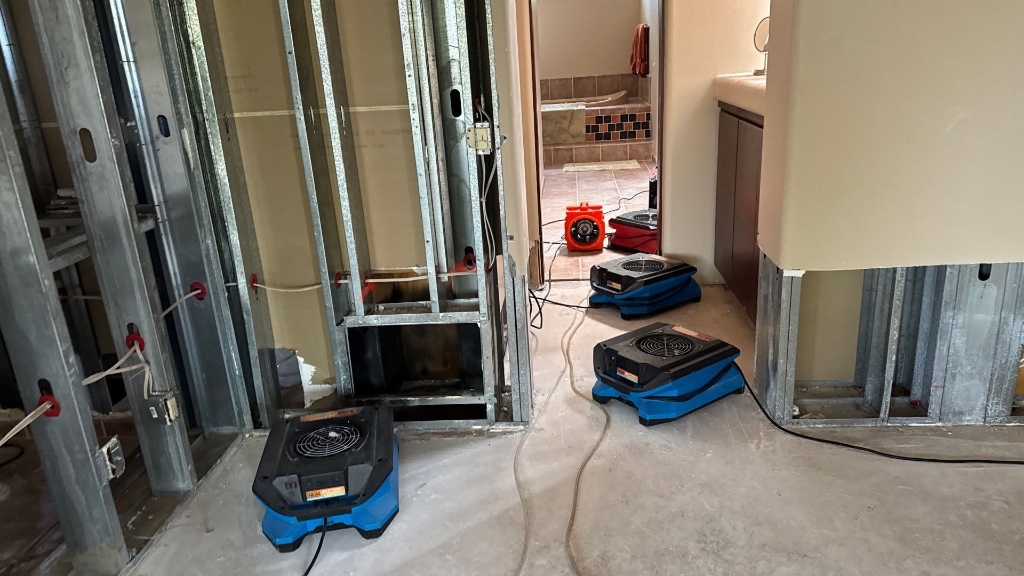
Controlled Selective Demolition
Precision flood cuts 12 to 24 inches above moisture lines, removing wet insulation and opening wall framing to dry airflow.
Thermodynamic Dehumidification
Industrial Low-Grain Refrigerant dehumidifiers pull deep trapped moisture from dense framing lumber and concrete slabs.
Antimicrobial Sanitization & Verification
EPA-registered botanical application (Benefect Decon 30) and calibrated moisture testing to issue an official dry certificate.

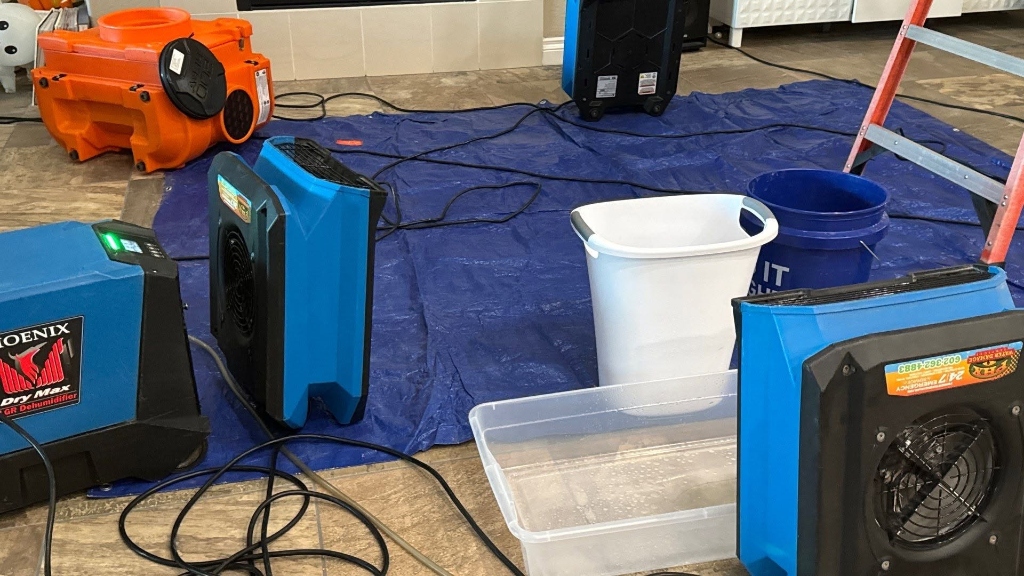
Specialized Equipment & Industrial Restoration Technology
Mitigating severe property damage requires industrial-grade technology capable of altering thermodynamic psychrometrics:
Truck-Mounted Extraction Rigs
31-HP engines producing 16+ inches Hg vacuum suction to evacuate bulk water rapidly into holding tanks.
Low-Grain Refrigerant Dryers
Pre-cooling heat-pipe systems driving ambient grains per pound below 25 GPP to draw deep trapped water out of framing.
HEPA Negative-Air Scrubbers
Hospital-grade 99.97% particulate filtration capturing microscopic fungal spores, soot, and biohazard aerosols.
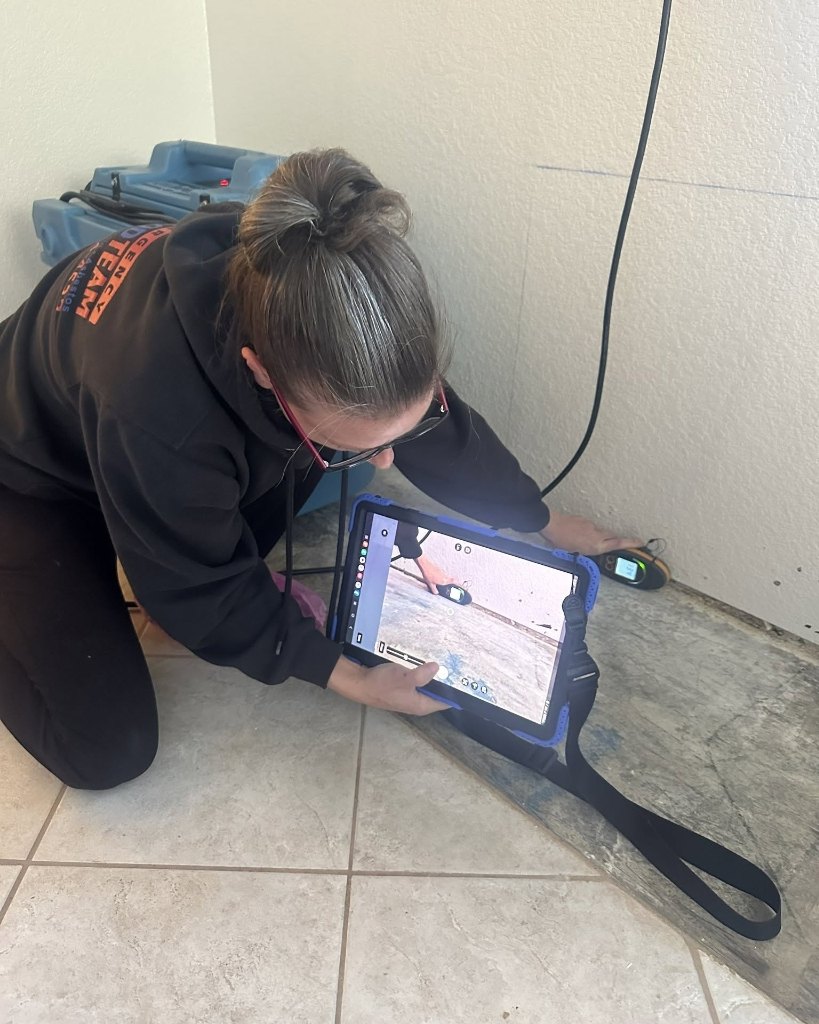
FLIR® Thermal Scanners & Probes
Infrared thermography detecting evaporative cooling boundaries behind walls, combined with digital RF pinless scanners.
Professional Restoration vs. DIY Mitigation
Attempting DIY cleanup during a property disaster creates severe hidden liabilities:
- Trapped Moisture: Surface drywall dries while moisture inside cavities triggers hidden mold blooms.
- Pathogenic Risks: Category 2 & 3 water contains bio-contaminants standard cleaners fail to kill.
- Insurance Denial: Insurers require daily psychrometric logs; lack of data causes claim disputes.
Transparent Upfront Itemized Pricing
Valley Restoration Pros operates with complete transparency:
- Free On-Site Assessment: Complete physical inspection before work begins.
- Upfront Itemized Estimates: Detailed line items calculated via industry-standard Xactimate.
- Zero Surprise Billing: No hidden charges or unauthorized repairs.
Certified goodyear airport industrial park commercial warehouse dewatering Field Documentation
Every response performed by Valley Restoration Pros is documented through photographic and thermographic records:
Comprehensive goodyear airport industrial park commercial warehouse dewatering Technical Manual & Operational Standards
Exhaustive engineering protocols, psychrometric calculations, geological multipliers, and step-by-step restoration standards for Maricopa County properties:
Executive Emergency Abstract: Goodyear Airport Industrial Park Commercial Warehouse Dewatering & Industrial Recovery
The Goodyear Airport Industrial Park Logistics and Aerospace Corridor—situated immediately south of Interstate 10 along Bullard Avenue, Yuma Road, MC-85, Litchfield Road, and Airport Road—represents one of the most critical high-velocity industrial centers in the Southwestern United States. Anchored by the Phoenix Goodyear Airport (GYR) aviation cluster, this sprawling district houses global aerospace manufacturing plants, precision aircraft maintenance operations, defense logistics contractors, regional automated e-commerce fulfillment centers, and massive cross-dock distribution hubs. These expansive commercial properties frequently feature clear heights ranging from 32 to 44 feet and footprint footprints spanning from 150,000 to well over 1,000,000 square feet. Within these high-bay structures, operations rely on continuous automated conveyor systems, subterranean robotics charging pits, autonomous inventory distribution cells, and multi-tier pallet racking holding millions of dollars in aviation-grade hardware and commercial goods.
When a primary mechanical failure strikes an industrial facility—such as an 8-inch high-pressure fire suppression deluge system main riser rupture, a catastrophic freeze-fracture on an unconditioned exterior riser assembly, or a high-velocity impact from a loaded 12,000-pound counterbalance forklift—the resulting hydraulic disaster is catastrophic. Discharging between 1,800 and 2,500 gallons per minute under 140 to 175 PSI of static municipal head pressure, an unmitigated fire suppression breach unleashes 85,000 or more gallons of contaminated water in less than an hour. Across a 150,000-square-foot footprint, this massive volume instantly forms standing water depths between 1 and 4 inches, which naturally gravitated into sunken floor features: automated conveyor trenches, below-slab robotics charging pits, electrical distribution vaults, and recessed dock leveler banks.
The operational stakes for industrial asset managers, operations directors, and logistics coordinators are astronomical. Uncontrolled standing deluge water immediately saturates palletized aerospace components, triggers electrolytic corrosion across expensive electronic assemblies, induces dielectric breakdown across 480V 3-phase switchgear, and migrates beneath the hard-troweled burnished concrete slab. Under Goodyear's intense Sonoran Desert climate, ambient warehouse temperatures rapidly accelerate relative humidity toward 95%, creating an aggressive indoor greenhouse effect that initiates secondary microbial amplification within 24 to 48 hours. Halting distribution lines costs facilities between $45,000 and $110,000 per hour in supply chain delay penalties, customer contract defaults, and lost manufacturing output. Rapid mobilization of certified emergency water extraction, high-GPM dewatering pumping manifolds, and industrial psychrometric drying is mandatory within the first 60 minutes to protect infrastructure and restore supply chain throughput.
Valley Restoration Pros deploys a specialized heavy-loss industrial response unit strategically positioned in the West Valley. Our certified commercial engineers execute rapid-deployment dewatering, technical trench extraction, and trailer-mounted desiccant stabilization for large-scale logistics properties under strict IICRC S500 standards. Our full-spectrum commercial water damage recovery capabilities ensure that complex industrial assets in the Goodyear Airport corridor are systematically stabilized, documented, and restored to production standards.
Immediate First-30-Minute Directives for Commercial Facility Managers
- Execute Main Fire Riser & Backflow Isolation: Immediately access the exterior fire suppression post indicator valve (PIV) or main OS&Y (outside stem and yoke) gate valve. Rotate handwheel clockwise until the valve stem retracts fully to shut off water inflow. Verify the deluge control valve alarm sounds have ceased.
- Initiate Sector-Specific Electrical LOTO: Do not enter standing water. Instruct master electricians or qualified maintenance personnel to trip and lock out the main 480V 3-phase breakers feeding affected floor distribution panels, conveyor motor control centers (MCC), and robotics pits from the main dry switchgear room.
- Deploy Sorbent Booms Around Critical Aerospace Inventory: Position non-reactive polypropylene chemical containment booms and water barriers around high-bay pallet racking storing sensitive aircraft avionics, precision titanium assemblies, and composite airframe structures to halt capillary wicking.
- Mobilize Valley Restoration Pros Large-Loss Division: Call our 24/7 industrial dispatch center directly at (602) 847-9593 or connect through our Commercial Emergency Dispatch Hotline for immediate staging of high-volume trailer pumps, desiccant trailers, and OSHA-certified dewatering crews.
Anatomy of Industrial Fire Riser Failure: Hydraulic Surge Dynamics & Deluge System Rupture Physics
Industrial fire protection systems within modern aerospace logistics facilities in Goodyear are engineered to deliver overwhelming water volume to suppress high-challenge fires in high-rack storage configurations. Designed under NFPA 13 and NFPA 25 standards, Early Suppression Fast Response (ESFR) and deluge systems require high-capacity supply infrastructure: 8-inch to 12-inch dedicated fire service mains connected to municipal loops along Bullard Avenue and Yuma Road. These heavy-diameter riser assemblies maintain standing static pressures between 140 and 175 PSI, reinforced by on-site diesel fire booster pumps engineered to push over 2,500 GPM at 150 PSI net pressure during emergency trips.
When a primary mechanical breach occurs on an 8-inch Schedule 40 steel or ductile iron fire riser, the release of energy is violent and instantaneous. Two distinct failure mechanisms predominate in the Southwest Valley industrial corridor: mechanical impact from heavy logistics equipment and severe hydraulic water hammer induced by rapid valve cycling or municipal pressure surges. When a high-reach forklift with an extended mast or a heavy telehandler accidentally impacts an unprotected riser leg, the sheer kinetic energy fractures grooved mechanical couplings (Victaulic fittings) or shears the cast iron flange connections at the base of the riser check valve.
Hydraulic Shockwave & Water Hammer
Rapid valve closures or municipal pump cycling can generate acoustic pressure waves traveling through water at approximately 4,700 feet per second. When this shockwave impacts an elbow, reducer, or closed check valve, pressure spikes can exceed 450 PSI. This hydraulic transient tears apart pipe hangars, shears riser brackets from precast tilt-up concrete walls, and causes catastrophic longitudinal rupture of the riser pipe wall.
Radial Slab Inundation & Surface Flow
Escaping water discharges at velocities exceeding 25 feet per second, creating an explosive radial fountain that impacts warehouse ceilings 36 feet above before raining down over thousands of square yards. Upon striking the dense, burnished concrete warehouse floor, the deluge expands as an unconfined sheet flow, spreading unimpeded across 150,000 square feet within 35 minutes and overcoming doorway thresholds.
Gravitational Subterranean Inflow
Sheet water naturally seeks topographic low points across the industrial facility. Modern distribution facilities incorporate subterranean utility passages: 4-foot deep automated conveyor motor trenches, 6-foot deep robotics maintenance pits, and in-ground hydraulic leveler vaults. Tens of thousands of gallons cascade into these sunken enclosures, submerging 480V drives, optical encoders, and heavy gearboxes.
Water Category Degradation
Although incoming fire service water originates from treated municipal potable mains, stagnant water inside closed sprinkler loops contains black iron oxide scale, bacteriological sludge, cutting oils, and corrosion inhibitors. Upon contacting industrial tire rubber residue, battery acid deposits, and floor degreasers, the water instantly transitions to Category 2 (significant contamination) and approaches Category 3 hazard levels.
As the volume expands, the weight of standing water exerts tremendous hydrostatic pressure against interior drywall partition bases, office separation walls, and perimeter expansion joints. If the building has unsealed seismic control joints, standing water penetrates downward through the slab cross-section, initiating deep moisture saturation in the uncompacted desert soil base course. Immediate intervention through certified burst pipe repair services and industrial dewatering pumping systems is essential to stop fluid migration and mitigate severe structural damage.
Southwest Valley & Goodyear Industrial Climatic Multipliers: Solar Radiation, Caliche Subgrade Shift & Desert Thermal Cycling
Large-loss water damage restoration in the Goodyear Airport Industrial Park cannot be executed using standard commercial drying playbooks designed for temperate climates. The geographic positioning of Goodyear—flanked by the Sierra Estrella mountains to the south, the White Tank mountains to the northwest, and the alluvial flood plains of the Gila and Agua Fria rivers—creates a hyper-arid microclimate with extreme thermal swings and aggressive geological dynamics. These environmental variables fundamentally alter psychrometric drying kinetics and subterranean soil stability.
Thermal Roof Radiant Loading & The High-Bay Vapor Pressure Chamber
During the prolonged desert summer stretching from May through October, ambient exterior temperatures in Goodyear regularly surpass 112°F to 118°F. Industrial logistics warehouses along Bullard Avenue and Yuma Road feature expansive standing-seam single-ply TPO or metal roof envelopes covering hundreds of thousands of square feet. Under relentless direct desert solar radiation, surface temperatures on these roof assemblies reach 165°F to 180°F. Even with R-30 roof insulation, immense radiant heat transfers into the upper air volume of the 36-foot to 44-foot clear height facility.
When 85,000 gallons of standing water cover the burnished concrete slab below, this intense overhead thermal loading supercharges evaporation rates at the water surface. The immense cubic volume of the warehouse rapidly transforms into a high-pressure humidity vessel. Within three to four hours, indoor relative humidity climbs from a dry desert baseline of 18% to over 92%. In this superheated, moisture-saturated atmosphere, the vapor pressure differential between the air and sensitive materials drops to near zero, bringing natural drying to a dead halt. Without trailer-mounted desiccant systems generating deep negative vapor pressure, moisture rapidly condenses against structural steel joists, roof purlins, and overhead skylights, raining rust and contaminants down onto palletized aerospace goods.
Expansive Caliche & Smectite Clay Subgrade Hydrostatic Heave
The geological stratigraphy across Goodyear and the Southwest Valley is characterized by dense alluvial deposits intertwined with heavily cemented calcium carbonate hardpan (caliche) and highly active smectite/montmorillonite clay seams. In its natural desiccated state, caliche possesses rock-like compressive strength. However, when large-scale industrial water discharges breach warehouse concrete control joints, isolation joints around columns, and unsealed perimeter expansion cuts, thousands of gallons of water penetrate directly into the subgrade.
When dry desert clay lenses absorb water, they exhibit high volumetric swelling potentials, expanding by 8% to 15% and exerting upward swell pressures exceeding 7,500 pounds per square foot. This immense subterranean force heaves heavy 7-inch to 8-inch steel-reinforced concrete slabs, creating vertical offset cracking, misaligning precision automated robotics tracks, and jamming laser-calibrated turret trucks operating in narrow aisles. Preventing moisture migration into Goodyear subgrade soils through rapid water extraction is the only effective defense against catastrophic slab replacement.
Compounding these physical dynamics is Goodyear's municipal water supply, which tests at an extreme 18 Grains Per Gallon (GPG) in total hardness (310+ ppm of calcium carbonate and magnesium silicates). When sprinkler deluge water pools and begins evaporating under desert heat, it deposits crusts of abrasive mineral scale across polished concrete, aluminum tooling, and electrical switchgear contacts. Furthermore, the combination of 105°F interior warehouse heat and 90%+ relative humidity accelerates microbial spore germination. Within 24 hours, Aspergillus, Penicillium, and Stachybotrys chartarum spores colonize paper-faced gypsum walls, corrugated inventory packaging, and wood pallets. Strict containment and decontamination under certified commercial mold remediation protocols must be executed immediately to prevent massive inventory write-offs.
Immediate Emergency First-Hour Protocol: 480V Electrical Isolation, Lockout/Tagout (LOTO) & Containment Zoning
The initial sixty minutes following a massive fire riser breach in a Goodyear aerospace logistics facility are critical. Entering a flooded industrial complex without systematic electrical isolation represents an extreme life-safety threat. Modern high-bay aerospace distribution facilities operate high-density 480V 3-phase electrical distribution networks. Power is stepped down from 12.47 kV utility feeds into 4,000-amp main switchboards, feeding overhead bus ducts, motor control centers (MCC), step-down transformers, floor-mounted distribution panels, and subterranean conduits powering automated conveyors, sorting turntables, and battery charging stations.
When 85,000 gallons of floodwater spread across the slab, water infiltrates in-floor junction boxes, wireways, low-mounted motor disconnects, and robotics charging pads. Water contaminated with dissolved salts and shop debris becomes highly conductive. Under these conditions, the risk of high-energy arc flash explosions (NFPA 70E compliance zones) and lethal step-and-touch voltage differentials across wet concrete is extreme. Our industrial restoration taskforce follows a rigorous six-stage safety isolation sequence before any restoration machinery touches the floor:
Industrial Six-Stage Lockout/Tagout & Site Stabilization Protocol
- Sector-Specific Main Switchboard Lockout: In coordination with facility plant engineers, our certified personnel locate the main dry electrical distribution room. Main 480V feeders dedicated to flooded warehouse zones (conveyors, charging banks, sub-panels) are tripped, locked with master safety padlocks, and tagged with OSHA-compliant warning labels.
- Zero-Energy Verification Testing: Utilizing calibrated personal protective equipment (PPE Category 4, 40 cal/cm² arc flash suits) and CAT IV 1000V industrial multi-meters with non-contact voltage probes, technicians test all submerged disconnects, busway drops, and floor conduits to verify complete zero-energy state across all phases.
- Uninterruptible Power Supply (UPS) & DC Busbar Isolation: Aerospace manufacturing and robotics fulfillment facilities maintain large battery rooms and centralized DC busbars for autonomous mobile robotic systems. Technicians isolate backup UPS systems, inverter banks, and 48V-80V forklift fast-charging stations to eliminate isolated DC electrical hazards.
- Containment Barrier & Exclusion Zone Erection: High-visibility physical barricades and bilingual safety signage are erected around the perimeter of the flooded zone. Warning tape and stanchions restrict unauthorized personnel and heavy forklift traffic from crossing wet concrete, which drops floor friction coefficients to dangerous levels.
- Temporary Aux-Power Distribution Staging: Because facility utility power is isolated, restoration teams stage external trailer-mounted diesel generators (150 kW to 300 kW units) located in the exterior truck apron. Power is routed through heavy-duty Spider boxes and CAM-lock cabling elevated above floor water level to safely power high-GPM pumps and air scrubbers.
- Critical Mechanical Valve Locking: The ruptured fire suppression riser and interconnected booster pump headers are physically chained, locked, and tagged out to prevent accidental pressurization while technicians work in downstream conveyor trenches and high-bay aisles.
Once electrical and mechanical systems are fully isolated and certified safe, our technical crews proceed with rapid bulk extraction. For emergency projects involving post-incident fire system discharge, review our specialized capabilities in fire and life-safety restoration procedures.
Advanced Heavy Industrial Dewatering Equipment Array: Submersible Trash Pumps, Desiccant Trailers & High-CFM Drying
Dewatering a 150,000-square-foot aerospace logistics facility containing 85,000+ gallons of standing deluge water cannot be accomplished with light commercial restoration equipment. Light-duty rotary extractors or standard portable extractors are completely outmatched. Valley Restoration Pros maintains a dedicated fleet of industrial-scale dewatering trailers and heavy restoration equipment positioned across the West Valley to deliver overwhelming extraction and dehumidification power directly to the Goodyear Airport Industrial Park.
High-GPM Dewatering & Extraction Equipment Specifications
| Equipment Category | Model / Specifications | Operating Capacity | Target Deployment Zone |
|---|---|---|---|
| Diesel Centrifugal Trash Pumps | Wacker Neuson PTS 4V / Multiquip 4" Dry-Prime | 680 - 850 GPM each; 2" solids handling | Bulk open-slab dewatering and exterior drainage discharge |
| Submersible Slurry & Pit Pumps | Flygt 2000 Series / BJM High-Head Submersibles | 250 - 450 GPM; 110 ft head; vortex impeller | Automated conveyor trenches, robotics charging pits & leveler vaults |
| Trailer Desiccant Dehumidifiers | Munters / CDI 5,000 to 10,000 CFM Desiccant Units | 3,200 - 6,500 lbs water/day; delivers <15 GPP dry air | High-bay envelope cubic volume drying & vapor pressure control |
| Continuous Slurry Extractors | Rover HVE / Phoenix HydroX Auto-Discharge Extractors | Continuous ride-on vacuum extraction; 1,200 sq ft/hr | Burnished concrete slab surface water and micro-film extraction |
| High-Velocity Axial Air Movers | Phoenix Focus II / Drieaz Stealth 3,500 CFM | 3,500 CFM laminar airflow at 2.4 amps | Floor-level air boundary layer disruption and vortex distribution |
The dewatering engineering plan relies on high-GPM manifolding. Four 4-inch heavy trash pumps are positioned at primary overhead dock access points, routing discharge water through 6-inch lay-flat hose lines directly into approved municipal storm interceptors under local industrial discharge permits. In subterranean pits, submersible vortex pumps discharge into mobile filtration tanks where suspended solids and oils are separated before disposal.
Simultaneously, trailer-mounted desiccant systems are positioned along exterior dock bays. High-static 24-inch spiral ductwork is introduced through dock weather seals, distributing ultra-dry, low-dewpoint process air into the upper reaches of the 36-foot warehouse rafters. This creates a vertical downward positive pressure displacement that forces warm, humid air down toward floor-level exhaust ports. Combining high-GPM extraction with high-grain depression desiccants is the core foundation of our engineered structural drying methodology.
IICRC S500 / S520 Large-Loss Industrial Restoration Protocol: Industrial Class 4 Water Damage Methodology
Commercial restoration operations in aerospace logistics facilities require strict adherence to standard industrial restoration criteria. Valley Restoration Pros strictly executes all large-loss restoration workflows under the ANSI/IICRC S500 Standard for Professional Water Damage Restoration and ANSI/IICRC S520 Standard for Professional Mold Remediation. In accordance with IICRC S500 Section 10, an industrial fire riser breach involving burnished concrete slabs, subterranean utility trenches, and aerospace components is classified as a Class 4 Large-Loss Water Intrusion.
Class 4 water intrusions involve deeply bound water within low-permeance, dense materials that require specialized drying equipment, significant vapor pressure differentials, and prolonged desiccant drying times. Burnished concrete—compacted under high-speed steel trowels and treated with silicate liquid hardeners—exhibits extremely low water absorption rates initially, but once submerged under continuous hydrostatic pressure, moisture penetrates deeply through micro-capillaries and control joints into the underlying slab core. Our certified Master Water Restorers execute a standardized six-stage industrial protocol:
Forensic Inspection & Psychrometric Mapping
Certified project managers utilize FLIR T865 high-resolution thermal imaging cameras and Tramex Dec Scanner non-destructive impedance meters to map the exact perimeter of moisture migration across the 150,000-square-foot facility. Baseline temperature, relative humidity, dew point, and grains per pound (GPP) are established inside and outside the facility.
Aggressive Bulk Dewatering & Surface Extraction
High-GPM trash pump manifolds and continuous auto-discharge ride-on extraction units eliminate 98% of standing water within the initial 4 to 6 hours of site deployment. Physics dictates that mechanical liquid extraction is 500 times more energy-efficient than mechanical evaporation, making aggressive dewatering the top priority.
Decontamination & EPA Antimicrobial Application
Because stagnant fire sprinkler water carries biological and chemical contaminants, all concrete surfaces, pit walls, and steel support bases are thoroughly scrubbed using ultra-low-toxicity EPA-registered botanical antimicrobials (Benefect Decon 30) applied via ultra-low volume (ULV) cold foggers to neutralize microbial spores without oxidizing aerospace metals.
Desiccant Grain Depression & Dynamic Airflow
Industrial desiccant trailers are engaged to achieve extreme grain depression (delivering process air under 15 GPP). High-velocity axial air movers are arranged in continuous circular vortex loops across the burnished slab at 20-foot intervals, continuously sweeping away the boundary layer of stagnant air and driving bound water from slab capillaries into the dry air stream.
Automated Psychrometric Data Logging
Every six hours, certified technicians take psychrometric readings across all warehouse zones, logging dry-bulb temperature, relative humidity, GPP, and concrete surface temperature. Data is transmitted directly into computerized restoration management software to generate real-time drying curves required by industrial property insurers.
Post-Restoration Clearance & ASTM Testing
Drying operations continue until concrete moisture levels return to established pre-loss baseline standards. Technicians execute ASTM F2170 in-situ relative humidity testing and calcium chloride vapor tests to confirm the slab meets specifications prior to re-energizing robotics charging systems and restarting automated inventory lines.
For commercial incidents where secondary sewer lines or storm drains back up during large deluge events, explore our comprehensive procedures for commercial blackwater and sewage cleanup.
Hyper-Local Goodyear Airport Industrial Park Case Study: 150,000 Sq Ft Aerospace Logistics Riser Rupture Recovery
To understand the logistical complexity and precision engineering required for large-loss industrial restoration in the West Valley, consider this real-world deployment executed by Valley Restoration Pros at a premier commercial aerospace logistics facility located near Bullard Avenue and Yuma Road, directly adjacent to the Phoenix Goodyear Airport (GYR) and the MC-85 commercial corridor.
Incident Profile: Bullard Avenue Logistics & Aerospace Facility
- Facility Specification: 152,000-square-foot high-bay aerospace distribution and manufacturing facility; 38-foot clear height; 8-inch burnished concrete slab; 4 subterranean automated conveyor trenches (totaling 820 linear feet); 12 automated mobile robot inductive charging pads.
- The Disaster: At 02:15 AM during third-shift distribution operations, an 8-inch fire suppression main riser suffered a massive flange shear caused by a combination of severe hydraulic surge and impact from a loaded clamp truck. Water discharged under 165 PSI for 42 minutes before municipal street valves could be isolated.
- Total Water Discharged: An estimated 87,500 gallons of pressurized water flooded across the warehouse floor, submerging the burnished slab under 2 to 4 inches of standing water and completely filling the 4-foot deep conveyor trenches and robotics pits.
- Direct Exposure Risks: $14.5 million in palletized aerospace turbine engine components, titanium avionics housings, 480V automated conveyor drives, and sensitive subgrade caliche soils susceptible to heave.
Chronological Emergency Mobilization & Restoration Timeline
02:35 AM - Emergency Call Received & Deployment Initiation
Goodyear emergency dispatch received the alert. Valley Restoration Pros commercial large-loss taskforce mobilized two 30-foot industrial equipment trailers, three diesel trash pump skids, and two 5,000 CFM trailer desiccants from our West Valley operational depot.
03:05 AM - On-Site Arrival & First-Hour Isolation Protocol
Technicians arrived on scene (30-minute response time). Coordinated with facility management to execute full sector LOTO across 480V switchgear and verify zero electrical potential. Installed polypropylene containment dikes around critical aerospace storage racks.
03:45 AM to 08:30 AM - High-GPM Manifold Dewatering
Deployed four 4-inch diesel trash pumps and six Flygt submersible pumps. Evacuated 85,000+ gallons of bulk water off the burnished slab and out of subterranean conveyor trenches in under 5 hours, discharging under emergency municipal permit.
08:30 AM to 02:00 PM - Surface Micro-Extraction & Decontamination
Executed continuous ride-on extraction to pull surface water films from slab pores. Applied Benefect Decon 30 botanical antimicrobial wash across all flooded concrete and trench walls. Pressure-washed mineral residue using demineralized water flushes to eliminate 18 GPG scale deposits.
18 Hours to 68 Hours - Desiccant Psychrometric Stabilization
Engaged two 5,000 CFM desiccant dehumidifiers running 24/7. Injected low-GPP process air directly into conveyor trenches and across the high-bay slab using 48 high-velocity axial air movers. Concrete moisture vapor emission rates stabilized below 3.0 lbs/1,000 sq ft/24 hrs. Facility resumed partial operations at 36 hours and achieved complete IICRC sign-off at 68 hours.
Psychrometric Recovery Verification Metrics
| Monitoring Stage | Ambient Temp (°F) | Relative Humidity (%) | Humidity Ratio (GPP) | Concrete In-Situ RH (%) |
|---|---|---|---|---|
| Initial Disaster Assessment (Hour 1) | 96°F | 94% RH | 238 GPP | 99% (Saturated) |
| Bulk Extraction Complete (Hour 6) | 91°F | 76% RH | 162 GPP | 96% |
| Desiccant Active - 24 Hours | 84°F | 38% RH | 66 GPP | 88% |
| Desiccant Active - 48 Hours | 81°F | 24% RH | 37 GPP | 79% |
| Final Certified Clearance (Hour 68) | 78°F | 18% RH | 26 GPP (Dry Standard) | 72% (Pass ASTM F2170) |
For comparable large-loss restoration case studies across adjacent West Valley transport corridors, explore our operational documentation on the Loop 303 logistics warehouse dewatering case study as well as the Buckeye logistics corridor dock flood cleanup.
Commercial Pay-Per-Call Financial Compliance & Industrial Insurance Claims Documentation
Industrial large-loss water intrusions present immense financial and contractual complexities. Facility owners, property management corporations, and corporate logistics operators require absolute financial clarity, transparent billing protocols, and forensic documentation to satisfy risk management departments and commercial property insurance underwriters. Valley Restoration Pros strictly adheres to ethical Pay-Per-Call compliance standards, delivering transparent itemized pricing before work begins and assisting clients with thorough claims documentation.
Core Financial Transparency Standards & Mandatory Disclosures
- Free Comprehensive On-Site Industrial Assessment: Our senior commercial project engineers perform an exhaustive on-site physical evaluation, thermal imaging moisture survey, and hazard audit at zero upfront cost to establish immediate scope boundaries.
- Transparent Upfront Itemized Pricing Before Work Begins: Every deployment phase—bulk extraction, trench dewatering, desiccant operation, hazardous material segregation, and antimicrobial application—is itemized line-by-line using industry-standard pricing schedules (Xactimate industrial codes). Facility managers review and authorize all work scopes prior to operational deployment.
- Zero Direct Billing Promises or Insurance Over-Commitments: We never guarantee that commercial property insurance carriers will cover 100% of costs or claim that insurance can be billed directly without facility responsibility. Commercial insurance policies involve complex business interruption riders, water damage sub-limits, equipment breakdown endorsements, and deductible structures that require formal adjuster adjudication.
- Forensic Claims Documentation & Psychrometric Logging: We equip corporate risk managers with comprehensive claims documentation packages, including certified IICRC psychrometric moisture logs, time-stamped FLIR thermal imaging matrices, equipment runtime records, and chain-of-custody inventory logs to streamline insurance reimbursement.
Our team routinely coordinates with major commercial industrial insurance carriers, including FM Global, Travelers Commercial, Zurich North America, Chubb, and Liberty Mutual. By providing incontrovertible scientific evidence of moisture reduction, drying kinetics, and structural preservation, we help eliminate coverage disputes and expedite claim resolution.
To calculate projected restoration costs and equipment deployment models for commercial warehouse facilities, visit our interactive commercial restoration cost estimator.
Exhaustive Technical FAQ: Large-Loss Industrial Dewatering & Facility Recovery
Review comprehensive answers to critical engineering, mechanical, and logistical questions concerning large-loss warehouse dewatering across the Goodyear Airport Industrial Park:
1. How rapidly can high-GPM industrial pumps evacuate 85,000+ gallons from an active logistics warehouse?
By mobilizing four 4-inch diesel trash pumps (rated at 800 GPM each) combined with six submersible vortex pumps in subterranean trenches, our pumping manifold delivers an aggregate evacuation capacity exceeding 4,000 GPM. Under typical warehouse floor configurations, 85,000 gallons of standing water across 150,000 square feet is evacuated from the slab in approximately 3.5 to 5 hours, transitioning the site immediately into mechanical surface micro-extraction and desiccant dehumidification.
2. Why are trailer-mounted desiccant dehumidifiers mandatory rather than standard refrigerant units for high-bay buildings?
Standard Low-Grain Refrigerant (LGR) dehumidifiers lose efficiency when relative humidity drops below 40% or when ambient temperatures exceed 95°F—common conditions in unconditioned Arizona warehouses. Desiccant dehumidifiers utilize chemical absorption wheels (silica gel matrices) that operate independently of condensation temperature, producing ultra-low vapor pressure air under 15 GPP (grains per pound) and dewpoints below 32°F. This massive vapor pressure differential is physically required to draw deeply bound water out of dense burnished concrete and 40-foot clear-span cubic volume.
3. How does standing deluge water compromise burnished concrete slabs and automated robotics paths?
Burnished concrete is treated with chemical liquid hardeners (sodium or lithium silicates) to densify the top 1/8-inch wear surface. Standing water under hydrostatic pressure penetrates unsealed construction control joints, migrating into the slab interior and desert subgrade clay. Furthermore, autonomous mobile robots (AMRs) and automated transport fleets rely on optical barcode floor grids, magnetic strips, and laser LiDAR reflectors. Water intrusion and 18 GPG mineral scale deposits obscure optical codes, short-circuit subsurface inductive charging coils, and degrade floor coefficient of friction, triggering immediate AMR navigation shutdowns.
4. What specific protocols are required for water-submerged 480V switchgear and conveyor drive pits?
Submerged electrical equipment must never be re-energized until thorough forensic reconditioning is complete. Under NFPA 70B and NEMA engineering standards, all submerged switchboards, motor starters, circuit breakers, and variable frequency drives (VFDs) require complete dewatering, particulate decontamination, demineralized flushes to eliminate conductive salts, and targeted warm-air desiccant baking. Certified electricians must conduct insulation resistance (Megger) testing to verify phase-to-phase and phase-to-ground dielectric ratings exceed 50 megaohms before power restoration.
5. What is the distinction between Category 2 and Category 3 contamination in fire sprinkler riser failures?
Although sprinkler systems are fed by potable municipal water, water trapped inside closed fire piping loops for months or years stagnates, cultivating anaerobic bacteria, iron oxides, and pipe scale. Upon discharge, this Category 2 water mixes with warehouse floor soil, forklift battery electrolytes, chemical dusts, and industrial degreasers. Within 24 to 48 hours under Arizona's 100°F+ temperatures, microbial amplification transforms the fluid into Category 3 blackwater, requiring biohazard-level containment and EPA-registered antimicrobial treatments.
6. How are palletized aerospace inventory items safeguarded during large-loss warehouse dewatering?
Aerospace inventory—including precision turbine blades, avionics enclosures, and titanium hardware—is immediately segregated behind poly containment curtains. Technicians deploy portable micro-desiccant pods delivering <20% RH air directly around racking bays to prevent condensation and flash rusting. Every affected pallet is logged with high-resolution photographic evidence and non-destructive moisture readings, maintaining FAA-compliant chain of custody records required by aerospace quality management systems (AS9100).
For direct technical consultation regarding an active industrial water damage incident in Goodyear, reach our engineering supervisors directly through our emergency dispatch team.
Deep Psychrometric Formulas for High-Bay Industrial Cubic Volume Drying & Vapor Pressure Control
Engineering a successful structural dryout in an industrial warehouse requires precise mathematical modeling of psychrometric state points. Unlike residential or standard commercial properties where room volumes are modest, a 150,000-square-foot aerospace logistics warehouse with a 38-foot average clear height encloses a massive cubic volume of 5,700,000 cubic feet. At this industrial scale, calculating required dehumidification capacity, air exchange rates, and grain depression requires specialized thermodynamic formulas.
Cubic Air Exchange & Moisture Load Calculations
Under IICRC S500 standards for Class 4 industrial water damage, achieving structural drying in large commercial spaces requires a minimum of 2.0 to 3.5 Air Changes per Hour (ACH) of dehumidified process air. For a 5,700,000 cubic foot facility:
Target CFM = (5,700,000 cu ft × 2.5 ACH) / 60 = 237,500 Total CFM Circulation
To achieve this immense air circulation, restoration engineers establish a two-tier mechanical array: high-volume primary desiccant dehumidifiers (introducing 15,000 to 25,000 CFM of ultra-dry process air) coupled with a distributed grid of 65 to 80 high-velocity axial air movers (producing 3,500 CFM each) to maintain continuous boundary-layer air disruption across the slab.
Desiccant Grain Depression & Moisture Removal Rate (MRR)
The performance of an industrial desiccant dehumidifier is governed by its grain depression—the difference between the humidity ratio of the incoming process air (GPP_in) and the supply air exiting the silica gel rotor (GPP_out). The Moisture Removal Rate (MRR) in pounds of water per hour is calculated as follows:
Where:
• CFM = 10,000 CFM (desiccant process airflow)
• GPP_in = 85 GPP (initial warehouse air at 85°F / 50% RH)
• GPP_out = 15 GPP (reactivated supply air)
• ΔGPP = 85 - 15 = 70 GPP (Grain Depression)
• Specific Volume = 14.1 cu ft/lb
• 7,000 = Grains per pound of water
MRR = (10,000 × 70 × 60) / (14.1 × 7,000) = 42,000,000 / 98,700 = 425.5 Pounds of Water per Hour (51.2 Gallons/hr)
Operating two 10,000 CFM desiccant trailers delivers over 102 gallons of water extraction per hour directly from the air and slab surfaces, continually maintaining low vapor pressure that draws moisture out of concrete capillaries.
For aerospace facilities featuring sensitive aviation components and large clear-span floor plans, review our specialized drying systems for aerospace hangar sprinkler discharge recovery.
Dewatering Automated Robotics Pits, Forklift Charging Stations & Conveyor Mechanical Trenches
The distinctive operational architecture of modern logistics hubs along Bullard Avenue and Yuma Road incorporates extensive below-slab mechanical features. Recessed conveyor trenches, automated sorter transfer tunnels, robotics maintenance pits, and industrial battery charging stations form a subterranean web of critical utility infrastructure. During an 85,000-gallon deluge event, gravity drives floodwater directly into these recessed features, turning functional mechanical areas into submerged sumps holding thousands of gallons of contaminated water.
Submerged Conveyor Drive Trenches
Conveyor trenches house heavy 480V gearmotors, drive chains, pneumatic belt tensioners, and optical tracking sensors. When submerged, floodwaters enter motor junction boxes, displacing lubricant in planetary gear reducers and corroding precision roller bearings. Restoration requires immediate deployment of electric submersible trash pumps, followed by high-pressure demineralized rinses, hot-air desiccant drying, and fluid flushing to salvage high-cost drive motors.
Robotics Inductive Charging Pits
Autonomous mobile robots (AMRs) dock over specialized floor-recessed charging coils transmitting high-frequency magnetic resonance power. Submergence under conductive deluge water causes severe dielectric breakdown across coil windings and high-power inverter circuits. Dewatering technicians utilize explosion-proof vacuum units and HEPA air drying before precision Megger testing verifies coil integrity.
Forklift Fast-Charging Battery Bays
Industrial battery charging rooms feature heavy DC rectifiers and 48V to 80V heavy charging leads. Deluge water entering battery bays mixes with trace sulfuric acid residue and copper corrosion salts, creating a dangerous acidic wash. Technicians execute hazardous substance neutralization using sodium bicarbonate slurries, followed by high-vacuum extraction and neutral-pH pressure washing.
OSHA Confined Space Entry standards (29 CFR 1910.146) are strictly enforced during trench and pit dewatering. Deep subterranean conveyor vaults and pits require continuous atmospheric monitoring for oxygen displacement, carbon monoxide, and volatile organic vapors before personnel enter. Positive-pressure fresh air blowers ensure safe breathing conditions for extraction technicians.
For commercial properties experiencing water intrusion across subterranean vaults and basement utility enclosures, examine our specialized subterranean pit and vault water extraction capabilities.
Aerospace Inventory Moisture Inspection, Preservation & OSHA Chain of Custody Protocols
In an aerospace logistics facility, inventory loss represents the single greatest financial liability of a fire sprinkler deluge event. Warehouses in the Goodyear Airport cluster store mission-critical aircraft assemblies, precision-machined titanium components, nickel-alloy turbine parts, hydraulic flight actuators, and sensitive avionics hardware. These aviation assets are held to stringent Federal Aviation Administration (FAA) and AS9100 quality standards. Even minor atmospheric exposure or moisture contamination can invalidate FAA airworthiness certifications, resulting in millions of dollars in inventory scrap.
Aerospace Quality Preservation & Inventory Salvage Framework
- Immediate Capillary Wicking Interruption: When floodwater touches pallet bottoms, moisture rapidly wicks upward through porous wooden stringers and corrugated packaging, reaching sealed parts crates. Technicians utilize pallet jacks and narrow-aisle reach trucks to immediately lift bottom-tier pallets onto dry secondary staging racks.
- Non-Destructive Thermal & RF Moisture Profiling: Restoration specialists utilize FLIR thermal imaging paired with radio-frequency non-penetrating moisture meters to scan cardboard packaging and wooden crates without breaking tamper-evident quality seals, identifying exact moisture ingress boundaries.
- Micro-Climate Containment & Desiccant Pods: High-value aerospace components that cannot be immediately relocated are enveloped within 6-mil anti-static polyethylene containment pods. Dedicated portable desiccant dehumidifiers inject dry process air (<15% RH) into each pod to maintain an ultra-dry micro-environment and halt flash corrosion.
- Demineralization & Corrosion-Inhibiting Cleansing: Components exposed to Goodyear's 18 GPG municipal sprinkler water are cleansed with demineralized deionized water flushes to eliminate chloride and calcium scale, followed by application of military-spec corrosion inhibitors (MIL-PRF-81309) approved by aerospace OEMs.
- AS9100 / FAA-Compliant Forensic Chain of Custody: Every inspected item is cataloged within our digital inventory management system. Documentation logs include part serial numbers, lot numbers, storage bin coordinates, photographic condition records, atmospheric exposure duration, and signed clearance verification to ensure full regulatory traceability for aviation audits.
Contaminated packaging materials—including water-logged cardboard cartons and timber pallets—must be expeditiously segregated from clean inventory areas. Corrugated fiberboard loses 85% of its structural stack strength when saturated, creating extreme rack collapse hazards under heavy aerospace part loads. Defective pallets are transferred to exterior dry disposal zones under OSHA safety oversight.
For commercial properties managing temperature-controlled and high-value industrial goods, consult our specialized industrial warehouse inventory dryout standards.
High-Strength Burnished Concrete MVER Testing, Relative Humidity Probes & Sub-Slab Moisture Stabilization
Modern industrial distribution warehouses in the Goodyear Airport corridor are constructed with heavy 7-inch to 9-inch steel-reinforced concrete slabs engineered to support high-density pallet rack point loads exceeding 12,000 pounds per upright. These slabs undergo high-speed steel power troweling to achieve a hard-troweled burnished finish, followed by the application of chemical silicate densifiers. While this burnished surface provides exceptional abrasion resistance against heavy forklift traffic, it creates unique, complex thermodynamic challenges during large-loss water restoration.
The Burnished Capillary Seal & Sub-Slab Vapor Pressure Entrapment
Burnishing compresses surface pore structures, dropping surface permeability to near zero. However, when 85,000 gallons of fire sprinkler water cover the floor for hours, water enters through construction control cuts, column isolation joints, and micro-fractures. Once inside the slab core and underlying sand base, moisture becomes trapped beneath the dense surface cap.
As the desert sun heats the warehouse envelope, trapped moisture vaporizes, creating high vapor drive pressure (exceeding 1.2 PSI). If left unmitigated, this upward vapor migration causes severe concrete problems: osmotic blistering of epoxy coatings, joint spalling, alkaline hydrolysis that destroys floor adhesives, and white efflorescence salt blooms that blind autonomous mobile robot optical tracking sensors.
Scientific Concrete Moisture Testing Standards
Restoration completion cannot be verified simply by visually inspecting the concrete surface. Valley Restoration Pros implements rigorous standardized scientific testing protocols to certify slab drying:
- ASTM F2170 In-Situ Relative Humidity Probe Testing: Technicians drill precision 5/8-inch test holes into the slab to a depth of 40% of slab thickness (e.g., 3.2 inches in an 8-inch slab). Sleeves and electronic RH sensors are sealed into the holes and allowed to equilibrate for 24 hours. The slab is certified dry only when internal relative humidity drops below 75% RH.
- ASTM F1869 Calcium Chloride Vapor Emission Testing: Sealed anhydrous calcium chloride test kits are affixed to prepped concrete sections for 72 hours to measure Moisture Vapor Emission Rate (MVER). Industrial flooring specifications require MVER to stabilize below 3.0 lbs of moisture per 1,000 square feet per 24 hours.
- Tramex Concrete Moisture Encounter (CME) Electronic Mapping: Continuous non-destructive impedance scanning maps electrical conductivity across the entire 150,000-square-foot grid, identifying isolated pockets of bound moisture requiring targeted desiccant ducting.
To accelerate deep sub-slab moisture extraction without damaging the burnished finish, our engineers utilize high-static negative-pressure desiccant drying matrices. Lay-flat drying manifolds are sealed directly over saw-cut control joints, drawing dry air down through the concrete matrix and evacuating vapor before it can destabilize the Goodyear caliche foundation.
To explore regional industrial service coverage throughout the West Valley and Maricopa County, visit our Valley-wide commercial service areas. For facilities operating autonomous logistics fleets and specialized battery depots, examine our technical procedures for commercial autonomous vehicle depot flood dewatering.
Verified Local Area Dispatch: Goodyear, AZ
Official Geo-Coordinates: 33.4353° N, -112.3582° W • Maricopa County
Related Specialized Emergency Restoration Services
Explore specialized rapid-response mitigation protocols across Greater Phoenix and Maricopa County:
Valley-Wide Emergency Response Service Coverage
Our mobile restoration fleet is dispatched across the entire Phoenix metropolitan region, providing rapid 30 to 60 minute emergency response: