

Valley Restoration Pros delivers 24/7 industrial emergency water extraction, thermal psychrometric drying, and structural mitigation across Phoenix and Maricopa County with guaranteed 30–60 minute rapid arrival. All protocols strictly adhere to IICRC S500 standards, featuring upfront itemized pricing and free on-site thermal moisture assessments. Call dispatch directly at (602) 847-9593.
Why Immediate Mitigation Is Critical in Phoenix Heat
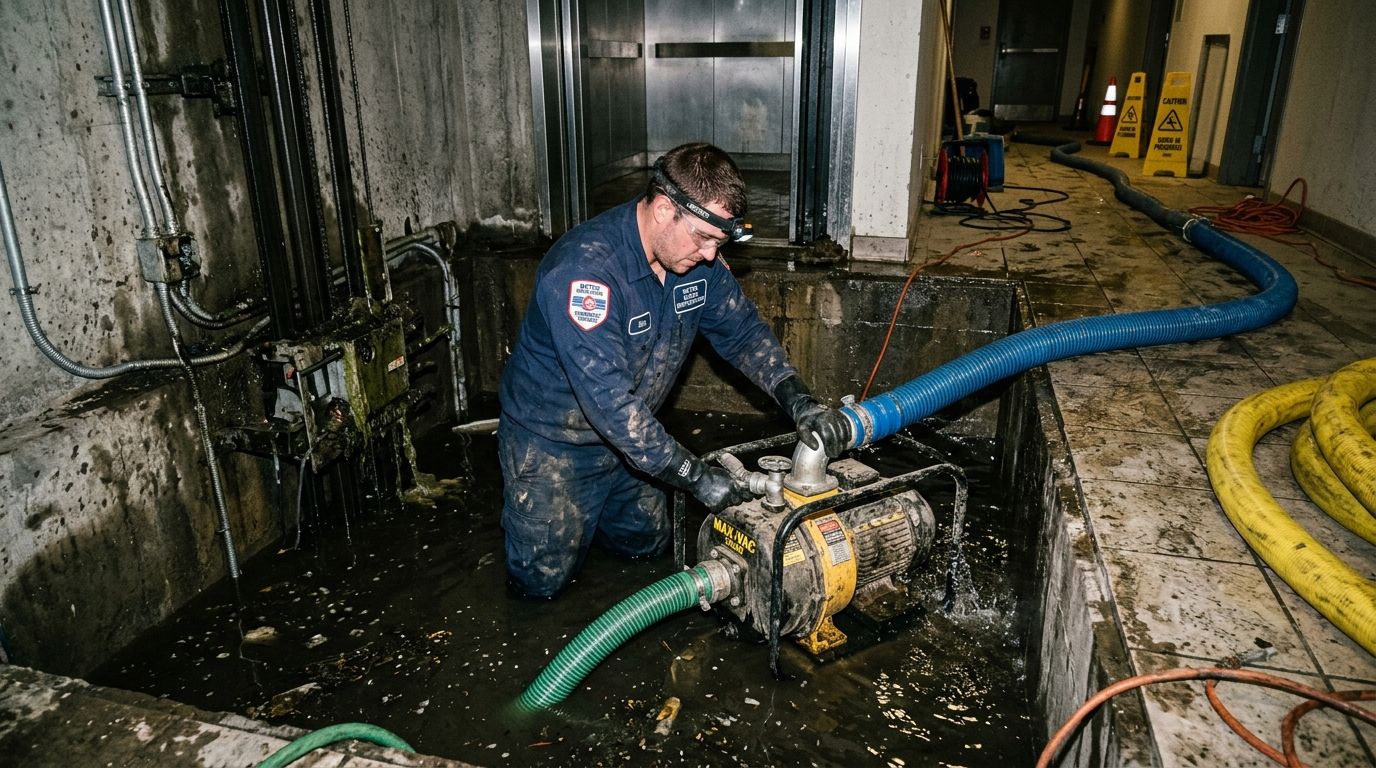
Severe desert monsoon storms in North Scottsdale channel thousands of gallons of sediment-laden stormwater runoff into subterranean commercial structures, overwhelming duplex submersible sump pump stations. Mechanical float switch binding from 18 to 24 GPG mineral encrustation, check valve hydraulic slam, and impeller silt clogging trigger massive overflows into Class-A parking garages, retail storage basements, and elevator pits. Under Scottsdale 115°F desert ambient heat, Category 3 stormwater runoff incubates toxic pathogens within 24 to 48 hours while expansive caliche soils exert upward hydrostatic pressure against concrete foundation slabs.

Service Definition & The IICRC Standard of Care
Professional kierland north scottsdale commercial stormwater sump pump overflow restoration is an engineering and environmental discipline adhering strictly to IICRC S500 protocols, not mere surface mopping. When structural plumbing failures strike in Maricopa County, certified emergency water extraction and thermal structural drying procedures must be deployed immediately. Whether triggered by high-pressure burst pipe emergencies, subfloor leaks, or commercial line ruptures, bound moisture rapidly penetrates concrete subfloors and wall framing. In the desert heat, delays trigger microbial proliferation requiring rapid mold remediation. Request damage assessment through our emergency assessment portal or request 30-minute dispatch across all Valley service areas.
Securing electrical feeds, inspecting load-bearing assemblies, and containing pathogens.
Stopping the intrusion source and erecting 6-mil plastic isolation containment airlocks.
31-HP truck-mount extraction, removing gallons exponentially faster than evaporation.
LGR dehumidifiers and HEPA air scrubbers driving grains per pound below 25 GPP.
Calibrated electronic pinless testing confirming baseline dry standards.
The Complete 6-Stage Restoration Roadmap
Our IICRC-certified crews execute a disciplined, scientific 6-stage protocol to stabilize and dry structural components:
Emergency Dispatch & Perimeter Isolation
30 to 60 minute arrival. Securing electrical shutoffs, evaluating structural loads, and erecting containment airlocks.
FLIR® Thermal Mapping & Baseline Scans
Infrared thermal scans detect trapped moisture behind walls and beneath concrete without invasive exploratory demolition.
High-Volume Bulk Extraction
31-HP truck-mount extraction units pump standing water away at hundreds of gallons per minute.
Controlled Selective Demolition
Precision flood cuts 12 to 24 inches above moisture lines, removing wet insulation and opening wall framing to dry airflow.
Thermodynamic Dehumidification
Industrial Low-Grain Refrigerant dehumidifiers pull deep trapped moisture from dense framing lumber and concrete slabs.
Antimicrobial Sanitization & Verification
EPA-registered botanical application (Benefect Decon 30) and calibrated moisture testing to issue an official dry certificate.

Specialized Equipment & Industrial Restoration Technology
Mitigating severe property damage requires industrial-grade technology capable of altering thermodynamic psychrometrics:
Truck-Mounted Extraction Rigs
31-HP engines producing 16+ inches Hg vacuum suction to evacuate bulk water rapidly into holding tanks.
Low-Grain Refrigerant Dryers
Pre-cooling heat-pipe systems driving ambient grains per pound below 25 GPP to draw deep trapped water out of framing.
HEPA Negative-Air Scrubbers
Hospital-grade 99.97% particulate filtration capturing microscopic fungal spores, soot, and biohazard aerosols.
FLIR® Thermal Scanners & Probes
Infrared thermography detecting evaporative cooling boundaries behind walls, combined with digital RF pinless scanners.
Professional Restoration vs. DIY Mitigation
Attempting DIY cleanup during a property disaster creates severe hidden liabilities:
- Trapped Moisture: Surface drywall dries while moisture inside cavities triggers hidden mold blooms.
- Pathogenic Risks: Category 2 & 3 water contains bio-contaminants standard cleaners fail to kill.
- Insurance Denial: Insurers require daily psychrometric logs; lack of data causes claim disputes.
Transparent Upfront Itemized Pricing
Valley Restoration Pros operates with complete transparency:
- Free On-Site Assessment: Complete physical inspection before work begins.
- Upfront Itemized Estimates: Detailed line items calculated via industry-standard Xactimate.
- Zero Surprise Billing: No hidden charges or unauthorized repairs.
Certified Kierland North Scottsdale Commercial Stormwater Sump Pump Overflow Restoration Field Documentation
Every response performed by Valley Restoration Pros is documented through photographic and thermographic records:
Comprehensive Kierland North Scottsdale Commercial Stormwater Sump Pump Overflow Restoration Technical Manual & Operational Standards
Exhaustive engineering protocols, psychrometric calculations, geological multipliers, and step-by-step restoration standards for Maricopa County properties:
Executive Emergency Abstract: Kierland & North Scottsdale Commercial Stormwater Sump Inundation
The premier commercial corridor spanning Kierland Commons, Scottsdale Quarter, the Greenway-Hayden Loop, and the Scottsdale Airpark perimeter represents one of the most economically dense mixed-use districts in the desert Southwest. This district features high-end retail flagships, Class-A corporate headquarters, boutique dining, medical suites, and luxury residential lofts. Beneath these prestigious commercial assets lies a vast, interconnected network of subterranean infrastructure: multi-level underground parking facilities, below-grade tenant inventory vaults, critical mechanical and electrical equipment rooms, and deep hydraulic elevator pits. Because these structures extend twenty to forty feet below the surrounding desert grade, their operational viability during extreme weather events depends entirely on automated commercial stormwater sump pump stations, exterior catch basins, and underground detention vaults.
During the North Scottsdale summer monsoon season (July through September), severe atmospheric microbursts frequently discharge between two and three inches of torrential rainfall within forty-five minutes. The surrounding desert landscape and expansive asphalt parking surfaces generate immediate, violent surface runoff. When this massive hydraulic surge channels into subterranean ramps, loading docks, and perimeter foundation collection trenches, commercial duplex and triplex submersible sump pump stations must activate instantly to evacuate thousands of gallons of water per minute against twenty-five to forty feet of static head pressure. If a mechanical float switch binds from mineral encrustation, an electrical transfer switch fails during a utility brownout, or high-velocity sediment clogs heavy-duty vortex impellers, catastrophic stormwater sump overflow occurs within minutes.
An unmitigated commercial stormwater sump pump overflow in a subterranean structure constitutes a severe dual emergency: rapid structural submergence and immediate Category 3 biohazard contamination. Stormwater runoff collected from commercial parking aprons, landscaping berms, and municipal roadways carries high concentrations of automotive petroleum hydrocarbons, polycyclic aromatic hydrocarbons (PAHs), heavy desert silt slurry, animal feces, agricultural fertilizers, and active bacterial pathogens. Standing water in below-grade facilities swiftly submerges primary electrical switchgear, infiltrates elevator hoistways, compromises structural drywall and tenant inventory, and saturates post-tensioned foundation slabs. In Scottsdale’s 115°F summer climate, below-grade temperatures hovering between 85°F and 95°F create an aggressive microbiological incubator, triggering toxic bacterial blooms and mold colonization within twenty-four to forty-eight hours.
Remediating large-scale subterranean stormwater deluge in Kierland commercial properties requires rapid industrial deployment, specialized confined-space extraction equipment, and rigorous adherence to IICRC S500 standards for Category 3 water losses. Valley Restoration Pros maintains dedicated commercial rapid-response teams staged across North Scottsdale, equipped with high-volume trailer-mounted extraction rigs, explosion-proof submersible slurry pumps, EPA-registered botanical sanitizing agents, and multi-ton desiccant dehumidification systems capable of restoring operational velocity to commercial enterprises with minimal business disruption.
Immediate North Scottsdale Commercial Emergency Directives: First 30 Minutes
- Secure Subterranean Electrical Infrastructure: Immediately isolate electrical breakers controlling submerged 480V 3-phase pump stations, basement branch panels, and low-voltage elevator controllers. Never enter flooded subterranean parking decks or mechanical vaults until a certified facility engineer or our master technicians verify zero electrical leakage into standing floodwaters.
- Park & Elevate Critical Elevator Cars: Recall all subterranean elevator cabs to the main lobby or upper retail levels and lock them out. Elevator traveling cables, counterweights, and electronic hoistway interlocks sustain catastrophic damage when submerged in stormwater and silt slurry.
- Establish Perimeter Hydrological Barriers: Deploy weighted sandbags, quick-dam water barriers, and silicone flood baffles along subterranean parking garage entry ramps, service corridors, and retail basement thresholds to prevent additional street runoff from descending into below-grade zones.
- Mobilize Industrial Dewatering Units: Contact Valley Restoration Pros at (602) 847-9593 or engage our Emergency Phone Dispatch for immediate deployment of commercial vacuum trucks, submersible trash pumps, and IICRC-certified large-loss structural drying units to the Kierland corridor.
Anatomy of Commercial Stormwater Sump Station Failures in North Scottsdale
Commercial stormwater management in North Scottsdale requires intricate engineering. Multi-story developments across Kierland Commons and Scottsdale Quarter feature deep subterranean excavation into prehistoric desert alluvium. To prevent torrential monsoon rains from inundating subterranean parking garages, delivery docks, and retail basements, civil engineers incorporate heavy-duty duplex or triplex stormwater collection sump vaults. These cast-in-place concrete or fiberglass sumps range from six to twelve feet in diameter and ten to twenty feet in depth, housing high-capacity submersible solids-handling wastewater pumps rated at 5 horsepower to 20 horsepower each, capable of discharging 300 to 1,200 gallons per minute (GPM) per pump against total dynamic heads exceeding forty vertical feet.
Under ideal operating parameters, an alternating duplex control panel alternates the lead pump on successive duty cycles while maintaining the lag pump on standby. If inflow exceeds single-pump capacity, both pumps engage simultaneously. However, during North Scottsdale convective summer cloudbursts, severe mechanical, electrical, and physical stress factors converge to cause catastrophic station failure. Understanding the precise anatomical mechanics of these system breakdowns is essential for property directors and commercial facility teams facing sudden subterranean flooding.
Mechanical Float Switch Hang-Ups & Mineral Encrustation
Submerged mechanical tilt-float switches and mercury displacement switches are the primary failure point in commercial sump pits. The extreme municipal water hardness in North Scottsdale (18 to 24 GPG) precipitates thick calcium carbonate scale over float cords and pivot brackets. When desert silt and petroleum residue coat these crusted floats, they become mechanically immobilized in the "off" position, preventing automated pump activation as flood levels surge.
Check Valve Slam & Discharge Line Shearing
High-head commercial sump systems incorporate heavy flanged swing check valves or silent wafer check valves to prevent vertical discharge water columns from back-siphoning into the collection pit upon pump shutoff. Repeated hydraulic water hammer cycles during rapid cycling fatigue iron clapper hinges and flanged rubber seats. When a clapper pin fractures or calcifies open, thousands of gallons of discharged stormwater violently backflow into the subterranean vault, overwhelming the station.
Impeller Clogging from Decomposed Granite & Silt Slurry
Monsoon runoff across North Scottsdale commercial properties carries dense slurries of crushed granite landscaping rock, clay alluvium, and palm fronds. Even vortex solids-handling impellers rated for two-inch spherical solids become bound when high concentrations of abrasive desert silt settle inside the volute casing. Silt binding causes rotor lock, causing motor winding amperage to spike instantly and tripping thermal overload relays inside the NEMA 4X control panel.
When these mechanical and electrical breakdowns occur during a torrential storm, stormwater rapidly fills the subterranean sump vault and spills over the rim, cascading across concrete parking slabs, flooding lower elevator vestibules, and saturating commercial basement walls. Immediate professional intervention utilizing certified industrial emergency water extraction units is essential to evacuate standing floodwater, dredge sediment accumulation, and prevent catastrophic structural degradation across the facility.
North Scottsdale & Kierland Environmental Multipliers: Mineral Scale, Caliche Soil, and Monsoon Deluges
Restoring commercial water damage in North Scottsdale requires specialized knowledge of regional geology, extreme desert hydrology, and aggressive water chemistry. The Sonoran Desert environment surrounding Kierland Commons and the Scottsdale Airpark possesses unique physical characteristics that exacerbate mechanical system failures and complicate post-flood structural drying. Far from being an inert, dry climate, North Scottsdale subjects subterranean commercial infrastructure to cyclical environmental forces of extraordinary magnitude.
The primary hydrochemical challenge in Scottsdale is extreme mineral hardness. Water sourced from the Central Arizona Project (CAP) aqueduct, Salt River reservoirs, and deep regional alluvial wells contains between 18 and 24 grains per gallon (GPG) of dissolved calcium carbonate, magnesium bicarbonate, and silica. In subterranean commercial stormwater sumps, where stagnant water pools and evaporates under high ambient temperatures, dissolved minerals rapidly crystallize into dense, cementitious scale. This calcification coats mechanical pump impellers, binds sliding float assemblies, degrades bronze check valve seats, and clogs level-transducer vent tubes, drastically accelerating the mechanical failure rate of dewatering systems across commercial properties.
Furthermore, when high-volume stormwater inundates subterranean facilities, it interacts directly with the surrounding caliche and clay soil profiles. Saturated soils expand dramatically, exerting thousands of pounds per square foot of hydrostatic uplift against commercial basement slabs. Without rapid structural dewatering and specialized burst pipe repair or stormwater evacuation methodologies, this hydraulic pressure can permanently displace post-tensioned slabs and crack foundational grade beams.
Immediate Emergency First-Hour Mitigation Protocol & Subterranean Safety Isolation
The initial sixty minutes following a commercial stormwater sump pump station failure represent the critical window for life-safety preservation, catastrophic asset loss prevention, and environmental containment. Subterranean environments pose severe hazards during flood conditions, including submerged high-voltage electrical infrastructure, hazardous gas accumulation, slippery silt depositions, and mechanical entrapment risks. Property managers and engineering teams in Kierland Commons and Scottsdale Quarter must enforce strict emergency protocols before restoration contractors arrive on site.
Valley Restoration Pros executes a standardized emergency response protocol upon dispatch to any North Scottsdale commercial property. Our rapid-deployment units arrive fully equipped with certified OSHA Confined Space Entry apparatus, multi-gas detection sensors, high-output industrial dewatering pumps, and auxiliary diesel generators. We immediately establish incident command, interface with facility management, and initiate site safety containment.
The 4-Stage Subterranean Emergency Isolation Protocol
Technicians deploy NFPA 70E personal protective equipment to verify electrical safety. Substation breakers feeding submerged subterranean branch circuits, 480V 3-phase pump controls, parking deck lighting circuits, and electric vehicle (EV) charging stations are locked out and tagged out (LOTO) to eliminate electrocution hazards.
Stagnant stormwater and decomposed organic matter produce hazardous gases in enclosed subterranean sumps and elevator pits. Calibrated four-gas monitors continuously measure oxygen (O2) levels, lower explosive limits (LEL) for combustible hydrocarbons, hydrogen sulfide (H2S), and carbon monoxide (CO) prior to personnel entry.
Crews insert high-pressure inflatable pneumatic pipe plugs into incoming storm lateral pipes and gravity drainage lines to halt external street stormwater from continuing to flood the subterranean pit. Mechanical check valve flap gates are mechanically secured to prevent municipal back-siphoning.
Floodwaters in commercial parking decks inevitably lift petroleum motor oils, transmission fluids, and radiator glycols. Technicians deploy oleophilic hydrocarbon absorption booms and floating skimmers across the water surface to capture free petroleum before high-volume evacuation commences.
Implementing these rigorous safety controls prevents catastrophic workplace injuries, satisfies Maricopa County environmental health codes, and sets the foundation for seamless subterranean parking garage flood extraction operations that protect building infrastructure and commercial enterprise assets.
Industrial High-Volume Dewatering Equipment & Desert Silt Slurry Management
Standard residential water damage restoration equipment is entirely ineffective in subterranean commercial flood scenarios. When a stormwater sump pump station fails in a Kierland or Scottsdale Airpark commercial facility, the floodwater is not clean tap water; it is a dense, abrasive suspension of water, dissolved organic matter, petroleum residues, and thousands of pounds of Sonoran Desert decomposed granite silt. Attempting to evacuate this slurry with standard portable carpet extractors or light-duty electric pumps leads to instantaneous impeller scoring, motor burnouts, and hose clogging.
Valley Restoration Pros mobilizes heavy-duty industrial dewatering fleets engineered specifically for severe commercial and subterranean large-loss incidents. Our operational arsenal includes high-volume diesel trash pumps, explosion-proof electric submersible solids-handling pumps, trailer-mounted vacuum extraction units, and high-pressure hot-water slurry scrubbers designed to handle high-density abrasive slurries while maintaining continuous evacuation velocities exceeding 1,500 gallons per minute.
Submersible Slurry Pumps with High-Chrome Agitators
To dewater deep subterranean sump pits and flooded elevator shafts, we deploy industrial submersible slurry pumps constructed from high-chrome alloy steel. These units feature integral mechanical agitators that churn heavy settled silt, decomposed granite gravel, and caliche mud back into fluid suspension, preventing pump suction clogging and evacuating solids up to three inches in diameter.
Trailer-Mounted Vacuum Extraction Systems
For subterranean parking decks with low overhead clearances (typically 7’0” to 8’2”) where full-size vac-trucks cannot enter, our fleet utilizes trailer-mounted positive-displacement rotary lobe vacuum blowers staged at ground level. Operating through 4-inch reinforced vacuum lines extended down access stairwells, these units produce 16 inches of mercury (Hg) vacuum, lifting thousands of gallons of standing water and sludge from forty vertical feet below grade.
Sediment Settling Baffles & Hydrocarbon Separation
Environmental regulations strictly prohibit discharging sediment-heavy or oil-contaminated floodwater directly into municipal storm drains along Scottsdale Road. Our extraction rigs route effluent through multi-stage settling manifold tanks and coalescing plate oil-water separators, trapping silt and capturing petroleum oils before clean, compliant wastewater disposal.
Managing desert mud and particulate after a storm surge requires comprehensive field experience in monsoon haboob dust mud slurry restoration. By simultaneously evacuating floodwaters, dredging settled caliche sediment, and filtering hazardous hydrocarbons, our specialized dewatering process protects property structures, prevents sewer line blockages, and prepares the subterranean envelope for clinical microbial decontamination.
IICRC S500 Category 3 Black Water Decontamination & Bio-Washing Protocol
Under the Institute of Inspection, Cleaning and Restoration Certification (IICRC) S500 Standard and Reference Manual for Professional Water Damage Restoration, water intrusion resulting from stormwater sump pump failure, exterior surface runoff, or ground surface flooding is formally designated as Category 3: "Black Water." Category 3 water is grossly contaminated and contains pathogenic micro-organisms, toxic biological agents, heavy metals, pesticides, and hazardous chemical residues capable of causing severe illness or death upon human exposure.
When Category 3 stormwater overflows in a Kierland commercial facility, porous materials such as gypsum drywall, acoustic ceiling tiles, fiberglass insulation, and carpet underlayment suffer irreversible microbial and chemical saturation. In accordance with IICRC S500 directives, all porous materials submerged by or in direct contact with Category 3 floodwaters cannot be salvaged or dried in place; they must be removed under strict containment protocols. Our technicians establish negative-pressure containment barriers using 6-mil poly sheeting and commercial HEPA air filtration units before performing precision flood-cuts twelve to twenty-four inches above the high-water waterline.
The 5-Step Clinical Decontamination & Bio-Washing Procedure
- Gross Particulate & Silt Extraction: Following liquid dewatering, residual layers of wet caliche clay, decomposed granite sediment, and hydrocarbon sludge are systematically shoveled, scraped, and extracted using high-powered squeegee vacuum units to expose the bare concrete substrate.
- Aqueous Pressure Washing & Surfactant Scrubbing: Commercial rotary surface cleaners and high-pressure hot-water wash units (operating at 200°F and 3,000 PSI) scour concrete slabs, masonry CMU walls, and steel structural columns. Biodegradable industrial degreasers break down petroleum bonds, lifting embedded oil and dirt into aqueous suspension for continuous vacuum extraction.
- Application of EPA-Registered Botanical Antimicrobial Biocides: All non-porous and semi-porous structural assemblies receive an electrostatic application of broad-spectrum, hospital-grade EPA-registered botanical antimicrobials (thymol-based) or fifth-generation quaternary ammonium formulations. These biocides achieve a 99.999% kill rate against gram-negative bacteria, Salmonella, E. coli, Norovirus, and fungal spores without leaving toxic chemical residues or corroding sensitive metal fixtures.
- Sump Pit & Trench Mechanical Decontamination: The failed sump vault itself, along with all perimeter trench drains and catch basins, is manually pumped dry, steam-cleaned, and chemically sanitized. Pump volutes, float assemblies, and discharge piping are treated with descaling solvents to dissolve 18 to 24 GPG mineral encrustations.
- ATP Bioluminescence Clearance Swabbing: Before transitioning to structural drying, technicians perform rapid Adenosine Triphosphate (ATP) bioluminescence surface swab testing across concrete slabs, elevator thresholds, and perimeter base plates. Clean baseline readings (RLU < 30) verify that microbial contamination has been eliminated to clinical healthcare standards.
For commercial properties experiencing simultaneous sanitary sewer backups alongside stormwater inundation, explore our comprehensive technical procedures for commercial sewage cleanup to learn how our multi-vector sanitization methodologies protect building occupants and restore sanitized commercial environments.
Advanced Subterranean Structural Drying: Desiccant Dehumidification & Psychrometrics
Drying a subterranean commercial structure in North Scottsdale following a catastrophic stormwater sump overflow presents exceptional psychrometric hurdles. Subterranean environments, including multi-level underground parking decks, tenant basement storage bays, and elevator machine vaults, lack natural exterior ventilation, possess zero solar thermal exposure, and are completely enclosed by dense, massive thermal envelopes of post-tensioned reinforced concrete, shotcrete, and concrete masonry units (CMU). Dense commercial concrete acts as a deep porous sponge, absorbing millions of pounds of water deep into its capillary pore structure.
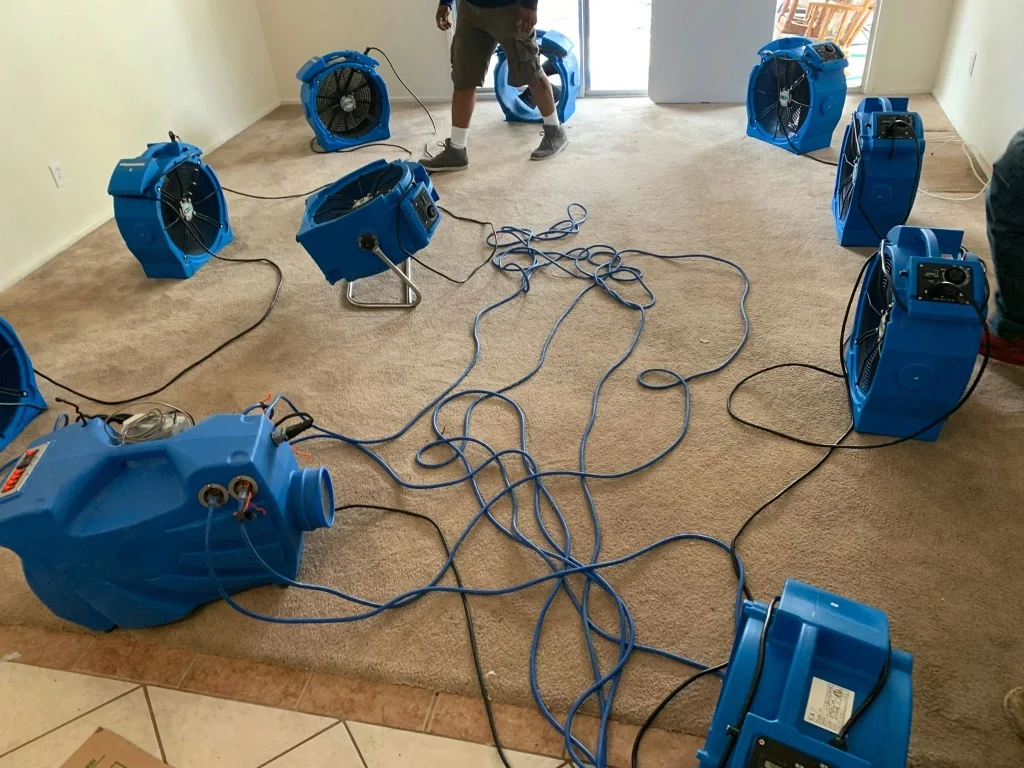
Conventional Low-Grain Refrigerant (LGR) dehumidifiers depend on a significant temperature differential between incoming moist air and internal refrigerated condensing coils. In subterranean structures where below-grade air temperatures remain at 70°F to 80°F while ambient humidity approaches 100%, LGR dehumidifiers quickly reach their dewpoint operational limits, losing the thermodynamic ability to extract deep capillary moisture from cold, thick concrete slabs. Furthermore, standard axial air movers merely circulate saturated, stagnant air across the surface, causing surface evaporation that chills the concrete and halts deep moisture migration.
The Psychrometric Superiority of Industrial Desiccant Dehumidification
Valley Restoration Pros deploys trailer-mounted industrial desiccant dehumidifiers (ranging from 2,500 CFM to 9,000 CFM per unit) powered by dedicated diesel generators. Desiccant technology utilizes a slowly rotating, porous titanium silica gel wheel that chemically adsorbs water vapor directly from incoming process air, regardless of ambient temperature or dewpoint limitations:
- Extreme Low-Dewpoint Process Air: While standard LGRs struggle to lower ambient humidity below 45 Grains Per Pound (GPP), our industrial desiccant systems deliver ultra-dry process air at 10 to 18 GPP with relative humidity levels below 10%.
- High Vapor Pressure Differential: By saturating the subterranean airspace with ultra-low dewpoint air, we establish a steep vapor pressure gradient between the ambient air (0.15 PSI vapor pressure) and the moisture trapped inside concrete pores (0.85 PSI vapor pressure). This massive gradient drives deep bound water to the surface through capillary effusion.
- High Static Pressure Long-Duct Distribution: Using 20-inch reinforced layflat and semi-rigid spiral ducting, desiccant dry air is routed hundreds of feet through elevator shafts, parking ramps, and subterranean corridors, ensuring uniform moisture evacuation across all levels.
- Continuous Moisture Mapping & ASTM F2170 Verification: Certified psychrometric technicians monitor drying kinetics using FLIR high-resolution thermal imaging cameras, non-destructive moisture meters, and calibrated in-situ relative humidity probes drilled into post-tensioned slabs in strict compliance with ASTM F2170.
Our engineered drying methodologies ensure that subterranean building components achieve verified dry standards within three to five days, preventing long-term concrete delamination, rebar corrosion, and microbial incubation. Learn more about our comprehensive commercial drying technologies in our technical manual for structural drying across commercial properties.
Elevator Shaft, Sump Pit & Mechanical Infrastructure Dewatering Protocol
In modern multi-story commercial facilities across Kierland Commons and the Scottsdale Airpark corridor, passenger and freight elevator pits represent the lowest topographical points of the subterranean building envelope. Constructed four to eight feet deeper than the lowest parking deck slab, elevator pits are exceptionally vulnerable to stormwater inundation whenever subterranean collection sumps fail. Floodwaters naturally seek the lowest path of gravity resistance, cascading down hoistway doors or backing up through pit floor drains, filling pits with four to eight feet of highly contaminated water and sludge.
Submerging an elevator pit initiates immediate, severe mechanical and electrical degradation. Heavy hydraulic jacks, plunger cylinders, and packing glands in hydraulic elevators become fouled with abrasive silt and water. In traction elevators, counterweight buffers, pit governor tensioner pulleys, compensating cable sheaves, and electrical limit switches suffer instant corrosion and short-circuit damage. Furthermore, hydraulic elevators frequently contain small volumes of hydraulic oil leaked into pit sumps; floodwaters lift this oil, coating the entire hoistway with a flammable, hazardous petroleum residue.
The 6-Step Elevator Pit Dewatering & Restoration Protocol
- Lockout/Tagout (LOTO) & Mechanical Pinning: Elevators are recalled to upper levels, isolated at the main machine room disconnects, and mechanically secured with hoistway rail clamps to prevent accidental movement.
- OSHA Confined Space Setup: Hoistway doors are barricaded, and continuous mechanical ventilation is established using negative air blowers. Continuous 4-gas atmospheric monitoring ensures safe entry for certified technicians.
- Hydrocarbon Separation & Slurry Extraction: Specialized diaphragm pumps equipped with oil-skimming suction heads evacuate contaminated water into dedicated holding tanks. Hazardous petroleum sheen is separated and manifested for certified off-site disposal.
- High-Pressure Washing & Degreasing: Concrete pit floors and walls, structural buffer stands, and vertical hoistway rail bases are high-pressure washed with biodegradable degreasers and sanitized with EPA-registered biocides.
- Desiccant Micro-Drying of Electrical Conduits & Buffers: Dedicated low-grain desiccant duct lines are directed into the pit to thoroughly dry traveling cable junctions, governor tensioners, and pit stop switches, eliminating residual moisture trapped inside electrical conduits.
- Certified Elevator Contractor Coordination: Following complete dewatering and sanitization, our team provides an official remediation clearance certificate to the facility’s certified elevator maintenance contractor (e.g., Otis, Schindler, TK Elevator, Kone) for mechanical re-certification and safe passenger service restoration.
For comprehensive details on our industrial extraction methodologies for submerged vertical transit shafts, review our specialized commercial manual for commercial elevator pit water extraction in Phoenix and Scottsdale commercial high-rises.
Hyper-Local Kierland Case Study: Subterranean Structure Inundation at Scottsdale Quarter & Greenway-Hayden
In August 2024, an intense Sonoran Desert monsoon supercell stalled directly over the Kierland and North Scottsdale corridor, unleashing 2.85 inches of torrential precipitation and 65 MPH wind gusts in under forty-five minutes. At a premier mixed-use commercial complex situated near the intersection of Scottsdale Road and the Greenway-Hayden Loop—comprising 120,000 square feet of upscale retail storefronts, corporate executive suites, and a two-level subterranean parking garage housing 450 vehicles—the massive volume of surface runoff overwhelmed the exterior perimeter drainage swales.
Runoff laden with decomposed granite landscaping gravel, street asphalt oils, and desert silt cascaded down the southern vehicular entrance ramp, rapidly filling the subterranean retention basin. The facility’s duplex 10-horsepower stormwater sump pump station was designed to handle high-volume inflows; however, extreme 22 GPG calcium carbonate scale buildup on the primary mechanical float switch bracket prevented the lead pump from engaging. Simultaneously, the secondary lag pump experienced an immediate locked-rotor electrical overload trip when coarse granite gravel jammed its semi-open vortex impeller. Within twenty minutes, the sump vault breached, submerging subterranean parking level P2 beneath thirty-four inches of Category 3 floodwater, inundating three hydraulic elevator pits, and breaching five subterranean tenant inventory storage suites.
Chronological Emergency Restoration Timeline & Technical Metrics
Valley Restoration Pros emergency dispatch received the emergency call at 9:18 PM. Our industrial large-loss response fleet arrived on site within twenty-seven minutes. Technicians executed NFPA 70E electrical disconnects, isolating 480V subterranean branch switchgear and elevator controllers, established OSHA confined-space air monitoring, and deployed pneumatic pipe plugs to stem incoming stormwater lateral flows.
Two trailer-mounted diesel trash pumps and three high-chrome submersible slurry pumps evacuated 165,000 gallons of standing floodwater at a continuous rate of 1,400 GPM. Floodwater was routed through mobile sediment filtration tanks and oil-water coalescers to comply with City of Scottsdale environmental discharge standards. Trailer vacuum blowers removed over twelve tons of settled caliche mud and decomposed granite gravel.
Technicians established negative air containment zones across five flooded retail storage suites, performing precision 24-inch flood cuts to remove saturated gypsum drywall, wet insulation, and contaminated baseboards. Concrete parking slabs and masonry walls were hot-water pressure washed at 200°F and treated with hospital-grade botanical biocides. ATP bioluminescence testing confirmed sanitized conditions with readings under 25 RLU.
Two 5,000 CFM trailer-mounted desiccant dehumidifiers ducted ultra-dry process air (14 GPP, 8% RH) throughout the subterranean levels. In-situ relative humidity probes verified that post-tensioned concrete slabs reached equilibrium relative humidity below 75% in accordance with ASTM F2170. Elevator shafts were cleared, inspected, and certified by elevator engineers, enabling full property re-occupancy in less than five days with zero permanent structural loss.
This real-world recovery demonstrates the critical necessity of rapid, certified industrial intervention. Discover our enterprise capabilities for complex commercial properties through our specialized division for commercial water damage mitigation across Maricopa County.
Pay-Per-Call Financial & Insurance Documentation Breakdown
Navigating the financial and insurance complexities of commercial stormwater sump pump overflows requires total fiscal transparency and forensic documentation precision. Commercial property managers, asset holding companies, and business owners in Kierland Commons frequently face immense financial exposure following a subterranean inundation, ranging from emergency extraction costs and structural drying expenses to tenant inventory claims and business interruption losses. Missteps in initial policy notification or incomplete moisture logging can result in delayed claims, disputed scope, or substantial coverage denials by commercial insurance carriers.
At Valley Restoration Pros, our operational ethos is founded on uncompromised integrity. We strictly uphold compliant commercial billing standards: we do not make false promises that insurance will pay 100% of costs without deductible responsibility, nor do we make misleading claims of direct billing without customer authorization. Instead, we empower our commercial clients with complete financial clarity and defensible forensic documentation from the very first hour on site.
Our Three Pillars of Commercial Billing Compliance
Free Comprehensive On-Site Damage Assessment
Our senior restoration engineers perform an exhaustive, zero-cost physical inspection of all affected subterranean zones, utilizing calibrated moisture meters, infrared thermal imaging, and atmospheric psychrometric sensors to define the exact spatial and structural extent of the water loss before any commitment is made.
Transparent Upfront Itemized Pricing Before Work Begins
We generate line-item estimates using industry-standard Xactimate commercial pricing codes (WTR, CLN, HMR, and DRY). Every pump deployment, labor hour, biocide application, and desiccant CFM volume is clearly itemized with fixed unit costs, providing facility directors and board executives with complete budgetary transparency before work begins.
Assistance with Detailed Claims Documentation & Psychrometric Moisture Logs
We compile a comprehensive commercial claims dossier for your commercial carrier (Travelers, Chubb, Liberty Mutual, Zurich, etc.), containing high-resolution photographic evidence, daily psychrometric dry logs (GPP, RH, temp), floor plan CAD moisture maps, and pump run-time manifests that substantiate every penny of your claim.
Understanding policy definitions is vital in stormwater sump pump overflows. Commercial policies frequently distinguish between "water damage" (burst internal pipes), "sewer or drain backup" (requiring a specific policy endorsement), and "surface floodwater" (covered under commercial flood policies through NFIP or private surplus lines). Our expert documentation clearly establishes the mechanical point of origin, distinguishing between equipment failure and surface inundation, ensuring your claim is presented with forensic accuracy under applicable policy endorsements.
To calculate preliminary remediation budgets based on square footage, water category, and extraction scope, utilize our interactive Instant Commercial Cost Estimator or contact our North Scottsdale commercial advisory desk.
Structural Concrete & Caliche Soil Integrity: Preventing Foundation Slab Displacement & Hydrostatic Upheaval
The geological foundation beneath North Scottsdale, including the areas surrounding Kierland Commons, the Promenade, and the Scottsdale Airport, is dominated by complex quaternary alluvium interbedded with dense, cementitious caliche hardpan and high-plasticity smectite clay lenses. Caliche consists of soil, gravel, and sand cemented together by calcium carbonate precipitated from prehistoric mineral groundwater over hundreds of thousands of years. Because caliche behaves essentially like natural concrete, it forms an almost completely impermeable geological shelf beneath commercial structural footings.
When a commercial stormwater sump pump station overflows or drainage retention sumps fail, thousands of gallons of stormwater are trapped within the subterranean building excavation. Water cannot percolate downward through the impermeable caliche barrier; instead, it ponds along foundation grade beams, fills elevator pit over-excavations, and saturates the sub-base aggregate beneath post-tensioned parking garage slabs. When the underlying clay seams absorb this trapped water, their volume expands by up to 20% to 30%, generating immense upward hydraulic uplift forces commonly referred to as hydrostatic heave.
Mechanisms of Structural Foundation Stress During Sump Vault Failures
- Hydrostatic Uplift Against Post-Tensioned Slabs: Water trapped beneath an impermeable concrete slab exerts upward buoyant pressure equal to 62.4 pounds per cubic foot. In a subterranean parking facility submerged under three feet of water, upward hydrostatic pressure can exceed 200 pounds per square foot, stressing tendon anchorages, cracking control joints, and inducing differential slab displacement.
- Caliche Hardpan Channeling & Cold-Joint Intrusion: Because groundwater cannot drain vertically, it follows horizontal strata until it contacts subterranean perimeter retaining walls. Lateral hydrostatic head forces water through cold joints, construction expansion seams, and form-tie penetrations, creating high-pressure geysers that continue to flood basement suites long after surface stormwaters have receded.
- Sub-Slab Void Formation from Silt Erosion: High-velocity water scouring around compromised sump pits erodes compacted sub-base gravel and fine caliche sand, leaving subterranean voids beneath heavily loaded structural columns and drive aisles. Unchecked, these voids lead to sudden slab punch-through under the dynamic weight of moving commercial delivery vehicles.
- Rebar Corrosion & Mineral Efflorescence: Scottsdale’s 18 to 24 GPG mineral-rich water carries chloride ions that penetrate concrete micro-cracks. When oxygen and moisture contact internal steel rebar, accelerated galvanic corrosion produces iron oxide expansion, spalling surface concrete and degrading structural load-bearing capacity.
Mitigating these catastrophic geotechnical risks requires immediate water evacuation combined with precision structural assessment. In instances involving foundation movement or suspected sub-slab utility failures, our commercial division executes advanced slab leak water damage restoration protocols to pinpoint subterranean anomalies and safeguard structural integrity.
Indoor Air Quality, Odor Neutralization & Microbial Remediation in Subterranean Enclosures
Subterranean commercial structures present profound atmospheric challenges following a stormwater sump overflow. Below-grade parking decks, retail basement suites, and utility vaults suffer from limited air exchange rates, relying heavily on mechanical ventilation louvers and jet fan exhaust systems. When contaminated Category 3 stormwater stagnates within an enclosed subterranean envelope, airborne biological and chemical pollutants accumulate rapidly. In North Scottsdale’s summer desert heat, where exterior air temperatures reach 115°F, below-grade temperatures remain in the 80°F to 95°F range with 90%+ relative humidity, creating the ideal biological breeding environment for pathogenic fungi and volatile organic compounds (VOCs).
The offensive, pungent odor commonly associated with stormwater sump overflows is caused by microbial volatile organic compounds (MVOCs) produced by anaerobic bacteria decomposing organic matter, blended with automotive hydrocarbons and sulfurous sewer vapors. These airborne contaminants travel upward through elevator shafts, stairwells, and mechanical utility penetrations, infiltrating high-end retail stores and corporate offices in Kierland Commons. Addressing this contamination demands aggressive, multi-stage indoor air quality remediation.
HEPA Negative Air Scrubber Arrays
We deploy commercial HEPA-500 air scrubbers fitted with multi-stage particulate pre-filters and activated carbon vapor filters. Operating under continuous negative pressure, these systems capture 99.97% of airborne mold spores, hazardous dust particles, and aerosolized bacteria down to 0.3 microns, exhausting scrubbed air away from occupied tenant zones.
Vapor-Phase Hydroxyl Oxidation
Unlike toxic ozone generators that require building evacuation and degrade rubber and electronics, our fleet utilizes advanced atmospheric hydroxyl generators. Safe for occupied environments, hydroxyl radicals continuously break down odor-causing MVOCs and hydrocarbon molecules at the molecular level without generating hazardous byproducts.
Antimicrobial Encapsulation Barriers
Following clinical washdown and structural drying, unfinished concrete masonry walls, cold joints, and exposed structural steel receive an application of breathable, EPA-registered clear antimicrobial sealant. This barrier prevents residual mold spores from colonizing substrate pores and locks out future moisture absorption.
Where floodwaters remain stagnant for more than forty-eight hours, aggressive fungal amplification can quickly compromise commercial building occupancy. Review our dedicated procedures for commercial mold remediation to understand our rigorous containment, clearance testing, and indoor environmental decontamination protocols.
Frequently Asked Questions: Commercial Stormwater Sump Overflows in North Scottsdale
In North Scottsdale commercial facilities, the primary mechanical cause of failure is float switch binding caused by heavy 18 to 24 GPG calcium carbonate scale encrustation combined with desert silt. Other frequent causes include locked-rotor impeller failure from decomposed granite gravel, check valve clapper pin fractures from hydraulic water hammer, and electrical transfer switch failure during localized monsoon power brownouts along the Scottsdale Road commercial grid.
Under IICRC S500 standards, all stormwater runoff that contacts outdoor parking aprons, landscaping, or roadways prior to entering a subterranean structure is classified as Category 3. It carries heavy loads of automotive motor oils, heavy metals, animal biological waste, fertilizer chemicals, and pathogenic soil microbes. This contamination poses significant human health risks and mandates professional biohazard decontamination, antimicrobial washdowns, and the removal of porous building materials.
Most subterranean commercial garages in Kierland have strict height restrictions between 7’0” and 8’2”, preventing standard full-size vacuum trucks from entering. Valley Restoration Pros utilizes specialized low-profile trailer extraction equipment and high-vacuum rotary lobe blowers staged at ground level. We route four-inch heavy-wall vacuum lines and industrial electric submersible slurry pumps down parking ramps and stairwells, achieving powerful extraction across lower levels without vehicle clearance limitations.
In the desert summer, subterranean structures become high-humidity microclimates. With ambient outdoor temperatures of 115°F and underground temperatures between 85°F and 95°F, mold spores germinate and colonize wet drywall, baseboards, and organic silt within 24 to 48 hours. Rapid dewatering, negative air HEPA scrubbing, and industrial desiccant dehumidification must begin immediately to prevent widespread microbial contamination.
Coverage depends heavily on policy language and specific endorsements. Standard commercial property policies often exclude subterranean water intrusion unless the business carries a specific "Water Backup of Sewers and Drains" endorsement or a commercial flood insurance policy. Our documentation specialists provide forensic causation reports, psychrometric moisture logs, and itemized Xactimate estimates that clearly demonstrate the mechanical failure sequence to assist adjusters in evaluating coverage under applicable policy provisions.
Returning an elevator pit to service requires a strict protocol: Lockout/Tagout isolation, OSHA confined space atmospheric testing, high-vacuum water and silt slurry evacuation, separation of leaked hydraulic fluids, high-pressure sanitizing with EPA biocides, and thorough desiccant drying of traveling cables, safety switches, and buffer assemblies. Once complete, an IICRC clearance certificate is issued to the certified elevator maintenance company for final inspection and state re-certification.
External storm surge carries high-density desert silt, mud slurries, and biological contaminants from roadways, requiring specialized filtration, slurry pumping, and Category 3 decontamination. Internal plumbing failures typically involve Category 1 or 2 water. For comprehensive details on dealing with severe desert storm deluges, consult our engineering manual on commercial storm flood cleanup throughout the Phoenix metropolitan area.
Preventative Engineering: Commercial Stormwater Sump System Hardening & Facility Playbook
For commercial facility directors, building engineers, and property asset managers in North Scottsdale, surviving a catastrophic subterranean sump overflow is only the first step. Long-term property value and operational resilience depend on implementing comprehensive preventative engineering hardening. Given that Sonoran Desert monsoon supercells will continue to stress drainage systems annually, commercial properties across Kierland Commons, Scottsdale Quarter, and the Scottsdale Airpark must upgrade their subterranean pumping topologies from reactive maintenance to robust proactive protection.
Valley Restoration Pros collaborates with commercial property engineering teams to develop customized facility hardening playbooks. By eliminating single points of mechanical and electrical failure, commercial structures can withstand extreme cloudbursts, severe mineral scaling, and utility grid disruptions without suffering subterranean inundation.
The 5 Pillars of Commercial Sump Station Hardening
Replace mechanical float switches susceptible to 18 to 24 GPG mineral scale with non-contact ultrasonic transducers or 80 GHz continuous radar level transmitters. Mounted above the high-water line, radar sensors measure water levels with millimeter accuracy, completely unaffected by foam, grease, or heavy sediment.
Upgrade duplex systems to a triplex configuration featuring heavy-duty non-clog submersible pumps with recessed vortex impellers and tungsten carbide mechanical seals. If one pump experiences impeller lock from decomposed granite gravel, the remaining two units provide 100% redundant discharge capacity.
Install an isolated NEMA 4X Automatic Transfer Switch (ATS) linked to a dedicated emergency diesel generator positioned on the ground-level roof or utility yard. During localized SRP/APS utility outages, the ATS transfers pump power within ten seconds, ensuring continuous dewatering.
Integrate cellular cloud-connected telemetry into the pump control panel. Automated alerts send real-time SMS notifications to facility directors if sump levels reach critical high-alarm thresholds, if pump running current deviates from normal operating curves, or if utility power is lost.
For commercial properties with specialized industrial infrastructure, such as flight facilities near the runway corridors, examine our specialized procedures for Scottsdale Airpark commercial hangar flood extraction to discover how robust facility engineering protects high-value commercial and aviation investments.
North Scottsdale & Airpark Commercial Cross-Facility Capabilities
The commercial real estate landscape of North Scottsdale is renowned for its diversity, architectural sophistication, and economic value. From the high-end retail boutiques and outdoor pedestrian concourses of Kierland Commons to the sprawling logistics parks, corporate data centers, luxury auto dealerships, and aviation hangars surrounding the Scottsdale Airpark along the Loop 101 freeway corridor, every commercial property demands a customized restoration methodology. A subterranean sump pump overflow in a multi-story retail center requires completely different containment, drying, and noise mitigation protocols than an industrial flood in a high-tech manufacturing cleanroom or corporate campus.
Valley Restoration Pros maintains the logistical scale, industrial equipment reserves, and multi-disciplinary expertise to handle concurrent large-loss commercial events across the North Scottsdale corridor. When a severe monsoon convective storm sweeps across the Valley, our centralized dispatch mobilizes self-contained restoration task forces capable of operating independently without draining local municipal utility resources.
Comprehensive Commercial Capabilities Across the North Scottsdale Corridor
Our dedicated commercial restoration divisions provide comprehensive disaster recovery across all major North Scottsdale commercial districts:
- Kierland Commons & Scottsdale Quarter Mixed-Use Hubs: Rapid dewatering of subterranean parking decks, retail basement inventory storage rooms, elevator hoistways, and below-grade customer amenities with zero disruption to active retail traffic.
- Scottsdale Airpark Corporate & Aviation Enclaves: Specialized stormwater and slurry evacuation for aircraft hangars, avionics cleanrooms, executive flight facilities, and corporate headquarters situated along Greenway Parkway and Frank Lloyd Wright Boulevard.
- North Scottsdale Medical & Professional Suites: Clinical Category 3 decontamination, hospital-grade botanical bio-washing, and indoor air quality certification for medical practices, diagnostic centers, and executive offices along Scottsdale Road.
- Regional Valley-Wide Mobilization: Explore our extensive capabilities throughout the region via our dedicated Scottsdale water damage restoration services division, or review our comprehensive coverage across all Valley-wide service areas.
Whether mitigating a sudden duplex sump pump failure in Kierland, an elevator shaft deluge in Gainey Ranch, or high-volume stormwater intrusion in DC Ranch, our certified restoration teams deliver the engineering expertise, industrial horsepower, and local commitment necessary to safeguard your business assets.
Regulatory Compliance, OSHA Confined Space & Municipal Stormwater Mandates
Resolving a major commercial stormwater sump pump overflow in North Scottsdale involves far more than pumping water and drying concrete; it demands complete adherence to complex federal, state, and municipal environmental mandates. Subterranean commercial flood incidents trigger oversight from multiple regulatory jurisdictions, including the Occupational Safety and Health Administration (OSHA), the Maricopa County Environmental Services Department (MCESD), and the City of Scottsdale Stormwater Quality Management Program under the federal Clean Water Act National Pollutant Discharge Elimination System (NPDES).
Discharging untreated, sediment-choked floodwaters containing petroleum residues, heavy metals, or chemical biocides directly into municipal storm sewers along Scottsdale Road or Greenway Parkway constitutes a severe environmental violation, carrying civil penalties exceeding $10,000 to $25,000 per day under Scottsdale Revised Code. Valley Restoration Pros ensures 100% regulatory compliance throughout every phase of the restoration lifecycle, shielding property owners, board members, and corporate management from catastrophic environmental liabilities.
The Four Core Regulatory Compliance Directives
All entries into submerged sump vaults, elevator pits, and underground detention basins are executed under strict Permit-Required Confined Space protocols. We maintain continuous multi-gas atmospheric logging (O2, LEL, CO, H2S), forced-air ventilation, certified mechanical retrieval tripods, and dedicated external safety attendants on continuous watch.
All evacuated floodwaters pass through on-site settling manifolds and hydrocarbon coalescing separators to filter out heavy sediment and petroleum sheen. Contaminated slurries and separated waste are manifested and transported by certified industrial waste carriers in full compliance with Arizona Department of Environmental Quality (ADEQ) standards.
Remediation adheres strictly to published IICRC standards for Black Water losses. Porous assemblies are professionally removed under negative pressure containment, semi-porous surfaces undergo hot-water pressure washdown and botanical biocide treatment, and rapid ATP bioluminescence swabs confirm sterile baseline verification before structural clearance.
Structural concrete drying is documented using electronic in-situ relative humidity probes installed at 40% slab depth. Our verified drying logs confirm concrete equilibrium relative humidity has dropped below 75%, providing building underwriters and flooring contractors with irrefutable proof of structural stability.
When sudden stormwater sump pump failures threaten your subterranean commercial property in Kierland or North Scottsdale, choose the certified restoration team with the engineering capacity, industrial fleet, and compliance rigor to protect your investments. Contact Valley Restoration Pros at (602) 847-9593 or contact our 24/7 commercial dispatch team for immediate emergency mobilization.
Verified Local Area Dispatch: Phoenix, AZ
Official Geo-Coordinates: 33.4484° N, -112.074° W • Maricopa County
Related Specialized Emergency Restoration Services
Explore specialized rapid-response mitigation protocols across Greater Phoenix and Maricopa County:
Valley-Wide Emergency Response Service Coverage
Our mobile restoration fleet is dispatched across the entire Phoenix metropolitan region, providing rapid 30 to 60 minute emergency response: