

Valley Restoration Pros delivers 24/7 industrial emergency water extraction, thermal psychrometric drying, and structural mitigation across Phoenix and Maricopa County with guaranteed 30–60 minute rapid arrival. All protocols strictly adhere to IICRC S500 standards, featuring upfront itemized pricing and free on-site thermal moisture assessments. Call dispatch directly at (602) 847-9593.
Why Immediate Mitigation Is Critical in Phoenix Heat
Accidental pre-action dry-pipe or deluge sprinkler rupture dumping 3,000+ GPM of municipal water and corrosive black iron pipe scale across monolithic epoxy hangar floors. Scottsdale municipal water hardness measuring 18 to 24 GPG depositing aggressive calcium carbonate and chloride salts, sparking rapid galvanic corrosion across avionics test benches and circuit cards. Sonoran Desert summer heat exceeding 115°F triggering rapid water evaporation, driving ambient relative humidity to 90% and forcing destructive condensation into unsealed aircraft fuselage bays and flight computers. Sub-slab hydrostatic pressure from standing water penetrating saw-cut expansion joints and swelling subterranean caliche clay, risking catastrophic foundation heave and warping precision aircraft leveling pads.
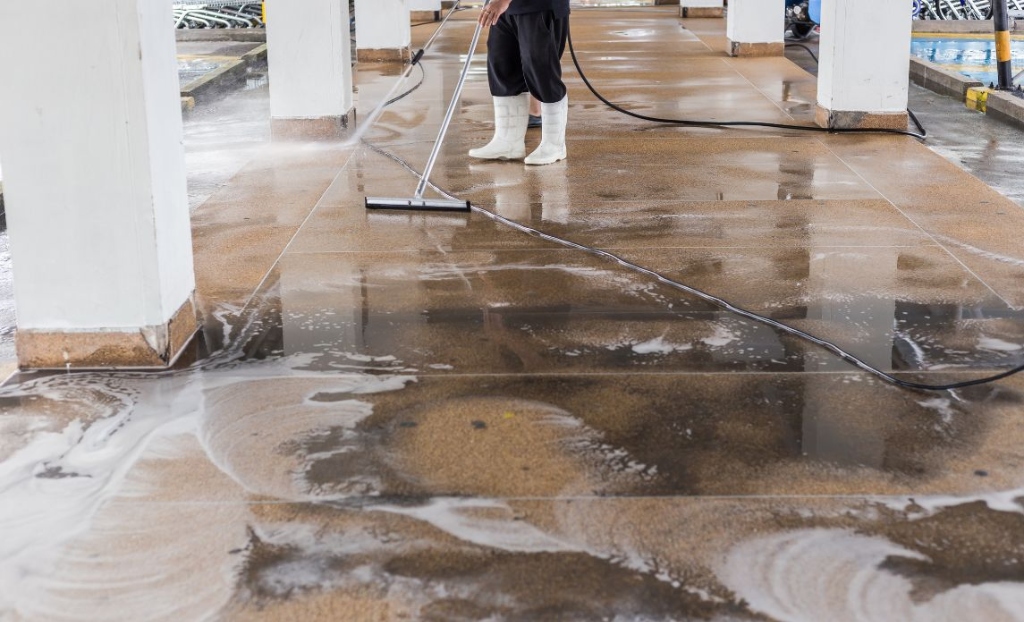
Service Definition & The IICRC Standard of Care
Professional scottsdale airpark avionics hangar sprinkler flood cleanup is an engineering and environmental discipline adhering strictly to IICRC S500 protocols, not mere surface mopping. When structural plumbing failures strike in Maricopa County, certified emergency water extraction and thermal structural drying procedures must be deployed immediately. Whether triggered by high-pressure burst pipe emergencies, subfloor leaks, or commercial line ruptures, bound moisture rapidly penetrates concrete subfloors and wall framing. In the desert heat, delays trigger microbial proliferation requiring rapid mold remediation. Request damage assessment through our emergency assessment portal or request 30-minute dispatch across all Valley service areas.
Securing electrical feeds, inspecting load-bearing assemblies, and containing pathogens.
Stopping the intrusion source and erecting 6-mil plastic isolation containment airlocks.
31-HP truck-mount extraction, removing gallons exponentially faster than evaporation.
LGR dehumidifiers and HEPA air scrubbers driving grains per pound below 25 GPP.
Calibrated electronic pinless testing confirming baseline dry standards.
The Complete 6-Stage Restoration Roadmap
Our IICRC-certified crews execute a disciplined, scientific 6-stage protocol to stabilize and dry structural components:
Emergency Dispatch & Perimeter Isolation
30 to 60 minute arrival. Securing electrical shutoffs, evaluating structural loads, and erecting containment airlocks.
FLIR® Thermal Mapping & Baseline Scans
Infrared thermal scans detect trapped moisture behind walls and beneath concrete without invasive exploratory demolition.
High-Volume Bulk Extraction
31-HP truck-mount extraction units pump standing water away at hundreds of gallons per minute.
Controlled Selective Demolition
Precision flood cuts 12 to 24 inches above moisture lines, removing wet insulation and opening wall framing to dry airflow.
Thermodynamic Dehumidification
Industrial Low-Grain Refrigerant dehumidifiers pull deep trapped moisture from dense framing lumber and concrete slabs.
Antimicrobial Sanitization & Verification
EPA-registered botanical application (Benefect Decon 30) and calibrated moisture testing to issue an official dry certificate.

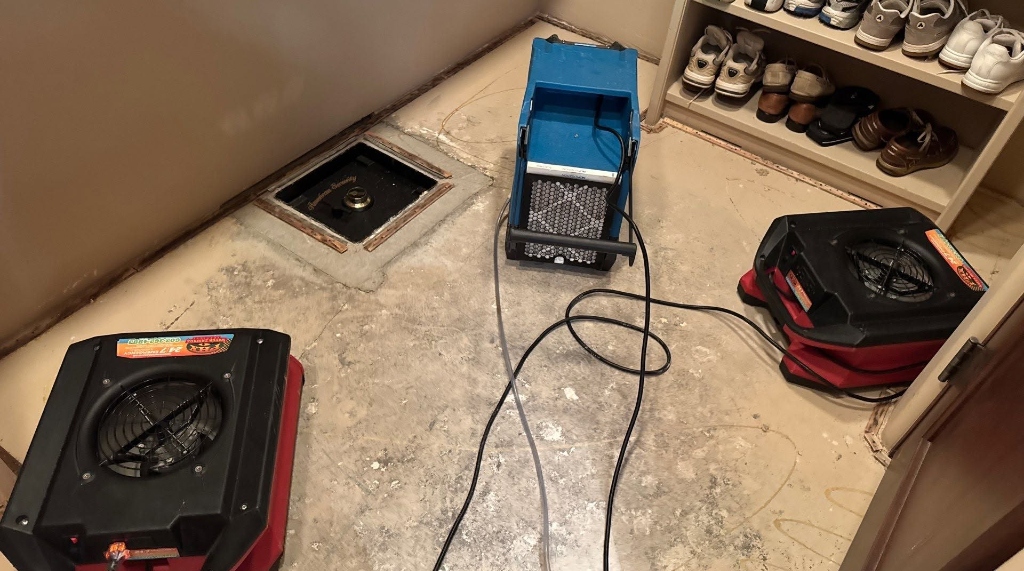
Specialized Equipment & Industrial Restoration Technology
Mitigating severe property damage requires industrial-grade technology capable of altering thermodynamic psychrometrics:
Truck-Mounted Extraction Rigs
31-HP engines producing 16+ inches Hg vacuum suction to evacuate bulk water rapidly into holding tanks.
Low-Grain Refrigerant Dryers
Pre-cooling heat-pipe systems driving ambient grains per pound below 25 GPP to draw deep trapped water out of framing.
HEPA Negative-Air Scrubbers
Hospital-grade 99.97% particulate filtration capturing microscopic fungal spores, soot, and biohazard aerosols.
FLIR® Thermal Scanners & Probes
Infrared thermography detecting evaporative cooling boundaries behind walls, combined with digital RF pinless scanners.
Professional Restoration vs. DIY Mitigation
Attempting DIY cleanup during a property disaster creates severe hidden liabilities:
- Trapped Moisture: Surface drywall dries while moisture inside cavities triggers hidden mold blooms.
- Pathogenic Risks: Category 2 & 3 water contains bio-contaminants standard cleaners fail to kill.
- Insurance Denial: Insurers require daily psychrometric logs; lack of data causes claim disputes.
Transparent Upfront Itemized Pricing
Valley Restoration Pros operates with complete transparency:
- Free On-Site Assessment: Complete physical inspection before work begins.
- Upfront Itemized Estimates: Detailed line items calculated via industry-standard Xactimate.
- Zero Surprise Billing: No hidden charges or unauthorized repairs.
Certified Scottsdale Airpark Avionics Hangar Sprinkler Flood Cleanup Field Documentation
Every response performed by Valley Restoration Pros is documented through photographic and thermographic records:

Comprehensive Scottsdale Airpark Avionics Hangar Sprinkler Flood Cleanup Technical Manual & Operational Standards
Exhaustive engineering protocols, psychrometric calculations, geological multipliers, and step-by-step restoration standards for Maricopa County properties:
Executive Emergency Abstract: Scottsdale Airpark Avionics Hangar Pre-Action Sprinkler Discharge Remediation
The Scottsdale Airpark surrounding Scottsdale Airport (SDL) represents one of the most concentrated, high-capital business aviation corridors in the Western United States. Encompassing thousands of aerospace enterprises along North Airport Drive, Frank Lloyd Wright Boulevard, Raintree Drive, and Redfield Road, this aviation hub shelters multimillion-dollar corporate airframes, FAA Part 145 certified repair stations, and ultra-sensitive avionics integration cleanrooms. Facilities here service ultra-long-range business aircraft including Gulfstream G650ER and G700 platforms, Bombardier Global 7500 systems, Dassault Falcon 8X models, and corporate Citation fleets. When a double-interlock pre-action fire sprinkler system suffers an accidental actuator trip, pneumatic line compromise, or structural pipe failure, the resulting high-volume discharge unleashes thousands of gallons of pressurized municipal water directly over critical flight line infrastructure, sensitive line-replaceable units (LRUs), wire harness looms, and microelectronic diagnostic test benches.
Unlike standard commercial warehouse facilities, an avionics hangar flood presents severe cross-disciplinary technical threats. Aviation maintenance enclosures combine sprawling non-porous epoxy floor planes with sub-slab electrical conduit raceways, grounding trenches, cleanroom environmental partitions, and ultra-dense electrical power distribution. When hundreds of gallons per minute of municipal water inundate the facility, fluid cannot penetrate the high-performance resin floor coating. Instead, it forms broad, standing surface sheets that rapidly migrate toward aircraft jacking pads, subterranean floor utility vaults, and sensitive cleanroom testing enclosures. Without instant commercial-grade intervention through specialized emergency water extraction, rapid evaporation within the dry desert atmosphere drives ambient relative humidity through the roof, precipitating secondary moisture condensation within unsealed avionics chassis, radar transceivers, and navigational computer racks.
The remediation protocol requires an uncompromising engineering standard. Restoring an avionics hangar demands thorough compliance with FAA Part 145 quality control criteria, IICRC S500 standards for professional water damage restoration, and ISO cleanroom particulate standards. Valley Restoration Pros deploys specialized industrial high-flow vacuum extraction units, trailer-mounted desiccant dehumidifiers producing sub-10 grain dry air, and certified cleanroom HEPA filtration systems to arrest moisture migration, neutralize aggressive waterborne mineral salts, and stabilize flight-critical equipment before permanent microelectronic degradation occurs. Our emergency flight-line response crews are stationed minutes from the airport perimeter, guaranteeing immediate on-site mobilization day or night.
Aviation Facility Emergency Protocol: Critical Initial Response Directives
- Immediate Pre-Action Header Isolation: Secure the OS&Y (outside screw and yoke) control valve and close the main dry-pipe riser control immediately to arrest ongoing discharge without bleeding pneumatic supervisory air unnecessarily across unactivated zones.
- Electrical Bus & Ground Power Unit De-Energization: Immediately drop main hangar sub-panel breakers, 400 Hz ground power units, and 28V DC bench rectifiers to prevent catastrophic high-amperage short circuits and arc-flash events across saturated subfloor trenches.
- Aircraft Electrostatic Grounding Protection: Inspect and safeguard ground cables attached to corporate jet airframes to ensure electrical continuity while isolating wet grounding plates from active stray currents and potential ground loops.
- Cleanroom Negative Pressure Containment: Seal avionics testing cleanrooms with temporary polyethylene barriers and activate dedicated HEPA air filtration to block airborne moisture plumes from entering sterile diagnostic suites.
- Mobilize Industrial Dewatering Dispatch: Contact Valley Restoration Pros at (602) 847-9593 for 24/7 industrial extraction trailers, high-tonnage desiccant equipment, and immediate flight line stabilization.
Anatomy of Pre-Action Sprinkler Systems & Mechanical Failure Dynamics
High-value aviation hangars and avionics engineering suites rarely utilize traditional wet-pipe sprinkler systems due to the catastrophic risk of inadvertent pipe fractures above delicate multimillion-dollar electronics. Instead, corporate hangars throughout the Scottsdale Airpark rely heavily on double-interlock pre-action fire sprinkler networks. In a double-interlock configuration, the overhead distribution piping remains pressurized with supervisory compressed air or nitrogen rather than water. Water rests behind a specialized pre-action deluge valve held closed by mechanical latches or differential pneumatic actuators.
For water to discharge under standard operational conditions, two independent operational criteria must be fulfilled simultaneously: an electronic detection circuit (such as optical infrared flame sensors, aspiration smoke detection, or thermal rate-of-rise detectors) must identify a combustion signature, and an overhead sprinkler head must shatter to vent supervisory air pressure. However, severe mechanical anomalies, component fatigue, or external structural forces can cause catastrophic false activation or destructive pipe ruptures, demanding rapid fire sprinkler water damage restoration services.
Mechanical failure modes in pre-action systems across the Scottsdale Airpark frequently stem from four primary engineering vulnerabilities:
- Solenoid Valve Actuator Leakage: Severe desert temperature swings and ambient thermal expansion can cause electronic pilot solenoids to degrade or short-circuit, releasing hydraulic pressure holding the internal clapper mechanism seated.
- Pneumatic Supervisory Pressure Decay: If the dedicated air compressor or nitrogen generation skid fails, supervisory pressure inside the dry pipe network decays below the low-pressure trip threshold. If accompanied by a false sensor fault, the pre-action valve unlatches instantaneously.
- Water Hammer & Valve Cavitation: Municipal pressure spikes from external City of Scottsdale water main adjustments can produce violent pressure transients exceeding 250 PSI, blowing past aging diaphragm seals and forcing open the pre-action clapper plate.
- Overhead Hangar Structural Thermal Deflection: Wide-span steel trusses supporting hangar roof envelopes can expand and contract by several inches during 115°F summer heat, putting severe mechanical shear stresses on rigid threaded schedule 10 and 40 pipe joints.
Once the clapper plate swings open, thousands of gallons of pressurized water enter the dry piping network. Unlike domestic systems delivering 15 to 25 GPM per head, industrial aircraft hangar systems operate high-capacity headers designed to deliver 2,500 to 5,000 gallons per minute at 60 to 100 PSI nozzle discharge pressure. Even a brief discharge duration of six to ten minutes inundates a 30,000-square-foot clear-span hangar with over 25,000 gallons of turbulent, non-potable water that surges across floor planes, into sub-slab utility ducts, and toward sensitive avionics workspaces.
Microbiological & Chemical Composition of Pre-Action Water Discharge
The initial deluge from a dry-pipe or pre-action system is never pristine potable water. Because piping networks sit empty under compressed atmospheric air for years, internal oxidation occurs continuously. When the valve unseats, the initial wave of liquid scours accumulated ferrous scale, black magnetite sediment, anaerobic pipe corrosion slime, and microbiologically influenced corrosion (MIC) byproducts directly onto hangar floors. This dark, corrosive slurry possesses an electrical conductivity several times higher than tap water, posing severe short-circuit hazards to avionics hardware.
Scottsdale Environmental Multipliers: Mineral Hardness, Caliche Heave & Heat
Remediating water intrusion within an aviation hangar in Scottsdale, Arizona requires an intimate understanding of regional geological and meteorological multipliers. The Sonoran Desert presents distinct ambient conditions that transform an ordinary flood into an ultra-aggressive corrosive and microbial event. Standard drying strategies developed for temperate climates fail completely when confronted with the physical realities of the Phoenix Valley.
18 to 24 GPG Municipal Hardness
Scottsdale municipal water sourced from Central Arizona Project (CAP) canals and Salt River Project reservoirs carries extreme dissolved mineral solids exceeding 800 PPM. Calcium carbonate, magnesium sulfate, and ionic chlorides precipitate out rapidly during surface drying, forming rock-hard alkaline scale that etches aerospace alloys and coats circuit contacts.
Expansive Caliche Soil Heave
The subterranean strata beneath Scottsdale Airpark consist of calcium-carbonate-cemented clay soils known as caliche. When floodwaters penetrate slab perimeter expansion joints and foundation footings, subterranean clays absorb moisture and expand with immense hydraulic force, shifting multi-ton slab panels and destabilizing precision aircraft balance fixtures.
115°F Summer Thermal Acceleration
During summer months, interior hangar skin temperatures often exceed 130°F. When standing water meets extreme thermal loads, rapid evaporation saturates the air mass. The resulting microclimatic greenhouse effect accelerates chemical oxidation on gold, silver, and copper avionics traces by a factor of 400% compared to baseline ambient conditions.
Monsoon Flash Flooding & Ingress
Summer monsoon storms bring microburst winds exceeding 60 MPH and torrential downpours. Runoff surging across aircraft taxiways frequently overwhelms exterior slot drains along Raintree Drive, driving Category 3 silt, petroleum hydrocarbons, and road contaminants into hangar entrances to mix with internal sprinkler discharge.
To learn more about our comprehensive regional capabilities and localized service teams, explore our dedicated Scottsdale water damage restoration services and municipal flood mitigation programs.
Avionics Vulnerability Matrix: Galvanic Corrosion, Micro-Bridging & Circuit Degradation
Modern corporate and commercial aircraft depend on intricate networks of flight management systems (FMS), attitude heading reference systems (AHRS), weather radar transceivers, and digital flight control computers. These systems are housed within Line Replaceable Units (LRUs) racked in forward equipment bays or maintained across static-safe cleanroom workbenches. When sprinkler discharge occurs, the vulnerability of microelectronic assemblies is extraordinary.
Water damage to avionics hardware does not require direct submersion. High-humidity plumes exceeding 70% relative humidity inside an unconditioned hangar cause airborne water vapor to penetrate chassis cooling perforations. Once inside, capillary action pulls moisture beneath Ball Grid Array (BGA) microprocessors, surface-mount capacitors, and multi-layer printed circuit boards (PCBs).
| Avionics Component | Primary Failure Mechanism | Water Ingress Vector | Tolerance Window |
|---|---|---|---|
| Flight Management Computers (FMC) | Dendritic silver migration, short-circuit bridging across micro-pitch ICs | Forced-air ventilation slots, unsealed bay covers | 2 to 4 Hours |
| Air Data Computers & Pitot-Static Sensors | Internal diaphragm corrosion, pneumatic sensor port fouling with mineral crust | Pneumatic quick-disconnect ports, calibration lines | 4 to 8 Hours |
| Airframe Wiring Harness Looms | Capillary wicking through braided insulation, pin-to-pin connector corrosion | Backshells of MIL-DTL-38999 circular connectors | 6 to 12 Hours |
| Automated Test Equipment (ATE) Benches | Power supply transformer dielectric breakdown, precision DAC board drift | Sub-floor utility cable troughs, cooling fan intakes | 1 to 3 Hours |
When Scottsdale municipal tap water with 20 GPG hardness reaches powered or unpowered circuit boards, the ionic mineral salts create conductive electrical pathways. Even after liquid water is removed, microscopic salt crystals bridge adjacent PCB traces spaced mere micrometers apart. When power is subsequently restored during diagnostic tests, catastrophic electrical arcing, dielectric breakdown, and irreversible micro-component destruction occur. This is why aggressive desiccant climate stabilization and deionized precision decontamination are mandatory.
Immediate First-Hour Emergency Protocol & Aircraft Safety Isolation
When a sprinkler release occurs inside an active corporate aviation hangar, chaos and confusion can quickly paralyze operations. Implementing an immediate, organized containment protocol during the critical first 60 minutes prevents millions of dollars in secondary structural and electrical losses. Aviation directors, maintenance supervisors, and flight line technicians must execute a synchronized sequence of safety and isolation measures.
Our rapid-deployment industrial mitigation teams work directly with corporate flight operations, FAA Part 145 quality managers, and hangar engineering staff to coordinate response activities. The primary initial objectives focus on human life safety, electrical hazard elimination, and preventing water from breaching aircraft envelopes or sterile testing environments.
Six-Stage First-Hour Aviation Facility Response Standard
- Life Safety & Evacuation Verification: Ensure all maintenance personnel, contract technicians, and flight crews clear the standing water zone. Wet epoxy hangar floors possess an extremely low coefficient of friction, creating severe slip-and-fall hazards.
- High-Voltage Isolation & Lockout/Tagout (LOTO): De-energize 480V 3-phase hangar distribution panels feeding overhead cranes, hydraulic door winches, and high-intensity discharge lighting before personnel enter wet zones.
- Aircraft Canopy, Radome & Access Hatch Closure: Immediately secure all open aircraft passenger doors, emergency exits, avionics bay cowlings, and battery compartment access panels on all parked airframes.
- Emergency Physical Diversion Berming: Deploy heavy-duty weighted rubber dikes and neoprene spill barriers around cleanroom entry thresholds, calibration labs, and ground power converter pits to divert flowing water away from high-asset zones.
- Sub-Slab Trench Isolation: Check subfloor utility troughs and wire race ways. Manually shut off sub-trench sump pumps if electrical vaults are flooded to avoid pumping contaminated oily wastewater into municipal sanitary mains without proper oil-water separation.
- Dispatch Emergency Restoration Infrastructure: Request immediate deployment of industrial mobile extraction systems, large-scale desiccant equipment, and cleanroom air scrubbing trailers through our direct dispatch line.
For comprehensive facility-wide disaster recovery standards, review our specialized commercial water damage mitigation protocols engineered for large-scale enterprise infrastructure across Maricopa County.
Advanced Industrial Dewatering & Sub-Slab Utility Trench Extraction
Extracting tens of thousands of gallons of standing water from a vast 40,000-square-foot corporate hangar floor requires heavy industrial equipment far exceeding the capabilities of standard commercial extraction machinery. Aircraft hangar floors are engineered with precision flatness (high F-number specifications) to support laser-aligned maintenance jigs and multi-ton jacking operations. Because these surfaces possess no functional floor slope or floor drains, water forms uniform pools varying from one-half inch to four inches deep across hundreds of feet of epoxy coating.
Valley Restoration Pros mobilizes heavy-duty industrial extraction units capable of moving immense fluid volumes. Our high-capacity vacuum trucks and trailer-mounted industrial extraction systems generate continuous airflow exceeding 1,200 CFM with lift capabilities exceeding 15 inches of mercury (Hg). Operating specialized wide-track squeegee wands and automated ride-on extraction scrubbers, our certified crews sweep across wide-span floor planes, capturing surface water at rates of up to 4,000 gallons per hour per operating team.
Sub-Slab Trench & Utility Vault Dewatering Protocols
The most hazardous water accumulation in an aviation hangar occurs beneath the finished floor slab. Modern corporate hangars feature extensive subterranean utility trenches housing 400 Hz ground power cables, high-pressure shop air lines, demineralized water distribution, fiber optic data networks, and grounding grid copper conductors. When surface water breaches trench cover plates, thousands of gallons flood these recessed conduits.
- Explosion-Proof Submersible Extraction: Deployment of pneumatic and intrinsically safe electric submersible pumps to evacuate flooded utility pits containing fuel vapors or volatile solvent traces.
- High-Vacuum Silt & Sediment Removal: Removal of conductive black iron scale, hydraulic oil film, and abrasive sand washed into sub-slab conduits during the sprinkler discharge.
- Pressurized Clean-Flush Rinsing: Flushing trenches with demineralized water to dissolve residual municipal chloride and calcium deposits from cable jackets and bus bars.
- Targeted Trench Cavity Dehydration: Direct injection of dry desiccant airflow through flexible trunk lines into trench access hatches to eliminate lingering moisture pockets.
For complex infrastructure projects involving subterranean structural flooding, explore our proven techniques in our aircraft deicing collection trench flood cleanup case study documenting precision drainage mitigation at Mesa Gateway Airport.
Trailer-Mounted Desiccant Dehumidification & Psychrometric Enclosure Engineering
Standard refrigerant dehumidifiers (LGR systems) are completely inadequate for large-volume aviation hangars and avionics facilities. Refrigerant systems rely on condensing airborne moisture onto cold coils, a process that loses thermal efficiency dramatically when ambient relative humidity drops below 40% or when temperatures climb above 90°F. In an aircraft hangar where millions of dollars in sensitive avionics cannot tolerate even moderate humidity, trailer-mounted industrial desiccant dehumidifiers are the only effective technical solution.
Our mobile remediation fleet includes heavy industrial desiccant drying trailers generating 5,000 to 15,000 CFM of ultra-dry processing air per unit. Desiccant technology utilizes a continuously rotating honeycomb wheel impregnated with active silica gel or molecular sieve desiccant material. Moisture in the process air stream is adsorbed directly onto the desiccant matrix through chemical vapor pressure differentials, delivering process air with dew points reaching -20°F and absolute moisture contents below 10 Grains Per Pound (GPP).
Psychrometric Control in Avionics Cleanrooms vs. Clear-Span Hangar Bays
Remediating a dual-zone facility requires microclimatic containment engineering. The main hangar bay represents an enormous air volume (often exceeding 1,000,000 cubic feet), whereas the adjacent avionics testing cleanrooms require surgical humidity control within a tightly sealed envelope.
We establish positive pressure cascades inside avionics labs using ducted desiccant supply air. By maintaining cleanroom pressure +0.05 inches of water column relative to the damp hangar bay, we guarantee that humid, contaminated hangar air cannot infiltrate sensitive diagnostic areas. Meanwhile, dedicated return ducts pull moist air out of hangar dead-zones, routing it back to the external desiccant reactivation system where captured moisture is vented outside the building.
To review the thermodynamic principles governing large-scale moisture removal and industrial vapor pressure management, explore our comprehensive structural drying protocols utilized across high-specification industrial facilities.
IICRC S500 / S520 Standards & FAA Part 145 Conforming Cleanroom Procedures
Remediation inside an FAA-regulated environment demands rigid procedural documentation that conforms to Title 14 of the Code of Federal Regulations (14 CFR Part 145). Every action taken within an FAA Certificated Repair Station must integrate seamlessly with the facility's Quality Control Manual (QCM) and Repair Station Operations Specifications. An uncertified restoration contractor using improper chemical agents or generating unmonitored particulate clouds can inadvertently void the repair station's operating certificate or ground multimillion-dollar aircraft indefinitely.
Valley Restoration Pros executes every phase of emergency response in strict compliance with the IICRC S500 Standard for Professional Water Damage Restoration and the IICRC S520 Standard for Professional Mold Remediation. Our certified technicians maintain Master Water Restorer and Commercial Drying Specialist credentials, ensuring that every drying step is grounded in verifiable psychrometric calculations and scientific methodology.
Aviation Cleanroom Compliance & Regulatory Protocols
- Non-Destructive Chemical Formulations: All antimicrobial treatments, biocides, and surfactants applied to building materials must possess aerospace material compatibility approval (Boeing D6-17487 or AMS 1526C conformance) to guarantee zero stress corrosion cracking on titanium, aluminum alloys, or acrylic windshields.
- Cleanroom Particle Baseline Recertification: Following moisture extraction, avionics cleanrooms are monitored using calibrated optical laser particle counters to verify ISO 14644-1 Class 7 or Class 8 compliance before technicians resume component testing.
- Electrostatic Discharge (ESD) Floor Continuity: Verification that flood extraction and floor decontamination procedures have not degraded the dissipative or conductive properties of static-control epoxy floor coatings (ANSI/ESD S20.20 compliance).
- Psychrometric Log Traceability: Complete hourly digital logs of dry-bulb temperature, relative humidity, dew point, and grains per pound recorded at multiple calibration stations to satisfy FAA audit trails.
To understand the rigorous protocols applied when indoor environmental quality is compromised by secondary microbial proliferation, read our technical breakdown on mold remediation and critical cleanroom decontamination.
Epoxy Hangar Flooring, Caliche Expansion Joints & Slab Moisture Remediation
Aircraft hangar slabs are heavy-duty structural concrete systems engineered to endure static point loads exceeding 75,000 pounds per square foot from aircraft landing gear assemblies. These slabs are typically coated with multi-layer high-solids polyurethane or aliphatic epoxy topcoats designed to resist aviation fuels (Jet-A, avgas), hydraulic fluids (Skydrol), and aggressive deicing chemicals. While the epoxy surface provides a non-porous liquid barrier on top, it creates a severe physical challenge when water bypasses the coating through expansion joints, perimeter footing seals, or equipment anchoring studs.
When 25,000 gallons of sprinkler water flood the hangar floor, hydraulic head pressure forces water down into saw-cut control joints and structural expansion seams. If elastomeric joint sealants have deteriorated under the brutal Scottsdale desert sun, water rapidly infiltrates the concrete substrate and enters the sub-base.
The Danger of Trapped Sub-Slab Moisture & Caliche Soil Heave
The sub-base beneath Scottsdale Airport properties is rich in highly expansive clay and dense calcium-carbonate caliche hardpan. When liquid water reaches this subterranean layer, the clay minerals absorb water into their crystal lattices, expanding by up to 15% in volume. This hydraulic swelling creates immense upward pressure known as foundation heave.
Foundation heave causes differential slab deflection, cracking high-gloss epoxy coatings, shearing floor conduit lines, and warping structural floor flat tolerances required for precision airframe alignment. Furthermore, trapped moisture trying to evaporate upward creates high vapor emission rates (MVER), causing osmotic blistering and delamination of expensive aircraft-grade epoxy coatings.
Our technicians utilize in-situ relative humidity probes conforming to ASTM F2170 and calcium chloride testing following ASTM F1869 to measure sub-surface slab moisture. We deploy deep-vacuum joint drying assemblies and positive-pressure heated desiccant air lines across expansion seams to extract moisture from deep within the concrete matrix, stabilizing the slab before soil heave or coating failure occurs.
For additional insights into sub-surface moisture migration and foundation protection protocols, examine our authoritative resource on slab leak water damage restoration for commercial and industrial structures.
Airborne Particulate Control, HEPA Negative Air Scrubbing & Cleanroom Class Compliance
Water damage restoration inside an aviation facility is inherently an air quality challenge as much as a liquid removal process. High-velocity air movers and extraction equipment, while necessary for rapid evaporation, can easily stir up ambient dust, metal shavings from machine shops, carbon brake dust, and microbial spores. In an avionics environment where microscopic particulates can contaminate optical laser gyroscopes or short out open microcircuits, uncontrolled air movement is unacceptable.
Valley Restoration Pros implements strict airborne particulate management protocols. Every drying zone is isolated using temporary flame-retardant poly containment walls equipped with magnetic self-closing airlocks. Within these containment zones, we operate industrial HEPA air filtration units (air scrubbers) generating continuous negative or positive pressure depending on cleanroom isolation requirements.
Cleanroom Particulate Standards (ISO 14644-1 Conformance)
Avionics repair facilities must maintain compliance with ISO Class 7 (maximum 352,000 particles ≥ 0.5 μm per cubic meter) or ISO Class 8 standards. Our industrial air scrubbers utilize true DOP-tested HEPA filters certified to capture 99.97% of airborne particulates down to 0.3 micrometers.
We engineer laminar airflow vectors that draw air downward from ceiling supply plenums toward floor-level return filters, sweeping moisture vapor and particulates away from exposed electronic benches. Real-time laser particle counters monitor air quality continuously throughout the remediation lifecycle, providing certified documentation for FAA quality records.
For other complex transportation infrastructure case studies involving airborne contamination and high-volume moisture removal, explore our specialized work on the commercial airport baggage handling tunnel flood restoration project in Phoenix.
Hyper-Local Case Study: Scottsdale Airpark Avionics Facility Sprinkler Rupture
Incident Genesis & Tactical Deployment
At 02:45 on an August morning following a 112°F thermal cycle, a 4-inch pre-action fire sprinkler header suffered a mechanical coupling failure 32 feet above the main flight apron. The resulting deluge discharged water for eight minutes before automatic isolation valves closed, flooding the high-gloss epoxy floor with up to three inches of mineral-dense municipal water and washing black scale directly toward parked multi-ton corporate aircraft and an open avionics component overhaul room.
Valley Restoration Pros dispatched emergency units from our Central Phoenix and Scottsdale response hubs, arriving on scene in 26 minutes. Immediate actions involved deploying weighted water diversion barriers around the nose cowlings of the G650ER airframes, isolating sub-slab 400 Hz electrical trenches, and positioning high-volume industrial vacuum trucks on the flight line.
Psychrometric Performance & Stabilization Milestones
| Operational Stage | Hangar Ambient RH | Cleanroom RH | GPP Level | Physical Status |
|---|---|---|---|---|
| Hour 0 (Arrival) | 88% RH @ 94°F | 72% RH @ 74°F | 142 GPP | Standing water 2-3 inches, subfloor trenches flooded |
| Hour 6 (Extraction Complete) | 64% RH @ 88°F | 48% RH @ 72°F | 88 GPP | Surface water evacuated; desiccant trailers online |
| Hour 24 (Desiccant Deep-Dry) | 24% RH @ 82°F | 18% RH @ 70°F | 34 GPP | Sub-slab trenches dehydrated, airframes declared secure |
| Hour 48 (Dry Standard Achieved) | 14% RH @ 78°F | 12% RH @ 68°F | 18 GPP | Concrete joints dry, zero delamination, ISO 7 certified |
By deploying dual 9,000-CFM desiccant trailers and establishing controlled negative pressure corridors, our team preserved over $140 million in aircraft and avionics inventory with zero recorded component loss. All three corporate aircraft were cleared for return-to-service within 56 hours of the initial sprinkler discharge.
To review our sibling case study on wide-span aircraft hangar flood mitigation at Scottsdale Airport, explore our detailed report on Scottsdale Airpark commercial hangar flood extraction.
Pay-Per-Call Financial Transparency, Itemized Estimates & Claims Support
Commercial aviation water damage losses involve complex multi-tiered insurance policies spanning property coverage, aviation hull and machinery riders, commercial general liability, and business interruption policies. During an emergency crisis, facility executives need absolute financial clarity, not ambiguous sales promises or misleading billing claims. Valley Restoration Pros adheres to an uncompromising policy of financial integrity and pay-per-call regulatory compliance.
Our Mandatory Financial Transparency Disclosures
To ensure complete alignment with corporate aviation risk management standards and federal consumer protection policies, we explicitly maintain:
- Free Comprehensive On-Site Damage Assessment: Our senior commercial project managers conduct an exhaustive on-site evaluation of your facility, identifying structural moisture boundaries, electrical hazards, and contamination levels at zero initial cost.
- Transparent Upfront Itemized Pricing Before Work Begins: We provide detailed, line-item pricing based on standardized aerospace and commercial restoration rate schedules. You review and authorize all operational scopes before equipment is mobilized.
- Assistance with Detailed Claims Documentation & Psychrometric Moisture Logs: We compile comprehensive forensic claims packages—including digital thermal imaging maps, ASTM slab moisture readings, equipment run logs, and Xactimate itemized billing data—to expedite seamless claims processing with your aviation insurer.
Notice: Valley Restoration Pros does not make deceptive direct insurance billing promises. Commercial property owners remain responsible for authorized scopes of work in accordance with their signed service agreements, and insurance coverage determinations rest solely with your insurance underwriter.
For commercial facility directors seeking preliminary project budget calculations before on-site dispatch, utilize our digital cost estimator tool for transparent rate schedules across industrial water remediation scopes.
Precision Moisture Mapping, Infrared Thermography & Micro-Atmospheric Monitoring
In an aerospace hangar housing intricate structural composite assemblies and dense insulation blankets, visual inspection alone cannot reveal the true boundaries of water migration. Liquid water easily seeps behind corrugated metal wall assemblies, beneath structural wall base plates, and into subterranean concrete expansion fissures without leaving surface signs. Scientific drying requires high-precision diagnostic instrumentation.
Valley Restoration Pros employs cutting-edge diagnostic technology to generate continuous, scientifically defensible moisture maps throughout the restoration process:
High-Resolution Infrared Thermography
Calibrated FLIR thermal imaging cameras detect microscopic surface temperature differentials caused by evaporative cooling. This allows technicians to pinpoint water trapped behind insulated steel hangar panels and beneath raised cleanroom access floors with millimeter accuracy.
Non-Destructive RF Moisture Meters
Radio-frequency capacitance meters penetrate up to 1.5 inches beneath high-gloss epoxy coatings without puncturing or damaging the specialized resin surface, providing instant qualitative moisture density readings across concrete slabs.
In-Situ Relative Humidity Probes
Digital probes installed in sleeve-lined test holes drilled into slab joints record true internal concrete equilibrium relative humidity (%RH) in accordance with ASTM F2170 standards, guaranteeing slabs achieve dry standard before containment removal.
Wireless Micro-Atmospheric Loggers
Automated Bluetooth and cellular telemetry sensors deployed inside avionics cleanrooms, avionics chassis, and hangar roof spaces transmit continuous psychrometric readings (ambient temperature, RH, dew point, GPP) directly to project managers 24 hours a day.
To review our precision moisture extraction techniques in mission-critical technology facilities where sensitive data infrastructure cannot tolerate moisture or static electricity, read our case study on data center underfloor CRAH chilled water loop flood cleanup.
Specialized Avionics Decontamination, Ultrasonic Cleaning & Residue Neutralization
When flight control line-replaceable units, navigation receivers, or wiring backplanes suffer exposure to mineral-heavy sprinkler water, drying alone is insufficient. As moisture evaporates, dissolved calcium carbonates, silicates, and pipe corrosion sediments crystallize across circuit traces, creating corrosive galvanic cells and conductive dendrites. Comprehensive restoration requires precision decontamination and chemical residue neutralization.
Valley Restoration Pros partners with certified avionics repair technicians to perform non-destructive, aerospace-compliant microelectronic reclamation protocols:
Four-Stage Microelectronic Reclamation Procedure
- Deionized (DI) Water Ultrasonic Cavitation: Circuit cards and disassembled components are bathed in multi-frequency ultrasonic immersion tanks filled with ultra-pure deionized water (> 18 Megaohm-cm resistivity). Ultrasonic cavitation bubbles scrub microscopic salt deposits and particulate contaminants from beneath surface-mount integrated circuits without damaging wire bonds.
- Aerospace Solvent Displacement: Cleaned assemblies undergo high-purity isopropyl alcohol (electronic grade 99.9% IPA) or specialized fluorinated solvent rinsing to displace lingering DI water and accelerate surface drying.
- Vacuum Baking & Molecular Desiccation: Assemblies are placed inside temperature-controlled vacuum drying chambers maintained at 130°F under 29 inches of vacuum for 12 to 24 hours. Under negative pressure, the boiling point of water drops below room temperature, ensuring 100% moisture extraction from deep inside multi-layer PCB vias and dielectric substrates.
- Conformal Coating & Dielectric Insulation Testing: Restored boards are inspected under ultraviolet light to evaluate conformal coating integrity (MIL-I-46058C conformance), followed by high-voltage insulation resistance testing (megohmmeter evaluation) before reinstallation into flight chassis.
When water intrusion involves pressurized plumbing failures, chilled water loops, or domestic supply lines within administrative or hangar annexes, review our targeted solutions for commercial burst pipe repair and high-velocity mitigation.
Aviation Restoration Technical FAQ: Scottsdale Airpark Operations
How quickly must desiccant dehumidification be initiated to prevent irreversible corrosion on corporate jet avionics?
Under the extreme thermal conditions of the Sonoran Desert, where summer hangar temperatures frequently exceed 110°F, desiccant climate stabilization must be established within two to four hours of discharge. At elevated temperatures, chemical oxidation rates on gold, copper, and tin micro-contacts accelerate exponentially. Once relative humidity inside the hangar is driven below 25% and grains per pound drop below 20 GPP, active galvanic corrosion is arrested, halting irreversible microelectronic damage.
Can discharged pre-action fire sprinkler water cause foundation heave under heavy corporate hangar slabs?
Yes. The geological subgrade throughout Scottsdale Airpark contains thick strata of caliche hardpan and expansive montmorillonite clays. If thousands of gallons of sprinkler water seep through unsealed control joints, perimeter expansion gaps, or plumbing penetrations, the underlying clays can swell by 10% to 15% in volume. This upward hydraulic force causes differential slab heave, cracking high-gloss epoxy floor finishes and misaligning precision aircraft weighing and maintenance jigs. Rapid extraction and deep joint desiccation are mandatory to protect structural slab integrity.
How does municipal water hardness in Scottsdale complicate the cleaning of high-gloss epoxy hangar floors?
Scottsdale municipal water registers between 18 and 24 grains per gallon (GPG) of dissolved mineral hardness. When large volumes of water evaporate naturally on a floor, dissolved calcium carbonate and magnesium silicates form thick, chalky alkaline scale crusts. In addition to being unsightly, this mineral scale destroys the electrostatic dissipative (ESD) properties of specialized aviation floor coatings and etches the topcoat surface. Our teams utilize neutral-pH demineralized surface washes and industrial scrubbers to remove mineral deposits without scratching the high-gloss polyurethane finish.
What documentation does Valley Restoration Pros provide to satisfy FAA Part 145 quality assurance audits?
We furnish an exhaustive FAA-conforming environmental restoration dossier. This package includes hourly time-stamped psychrometric data logs (temperature, relative humidity, dew point, GPP), calibrated infrared thermographic mapping imagery, ASTM F2170 slab moisture equilibrium reports, ISO 14644-1 optical laser particulate counter certificates, and chemical compatibility declarations for all applied antimicrobial and cleaning agents conforming to Boeing and AMS standards.
Are standard commercial air movers safe to operate inside an active avionics cleanroom or overhaul facility?
No. Standard commercial air movers generate turbulent high-velocity airflow that disperses ambient shop dust, carbon particulate, and microbial spores throughout the room. In an avionics cleanroom, turbulent airflow drives airborne debris into open circuit assemblies and test ports. Valley Restoration Pros uses low-profile, laminar-flow HEPA air filtration systems and indirect desiccant dry-air ducting to sweep moisture vapor away without compromising cleanroom particle classifications.
How are black water or Category 3 sewer backups handled when combined with sprinkler discharge?
If sprinkler floodwaters breach sanitary sewer cleanouts, municipal lift station lines, or floor drains, the resulting mixture is classified as Category 3 black water containing biohazards, pathogenic bacteria, and chemical contaminants. In such events, strict containment, hospital-grade antimicrobial sanitization, and full OSHA-compliant decontamination procedures are mobilized. For specialized biohazard and waste remediation details, consult our certified sewage cleanup protocols for commercial properties.
24/7 Aviation Emergency Dispatch & Immediate Scottsdale Airpark Mobilization
When an accidental pre-action sprinkler discharge, overhead deluge failure, or municipal main rupture threatens multi-ton corporate aircraft, flight-critical avionics test benches, and multimillion-dollar hangar real estate, every second counts. Delaying professional remediation allows high-humidity desert air and 20 GPG hard water to inflict irreversible galvanic corrosion on electronic assemblies and structural airframes.
Valley Restoration Pros maintains dedicated emergency response teams stationed adjacent to the Scottsdale Airpark, ensuring rapid flight-line dispatch within 30 minutes of your call. Our industrial fleet is fully stocked with high-volume vacuum extraction trailers, 5,000 to 15,000 CFM desiccant dehumidifiers, certified cleanroom HEPA scrubbers, and precision thermographic mapping diagnostic equipment. If your corporate flight department or Part 145 repair station requires rapid crisis mobilization, immediate psychrometric consultation, or an on-site flight-line inspection, please contact us immediately for 24/7 priority emergency dispatch.
Immediate Aviation Crisis Dispatch: Scottsdale Airport & Greater Phoenix
Connect directly with an aviation disaster recovery coordinator. We deploy industrial extraction trailers, flight-line desiccant systems, and certified cleanroom specialists immediately.
Serving Scottsdale Airport (SDL), Deer Valley Airport (DVT), Phoenix Sky Harbor (PHX), Falcon Field (FFZ), and Phoenix-Mesa Gateway (IWA).
Explore all regional municipal services across the Valley through our central directory of areas we serve, providing 24/7 disaster mitigation coverage throughout Arizona.
Verified Local Area Dispatch: Scottsdale, AZ
Official Geo-Coordinates: 33.4942° N, -111.9261° W • Maricopa County
Related Specialized Emergency Restoration Services
Explore specialized rapid-response mitigation protocols across Greater Phoenix and Maricopa County:
Valley-Wide Emergency Response Service Coverage
Our mobile restoration fleet is dispatched across the entire Phoenix metropolitan region, providing rapid 30 to 60 minute emergency response: