

Valley Restoration Pros delivers 24/7 industrial emergency water extraction, thermal psychrometric drying, and structural mitigation across Phoenix and Maricopa County with guaranteed 30–60 minute rapid arrival. All protocols strictly adhere to IICRC S500 standards, featuring upfront itemized pricing and free on-site thermal moisture assessments. Call dispatch directly at (602) 847-9593.
Why Immediate Mitigation Is Critical in Phoenix Heat
Subfloor pressurized chilled water eruptions submerge 480V 3-phase PDU whips, busway conduits, and structural pedestals, creating catastrophic arc-flash hazards and multi-million-dollar computing blackouts. Positive-pressure CRAH air plenums atomize standing chilled water into aerosol micro-droplets, driving saturated humidity into cold aisles and violating ASHRAE TC 9.9 thermal envelopes. Mesa municipal water contains 18 GPG extreme mineral hardness, leaving conductive calcium carbonate and magnesium sulfate scale upon drying that triggers irreversible dendritic short circuits on server motherboards. Desert ambient summer heat reaching 115 deg F combined with sudden indoor flood evaporation creates extreme vapor pressure differentials, threatening mission-critical hyperscale computing SLAs across East Mesa campuses.

Service Definition & The IICRC Standard of Care
Professional data center underfloor crah chilled water loop flood extraction mesa is an engineering and environmental discipline adhering strictly to IICRC S500 protocols, not mere surface mopping. When structural plumbing failures strike in Maricopa County, certified emergency water extraction and thermal structural drying procedures must be deployed immediately. Whether triggered by high-pressure burst pipe emergencies, subfloor leaks, or commercial line ruptures, bound moisture rapidly penetrates concrete subfloors and wall framing. In the desert heat, delays trigger microbial proliferation requiring rapid mold remediation. Request damage assessment through our emergency assessment portal or request 30-minute dispatch across all Valley service areas.
Securing electrical feeds, inspecting load-bearing assemblies, and containing pathogens.
Stopping the intrusion source and erecting 6-mil plastic isolation containment airlocks.
31-HP truck-mount extraction, removing gallons exponentially faster than evaporation.
LGR dehumidifiers and HEPA air scrubbers driving grains per pound below 25 GPP.
Calibrated electronic pinless testing confirming baseline dry standards.
The Complete 6-Stage Restoration Roadmap
Our IICRC-certified crews execute a disciplined, scientific 6-stage protocol to stabilize and dry structural components:
Emergency Dispatch & Perimeter Isolation
30 to 60 minute arrival. Securing electrical shutoffs, evaluating structural loads, and erecting containment airlocks.
FLIR® Thermal Mapping & Baseline Scans
Infrared thermal scans detect trapped moisture behind walls and beneath concrete without invasive exploratory demolition.
High-Volume Bulk Extraction
31-HP truck-mount extraction units pump standing water away at hundreds of gallons per minute.
Controlled Selective Demolition
Precision flood cuts 12 to 24 inches above moisture lines, removing wet insulation and opening wall framing to dry airflow.
Thermodynamic Dehumidification
Industrial Low-Grain Refrigerant dehumidifiers pull deep trapped moisture from dense framing lumber and concrete slabs.
Antimicrobial Sanitization & Verification
EPA-registered botanical application (Benefect Decon 30) and calibrated moisture testing to issue an official dry certificate.
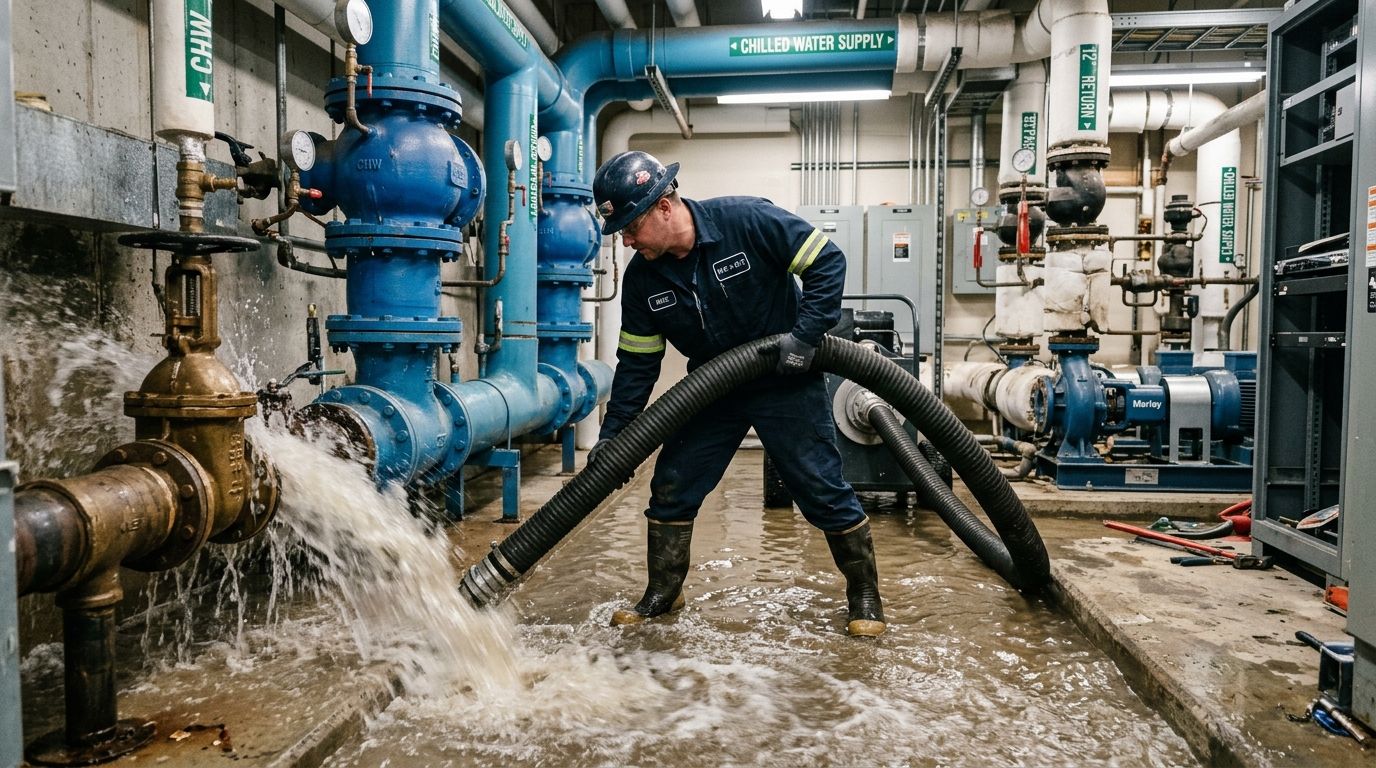

Specialized Equipment & Industrial Restoration Technology
Mitigating severe property damage requires industrial-grade technology capable of altering thermodynamic psychrometrics:
Truck-Mounted Extraction Rigs
31-HP engines producing 16+ inches Hg vacuum suction to evacuate bulk water rapidly into holding tanks.
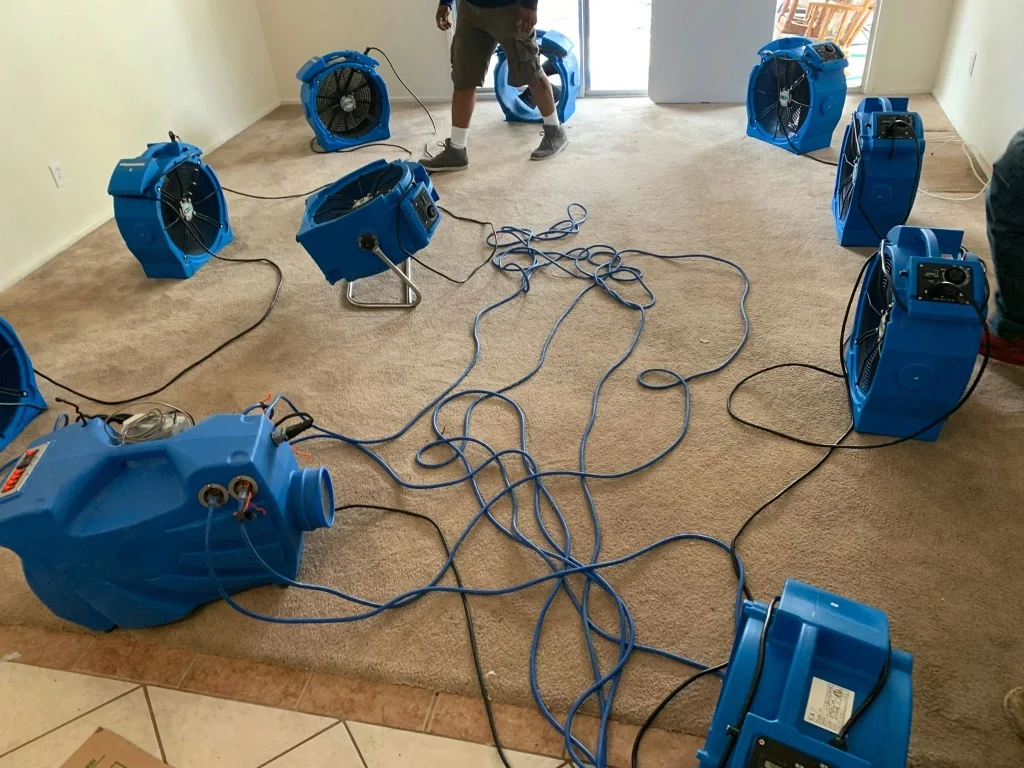
Low-Grain Refrigerant Dryers
Pre-cooling heat-pipe systems driving ambient grains per pound below 25 GPP to draw deep trapped water out of framing.
HEPA Negative-Air Scrubbers
Hospital-grade 99.97% particulate filtration capturing microscopic fungal spores, soot, and biohazard aerosols.
FLIR® Thermal Scanners & Probes
Infrared thermography detecting evaporative cooling boundaries behind walls, combined with digital RF pinless scanners.

Professional Restoration vs. DIY Mitigation
Attempting DIY cleanup during a property disaster creates severe hidden liabilities:
- Trapped Moisture: Surface drywall dries while moisture inside cavities triggers hidden mold blooms.
- Pathogenic Risks: Category 2 & 3 water contains bio-contaminants standard cleaners fail to kill.
- Insurance Denial: Insurers require daily psychrometric logs; lack of data causes claim disputes.
Transparent Upfront Itemized Pricing
Valley Restoration Pros operates with complete transparency:
- Free On-Site Assessment: Complete physical inspection before work begins.
- Upfront Itemized Estimates: Detailed line items calculated via industry-standard Xactimate.
- Zero Surprise Billing: No hidden charges or unauthorized repairs.
Certified Data center underfloor CRAH chilled water loop flood extraction Mesa Field Documentation
Every response performed by Valley Restoration Pros is documented through photographic and thermographic records:
Comprehensive Data center underfloor CRAH chilled water loop flood extraction Mesa Technical Manual & Operational Standards
Exhaustive engineering protocols, psychrometric calculations, geological multipliers, and step-by-step restoration standards for Maricopa County properties:
Executive Emergency Abstract: Mesa Elliot Road Technology Corridor Data Center Underfloor CRAH Loop Flooding
The Elliot Road Technology Corridor in East Mesa, Arizona, anchors one of the most dense hyperscale computing, enterprise colocation, and cloud infrastructure epicenters in the American Southwest. Spanning eastward from Loop 202 through Signal Butte Road, Hawes Road, Ellsworth Road, and the Eastmark technology sector, this specialized industrial zone houses dozens of multi-megawatt mission-critical campuses operating thousands of active server cabinets. To maintain precise thermal management across continuous high-density computing loads, these state-of-the-art facilities rely on Computer Room Air Handler (CRAH) networks coupled with subterranean pressurized chilled water distribution loops installed beneath raised access flooring systems.
When an underfloor hydronic supply line fractures, a mechanical victaulic coupling dislodges, or an automated control valve shears under continuous operating pressures of 65 to 95 PSI, the resulting deluge discharges thousands of gallons of 42°F to 48°F chilled water directly into the pressurized underfloor plenum. Within seconds, high-velocity water covers the concrete structural slab, submerging 415V and 480V three-phase Power Distribution Unit (PDU) conduits, grounding stanchions, and subterranean communications raceways. In mission-critical environments where computing downtime costs reach tens of thousands of dollars per minute in contractual SLA default penalties, instant deployment of specialized emergency water extraction is required to avert catastrophic power interruptions and structural system degradation.
Unlike standard commercial real estate flood losses, data center subfloor hydronic ruptures present severe aerodynamic and thermodynamic complications. The positive-pressure airflow generated by operating CRAH fans continuously forces air across standing liquid, aerosolizing water micro-droplets and driving saturated humidity directly into server cold aisles through perforated floor tiles. In the arid Sonoran Desert environment where summer outdoor temperatures surpass 115°F, the rapid introduction of unconditioned moisture creates extreme vapor pressure gradients, accelerating surface condensation across sensitive silicon processors, fiber-optic transceivers, and high-density memory arrays.
Mission-Critical Response Protocol Snapshot
Valley Restoration Pros maintains dedicated emergency response teams stationed adjacent to the Mesa Elliot Road Technology Corridor. Our technicians are cross-trained in IICRC S500 structural drying standards and ISO 14644-1 Cleanroom Class 8 contamination control protocols. Equipped with static-grounded extraction arrays, explosion-proof submersible pumping units, and high-volume mobile desiccant dehumidification trailers, we stabilize flooded sub-plenums without requiring live server whitespaces to power down, protecting mission-critical computing infrastructure and operational continuity around the clock.
Anatomy of Underfloor CRAH Chilled Water Loop Failures & Subfloor Plenum Hydrodynamics
Modern enterprise data centers utilize closed-loop hydronic cooling systems designed to continuously circulate chilled water between exterior central cooling plants—chillers, evaporative cooling towers, and plate heat exchangers—and interior Computer Room Air Handlers. Underfloor distribution headers, typically constructed from 4-inch to 12-inch schedule 40 carbon steel or copper piping, run through the 24-inch to 36-inch cavity created by raised access floor systems. These supply and return headers route chilled water at velocities between 5 and 10 feet per second to individual CRAH fan coils positioned throughout the whitespace perimeter.
Mechanical failure along these subterranean hydronic loops typically stems from four distinct engineering vulnerabilities. First, hydraulic shock—commonly known as water hammer—occurs when fast-acting motorized modulating valves or emergency isolation actuators snap shut during chiller staging or sudden electrical fluctuations. The resulting pressure surge can exceed twice the steady-state operating pressure, shearing grooved mechanical victaulic couplings or fracturing cast iron valve housings. Second, severe thermal expansion cycling between cold supply water (42°F) and warm standby conditions induces mechanical fatigue along welded joints and flexible stainless steel braided connectors. Third, galvanic corrosion occurs when dielectric insulators degrade at junctions between dissimilar metals, such as carbon steel headers and copper CRAH coil connection pipes. Fourth, elastomer gasket hardening within mechanical couplings over extended operational lifespans leads to catastrophic seal blowouts when unexpected hydronic pressure spikes occur. When these failures strike, immediate structural containment and burst pipe repair protocols must be initiated instantaneously.
Once released, the physical behavior of water within a raised floor plenum differs radically from standard commercial real estate flooring. The underfloor space functions as a pressurized distribution duct, maintaining positive static pressures between 0.05 and 0.12 inches of water column (in. w.g.) to drive cooling airflow upward through perforated floor tiles into server cold aisles. High-velocity air currents sweeping across standing chilled water generate surface shear, creating an aerosol mist that suspends fine water droplets within the supply airstream. Concurrently, pooling water encounters vertical pedestal stanchions, seismic cross-bracing stringers, electrical grounding grids, and dense bundles of subterranean low-voltage cabling, which act as micro-dams, creating localized hydro-pooling and capillary wicking along structural supports.
| Failure Vector | Underlying Mechanism | Hydronic Pressure Range | Plenum Impact Severity |
|---|---|---|---|
| Hydraulic Water Hammer | Rapid valve actuation producing kinetic shockwave surges | 140 - 220 PSI Transient Spike | Critical: Immediate Coupling Fracture |
| Victaulic Gasket Degradation | EPDM elastomer embrittlement from chemical water treatment | 65 - 95 PSI Steady State | Severe: High-Volume Continuous Leakage |
| Galvanic Joint Erosion | Electrochemical potential differential between steel & copper | 70 - 85 PSI Operating Loop | Severe: Localized Thread & Flange Failure |
| Thermal Expansion Fatigue | Cyclic stress concentration along rigid anchor stanchions | 65 - 90 PSI Continuous | Critical: Catastrophic Weld Seam Rupture |
East Mesa Geological & Climatic Environmental Multipliers: Severe Data Center Risk Factors
Data centers operating in the Mesa Elliot Road Technology Corridor face harsh regional geological and climatic conditions that intensify mechanical piping vulnerabilities and complicate structural restoration. The sub-surface geology of East Mesa features extensive layers of expansive clay interlaced with dense calcium carbonate caliche beds. Caliche deposits form rigid, impenetrable rock-like formations that resist uniform moisture absorption. When seasonal storm runoff, irrigation pooling, or underground utility shifts introduce moisture, surrounding expansive clays swell with upward pressures exceeding 8,000 pounds per square foot, followed by deep contraction during extended arid droughts.
This ongoing soil heave and micro-subsidence transmits continuous mechanical shear stress through commercial concrete foundations. For massive hyperscale data centers spanning hundreds of thousands of square feet, even fractional millimeter foundation shifts exert immense torque on rigid carbon steel hydronic pipe penetrations that anchor directly into the structural slab. Over months of thermal cycling, these stresses weaken flanged fittings and victaulic connections, turning minor vibrations into sudden structural line ruptures that resemble subterranean slab leak water damage restoration in Mesa scenarios.
The chemical profile of East Mesa municipal water represents an equally critical risk multiplier. Sourced from the Salt River and Verde River watersheds alongside deep municipal wells, Mesa tap water exhibits extreme mineral hardness averaging 18 Grains Per Gallon (GPG), equivalent to over 308 milligrams per liter of dissolved calcium carbonate, magnesium sulfate, and silica. In closed-loop CRAH chilled water networks, this water is heavily treated with chemical corrosion inhibitors, biocide dispersants, and tolyltriazole copper passivation agents.
When a pressurized rupture ejects this chemically treated, mineral-rich chilled water across a warm concrete subfloor, rapid evaporation under high-velocity airflow causes mineral salts to precipitate instantly. Unlike pure distilled water, Mesa hydronic water deposits a highly conductive crystalline residue across concrete slabs, stanchion bases, and submerged electrical conduit runs. If these conductive mineral residues bridge adjacent electrical contact pins or deposit onto circuit boards, they cause catastrophic electrolytic dendritic migration and permanent printed circuit board short circuits. Furthermore, with ambient summer temperatures regularly hovering at 115°F during July and August, outdoor vapor pressure reaches extreme levels, creating massive moisture drive that forces ambient humidity through every unsealed building envelope penetration.
Critical Power Infrastructure Risks: 480V PDU Whips, Subfloor Busways & Arc-Flash Hazards
The subfloor plenum of an enterprise data hall houses the electrical lifeblood of the entire computing facility. Directly beneath the removable access tiles lies a labyrinth of high-amperage electrical distribution systems, including 415V and 480V three-phase Power Distribution Units (PDUs), Remote Power Panels (RPPs), Static Transfer Switches (STS), Liquidtight Flexible Metal Conduit (LFMC) power whips, and open-trench busway drop boxes. These systems channel hundreds of thousands of volt-amperes of raw power directly into the base of each computing rack.
When pressurized chilled water floods this plenum, the threat of catastrophic electrical compromise is instantaneous. Although liquid-tight flexible metal conduit and industrial junction boxes are engineered to resist incidental moisture exposure, continuous submersion under several inches of standing water inevitably breaches standard conduit fittings, compression couplings, and pull-box gaskets. The ingress of conductive water contaminated with dissolved concrete salts and chemical hydronic additives severely compromises dielectric insulation resistance across phase conductors, neutral buses, and equipment grounding conductors.
Under these conditions, the potential for high-energy arc-flash explosions becomes extreme. In accordance with NFPA 70E safety mandates, an electrical flashover inside an energized 480V subfloor distribution box can release explosive plasma blasts with instantaneous temperatures exceeding 35,000°F. Such catastrophic failures instantly incinerate electrical wiring, trigger building-wide emergency power off (EPO) interlocks, and release toxic copper vapor and carbonaceous smoke into the pressurized plenum airstream. This smoke is then pulled upward into operational server cabinets, destroying millions of dollars in compute infrastructure. Similar critical vulnerabilities occur in telecommunications infrastructure, requiring protocols analogous to specialized subterranean fiber optic vault water extraction to protect high-density fiber backbones.
| Electrical Component | Operating Voltage / Capacity | Primary Water Threat | Arc-Flash Risk Rating |
|---|---|---|---|
| 480V 3-Phase PDU Whips | 480V / 30A - 60A Drops | Conduit fitting water entry, dielectric breakdown | Hazard Category 4 (Extreme) |
| Overhead / Underfloor Busways | 415V / 250A - 800A Bus Runs | Aerosol droplet condensation on copper bus bars | Hazard Category 4 (Extreme) |
| Subfloor Grounding Halo Grid | Low-Impedance Reference Grid | Galvanic copper-to-steel corrosion, impedance rise | Moderate: Ground Loop Voltage Spikes |
| Static Transfer Switches (STS) | Dual 480V Feeds (Source A & B) | Cross-phase short circuits during automatic transfer | Hazard Category 4 (Extreme) |
ASHRAE TC 9.9 Thermal Envelope Violations & Whitespace Condensation Dynamics
Mission-critical data center thermal operations are governed globally by the ASHRAE Technical Committee 9.9 (TC 9.9) Thermal Standards for Data Processing Environments. For enterprise IT equipment (Class A1 to A4), ASHRAE defines strict environmental envelopes to prevent thermal stress and moisture-induced hardware failures. The recommended operational envelope mandates dry-bulb temperatures between 18°F and 27°C (64.4°F to 80.6°F), an absolute maximum dew point of 15°C (59°F), and relative humidity maintained between 50% and 60%.
When an underfloor CRAH chilled water loop fractures, these environmental parameters collapse instantaneously. The pooling of cold water across the warm concrete subfloor, combined with high-velocity airflow from adjacent operational CRAH units, causes subfloor plenum relative humidity to skyrocket to 100% saturation. Because the subfloor operates under positive static pressure, this saturated, moisture-laden air is forced upward through perforated floor tiles directly into the server cold aisles.
As server intake fans draw this humid air across chilled internal hardware components, the psychrometric dew point is breached. When the dew point of the supply airstream exceeds the surface temperature of electronic components—particularly solid-state drive heatsinks, memory DIMMs, network interface cards, and optical transceivers (such as SFP28 and QSFP-DD modules)—microscopic liquid water condenses directly onto energized circuit assemblies. This microscopic moisture layer dissolves atmospheric ionic contaminants and flux residues, creating conductive electrolyte pathways that trigger dendritic copper migration, leakage currents, and permanent component short circuits.
Simultaneously, excessive relative humidity accelerates the growth of conductive tin and zinc whiskers from galvanized subfloor pedestal stanchions, access floor panel undersides, and structural steel brackets. These microscopic conductive filaments, once detached by CRAH airflow, circulate into server chassis, bridging circuit traces and causing intermittent processor crashes that mimic software bugs. Containing these catastrophic atmospheric shifts requires the specialized decontamination methodology established in data center server room water damage restoration protocols.
Immediate Emergency First-Hour Response Protocol & Whitespace Isolation
The initial sixty minutes following an underfloor hydronic line burst in an enterprise data hall dictate whether the incident results in a localized mechanical repair or a catastrophic, multi-million-dollar computing outage. Valley Restoration Pros implements a rigorous, five-stage emergency containment protocol engineered specifically for live mission-critical computing environments:
- Stage 1: Emergency Operations Center (EOC) Triage & Incident Verification: Direct communication is established between facility engineering directors, network operations center (NOC) shift managers, and our commercial disaster response commanders. Real-time telemetry from Building Management Systems (BMS) and underfloor conductive liquid detection cables is analyzed to pinpoint the precise hydronic rupture zone.
- Stage 2: Hydronic Loop Isolation & Pressure Neutralization: In coordination with on-site mechanical engineers, automated motorized butterfly valves are actuated to isolate the compromised CRAH supply and return headers. If automated isolation fails, our technicians execute emergency manual Lockout/Tagout (LOTO) protocols on quadrant gate valves, neutralizing loop pressure while secondary chilled loops maintain thermal cooling across unaffected data hall sectors.
- Stage 3: Clean Agent Fire Suppression Interlock Management: Technicians coordinate with facility life-safety personnel to inspect clean agent gaseous fire suppression systems (FM-200, Novec 1230, or Inergen) and double-interlock pre-action sprinkler systems. Water presence in the subfloor can trigger false optical smoke or ionization detector signals; our team manages cross-zoned detector interlocks to prevent accidental chemical gas discharges while preserving active life-safety protection.
- Stage 4: Antistatic Cleanroom Perimeter Containment: Rapid deployment of flame-retardant, static-dissipative polyethylene barrier walls (conforming to NFPA 701 and ASTM E84) isolates the flooded whitespace quadrant from adjacent operational server aisles. This physical containment prevents aerosolized moisture and particulate matter from migrating into sensitive computing clusters, adhering to enterprise commercial water damage restoration standards.
- Stage 5: Live Whitespace ESD Personnel Grounding Protocol: Prior to entering the energized server whitespace, all restoration technicians don conductive ESD footwear, wrist-strap grounding tethers connected to the facility halo ground bus, lint-free Class 100 Tyvek cleanroom suits, and nitrile gloves. Non-sparking, insulated tools rated to 1,000V (ASTM F1505) are inspected and staged at the containment airlock.
Critical Safety Warning: Energized Subfloor Electrocution Hazard
Never permit non-certified personnel to walk across submerged raised floor access tiles or insert metallic tools beneath the floor grid. Standing water in contact with damaged 480V PDU conduits creates lethal step-potential and touch-potential electrical hazards. All initial inspections must be conducted using calibrated non-contact AC voltage detectors and thermal imaging cameras operated by certified commercial restoration technicians.
Specialized ESD-Safe Industrial Equipment Architecture & Cleanroom Setup
Standard commercial water restoration equipment—such as rotomolded plastic air movers, unshielded shop vacuums, and portable refrigerant dehumidifiers—is strictly prohibited inside enterprise data centers. Conventional equipment generates massive electrostatic charges (exceeding 12,000 volts) through turbulent airflow and motor friction, emitting carbon brush particulate that destroys sensitive microprocessors and breaches ISO 14644-1 Cleanroom Class 8 thresholds.
Valley Restoration Pros utilizes a specialized, static-dissipative equipment fleet engineered exclusively for live mission-critical computing spaces. Our liquid extraction arrays utilize explosion-proof, positive-displacement pumps mounted on vibration-damped, rubber-tired utility trailers stationed outside the computing whitespace. High-volume, crush-proof antistatic suction hoses featuring continuous internal braided copper grounding wires connect to specialized extraction wands. Each wand is bonded directly to the facility computer room signal reference grid (SRG) via heavy-duty copper alligator clamps, ensuring that fluid velocity does not generate static electrical potentials.
To manage subfloor airflow without disturbing overhead laminar cooling patterns, we deploy static-dissipative axial air movers constructed with conductive polypropylene housings and sealed, brushless induction motors. These units generate zero electrical arcing and maintain surface resistivity measurements between 10^6 and 10^9 ohms per square, safely channeling static electricity to ground. Concurrently, negative-air HEPA scrubbers fitted with DOP-tested 99.97% 0.3-micron filtration media capture any pulverized concrete dust or airborne particles dislodged during underfloor access tile handling, matching the stringent requirements enforced during aerospace avionics cleanroom water decontamination operations in East Mesa.
| Equipment Type | Engineering Specifications | ESD Grounding Mechanism | Operational Function |
|---|---|---|---|
| Static-Grounded Extraction Wand | Conductive carbon polymer head, 2" grounded hose | Braided copper wire clamped to halo ground | High-speed bulk chilled water removal from concrete slab |
| Static-Dissipative Axial Fan | Conductive composite body, sealed brushless motor | Internal 3-prong industrial grounding circuit | Directing dry air across concrete slab & pedestal bases |
| DOP-Tested HEPA Air Scrubber | 99.97% at 0.3 microns, stainless steel housing | Bonded chassis ground to facility earth reference | Continuous particulate scrubbing to preserve ISO Class 8 |
| External Pumping Trailer | Positive displacement, 180 GPM continuous flow | Isolated earth ground rod driven at loading dock | Remote fluid transport without electrical noise in hall |
Trailer-Mounted Industrial Desiccant Dehumidification & Dry Air Injection
Dehumidifying a flooded mission-critical data center raised floor plenum presents extraordinary thermodynamic hurdles that render traditional Low Grain Refrigerant (LGR) dehumidifiers completely ineffective. LGR units rely on condensation coils that experience dramatic efficiency drops when ambient temperatures fall below 65°F or when relative humidity falls below 35%. Because enterprise server halls operate under controlled cooling envelopes (64°F to 72°F), refrigerant dehumidifiers quickly freeze up or fail to lower moisture levels below critical condensation thresholds.
To achieve rapid, deep psychrometric drying, Valley Restoration Pros deploys mobile industrial desiccant dehumidification trailers rated from 5,000 to 15,000 Cubic Feet per Minute (CFM). These massive drying systems utilize continuous honeycomb silica gel rotor wheels that adsorb water vapor directly from the airstream via chemical sorption, functioning independently of ambient air temperature and capable of producing supply air with dew points below -10°F and moisture ratios under 15 grains per pound (GPP).
Our desiccant trailers are powered by dedicated, exterior trailer-mounted 480V three-phase diesel generators parked outside the facility loading dock. This design ensures that our drying operations draw zero electrical power from facility uninterruptible power supply (UPS) batteries or backup generator buses. The desiccant reactivation air stream—which heats the silica gel wheel to purge collected moisture—is ducted completely outside the building envelope, expelling thousands of pounds of vapor directly into the dry Mesa desert atmosphere.
Processed, ultra-dry air is injected into the flooded subfloor plenum using pressurized 20-inch antistatic flexible ducting connected to custom plenum transition plates. By pressurizing the subfloor with air at less than 15 GPP, we create a massive vapor pressure differential between the saturated concrete sub-slab and the dry airflow. This drives deep moisture out of the concrete pores, electrical conduit raceways, and pedestal bases via accelerated vapor diffusion, accomplishing total structural drying within a fraction of the time required by conventional systems.
| Psychrometric Metric | Conventional LGR Dehumidifier | Trailer-Mounted Desiccant (Silica Rotor) | Data Center Whitespace Requirement |
|---|---|---|---|
| Minimum Operating Dew Point | 33°F to 40°F (Stalls in cold air) | -10°F to -40°F (Deep sorption) | Mandatory < 25°F to halt motherboard condensation |
| Minimum Grains Per Pound (GPP) | 35 - 45 GPP Minimum Limit | 8 - 15 GPP Ultra-Dry Output | Target < 25 GPP across subfloor airflow plenum |
| Internal Thermal Heat Load | Dumps hot condenser heat into room | Reactivation heat ducted outdoors | Zero added thermal load permitted on server racks |
| Facility Power Consumption | Draws 12A per unit on room circuits | 100% self-powered by exterior generator | Zero power draw from facility UPS or PDU infrastructure |
IICRC S500 / S520 Specialized Cleanroom Decontamination & Subfloor Sanitation
Under the IICRC S500 Standard and Reference Procedures for Professional Water Damage Restoration, water from a closed-loop hydronic cooling system must be classified as Category 2 (Significant Chemical / Microbial Contamination) upon release. Hydronic chilled water loops are chemically treated with corrosion inhibitors, biocides, ethylene or propylene glycol anti-freeze blends, and scale dispersants. Furthermore, once this fluid contacts the concrete sub-slab, it dissolves accumulated efflorescence salts and microscopic construction dust, rapidly escalating toward Category 3 bio-chemical hazard levels if left unmitigated.
Decontaminating an enterprise data hall subfloor requires surgical execution to prevent particulate cross-contamination. Our certified technicians employ dual-cup vacuum suction lifters to remove raised floor access tiles in an alternating checkerboard pattern. This technique maintains lateral structural rigidity across the pedestal stringer grid while providing direct physical access to the flooded concrete slab beneath. Removed access tiles are inspected, wiped down with antistatic microfiber cloths, and staged in vertical, padded storage carts within the containment barrier.
Once bulk water extraction is complete, concrete sub-slabs and galvanized steel pedestal bases undergo precision sanitization. Technicians apply an EPA-registered, hospital-grade, non-conductive, non-corrosive botanical antimicrobial formulation specifically approved for sensitive telecommunications environments. This agent neutralizes microbial spores and chemical residues without emitting volatile organic compounds (VOCs) or leaving conductive films on electrical grounding connections. Similar specialized chemical neutralization procedures are applied during CRAAC glycol loop flood cleanup operations across East Valley computing facilities.
Following antimicrobial application, the structural slab is micro-vacuumed using four-stage ULPA-filtered cleanroom vacuum systems certified to retain 99.999% of particulate down to 0.12 microns. This critical step captures dried calcium carbonate scale, pulverized concrete dust, and microscopic debris, ensuring that once CRAH air handlers return to full operating static pressures, no abrasive or conductive particles are swept into server rack intake grilles.
Advanced Psychrometric Monitoring, FLIR Radiometry & Structural Concrete Logging
Validating complete structural dry-out within a high-density data center demands sophisticated diagnostic instrumentation far beyond standard handheld moisture meters. Valley Restoration Pros deploys continuous digital psychrometric telemetry arrays alongside high-definition FLIR T1020 thermal imaging cameras. Operating with a thermal sensitivity of <0.03°C and 1024 x 768 native infrared sensor resolution, our thermographers map sub-surface evaporative cooling signatures, identifying concealed moisture trapped beneath heavy server cabinets, within electrical conduit elbows, and deep inside concrete slab expansion joints.
Concrete sub-slab moisture is measured using non-destructive radio frequency (RF) surface impedance meters combined with in-situ relative humidity probes installed in accordance with ASTM F2170 standards. In-situ probe sleeves installed in non-critical slab sectors measure internal slab equilibrium relative humidity (ERH) and moisture vapor emission rates (MVER). This ensures that concrete slabs do not retain latent moisture that could gradually migrate upward into the conditioned whitespace over subsequent weeks of operation, adhering to standards established in our Elliot Tech Corridor raised floor water extraction procedures.
Throughout the restoration cycle, our lead restoration engineers log psychrometric readings every two hours across multiple monitoring stations: exterior ambient air, server whitespace cold aisles, server hot aisles, and subfloor plenum discharge zones. Measurements tracked include dry-bulb temperature, wet-bulb temperature, relative humidity, dew point, vapor pressure (in inches of mercury, in. Hg), and humidity ratio (grains per pound, GPP). Stabilization is certified only when plenum air maintains <30 GPP and concrete slab ERH drops below 75% for 24 consecutive hours under active CRAH operating conditions.
| Restoration Milestone | Plenum Relative Humidity | Plenum Dew Point | Humidity Ratio (GPP) | Concrete Slab Status |
|---|---|---|---|---|
| T+0 Hours: Initial Rupture | 98% - 100% RH | 68°F - 72°F | 110 - 125 GPP | Standing liquid (1.5" - 3.0") |
| T+4 Hours: Extraction Complete | 78% - 85% RH | 58°F - 62°F | 75 - 85 GPP | Surface water cleared; capillary saturation |
| T+18 Hours: Desiccant Purge | 40% - 48% RH | 42°F - 46°F | 38 - 45 GPP | Slab ERH 84%; rapid vapor release |
| T+36 Hours: Full Dry Standard | 22% - 28% RH | 24°F - 28°F | 18 - 24 GPP | Slab ERH < 72%; complete baseline achieved |
Commercial Insurance Documentation, Transparent Billing & Financial Protocol
Enterprise data center water damage claims represent high-stakes commercial property and business interruption insurance losses. When hydronic lines burst, corporate risk managers and facility operations directors require total financial transparency and bulletproof documentation to ensure rapid claim adjustment and seamless settlement with major commercial insurance underwriters.
Valley Restoration Pros operates under strict Pay-Per-Call (PPC) and commercial compliance standards. We provide a Free Comprehensive On-Site Damage Assessment for commercial facility operators in the Mesa Elliot Road Technology Corridor. Before physical mitigation begins, our senior project managers provide Transparent Upfront Itemized Pricing Before Work Begins, utilizing standardized commercial Xactimate pricing matrices and industrial rate sheets. We explicitly state our policy: we do not make false direct billing promises or claim that insurance will cover 100% of costs without client responsibility. Commercial clients retain ultimate financial ownership of their service agreements and deductibles while we work directly alongside their designated insurance adjusters.
To expedite carrier claim approval, our forensic administration department delivers Assistance with Detailed Claims Documentation & Psychrometric Moisture Logs. Every project file includes high-resolution FLIR radiometric thermal images, ASTM F2170 in-situ slab relative humidity test logs, IICRC-compliant psychrometric drying curves, equipment runtime verification records, and ISO 14644-1 airborne particulate count certificates. For preliminary planning and project scoping, facility managers can utilize our interactive instant commercial cost estimator to model equipment and extraction parameters.
Commercial Insurance Claim Forensic Package
Our comprehensive documentation binder provides commercial insurance adjusters with incontrovertible technical evidence: timestamped high-definition thermal imaging thermograms, psychrometric chamber logs, continuous subfloor GPP tracking charts, equipment runtime hour meters, and third-party particulate certifications. This rigorous documentation ensures seamless coordination with major commercial carriers, including FM Global, Travelers, Chubb, and Zurich Commercial.
Hyper-Local Case Study: Chilled Water CRAH Header Rupture in East Mesa Hyperscale Data Hall
The Incident & Immediate Mobilization
At 03:18 AM on July 24 during a severe Sonoran Desert heatwave with daytime temperatures exceeding 114°F, an automated alarm lit up the Network Operations Center of a 125,000 square foot Tier III colocation data facility located near the intersection of Signal Butte Road and Elliot Road in East Mesa. A 6-inch mechanical victaulic coupling along the primary chilled water supply header of CRAH Loop 3 experienced an instantaneous gasket blowout under 85 PSI operating pressure. Within minutes, an estimated 12,500 gallons of 44°F chemically treated water discharged directly into the 28-inch raised access floor plenum beneath Data Hall 2, which supported 850 fully populated, active server cabinets delivering enterprise financial cloud transactions.
By 03:22 AM, the facility management team initiated an emergency dispatch call to Valley Restoration Pros. Our dedicated East Mesa rapid-response commercial disaster team arrived on site at 03:40 AM—exactly 22 minutes post-dispatch. Our mobile command unit staged at the facility loading dock, accompanied by two 9,000 CFM trailer-mounted desiccant dehumidification systems, self-contained 480V three-phase diesel generators, and our specialized static-grounded extraction array, drawing on techniques proven in large-scale commercial chiller pipe flood restoration projects.
Containment, Dewatering & Whitespace Preservation
Upon entry, lead technicians verified that facility engineers had successfully isolated the Loop 3 motorized quadrant butterfly valves, stopping the active deluge. Water depth across the concrete sub-slab measured 2.8 inches, directly submerging 480V PDU drops, flexible conduits, and copper grounding ribbons. Ambient relative humidity in Data Hall 2 had spiked from a baseline of 48% to 99%, with plenum air reaching an alarming 114 grains per pound (GPP)—approaching immediate dew point condensation on cold server chassis.
Working in complete synchronicity with the facility electrical team, our certified crew deployed three static-grounded positive-displacement extraction wands, bonding each wand to the facility signal reference grid. By 07:30 AM (Hour 4), all bulk standing liquid—over 12,100 gallons—had been evacuated from the 35,000 square foot affected plenum into external holding tanks without a single electrical arc-flash or server cabinet trip.
Desiccant Drying & Psychrometric Recovery Results
Immediately following bulk water extraction, technicians connected our external 9,000 CFM desiccant dehumidifier to the plenum via 20-inch antistatic ducting. Delivering ultra-dry process air at 12 GPP and a -15°F dew point, the system rapidly established a powerful vapor pressure differential across the concrete slab. Forty-five static-dissipative axial air movers were strategically placed beneath raised floor access tiles in alternating rows to circulate dry air across pedestal bases and cable trays.
- Hour 4: Bulk water eliminated; plenum humidity reduced from 99% to 82% RH (78 GPP).
- Hour 18: Concrete slab moisture impedance dropped from 94% WME to 62% WME; plenum air stabilized at 45% RH (41 GPP).
- Hour 36: Full dry standard certified: plenum air at 24% RH (19 GPP), concrete in-situ ERH verified at 71% per ASTM F2170, and zero particle contamination confirmed via ISO Class 8 laser particle counting.
Throughout the entire 36-hour emergency intervention, Data Hall 2 remained fully energized. The facility maintained 100% computing uptime with zero server cabinet outages, saving the corporate operator an estimated $4.2 million in SLA penalties and hardware replacement expenditures.
Comprehensive Post-Restoration Re-Commissioning & ISO Cleanroom Certification Protocol
Decommissioning drying equipment and removing containment barriers from an enterprise data hall whitespace requires formal multi-disciplinary verification. Before the raised floor grid is reassembled and permanent operational control is returned to the facility engineering team, Valley Restoration Pros executes a rigorous four-part re-commissioning protocol:
- 1. ISO 14644-1 Airborne Particle Count Certification: Certified technicians utilize calibrated discrete particle counters (DPCs) to sample airborne particulates across multiple grid coordinates in cold aisles, hot aisles, and subfloor plenum channels. Whitespace air quality must verify at or below ISO Class 8 cleanroom thresholds—permitting no more than 3,520,000 particles >=0.5 microns and 29,300 particles >=5.0 microns per cubic meter—matching the standards required in semiconductor cleanroom water damage restoration operations.
- 2. Megohmmeter (Megger) Dielectric Insulation Resistance Testing: Certified commercial electrical partners perform 1,000V DC megohmmeter insulation resistance tests across all 480V PDU whips, busway plug-in units, and underfloor junction splices that were submerged during the flood. Dielectric readings must exceed 100 megohms to guarantee complete insulation integrity and eliminate arc-flash hazards before full electrical re-energization.
- 3. Raised Floor Structural Pedestal & Stringer Torque Audit: Technicians inspect every galvanized steel pedestal base, locking collar, and seismic stringer for signs of chemical corrosion or structural displacement. Leveling nuts are torqued to manufacturer specifications, and electrical ground bonding clips connecting pedestals to the signal reference grid are verified with milliohmmeter testing (<0.1 ohm resistance to ground).
- 4. CRAH Static Airflow & Differential Pressure Recalibration: Once all perforated floor tiles are reset with suction lifters, airflow engineers measure static air pressure across all cold aisle containment zones. Static pressure differentials must verify between 0.05 and 0.10 in. w.g., ensuring uniform cooling distribution without hot-spot starvation across server cabinets.
Preventative Engineering & Mission-Critical Disaster Preparedness for Mesa Plenums
While 24/7 emergency restoration capability is vital, enterprise data centers must integrate proactive engineering defenses to minimize the frequency and catastrophic impact of underfloor hydronic piping ruptures. Facilities operating throughout the Mesa Elliot Road Technology Corridor should incorporate five key resilience strategies into their ongoing infrastructure standards:
- Double-Containment Hydronic Piping Systems: Transitioning subfloor chilled water distribution lines to dual-contained piping systems—featuring a secondary outer containment pipe surrounding the primary carbon steel carrier pipe—provides an impenetrable physical barrier against catastrophic spray. The interstitial space is continuously monitored by vacuum sensors to detect microscopic leaks before fluid enters the plenum.
- Addressable Conductive Liquid Sensing Rope Networks: Installing continuous conductive polymer sensing cables beneath all chilled water piping headers, CRAH connection valves, and condensation drain lines provides immediate millimeter-level leak localization. These sensors interface directly with Data Center Infrastructure Management (DCIM) and Building Automation Systems (BAS), triggering automated alarms within seconds of liquid contact.
- Automated Fast-Acting Motorized Shutoff Valves with Water Hammer Arrestors: Equipping all CRAH branch lines with fast-acting quarter-turn electric actuators linked to leak detection relays enables instantaneous hydronic isolation. Integrating industrial stainless steel water hammer arrestors immediately upstream of valves dampens kinetic pressure spikes, preventing coupling blowouts.
- Sub-Slab Trench Drainage & Redundant Sump Pump Stations: Engineering gentle slope gradients across the concrete sub-slab directing toward subterranean perimeter drainage trenches allows standing water to gravitate toward recessed sump basins equipped with dual, emergency-powered submersible pumps. Similar containment principles are critical when handling hazardous spills during data center battery room flood cleanup operations.
- Pre-Arranged Priority Disaster Response Agreements: Corporate facility operators should establish formal Master Services Agreements (MSAs) with specialized mission-critical restoration contractors prior to experiencing an emergency. A pre-established agreement guarantees guaranteed 30-minute response times, pre-authorized security clearance badges, and dedicated equipment staging for immediate deployment.
Exhaustive Technical FAQ: Data Center Underfloor CRAH Chilled Water Loop Recovery
Underfloor hydronic loop failures in Mesa data centers predominantly result from hydraulic water hammer, mechanical victaulic coupling gasket degradation, thermal expansion fatigue, and foundation shear stress caused by expansive caliche clay soil movement. Operating under pressures of 65 to 95 PSI, rapid valve closures or chiller staging can produce pressure spikes exceeding 200 PSI, shearing couplings or fracturing cast iron valve housings.
All restoration equipment utilized in our data center response fleet is specifically engineered for live computing environments. Extraction wands feature antistatic carbon polymer construction and braided copper grounding wires clamped directly to the facility computer room signal reference grid (SRG). Technicians wear ESD-rated footwear, continuous grounding wrist straps, and lint-free Class 100 Tyvek cleanroom suits to ensure electrostatic voltages remain below 20 volts at all times.
Yes. Our mission-critical restoration protocols are designed specifically to achieve zero-downtime stabilization. By deploying negative-air cleanroom containment barriers, isolated mobile desiccant dehumidifiers powered by exterior diesel generators, and static-grounded extraction wands, we dewater and dry the subfloor plenum without interrupting live server power feeds or breaching ASHRAE TC 9.9 thermal envelopes.
Conventional refrigerant (LGR) dehumidifiers lose moisture removal capability below 65°F and cannot lower air moisture ratios below 35 GPP. In contrast, industrial trailer-mounted desiccant dehumidifiers utilize silica gel rotors that operate effectively in cool server halls, delivering process air with dew points below -10°F and humidity ratios under 15 GPP. Furthermore, desiccant trailers exhaust moisture and reactivation heat outdoors, preventing thermal load increases on operational servers.
City of Mesa municipal water contains 18 GPG (over 300 PPM) of dissolved calcium carbonate, magnesium sulfate, and silica, alongside hydronic corrosion inhibitors. When this water evaporates under high airflow, it leaves conductive crystalline salt crusts across concrete sub-slabs and electrical conduits. If aerosolized droplets settle onto circuit boards, these minerals create conductive dendritic bridges across micro-circuits, resulting in permanent electrical short circuits and PCB destruction.
Valley Restoration Pros maintains fully equipped commercial disaster response trailers and certified personnel on standby 24 hours a day, 365 days a year. For enterprise facilities located along the Mesa Elliot Road Technology Corridor, Hawes Road, and Signal Butte Road, our guaranteed on-site arrival window is under 30 minutes from emergency call dispatch across all Valley areas we serve.
We compile a complete forensic documentation package for risk management teams and commercial adjusters. This includes timestamped FLIR radiometric thermal imaging thermograms, ASTM F2170 in-situ slab relative humidity test logs, IICRC-compliant psychrometric drying curves, discrete particle count certificates confirming ISO Class 8 cleanroom compliance, and itemized Xactimate commercial estimates. To initiate an emergency assessment, contact our emergency commercial restoration team immediately.
Before containment is dismantled, we conduct ISO 14644-1 airborne laser particle counting to verify cleanroom air quality at or below Class 8 limits. Additionally, electrical partners perform 1,000V DC megohmmeter insulation resistance tests on all subfloor electrical conduits and busway drops to guarantee dielectric integrity, while airflow engineers verify static pressure differentials between 0.05 and 0.10 in. w.g. across all cold aisle containment corridors.
Verified Local Area Dispatch: Phoenix, AZ
Official Geo-Coordinates: 33.4484° N, -112.074° W • Maricopa County
Related Specialized Emergency Restoration Services
Explore specialized rapid-response mitigation protocols across Greater Phoenix and Maricopa County:
Valley-Wide Emergency Response Service Coverage
Our mobile restoration fleet is dispatched across the entire Phoenix metropolitan region, providing rapid 30 to 60 minute emergency response: