

Valley Restoration Pros delivers 24/7 industrial emergency water extraction, thermal psychrometric drying, and structural mitigation across Phoenix and Maricopa County with guaranteed 30–60 minute rapid arrival. All protocols strictly adhere to IICRC S500 standards, featuring upfront itemized pricing and free on-site thermal moisture assessments. Call dispatch directly at (602) 847-9593.
Why Immediate Mitigation Is Critical in Phoenix Heat
Pressurized commercial preaction fire sprinkler riser systems operating under 120-175 PSI discharge up to 1,500 gallons per minute of stagnant blackwater across elevated commercial floors, saturating mechanical chaseways, electrical bus ducts, and high-speed elevator shafts. Preaction dry-pipe sprinkler infrastructure contains accumulated black iron scale, microbiological induced corrosion (MIC) sludge, and heavy mineral sediment (18+ GPG), classifying initial discharges as hazardous Category 2 or Category 3 bio-chemically compromised gray and black water. Tempe summer ambient temperatures exceeding 115°F create an aggressive microbial incubation chamber within damp drywall plenums, acoustic ceilings, and demising wall cavities, triggering rampant toxic mold colonization within 24 to 48 hours. Uncontrolled vertical water migration down multi-tenant core utility penetrations and post-tensioned concrete decks threatens structural integrity, high-voltage transformer gear, and underfloor telecommunications, triggering millions in tenant business interruption.

Service Definition & The IICRC Standard of Care
Professional tempe commercial high rise preaction fire sprinkler pipe burst cleanup is an engineering and environmental discipline adhering strictly to IICRC S500 protocols, not mere surface mopping. When structural plumbing failures strike in Maricopa County, certified emergency water extraction and thermal structural drying procedures must be deployed immediately. Whether triggered by high-pressure burst pipe emergencies, subfloor leaks, or commercial line ruptures, bound moisture rapidly penetrates concrete subfloors and wall framing. In the desert heat, delays trigger microbial proliferation requiring rapid mold remediation. Request damage assessment through our emergency assessment portal or request 30-minute dispatch across all Valley service areas.
Securing electrical feeds, inspecting load-bearing assemblies, and containing pathogens.
Stopping the intrusion source and erecting 6-mil plastic isolation containment airlocks.
31-HP truck-mount extraction, removing gallons exponentially faster than evaporation.
LGR dehumidifiers and HEPA air scrubbers driving grains per pound below 25 GPP.
Calibrated electronic pinless testing confirming baseline dry standards.
The Complete 6-Stage Restoration Roadmap
Our IICRC-certified crews execute a disciplined, scientific 6-stage protocol to stabilize and dry structural components:
Emergency Dispatch & Perimeter Isolation
30 to 60 minute arrival. Securing electrical shutoffs, evaluating structural loads, and erecting containment airlocks.
FLIR® Thermal Mapping & Baseline Scans
Infrared thermal scans detect trapped moisture behind walls and beneath concrete without invasive exploratory demolition.
High-Volume Bulk Extraction
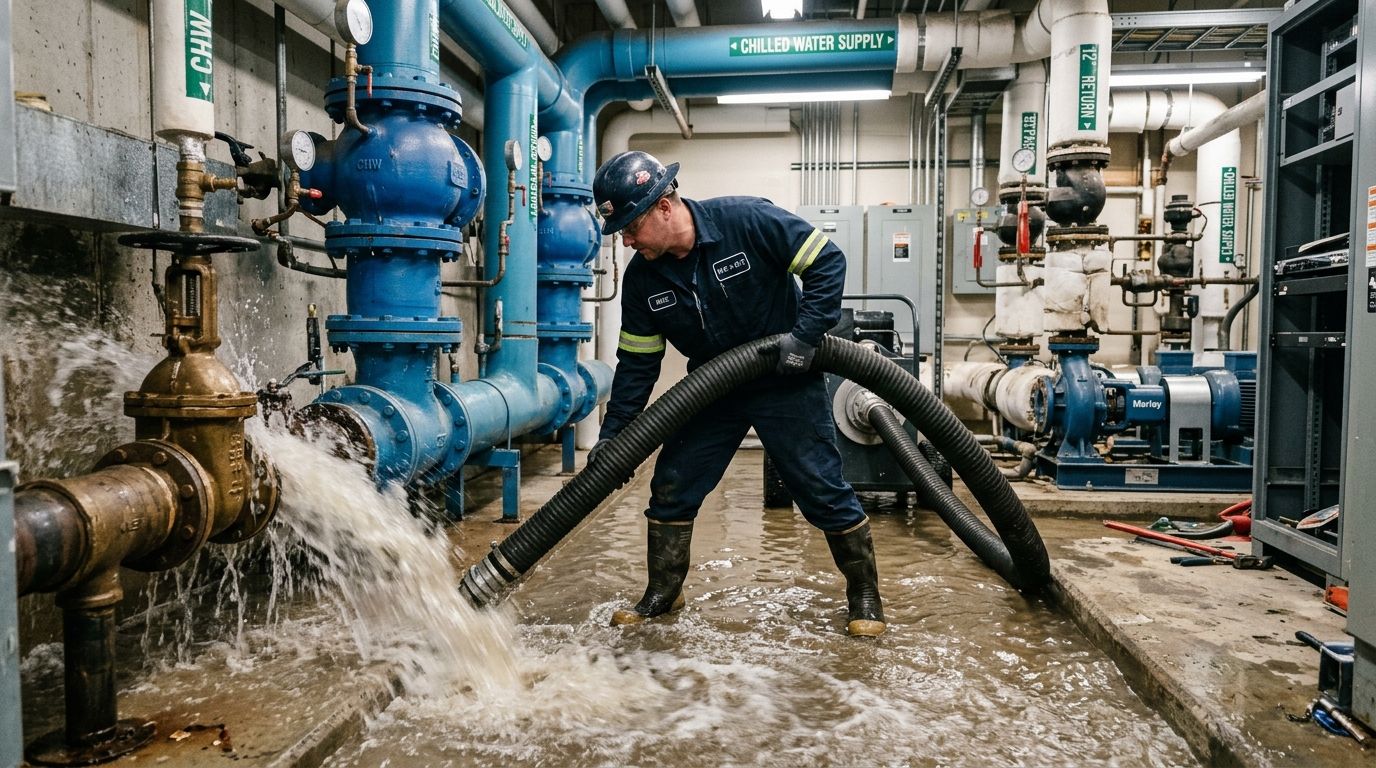
31-HP truck-mount extraction units pump standing water away at hundreds of gallons per minute.
Controlled Selective Demolition
Precision flood cuts 12 to 24 inches above moisture lines, removing wet insulation and opening wall framing to dry airflow.
Thermodynamic Dehumidification
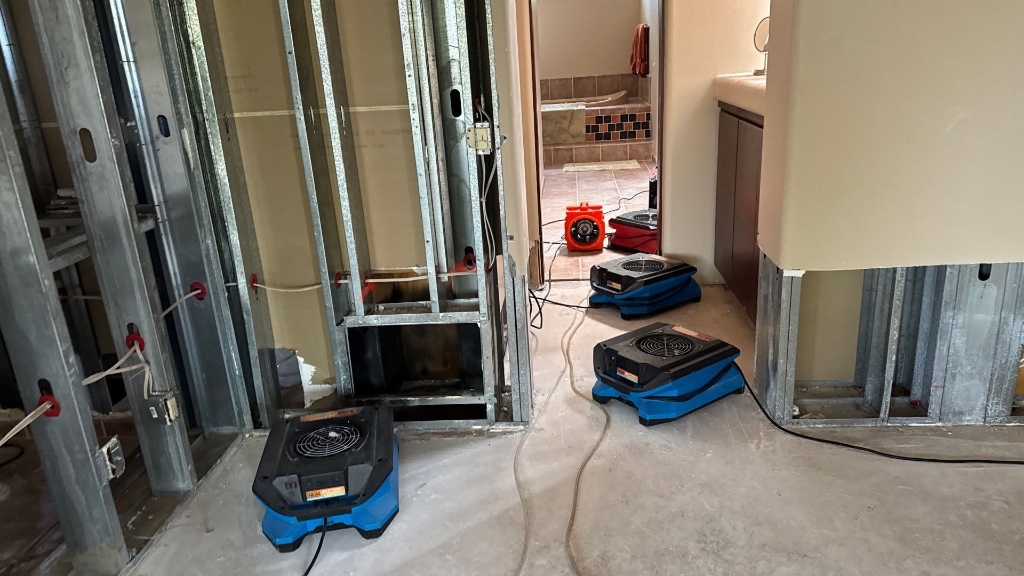
Industrial Low-Grain Refrigerant dehumidifiers pull deep trapped moisture from dense framing lumber and concrete slabs.
Antimicrobial Sanitization & Verification
EPA-registered botanical application (Benefect Decon 30) and calibrated moisture testing to issue an official dry certificate.

Specialized Equipment & Industrial Restoration Technology
Mitigating severe property damage requires industrial-grade technology capable of altering thermodynamic psychrometrics:
Truck-Mounted Extraction Rigs
31-HP engines producing 16+ inches Hg vacuum suction to evacuate bulk water rapidly into holding tanks.
Low-Grain Refrigerant Dryers
Pre-cooling heat-pipe systems driving ambient grains per pound below 25 GPP to draw deep trapped water out of framing.
HEPA Negative-Air Scrubbers
Hospital-grade 99.97% particulate filtration capturing microscopic fungal spores, soot, and biohazard aerosols.
FLIR® Thermal Scanners & Probes
Infrared thermography detecting evaporative cooling boundaries behind walls, combined with digital RF pinless scanners.
Professional Restoration vs. DIY Mitigation
Attempting DIY cleanup during a property disaster creates severe hidden liabilities:
- Trapped Moisture: Surface drywall dries while moisture inside cavities triggers hidden mold blooms.
- Pathogenic Risks: Category 2 & 3 water contains bio-contaminants standard cleaners fail to kill.
- Insurance Denial: Insurers require daily psychrometric logs; lack of data causes claim disputes.
Transparent Upfront Itemized Pricing
Valley Restoration Pros operates with complete transparency:
- Free On-Site Assessment: Complete physical inspection before work begins.
- Upfront Itemized Estimates: Detailed line items calculated via industry-standard Xactimate.
- Zero Surprise Billing: No hidden charges or unauthorized repairs.
Certified tempe commercial high rise preaction fire sprinkler pipe burst cleanup Field Documentation
Every response performed by Valley Restoration Pros is documented through photographic and thermographic records:

Comprehensive tempe commercial high rise preaction fire sprinkler pipe burst cleanup Technical Manual & Operational Standards
Exhaustive engineering protocols, psychrometric calculations, geological multipliers, and step-by-step restoration standards for Maricopa County properties:
Executive Emergency Abstract: Tempe Commercial High-Rise Preaction Fire Sprinkler Pipe Burst Disaster Mitigation
The skyline of Downtown Tempe, defined by prestigious Class A commercial office towers, corporate technology headquarters, high-density financial institutions, and multi-tenant biomedical suites along Mill Avenue, Rio Salado Parkway, and the Novus Innovation Corridor, represents millions of square feet of concentrated corporate infrastructure. These multi-story commercial structures rely on complex life-safety infrastructure engineered to suppress fires while mitigating the catastrophic liability of accidental water discharge in sensitive environments such as corporate enterprise data centers, executive server rooms, and telecommunications demarc facilities. At the heart of this life-safety defense are double-interlock and single-interlock preaction fire sprinkler systems. Unlike standard wet-pipe systems that maintain pressurized water continuously at the sprinkler head, preaction systems keep overhead distribution piping dry, charged with supervisory compressed air or nitrogen, until an electronic smoke or thermal detection network activates a deluge preaction valve, releasing pressurized suppression water into the overhead piping grid.
Despite these multi-stage fail-safes, catastrophic structural pipe bursts and accidental preaction discharges occur with devastating velocity. When an overhead schedule 10 or schedule 40 steel branch line ruptures due to micro-fractures, mechanical joint slippage, water hammer hydraulic shock, or severe microbiological induced corrosion (MIC), or when an accidental supervisory pressure drop triggers the premature flooding of an overhead grid, the consequence is an uncontrolled deluge. Pressurized fire main risers operating at static pressures between 120 and 175 PSI discharge between 800 and 1,500 gallons per minute of black, foul-smelling water loaded with iron scale, pipe rust, and industrial sediment directly into suspended acoustic ceiling plenums, raised computer flooring systems, and executive office suites. Because multi-story commercial high-rises are vertically integrated through utility chaseways, electrical bus ducts, telecommunication conduit sleeves, and high-speed elevator hoistways, gravity forces this deluge downward floor by floor. Within less than forty-five minutes of a preaction sprinkler pipe rupture on the twelfth floor of a Mill Avenue tower, water cascades down through ten contiguous tenant floors, flooding core electrical distribution rooms, collapsing acoustic ceiling grids, and pooling tens of thousands of gallons into the subterranean elevator pits.
The resulting operational, financial, and legal liabilities are staggering. Corporate tenants face catastrophic operational downtime, server hardware loss, destroyed client case files, and productivity losses frequently exceeding $350,000 per business day. Concurrently, commercial property owners, institutional asset managers, and corporate facility directors face multi-million-dollar structural liabilities, including post-tensioned cable tendon corrosion, high-voltage busway phase-to-phase arc-flash contamination, traction elevator machine flooding, and toxic mold colonization accelerated by Arizona extreme ambient heat. Resolving a high-rise preaction sprinkler catastrophe demands an immediate, industrial-scale deployment by certified master commercial restorers. Property teams must immediately engage industrial-grade emergency water extraction assets, trailer-mounted desiccant dehumidification systems, and forensic psychrometric monitoring to halt vertical migration, dewater mechanical hoistways, and preserve structural integrity across all affected tenant suites.
Immediate Commercial High-Rise Fire Sprinkler Emergency Checklist
- Emergency Preaction Riser Isolation: Immediately access the affected floor mechanical riser room and close the Outside Screw and Yoke (OS&Y) gate valve or post indicator valve controlling the active preaction zone. Open the 2-inch main system inspector drain to relieve pressurized water head trapped within vertical distribution risers.
- Phase I Firefighters Emergency Elevator Recall: Activate Phase I elevator key switches on the primary recall floor to command all passenger and service elevator cars to return to the designated ground or dry mezzanine landing. Once parked, open elevator circuit breakers in the penthouse motor room to prevent water immersion of traveling cables, counterweight safety assemblies, and car-top electronics. For subterranean water intrusion, review our protocol for tempe water damage company.
- Electrical Busway & Subpanel De-Energization: Coordinate with building chief engineers and municipal utilities to de-energize vertical electrical busways and tenant distribution panels serving flooded vertical sectors to eliminate life-safety arc flash and electrocution hazards prior to technician entry.
- Mobilize Industrial Disaster Mitigation: Immediately contact Valley Restoration Pros via our 24/7 High-Rise Commercial Disaster Hotline: (602) 847-9593. Our emergency response units arrive on site in Downtown Tempe within 30 minutes with high-volume extraction apparatus, generator power plants, and trailer-mounted desiccant drying units.
From the initial high-volume extraction across elevated tenant suites down to forensic sub-slab moisture remediation, our certified crews execute the full spectrum of high-rise mitigation, including structural drying, server room climate stabilization, and emergency burst pipe repair protocols engineered for multi-story commercial real estate.
Anatomy of High-Rise Preaction Sprinkler Failure: Fluid Mechanics, Pipe Rupture Dynamics & Multi-Story Vertical Inundation
To understand the immense scale of water damage generated by a commercial preaction fire sprinkler pipe burst, facility managers and building engineers must examine the mechanical architecture and hydraulic dynamics governing these specialized systems. In high-rise commercial structures throughout Tempe, preaction fire suppression systems are specified in lieu of standard wet systems across mission-critical spaces—including corporate server rooms, network operations centers (NOCs), trading floors, telecommunications switch rooms, and executive archive vaults. The primary goal of a preaction system is dual-stage containment: water is withheld from the overhead piping grid until two independent physical events occur simultaneously. In a double-interlock system, the preaction valve requires both an electronic detection event (such as cross-zoned optical smoke sensors or thermal rate-of-rise detectors) and a physical drop in supervisory air or nitrogen pressure (caused by the thermal activation of a sprinkler head) before the main deluge valve unseats to charge the overhead grid with pressurized water.
However, the mechanical complexity of preaction assemblies introduces specific structural vulnerabilities that do not exist in conventional wet-pipe installations. Because preaction piping contains atmospheric air and compressed gases that fluctuate with seasonal temperatures, moisture condensation naturally accumulates at low points, pipe dips, and branch takeoffs. When compressed air is supplied without dedicated refrigerated desiccant air dryers, this internal moisture creates a hyper-oxygenated, damp environment inside thin-walled schedule 10 black steel piping. This combination catalyzes aggressive internal pitting, tubercules, and Microbiological Induced Corrosion (MIC). Acid-producing bacteria (APB) and iron-oxidizing bacteria (IOB) feast on the internal carbon steel matrix, eating microscopic pinholes and structural fissures straight through the pipe wall. Over time, internal pipe wall thickness can deteriorate by over 60%, creating fragile zones that remain undetected while holding supervisory pressure of 10 to 20 PSI.
Microbiological Induced Corrosion (MIC) Catastrophic Rupture
Stagnant internal moisture pools in horizontal dry preaction branch pipes foster colonies of sulfur-reducing and iron-related bacteria. These microbes excrete highly acidic byproducts that corrode localized pits through schedule 10 steel piping. When supervisory pressure drops or an automated system test surges water into degraded pipe branches, the structural compromise results in a violent longitudinal pipe split, unleashing hundreds of gallons per minute of corrosive, foul black effluent into tenant ceilings.
Water Hammer & Hydraulic Shock Wave Spikes
When a preaction deluge valve snaps open, incoming water slams against the column of compressed air inside empty piping. As water reaches closed pendant heads or 90-degree elbows, kinetic energy converts instantly into severe hydraulic shock waves, generating transient pressure spikes exceeding 300 to 450 PSI. These massive water hammer forces sheer mechanical grooved couplings, fracture threaded cast-iron fittings, and detach seismic pipe hangers from concrete overhead decks. For parallel mechanical catastrophes, review our procedures for commercial chiller pipe burst water damage.
Multi-Floor Vertical Hydrodynamics & Core Penetrations
High-rise structures are vertical hydro-dynamic chimneys. When thousands of gallons discharge on an elevated floor, floodwater quickly breaches drywall baseboards and flows toward building core shafts. Water plunges down unsealed electrical busway sleeves, communication riser conduits, mechanical duct penetrations, and elevator door thresholds. The gravitational cascade transfers liquid and airborne moisture downward across multiple tenant suites, pooling in subterranean mechanical basements.
Hydrostatic pressure amplification plays a decisive role in the magnitude of a high-rise sprinkler disaster. In multi-story commercial buildings, static head pressure increases at 0.433 PSI per vertical foot of elevation. In a 20-story commercial tower, fire protection standpipes and dedicated fire pump assemblies maintain line pressures of 150 to 175 PSI at the lower levels and mechanical basements to ensure that minimum operational discharge pressures (typically 50 to 65 PSI residual) are achieved at the uppermost roof monitors. When a rupture occurs on a mid-level floor (such as Floor 10 or Floor 12), the pressure driving fluid discharge is tremendous. A complete severance of a 3-inch or 4-inch sprinkler main can release over 1,200 gallons per minute, transforming executive office suites into torrential waterfalls in a matter of seconds.
The contamination profile of fire sprinkler discharge is exceptionally hazardous under IICRC S500 Standards for Professional Water Damage Restoration. Because preaction piping networks contain dormant water remnants, cutting oils, iron oxide scale, bacterial slime, and anaerobic bacterial colonies, the initial thousands of gallons discharged are classified as Category 2 (significant chemical and physical contamination) or Category 3 (grossly unsanitary blackwater). This dark, oily slurry permanently stains commercial modular carpets, saturates porous gypsum wallboard assemblies, contaminates underfloor data cabling, and deposits heavy metallic residues across computer motherboards and high-voltage power distribution gear.
Furthermore, modern high-rise office towers utilize post-tensioned concrete slab construction. Post-tensioned slabs incorporate high-strength steel tendon cables encased in plastic sheathing under tens of thousands of pounds of tension. When water pools on unsealed concrete slabs and penetrates micro-fissures or un-grouted tendon anchor pockets along slab perimeters, prolonged moisture exposure initiates crevice corrosion and hydrogen embrittlement. If comprehensive structural drying is not executed immediately to extract deeply bound slab moisture, the structural integrity of the entire high-rise floor deck can be permanently compromised.
Tempe & Sonoran Desert Climatic & Geological Multipliers: 115°F Thermal Acceleration, Hard Water Scale & Alluvial Soil Shift
Commercial structural drying in Downtown Tempe cannot be treated like high-rise restoration in temperate, humid regions. The unique environmental realities of the Sonoran Desert—characterized by extreme ambient summer temperatures exceeding 115°F, aggressive municipal water chemistry carrying 18+ Grains Per Gallon (GPG) of mineral hardness, expansive caliche soil formations, and violent monsoon convective storms—radically alter the thermodynamics of building drying and structural degradation. When a preaction fire sprinkler pipe bursts within a Downtown Tempe high-rise, these climatic multipliers accelerate physical damage and microbial growth at rates rarely observed in other commercial real estate markets.
The primary atmospheric multiplier is extreme desert heat. During Tempe long summer months, exterior ambient temperatures routinely climb to 110°F to 118°F, heating commercial building curtain walls, exterior glazing, and unconditioned mechanical chaseways to over 130°F. When an overhead sprinkler line bursts, thousands of gallons of cold supply water inundate building interiors that are actively cooled by building HVAC chillers. However, when building engineers shut down HVAC air handlers to prevent electrical short-circuits or air duct water intake, interior spaces rapidly equilibrate with ambient desert heat. In an unconditioned commercial building where saturated drywall, carpet padding, and acoustic ceiling tiles are subjected to temperatures between 90°F and 105°F with relative humidity exceeding 85%, the psychrometric environment transforms into an optimal incubation chamber for toxic mold proliferation. Fungal organisms such as Aspergillus niger, Penicillium chrysogenum, and Stachybotrys chartarum germinate and establish active hyphal colonies within 24 to 36 hours. Immediate structural containment and antimicrobial stabilization governed by our certified mold remediation protocols are essential to prevent entire office towers from requiring multi-million-dollar biohazard remediations.
Sonoran Desert Environmental Impact Matrix on High-Rise Mechanical Failures
| Climatic / Geological Factor | Physical Mechanism | Impact on Sprinkler Failure & Restoration |
|---|---|---|
| 18+ GPG Municipal Hard Water | High calcium carbonate and magnesium sulfate concentrations in Salt River and CAP municipal water supplies. | Heavy mineral scale encrusts preaction valve clappers, accelerating valve leakage and depositing corrosive salt efflorescence across structural concrete decks during dryout. |
| 115°F+ Desert Ambient Heat | Massive thermal load transfers through exterior curtain walls into saturated building cavities once HVAC systems trip. | Accelerates vapor pressure and microbial amplification. Reduces mold incubation window from standard 72 hours down to 24-36 hours, demanding immediate desiccant drying. |
| Expansive Caliche & Alluvial Soils | Dense calcium carbonate-cemented sedimentary layers that resist water drainage and swell when exposed to massive moisture. | Subterranean elevator pit flooding saturates surrounding foundation soil, inducing localized hydro-compaction, slab heaving, and perimeter foundation settlement risks. |
| Monsoon Microburst Inundation | Violent July-September convective storms dropping 2-3 inches of rain in minutes, overwhelming municipal storm infrastructure. | When sprinkler failures coincide with monsoon storms, street-level storm runoff backs up into subterranean basement vaults, creating dual-source commercial flooding. |
Water hardness is a critical factor throughout the Salt River Valley. Tempe municipal water, sourced from the Salt and Verde River watersheds augmented by the Central Arizona Project (CAP), averages 18 to 22 Grains Per Gallon of dissolved calcium carbonate, magnesium, and chloride ions. In a fire suppression system where water sits dormant in risers for months or years, these minerals precipitate out of solution, coating pipe walls, valve gaskets, and mechanical clapper seals with thick mineral scale. When a rupture occurs, this mineral-rich water discharges over sensitive building materials. As water evaporates during standard heating or ventilation, it leaves behind crystalline mineral salts that leach into porous concrete slabs, creating severe efflorescence and sub-surface spalling. Moreover, when hard water comes into contact with high-voltage electrical bus ducts and copper switchgear terminals, the conductive mineral ions facilitate catastrophic phase-to-phase short circuits, arcing, and permanent transformer destruction.
Geologically, the terrain underlying Downtown Tempe and the Rio Salado basin consists of complex alluvial sedimentary deposits interbedded with dense caliche formations. Caliche is a rock-like soil layer cemented by calcium carbonate that acts as an impermeable geological barrier. When high-rise sprinkler water cascades into subterranean elevator hoistways, underground parking basements, and sump vaults, the discharged water cannot naturally perk into the earth. It ponds continuously against foundation retaining walls and subterranean concrete footings, exerting immense hydrostatic uplift pressure. For properties experiencing deep foundation moisture or compromised sub-grade infrastructure, our specialized slab leak water damage restoration protocols deploy high-volume extraction and subterranean drying technology to neutralize foundation upheaval risks.
Immediate First-Hour Containment & High-Rise Mechanical Isolation Protocol
The first sixty minutes following a commercial high-rise preaction fire sprinkler pipe burst represent the critical operational window that dictates whether a facility suffers an isolated tenant disruption or a multi-million-dollar total building shutdown. In multi-tenant commercial towers along Mill Avenue and Rio Salado Parkway, the speed and technical precision of initial isolation actions determine the extent of vertical water migration down core shafts and elevator hoistways. Building operating engineers, security directors, and facility managers must execute a synchronized, methodical emergency response protocol before commercial extraction crews arrive on site.
Step 1: Valve Isolation & Standpipe Drainage
Locate the floor mechanical riser room on the affected level. Immediately turn the handwheel of the Outside Screw and Yoke (OS&Y) gate valve clockwise until fully seated. Confirm that the supervisory tamper switch triggers an alarm silence. Immediately open the main 2-inch riser inspector drain valve to redirect thousands of gallons of trapped riser water into building storm drains rather than allowing it to continue discharging through the ruptured overhead pipe.
Step 2: Elevator Hoistway Emergency Recall
Insert the elevator recall key into the primary lobby station and switch to Phase I Emergency Recall. This forces all passenger and service elevator cars to bypass all floor calls and travel immediately to the designated recall landing. Once doors open and confirm empty, power down elevator car switches and main disconnects in the penthouse traction machine room to protect multi-thousand-dollar electronic drives from water cascading down the hoistway.
Step 3: High-Voltage LOTO Electrical Isolation
Execute certified Lockout/Tagout (LOTO) procedures on all 480V 3-phase power distribution busways, step-down transformers, and tenant lighting/receptacle panels feeding the saturated floors. Never enter a flooded commercial office suite with standing water above carpet level until licensed electricians or building operating engineers confirm zero voltage across all sub-slab distribution tracks and wall outlets.
Step 4: Containment Berming & Core Shaft Barrier Deployment
While emergency extraction units are en route, building maintenance teams should immediately deploy weighted sandbags, absorbent boom socks, and polyurethane barriers across elevator lobby door saddles, stairwell landings, and telecommunication riser closet sills. Creating physical diversion dikes channels standing water away from sensitive electronic data rooms and elevator hoistways, directing flow toward designated wet utility chases or exterior balcony drainage points.
For specialized commercial operations facing critical equipment inundation—such as printing plants, heavy machinery shops, or subterranean industrial facilities—our crews implement custom extraction blueprints similar to our tempe commercial printing press pit water damage extraction procedures.
Additionally, if secondary plumbing fixtures, water supply lines, or commercial domestic mains fail under concurrent hydraulic shocks, facility teams can coordinate rapid stabilization through our dedicated burst pipe repair protocols.
Immediately following initial containment, notify corporate leadership and dispatch our 24/7 master commercial restoration teams. Our rapid response fleet mobilizes across Tempe with heavy-duty truck-mounted vacuum extractors, high-volume submersible pumps, and trailer-mounted desiccant dehumidifiers to initiate comprehensive structural mitigation within minutes of arrival.
Advanced Industrial Equipment Specifications: High-Capacity Desiccant Dehumidification, Extraction Arrays & Psychrometric Diagnostics
Drying a multi-story commercial high-rise inundated by thousands of gallons of preaction fire sprinkler water cannot be accomplished using conventional residential restoration equipment. Standard portable refrigerant dehumidifiers and basic rotary air movers lack the volumetric airflow, grain depression capacity, and static pressure capability required to overcome multi-floor moisture loads in a desert climate. Valley Restoration Pros deploys an elite arsenal of heavy commercial drying machinery engineered specifically for large-loss high-rise environments.
Trailer-Mounted Desiccant Dehumidifiers (5,000–15,000 CFM)
Our mobile desiccant systems utilize active silica gel rotor technology to process between 5,000 and 15,000 cubic feet per minute of air, generating ultra-low grain depression below 15 GPP (grains per pound) and relative humidity under 10%. Positioned at street level or loading docks, these trailer units deliver dry air up vertical building shafts via 20-inch reinforced lay-flat ducting across 10 to 20 stories.
Vertical Lay-Flat Ducting & Temporary Power Generation
Because high-rise floods frequently compromise building electrical subpanels, our units are powered by self-contained 150kW to 300kW mobile diesel generators. Ultra-durable, fire-retardant vertical lay-flat ducting is anchored through exterior window portals or pressurized stairwell shafts, delivering conditioned, desiccated air directly into affected tenant suites without drawing from compromised building power.
Ride-On Extraction & Submersible Pumping Units
For massive standing water, we deploy Rover and Phoenix ride-on weighted extraction units that compress commercial carpets under mechanical roller pressure while pulling deep sub-carpet water under high-cfm vacuum. In subterranean elevator shafts and basement mechanical rooms, high-head submersible trash pumps discharge up to 500 GPM directly into municipal sanitary sewers.
Industrial Equipment Engineering & Operational Capabilities
| Equipment Category | Technical Specification | Operational Mission in High-Rise Disasters |
|---|---|---|
| Desiccant Dehumidifiers | Munters / CDI 5,000–9,000 CFM, active reactivation heat, 12 GPP effluent capability. | Generates extreme vapor pressure differential to extract deep moisture bound within post-tensioned concrete slabs and drywall partitions. |
| Low Grain Refrigerant (LGR) Units | Phoenix DryMAX XL / Drieaz Revolution LGRs, 140–250 PPD @ AHAM, low-amp draw. | Localized structural drying in enclosed corporate conference rooms, executive suites, and secure data closets. |
| High-Velocity Axial Air Movers | Phoenix Focus II / AirMax, 3,000+ CFM, 1.8–2.5 amps, focused laminar airflow. | Breaks boundary moisture layer across large floor plates, directing moisture into desiccant intake streams. |
| Injectidry High-Pressure Systems | Injectidry HP-PLUS / PDS-12 floor and wall cavity injection systems with manifold tubing. | Dries luxury commercial wall paneling, millwork, and underfloor air distribution cavities without destructive demolition. |
| FLIR Infrared Diagnostics | FLIR T860 high-definition thermal imaging cameras & Tramex Dec Scanner non-destructive moisture meters. | Maps concealed water migration pathways within core structural slabs, curtain wall perimeter mullions, and elevator shafts. |
Diagnostic accuracy is paramount when mitigating multi-story commercial inundation. Water follows the path of least resistance, often traveling hundreds of horizontal feet along steel deck corrugations or beneath access floor panels before surfacing. Our certified technicians utilize FLIR high-resolution thermal imaging cameras calibrated to detect microscopic temperature differentials created by evaporative cooling. This infrared mapping reveals the precise boundary of moisture migration behind finished commercial wall finishes, within post-tensioned concrete slab assemblies, and inside vertical pipe chaseways without requiring exploratory demolition.
To learn how our high-capacity desiccant systems integrate into full-scale property stabilization programs, explore our specialized structural drying methodologies. In cases where multi-story water intrusion affects core cooling plants or hydronic chillers, review our technical execution for commercial chiller pipe burst water damage.
Non-destructive capacitive moisture meters and digital pin-probe instruments (Tramex and Protimeter MMS3) are deployed across every affected tenant suite. These precision tools record baseline moisture readings and track daily psychrometric progress against predetermined dry standards, ensuring that structural materials achieve complete equilibrium before reconstruction commences.
IICRC S500 / S520 Multi-Story Commercial Drying Protocol: Six-Phase Technical Execution
Restoring a multi-tenant commercial high-rise tower following a major preaction sprinkler pipe rupture requires strict adherence to scientific drying methodologies. Valley Restoration Pros executes an exhaustive six-phase protocol adhering to the Institute of Inspection, Cleaning and Restoration Certification (IICRC) S500 Standard for Professional Water Damage Restoration and S520 Standard for Professional Mold Remediation. This structured approach guarantees systematic hazard neutralization, multi-story moisture containment, and complete structural recovery while minimizing tenant business interruption.
Phase 1: Rapid Loss Assessment & Category 2/3 Triage Containment
Upon arrival, our commercial restoration supervisors establish an Incident Command Post and perform a comprehensive safety and structural hazard assessment. Because preaction sprinkler discharge carries black iron oxide scale, bacterial slime, and pipe debris, water is classified as Category 2 or Category 3. Technicians erect 6-mil poly containment barriers with zippered airlock chambers across elevator lobbies and common corridors, isolating affected tenant suites from unaffected commercial floors. HEPA-filtered negative air machines (DefendAir HEPA 500) are installed to maintain negative air pressure differentials (-0.02 inches of water column), preventing airborne soot, chemical particulates, and microbial spores from migrating into building return air plenums.
Phase 2: High-Volume Bulk Extraction & Deep Carpet De-Saturating
Extraction is the single most critical step in high-rise water damage restoration; removing water in liquid state is 500 times faster and more energy-efficient than evaporating it through dehumidification. Our crews deploy heavy-duty truck-mounted vacuum extractors and electric portable high-head extractors across all saturated floor levels. Ride-on weighted extraction machines compress commercial glued-down carpet and tile underlayments, pulling deep sub-surface moisture out of commercial floor coverings. In subterranean elevator shafts and mechanical pits, submersible trash pumps remove tens of thousands of gallons of pooled water, allowing elevator service technicians to safely access hoistway mechanicals. For specialized extraction requirements across heavy commercial corridors, review our emergency water extraction service overview.
Phase 3: Controlled Demolition & Mechanical Plenum Access
Porous building materials saturated with Category 2/3 sprinkler discharge that cannot be effectively sanitized must be removed to prevent structural decay and fungal growth. Crews perform precision horizontal flood cuts 12 to 24 inches above the moisture line on affected drywall partitions. Saturated vinyl baseboards are stripped, and weep holes are drilled into metal framing cavities to facilitate rapid convective airflow. Saturated acoustic ceiling tiles that have lost structural integrity are carefully removed and bagged under HEPA containment to expose overhead concrete decks and concealed mechanical plenums for structural drying.
Phase 4: Antimicrobial Sanitization & EPA-Registered Bio-Wash
Following bulk extraction and material removal, exposed structural framing, concrete floor slabs, and metal studs are treated with EPA-registered broad-spectrum botanical or quaternary ammonium antimicrobial solutions. Utilizing ultra-low volume (ULV) cold foggers and electrostatic sprayers, technicians apply non-staining biocides that eliminate mold spores, anaerobic bacteria, and foul sulfur odors without damaging sensitive electronics or releasing toxic volatile organic compounds (VOCs) into tenant air systems. In cases where microbial colonization is identified behind saturated drywall or demising partitions, our technicians initiate targeted mold remediation containment.
Phase 5: Large-Loss Desiccant Dehumidification & Vortex Airflow
Our engineering team calculates the exact cubic footage, moisture load, and specific humidity requirements of the structure. We connect 5,000 to 15,000 CFM trailer-mounted desiccant dehumidifiers via heavy vertical lay-flat ducting routed through exterior elevator shafts or window access portals. Desiccated air (under 15 GPP) is pumped into tenant spaces while industrial axial air movers sweep moisture away from floor slabs, concrete columns, and demising walls. In raised-floor computer environments, pressurized positive-pressure drying manifolds force dry air beneath floor tiles, purging moisture from underfloor telecommunications cavities.
Phase 6: Daily Psychrometric Validation & Dry Standard Verification
Certified structural drying specialists monitor the drying chamber every twelve hours, logging temperature, relative humidity, dew point, grains per pound (GPP), and material moisture content (MC%) on electronic psychrometric logs. Equipment arrays are dynamically reconfigured to target stubborn wet pockets. The project is certified complete only when all post-tensioned concrete slabs, perimeter framing, and architectural finishes meet predetermined baseline dry standards (concrete under 75% internal RH per ASTM F2170, framing under 12% MC).
For commercial properties seeking comprehensive restoration standards or requesting emergency evaluation, review our complete suite of capabilities across our regional network at areas we serve throughout the Valley of the Sun.
Hyper-Local Case Study: Double-Interlock Preaction Pipe Failure at Mill Avenue Commercial Tower
16-Story Class A Corporate Tower, Mill Avenue & Rio Salado Parkway, Tempe, AZ
Incident: Catastrophic 3-Inch Preaction Sprinkler Header Split on Floor 11 | Multi-Tenant Inundation
Incident Scenario: At 2:15 AM on a Tuesday in mid-July, an overhead 3-inch grooved mechanical coupling on a double-interlock preaction fire sprinkler branch line failed catastrophically inside an enterprise software developer server room on the 11th floor of a premier commercial high-rise tower located near Mill Avenue and Rio Salado Parkway. A transient electrical glitch on a secondary smoke detector coincided with a mechanical supervisory air compressor pressure drop, causing the dry-pipe deluge clapper to unseat and surge full municipal fire line pressure (145 PSI static head) into the degraded branch. Within minutes, the pressurized coupling blew out entirely, releasing an estimated 1,100 gallons per minute of black, scale-laden water.
Initial Damage & Vertical Inundation: Water rapidly inundated the 11th-floor raised computer floor, saturated server rack power strips, collapsed 4,000 square feet of acoustic ceiling grid, and found vertical pathways through unsealed core electrical chases and elevator door sills. The deluge cascaded down through Floors 10, 9, 8, 7, and 6, damaging executive legal offices, a private wealth management firm, and engineering suites. The water poured down the high-speed traction elevator hoistway, flooding elevator car tops and accumulating six feet of dirty water in the subterranean elevator pit located two levels below street grade.
Emergency Response & Deployment: Valley Restoration Pros was dispatched via our 24/7 commercial emergency line. Our Master Commercial Disaster Response team arrived on site in 26 minutes with an incident command trailer, two truck-mounted high-flow extractors, and a 9,000 CFM trailer-mounted desiccant dehumidification system. Our technicians immediately confirmed that building engineers had isolated the riser OS&Y valve. We placed Phase I elevator recall locks, deployed submersible trash pumps into the subterranean elevator pit, and established containment barriers across all six flooded levels.
Psychrometric Baseline vs. Certified Dry Standard Metrics
- Initial Atmospheric Readings (Floor 11 Server Room): Ambient Temp: 84°F | Relative Humidity: 91% RH | Specific Humidity: 162 GPP (Extreme Mold Amplification Risk).
- Baseline Material Moisture Content: Post-tensioned concrete slab: 98% internal relative humidity (ASTM F2170) | Drywall framing partitions: 34%–42% moisture content.
- 24-Hour Desiccant Psychrometric Progress: Desiccant dry air delivery: 88°F @ 9% RH (14 GPP). Saturated ambient chamber reduced to 74°F @ 28% RH (36 GPP).
- Final 96-Hour Certified Dry Standards: Concrete slab internal RH reduced to 68% (Standard < 75%) | Structural steel framing & drywall: 8.5%–9.2% MC (Target < 12%).
- Subterranean Hoistway Dewatering: 18,500 gallons extracted from elevator pit in 140 minutes; industrial air drying restored traction rails and traveling cables without motor replacement.
Outcome & Business Continuity: By mobilizing large-capacity desiccant drying and negative-pressure containment within the first hour, Valley Restoration Pros prevented mold germination across all six impacted floors. Four of the six tenant floors reopened for normal commercial business within 72 hours, while the server room sustained zero structural data loss. The corporate property group saved an estimated $1.8 million in structural replacement and business interruption penalties.
For property management groups interested in comparing restoration protocols across similar high-rise environments, review our technical analysis for commercial elevator pit water extraction.
For commercial facility directors requiring immediate cost estimates or disaster planning data, utilize our interactive online cost estimator to analyze commercial property restoration metrics.
Commercial Insurance Claims Transparency & Pay-Per-Call Documentation Standards
Commercial high-rise water damage losses involve intricate legal, financial, and insurance responsibilities. In multi-tenant commercial office towers, a major fire sprinkler pipe burst triggers concurrent claims across multiple property policies: the commercial property building owner policy (covering core building structure, common areas, and vertical risers), tenant commercial general liability (CGL) policies, and individual tenant business personal property (BPP) and business interruption policies. In this high-stakes corporate environment, billing ambiguity, unsubstantiated estimates, and improper insurance representations create massive legal disputes and delay financial recovery.
Valley Restoration Pros operates under strict Pay-Per-Call compliance and fiduciary transparency standards. We maintain explicit, ethical pricing and insurance practices across every commercial assignment throughout Greater Phoenix:
Valley Restoration Pros Commercial Fiduciary & Billing Commitments
- Free Comprehensive On-Site Damage Assessment: Our senior commercial disaster estimators arrive on site, inspect structural moisture migration with thermal imaging and digital diagnostic equipment, establish scope of work, and provide property directors with a thorough emergency assessment at zero upfront cost.
- Transparent Upfront Itemized Pricing Before Work Begins: We never begin billable mitigation, extraction, or demolition work until building management and designated risk managers review and authorize a detailed, itemized commercial work authorization with clear rate schedules.
- Assistance with Detailed Claims Documentation & Psychrometric Moisture Logs: We compile comprehensive, court-ready insurance documentation packages—including daily psychrometric dry logs, high-resolution infrared thermal imaging scans, floor-by-floor moisture maps, and standardized Xactimate line-item billing—to ensure rapid claim approvals with major commercial underwriters (Travelers, FM Global, Chubb, Liberty Mutual, Zurich).
- Zero Direct Billing Guarantees: We never promise or misrepresent that insurance carriers will cover 100% of costs without deductible or policy limits, nor do we promise that commercial property owners will face zero out-of-pocket financial responsibility. Policy coverages, deductibles, sub-limits, and co-insurance clauses are governed solely by the commercial policy contract.
Our forensic documentation process integrates real-time digital tracking. Every piece of industrial drying equipment—from trailer desiccants to individual axial air movers—is tagged, barcoded, and time-stamped. Moisture readings are uploaded to cloud servers twice daily, allowing insurance adjusters and property executives to monitor real-time drying progress remotely. This level of meticulous accounting eliminates claim disputes, expedites business interruption settlements, and provides corporate risk managers with indisputable proof of standard of care.
When sub-grade structural foundations or subterranean parking facilities are implicated, property directors can also access our technical protocols for slab leak water damage restoration to review baseline structural moisture standards.
For direct emergency consultation, immediate dispatch authorization, or claims documentation assistance, facility managers can connect directly with our commercial disaster dispatch center via our contact us portal or call our 24/7 hotline at (602) 847-9593.
Exhaustive Technical FAQ: Commercial High-Rise Fire Sprinkler Pipe Burst Restoration
1. Why is preaction fire sprinkler pipe burst water classified as Category 2 or Category 3 blackwater?
Although fire protection systems are connected to municipal potable water supplies, water that enters dry-pipe or preaction sprinkler networks sits stagnant within black steel or galvanized piping for months or years. During this dormant period, oxygen and condensation create an ideal environment for Microbiological Induced Corrosion (MIC), producing heavy concentrations of iron-oxidizing bacteria, anaerobic sulfate-reducing bacteria, pipe rust flakes, and industrial cutting oils. Under the IICRC S500 Standard for Professional Water Damage Restoration, water containing heavy particulate matter, chemical scale, or microbiological contamination is classified as Category 2 (significantly contaminated gray water) or Category 3 (grossly unsanitary blackwater). Discharged sprinkler water poses serious contact and respiratory health hazards, demanding containment barriers, HEPA filtration, and EPA-registered antimicrobial disinfection.
2. How does water cascading down elevator hoistways impact commercial building operations?
Elevator hoistways act as vertical conduits during a high-rise water loss. When floodwaters enter door sills, water pours over elevator car roofs, traveling electrical cables, hoistway door interlocks, counterweight directional tracks, and governor tension assemblies. In modern traction elevators, traveling cables contain high-density shielded wiring and fiber-optic communication lines; water ingress can short-circuit car electronics and damage structural steel cables. Furthermore, water pools in subterranean elevator pits, submerging hydraulic pistons, buffer springs, and limit switches. To restore operation, certified commercial restorers must pump out standing pit water, clean conductive mineral deposits left by 18+ GPG municipal water, and deploy desiccant air drying to achieve dry standards before elevator inspection agencies (such as ADOSH in Arizona) can recertify cabs for passenger transit.
3. Can raised computer access floors and server room telecommunications cabling be dried without replacement?
Yes, provided that industrial desiccant dehumidification and vacuum extraction are mobilized within the first 12 to 24 hours. Raised access floor systems—consisting of steel-encased cementitious panels supported by adjustable pedestals—create an underfloor air distribution (UFAD) plenum containing power distribution whips and Category 6A or fiber-optic data cabling. Valley Restoration Pros removes strategic floor tiles to introduce positive-pressure dry air injection manifolds beneath the floor. High-volume desiccant airflow (relative humidity < 15%) sweeps moisture across the concrete sub-slab, purging trapped water without requiring complete tile removal. However, any server equipment or power distribution units (PDUs) subjected to direct water contact must undergo forensic electronic decontamination and megohmmeter insulation resistance testing prior to re-energization.
4. Why are trailer-mounted desiccant dehumidifiers required instead of standard commercial refrigerant units?
Standard Low Grain Refrigerant (LGR) dehumidifiers operate efficiently only within moderate temperature (70°F–90°F) and relative humidity (above 40% RH) ranges. In a high-rise commercial disaster, the sheer volume of bound water within dense post-tensioned concrete slabs and multi-layered drywall partitions requires extreme vapor pressure differentials to force bound moisture out of structural pores. Trailer-mounted desiccant dehumidifiers utilize chemical adsorption (silica gel rotors) that operate independently of ambient temperature, producing deep grain depressions down to 10–15 GPP with relative humidity under 10%. Furthermore, desiccants can push large volumes of conditioned air (up to 15,000 CFM) up vertical high-rise shafts via lay-flat ducting, delivering drying capacity across multiple floors simultaneously.
5. What is the impact of Tempe 18+ GPG water hardness on commercial electrical switchgear during a flood?
Municipal water in Tempe contains heavy concentrations of dissolved calcium, magnesium, and carbonate ions (18 to 22 Grains Per Gallon). While pure distilled water is a poor electrical conductor, water carrying heavy mineral salts is highly conductive. When sprinkler water cascades through electrical closets, saturating 480V 3-phase vertical bus ducts, motor control centers (MCCs), or floor subpanels, the mineral-laden fluid forms conductive paths between live bus bars and grounded steel enclosures. This causes catastrophic phase-to-phase and phase-to-ground arcing, explosive arc flash events, and insulation breakdown. Even after water dries, crystalline mineral salt deposits remain on busbars, promoting galvanic corrosion and future tracking faults. Professional electrical testing, de-energization, and ultrasonic decontamination are mandatory.
6. How do restorers prevent post-tensioned concrete slab corrosion in multi-story buildings?
Post-tensioned concrete slabs utilize high-strength steel strands greased and encased in plastic sheathing, tensioned up to 33,000 pounds of force. In a major flood, water penetrates slab cracks, core-drilled pipe penetrations, and perimeter tendon anchor pockets. If water remains trapped within concrete pores, moisture interacts with concrete alkalinity, potentially compromising tendon sheathing and initiating stress-corrosion cracking or hydrogen embrittlement. To safeguard structural integrity, Valley Restoration Pros deploys deep-drying desiccant systems, monitoring internal slab relative humidity using in-situ probe sensors complying with ASTM F2170 standards. Drying continues until internal slab moisture content drops below safe structural thresholds (typically < 75% internal RH), preventing long-term corrosion.
7. What documentation is required by commercial insurance adjusters for large-loss preaction sprinkler claims?
Commercial insurance carriers (such as FM Global, Travelers, and Chubb) require exhaustive forensic proof before approving multi-million-dollar structural drying and business interruption claims. Valley Restoration Pros compiles an institutional-grade documentation package: (1) Initial infrared thermal imaging scans detailing exact water boundaries; (2) Daily psychrometric logs tracking ambient temperature, RH, and GPP across all affected zones; (3) Moisture mapping diagrams with pin-probe readings for drywall, concrete, and subfloors; (4) Barcode-verified equipment runtime logs demonstrating the necessity of desiccant and extraction assets; (5) Photographic evidence of Category 2/3 contamination and controlled flood cuts; and (6) Itemized Xactimate commercial estimates with standardized unit pricing. This comprehensive standard of documentation ensures rapid claim adjudication and uninterrupted business recovery.
Verified Local Area Dispatch: Tempe, AZ
Official Geo-Coordinates: 33.4255° N, -111.94° W • Maricopa County
Related Specialized Emergency Restoration Services
Explore specialized rapid-response mitigation protocols across Greater Phoenix and Maricopa County:
Valley-Wide Emergency Response Service Coverage
Our mobile restoration fleet is dispatched across the entire Phoenix metropolitan region, providing rapid 30 to 60 minute emergency response: