

Valley Restoration Pros delivers 24/7 industrial emergency water extraction, thermal psychrometric drying, and structural mitigation across Phoenix and Maricopa County with guaranteed 30–60 minute rapid arrival. All protocols strictly adhere to IICRC S500 standards, featuring upfront itemized pricing and free on-site thermal moisture assessments. Call dispatch directly at (602) 847-9593.
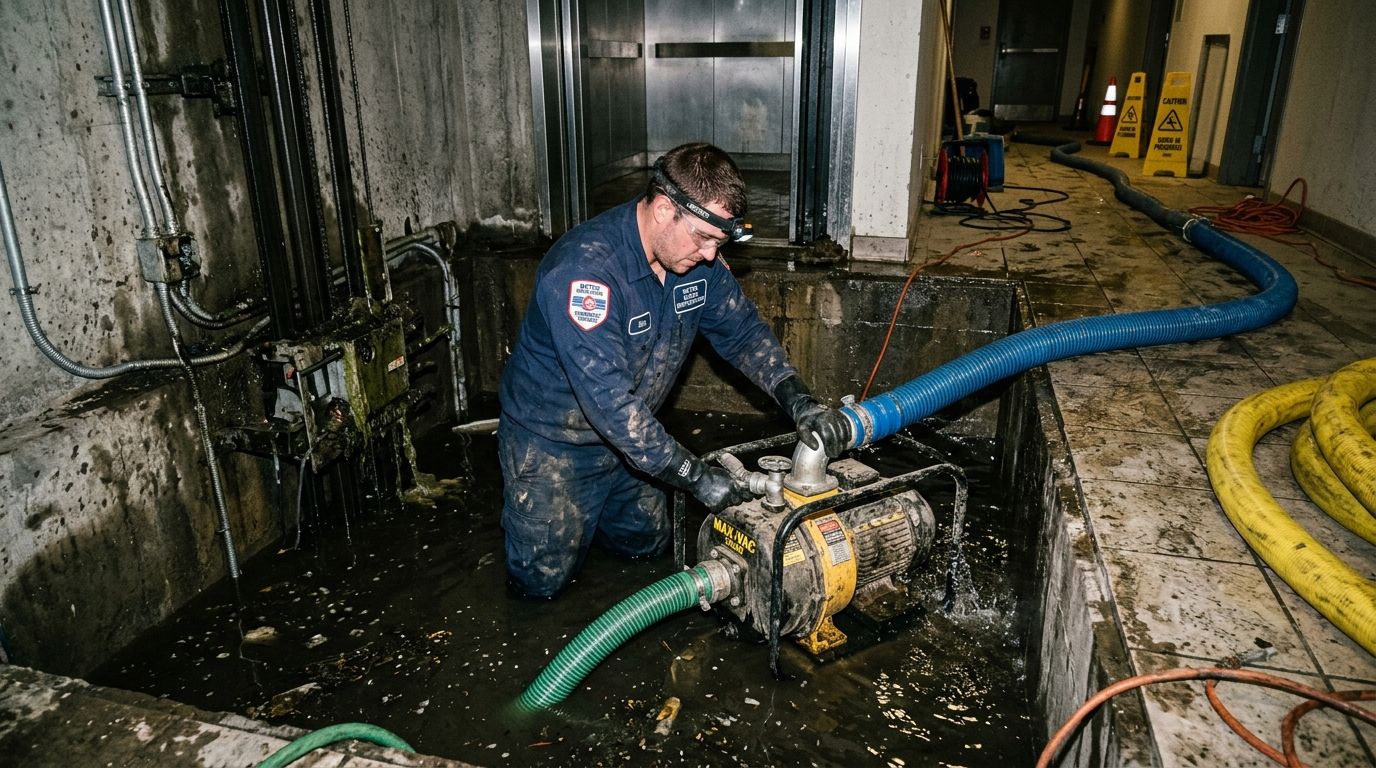
Immediate Incident Containment Protocol
- Shut off main water supply: Isolate mechanical riser valves, street curb meters, or supply manifolds immediately.
- Establish electrical safety: De-energize sub-floor circuits and submerged outlets before walking into affected zones.
- Avoid delay: 115°F desert summer ambient heat accelerates microbial spore incubation within 24 to 48 hours.
Free On-Site Assessment & Transparent Estimates
- Non-invasive thermal imaging: FLIR infrared scans map hidden water boundaries behind drywall and under concrete.
- Transparent itemized estimates: Industry-standard Xactimate line items prepared upfront with zero surprises.
- Rapid 30-to-60 minute dispatch: Mobile units fully equipped with heavy extraction pumps on active standby.
Direct Answer: Commercial Elevator Pit Water Extraction in Phoenix Facilities
When sub-grade water floods an elevator shaft in Maricopa County, commercial facility directors and property engineers face an immediate life-safety crisis and mandatory code enforcement shutdown. If your commercial high-rise, medical tower, hotel, or retail complex is experiencing active commercial elevator pit water extraction phoenix emergencies, standing water in the pit submerges critical electrical safety interlocks, hydraulic cylinder packings, governor tension pulleys, and traveling cable loops. Under Arizona state safety codes (ASME A17.1) and Maricopa County building safety regulations, elevators with standing water in the pit are subject to immediate red-tag out-of-service orders from state inspectors.
Standard sump pumps cannot handle flooded pits because the water commingles with hydraulic oil, petroleum lubricants, and subterranean silt, transforming the flood into hazardous industrial slurry. Discharging oily water into municipal storm mains or sanitary sewers violates City of Phoenix Environmental Services Department stormwater regulations and federal Clean Water Act provisions, triggering severe municipal fines. Valley Restoration Pros deploys certified hazardous fluid extraction trucks, oil-water separation equipment, and industrial desiccant air drying to remove water safely, decontaminate concrete shaft surfaces, and prepare the hoistway for state elevator inspection sign-off within hours.
1. Executive Emergency Abstract & Incident Overview
Elevator pits represent the lowest structural elevation in any multi-story commercial building across the Phoenix metropolitan basin. Designed strictly as mechanical safety zones housing hydraulic buffers, compensating sheaves, limit directional switches, and hydraulic piston cylinders, elevator pits are never engineered to store fluids. However, due to Phoenix’s unique subterranean hydrology, high summer water table fluctuations near the Salt River canal network, aging commercial domestic water services, and violent monsoonal flash deluges, elevator pits frequently convert into subterranean water reservoirs within minutes of an upstream failure.
The immediate operational consequence of pit flooding is total vertical transportation paralysis. Modern commercial elevators rely on sensitive electronic low-voltage interlocks and high-voltage 480V three-phase electrical circuits. When water rises above two inches in the pit floor, safety switches such as the pit stop switch, directional limit switches, and governor rope tension switches become submerged. This grounds the electrical safety circuit, tripping the building’s main elevator controller and instantly stranding elevator cars at intermediate landings. In hospitals, medical office buildings (MOBs), and multi-story corporate towers, elevator downtime halts clinical operations, violates Americans with Disabilities Act (ADA) accessibility mandates, and generates thousands of dollars per hour in commercial tenant productivity losses.
Furthermore, an inundated elevator pit triggers severe regulatory scrutiny. The State of Arizona Department of Administration and the Phoenix Fire Department execute strict enforcement of ASME A17.1 / CSA B44 Safety Code for Elevators and Escalators. Section 2.2.2 explicitly mandates that elevator pits must be kept clean, dry, and free from any accumulated water, oil, or debris. Once an elevator car or hoistway mechanism is compromised by water intrusion, certified elevator service technicians (such as Otis, Schindler, Kone, or TK Elevator) are legally prohibited from restoring power or releasing the cab into operational service until an IICRC-certified commercial disaster restoration contractor provides certified extraction, antimicrobial decontamination, and psychrometric dry-clearance documentation.
Valley Restoration Pros functions as the premier emergency commercial response partner for building owners, property asset managers, and facility engineers across Phoenix, Scottsdale, Tempe, Mesa, and Glendale. Our technical restoration teams maintain emergency dispatch staging 24 hours a day, 365 days a year. Equipped with specialized sub-grade vacuum extraction tankers, explosion-proof submersible pump systems, hazardous fluid separators, and high-temperature desiccant dehumidification trailers, we mitigate structural damage, safeguard life-safety mechanisms, and compress downtime from weeks into hours.
In commercial real estate portfolios, elevator shafts act as vertical conduits for the entire property. When water pools in an elevator pit, the moisture does not remain static. It begins evaporating, creating a microclimate of 95% to 100% relative humidity that ascends the hoistway via natural convective air currents. As this humid air rises through the shaft, it encounters cool conditioned air from tenant floors, causing condensation on electrical conduit runs, hall call stations, and steel structural beams on upper floors. What began as an isolated sub-grade leak can transform into building-wide secondary moisture intrusion within 48 hours if high-velocity extraction and desiccant psychrometrics are not deployed immediately.
2. Anatomy of the Failure & Physical Dynamics in Commercial Hoistways
To understand the urgency of commercial elevator pit water extraction, building operators must comprehend the mechanical and physical anatomy of modern vertical hoistways. A standard hydraulic elevator installation utilizes a subterranean steel casing or an above-ground telescopic jack assembly positioned directly in the center of the pit. In traction elevators, the pit contains heavy counterweight rail assemblies, steel buffer springs, governor rope tension sheaves, and the electrical traveling cable hanging loop that connects the moving cab to the machine room controller.
Submerged Mechanical & Electrical Component Vulnerability Matrix
- Hydraulic Cylinder Seals & Packing Glans: Submersion under municipal tap water or storm runoff exposes hydraulic cylinder packings to fine abrasive silica, caliche grit, and corrosive salts. When the cylinder extends or retracts through dirty water, grit scores the micro-polished steel ram, destroying the elastomer seal and allowing gallons of ISO 32/46 hydraulic oil to leak directly into the pit water.
- Compensating Cables & Traveling Cables: Modern elevator traveling cables consist of hundreds of insulated copper conductors encased in flexible synthetic elastomeric jackets, frequently incorporating fiber-optic data cores for cab CCTV, hall calls, and digital displays. Capillary action wicks water upward through internal cable braiding if the hanging loop rests in standing water. Once moisture enters the cable jacket, dielectric breakdown causes unpredictable communication faults and short circuits, necessitating full cable replacement at costs exceeding $15,000 to $40,000 per hoistway.
- Governor Tension Sheaves & Safety Switch Interlocks: The car governor assembly utilizes a continuous steel wire rope that runs from the overhead machine room down to a tension sheave anchored to the pit channel beams. When submerged, the sheave bearings seize due to rust, and the associated electrical safety switch corrodes, locking the entire car braking apparatus in permanent mechanical emergency lockup.
- Structural Buffer Springs & Hydraulic Buffers: Impact buffer cylinders located at the base of the hoistway absorb car kinetic energy in emergency over-travel incidents. Water intrusion rusts buffer spring coils and contaminates hydraulic fluid within buffer dampening reservoirs, causing structural failure during state load-drop testing.
- Concrete Slab Hydrostatic Pressure & Cold Joint Failure: Elevator pits are cast below the primary basement foundation slab, forming a cold construction joint between the vertical pit retaining walls and the base slab. When subterranean groundwater rises, hydrostatic pressure exerts hundreds of pounds of uplifting force per square foot against the exterior concrete. Unsealed penetrations, tie-rod holes, and micro-fissures in aged concrete blow out, resulting in continuous high-pressure subterranean fountains entering the pit.
- Electrolytic Galvanic Corrosion of Rail Anchor Brackets: Elevator vertical directional track rails are mounted to structural pit channel irons via heavy steel clip assemblies. When submerged in mineral-heavy water, galvanic currents form between dissimilar metals—such as copper ground bonds, zinc plating, and carbon steel rails. This galvanic reaction accelerates metal pitting and weakens rail alignment tolerances, causing excessive vibration or binding when the cab is restored to service.
The chemical interaction between water and machinery in an elevator shaft is exceptionally destructive. Concrete in subterranean elevator pits is inherently alkaline. When water enters through concrete fissures, it leaches free calcium hydroxide, creating a highly corrosive alkaline slurry with a pH often exceeding 11.5. This caustic alkaline water aggressively attacks bare steel rail brackets, structural rail clips, counterweight frames, and zinc-galvanized electrical conduits. Within 24 to 48 hours of initial flooding, bright orange ferric oxide (corrosion scale) forms across precision-machined vertical track rails, destroying the smooth riding surface and requiring extensive mechanical resurfacing before car re-certification.
In hydraulic systems, water ingress creates emulsion breakdown within the fluid reservoir. If floodwater penetrates the cylinder head through compromised wiper rings, water blends with the hydraulic oil under high operating pressures. This transforms clear hydraulic fluid into a milky, acidic emulsion. The presence of just 0.5% water in hydraulic oil reduces lubricity by 75%, leading to catastrophic cavitation within the pump, scoring of valve spools, and severe elevator leveling instability that can trap passengers between landing floors.
3. Phoenix-Specific Climatic & Geological Multipliers
Commercial structures in Phoenix, Arizona operate in one of the most mechanically punishing geological and atmospheric environments in North America. While external observers assume the Sonoran Desert is dry and free from water damage risks, commercial facility engineers know that Phoenix experiences specific geological multipliers that amplify elevator pit flood frequency and structural severity:
Municipal water supplied across Phoenix, Glendale, Tempe, and Mesa averages between 18 and 25 Grains Per Gallon (GPG) of dissolved calcium carbonate and magnesium mineral salts. When domestic supply lines, chillers, or fire sprinkler loops rupture above an elevator hoistway, this mineral-saturated water cascades down the shaft. As moisture evaporates in the dry desert air, it leaves dense calcite scale bonded to electrical contacts, limit switches, and polished steel cylinder rams, creating persistent mechanical binding and electrical arc tracking.
The valley floor is underlain by dense sedimentary caliche hardpan and high-plasticity bentonite clay soils. During prolonged drought periods, this sub-base shrinks and pulls away from elevator pit retaining walls. When sudden monsoon storms saturate the soil, the clay expands by up to 15% in volume, exerting immense lateral compressive shear forces against subterranean concrete walls. This cyclic expansion shears water-stop seals at the pit floor-wall cold joints, allowing high-pressure groundwater penetration.
During summer monsoon events, Phoenix frequently receives 1.5 to 2.5 inches of high-intensity precipitation in under 45 minutes. Municipal storm sewer lines instantly become pressurized and surcharged. Low-grade commercial parking garages, subterranean loading docks, and exterior courtyard trench drains back up, sending thousands of gallons of surface floodwater cascading down stairwells, beneath elevator landing door thresholds, and plummeting directly into elevator pits.
Phoenix summer temperatures frequently exceed 115°F on roof decks where elevator machine rooms and hoistway vent louvers are located. This creates a vertical “thermal chimney effect,” pulling superheated desert air up through the hoistway. When high heat encounters standing water in the unventilated pit, ambient relative humidity in the lower shaft spikes to 95%+, creating an optimal microbial incubator that generates toxic black mold (Stachybotrys and Aspergillus) within 24 to 36 hours.
Another critical local factor is the Salt River Project (SRP) agricultural canal network traversing Maricopa County. Many commercial properties in Scottsdale, Tempe, and Central Phoenix were constructed above historic agricultural fields with shallow, fluctuating perched water tables. During active irrigation cycles in spring and summer, the subterranean water table rises several feet, subjecting elevator pit retaining walls to hydrostatic head pressure that exceeds original design parameters. Pits that remained completely dry for decades suddenly develop high-velocity hydrostatic weeping through cold joints and tie-wire penetrations.
4. Immediate Emergency First-Hour Protocol & Safety Isolation
The initial sixty minutes following an elevator pit flood incident dictate whether the building faces minor mechanical cleaning or catastrophic multi-week structural equipment replacement. Commercial facility engineers and building maintenance supervisors must adhere to this standardized emergency containment protocol before restoration specialists arrive on scene:
CRITICAL FIRST-HOUR COMMERCIAL FACILITY ACTION STEPS
- Execute Car Recall & Upper-Floor Parking: Using the designated independent service key or building automation system (BAS) elevator management console, command the elevator car to travel to the top terminal landing. Once parked, engage the car stop switch. This prevents the cab chassis, under-car electronic sensors, load weighing devices, and bottom door interlocks from descending into rising floodwater.
- Apply OSHA Lockout / Tagout (LOTO) on Primary Disconnects: Enter the elevator machine room and throw the main 480V/208V fused three-phase power disconnect switch to the “OFF” position. Apply an OSHA-compliant padlock and danger tag. De-energize pit light circuits, 120V convenience receptacles, and pit emergency stop switches. Never assume a tripped breaker has removed all stray voltage from standing water in a sub-grade vault.
- Isolate Upstream Water Ingress Sources: If the flood originates from an internal domestic line break, fire sprinkler riser rupture, or mechanical chiller loop, locate the appropriate mechanical room isolation gate valve or backflow preventer and shut down fluid flow immediately. If the water enters from municipal stormwater backflow, deploy sandbags or inflatable pneumatic pipe plugs at lowest-level floor drains.
- Barricade Hoistway Landings Across All Sub-Grade Floors: Water collecting beneath the bottom hoistway door sill easily migrates across polished stone, commercial carpet tiles, and structural corridors. Place heavy-duty containment absorbent socks along door sills and erect high-visibility pedestrian stanchions with “Danger – Elevator Hoistway Out of Service” signage to prevent tenant accidents.
- Inspect for Petroleum Hydrocarbon Floating Sheen: Using an explosion-proof inspection light, visually examine the water surface in the pit from the lowest landing door threshold. Check for an iridescent rainbow film or amber hydraulic fluid slick. If oil is detected, immediately instruct building staff that standard utility submersible pumps MUST NOT be engaged, as pumping oil into public sewers constitutes a Class 2 environmental misdemeanor under Arizona Revised Statutes.
- Contact Valley Restoration Pros Emergency Dispatch: Call our 24/7 commercial incident response center at (602) 847-9593. Our commercial disaster unit dispatches within minutes, equipped with truck-mounted vacuum recovery tankers, certified hazardous liquid separators, and industrial drying arrays.
Never attempt to enter an elevator pit with standing water without verified Lockout/Tagout isolation and four-gas atmospheric testing. Pit water can conceal broken glass, fallen mechanical hardware, deep sump drop-offs, and live 480V three-phase electrical wires. Building staff should remain at the landing entrance, maintain secure containment barriers, and await arrival of certified commercial restoration technicians equipped with personal protective equipment (PPE) and OSHA confined-space rescue gear.
5. Advanced Industrial Equipment Specifications & Setup
Commercial elevator pit water mitigation cannot be executed using residential-grade shop vacs or light utility pumps. The depth of commercial shafts (often extending 6 to 12 feet below the basement floor), the presence of electrical conduit channels, and the presence of petroleum contaminants require advanced industrial equipment engineered specifically for confined-space restoration:
| Equipment Category | Industrial Model / Spec | Performance Capacity | Elevator Pit Application |
|---|---|---|---|
| High-Head Submersible Pumps | Tsurumi LB-800 / Bsurfer Cast Iron Rigs | 85 GPM at 45 ft vertical static head | Rapid bulk water dewatering from deep subterranean pit floors up to ground level. |
| Truck-Mounted Vacuum Extractors | Sapphire Scientific 870SS Tri-Lobe Blower | 16 in. Hg vacuum lift; 655 CFM airflow | Extraction of heavy oil-water emulsion, silt, and sludge from sump depressions and rail bases. |
| Hydrocarbon Separator Filtration | Ultrasorb Coalescing Plate Oil Separators | Continuous oil-water separation down to <10 PPM | Filtration of contaminated pit water to comply with Phoenix municipal discharge limits. |
| Desiccant Dehumidification Trailers | Quest Hi-E Dry / Munters 5000 CFM Desiccant | Delivers dry air at <15 GPP moisture content | Injects super-dry, low-dewpoint air down hoistway shaft to dry concrete and prevent rail flash-rusting. |
| HEPA Negative-Air Scrubbers | DefendAir HEPA 500 Industrial Scrubbers | 99.97% particulate capture at 0.3 microns | Exhausts airborne microbial spores and petroleum VOC vapors out of building corridors. |
| Thermal Imaging & Moisture Meters | FLIR T540 Professional Thermal Camera | 464 x 348 IR resolution; 0.03°C sensitivity | Maps moisture intrusion paths behind shaft drywall lining, elevator landing sills, and masonry blocks. |
Our mobile recovery trailers operate with dedicated on-board diesel generators ranging from 75 kW to 150 kW. This ensures that even if building main power has been severed or locked out due to flood interlocks, our extraction pumps, desiccant blowers, and air filtration scrubbers operate continuously without drawing from the facility’s emergency backup circuits.
In addition, we deploy intrinsically safe pneumatic diaphragm pumps (Wilden Pro-Flo Shift Series). When handling elevator pits where volatile petroleum vapors or fuel additives have commingled with floodwater, pneumatic diaphragm pumps eliminate all electrical sparking hazards, operating entirely on clean compressed air supplied from our external support trailers parked in street-level staging bays.
6. IICRC S500 / S520 Step-by-Step Restoration Protocol
Elevator hoistway drying must comply with the Institute of Inspection, Cleaning and Restoration Certification (IICRC) S500 Standard for Professional Water Damage Restoration and S520 Standard for Microbial Remediation. Our certified field specialists execute this proven multi-phase protocol:
Phase 1: Confined Space Entry & Atmospheric Life-Safety Clearance
Under OSHA 29 CFR 1910.146, elevator pits exceeding four feet in depth with limited egress qualify as permit-required confined spaces. Prior to technician descent, our certified safety team conducts four-gas atmospheric testing (measuring Oxygen levels, Carbon Monoxide, Lower Explosive Limit for volatile petroleum gases, and Hydrogen Sulfide from anaerobic sewer backup). Continuous positive-pressure fresh air ventilation blowers are ducted directly into the pit bottom throughout the operation.
Phase 2: High-Volume Industrial Extraction & Hydrocarbon Separation
Technicians deploy heavy-duty submersible sludge pumps and truck-mount vacuum hoses down the hoistway. If petroleum hydraulic oil is present, floating oleophilic absorbent skimmers capture the hydrocarbon layer before water dewatering commences. Extracted liquids pass through multi-stage coalescing oil-water separators. Clean water meeting local municipal discharge standards is routed to designated sanitary access points, while recovered hydraulic oil slurry is pumped into certified DOT 55-gallon drums for legal hazardous waste manifest disposal.
Phase 3: Deep Slurry Muck-Out & Shaft Substrate Decontamination
Water dewatering leaves behind several inches of mineral silt, grease residue, and bacterial biofilm. Our technicians manually scrape and wash down concrete pit floors, buffer channel beams, and cylinder jack casings using non-corrosive, EPA-registered botanical antimicrobial agents (such as Benefect Decon 30). This destroys pathogenic micro-organisms without generating hazardous fumes that could enter the building’s public HVAC air intakes.
Phase 4: Mechanical Rust Inhibitor Application & Directional Track Rail Protection
Bare steel elevator directional track rails, counterweight tracks, and structural fishplates rapidly develop flash rust in high-humidity post-flood environments. Our technicians immediately apply industrial moisture-displacing dielectric rust preventative compounds to exposed metal components, preventing oxidation pitting and saving thousands of dollars in mechanical rail machining costs.
Phase 5: High-Performance Closed-Chamber Psychrometric Drying
Concrete is a porous capillary sponge that absorbs thousands of pounds of water during an inundation event. Left untreated, water vapor continuously migrates out of the slab, corroding new elevator parts months after the incident. We isolate the lower hoistway using 6-mil poly containment barriers, establishing negative pressure. We duct high-temperature desiccant dehumidifiers into the shaft, driving the ambient grain depression below 30 GPP. High-velocity axial air movers are positioned across concrete walls to accelerate deep evaporative boundary layer drying.
Phase 6: Psychrometric Verification & State Re-Certification Sign-Off
Our Master Water Restorers utilize non-invasive impedance moisture meters and FLIR infrared thermography to confirm that concrete pit walls and base slabs have returned to pre-loss dry baseline equilibrium standards (less than 12% moisture equivalent). We generate an exhaustive psychrometric clearance packet, complete with photographic documentation, drying logs, and hazardous waste disposal manifests, enabling the elevator maintenance company and state safety inspectors to re-certify the elevator cab immediately.
7. Hyper-Local Phoenix Field Case Study: Midtown Medical Tower Hoistway Deluge
Incident Incident Report #PHX-ELV-4091
Incident Scenario: At 2:15 AM on August 14th, during a violent monsoon microburst event, an aging 4-inch domestic water main coupling failed in the sub-basement utility corridor of an 8-story professional medical pavilion located near Central Avenue and Thomas Road in Midtown Phoenix. An estimated 12,000 gallons of high-pressure municipal water escaped, overwhelming subterranean trench drains and pouring beneath the hoistway doors of the building’s two primary patient-transfer hydraulic elevators. By 3:00 AM, standing water in both elevator pits had reached a depth of 4.5 feet, totally submerging hydraulic jack cylinder packings, buffer channels, and electrical traveling cable hanging loops. Both cars faulted out, stranding outpatient surgeries scheduled for 7:00 AM.
Rapid Deployment & Containment: Valley Restoration Pros dispatched our commercial large-loss mobile unit from our central Phoenix staging facility. Our emergency crew arrived on site within 24 minutes of the dispatch call. Technicians coordinated immediately with the on-site chief building engineer, verified 480V machine room LOTO isolation, and completed four-gas atmospheric air safety clearance tests. An oil sheen was detected on the surface, originating from submerged cylinder packing lubricants.
Execution & Environmental Mitigation: Rather than discharging hazardous fluid into the city sewer, our team deployed twin Sapphire 870SS truck-mounted extraction units coupled with an on-site coalescing plate oil-water separation rig. In under 90 minutes, 10,800 gallons of water and hydrocarbon emulsion were evacuated from the pits. Recovered oily sludge was drummed for legal hazardous material disposal. Concrete pit walls were power-washed with botanical Benefect Decon 30 antimicrobials, and moisture-displacing dielectric rust preventative was hand-applied to precision directional track rails.
Restoration Outcome & Re-Certification: A 5000-CFM desiccant drying trailer was ducted into both hoistways under negative pressure. By 11:30 AM, concrete moisture levels reached pre-loss equilibrium standards (9.8% moisture content). State elevator safety inspectors arrived at 1:15 PM, reviewed our complete psychrometric logs and environmental discharge manifests, and issued full operational clearance. Both medical elevators were returned to active patient service in under 12 hours from initial dispatch, averting over $180,000 in delayed surgical suite revenues and tenant displacement claims.
8. Pay-Per-Call Financial & Insurance Documentation Breakdown
Commercial elevator water damage claims are scrutinized heavily by commercial property insurance carriers. Adjusters frequently dispute elevator claims, alleging pre-existing mechanical wear, deferred sump pump maintenance, or unapproved contractor line items. Valley Restoration Pros protects commercial property asset managers through transparent, ironclad documentation standards:
Our Standard Commercial Pricing & Claims Support Commitments
- Free Comprehensive On-Site Damage Assessment: We deploy experienced Master Water Restorers to your facility to conduct immediate thermal imaging scans, water depth measurements, and contamination assessments at absolutely zero upfront obligation.
- Transparent Upfront Itemized Pricing: Before any extraction equipment is activated, we provide building management with a complete, transparent line-item estimate based on standard industry Xactimate commercial pricing codes (WTR, HMR, and DRY categories). We maintain zero hidden fees or unverified emergency surcharges.
- Zero Direct Billing Guarantees: In strict compliance with professional insurance ethics and consumer protection standards, we do not make false promises that insurance will cover 100% of costs or claim that clients have zero financial responsibility. Property owners are provided full pricing clarity prior to commencement.
- Comprehensive Claims Documentation Package: We furnish your commercial insurance adjuster with daily psychrometric moisture logs, thermal infrared temperature differential maps, atmospheric confined-space entry permits, and licensed environmental hazardous liquid disposal manifests. This undeniable documentation package accelerates claim approvals and prevents contentious settlement disputes.
9. Frequently Asked Technical Questions Regarding Elevator Pit Flooding
Q1: Can building maintenance pump out an elevator pit using a standard utility sump pump?
No. Standard sump pumps should never be used without verifying water contamination. Elevator pits consistently contain traces of hydraulic fluid, gear oil, and machine lubricants. Discharging petroleum-contaminated water into city storm drains or sanitary sewer lines is an environmental violation enforced by the City of Phoenix and the EPA. Additionally, standard sump pumps leave one to two inches of slurry on the floor, failing to remediate moisture trapped within concrete pores.
Q2: What specific elevator components must be replaced after being submerged in water?
Under ASME A17.1 elevator safety standards, any electrical safety switch, pit stop switch, limit switch, or traveling cable that has been submerged in water must typically be replaced rather than dried. Electrical contacts corrode, and traveling cable insulation suffers dielectric breakdown. Hydraulic cylinder packings must be inspected and repacked if contaminated with grit. Steel directional track rails and buffer springs can often be preserved if treated with rust inhibitors within 24 hours of flooding.
Q3: How long does complete industrial dehumidification of an elevator shaft take?
While bulk standing water extraction is typically completed in two to four hours, deep structural psychrometric drying of the concrete pit floor and masonry walls requires 24 to 48 hours using high-capacity desiccant dehumidifiers. Rushing this process leaves residual moisture in the concrete, causing persistent electronic faults, corrosion of newly installed elevator switches, and mold amplification inside the enclosed hoistway.
Q4: Why does our elevator pit flood during dry weather when it hasn’t rained in weeks?
Dry-weather elevator pit flooding in Phoenix is commonly triggered by subterranean groundwater table shifts near historic agricultural irrigation canals, municipal domestic water service leaks beneath foundation slabs, or mechanical chiller loop leaks on upper floors that travel down vertical pipe chases and drain into the pit. Valley Restoration Pros conducts acoustic leak detection and thermal imaging to isolate the precise source of non-weather water intrusion.
Q5: What documentation is required to clear an elevator red-tag after flooding?
To remove a state inspection red-tag and return an elevator to service, property owners must present: (1) An IICRC-certified restoration dry-clearance report confirming pit concrete equilibrium moisture standards, (2) An invoice demonstrating certified environmental disposal of any hazardous oily fluids, and (3) A comprehensive safety inspection sign-off from a licensed elevator service company verifying that all safety circuits and switches have been tested and replaced if compromised.
Q6: How can commercial buildings prevent recurrent elevator pit groundwater seepage?
Permanent mitigation requires professional concrete waterproofing. Following complete psychrometric drying, our commercial restoration team applies high-pressure polyurethane or epoxy chemical grout injection into the cold joints and cracks where pit walls meet the slab. This expands by 400% inside micro-fissures, creating an impervious hydrostatic barrier. We also install oil-sensing automatic sump pump systems with dual float alarms that alert building automation systems before water reaches safety switches.
Q7: Does commercial property insurance cover elevator pit flood restoration?
Most commercial property policies cover elevator water damage if the cause is sudden and accidental, such as a ruptured fire sprinkler pipe, HVAC chiller burst, or domestic water line failure. Damage caused by long-term gradual seepage or external surface flooding may require specialized groundwater or commercial flood endorsements. Valley Restoration Pros provides detailed forensic documentation and psychrometric logs to assist your insurance adjuster in processing valid claims efficiently.
Q8: How quickly can Valley Restoration Pros deploy commercial extraction crews to our Phoenix property?
Our emergency commercial response units maintain a 30 to 60 minute arrival window across the entire Phoenix metropolitan area, including Downtown Phoenix, Midtown, Camelback Corridor, Scottsdale Airpark, Tempe Tech Corridor, Deer Valley, and Mesa. We arrive fully equipped with truck-mounted vacuum extractors, temporary power, and hazardous fluid separation units to begin immediate dewatering.
10. Advanced Hoistway Waterproofing & Permanent Seepage Prevention Protocols
Extracting standing water from an elevator pit solves the immediate acute crisis, but without secondary structural waterproofing, subterranean hydraulic pressure in Phoenix’s expansive caliche soil guarantees future re-flooding. To safeguard vertical transit shafts over multi-decade operational horizons, commercial property owners must implement negative-side crystal crystalline waterproofing and high-pressure chemical polymer grouting.
Standard positive-side exterior waterproofing membranes installed during initial building construction eventually deteriorate due to soil friction, chemical attack from alkaline desert groundwater, and foundation settling. Because exterior excavation around an operational multi-story elevator bank is physically and economically impossible, restoration engineers utilize negative-side hydrophobic polyurethane resin injection. Technicians drill staggered injection ports (packers) along the cold perimeter joint at 45-degree angles, intersecting the seam where the vertical cast-in-place concrete walls meet the horizontal base footing.
Hydrophobic polyurethane resin is injected at pressures ranging from 1,500 to 3,000 PSI using specialized electric reciprocating pumps. Upon contacting residual moisture within the concrete fissures, the resin expands up to 800% in volume, curing into an elastomeric, closed-cell synthetic rubber gasket. This chemical gasket remains permanently flexible, accommodating thermal foundation expansion during 115°F desert summers and ground contraction during winter chill without tearing or pulling away from the concrete substrate.
Following chemical resin injection, all exposed concrete surfaces in the pit receive a multi-coat crystalline slurry treatment (such as Xypex Concentrate). The active chemicals in crystalline waterproofing penetrate deep into the concrete’s microscopic pores via osmosis. When these chemicals encounter unhydrated cement particles and moisture, they react to form millions of non-soluble dendritic crystalline fibers. These microscopic crystals fill the capillary tracts and micro-cracks permanently, converting the porous concrete into an impervious waterproof mass capable of withstanding over 400 feet of hydrostatic head pressure.
11. Mechanical Re-Commissioning & Elevator Safety Code Compliance Standards
The interface between commercial water damage restoration contractors and certified elevator mechanics is governed by stringent statutory standards. Under Arizona Administrative Code (R20-5-507), non-licensed elevator personnel are strictly forbidden from altering, adjusting, or energizing elevator mechanical systems. Valley Restoration Pros coordinates directly with certified elevator maintenance contractors (such as Otis, Schindler, TK Elevator, Kone, and independent service providers) to ensure smooth re-commissioning.
Once our psychrometric drying arrays have brought the hoistway atmosphere and concrete substrate to dry equilibrium standards, the licensed elevator mechanic performs the formal mechanical re-certification checklist:
- Insulation Resistance (Megohmmeter) Testing: The elevator technician applies high-voltage test charges (500V to 1000V DC) across traveling cable conductors, directional limit switch wiring, and motor feeder lines to test for dielectric insulation breakdown. A minimum reading of 50 Mega-ohms is required to confirm that no water tracks exist inside wire conduits.
- Hydraulic Fluid Contamination Testing: Fluid samples extracted from the hydraulic power unit reservoir undergo spectrophotometric analysis to measure water saturation and particulate count. If moisture exceeds 100 PPM or ISO 4406 cleanliness codes are violated, full system flushing and fluid replacement are completed.
- Safety Gear & Governor Drop Testing: Mechanical car safeties, overspeed governors, and pit buffer return mechanisms are manually exercised and lubricated. Buffers undergo full compression cycling to ensure internal return springs and hydraulic dampeners function in accordance with ASME A17.1 specifications.
- Final State Inspection Sign-Off: Upon completion of mechanical checks, the State of Arizona elevator inspector reviews our certified drying logs, signs off on the hoistway clearance permit, and removes the official red tag, allowing building management to restore full elevator service to building tenants.
Standing Water in Your Commercial Elevator Shaft?
Do not risk state red-tag fines, catastrophic hydraulic ram scoring, or permanent electrical cable destruction. Our certified commercial disaster crews are on standby 24/7 across Maricopa County.
November 2026 Technical Field Advisory & Operations Update
Verified by IICRC Master Water Restorer | Active Emergency Deployment
Greater Phoenix Seasonal Water Damage Dynamics & 2026 Rapid Response Protocol
As ambient desert temperatures decline in late autumn across Maricopa County, concrete slabs experience thermal contraction cycles, increasing structural stress on subterranean copper plumbing lines weakened by Phoenix’s extreme 18 GPG municipal hard water scale. Valley Restoration Pro maintains rapid 30-to-60 minute emergency staging across Phoenix, Scottsdale, Mesa, Chandler, Glendale, Gilbert, Tempe, Peoria, Surprise, and Goodyear. Our master crews deploy non-destructive FLIR thermal imaging and high-volume industrial LGR dehumidification trailers to achieve dry standard equilibrium without needless structural demolition.
Verified Local Area Dispatch: Phoenix, AZ
Official Geo-Coordinates: 33.4484° N, -112.074° W • Maricopa County
Verified Technical Standard & Engineering Quality Assurance
Every mitigation project executed by Valley Restoration Pros complies strictly with national standards established by the Institute of Inspection, Cleaning and Restoration Certification (IICRC S500 / S520) and OSHA safety regulations across Maricopa County.