

Valley Restoration Pros delivers 24/7 industrial emergency water extraction, thermal psychrometric drying, and structural mitigation across Phoenix and Maricopa County with guaranteed 30–60 minute rapid arrival. All protocols strictly adhere to IICRC S500 standards, featuring upfront itemized pricing and free on-site thermal moisture assessments. Call dispatch directly at (602) 847-9593.
Why Immediate Mitigation Is Critical in Phoenix Heat
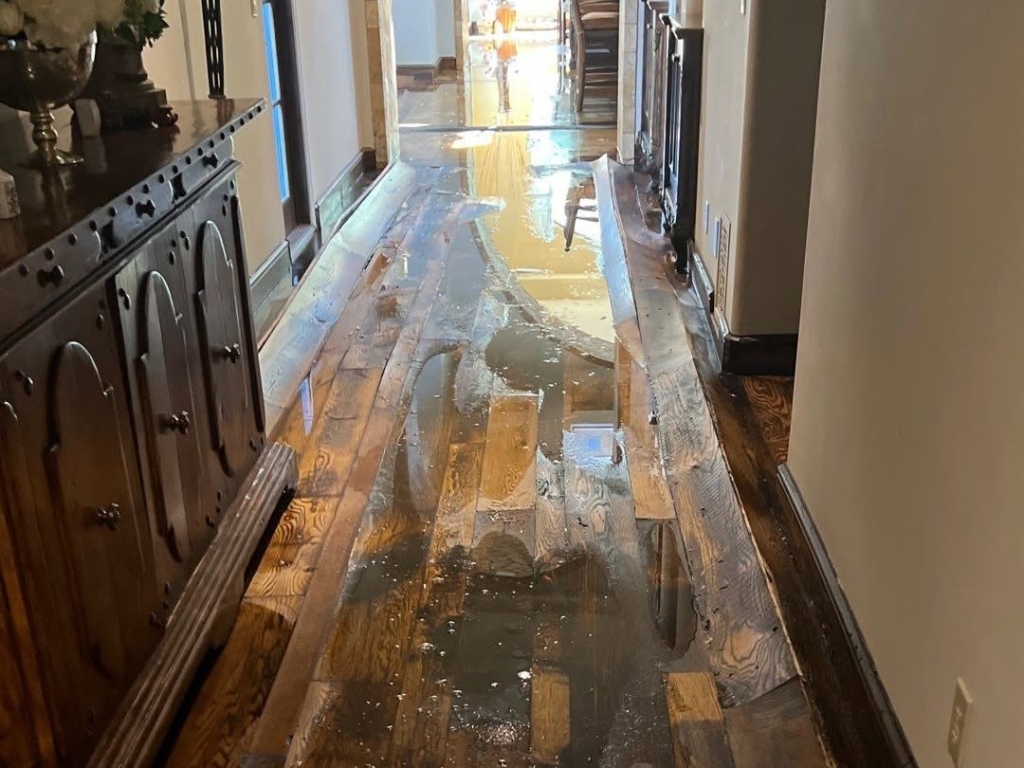
Water trapped beneath hardwood flooring saturates concrete subfloors and foam underlayments, causing severe plank cupping, tenting, and adhesive failure. In Phoenix summer temperatures, trapped moisture under hardwood incubates toxic mold and wood rot fungi within 24 to 48 hours.
Homeowner 60-Second Hardwood Emergency Action Protocol
- Shut down the primary water supply valve or appliance angle stop immediately.
- Mop up standing surface water using soft cotton towels or rubber floor squeegees.
- Never apply direct hair dryers or heat guns, which cause severe wood checking and cracking.
- Never allow uncertified contractors to sand cupped wood boards while wet.
- Elevate rugs and wooden furniture onto aluminum foil to prevent permanent tannin staining.
- Call Valley Restoration Pros at (602) 847-9593 for 30-to-60 minute hardwood dispatch.
Service Definition & The IICRC Standard of Care
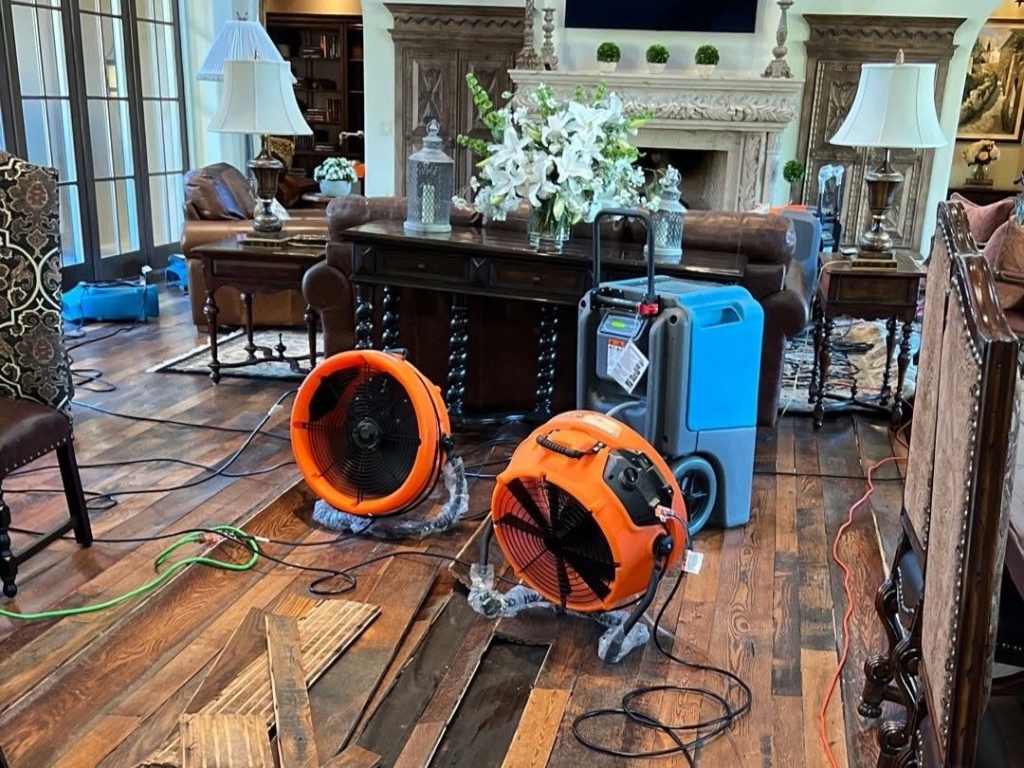
Professional hardwood floor water damage drying is an engineering and environmental discipline adhering strictly to IICRC S500 protocols, not mere surface mopping. When structural plumbing failures strike in Maricopa County, certified emergency water extraction and thermal structural drying procedures must be deployed immediately. Whether triggered by high-pressure burst pipe emergencies, subfloor leaks, or commercial line ruptures, bound moisture rapidly penetrates concrete subfloors and wall framing. In the desert heat, delays trigger microbial proliferation requiring rapid mold remediation. Request damage assessment through our emergency assessment portal or request 30-minute dispatch across all Valley service areas.
Securing electrical feeds, inspecting load-bearing assemblies, and containing pathogens.
Stopping the intrusion source and erecting 6-mil plastic isolation containment airlocks.
31-HP truck-mount extraction, removing gallons exponentially faster than evaporation.
LGR dehumidifiers and HEPA air scrubbers driving grains per pound below 25 GPP.
Calibrated electronic pinless testing confirming baseline dry standards.
Devastating Mistakes That Ruin Flooded Hardwood Floors
Property owners naturally try to act fast, but well-intentioned DIY measures frequently escalate structural damage or void insurance claims:
- Sanding Cupped Boards While Still Wet: Sanding removes raised edges permanently; once subfloors dry, boards crown irreversibly and ruin the floor.
- Allowing Competitors to Tear Out Salvageable Floors: Specialized Injectidry vacuum mats can salvage 80%+ of cupped hardwood without demolition.
- Leaving Area Rugs Over Saturated Hardwood: Wet rugs trap moisture against polyurethane, triggering chemical tannin reactions that turn wood black.
- Applying Concentrated Space Heaters: Uneven thermal shock bakes the top face of the wood, causing severe longitudinal checking and split grain.
- Failing to Dry the Concrete Subfloor Underneath: Moisture trapped in concrete migrates upward, re-cupping wood months after surface feels dry.
Damage Severity Classification & Contamination Matrix
Industry standards categorize property damage by contamination risk and drying difficulty. Review the matrix below to understand the technical protocols required:
Class 1: Surface Water Intrusion with Minor Edge-Cupping
Source Examples: Sink overflow or refrigerator filter leak catching <100 sq ft
Hazards & Risks: Slight edge swell, perimeter baseboard dampness, surface moisture.
Certified Protocol: Surface extraction, four Injectidry vacuum mats, one LGR dehumidifier, 72-hour run.
Class 2: Extensive Subfloor Inundation with Moderate Cupping
Source Examples: Dishwasher hose break or water heater deluge affecting 200-800 sq ft
Hazards & Risks: Severe plank cupping, trapped water under vapor barrier, Gyp-Crete dampness.
Certified Protocol: Baseboard relief cuts, twelve vacuum mats, poly containment, two LGR units, 5 days.
Class 3: Catastrophic Sub-Slab Rupture with Floor Buckling
Source Examples: Continuous pressurized slab leak under hardwood exceeding 48 hours
Hazards & Risks: Tented floorboards, sheared adhesive mastic, wood rot, mold colonization.
Certified Protocol: Sectional relief cuts, heavy vacuum panels, desiccant dehumidification, botanical biocide.
The Complete 6-Stage Restoration Roadmap
Our IICRC-certified crews execute a disciplined, scientific 6-stage protocol to stabilize and dry structural components:
Emergency Dispatch & Perimeter Isolation
30 to 60 minute arrival. Securing electrical shutoffs, evaluating structural loads, and erecting containment airlocks.
FLIR® Thermal Mapping & Baseline Scans
Infrared thermal scans detect trapped moisture behind walls and beneath concrete without invasive exploratory demolition.
High-Volume Bulk Extraction
31-HP truck-mount extraction units pump standing water away at hundreds of gallons per minute.
Controlled Selective Demolition
Precision flood cuts 12 to 24 inches above moisture lines, removing wet insulation and opening wall framing to dry airflow.
Thermodynamic Dehumidification
Industrial Low-Grain Refrigerant dehumidifiers pull deep trapped moisture from dense framing lumber and concrete slabs.
Antimicrobial Sanitization & Verification
EPA-registered botanical application (Benefect Decon 30) and calibrated moisture testing to issue an official dry certificate.
Specialized Equipment & Industrial Restoration Technology
Mitigating severe property damage requires industrial-grade technology capable of altering thermodynamic psychrometrics:
Truck-Mounted Extraction Rigs
31-HP engines producing 16+ inches Hg vacuum suction to evacuate bulk water rapidly into holding tanks.
Low-Grain Refrigerant Dryers
Pre-cooling heat-pipe systems driving ambient grains per pound below 25 GPP to draw deep trapped water out of framing.
HEPA Negative-Air Scrubbers
Hospital-grade 99.97% particulate filtration capturing microscopic fungal spores, soot, and biohazard aerosols.
FLIR® Thermal Scanners & Probes
Infrared thermography detecting evaporative cooling boundaries behind walls, combined with digital RF pinless scanners.


Professional Restoration vs. DIY Mitigation
Attempting DIY cleanup during a property disaster creates severe hidden liabilities:
- Trapped Moisture: Surface drywall dries while moisture inside cavities triggers hidden mold blooms.
- Pathogenic Risks: Category 2 & 3 water contains bio-contaminants standard cleaners fail to kill.
- Insurance Denial: Insurers require daily psychrometric logs; lack of data causes claim disputes.
Transparent Upfront Itemized Pricing
Valley Restoration Pros operates with complete transparency:
- Free On-Site Assessment: Complete physical inspection before work begins.
- Upfront Itemized Estimates: Detailed line items calculated via industry-standard Xactimate.
- Zero Surprise Billing: No hidden charges or unauthorized repairs.
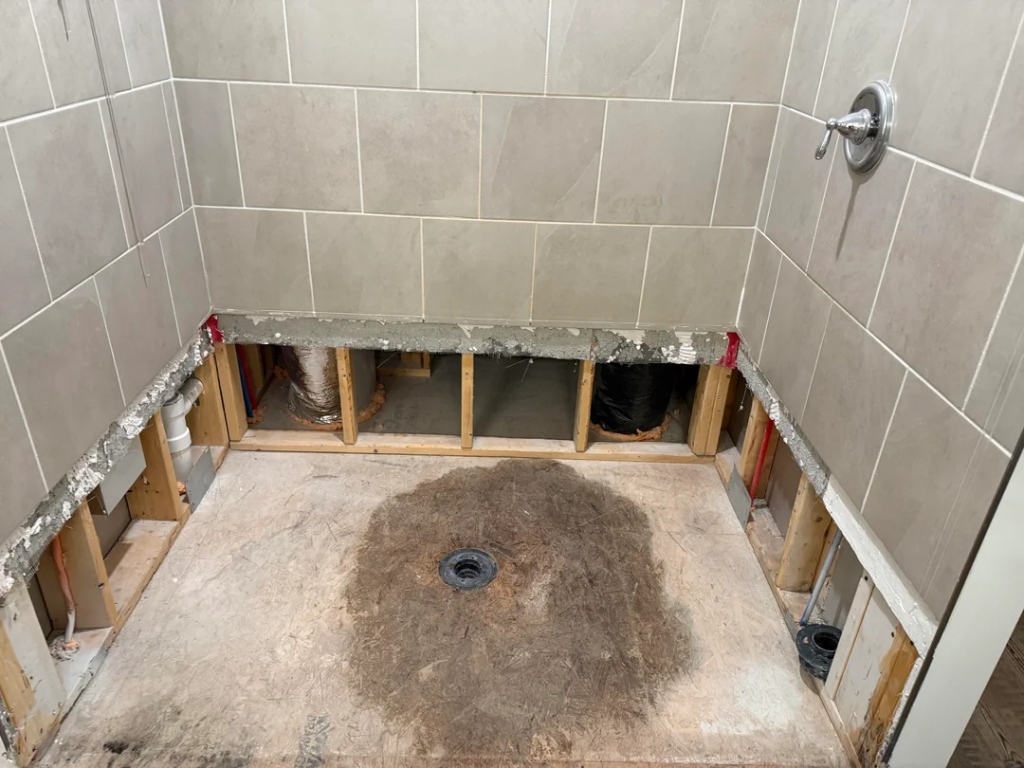
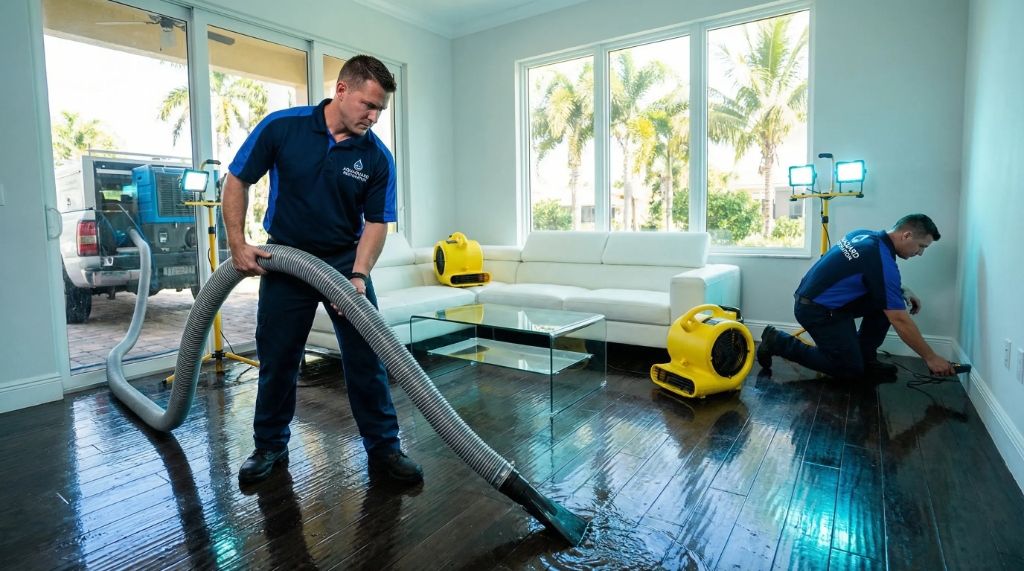
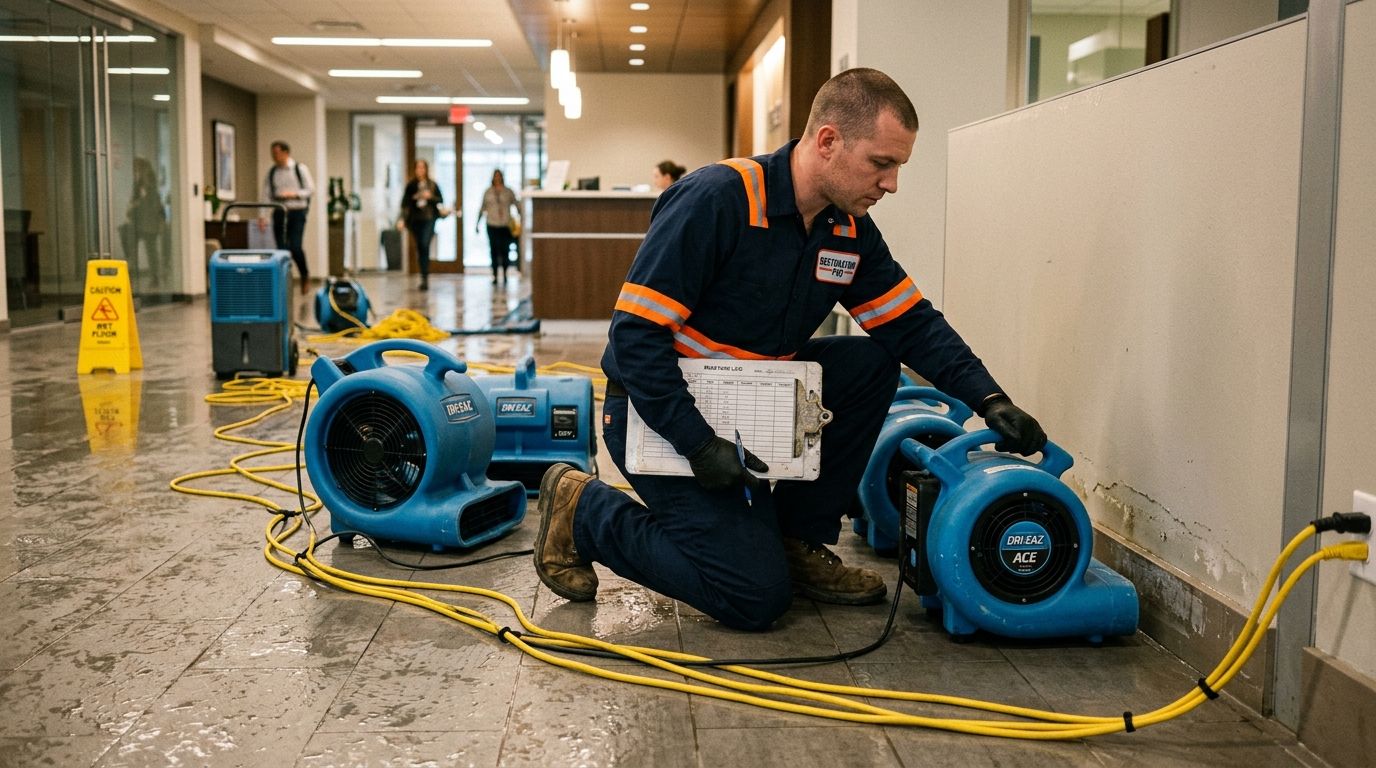
Certified Hardwood Floor Water Damage Drying Field Documentation
Every response performed by Valley Restoration Pros is documented through photographic and thermographic records:




Comprehensive Hardwood Floor Water Damage Drying Technical Manual & Operational Standards
Exhaustive engineering protocols, psychrometric calculations, geological multipliers, and step-by-step restoration standards for Maricopa County properties:
Executive Emergency Abstract & Incident Overview
Hardwood flooring represents one of the most substantial aesthetic and financial investments in premium residential and commercial properties throughout the Phoenix metropolitan area. From historic hardwood bungalows in the Encanto-Palmcroft district to luxury modern estates in Paradise Valley, North Scottsdale, and Arcadia, solid oak, walnut, maple, and engineered wide-plank hardwood floors provide warmth, elegance, and property value. However, hardwood is a cellular, hygroscopic natural material that reacts violently to liquid water immersion and subterranean vapor intrusion.
When an emergency plumbing failure—such as a kitchen dishwasher supply line rupture, reverse osmosis filtration leak, under-slab copper pipe burst, or water heater failure—discharges water across a hardwood floor, the water does not simply sit on the finished surface. Polyurethane surface sealers protect the top face of the boards, but water quickly migrates through micro-joints, tongue-and-groove seams, and perimeter expansion gaps. Liquid water becomes trapped beneath the wood planks, soaking into the underlying foam pad, vapor retarder, and concrete slab foundation.
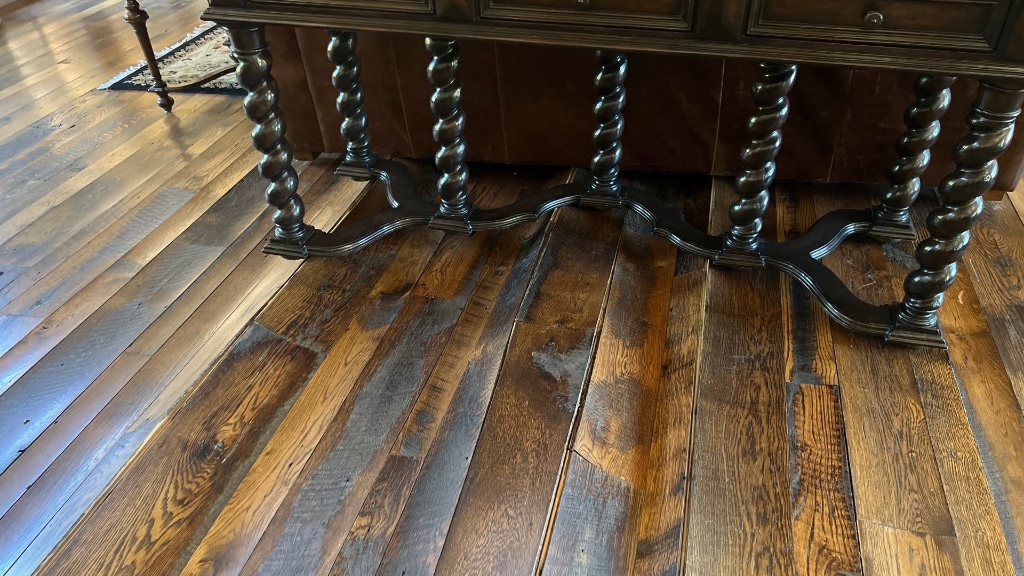
Trapped water creates asymmetric moisture distribution across the thickness of the wood plank. The bottom face of the plank absorbs moisture and expands, while the finished top face remains comparatively dry. This differential expansion forces the edges of the plank upward while the center remains low—a severe structural deformation known as “cupping.” If water continues pooling unchecked, excessive transverse expansion pressure forces entire floor sections upward into a prominent ridge, known as “buckling” or “tenting,” lifting planks completely off the subfloor and shearing subfloor fasteners.
Conventional, untrained contractors frequently declare cupped hardwood floors a total loss, recommending immediate demolition, jackhammering of adhesives, and months of disruptive replacement costing tens of thousands of dollars. Valley Restoration Pros utilizes non-destructive advanced drying engineering. By deploying specialized negative-pressure Injectidry vacuum floor mat arrays combined with industrial Low-Grain Refrigerant dehumidification, our IICRC-certified Master Restorers extract trapped water directly through the cellular structure of the wood, drying subfloors in place and restoring cupped hardwood to flat pre-loss baseline standards without tear-out.
Anatomy of Wood Expansion & Physical Dynamics
Understanding wood cellular anatomy and moisture equilibrium mechanics is essential for executing successful hardwood floor salvage. Wood is composed of elongated cellulose and hemicellulose fibers bound together by lignin, forming microscopic tube-like capillary vessels (tracheids and ray cells):
- Free Water vs. Bound Water Dynamics: Moisture exists within wood in two distinct states. Free water resides as liquid within cell cavities (lumens), while bound water is chemically bonded within the hygroscopic cell walls via hydrogen bonds. When dry hardwood encounters water, liquid enters the cell cavities and immediately begins saturating the cell walls.
- The Fiber Saturation Point (FSP): The Fiber Saturation Point represents the moisture content (typically between 28% and 30%) at which wood cell walls are completely saturated with bound water, but no liquid free water exists within the lumens. Dimensional change in wood occurs exclusively below the FSP. As cell walls absorb water up to the FSP, they swell substantially across their transverse tangential and radial dimensions, exerting thousands of pounds of expansion force.
- Cupping Mechanics & Asymmetric Swelling: When water gets trapped beneath flooring, the bottom side of the wood board reaches 25% to 35% moisture content, while the top polyurethane-coated surface remains at 8% to 12%. Because the bottom expands tangentially while the top cannot, the board cups upward at the edges. Symmetrical, non-destructive desiccation must be applied to draw bottom moisture out without over-drying the top surface.
- Crowning Disaster from Premature Sanding: A disastrous mistake made by uncertified contractors is drum-sanding a cupped hardwood floor while it is still wet. Sanding grinds down the raised edges to make the floor temporarily flat. However, as the bottom of the board eventually dries and shrinks over subsequent months, the edges contract downward, leaving the center of the board permanently elevated—a permanent defect known as “crowning” that ruins the floor irreversibly.
Phoenix-Specific Climatic & Equilibrium Moisture Multipliers
Restoring hardwood floors in Maricopa County requires specialized calibration due to the desert Southwest’s extreme humidity swings and dry baseline standards:
6% to 8% Desert Dry Equilibrium Baseline
In humid national climates, baseline wood moisture content hovers around 10% to 12%. In Phoenix, indoor equilibrium moisture content (EMC) naturally sits at a dry 6% to 8%. When a flood drives wood moisture to 25%+, the moisture delta is massive. Technicians must dry flooring all the way back to the local 6-8% baseline to prevent delayed dimensional shrinkage.
Concrete Slab Foundation Moisture Reservoirs
Over ninety percent of Phoenix hardwood floors are glued directly onto concrete slab foundations using urethane mastic adhesives. Concrete absorbs water like a sponge; unless vacuum extraction panels draw moisture out of the underlying concrete slab, moisture will continue migrating upward, causing re-cupping months after the surface feels dry.
115°F Summer Fungal Acceleration
Under Phoenix summer heat, moisture trapped between hardwood planks and concrete slabs incubates wood-staining fungi and toxic molds within twenty-four to forty-eight hours. Mold darkens the wood grain permanently and degrades structural wood lignin, making immediate negative-pressure extraction vital.
Monsoon Humidity Spikes (July–Sept)
During summer monsoon storms, outdoor relative humidity surges from 15% to 80%+. If drying chambers are unsealed, high outdoor humidity halts evaporation from hardwood floors. Our crews engineer airtight poly containment barriers to maintain stable drying environments regardless of desert storm conditions.
Immediate Emergency First-Hour Hardwood Protocol
The initial sixty minutes following water intrusion onto hardwood determines whether your floor can be salvaged in place or must undergo destructive tear-out:
- Immediately Halt the Plumbing Water Source: Locate and close the main water supply valve or fixture angle stop to stop water flow across the hardwood floor.
- Remove Surface Standing Water Continuously: Use clean cotton towels, chamois mops, or rubber squeegees to remove pooling surface water immediately. Do not allow water to stand along perimeter baseboards or cabinet toe kicks where it wicks directly underneath.
- Do NOT Apply Direct Heat or Household Hair Dryers: Exposing wet hardwood to concentrated heat guns or domestic heaters causes the board surface to dry too rapidly, resulting in catastrophic surface checking, split grain, and permanent plank cracking.
- Do NOT Attempt DIY Floor Sanding: Sanding cupped boards while wet removes wood permanently from the edges, causing permanent crowning once the subfloor eventually dries.
- Elevate Area Rugs & Furniture Legs: Remove all wet area rugs, runners, and furniture from the hardwood. Rug backings trap moisture against the finish, causing dark tannin chemical reactions that permanently stain the wood. Place aluminum foil under heavy furniture feet.
- Dispatch Valley Restoration Pros Emergency Hardwood Unit: Call our 24/7 emergency hotline immediately. Our hardwood salvage technicians deploy within thirty to sixty minutes across Greater Phoenix with commercial Injectidry vacuum mat systems.
Advanced Industrial Equipment Specifications & Setup
Salvaging saturated hardwood in place requires specialized non-destructive drying technology engineered specifically for hardwood and subfloor assemblies:
Injectidry® HP-PLUS Floor Mat Vacuum Arrays
High-pressure negative-air vacuum panels sealed over hardwood joints with non-residue gasket tape. Industrial vacuum blowers generate up to twenty-nine inches of mercury vacuum, pulling trapped moisture directly through the wood grain from the concrete slab below.
Delmhorst RDM-3 Wood Moisture Meters
Advanced micro-processor resistance meters equipped with slide-hammer insulated pin probes (26-ES). Allows technicians to measure exact moisture gradients at varying depths (top face, core, and bottom face of the plank) to verify symmetrical desiccation.
Tramex Feedback Non-Invasive RF Scanners
Calibrated radio-frequency moisture meters mapping hidden moisture boundaries across expansive hardwood floors without penetrating or scratching high-end polyurethane surface finishes.
Low-Grain Refrigerant (LGR) Dehumidifiers
Commercial Dri-Eaz LGR units driving ambient relative humidity below twenty-five percent and ambient GPP below twenty-five, creating steep vapor pressure differentials that pull moisture out of hardwood cellular structures.
Direct-Fired Toe-Kick Cavity Dryers
Specialized injection systems delivering low-humidity desiccated air beneath kitchen cabinet toe kicks and island bases, drying trapped water under cabinetry without pulling cabinets off the wall.
Laminar Axial Downdraft Air Movers
High-velocity low-profile snail blowers circulating dry air across vacuum mat exhaust zones to evaporate extracted moisture vapor continuously and prevent condensation settling.
IICRC S500 Step-by-Step Hardwood Restoration Protocol
Our certified technicians follow an eight-stage engineering roadmap designed to rescue and restore cupped hardwood floors:
Stage 1: Multi-Point Moisture Survey & Baseline Mapping
Our crew arrives within thirty to sixty minutes. Technicians conduct non-invasive RF surface scans and slide-hammer insulated pin probe readings to establish baseline moisture content across affected and unaffected wood planks. We determine the species-specific dry baseline standard (typically 6% to 8% in Phoenix).
Stage 2: Perimeter Baseboard Removal & Expansion Gap Relief
To prevent swelling hardwood boards from crushing against drywall and buckling into high ridges, technicians carefully detach perimeter baseboards and shoe moldings. If wood planks have expanded tightly against wall framing, precision relief cuts are made along perimeter expansion gaps to release lateral pressure.
Stage 3: Poly Drying Chamber Containment Setup
Crews erect airtight 6-mil poly containment chambers around the hardwood zone. Isolating the drying chamber allows industrial LGR dehumidifiers to pull indoor relative humidity down to twenty percent without interference from humid exterior desert monsoon weather.
Stage 4: Injectidry Negative-Pressure Mat Installation
Interlocking Injectidry vacuum floor panels are secured directly over cupped hardwood planks and sealed around the perimeter using non-damaging release tape. Vacuum hoses connect panels directly to high-pressure vacuum extraction units, creating continuous sub-floor suction.
Stage 5: High-Vacuum Vapor Extraction Activation
The vacuum systems are powered on, pulling high-vacuum negative pressure beneath the floor. Moisture trapped within the subfloor concrete and bottom of the wood planks is converted to vapor under reduced pressure, drawn through the wood pores into vacuum collection canisters, and discharged outside.
Stage 6: Controlled Thermodynamic Dehumidification
Industrial LGR dehumidifiers maintain a steep psychrometric drying gradient within the containment tent. Technicians carefully balance vacuum extraction and ambient dehumidification to ensure the wood dries symmetrically from bottom to top, preventing surface cracking.
Stage 7: Daily Pin-Probe Depth Calibration
Every twenty-four hours, our lead restorer takes depth-specific moisture readings across all quadrants of the floor using insulated pin probes. We track the progressive flattening of cupped boards as bottom moisture content drops toward dry equilibrium standards.
Stage 8: Final Acclimation & Structural Clearance
Once moisture content reaches the Phoenix dry standard baseline (6% to 8%) across both wood planks and concrete subfloor, equipment is removed. The floor is allowed a 48-hour acclimation period to verify permanent flat equilibrium, and we issue an official Certificate of Structural Dryout.
Engineered Hardwood vs. Solid Hardwood Drying Behavior
In modern Phoenix residential construction, engineered wide-plank hardwood is frequently installed over concrete slabs. Engineered flooring consists of a real hardwood top wear layer (lamella) bonded to multiple cross-laminated plywood or high-density fiberboard (HDF) substrate layers.
While cross-lamination delivers excellent dimensional stability during minor humidity changes, prolonged water exposure introduces severe structural failure risks. If standing water remains beneath engineered hardwood for over forty-eight hours, moisture dissolves the adhesive bonding the top wear layer to the plywood core, causing irreversible delamination. Once delamination occurs, the wear layer peels and cannot be restored.
Conversely, solid hardwood (typically three-quarter-inch thick solid oak or maple) can withstand prolonged water exposure without delamination. While solid hardwood cups aggressively, its monolithic cellular structure allows it to be completely flattened through negative-pressure vacuum extraction, provided drying begins before wood-decay fungi compromise cellulose fibers.
Moisture Gradient Equilibrium: Tangential vs. Radial Shrinkage
Wood is an anisotropic material, meaning its physical properties vary dramatically depending on cellular grain orientation. When solid hardwood planks absorb water, swelling does not occur uniformly. In plain-sawn (flat-sawn) boards—which comprise eighty percent of residential hardwood floors—tangential dimensional shrinkage and swelling coefficients are approximately twice as high as radial coefficients.
For domestic red oak (Quercus rubra), tangential shrinkage from green saturation to oven-dry averages 8.6%, while radial shrinkage is only 4.0%. When water pools under a flat-sawn oak floor, the bottom surface expands tangentially at double the rate of the radial plane, generating immense lateral compression forces that cause severe upward cupping.
Valley Restoration Pros manages these anisotropic stresses through controlled thermodynamic desiccation. By calibrating the vacuum pressure and air temperature of our Injectidry systems, our technicians control the rate of moisture diffusion (governed by Fick’s Second Law of Diffusion), ensuring that water vapor leaves the wood at a rate that allows cell walls to relax smoothly without inducing internal tensile stresses, surface checks, or permanent ring shake separation.
Concrete Vapor Transmission & MVER Testing Post-Restoration
In Phoenix construction, hardwood floors installed over monolithic concrete slabs are intensely susceptible to subterranean moisture vapor transmission (MVT). When an indoor plumbing deluge occurs, hundreds of gallons of water penetrate the concrete slab foundation. Because concrete is dense and porous, moisture penetrates several inches into the slab.
If a contractor simply dries the top surface of the wood and departs, moisture trapped within the concrete slab will continue migrating upward via vapor pressure gradients. As this water vapor reaches the underside of the hardwood, it re-saturates the bottom face of the boards, causing the floor to cup a second time weeks after the initial claim was closed.
Valley Restoration Pros prevents secondary moisture failures by continuing negative-pressure vacuum extraction until the underlying concrete slab reaches verified dry baseline standards. We verify subfloor dryout utilizing Anhydrous Calcium Chloride testing conforming to ASTM F1869 (measuring Moisture Vapor Emission Rate or MVER below 3.0 lbs/1,000 sq ft/24 hrs) and in-situ relative humidity probes conforming to ASTM F2170 (confirming internal slab RH <75%), ensuring permanent floor stability.
Specialty Exotic vs. Domestic Hardwood Drying Profiles
Luxury residences throughout Paradise Valley and North Scottsdale frequently feature dense domestic and exotic hardwood species that possess unique drying characteristics. Species such as Brazilian Cherry (Jatoba), Hickory, Santos Mahogany, Teak, and Australian Cypress have Janka hardness ratings exceeding 1,800 to 2,800 pounds-force (nearly double red oak).
Dense exotic woods possess tight cellular structures with narrow vascular channels that exhibit high capillary resistance. When saturated, these species release water very slowly. Attempting to force rapid drying on Brazilian Cherry or Hickory using high heat causes the outer shell of the wood to dry while the core remains saturated, triggering severe “case-hardening” and internal “honeycomb” cellular collapse.
Valley Restoration Pros customizes psychrometric drying profiles for each specific wood species. For dense exotics, our technicians program our Injectidry systems to cycle intermittent negative-pressure pulses combined with stable LGR dehumidification, gently coaxing core moisture out over seven to ten days without inducing internal structural checking or grain tears.
Hyper-Local Phoenix Case Study: Arcadia Custom French Oak Hardwood Restoration
Dishwasher Solenoid Failure • Custom French White Oak Salvage
Verified In-Place Salvage • $34,000 Floor SavedIncident Location: Luxury custom residence near East Camelback Road and North 56th Street, Phoenix / Arcadia district.
Incident Overview: On a Sunday evening, a plastic solenoid inlet valve on a high-end built-in kitchen dishwasher cracked under 75 PSI municipal pressure while the homeowners were out for dinner. Approximately 180 gallons of water flooded across 950 square feet of custom wide-plank (8-inch) French white oak hardwood flooring glued directly to the post-tension concrete slab. The homeowner returned at 10:30 PM to find significant standing water and severe edge-cupping across the kitchen, dining salon, and butler’s pantry.
Technical Assessment & Mitigation Strategy: Valley Restoration Pros dispatched our emergency hardwood recovery squad, arriving in 32 minutes. Initial Tramex RF scans and Delmhorst slide-hammer pin readings revealed wood moisture content ranging from 26% to 32% (severe saturation), with plank cupping measuring up to 3/16 inch at board seams. A competitor had already quoted full floor demolition and replacement at $34,000.
Execution & In-Place Drying:
- Extracted all surface water using high-flow squeegee wands and removed perimeter baseboards to release lateral expansion pressure.
- Deployed twenty-four Injectidry HP-PLUS negative-pressure vacuum mats sealed across affected oak planks, pulling twenty-eight inches of mercury vacuum.
- Erected airtight 6-mil poly containment tents across the kitchen and dining zones, powered by two Dri-Eaz LGR 7000XLi dehumidifiers maintaining 22 GPP.
- Injected warm desiccated air beneath kitchen cabinet toe kicks to dry sub-cabinet slab areas without pulling custom cabinetry off the walls.
Final Outcome: Over six days of continuous controlled vacuum desiccation, wood moisture content dropped systematically from 28% down to 7.4% (matching the home’s unaffected baseline). All cupped oak planks flattened completely without cracking or delamination. Zero floorboards required replacement, saving the homeowner and insurer over $34,000 in demolition and reconstruction expenses.
Pay-Per-Call Financial & Insurance Documentation Breakdown
Hardwood floor water damage claims represent high-value insurance events requiring rigorous documentation. Standard property insurance policies routinely cover in-place specialty drying or floor replacement resulting from sudden, accidental plumbing discharges:
- Free Comprehensive On-Site Hardwood Assessment: We dispatch certified hardwood restoration technicians to inspect moisture saturation, record electronic pin-probe depth readings, and evaluate salvageability at zero upfront obligation.
- Transparent Upfront Itemized Pricing Before Work Begins: Every estimate is generated using Xactimate line items (WTR DRYM for specialty hardwood vacuum mat drying systems), ensuring complete pricing transparency before mitigation starts.
- Zero Direct Billing Guarantees: We never claim that insurance carriers will cover 100% of costs or claim that property owners carry zero responsibility. We provide clear, ethical explanations of deductibles, sub-limits, and coverage parameters.
- Defensible Claims Documentation Package: We furnish insurance adjusters with calibrated daily psychrometric spreadsheets, moisture mapping diagrams, depth gradient charts, and photographic proof of in-place recovery to justify full claim reimbursement.
Verified Local Area Dispatch: Phoenix, AZ
Official Geo-Coordinates: 33.4484° N, -112.074° W • Maricopa County
Frequently Asked Questions: Certified Restorer Insights
Direct answers to the most critical technical, operational, and insurance questions Phoenix property owners ask:
Related Specialized Emergency Restoration Services
Explore specialized rapid-response mitigation protocols across Greater Phoenix and Maricopa County:
Valley-Wide Emergency Response Service Coverage
Our mobile restoration fleet is dispatched across the entire Phoenix metropolitan region, providing rapid 30 to 60 minute emergency response: