

Valley Restoration Pros delivers 24/7 industrial emergency water extraction, thermal psychrometric drying, and structural mitigation across Phoenix and Maricopa County with guaranteed 30–60 minute rapid arrival. All protocols strictly adhere to IICRC S500 standards, featuring upfront itemized pricing and free on-site thermal moisture assessments. Call dispatch directly at (602) 847-9593.
Why Immediate Mitigation Is Critical in Phoenix Heat
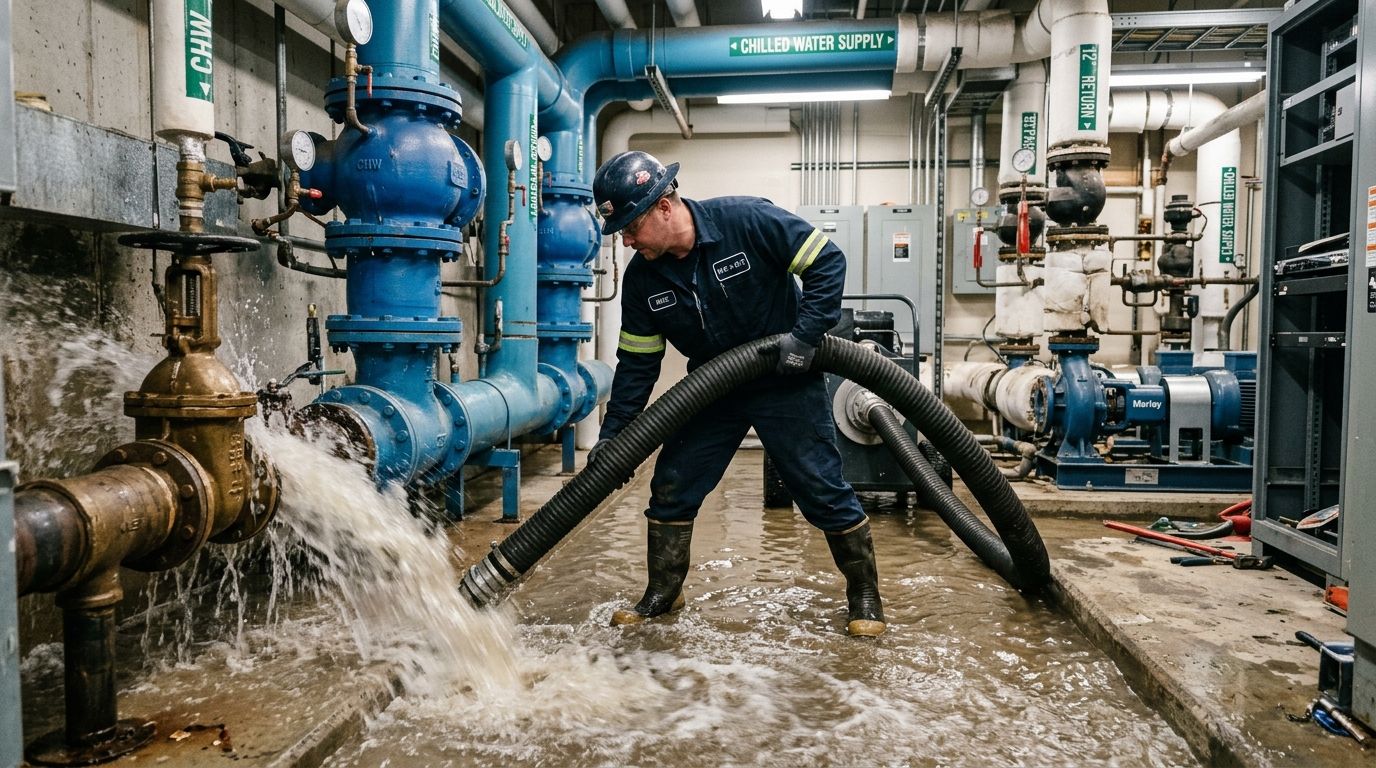
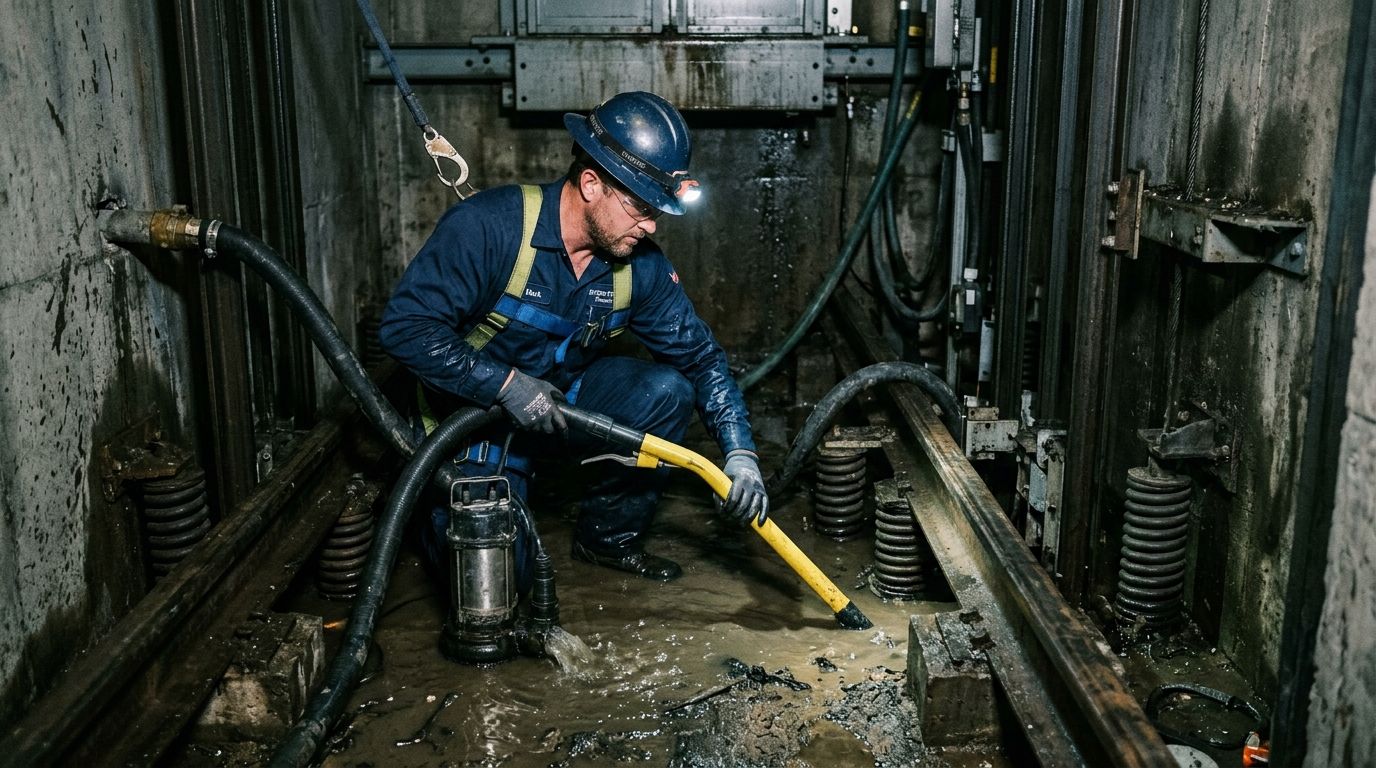
Pressurized commercial chilled water loops operating at 120-160 PSI release thousands of gallons per minute across penthouse machine room slabs, threatening catastrophic 480V traction motor short-circuits and drive cabinet burnouts. Water breaching elevator cable slots cascades down 15 to 25 stories of vertical hoistway shafts, saturating car top electronics, traveling cables, and landing door interlocks across multiple commercial tenant levels. Closed-loop hydronic water carrying 18 GPG municipal hard water salts, chemical biocides, and rust inhibitors leaves corrosive, conductive mineral scale across sensitive microprocessor dispatch boards and electromagnetic brakes. Tempe Sonoran Desert ambient temperatures reaching 115°F create an intense thermal chimney effect inside wet hoistways, triggering hazardous fungal spore colonization within 24 to 48 hours.

Service Definition & The IICRC Standard of Care
Professional tempe town lake high-rise elevator machine room chilled water leak cleanup is an engineering and environmental discipline adhering strictly to IICRC S500 protocols, not mere surface mopping. When structural plumbing failures strike in Maricopa County, certified emergency water extraction and thermal structural drying procedures must be deployed immediately. Whether triggered by high-pressure burst pipe emergencies, subfloor leaks, or commercial line ruptures, bound moisture rapidly penetrates concrete subfloors and wall framing. In the desert heat, delays trigger microbial proliferation requiring rapid mold remediation. Request damage assessment through our emergency assessment portal or request 30-minute dispatch across all Valley service areas.
Securing electrical feeds, inspecting load-bearing assemblies, and containing pathogens.
Stopping the intrusion source and erecting 6-mil plastic isolation containment airlocks.
31-HP truck-mount extraction, removing gallons exponentially faster than evaporation.
LGR dehumidifiers and HEPA air scrubbers driving grains per pound below 25 GPP.
Calibrated electronic pinless testing confirming baseline dry standards.
The Complete 6-Stage Restoration Roadmap
Our IICRC-certified crews execute a disciplined, scientific 6-stage protocol to stabilize and dry structural components:
Emergency Dispatch & Perimeter Isolation
30 to 60 minute arrival. Securing electrical shutoffs, evaluating structural loads, and erecting containment airlocks.
FLIR® Thermal Mapping & Baseline Scans
Infrared thermal scans detect trapped moisture behind walls and beneath concrete without invasive exploratory demolition.
High-Volume Bulk Extraction
31-HP truck-mount extraction units pump standing water away at hundreds of gallons per minute.
Controlled Selective Demolition
Precision flood cuts 12 to 24 inches above moisture lines, removing wet insulation and opening wall framing to dry airflow.
Thermodynamic Dehumidification
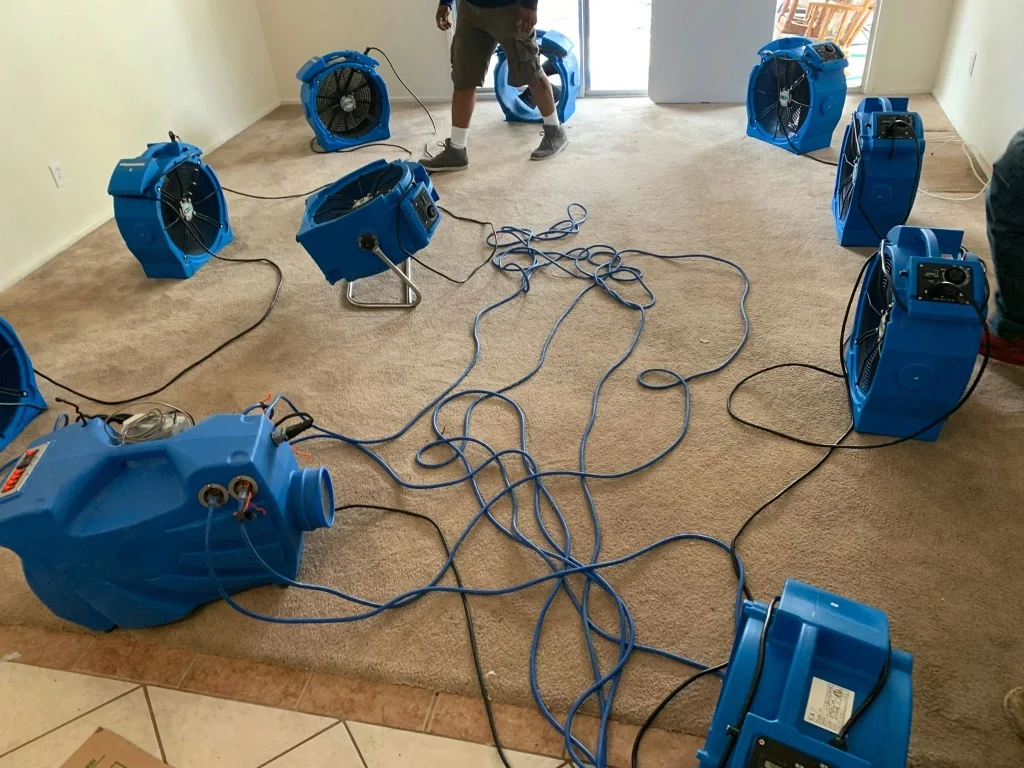
Industrial Low-Grain Refrigerant dehumidifiers pull deep trapped moisture from dense framing lumber and concrete slabs.
Antimicrobial Sanitization & Verification
EPA-registered botanical application (Benefect Decon 30) and calibrated moisture testing to issue an official dry certificate.
Specialized Equipment & Industrial Restoration Technology
Mitigating severe property damage requires industrial-grade technology capable of altering thermodynamic psychrometrics:
Truck-Mounted Extraction Rigs
31-HP engines producing 16+ inches Hg vacuum suction to evacuate bulk water rapidly into holding tanks.
Low-Grain Refrigerant Dryers
Pre-cooling heat-pipe systems driving ambient grains per pound below 25 GPP to draw deep trapped water out of framing.
HEPA Negative-Air Scrubbers
Hospital-grade 99.97% particulate filtration capturing microscopic fungal spores, soot, and biohazard aerosols.
FLIR® Thermal Scanners & Probes
Infrared thermography detecting evaporative cooling boundaries behind walls, combined with digital RF pinless scanners.
Professional Restoration vs. DIY Mitigation
Attempting DIY cleanup during a property disaster creates severe hidden liabilities:
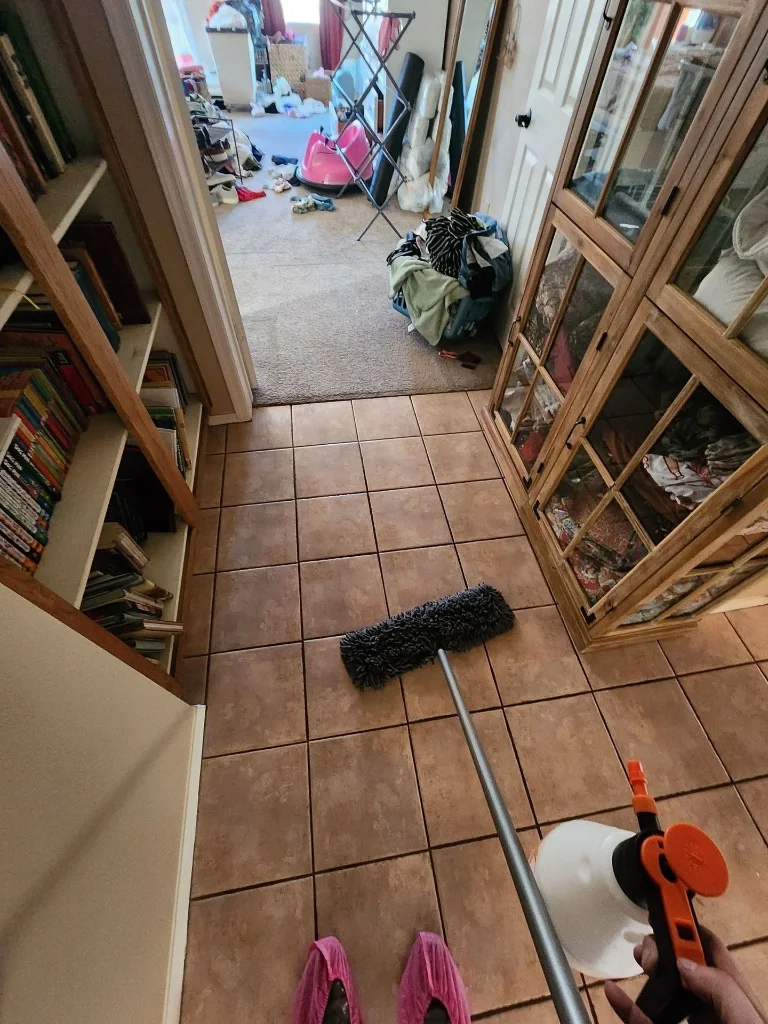
- Trapped Moisture: Surface drywall dries while moisture inside cavities triggers hidden mold blooms.
- Pathogenic Risks: Category 2 & 3 water contains bio-contaminants standard cleaners fail to kill.
- Insurance Denial: Insurers require daily psychrometric logs; lack of data causes claim disputes.
Transparent Upfront Itemized Pricing
Valley Restoration Pros operates with complete transparency:
- Free On-Site Assessment: Complete physical inspection before work begins.
- Upfront Itemized Estimates: Detailed line items calculated via industry-standard Xactimate.
- Zero Surprise Billing: No hidden charges or unauthorized repairs.
Certified tempe town lake high-rise elevator machine room chilled water leak cleanup Field Documentation
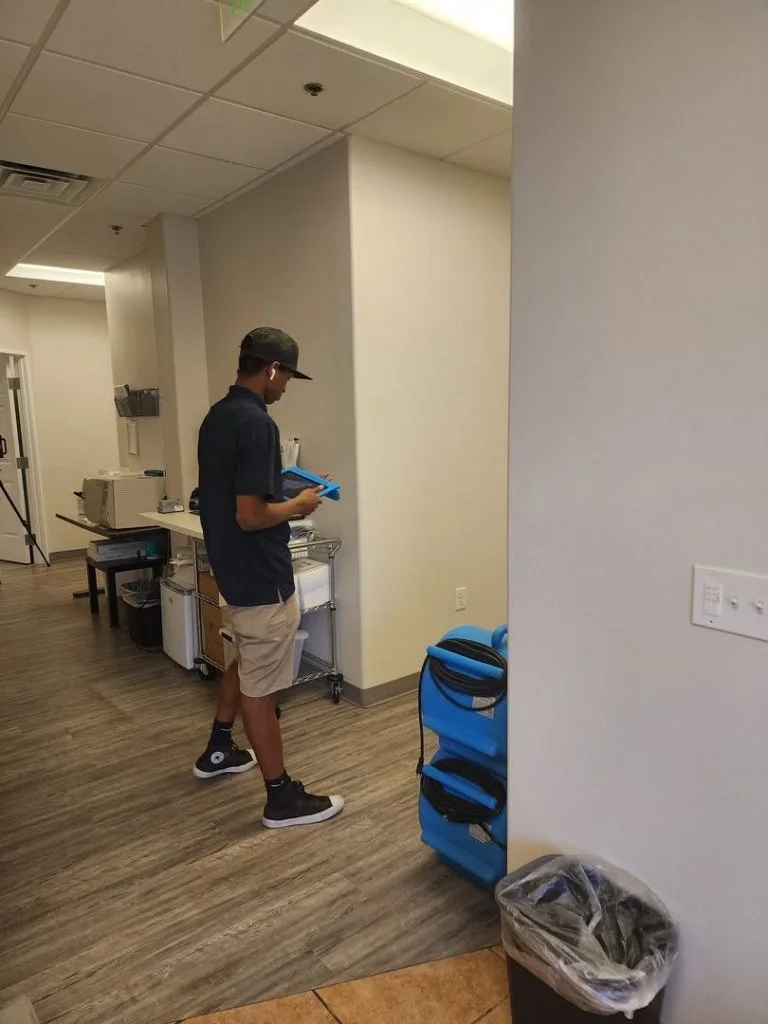
Every response performed by Valley Restoration Pros is documented through photographic and thermographic records:
Comprehensive tempe town lake high-rise elevator machine room chilled water leak cleanup Technical Manual & Operational Standards
Exhaustive engineering protocols, psychrometric calculations, geological multipliers, and step-by-step restoration standards for Maricopa County properties:
Executive Emergency Abstract: Tempe Town Lake High-Rise Elevator Machine Room Chilled Water Inundation & Hoistway Recovery
The premier urban skyline flanking Tempe Town Lake—anchored by iconic Class A corporate towers along Rio Salado Parkway, the historic Mill Avenue Bridge corridor, Hayden Ferry Lakeside, Novus Innovation Corridor, and the Marina Heights financial district—houses elite regional headquarters, international technology firms, software engineering hubs, and prominent commercial financial institutions. These prestigious multi-story commercial properties rely upon high-velocity, multi-car elevator banks powered by penthouse traction machine rooms (MR) or top-of-hoistway Machine-Room-Less (MRL) configurations. Operating directly above or adjacent to central cooling plants, rooftop chillers, and vertical chilled water distribution risers, these critical mechanical compartments are acutely vulnerable to catastrophic hydronic pipe failures.
Commercial chilled water systems circulating 42°F hydronic cooling fluids operate under continuous closed-loop hydrostatic pressures of 120 to 160 PSI to counteract extreme Sonoran Desert ambient temperatures that routinely exceed 115°F. When an overhead chilled water loop, mechanical coupling, expansion compensator, or rooftop fan coil unit (FCU) supply line ruptures within or above a penthouse elevator machine room, the discharge is violent and instantaneous. Pressurized chilled water discharges between 600 and 1,200 gallons per minute across structural machine room slabs. Because penthouse slabs are penetrated by floor cable slots, governor rope apertures, and secondary deflector sheave openings, thousands of gallons of chemically conditioned chilled water breach the floor barriers within minutes, transforming multi-story elevator hoistway enclosures into vertical conduits of cascading floodwater.
The operational and financial ramifications of a penthouse elevator machine room flood along Rio Salado Parkway are severe. High-speed gearless traction machines, 480V three-phase solid-state variable voltage variable frequency (VVVF) regenerative drives, and sensitive microprocessor dispatch controllers face immediate dielectric breakdown, permanent motor stator burnout, and galvanic corrosion. Water cascading down the hoistway enclosure saturates elevator cab roofs, door operator headers, electronic interlocks, traveling electrical cables, and counterweight track rails across 12 to 25 structural stories before inundating subterranean elevator pit sumps. Displaced corporate tenants face business interruption penalties exceeding $300,000 per operational day. Immediate intervention by certified commercial water damage specialists equipped for rapid hydronic isolation, high-voltage electrical desiccation, and precision hoistway decontamination is vital to preventing catastrophic capital replacement and preserving building life-safety operations.
Critical Penthouse Machine Room Flood Protocol Directives
- Emergency 480V Traction Electrical Disconnect: Instantly trip the primary 480V three-phase high-voltage knife-blade disconnect switches located at the machine room entrance to completely de-energize traction motors, brake coils, and drive cabinets before personnel make contact with standing water.
- Phase I Firefighters Recall Hoistway Parking: If safe and before electrical disconnect, activate Phase I Firefighters Emergency Operation (FEO) key switches to command all operational elevator cabs to descend away from the penthouse level to dry intermediate landings, preventing structural cab inundation.
- Hydronic Riser Zone Isolation: Actuate central Building Automation System (BAS) motorized isolation valves or manually close secondary chilled water butterfly valves feeding the penthouse mechanical mezzanine to halt continuous line pressure.
- Deploy Industrial Rapid Extraction Assets: Contact Valley Restoration Pros at our 24/7 High-Rise Emergency Dispatch Hotline: (602) 847-9593. Our rapid deployment squads mobilize high-head submersible pumps, explosion-proof extraction units, and trailer-mounted desiccant systems within 30 minutes across Tempe.
For commercial properties experiencing catastrophic multi-level water intrusion from overhead mechanical ruptures, our commercial divisions provide rapid-response emergency water extraction across high-rise corporate towers, educational facilities, and luxury hospitality venues throughout the Greater Phoenix metropolitan territory.
Anatomy of Rooftop Chilled Water Loop Pressures, FCU Riser Failures & Penthouse Inundation Dynamics
Commercial high-rise towers in the Tempe Town Lake urban center rely on closed-loop hydronic cooling systems designed to transport millions of BTUs of thermal energy away from interior office suites, executive conference centers, and high-density computing servers. Centrally located roof-mounted cooling towers and mechanical room chillers maintain heavy-tonnage circulation through 4-inch to 8-inch schedule 40 carbon steel or copper chilled water risers. Operating under pump head pressures ranging from 120 to 160 PSI, these supply and return loops distribute 42°F chilled water to dedicated fan coil units (FCUs) and computer room air handlers (CRAHs) positioned directly across mechanical mezzanines and penthouse floor spaces.
Mechanical failures within these overhead hydronic systems are driven by several overlapping physical stresses. Continuous operational vibration from heavy centrifugal chillers and rooftop cooling tower fans transmits severe cyclic harmonic oscillations through rigid mechanical pipe supports. Over years of high-volume seasonal cycling, these vibrations induce metal fatigue along grooved Victaulic couplings, mechanical pipe roll grooves, threaded brass fittings, and flexible braided expansion joints. Furthermore, water hammer events—caused by rapid motorized two-way control valve closures or sudden circulation pump staging during peak summer afternoon cooling demand swings—generate destructive transient pressure spikes exceeding 250 PSI.
When a mechanical coupling separates or an aging expansion joint ruptures above an elevator machine room slab, the physical result is a high-volume deluge. Unlike domestic municipal water lines that discharge potable water, closed-loop hydronic chilled water contains heavy concentrations of chemical additives. Commercial HVAC water treatment programs introduce chemical corrosion inhibitors such as sodium nitrite, sodium molybdate, and tolyltriazole, alongside concentrated biocidal agents like isothiazolinones and glutaraldehyde. Blended with municipal makeup water that carries extreme hardness (exceeding 18 grains per gallon in Tempe), this discharge is chemically aggressive, electrically conductive, and corrosive to structural and electrical components.
Because high-rise penthouse elevator machine room floors are built from reinforced cast-in-place concrete or post-tensioned slabs designed primarily for structural load support rather than fluid containment, they rarely feature secondary elastomeric waterproofing membranes or perimeter retention curbing. When pressurized lines rupture, floodwater rapidly spreads across the flat concrete slab, flooding traction machine beds, pooling inside floor-mounted electrical transformer housings, and pouring unrestrained into hoistway cable slots. If an unmonitored riser pipe fails during non-business hours, thousands of gallons of water discharge before isolation, requiring immediate industrial burst pipe repair protocols and mechanical containment procedures.
Vertical Hoistway Cascading Dynamics: Multi-Level Penetration, Cab Inundation & Vestibule Flooding
The structural architectural geometry of a modern commercial high-rise elevator shaft functions as an unobstructed vertical chimney spanning hundreds of feet. When chilled water escapes a penthouse machine room through rope slots, governor openings, and secondary sheave penetrations, gravity accelerates the water column down the interior perimeter of the hoistway enclosure. The vertical flume impacts structural steel divider beams, counterweight rail assemblies, cab traveling cables, and hoistway wall surfaces, atomizing into high-velocity mist and continuous water curtains that cascade across 15 to 25 structural levels.
Elevator cabs positioned along the hoistway travel path bear the initial direct physical brunt of this falling water column. The structural exterior cab roof—housing the car top inspection station, emergency escape hatch, ventilation blowers, electronic leveling optical sensors, and door operator motors—is rapidly submerged. Water penetrates electrical junction enclosures and flows through cab roof panel joints into the passenger compartment interior. High-end architectural finishes within Class A office elevators, including acoustic fabric wall panels, wood veneers, illuminated drop ceilings, and emergency phone communication stations, suffer immediate saturation, warping, and electrical short-circuiting.
As the cascading floodwater impacts landing door sills at each intermediate floor elevation, lateral migration initiates. Chilled water pools inside structural landing sill track grooves, exceeding sill retainers and overflowing outward into finished elevator lobbies and corporate tenant corridors. From the 15th floor down to the 2nd floor, water migrates laterally beneath demising walls, saturating commercial carpet tiling, drywall partition assemblies, and underfloor electrical trenches. Simultaneously, water finding openings around landing door frames drips into false ceiling plenums below, destroying mineral fiber acoustic tiles, soaking recessed LED lighting fixtures, and flooding executive workstations across lower floors.
Without immediate containment and moisture extraction, the water running down structural elevator track rails washes away heavy lubricating greases, precipitating rapid oxidation along structural steel T-rails, counterweight frames, and structural buffer brackets. Mitigating this widespread vertical and lateral devastation requires immediate deployment of industrial structural drying protocols, high-velocity evaporation air movers, and specialized high-rise floor containment barriers to arrest migration across finished tenant suites.
Traction Machine Restoration: AC Gearless PMSM Motors, Solid-State Drives & Controller Recovery
Elevator machine rooms house the mechanical and electronic heart of high-rise vertical transportation systems. High-speed passenger elevators in Tempe Town Lake towers are propelled by advanced AC gearless permanent magnet synchronous motors (PMSM) or heavy-duty geared traction machines operating on 480V three-phase alternating current. These precision machines feature tightly wound copper stator coils, specialized high-dielectric varnish insulation, high-resolution optical rotary encoders, and dual-plunger electromagnetic safety brakes. Flooding these components with conductive, chemically treated chilled water poses severe risks of catastrophic winding insulation breakdown, phase-to-ground flashovers, and permanent motor destruction.
Adjacent to traction motors stand computerized dispatch controllers and solid-state Variable Voltage Variable Frequency (VVVF) regenerative motor drives. These electronic enclosures contain sensitive microprocessor motherboards, Silicon Controlled Rectifier (SCR) power bridges, insulated-gate bipolar transistors (IGBT modules), and bank capacitors. When flooded, water carries dissolved mineral salts and chilled water corrosion inhibitors across printed circuit boards (PCBs), creating conductive bridges across high-density circuit traces. If energized while damp, immediate arc-flash destruction occurs. Even when de-energized, lingering moisture triggers rapid galvanic corrosion along component leads, gold connector pins, and solder joints within hours.
Valley Restoration Pros employs specialized industrial electrical desiccation protocols designed specifically for high-rise commercial elevator equipment. Our recovery methodology incorporates non-destructive moisture extraction, precision infrared thermal mapping, and staged dielectric insulation testing utilizing calibrated megohmmeters (Megger diagnostics). Stator windings undergo controlled 500V and 1,000V direct current insulation resistance testing to establish baseline dielectric integrity. In accordance with IEEE and NEMA standards, clean dry motor windings must demonstrate minimum insulation resistance values exceeding 50 to 100 Megaohms before re-energization can be safely authorized.
Simultaneously, solid-state controller cabinets and drive modules are subjected to specialized circuit board decontamination. Technicians utilize anhydrous isopropyl solvent flushes, ultrasonic contact cleaning, and continuous low-dewpoint desiccant air streams to eliminate conductive chemical residues without damaging delicate silicon dies or optical sensors. Concurrently, emergency extraction squads dewater the hoistway bottom using certified commercial elevator pit water extraction procedures, preventing oil-contaminated floodwater from corroding lower car buffers and compensation sheaves.
Phoenix & Tempe Climatic Multipliers: 18 GPG Hard Water Mineralization & 115°F Heat Incubation
Commercial building restoration in the Sonoran Desert presents severe environmental challenges that do not exist in temperate climates. The municipal water supply serving Tempe, Phoenix, and Scottsdale is drawn from the Salt River, Verde River, and Central Arizona Project (CAP) aqueducts. This water exhibits extreme mineral hardness, routinely testing at 18 to 22 grains per gallon (GPG) of dissolved calcium carbonate, magnesium sulfate, and silica. In closed-loop commercial cooling towers and hydronic systems, continuous evaporation cycles concentrate these mineral ions even further, producing a dense chemical cocktail that accelerates scaling and electrolytic corrosion upon discharge.
When this mineral-laden chilled water floods an elevator machine room, rapid evaporation triggered by warm ambient desert air causes instant mineral crystallization. Dense chalky deposits of calcium carbonate and silica precipitate across traction sheave grooves, electromagnetic brake plungers, directional relays, and optical shaft positioning tape. Unlike clean rainwater or pure condensation, dried hydronic scale forms a tenacious, abrasive, and electrically semi-conductive encrustation that binds mechanical linkages, creates parasitic electrical leakage paths across switchgear, and damages precision motor bearings if not professionally neutralized and removed with specialty chemical chelating agents.
The thermal reality of the Phoenix metropolitan summer represents another severe multiplier. Between May and September, ambient outdoor temperatures across the Salt River Valley consistently exceed 110°F to 115°F. Rooftop penthouses and non-conditioned elevator machine rooms frequently record ambient interior temperatures of 130°F to 140°F when HVAC cooling loops are shut down following a pipe rupture. High thermal energy combined with thousands of gallons of standing water creates an instant, high-humidity incubation chamber inside elevator shafts. Under these psychrometric conditions, microbial spore germination and toxic mold colonization on drywall, acoustic insulation, and elevator cab finishes accelerate from standard multi-day timelines into an aggressive 24 to 48-hour incubation window.
Furthermore, geological ground conditions along the Tempe Town Lake basin and Rio Salado riverbed feature deep strata of expansive clay soils intermixed with hard calcium carbonate caliche deposits. Seasonal monsoon storm runoff and high subterranean water tables exert immense hydrostatic pressure against subterranean elevator pit foundations, compounding the complexity of water extraction when floodwater cascades down from penthouse levels. In cases where foundation cracking or subsurface pipe damage occurs, our specialized teams execute comprehensive slab leak water damage restoration to ensure the sub-grade structural envelope remains fully watertight.
Regulatory Mandates: ASME A17.1 Safety Code & ADOSH Elevator Division Re-Commissioning
Vertical transportation systems in the State of Arizona are governed by stringent life-safety regulations enforced by the Arizona Division of Occupational Safety and Health (ADOSH) Elevator Safety Section, incorporating the American Society of Mechanical Engineers (ASME) A17.1 / CSA B44 Safety Code for Elevators and Escalators. Under ASME A17.1 Rule 8.6.11 and ADOSH state administrative mandates, any elevator installation that has been exposed to standing water, high-pressure hydronic discharge, or significant moisture intrusion must be immediately placed out of service, mechanically locked out, and tagged with an official Out-of-Service Red Tag until comprehensive forensic inspection and formal recertification are completed.
Re-energizing or operating a flood-impacted elevator without passing formal recertification is a severe regulatory violation that invalidates commercial property liability insurance policies and exposes building ownership to crippling administrative fines and premises liability litigation. Flooded hoistway enclosures present grave mechanical and electrical risks, including brake slip caused by contaminated brake drums, failure of terminal stopping switches, short-circuiting of door safety interlocks, and sudden brake lockup during high-speed travel.
A critical regulatory mandate under ASME A17.1 concerns the mandatory inspection and condemning criteria for elevator suspension wire ropes and traveling cables. Steel hoist ropes consist of high-carbon steel strands twisted around an internal natural fiber core (such as sisal) or an independent wire rope core (IWRC). When soaked in chemically treated chilled water, fiber cores absorb water and corrosive hydronic biocides, washing away factory internal lubricants. This induces accelerated internal core rust (rouge) that cannot be detected by external visual inspection alone. Under ASME A17.1 Section 8.6.3, wire ropes exhibiting moisture intrusion, core collapse, or crown wire corrosion must be condemned and completely replaced.
Valley Restoration Pros works in direct alignment with certified Qualified Elevator Inspectors (QEI-1), licensed elevator maintenance contractors (such as Otis, Schindler, TK Elevator, and Kone), and ADOSH jurisdictional safety officers. We deliver the forensic drying, insulation resistance validation, and decontamination data required by inspectors to sign off on formal safety recertification. For building owners seeking comprehensive regional disaster recovery across the East Valley, our teams deliver certified mitigation for commercial properties suffering severe Tempe water damage and structural system compromises.
First-Hour Rapid Triage: Emergency Power Isolation & Penthouse Containment Procedures
The initial sixty minutes following a commercial chilled water riser rupture represent the critical window that determines whether high-rise elevator machinery can be salvaged through non-destructive restoration or must be condemned at a cost of millions of dollars. Upon discovering water intrusion inside a penthouse machine room or observing water pouring down hoistway landing doors along Rio Salado Parkway, high-rise facility managers, chief building engineers, and security personnel must immediately execute decisive first-hour triage procedures.
The immediate primary life-safety priority is total electrical de-energization. Personnel must never enter a flooded elevator machine room without first isolating primary 480V three-phase electrical disconnects located in the dry corridor or main mechanical electrical switchgear room. Standing water in contact with 480V traction motor supplies, energized drive buses, or 120V cab lighting feeds creates fatal electrocution hazards and explosive arc-flash potentials. Once primary power is locked and tagged out (LOTO), auxiliary power supplies, uninterruptible power supply (UPS) emergency battery backup banks, and emergency generator transfer circuits dedicated to vertical transportation must be systematically isolated.
Simultaneously, mechanical staff must isolate hydronic flow by actuating pneumatic or motorized butterfly valves on the chilled water supply and return risers feeding the penthouse zone. If automated Building Automation System (BAS) valves fail to seat completely due to hard water scale buildup, manual chain-wheel gate valves must be closed and secondary mechanical drain valves opened to relieve hydrostatic head pressure trapped in the riser column. Rapid containment must then be established at the penthouse slab level. Technicians deploy weighted polyurethane flood containment berms, magnetic rubber drain covers, and sorbent boom barriers around open cable slots, governor rope floor thimbles, and secondary sheave openings to halt the vertical cascade into the hoistway enclosure.
Immediate Commercial High-Rise Dispatch Emergency Protocol
Valley Restoration Pros operates a dedicated 24/7 Commercial Large-Loss Response Squad stationed minutes from Tempe Town Lake. For rapid emergency response, immediate mechanical room isolation, and rapid deployment of trailer-mounted extraction units:
To coordinate immediate dispatch of certified commercial large-loss project managers, industrial hygienists, and moisture mitigation squads directly to your commercial high-rise tower, commercial property owners can instantly contact us for rapid emergency mobilization.
Industrial Water Extraction: High-Head Vacuum Recovery & Subterranean Pit Dewatering
Removing high volumes of standing water from a high-rise structure requires dual-elevation extraction engineering. Water must be removed simultaneously at the uppermost penthouse machine room elevation and at the lowest subterranean elevator pit level, which in high-rise buildings along Rio Salado Parkway may be positioned 150 to 300 feet below grade within multi-level underground parking garages. Standard commercial portable extractors lack the hydrostatic lift and CFM capacity required to manage water columns across extreme vertical elevations.
Valley Restoration Pros deploys a fleet of industrial truck-mounted vacuum recovery units equipped with positive-displacement rotary lobe blowers capable of maintaining 16 inches of mercury (inHg) vacuum lift across vertical runs exceeding 25 stories. In penthouse machine rooms, technicians utilize weighted commercial squeegee extraction wands and floor-scrubbing vacuum attachments to extract standing water from concrete depressions, cable raceways, transformer troughs, and traction bedplates. Every gallon removed at the penthouse slab level eliminates another gallon that would otherwise cascade down the hoistway.
Concurrently, extraction squads enter the subterranean elevator pit under strict OSHA Confined Space Entry procedures (29 CFR 1910.146). Hoistway pit extraction presents complex environmental challenges because the descending floodwater washes down decades of heavy petroleum-based lubricants, hydraulic oils, and rail greases from structural steel components. Standing water collected inside elevator pit sumps becomes heavily contaminated with hydrocarbons, classifying it as a regulated hazardous liquid under Arizona Department of Environmental Quality (ADEQ) clean water statutes.
Pumping petroleum-contaminated elevator pit water directly into municipal storm drains or sanitary sewer lines is illegal and subject to severe environmental enforcement penalties. Our response teams deploy explosion-proof pneumatic diaphragm pumps and mobile oil-water separation filtration units to separate hydrocarbons and heavy grease from the water column before licensed transport to certified disposal facilities. For complex commercial properties interconnected with subterranean infrastructure, our teams execute similar protocols seen during a subterranean campus utility tunnel chilled water flood mitigation, safeguarding sensitive underground utilities and high-voltage power conduits.
Psychrometric Engineering: High-CFM Desiccant Dehumidification & Hoistway Airflow Dynamics
Drying an elevator hoistway enclosure and its associated penthouse machine room represents a Class 4 water intrusion scenario under IICRC S500 Standards for Professional Water Damage Restoration. Class 4 drying environments consist of deeply bound moisture trapped within low-porosity, low-permeance materials, including reinforced concrete elevator core shear walls, structural steel I-beams, post-tensioned slabs, motor copper windings, and high-density traveling cable sheathing. Standard commercial Low-Grain Refrigerant (LGR) dehumidifiers are physically incapable of achieving the extreme vapor pressure differentials required to extract moisture from dense concrete enclosures and electrical machinery.
To achieve rapid, non-destructive moisture extraction, Valley Restoration Pros deploys industrial trailer-mounted desiccant dehumidifiers utilizing active silica gel adsorption rotors. These high-capacity units process 2,000 to 5,000+ cubic feet per minute (CFM) of air, delivering ultra-dry supply air at single-digit humidity ratios—consistently measuring below 10 to 15 grains per pound (GPP) with relative humidity levels under 10%. By introducing this dry air into the machine room and upper hoistway, we generate a massive vapor pressure differential exceeding 1.2 to 1.5 inches of mercury (inHg), drawing moisture out of concrete pores, motor windings, and internal cab wall assemblies.
Psychrometric engineering in high-rise elevator shafts requires precise management of airflow dynamics to overcome the natural building "stack effect." In the hot Sonoran Desert summer, the temperature differential between outdoor air and conditioned indoor air causes high-velocity downward or upward air drafts within vertical shafts. Our psychrometric engineers deploy high-pressure lay-flat ductwork to route desiccant supply air directly to the uppermost penthouse machine room, while establishing controlled exhaust points at lower hoistway landings. This positive-pressure dry air curtain forces moist air downward through the shaft and out through HEPA-filtered relief ports, eliminating humidity without driving moist air into occupied tenant floors.
Technicians record comprehensive psychrometric data every twelve hours, tracking grains per pound depression, ambient temperature, relative humidity, and surface temperature dew point deltas. Our high-velocity desiccant methodologies mirror those deployed during a massive Tempe Town Lake commercial high-rise chilled water loop flood cleanup, ensuring that multi-story commercial properties return to strict dry standards within optimal recovery timelines.
Mechanical Component Restoration: Electromagnetic Brakes, Deflector Sheaves & Hoist Cables
Restoring an elevator machine room after a high-pressure chilled water flood requires meticulous mechanical decontamination beyond bulk water removal. Precision traction mechanisms depend upon exact tolerances, clean friction surfaces, and specialized lubricants that are destroyed when saturated with chemically treated hydronic fluid. Chief among these critical assemblies is the elevator machine electromagnetic brake system, which serves as the primary mechanical holding and emergency stopping device under ASME A17.1 safety standards.
When floodwater penetrates electromagnetic brake assemblies, water enters the solenoid coil housing and saturates the brake shoes and brake drum contact surfaces. Chemical biocides, corrosion inhibitors, and suspended pipe sediments form a slick, glazed film across the brake lining material, severely reducing coefficient of friction. Furthermore, residual moisture triggers flash rusting along machined steel brake drum faces within hours. Our mechanical restoration technicians perform controlled disassembly of brake housing covers, inspect electromagnetic coil insulation integrity, and execute precision chemical decontamination of brake shoe linings. Brake drums undergo micro-abrasive polishing to eliminate flash rust and restore specified surface finishes without altering drum concentricity.
Secondary deflector sheaves, overhead governor sheaves, and machine drive bearings also require detailed rehabilitation. Water cascading through floor slots enters sheave shaft bearing housings, emulsifying high-pressure bearing grease and precipitating micro-pitting along hardened steel raceways. Technicians flush bearing cavities with moisture-displacing dielectric solvents, perform vacuum drying, and repack bearing housings with manufacturer-specified synthetic high-temperature greases. Deflector sheave wire rope grooves undergo non-destructive magnetic particle inspection to verify that water impact and thermal contraction have not induced micro-fissures in cast iron sheave rims.
For steel suspension wire ropes that pass initial non-destructive condemning evaluations, technicians apply high-pressure air knives to strip surface water from cable valleys, followed by the application of specialized water-displacing rope dressing compounds that penetrate to the internal wire strands. This intensive mechanical rehabilitation is conducted alongside commercial piping repairs, reflecting the high-precision procedures executed during commercial chiller pipe flood restoration across high-tonnage corporate physical plants.
IICRC S520 Microbial Remediation: Preventing Vertical Hoistway Chimney Mold Amplification
A major risk accompanying elevator hoistway flooding in hot desert environments is the rapid incubation and structural spread of fungal mold spores. In a multi-story commercial high-rise, the elevator shaft functions as an enormous vertical air conduit. Thermal buoyancy and air currents created by moving elevator cabs create continuous vertical airflow drafts, commonly known as the stack or chimney effect. If microbial proliferation takes hold within the damp hoistway, this continuous air motion distributes millions of airborne mold spores directly into tenant elevator lobbies and occupied office suites on every upper floor.
Valley Restoration Pros executes strict microbial prevention and decontamination protocols in accordance with the IICRC S520 Standard for Professional Mold Remediation. Moisture trapped behind acoustic insulation bats, drywall shaftliner panels, and elevator pit wall surfaces creates an ideal environment for xerophilic and hydrophilic fungal species, including Aspergillus, Penicillium, Cladosporium, and Stachybotrys chartarum. Because outdoor ambient temperatures in Tempe frequently surpass 115°F during the summer months, interior unconditioned shafts reach optimal incubation temperatures, allowing fungal germination within 24 to 48 hours.
To arrest microbial growth, our certified technicians establish continuous negative-air pressure containment across the penthouse machine room and all hoistway landing door perimeters. Industrial HEPA air filtration scrubbers processing thousands of CFM maintain 99.97% particulate capture efficiency down to 0.3 microns, preventing fungal spore dispersal into corporate tenant corridors. Saturated non-structural materials, such as wet acoustic soundproofing fiberglass and porous cab wall padding, are safely removed under controlled containment and bagged for disposal.
All exposed concrete shear walls, structural divider beams, and hoistway steel assemblies are treated with EPA-registered, hospital-grade antimicrobial biocides applied via Ultra-Low Volume (ULV) cold fogging technology. These broad-spectrum botanical formulations neutralize fungal spores, eradicate bacteria, and eliminate damp organic odors without releasing toxic volatile organic compounds (VOCs) into tenant air supply systems. For commercial high-rises experiencing environmental contamination, our certified microbial divisions provide comprehensive mold remediation and post-remediation verification clearance testing.
Chemical Containment & Disposal: Closed-Loop Hydronic Additives & Contaminated Blackwater
Water damage restoration within commercial high-rise central mechanical spaces cannot be treated as a standard clean-water loss. Closed-loop hydronic chilled water systems are chemically closed environments intentionally dosed with industrial chemical formulations designed to protect massive steel chillers and copper coils from internal corrosion, mineral scaling, and biological fouling. When a catastrophic rupture occurs, thousands of gallons of this chemically loaded fluid are released into public and mechanical building compartments.
Primary chemical constituents in commercial chilled water include heavy concentrations of sodium nitrite (often maintained at 800 to 1,200 parts per million), sodium molybdate, aromatic azoles such as tolyltriazole, and polymeric dispersants. In addition, closed hydronic systems incorporate industrial microbiocides, including quaternary ammonium compounds, isothiazolinones, and glutaraldehyde. When this chemical fluid cascades down through an elevator hoistway, it washes down heavy lubricating greases, hydraulic petroleum residues, and decades of accumulated brake dust and industrial particulates.
Under IICRC S500 standards, this wastewater classification immediately escalates to Category 2 (significant chemical contamination) or Category 3 (blackwater containing heavy hazardous industrial contaminants). Discharging this wastewater into municipal storm sewers along Tempe Town Lake violates federal Clean Water Act provisions and Arizona Department of Environmental Quality (ADEQ) industrial discharge standards. Runoff into municipal storm sewers risks heavy environmental penalties, regulatory investigations, and mandatory environmental remediation.
Valley Restoration Pros maintains certified hazardous materials containment and waste handling protocols. All extracted hydronic and hoistway pit effluent is pumped into dedicated poly containment holding tanks or vacuum tanker trucks. Water samples undergo field pH, hydrocarbon, and chemical screening before being transported to licensed industrial wastewater treatment facilities for legal neutralization and disposal. For properties facing severe contamination from building sanitary or industrial wastewater breaches, our certified response teams deliver comprehensive sewage cleanup and biohazard extraction services across Maricopa County.
Penthouse & Rooftop Restaurant Drainage Interceptors: Preventing Cross-System Inundation
Modern mixed-use Class A commercial developments flanking Tempe Town Lake frequently combine executive corporate offices with premier rooftop restaurants, penthouse hospitality lounges, and executive dining facilities. These high-elevation culinary venues operate specialized commercial plumbing systems, including dedicated kitchen grease waste drainage lines, commercial dishwashing booster heaters, and rooftop gravity grease interceptors or internal hydromechanical grease interceptor tanks.
When a major chilled water loop rupture floods a penthouse mechanical mezzanine, uncontrolled water volumes frequently compromise surrounding utility chases and plumbing penetrations. Floodwater pooling on uncurbed penthouse slabs can enter floor cleanouts, overflow into kitchen floor sink drains, or penetrate vertical drainage chases carrying commercial culinary wastewater. If hydronic water enters open grease trap vents or drainage pipes, sudden hydraulic overloading can cause grease interceptors to back up, releasing hot fats, oils, grease (FOG), and high-temperature blackwater across penthouse kitchen floors and adjacent elevator vestibules.
Valley Restoration Pros implements multi-system environmental containment protocols to prevent cross-contamination between mechanical floodwaters and commercial kitchen plumbing infrastructure. Our commercial specialists immediately isolate kitchen drainage connections, inspect floor drain backwater prevention valves, and deploy mechanical pipe stoppers in affected utility chases. Technicians inspect adjacent sanitary stacks and kitchen waste lines for structural integrity and pressure balance to ensure that commercial kitchen grease does not infiltrate flooded elevator shafts.
If cross-contamination occurs between mechanical floodwaters and commercial kitchen fats, oils, and grease, specialized biohazard decontamination and grease extraction protocols are immediately deployed. Our commercial teams provide rapid containment and remediation mirroring the complex procedures executed during a commercial high-rise grease interceptor backup, restoring hygiene, commercial plumbing flow, and air quality standards across high-density hospitality facilities.
Real-World Case Study: 18-Story Rio Salado Parkway Corporate Center Penthouse Catastrophe
In mid-July, during an extreme Tempe heatwave with outdoor afternoon temperatures reaching 116°F, an 18-story Class A corporate office tower located at the intersection of Rio Salado Parkway and Mill Avenue suffered a catastrophic hydronic disaster. At 3:15 AM on a Saturday, a 3-inch high-pressure chilled water loop expansion joint located on the mechanical penthouse mezzanine ruptured violently under 145 PSI line pressure. The mechanical mezzanine was situated directly above the main penthouse elevator machine room serving Bank A, which housed four high-speed gearless traction passenger elevators.
Before automated building automation alarms alerted off-site engineering personnel and emergency manual isolation was achieved, an estimated 4,500 gallons of 42°F chemically treated chilled water discharged across the penthouse slab. The floodwater submerged the machine room floor to a depth of four inches, flooding two 480V traction motor stator housings, two solid-state VVVF drive cabinets, and the master microprocessor dispatch controller console. Water quickly poured into rope slots and governor floor penetrations, cascading down all four vertical hoistways across 18 corporate office levels, saturating car tops and traveling cables before pooling in the P3 subterranean parking elevator pit.
Valley Restoration Pros was dispatched via our 24/7 priority commercial emergency line and arrived on site within 22 minutes. The incident commander immediately confirmed that building engineering had completed 480V electrical Lockout/Tagout (LOTO) and isolated the hydronic supply. Extraction crews deployed heavy-duty truck-mounted extraction wands in the penthouse machine room while a second crew established confined-space extraction in the subterranean elevator pit, removing 4,100 gallons of contaminated standing water within 90 minutes. Technicians placed magnetic flood dams and sorbent booms around all rope slots to prevent further vertical migration.
Within three hours of arrival, an industrial trailer-mounted 5,000 CFM desiccant dehumidifier was positioned at grade level, ducting sub-10 GPP dry air directly up the exterior service chase to the 18th-floor penthouse and down through the hoistway shaft. Specialized warm-air desiccant drying enclosures were erected over the saturated gearless traction motors and drive cabinets. Baseline Megger insulation resistance testing on the flooded traction motors initially showed critical failure readings of 0.8 Megaohms. After 48 hours of continuous controlled desiccation, Megger testing verified insulation resistance recovery to 85 Megaohms, far exceeding the 50 Megaohm safety threshold.
Certified Qualified Elevator Inspectors (QEI-1) and ADOSH elevator safety officials completed formal safety evaluations on Tuesday morning. All four traction machines, solid-state drives, and traveling cables passed recertification without requiring motor rewinding or replacement. By avoiding capital motor replacement and weeks of downtime, Valley Restoration Pros saved the commercial property management firm over $1,850,000 in capital replacement costs and tenant business interruption penalties. To explore our comprehensive rapid-response coverage throughout the Valley, review our regional areas we serve.
Commercial Financial Transparency: Upfront Itemized Pricing & Comprehensive Insurance Claims Support
Navigating a large-loss commercial insurance claim following a high-rise mechanical water failure requires absolute financial clarity, exhaustive forensic documentation, and complete operational transparency. Commercial property management groups, institutional REIT asset directors, and corporate risk managers require accurate cost tracking without ambiguous billing practices. Valley Restoration Pros strictly upholds a transparent pricing and billing philosophy that protects our clients from financial surprises and facilitates rapid claim resolution with commercial insurance carriers.
We provide our commercial clients with a Free Comprehensive On-Site Damage Assessment immediately upon emergency arrival. Our senior commercial project managers inspect the flooded penthouse machine room, evaluate electrical equipment saturation, trace vertical hoistway water paths across tenant floors, and inspect subterranean elevator pit sumps. We utilize high-resolution FLIR infrared thermal imaging, calibrated moisture meters, and Megger electrical testing tools to quantify the exact scope of water intrusion before formulating a recovery plan.
Before deploying industrial equipment or executing structural drying procedures, we provide Transparent Upfront Itemized Pricing Before Work Begins. All labor, extraction machinery, industrial desiccant trailer operations, antimicrobial sanitization, and specialized electrical desiccation protocols are itemized using standardized Xactimate commercial pricing schedules recognized and approved by major national commercial insurance underwriters. We make zero misleading promises regarding direct insurer billing; commercial property owners maintain full control of their claim with complete visibility into all proposed mitigation costs.
To ensure seamless insurance claim reimbursement, our forensic documentation department delivers Assistance with Detailed Claims Documentation & Psychrometric Moisture Logs. Every twelve hours, our technicians compile comprehensive drying progress reports containing psychrometric temperature, relative humidity, and grains per pound (GPP) depression metrics, alongside FLIR thermographic images and daily Megger dielectric insulation readings. This indisputable forensic audit trail proves that equipment drying was executed under professional engineering standards, defending the property owner against premature depreciation or denied claims.
Commercial facility directors, chief engineers, and property managers can utilize our interactive online estimation tool to calculate immediate commercial mitigation ranges by accessing our specialized cost estimator portal.
Frequently Asked Questions: Commercial Elevator Machine Room Chilled Water Leak Recovery
How quickly must a flooded elevator traction motor be dried to avoid permanent stator burnout?
Controlled thermal and desiccant drying must commence within 12 to 24 hours of water exposure to prevent irreversible dielectric breakdown. Commercial traction motor stator windings are insulated with specialized varnishes that absorb moisture when submerged or sprayed with chemically treated chilled water. If moisture remains trapped within copper winding bundles in the hot Arizona desert climate, copper oxidation and galvanic degradation permanently weaken insulation resistance. If an elevator motor is energized with insulation resistance below 50 Megaohms, an immediate phase-to-phase or phase-to-ground flashover occurs, melting winding coils and requiring a complete motor rewind or replacement costing $80,000 to $180,000 per machine. Controlled desiccation initiated within the first 24 hours achieves a 90%+ success rate in restoring factory dielectric resistance.
Are commercial elevator traveling cables salvageable after chemical chilled water saturation?
Salvageability depends on cable construction, immersion duration, and post-drying dielectric testing under ASME A17.1 safety parameters. Traveling cables consist of dozens of insulated electrical conductors, shielded communication pairs, and coaxial or fiber-optic lines bundled inside an outer neoprene or PVC jacket. If chemically treated chilled water containing biocides and corrosion inhibitors breaches cable end terminations or enters through jacket punctures, water migrates along internal conductors through capillary action (the wick effect). While exterior jackets can be dried, moisture trapped inside conductor bundles causes cross-talk, intermittent safety circuit tripping, and internal short-circuits. If high-voltage dielectric insulation resistance testing (Megger testing at 500V DC) indicates conductor-to-conductor or conductor-to-ground leakage, the traveling cable must be replaced under ADOSH elevator safety standards.
What is the technical difference between drying an overhead machine room (MR) versus a Machine-Room-Less (MRL) installation?
Overhead machine rooms (MR) are dedicated walk-in mechanical rooms located on the building roof or penthouse level above the hoistway, allowing technicians direct access to set up containment chambers, floor-mounted desiccant ducting, and electrical test arrays around traction machines and controllers. In contrast, Machine-Room-Less (MRL) configurations mount the gearless traction machine, deflector sheaves, and governor directly onto structural hoistway track rails inside the top of the elevator shaft, with the controller cabinet integrated into the top-landing door jamb. Drying an MRL system requires specialized OSHA Confined Space Entry procedures, hoistway scaffolding or car top staging, and customized pressurized lay-flat ducting delivering warm desiccant air directly into the uppermost hoistway enclosure while technicians work under strict fall-protection safety protocols.
How does closed-loop chilled water chemical treatment affect solid-state controller electronics?
Closed-loop chilled water contains chemical corrosion inhibitors such as sodium nitrite and sodium molybdate, alongside municipal mineral salts (18+ GPG in Tempe) and chemical biocides. When this water dries naturally on printed circuit boards (PCBs), surface-mount microprocessor chips, and power inverter modules (IGBTs), it leaves an abrasive, hygroscopic, and electrically semi-conductive chemical residue. This residue readily absorbs ambient moisture from the air, creating continuous micro-arcing, short-circuits, and galvanic corrosion across sensitive circuit traces. To salvage affected solid-state components, technicians must execute immediate de-energization, ultrasonic solvent baths using pure anhydrous isopropyl alcohol, precision contact cleaning, and complete vacuum desiccation before power is restored.
What documentation does commercial property insurance require to approve high-rise elevator water damage claims?
Commercial property insurance underwriters and forensic adjusters require comprehensive technical documentation demonstrating that drying and restoration conformed to IICRC S500 standards. Mandatory documentation includes: (1) Initial emergency dispatch logs and origin-of-loss forensic reports identifying the failed hydronic pipe, valve, or coupling; (2) Daily psychrometric logs recording ambient temperature, relative humidity, dew point, and grain depression (GPP) across every twelve-hour drying shift; (3) Infrared thermographic moisture maps showing wet versus dry boundaries within walls and slabs; (4) Certified Megger insulation resistance test logs recorded before, during, and after desiccation on all motor windings and power cables; (5) Qualified Elevator Inspector (QEI-1) and ADOSH inspection certificates; and (6) Standardized Xactimate itemized pricing invoices with certified hazardous waste disposal manifests for contaminated pit effluent.
Why is industrial desiccant dehumidification mandatory rather than standard commercial LGR dehumidifiers for elevator hoistways?
Standard commercial Low-Grain Refrigerant (LGR) dehumidifiers operate efficiently in Class 1 and Class 2 water losses involving porous drywall and carpet. However, a flooded elevator hoistway and machine room represent a Class 4 low-permeance drying environment dominated by reinforced concrete shear cores, structural steel, and tightly wound copper electrical windings. LGR units struggle to lower relative humidity below 30% or air grains below 35 GPP. In contrast, industrial desiccant dehumidifiers utilize chemical adsorption rotors capable of producing massive volumes of air at under 10% relative humidity and single-digit grains per pound (below 10 GPP). This ultra-low humidity creates the intense vapor pressure differential required to pull deeply bound water molecules out of dense concrete and motor insulation, accelerating drying by 300% to 500% and preventing catastrophic equipment replacement.
Verified Local Area Dispatch: Tempe, AZ
Official Geo-Coordinates: 33.4255° N, -111.94° W • Maricopa County
Related Specialized Emergency Restoration Services
Explore specialized rapid-response mitigation protocols across Greater Phoenix and Maricopa County:
Valley-Wide Emergency Response Service Coverage
Our mobile restoration fleet is dispatched across the entire Phoenix metropolitan region, providing rapid 30 to 60 minute emergency response: