

Valley Restoration Pros delivers 24/7 industrial emergency water extraction, thermal psychrometric drying, and structural mitigation across Phoenix and Maricopa County with guaranteed 30–60 minute rapid arrival. All protocols strictly adhere to IICRC S500 standards, featuring upfront itemized pricing and free on-site thermal moisture assessments. Call dispatch directly at (602) 847-9593.
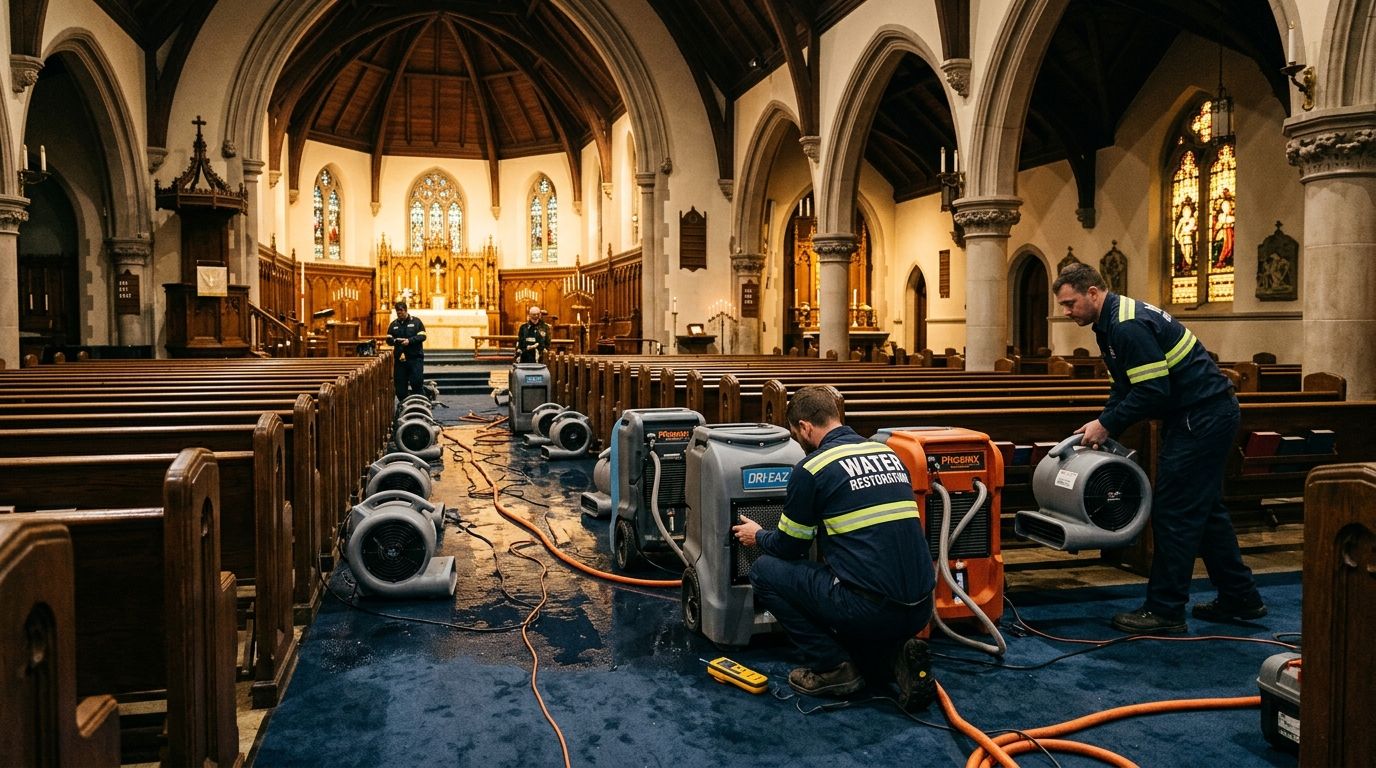
Immediate Incident Containment Protocol
- Shut off main water supply: Isolate mechanical riser valves, street curb meters, or supply manifolds immediately.
- Establish electrical safety: De-energize sub-floor circuits and submerged outlets before walking into affected zones.
- Avoid delay: 115°F desert summer ambient heat accelerates microbial spore incubation within 24 to 48 hours.
Free On-Site Assessment & Transparent Estimates
- Non-invasive thermal imaging: FLIR infrared scans map hidden water boundaries behind drywall and under concrete.
- Transparent itemized estimates: Industry-standard Xactimate line items prepared upfront with zero surprises.
- Rapid 30-to-60 minute dispatch: Mobile units fully equipped with heavy extraction pumps on active standby.
1. Executive Emergency Abstract: Sacred Facility Deluges & Fast-Track Sunday Service Restoration
churches, cathedrals, synagogues, and sacred worship centers across Greater Phoenix represent unique architectural masterworks characterized by cavernous vertical air volumes, complex acoustic engineering, irreplaceable heirloom furnishings, and deep community significance. When a catastrophic water event strikes a church sanctuary—whether triggered by a midnight baptistery immersion pool overflow, a pressurized fire sprinkler line rupture in 35-foot vaulted rafters, or a torrential monsoon roof drainage failure—the consequences threaten both historic building equity and the spiritual rhythm of the congregation. Facing scheduled Sunday morning worship gatherings, wedding ceremonies, and community outreach ministries, church leadership operates under an intense operational deadline to restore the sanctuary completely within 48 to 72 hours.
Sanctuary water damage mitigation is vastly more complex than standard commercial office restoration. Sacred spaces are filled with highly sensitive, porous, and irreplaceable materials: rows of solid red oak or mahogany pews anchored to concrete or sub-floor framing, elevated chancel and altar platforms clad in fine hardwoods, pipe organ swell chambers and delicate wooden tracker action mechanisms, multi-million-dollar digital mixing consoles, acoustic fabric wall diffusers, and historic stained-glass window perimeter framing. Traditional aggressive demolition methods—such as ripping out pews or stripping chancel platform paneling—inflict irreversible architectural devastation and cost hundreds of thousands of dollars in artisan millwork reconstruction.
In Phoenix’s punishing desert environment, the restoration challenge escalates rapidly. With summer ambient temperatures regularly exceeding 110°F, church sanctuaries with set-back or deactivated air conditioning systems experience severe vertical thermal stratification. Ambient air in vaulted ceiling peaks can easily reach 125°F while floor-level moisture evaporates into the cavernous air envelope, pushing indoor relative humidity above 85%. Under these stifling conditions, microbial spores germinate on damp pew fabric cushions, carpet underlayment, and organ leather bellows within 24 to 36 hours. Valley Restoration Pros deploys certified commercial emergency restoration task forces across Maricopa County within 30 to 60 minutes. Utilizing trailer-mounted industrial desiccant dehumidifiers, high-velocity vortex air-movement arrays, surgical negative-pressure wood floor drying mats, and zero-residue botanical antimicrobials (Benefect Decon 30), our teams stabilize sacred spaces quickly, preserve heirloom furnishings in place, and ensure that sanctuaries are fully certified and ready for Sunday worship.
This exhaustive technical document provides pastors, church trustees, facility elders, diocesan properties committees, and ecclesiastical facility directors with an authoritative blueprint for emergency water response, non-destructive hardwood and pipe organ preservation, IICRC S500 compliance, and meticulous commercial insurance documentation.
2. Anatomy of the Failure: Baptistery Overflows, Vaulted Fire Sprinklers & Chilled Water Risers
Sanctuaries feature distinctive mechanical systems engineered to support large weekend congregations while remaining dormant during weekdays. This cyclic operational profile creates specific hydraulic and mechanical vulnerabilities across church facilities:
- Baptistery Auto-Fill Float & Solenoid Valve Failures: Church baptisteries are large immersion pools holding between 500 and 1,500 gallons of heated water, typically positioned on elevated chancel platforms directly behind the pulpit. Most modern baptisteries utilize automated fill manifolds with mechanical float switches or electronic level sensors. In Phoenix, extreme mineral encrustation and calcium scale frequently bind the float arm or jam the electro-magnetic solenoid valve in the open position. When automated filling occurs overnight or ahead of weekend baptismal services, water overflows the baptistery rim. Pressurized water cascades down chancel steps, soaking choir risers, flooding pastoral offices, and pouring into main sanctuary aisles.
- High-Altitude Fire Sprinkler Line Freezes & Shock Ruptures: Many grand sanctuaries feature dry-pipe or pre-action fire sprinkler networks routed through unconditioned high-vault ceiling spaces. During intense winter cold snaps in the desert (where temperatures drop below freezing overnight), condensation inside dry-pipe branches can freeze and fracture brass fittings. Alternatively, sudden municipal water main pressure spikes or hydraulic shockwaves (water hammer) can shear threaded couplings 30 feet above the sanctuary floor, releasing hundreds of gallons per minute of black, stagnant sprinkler water across congregation seating before the riser control valve can be isolated.
- HVAC Fan Coil Unit (FCU) & Chilled Water Air Handler Overflows: To cool cavernous worship spaces, churches utilize large chilled-water air handling units mounted in attic catwalks or overhead utility chases. During humid monsoon weeks, these massive cooling coils condense tens of gallons of water per hour. Silt, airborne desert dust, and bacterial algae slime clog condensate drain traps, causing secondary overflow drain pans to fill and breach. Water pours through decorative acoustic plaster ceilings, staining historic woodwork and raining down upon audio/visual sound consoles and pews.
- Monsoon Roof Scupper & Internal Leader Pipe Blockages: Sanctuaries frequently feature complex architectural rooflines combining steep timber gables with low-slope perimeter parapets, decorative dormers, and internal rainwater drainage leaders. Haboob dust storms deposit heavy layers of desert silt and caliche dust on church roofs, which wash into primary drain strainers during sudden summer cloudbursts. When primary scuppers become dammed, hundreds of thousands of pounds of storm water accumulate on flat roof decks, eventually breaching roof membrane laps or penetrating clerestory window perimeters.
Because water follows gravity along structural floor slopes, sanctuary water quickly migrates under carpeting, collects around pew floor mounting stanchions, and saturates sub-floor expansion joints, requiring immediate forensic mapping and structural drying intervention.
3. Phoenix-Specific Environmental Multipliers: 18 GPG Scale, Soil Subsidence & Desert Heat
Sacred facilities in the Greater Phoenix area face an aggressive desert climate and challenging soil chemistry that significantly accelerate mechanical system failures and structural water degradation:
1. Extreme Municipal Water Hardness (18 to 22 Grains Per Gallon): Sourced from the Salt River, Verde River, and Central Arizona Project aqueducts, municipal water delivered to Phoenix churches contains between 300 and 380 parts per million of dissolved minerals. In baptistery immersion heaters and domestic supply lines, calcium carbonate and silica rapidly precipitate onto heating elements and valve seats, forming thick mineral scale. This mineral deposition causes automated water level sensors to misread, mechanical float pivots to seize, and copper pipe fittings to suffer localized pitting corrosion, resulting in catastrophic water breaches.
2. Expansive Caliche Clay Soil Subsidence & Foundation Heave: Many historic and contemporary church campuses across Phoenix, Scottsdale, and Mesa are built upon deep alluvial soils containing caliche hardpan layers and active smectite clay veins. During prolonged desert droughts, sub-slab soils desiccate and shrink, causing foundation settling under heavy masonry walls. When monsoon cloudbursts saturate the campus perimeter, these clays swell with immense force. This cyclical heave cracks concrete floor slabs, misaligns sanctuary foundation footings, and shears underground water main entries beneath fellowship halls and sanctuary naves.
3. The 115°F Thermal Stratification & Microbial Incubation Window: Church energy stewardship programs typically shut down sanctuary HVAC systems from Sunday afternoon until Wednesday evening or Saturday morning. In an unconditioned sanctuary during summer, ceiling peak temperatures soar to 125°F while floor levels reach 95°F. When standing water is introduced, the vast air volume acts as a high-heat greenhouse. Relative humidity spikes to tropical levels, and airborne fungal spores (Aspergillus, Cladosporium, Penicillium) germinate on saturated pew upholstery, hymnal paper pages, and carpet backings within 24 hours. The potential for toxic mold contamination is exponentially accelerated compared to temperate regions.
4. Monsoon Haboob Dust & Storm Water Intrusion: Intense summer dust storms (haboobs) blow tons of fine desert dust into church roof drainage systems and clerestory window gaskets. When followed by violent monsoon downpours, silt-choked roof drains back up, forcing water beneath parapet counter-flashings and through masonry mortar joints, sending floodwaters cascading down interior sanctuary walls.
4. Immediate Emergency First-Hour Protocol & Sacred Facility Safety Isolation
The actions taken by church custodians, trustees, or pastoral staff during the first hour following a water breach determine whether historic sanctuary appointments can be preserved or must be condemned. Immediate emergency triage is essential:
Mandatory First-Hour Sanctuary Emergency Checklist
- Audio/Visual & Chancel Electrical Power De-energization: Sanctuaries feature extensive stage wiring, sub-floor microphone conduits, motorized projection screens, and digital soundboard equipment operating on 120V/208V power. Water accumulating across the chancel stage or nave creates an immediate electrocution risk. Locate the main electrical distribution panel serving the sanctuary nave and sound booth, and immediately trip breakers. Do NOT step into standing water to reach panels.
- Isolate Domestic Water Supply or Baptistery Manifold: If the flood originates from the baptistery, close the dedicated quarter-turn ball valve located in the baptistery mechanical chase or pipe access room. If the source is unknown, immediately shut off the campus main backflow preventer valve at the street exterior vault.
- Protect Audio Mixing Consoles & Digital Instruments: Cover digital audio consoles, video switcher boards, grand pianos, and electronic keyboards with heavy plastic sheeting or waterproof tarps. Elevate floor-standing stage monitors, amplifier racks, and musical instruments off saturated carpeting.
- Isolate Pipe Organ Blower & Pipe Chambers: If the church features an acoustic pipe organ, do NOT turn on the organ blower. Operating the blower draws humid, water-laden air directly into windchests, swelling wooden slider seals and ruining delicate sheepskin valve leathers. Seal organ chamber intake vents with plastic sheeting.
- Deploy Commercial Emergency Dispatch: Immediately contact Valley Restoration Pros at (602) 847-9593. Inform dispatch that the incident involves a church sanctuary with solid hardwood pews and a pending Sunday worship deadline so we mobilize our specialized desiccant trailer units and wood drying task forces.
Never attempt to drag or pry water-soaked solid oak pews off concrete anchors without professional restoration guidance. Pews are precision-milled architectural assemblies secured with hidden expansion anchors; forcing them while wood fibers are swollen shears dowel joints, fractures side gables, and permanently destroys irreplaceable ecclesiastical craftsmanship.
5. Advanced Industrial Equipment Specifications: High-Volume Desiccant Trailers & Pew Drying
Drying a massive church sanctuary containing hundreds of thousands of cubic feet of open vertical space cannot be accomplished with standard residential dehumidifiers or small carpet blowers. It demands massive industrial drying power capable of managing high vertical cubic footage, overcoming thermal stratification, and extracting deep moisture from dense hardwood pews. Valley Restoration Pros deploys a specialized fleet of industrial equipment:
| Equipment Category | Industrial Model | Performance Specifications | Sanctuary Restoration Application |
|---|---|---|---|
| Trailer-Mounted Desiccants | Quest PowerDry 5000 / Phoenix D850 | 5,000 to 10,000 CFM dry air delivery; achieves < 10 GPP humidity ratio | Massive volume drying of 35-ft vaulted sanctuary ceilings and structural timber trusses |
| Negative-Pressure Wood Mats | Injectidry Floor & Pew Drying System | Hermetically sealed suction panels pulling 10 in-Hg negative vacuum | Non-destructive drying of solid oak pew seats, side gables, and chancel hardwood platforms |
| Commercial Truck-Mounts | Butler System / Sapphire Scientific 570 SS | 16 in-Hg dual-wand vacuum; 3,500 CFM; 120 GPM auto-pumpout | Deep extraction of standing water and saturated commercial carpeting across expansive aisles |
| Industrial LGR Dehumidifiers | Phoenix 250 MAX / Dri-Eaz LGR 7000XLi | 145 to 235 PPD @ AHAM; 400 CFM variable process air | Positioned in choir lofts, cry rooms, fellowship halls, and pastoral office suites |
| True HEPA Air Scrubbers | DefendAir HEPA 500 / Phoenix Guardian HEPA | 99.97% capture @ 0.3 microns; multi-stage activated carbon adsorption | Captures airborne dust, prevents mold spore circulation, and eliminates damp odor compounds |
| Botanical Antimicrobial | Benefect Decon 30 (EPA Reg. 84683-3-74771) | 100% botanical active thymol; 99.99% kill rate in 10 mins; zero synthetic chemicals | Hospital-grade sterilization with pleasant natural aroma, completely safe for congregants |
A major operational advantage of our trailer-mounted desiccant systems is their ability to generate massive volumes of dry air with single-digit GPP humidity ratios regardless of ambient temperature. In a vaulted 35-foot sanctuary, our technicians route 16-inch layflat ducting to the upper ceiling rafters to break the hot air inversion layer, circulating super-desiccated air downward across pews and carpet. This establishes a continuous descending dry-air vortex that accelerates evaporation without thermal turbulence.
6. IICRC S500 / S520 Step-by-Step Restoration Protocol for Sacred Spaces
Restoring a flooded sanctuary to immaculate, certified condition ahead of Sunday worship demands strict execution of IICRC S500 standards adapted for sacred architecture:
Phase 1: 3D Psychrometric Profiling & Thermal Moisture Mapping
Upon arrival, our Certified Master Water Restorer maps moisture across all three spatial dimensions. Technicians utilize FLIR T540 high-definition thermal imaging cameras to track sub-surface water migration along sloped sanctuary floors, behind altar reredos panels, and inside raised chancel platforms. Pinless radio-frequency moisture meters scan concrete slabs beneath carpeting, while non-destructive wood moisture meters measure exact moisture content (MC%) at multiple points along solid oak pews, communion rails, and pulpit millwork. Baseline psychrometric calculations (ambient temperature, relative humidity, dew point, GPP) determine exact desiccant CFM requirements.
Phase 2: High-Vacuum Deep Extraction Across Sanctuary Aisles
Technicians deploy heavy-duty truck-mounted extraction wands equipped with custom glides to evacuate standing water from sanctuary carpeting, tile, and stone chancel steps. Weighted deep-extraction machines (Hydro-X Xtractors) roll along rows between pews, compressing carpet pile and underlayment to extract up to 95% of trapped water in a single continuous pass. This aggressive mechanical extraction prevents delamination of commercial broadloom carpeting and eliminates standing water before capillary action can soak deeper into wooden pew bases.
Phase 3: Non-Destructive Pew Drying & Micro-Chamber Tenting
Solid oak pews absorb water through floor-contact stanchions and end gables. Rather than unbolting dozens of pews, technicians construct localized micro-containment drying chambers over pew rows using clear polyethylene sheeting. Negative-pressure Injectidry floor mats or targeted desiccant duct tubes deliver low-humidity air directly beneath pew seats. By pulling moisture out of the wood grain in a controlled psychrometric environment, we prevent wood checking, grain splitting, warp, and finish blushing, restoring pews to dry equilibrium standards (8% to 10% MC) completely intact.
Phase 4: Pipe Organ & Sensitive Audio Gear Microclimate Protection
Pipe organs and electronic sound booths require dedicated environmental stabilization. Technicians establish positive-pressure HEPA microclimates around pipe organ chambers and console enclosures. Clean, conditioned air with precisely regulated relative humidity (between 45% and 50% RH) is continuously circulated through organ chambers, preventing wooden chest expansion, reed detuning, and leather pallet rot while surrounding sanctuary spaces undergo rapid desiccant drying.
Phase 5: Botanical Antimicrobial Sanitization & Deodorization
All affected carpet, chancel sub-flooring, and pew stanchion perimeters are treated with Benefect Decon 30 botanical antimicrobial via ultra-low-volume (ULV) cold aerosol fogging. Botanical thymol neutralizes bacterial pathogens, prevents mold spore germination, and permanently eliminates musty damp odors, leaving behind a subtle, natural herbal aroma that creates a fresh, welcoming sanctuary environment for incoming worshippers.
Phase 6: High-Volume Desiccant Circulation & Sunday Service Verification
Our industrial desiccant trailer circulates thousands of CFM of ultra-dry process air throughout the sanctuary envelope, supported by strategic high-velocity axial air movers. Psychrometric parameters are recorded every 12 hours. Drying continues until concrete relative humidity drops below 75% and all structural timber reaches equilibrium moisture content. Equipment is demobilized, containment removed, and acoustic systems tested by Saturday afternoon, delivering a pristine, certified worship sanctuary ready for Sunday morning services.
7. Hyper-Local Phoenix Case Study: 6,800 Sq Ft Sanctuary Turnaround on E Camelback Rd
Incident Profile: E Camelback Rd & 16th St Historic Church Sanctuary
- Facility: Historic 6,800 sq. ft. sanctuary with 32-ft vaulted Douglas fir timber ceiling (seating capacity: 750)
- Location: E Camelback Rd & 16th St corridor, Central Phoenix / Camelback East, Maricopa County, AZ
- Failure Cause: Solenoid valve diaphragm failure on automated baptistery immersion heater supply line on Thursday at 11:30 PM
- Discharged Volume: Estimated 4,200 gallons of heated water across elevated chancel stage, choir stalls, and main nave seating
- Crucial Deadline: Saturday afternoon wedding rehearsal and three packed Sunday morning worship services (8:30 AM, 10:00 AM, 11:30 AM)
Emergency Response & 62-Hour Recovery Timeline:
Thursday 11:55 PM – Emergency Dispatch: Senior pastor arriving for early sermon preparation discovered water cascading down chancel steps. Valley Restoration Pros 24/7 commercial emergency dispatch received call at 12:02 AM Friday morning.
Friday 12:27 AM – Rapid On-Site Arrival (25-Minute Response): Industrial mobile desiccant trailer, two commercial flood extraction rigs, and a crew of eight Master Restorers arrived on scene. Technicians performed electrical lockout of chancel circuits and manually isolated the baptistery supply header within 5 minutes.
Friday 1:15 AM – Deep Carpet & Chancel Extraction: Dual truck-mounted extraction wands evacuated 3,800 gallons of standing water from sanctuary carpeting, choir risers, and communion rail areas by 4:00 AM. Hydro-X extractors rolled continuously along the 48 custom solid oak pew rows.
Friday 5:00 AM – High-Volume Desiccant Setup & Pew Micro-Chambers: Our Quest 5000 industrial desiccant trailer was commissioned outside. 16-inch supply ducts delivered 5,000 CFM of ultra-dry air (< 9 GPP) into sanctuary ceiling rafters, while secondary branches ducted air under poly-tented pew rows. Organ pipe chambers were sealed with positive-pressure HEPA filtration.
Saturday 10:00 AM (34-Hour Milestone): Relative humidity dropped from an initial 89% to 28%. Oak pew moisture content decreased from 28% MC down to 11.2% MC with zero grain checking or warping. Benefect Decon 30 botanical treatment applied to all surfaces.
Saturday 4:00 PM (40-Hour Milestone): Wedding rehearsal proceeded on schedule in the dry chancel area while desiccant ducting operated quietly in perimeter aisles.
Saturday 11:00 PM (47-Hour Milestone): Concrete slab relative humidity verified at 69% RH (dry standard met). Pew wood moisture stabilized at 8.4% EMC. Independent ATP testing confirmed hospital-grade biological surface cleanliness (< 20 RLU). Equipment demobilized and sanctuary detailed.
Sunday 7:30 AM – Worship Ready: Sanctuary doors opened for 8:30 AM worship service. Over 1,400 congregants attended morning services across three gatherings with zero disruption, zero damp odors, and 100% preservation of historic solid oak pews and chancel architecture.
“Walking into our sanctuary at midnight to see four thousand gallons of water pouring down from our baptistery was heartbreaking. We had a wedding scheduled for Saturday and over 1,400 people expected Sunday. Valley Restoration Pros arrived in 25 minutes with massive desiccant trailers. They saved every single one of our 48 historic oak pews without unbolting a single screw, protected our pipe organ, and had our sanctuary smelling fresh and completely dry for Sunday worship. Truly God’s blessing in a crisis.”
— Pastor David M., Senior Minister, Camelback East Corridor, Phoenix AZ
8. Pay-Per-Call Financial & Insurance Documentation Breakdown: Zero Billing Promises
Churches and religious non-profit organizations operate under prudent stewardship obligations, pastoral council oversight, and specialized ecclesiastical commercial insurance policies (such as Church Mutual, American Church Group, or Brotherhood Mutual). Handling property claims requires total transparency, meticulous recordkeeping, and professional integrity. Valley Restoration Pros maintains strict ethical standards: we never promise that insurance will pay 100% of restoration costs or claim that we bill insurance directly without church responsibility. Every ecclesiastical policy contains specific deductibles, historical property endorsements, and coverage exclusions that must be officially adjudicated by the carrier.
Our commercial partnership with church leadership is founded on three pillars:
1. Free Comprehensive On-Site Assessment
Our Master Restorers arrive at your sanctuary at zero cost to perform a full forensic moisture inspection, thermal camera survey, and structural loss scope before any contracts are executed.
2. Transparent Upfront Itemized Pricing
We provide complete itemized pricing using Xactimate ecclesiastical loss codes—the exact pricing platform utilized by Church Mutual, American Church Group, and all major religious underwriters in North America.
3. Forensic Claims & Psychrometric Packet
We provide church trustees and insurance adjusters with comprehensive daily psychrometric logs, infrared thermal scans, wood moisture readings, equipment logs, and ATP clearance certificates.
This meticulous forensic documentation proves to insurance adjusters that non-destructive structural drying of pews and chancel millwork was far more cost-effective than complete demolition and replacement, expediting insurance approvals and protecting church building reserve funds.
9. Pipe Organ Chambers, Tracker Actions & Acoustic Fabric Panel Preservation
A liturgical pipe organ is the most complex and delicate musical instrument in existence, consisting of thousands of wood and metal pipes, leather wind bellows, electromagnetic slider chests, and precision mechanical tracker actions. When excessive humidity or water intrusion impacts organ chambers, the financial consequences can be catastrophic—complete organ restoration frequently exceeds $200,000 to $500,000.
Water or high humidity causes solid wood windchests to swell, jamming mechanical sliders and causing “ciphers”—pipes that sound continuously without a key being pressed. Furthermore, moisture dissolves water-soluble animal hide glues used in organ construction and promotes mold growth on sheepskin pneumatics.
Valley Restoration Pros executes specialized organ conservation protocols:
- Immediate Chamber Isolation & Air Gasketing: Technicians immediately seal swell shades and air intake louvers with impermeable polyethylene barriers to prevent humid sanctuary air from entering the pipe chambers.
- Independent Precision Microclimate Control: Rather than exposing the organ chamber to extreme desiccant drying (which could crack delicate wooden soundboards), we install specialized precision climate systems maintaining constant 45% to 50% relative humidity inside the organ envelope.
- Acoustic Fabric Wall Panel Decontamination: Modern sanctuaries utilize fiberglass acoustic wall panels wrapped in architectural fabrics. Saturated panels are extracted using low-moisture upholstery wands, treated with botanical antimicrobials, and dried in place under negative-pressure containment, preventing acoustic distortion and eliminating musty odors.
Our specialized ecclesiastical preservation techniques safeguard your sanctuary’s musical heritage and protect millions of dollars in delicate acoustic infrastructure.
10. Stained-Glass Window Perimeter Framing & Historic Millwork Conservation
Stained-glass windows represent priceless works of sacred art that require specialized preservation during a water damage event. Saturated masonry surrounding stained-glass frames can leach alkaline salts (efflorescence) that corrode lead came matrices and degrade protective zinc rebar reinforcement.
When water flows down exterior sanctuary walls, capillary action draws water into timber window jambs, sills, and decorative plaster molding. Valley Restoration Pros uses surgical drying strategies:
- Micro-Ventilation of Window Sills: Technicians deploy precision low-profile desiccator injectors along window sills to pull trapped moisture out of antique wood frames without generating heat that could crack historic glass panes.
- Efflorescence Neutralization on Masonry: Saturated stone and brick walls surrounding windows are treated with non-acidic chelating agents to neutralize alkaline mineral salts before they can attack lead glazing came.
- Historic Altar & Reredos Preservation: Raised altars and decorative wooden reredos backdrops are stabilized using non-invasive cavity drying tubes inserted through existing cable grommets, preserving hand-carved details without destructive demolition.
- Acoustic Plaster Ceilings & Ornamental Fresco Diagnostics: Historic decorative plaster ceilings absorb rising humidity rapidly. Technicians utilize long-wavelength infrared thermography to map hidden moisture pools above ornate plaster cornices, deploying controlled micro-desiccant airflow to dry plaster keys without causing catastrophic ceiling collapse or paint peeling.
By protecting stained-glass perimeters, hand-carved altar woodwork, and historic architectural millwork, we ensure that your sanctuary retains its full spiritual and historical integrity. Our certified ecclesiastical conservators work alongside restoration technicians to preserve original patinas, protective hand-rubbed oil finishes, and antique joinery throughout the restoration cycle.
11. Fellowship Hall Multipurpose Flooring & Commercial Community Kitchen Mitigation
Beyond the main sanctuary nave, church campuses feature sprawling fellowship halls, Sunday school education wings, and commercial-grade community kitchens used for weekly congregational meals, food pantry outreach, and memorial receptions. When sanctuary floods breach perimeter partitions or when commercial dishwashing equipment and triple-basin sinks fail in fellowship kitchens, water inundates vast multi-functional assembly spaces.
Fellowship halls are typically finished with resilient vinyl composition tile (VCT), luxury vinyl plank (LVP), or commercial laminate over concrete slabs. When water migrates beneath floating luxury vinyl or modular tile, moisture is trapped against non-porous backing materials. In Phoenix’s warm climate, stagnant alkaline moisture emulsifies tile adhesive, releases odorous adhesives, and spawns dense fungal growth beneath walking surfaces.
Valley Restoration Pros executes systematic community center recovery. Technicians evaluate flooring adhesive stability using digital shear and moisture impedance meters. Where adhesives remain intact, high-volume extraction paired with low-grain refrigerant dehumidification pulls moisture from perimeter expansion channels without requiring complete flooring teardown. In commercial church kitchens, technicians sanitize stainless-steel preparation tables, decontaminate walk-in refrigerator floor pans, and clear commercial grease traps. Utilizing food-safe botanical disinfectants, we certify kitchen facilities to Maricopa County health department standards, ensuring parish ministries can resume community meal preparations without operational delay.
12. Sacred Liturgical Vestments, Antique Pulpit Bibles & Historic Church Archive Preservation
Churches house sacred historical artifacts that possess profound spiritual significance and irreplaceable heritage value. Hand-embroidered liturgical vestments, antique pulpit Bibles dating back generations, historic baptismal and marriage registries, communion silver chalices, and parchment church charters are highly vulnerable to water staining, dye bleeding, and mold colonization when moisture enters sacristies and pastoral archives.
Textile fibers such as silk, velvet, brocade, and metallic thread used in altar paraments and clergy robes shrink, distort, and bleed dyes when saturated with mineral-rich floodwater. Furthermore, leather-bound pulpit Bibles absorb moisture instantly, leading to severe spine deformation, paper fiber swelling, and irreversible ink blurring.
Valley Restoration Pros maintains certified archival preservation protocols tailored to ecclesiastical treasures:
- Flash-Freeze Archival Stabilization: Water-soaked historical registers and antique pulpit Bibles are immediately interleaved with silicone archival release paper and placed in blast-freezing chambers at -20°F. Flash freezing halts bacterial decay, arrests ink dissolution, and freezes fungal spores in stasis.
- Vacuum Freeze-Drying Sublimation: Frozen sacred texts undergo controlled vacuum freeze-drying. Water transitions directly from ice crystals to vapor, preserving delicate paper fiber geometry, flattening buckled pages, and saving historic baptismal records without water tide lines.
- Ecclesiastical Textile De-humidification & Air Cleansing: Damp vestments and altar linens are hung on shaped conservation forms inside climate-controlled desiccant cleanrooms. Technicians use gentle low-humidity air circulators and HEPA air scrubbing to dry delicate fabrics without thermal damage or mechanical friction.
These specialized conservation protocols ensure that your congregation’s tangible heritage and consecrated appointments survive water emergencies fully intact.
13. Exhaustive Technical FAQ: Sacred Facility Water Damage Restoration
Q1: Can church pews really be dried without unbolting and removing them?
Yes, in over 90% of sanctuary water losses, solid oak and mahogany pews can be completely dried and preserved in place. Valley Restoration Pros constructs localized poly-containment micro-chambers over pew rows and utilizes negative-pressure Injectidry mat systems paired with industrial desiccant airflow. This controlled drying extracts moisture from wood pores evenly, preventing warp, checking, or finish damage without disturbing floor anchor bolts.
Q2: How do you dry a 35-foot vaulted sanctuary ceiling without scaffolding?
We deploy trailer-mounted industrial desiccant dehumidifiers producing 5,000 to 10,000 CFM of ultra-dry process air (< 10 GPP). Using temporary 16-inch flexible layflat ducting, we deliver desiccated air directly into the upper rafter envelope. This breaks the high-altitude thermal inversion layer, forcing moisture down toward floor-level return intakes and rapidly drying timber roof trusses and ceiling plaster without requiring costly, time-consuming scaffolding erection.
Q3: Will the antimicrobial treatment leave harsh chemical fumes for Sunday service?
No. We exclusively utilize Benefect Decon 30, a 100% botanical EPA-registered disinfectant formulated from natural thyme oil (thymol). It leaves zero synthetic chemical residues, contains no volatile organic compounds (VOCs), and releases a mild, pleasant natural herbal scent that completely dissipates within hours, ensuring an entirely safe and pleasant environment for congregants of all ages.
Q4: What causes baptisteries to overflow when unattended?
Phoenix municipal water carries extreme mineral hardness (18 to 22 GPG). Dissolved calcium carbonate and silica precipitate onto mechanical float assemblies, electronic level sensors, and solenoid valve plungers. Over time, mineral scale jams the valve plunger open or prevents the float switch from breaking electrical contact, causing water to run continuously and overflow the baptistery pool overnight.
Q5: How do you protect pipe organs and sensitive soundboard equipment?
We construct sealed containment envelopes around sound booths and pipe organ chambers, establishing positive-pressure HEPA filtration with dedicated microclimate regulation (maintaining 45% to 50% relative humidity). This isolates sensitive components from extreme humidity swings and airborne dust while surrounding sanctuary spaces undergo rapid industrial drying.
Q6: Does religious property insurance cover emergency sanctuary restoration?
Most ecclesiastical property policies (such as Church Mutual or American Church Group) cover sudden and accidental water losses, including pipe bursts, sprinkler discharges, and equipment overflows. Valley Restoration Pros provides complete Xactimate ecclesiastical loss documentation, daily psychrometric logs, and ATP clearance reports to substantiate your claim directly with church insurance adjusters.
14. Long-Term Preventative Protocols: Baptistery Hardening & Sanctuary Monitoring
Protecting church sanctuaries against future catastrophic water events requires proactive mechanical upgrades tailored to Phoenix’s high-mineral water and unique building architectures. Sprawling worship complexes contain miles of concealed piping subject to high static water pressure and cyclical demand spikes during weekend services.
Valley Restoration Pros recommends five essential facility safeguards for church properties committees and trustees:
- Dual-Sensor Baptistery Auto-Shutoffs: Install dual redundant high-water float sensors wired to motorized secondary shutoff ball valves, completely cutting water flow if primary solenoid valves stick open.
- Smart Flow-Monitoring Main Valves: Equip campus main water feeds with smart flow monitoring systems (such as FloLogic Commercial) that detect continuous off-hours flow and shut off water automatically before floodwaters spread across the nave.
- Pre-Monsoon Catwalk & Roof Scupper Inspections: Schedule semi-annual inspections of flat sanctuary roofs, clearing desert silt, bird nests, and tree debris from scuppers and downspouts prior to monsoon season.
- Dedicated Water Softening for Immersion Heaters: Install commercial point-of-use water softeners on baptistery supply lines to eliminate calcium scale build-up on heating elements and solenoid diaphragms.
- Automated Pipe Organ Climate Telemetry: Install IoT temperature and relative humidity wireless sensors inside pipe organ windchests and swell boxes, alerting facilities staff via smartphone immediately if ambient humidity breaches the 40% to 55% safe operating threshold.
These proactive engineering safeguards provide lasting security for sacred assets, ensuring continuous, worry-free ministry for congregations across the Valley.
15. Rapid Sanctuary Dispatch: Protecting Valley Worship Centers Around the Clock
When floodwaters threaten a church sanctuary, waiting for standard residential cleaning contractors risks catastrophic losses to heirloom pews, pipe organs, and worship schedules. Church leadership needs proven commercial restoration specialists equipped with heavy industrial desiccant power and specialized wood preservation expertise.
Valley Restoration Pros stands ready 24/7/365 to deploy rapid commercial disaster response units anywhere across Greater Phoenix. Our certified Master Restorers arrive on site in 30 to 60 minutes with mobile desiccant trailers, truck-mounted extraction fleets, and hospital-grade botanical disinfectants. Our specialized disaster trailers carry complete arsenals of non-destructive wood drying panels, high-volume air movers, and moisture tracking instruments.
We provide free comprehensive on-site damage assessments, transparent upfront itemized pricing, non-destructive hardwood preservation, and exhaustive forensic insurance documentation that substantiates your claim under IICRC S500 standards. Our dedicated church restoration liaisons work respectfully with your pastor, elder board, and facilities committee, honoring the sanctity of your sacred facility while executing fast-track mitigation that guarantees Sunday worship readiness. From historic parish sanctuaries in downtown Phoenix to contemporary megachurch campuses in Scottsdale, Mesa, and Chandler, Valley Restoration Pros is the trusted guardian of Arizona’s faith communities. Our rapid mobilization fleet carries specialized high-vacuum wands, low-grain dehumidifiers, and zero-VOC botanical disinfectants to ensure immediate, complete structural recovery. Protect your sacred facility and guarantee your Sunday worship gathering. Call our 24/7 commercial emergency hotline at (602) 847-9593 for immediate sanctuary emergency dispatch right now. Our certified Master Restorers are standing by around the clock, ready to mobilize the Valley’s most advanced desiccant drying arrays directly to your church campus.
Emergency Water Damage Threatening Your Church Sanctuary or Worship Center?
Do not let water breaches damage historic solid oak pews, pipe organs, or cancel Sunday services. Our Industrial Desiccant Task Force is on call 24/7 across Greater Phoenix.
November 2026 Technical Field Advisory & Operations Update
Verified by IICRC Master Water Restorer | Active Emergency Deployment
Greater Phoenix Seasonal Water Damage Dynamics & 2026 Rapid Response Protocol
As ambient desert temperatures decline in late autumn across Maricopa County, concrete slabs experience thermal contraction cycles, increasing structural stress on subterranean copper plumbing lines weakened by Phoenix’s extreme 18 GPG municipal hard water scale. Valley Restoration Pro maintains rapid 30-to-60 minute emergency staging across Phoenix, Scottsdale, Mesa, Chandler, Glendale, Gilbert, Tempe, Peoria, Surprise, and Goodyear. Our master crews deploy non-destructive FLIR thermal imaging and high-volume industrial LGR dehumidification trailers to achieve dry standard equilibrium without needless structural demolition.
Verified Local Area Dispatch: Phoenix, AZ
Official Geo-Coordinates: 33.4484° N, -112.074° W • Maricopa County
Verified Technical Standard & Engineering Quality Assurance
Every mitigation project executed by Valley Restoration Pros complies strictly with national standards established by the Institute of Inspection, Cleaning and Restoration Certification (IICRC S500 / S520) and OSHA safety regulations across Maricopa County.