

Valley Restoration Pros delivers 24/7 industrial emergency water extraction, thermal psychrometric drying, and structural mitigation across Phoenix and Maricopa County with guaranteed 30–60 minute rapid arrival. All protocols strictly adhere to IICRC S500 standards, featuring upfront itemized pricing and free on-site thermal moisture assessments. Call dispatch directly at (602) 847-9593.
Why Immediate Mitigation Is Critical in Phoenix Heat
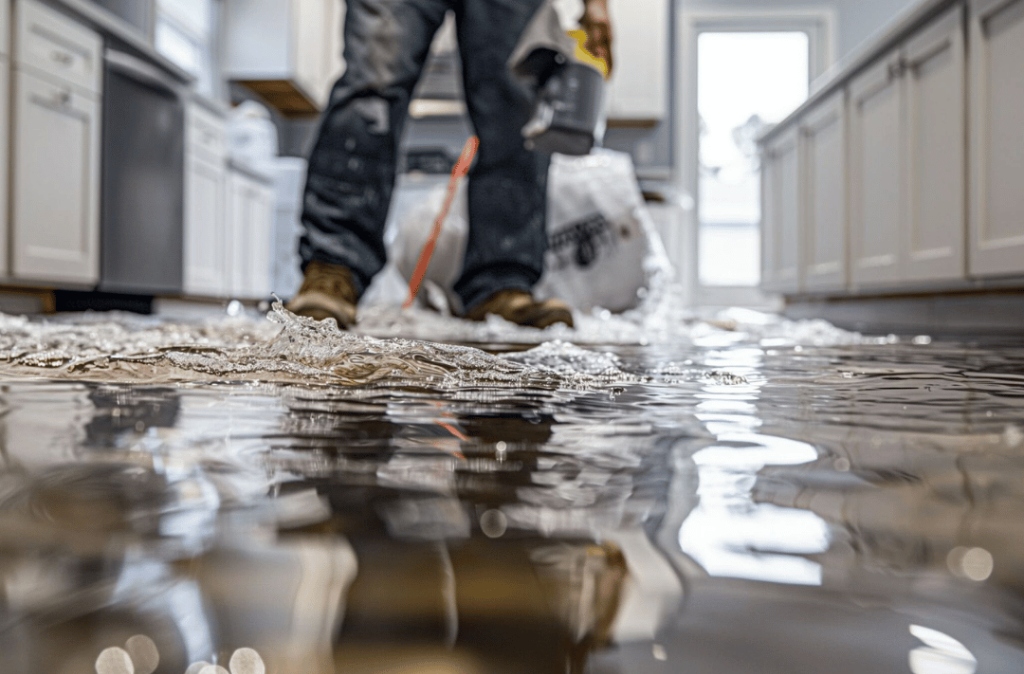
Appliance supply line ruptures and under-sink RO filter leaks release hundreds of gallons of pressurized water into cabinetry and subfloors. Saturated particleboard cabinetry swells irreversibly, tile adhesives break down, and trapped moisture under kitchen flooring breeds aggressive black mold colonies within 24 to 48 hours in Phoenix summer heat.
Immediate First-Hour Appliance Leak Action Checklist
- If the appliance valve is accessible, turn it clockwise; if seized, immediately close the whole-house main water valve.
- De-energize dedicated electrical breakers for the kitchen, dishwasher, or laundry room before stepping into standing water.
- Deploy dry towels or spill berms along tile-to-hardwood floor transitions to block moisture migration into wood planks.
- Elevate porous pantry goods, cardboard boxes, and cleaning chemicals from flooded under-sink cabinets.
- Wipe up pooling surface water with clean towels or mops; never use a standard household vacuum on standing water.
- Call Valley Restoration Pros at (602) 847-9593 for emergency dispatch and 30-to-60 minute on-site response.

Service Definition & The IICRC Standard of Care
Professional appliance leak water damage restoration is an engineering and environmental discipline adhering strictly to IICRC S500 protocols, not mere surface mopping. When structural plumbing failures strike in Maricopa County, certified emergency water extraction and thermal structural drying procedures must be deployed immediately. Whether triggered by high-pressure burst pipe emergencies, subfloor leaks, or commercial line ruptures, bound moisture rapidly penetrates concrete subfloors and wall framing. In the desert heat, delays trigger microbial proliferation requiring rapid mold remediation. Request damage assessment through our emergency assessment portal or request 30-minute dispatch across all Valley service areas.
Securing electrical feeds, inspecting load-bearing assemblies, and containing pathogens.
Stopping the intrusion source and erecting 6-mil plastic isolation containment airlocks.
31-HP truck-mount extraction, removing gallons exponentially faster than evaporation.
LGR dehumidifiers and HEPA air scrubbers driving grains per pound below 25 GPP.
Calibrated electronic pinless testing confirming baseline dry standards.
Disastrous Mistakes Homeowners Make During Appliance Water Leaks
Property owners naturally try to act fast, but well-intentioned DIY measures frequently escalate structural damage or void insurance claims:
- Forcing a Calcified Water Valve with Pliers: Extreme mineral scale in Phoenix seizes brass valves; forcing them snaps copper pipes inside walls.
- Attempting to Dry Saturated Hardwood Floors with Household Fans: Surface air case-hardens top wood grain while moisture beneath causes permanent cupping.
- Leaving Damp Particleboard Cabinets to Air Dry: MDF absorbs water like a sponge; without active desiccation, cabinets swell and grow toxic mold within 48 hours.
- Delaying Mitigation Waiting for an Insurance Adjuster: Property insurance policies mandate prompt mitigation to prevent avoidable secondary microbial growth.
- Failing to Inspect Adjacent Wall Chases: Water spreads through drywall baseplates into adjoining bedrooms and closets out of sight.
Damage Severity Classification & Contamination Matrix
Industry standards categorize property damage by contamination risk and drying difficulty. Review the matrix below to understand the technical protocols required:
Class 1: Localized Under-Sink Seep (Minor Intrusion)
Source Examples: Loose RO filter fitting or small faucet supply line drip discharging under 10 gallons
Hazards & Risks: Cabinet baseboard swelling, localized drywall dampness, minor subfloor moisture.
Certified Protocol: FLIR infrared mapping, pinless RF scanning, cabinet baseplate airflow, one LGR dehumidifier.
Class 2: Pressurized Line Rupture Across Multiple Rooms (Active Deluge)
Source Examples: Burst dishwasher supply hose or washing machine line discharging 50-200 gallons
Hazards & Risks: Hardwood floor cupping, drywall wicking up to 24 inches, toe-kick saturation, baseboard warping.
Certified Protocol: Sub-surface water extraction, Injectidry toe-kick desiccation, Rescue Mat floor drying, Benefect wash.
Class 3: Multi-Day Unattended Supply Rupture (Catastrophic Loss)
Source Examples: Appliance line burst while homeowners were away discharging 500+ gallons
Hazards & Risks: Complete subfloor structural degradation, swollen cabinetry, widespread toxic black mold outbreak.
Certified Protocol: Industrial desiccant trailers, selective cabinet demolition, negative-air HEPA scrubbers, biocide fogging.
The Complete 6-Stage Restoration Roadmap
Our IICRC-certified crews execute a disciplined, scientific 6-stage protocol to stabilize and dry structural components:
Emergency Dispatch & Perimeter Isolation
30 to 60 minute arrival. Securing electrical shutoffs, evaluating structural loads, and erecting containment airlocks.
FLIR® Thermal Mapping & Baseline Scans
Infrared thermal scans detect trapped moisture behind walls and beneath concrete without invasive exploratory demolition.
High-Volume Bulk Extraction
31-HP truck-mount extraction units pump standing water away at hundreds of gallons per minute.
Controlled Selective Demolition
Precision flood cuts 12 to 24 inches above moisture lines, removing wet insulation and opening wall framing to dry airflow.
Thermodynamic Dehumidification
Industrial Low-Grain Refrigerant dehumidifiers pull deep trapped moisture from dense framing lumber and concrete slabs.
Antimicrobial Sanitization & Verification
EPA-registered botanical application (Benefect Decon 30) and calibrated moisture testing to issue an official dry certificate.
Specialized Equipment & Industrial Restoration Technology
Mitigating severe property damage requires industrial-grade technology capable of altering thermodynamic psychrometrics:
Truck-Mounted Extraction Rigs
31-HP engines producing 16+ inches Hg vacuum suction to evacuate bulk water rapidly into holding tanks.
Low-Grain Refrigerant Dryers
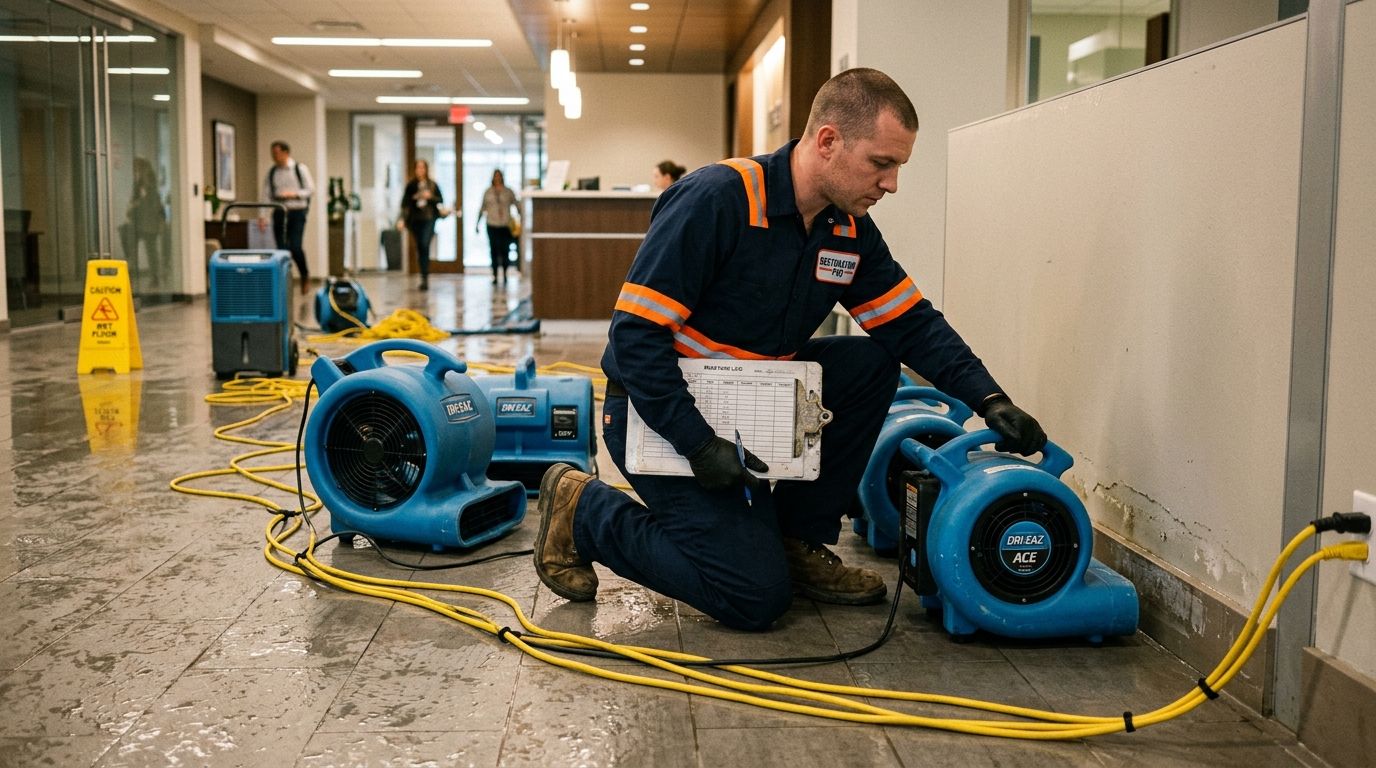
Pre-cooling heat-pipe systems driving ambient grains per pound below 25 GPP to draw deep trapped water out of framing.
HEPA Negative-Air Scrubbers
Hospital-grade 99.97% particulate filtration capturing microscopic fungal spores, soot, and biohazard aerosols.
FLIR® Thermal Scanners & Probes
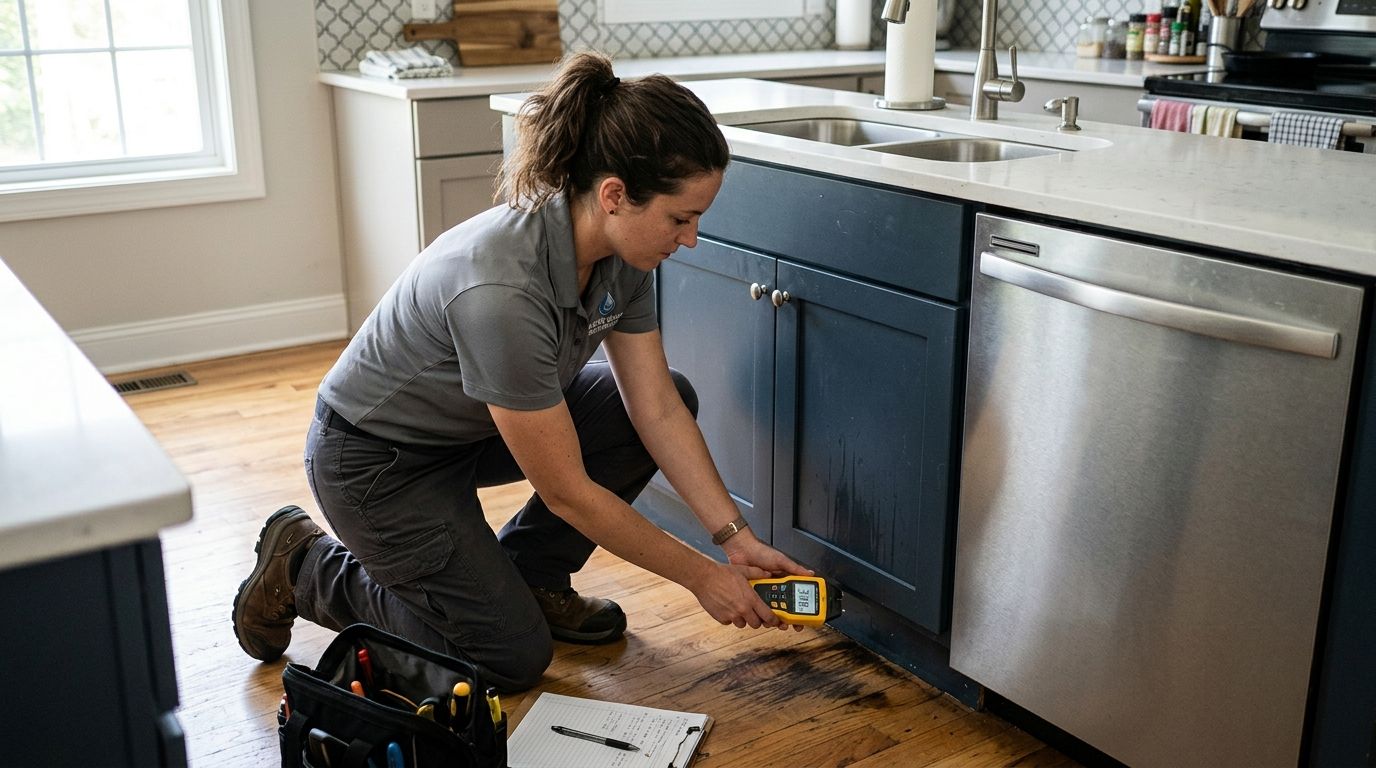
Infrared thermography detecting evaporative cooling boundaries behind walls, combined with digital RF pinless scanners.
Professional Restoration vs. DIY Mitigation
Attempting DIY cleanup during a property disaster creates severe hidden liabilities:
- Trapped Moisture: Surface drywall dries while moisture inside cavities triggers hidden mold blooms.
- Pathogenic Risks: Category 2 & 3 water contains bio-contaminants standard cleaners fail to kill.
- Insurance Denial: Insurers require daily psychrometric logs; lack of data causes claim disputes.
Transparent Upfront Itemized Pricing
Valley Restoration Pros operates with complete transparency:
- Free On-Site Assessment: Complete physical inspection before work begins.
- Upfront Itemized Estimates: Detailed line items calculated via industry-standard Xactimate.
- Zero Surprise Billing: No hidden charges or unauthorized repairs.
Certified Appliance Leak Water Damage Restoration Field Documentation
Every response performed by Valley Restoration Pros is documented through photographic and thermographic records:

Comprehensive Appliance Leak Water Damage Restoration Technical Manual & Operational Standards
Exhaustive engineering protocols, psychrometric calculations, geological multipliers, and step-by-step restoration standards for Maricopa County properties:
Executive Emergency Abstract & Incident Overview
Household appliance water breaches represent the single most frequent, insidious, and financially destructive source of indoor property flooding across residential properties and luxury estates throughout the Phoenix metropolitan area. Modern residential living depends heavily on automated water-fed appliances—high-efficiency dishwashers, front-loading washing machines, multi-stage under-sink Reverse Osmosis (RO) water purification units, refrigerator ice makers, and whole-home water softeners. While these pressurized mechanical devices deliver daily convenience, they function under continuous municipal hydraulic stress. When a quarter-inch poly ice-maker tubing splits, a dishwasher braided stainless steel supply line ruptures at the brass compression ferrule, or a washing machine solenoid valve fails open, pressurized water surges unchecked into kitchen cabinetry, interior laundry rooms, and adjoining living spaces at rates ranging between three and twelve gallons per minute.
In Greater Phoenix, appliance water damage is magnified by extreme municipal water hardness averaging between sixteen and twenty-two grains per gallon (GPG) and harsh summer attic and kitchen temperatures. Aggressive calcium carbonate scale encrusts internal solenoid shutoff valves, embrittles plastic quick-connect push fittings, and attacks brass coupling nuts. Because appliances are recessed into cabinetry cavities or installed behind heavy drywall enclosures, small pinhole supply leaks often spray invisibly for days or weeks before standing water emerges across kitchen floor surfaces. By the time water seeps out from under cabinet toe kicks, gallons of moisture have already saturated subfloor OSB sheathing, wicked up interior drywall partitions, and migrated beneath hardwood flooring or floor tile underlayments. Immediate deployment of certified emergency water extraction and specialized structural drying protocols is vital to prevent permanent wood rot, tile delamination, and severe microbial contamination.
Kitchen cabinetry is constructed predominantly from engineered particleboard and medium-density fiberboard (MDF) veneered with hardwood or laminate facings. These organic composite materials possess extraordinary hygroscopic porosity. When exposed to liquid water, MDF boards swell up to three times their original thickness through irreversible capillary absorption, popping cabinet doors off hinges and ruining expensive quartz or granite countertops. Water trapped beneath kitchen cabinets in unconditioned Phoenix environments creates an ideal dark, warm incubator for toxic fungal species like Aspergillus and Stachybotrys chartarum, with mold blooms emerging in as few as 24 to 48 hours. If your home has suffered an appliance leak or active water flow, contact our priority emergency operations team immediately at (602) 847-9593.
Valley Restoration Pros functions as the premier emergency water mitigation contractor for homeowners, custom estate managers, and commercial properties throughout Phoenix, Scottsdale, Paradise Valley, Tempe, Mesa, Chandler, and Glendale. Our master-certified IICRC restoration specialists arrive within thirty to sixty minutes of your emergency call, equipped with high-velocity truck-mounted extraction units, specialized Injectidry toe-kick desiccation systems, non-destructive FLIR thermal imaging cameras, and EPA-registered botanical antimicrobials to stabilize your home and prevent aggressive mold growth under rigorous IICRC S500 standards.
Anatomy of the Failure & Mechanical Dynamics of Appliance Floods
Residential and commercial appliances operate as electromechanical systems connected to pressurized domestic plumbing lines. Understanding the distinct mechanical failure modes of individual appliances reveals why appliance leaks generate such rapid structural destruction:
1. Dishwasher Pressurized Supply Line & Solenoid Valve Failure
Modern dishwashers are supplied with hot water via a 3/8-inch flexible braided stainless steel hose connected to an under-sink angle stop valve. Water entry is regulated by an electric solenoid fill valve mounted at the base of the machine. The internal valve uses a rubber diaphragm and magnetic plunger to open and close during washing cycles.
In Phoenix, heavy mineral scale builds up on the rubber solenoid diaphragm, preventing the valve from seating completely. The valve sticks open, allowing hot water to continuously overfill the wash tub until water spills over the door gasket. Alternatively, constant thermal expansion and hydraulic pressure pulsing cause the plastic inlet housing of the solenoid valve to crack, discharging three to five gallons per minute directly under the dishwasher chassis. Water pools beneath adjoining cabinets and seeps into floor expansion gaps without triggering any external appliance error codes. For catastrophic pipe failures behind walls, consult our burst pipe repair protocols.
2. Washing Machine Supply Hose Ruptures & Internal Standpipe Backflows
Standard residential washing machines are connected to hot and cold water wall supply valves via flexible rubber or reinforced braided hoses. Unlike outdoor garden hoses that are only pressurized during use, washing machine supply hoses remain under continuous, static municipal water pressure (typically 60 to 85 PSI) twenty-four hours a day, 365 days a year.
Over three to five years, continuous hydraulic pressure pulsing, water hammer shockwaves, and environmental oxidation degrade the internal EPDM rubber lining. The hose develops an aneurysm-like bubble before bursting catastrophically. An unrestricted 1/2-inch washing machine hose discharges eight to twelve gallons per minute. Within one hour, over six hundred gallons of pressurized water inundate the laundry room, overflowing door thresholds and saturating adjoining bedrooms, hallways, and living rooms. For large-scale multi-family apartment floods, review our specialized multi-family flood restoration manual.
3. Under-Sink Reverse Osmosis (RO) System Filtration Fractures
Due to extreme municipal water hardness and high total dissolved solids in Phoenix municipal water, an estimated 70% of homes throughout the Valley utilize multi-stage Reverse Osmosis (RO) filtration systems installed inside kitchen sink base cabinets. These systems incorporate pressurized plastic filter sumps, membrane housings, a 3-to-5 gallon pressurized bladder storage tank, and dozens of 1/4-inch and 3/8-inch polyethylene tubing connections held together with quick-connect push fittings (John Guest type).
RO filter sumps are subjected to continuous hydraulic fatigue. When municipal pressure spikes occur at night—frequently exceeding 100 PSI during low-demand municipal hours—the brittle polypropylene plastic filter housings fracture along threaded collars or the small poly tubing slips out of quick-connect fittings. The pressurized supply line discharges continuously into the enclosed kitchen sink base cabinet, soaking cabinet bottom panels, degrading structural glue, and running beneath kitchen tile and hardwood floors.
4. Refrigerator Ice Maker Polyethylene Line Pinholes & Punctures
Refrigerators with automatic ice makers and door water dispensers are fed by flexible 1/4-inch copper or white polyethylene tubing running from a wall shutoff valve into the rear mechanical compartment. When the refrigerator is rolled in and out for cleaning, this thin plastic line is easily kinked, pinched against metal condenser coils, or abraded against rough baseboards.
A pinhole puncture produces a fine, high-pressure spray that shoots directly onto the drywall backing and subfloor behind the refrigerator. Because the refrigerator conceals the moisture, the leak sprays undetected for months. The water rots the drywall, saturates the sill plate, and spreads across subflooring into adjoining rooms. When major water heaters fail catastrophically in utility rooms, explore our water heater burst cleanup protocols.
Phoenix-Specific Climatic & Geological Multipliers
Appliance water emergencies in the Phoenix desert environment behave drastically differently than in cooler, softer-water regions of the United States. Four distinct regional factors magnify physical destruction:
18 GPG Extreme Municipal Hard Water Scale & Valve Seizure
Water delivered across Phoenix from the Central Arizona Project and Salt River Project carries extreme mineral hardness averaging 18 GPG, containing heavy concentrations of dissolved calcium carbonate and magnesium sulfate.
As water flows through appliance valves and heating elements, minerals precipitate out of solution, forming hard rock-like scale. This scale accumulates on appliance solenoid seals, angle stop shutoff valves, and backflow check valves. When a homeowner experiences an active leak and tries to turn the emergency shutoff valve behind the toilet or under the kitchen sink, the valve is physically calcified in place. Attempting to force the seized valve frequently snaps the aging copper pipe, escalating a minor leak into a whole-house flood.
115°F Desert Heat & Accelerated Fungal Incubation
During Phoenix summer months, outdoor temperatures exceed 115°F, driving indoor ambient temperatures in unconditioned spaces or during HVAC power shutdowns to well above 90°F.
High heat combined with warm standing water from dishwashers or washing machines creates optimal conditions for microbial colonization. Fungal mold spores (Aspergillus, Cladosporium, and Penicillium) germinate on saturated cellulose drywall paper and particleboard cabinetry within 24 to 36 hours. Immediate high-capacity extraction and botanical antimicrobial washdown are critical to halt fungal amplification before whole-cabinetry replacement becomes legally mandated.
Nighttime Municipal Pressure Surges Exceeding 100 PSI
Municipal water utility distribution networks in Maricopa County experience dramatic pressure fluctuations between peak daytime usage and overnight low-demand hours. While daytime operating pressures range from 50 to 65 PSI, overnight municipal pressures frequently surge above 100 to 120 PSI.
If a residence lacks an operating pressure reducing valve (PRV) or expansion tank, these repetitive nighttime pressure hammer spikes cause brittle plastic RO filter canisters, washing machine rubber hoses, and dishwasher fittings to rupture while occupants are asleep, resulting in hours of unmonitored flooding before discovery.
Expansive Clay Soil Shifting Subfloor Slabs & Plumbing Lines
The expansive smectite clay and dense caliche soils of the Salt River Valley swell when wet and contract during dry spells, causing concrete slab foundations to shift and crack.
Foundation movement places mechanical shear stress on copper plumbing supply stub-outs and PVC drain lines exiting wall cavities behind kitchen sinks and washing machines. When a stub-out shears, high-pressure water floods wall cavities and subflooring directly. For foundation and under-slab diagnostic protocols, review our slab leak water damage restoration manual.
To calculate accurate drying requirements and equipment deployment for your appliance flood, access our interactive online free on-site damage assessment or call our technicians for a physical evaluation.
Immediate Emergency First-Hour Safety & Appliance Isolation Protocol
The initial sixty minutes following the discovery of an appliance flood determine whether kitchen cabinetry, subflooring, and adjacent hardwood floors can be preserved or must be torn out and replaced. Follow this disciplined emergency isolation sequence:
Homeowner Emergency Action Sequence
- Terminate the Primary Water Supply: If the appliance angle stop valve is easily accessible and turns freely, rotate it clockwise to isolate the appliance. If the valve is calcified, seized, or leaking, do not force it! Immediately navigate to the whole-house main water shutoff valve (located on the front exterior hose bib riser or inside the garage) and close it completely to halt all water flow.
- De-Energize Dedicated Appliance Electrical Breakers: Dishwashers, washing machines, and garbage disposals operate on high-amperage 120V and 240V circuits. Never step into standing water to unplug an appliance! Go directly to your electrical main breaker panel and switch off the dedicated circuit breakers for the kitchen, laundry room, and refrigerator circuits.
- Contain Water from Spreading to Hardwood Flooring: Hardwood flooring absorbs standing water rapidly, causing cupping and crown warping within hours. Roll up dry towels or deploy commercial absorbent barriers along the transition line between tile kitchens and wood living rooms to block fluid migration.
- Elevate Porous Cabinet Contents & Valuables: Open kitchen sink base cabinets and pantry cupboards. Remove cardboard detergent boxes, food containers, cleaning chemicals, and paper products resting on damp bottom shelving to prevent chemical leaching and mold breeding.
- Remove Standing Surface Water with Clean Towels or Mops: Wipe up surface pooling on tile floors to reduce slip-and-fall hazards. Never use a domestic household vacuum cleaner on standing water, as this creates lethal electrocution risks and motor burnout.
- Call Valley Restoration Pros for Priority Emergency Dispatch: Immediately dial (602) 847-9593. Our certified water extraction trucks are mobilized across the Valley with 30-to-60 minute on-site response guarantees.
Advanced Industrial Equipment Specifications & Setup
Drying kitchen cabinetry, toe-kick cavities, and subfloor assemblies requires specialized non-destructive drying technology engineered specifically to force air into enclosed architectural cavities without destroying high-end custom cabinetry:
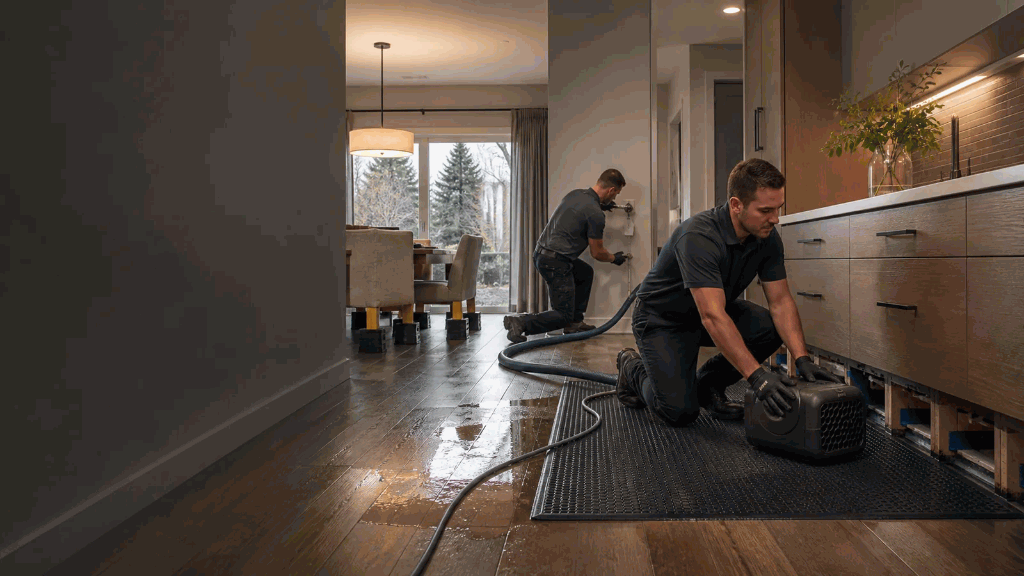
High-pressure positive and negative airflow machines. Our technicians remove decorative cabinet toe-kick facings and drill discrete 5/8-inch holes in the recessed kickplate. Flexible manifold tubing delivers heated, ultra-dry air directly into the dead-air cavity beneath base cabinets, desiccating the framing and concrete slab without removing custom countertops.
Specialized vacuum floor drying panels placed directly across cupped hardwood floor planks. Connected to high-vacuum blowers, these mats create a powerful negative pressure vacuum seal that draws trapped water out from between floorboard tongue-and-groove joints and subfloor concrete without tearing out the floorboards.
Industrial LGR dehumidifiers removing 125 pints of water daily at AHAM conditions. These compact units generate low vapor pressure air down to 28 GPP, pulling deep bound moisture out of saturated Douglas fir sill plates, subfloors, and multi-layer drywall partitions.
High-resolution infrared radiometers combined with Delmhorst and Tramex non-invasive RF capacitance meters. Technicians trace water migration paths beneath tile floors, behind refrigerators, and into adjoining wall chases without scratching luxury finishes.
To explore specialized wood drying technology and subfloor desiccation, consult our dedicated hardwood floor water damage drying manual and structural drying standards.
IICRC S500 Step-by-Step Appliance Restoration Protocol
Restoring an appliance flood requires a systematic, scientific workflow conforming to the Institute of Inspection, Cleaning and Restoration Certification (IICRC) S500 Standard for Professional Water Damage Restoration. Our certified project managers execute a strict six-stage protocol:
Stage 1: Psychrometric Inspection & FLIR Thermal Mapping
Upon arrival, technicians establish temperature, relative humidity, and dew point baselines. Using FLIR thermal radiometers and pinless radio-frequency scanners, crews map the moisture perimeter across kitchen flooring, behind appliance alcoves, and into wall cavities, determining whether water is Category 1 (potable RO supply line), Category 2 (dishwasher wash water carrying food residue and detergents), or Category 3 (washing machine sewer drain line backup).
Stage 2: High-Volume Extraction & Cavity Access
Technicians disconnect and extract the failed appliance safely, rolling it onto protective neoprene tracks to prevent floor scratching. Heavy 31-HP truck-mounted extraction wands evacuate standing water from tile, concrete, and hardwood flooring. Toe-kick trim is carefully detached from base cabinets to inspect the dead-air cavity underneath.
Stage 3: Poly Containment & Selective Precision Demolition
Crews erect 6-mil poly containment barriers with magnetic zipper doorways and HEPA air scrubbers to isolate the kitchen from living spaces. If water has wicked into wall partitions behind cabinets, precision flood cuts are executed below the cabinet countertop line or from the reverse side of the wall in an adjoining room, exposing framing studs to dry air while preserving custom kitchen cabinetry.
Stage 4: EPA-Registered Botanical Antimicrobial Sanitization
All exposed subfloors, concrete slabs, cabinet bases, and framing studs are treated with an EPA-registered hospital-grade botanical disinfectant (Benefect Decon 30). This thyme-based antimicrobial neutralizes active fungal hyphae, mold spores, and bacteria without off-gassing synthetic chemicals or artificial fragrances into food-preparation areas.
Stage 5: Directional Injectidry & LGR Dehumidification Setup
Crews install specialized Injectidry toe-kick manifolds, directing super-dry heated dehumidifier air beneath kitchen cabinetry. Rescue Mat panels are deployed across saturated hardwood flooring, connected to high-vacuum pumps to extract sub-surface moisture. Phoenix DryMAX XL LGR dehumidifiers and high-velocity axial air movers operate continuously to maintain low-vapor-pressure conditions.
Stage 6: Final Moisture Verification & Dry Certification
Technicians monitor and record psychrometric data twice daily. Once electronic pin sensors confirm that subflooring, cabinet framing, and wall studs have returned to dry baseline standards (below 10% to 12% moisture content), an official IICRC Certificate of Completion and psychrometric dry log packet is generated for insurance claims settlement.
Psychrometric Dehumidification Sizing & Wood Equilibrium Formulas
Restoring saturated hardwood floors and custom cabinetry requires strict adherence to thermodynamic psychrometrics. Wood is a hygroscopic material that continuously exchanges moisture with surrounding air until it reaches its Equilibrium Moisture Content (EMC). Under the Hailwood-Horrobin thermodynamic sorption model, wood EMC is mathematically expressed as:
Wood Equilibrium Moisture Content (EMC) Formula:
EMC (%) = [ (1,800 ÷ W) × ( (K × h) ÷ (1 - K × h) ) ] + [ (K1 × K × h + 2 × K1 × K2 × K^2 × h^2) ÷ (1 + K1 × K × h + K1 × K2 × K^2 × h^2) ]
Where h represents relative humidity (decimal), and W, K, K1, K2 are temperature-dependent coefficients. In the arid Phoenix climate, normal interior equilibrium moisture content for Douglas fir framing and oak hardwood floors sits between 6% and 9%. When an appliance flood elevates wood moisture content to 28% to 35%, cellular saturation triggers plank swelling and buckling. Our Low-Grain Refrigerant dehumidifier fleet reduces ambient specific humidity below 30 GPP, establishing a 15% vapor pressure differential that rapidly extracts bound moisture from wood cells.
Floor Drying Negative-Pressure CFM Calculation:
Required Vacuum Lift = 5 to 7 Inches Hg per 100 sq. ft. of Drying Mat Surface
Dri-Eaz Rescue Mat systems generate sustained negative pressure across plank seams. By drawing high-velocity dry air through the expansion gaps of the floorboards, water trapped between the vapor retarder underlayment and the concrete subfloor is vaporized and evacuated without requiring hardwood floor demolition. For complete flooring restoration procedures, review our hardwood floor water damage drying manual.
Ceramic Tile Vapor Retardation & Subfloor Osmotic Blistering:
Glazed ceramic and porcelain kitchen tiles are virtually non-porous (water absorption rate less than 0.5% under ASTM C373). When an appliance flood discharges water, liquid seeps through porous cementitious grout joints into the underlying mortar bed and concrete slab. The dense tiles act as an impermeable vapor barrier, trapping moisture underneath.
Under Phoenix summer ambient heat, trapped moisture generates hydrostatic vapor pressure exceeding five pounds per square inch. This vapor pressure causes chemical saponification and hydrolysis of organic mastic adhesives, debonding floor tiles and leaving hollow, clicking spots underfoot. Valley Restoration Pros deploys high-volume LGR dehumidifiers and directed radiant heating panels to draw trapped sub-tile moisture horizontally through grout channels before adhesive crystallization fails permanently. For commercial hospitality kitchens, consult our hotel flood restoration and biohazard cleanup protocols.
Hyper-Local Phoenix Case Study: Scottsdale Luxury Kitchen Dishwasher Deluge
Over a holiday weekend while the homeowners were out of town, a luxury custom estate in North Scottsdale suffered a catastrophic kitchen water loss. A 3/8-inch braided stainless steel dishwasher hot water supply line ruptured at its brass compression ferrule under 85 PSI of municipal water pressure.
The continuous flow discharged approximately 180 gallons over twenty-four hours before discovery by a house-sitter. Water submerged thirty linear feet of custom walnut kitchen cabinetry, wicked up the back of kitchen island partitions, and migrated across 600 square feet of wide-plank engineered European white oak hardwood flooring, causing widespread plank cupping.
Empirical Psychrometric Restoration Metrics & Drying Timeline:
- Baseline Hardwood Floor Moisture Content: 29.8% (Severe saturation, high fiber deformation risk)
- Initial Atmospheric Humidity (Kitchen): 82°F, 81% Relative Humidity (136 GPP Specific Humidity)
- Emergency Crew Arrival Time: 26 minutes from dispatch call
- Equipment Deployment: Injectidry HP-PLUS toe-kick system, 8 Dri-Eaz Rescue Floor Mats, 2 Phoenix DryMAX XL LGR dehumidifiers, 10 axial air movers, 1 HEPA 500 air scrubber
- 36-Hour Progress Metric: Kitchen island toe-kick dead-air cavity dried to 14% moisture content; standing water between hardwood planks evacuated via vacuum suction
- 76-Hour Equilibrium Dry Standard: Custom walnut cabinetry completely preserved without demolition; European white oak hardwood stabilized at 8.8% moisture content without permanent cupping
- Total Mitigation Cost: $7,420 itemized via Xactimate®—approved 100% by Chubb luxury homeowner insurance adjuster without dispute
“We returned from our trip to find water bubbling up through our luxury European oak floors. Valley Restoration Pros was on-site in twenty-six minutes. Their Injectidry system completely dried our custom walnut cabinets and saved our hardwood floors from being torn out. Truly exceptional craftsmanship and technical care!”
Pay-Per-Call Financial & Insurance Documentation Breakdown
Experiencing an appliance flood in your kitchen or laundry room is deeply disruptive. Dealing with itemized estimates and insurance adjusters should not add to that burden. Valley Restoration Pros operates under rigid Pay-Per-Call compliance standards:
Our master-certified technicians conduct an exhaustive physical evaluation, thermal infrared mapping survey, and moisture assessment of your kitchen cabinetry and flooring at zero initial cost or obligation.
We prepare complete, itemized estimates utilizing Xactimate®—the standardized estimating software adopted by major insurance carriers (State Farm, Allstate, USAA, Farmers, Chubb). Every line item is clearly defined at regional Maricopa County insurance-approved pricing.
We supply your insurance adjuster with daily digital psychrometric dry logs, timestamped high-resolution photos, FLIR thermal imaging reports, and equipment run-time logs, streamlining claims processing and preventing disputed payouts.
Our senior billing specialists work directly alongside regional property adjusters across Maricopa County. We furnish comprehensive drying chamber documentation, floor moisture progression charts, and itemized equipment run-time verification that validate all mitigation activities under standardized insurance underwriting criteria, ensuring full transparency throughout the claims cycle.
We never make false promises regarding insurance billing, nor do we perform unauthorized repairs. Reach out through our emergency contact portal for rapid response across the Valley.
Exhaustive Technical FAQ Expansion & Appliance Science Standards
Explore deep technical insights addressing the physics, chemistry, and operational restoration protocols of appliance flood mitigation in Phoenix, Arizona:
Braided stainless steel hoses consist of an inner rubber or PVC hose wrapped in a protective woven stainless steel mesh. In Phoenix, 18 GPG hard municipal water scale and chemical chlorine disinfectants degrade the inner rubber core over time. When nighttime closed-loop municipal pressure surges spike above 90 to 110 PSI, the weakened rubber ruptures inside the mesh, resulting in high-velocity water spraying from the fitting crimps.
Yes! Valley Restoration Pros utilizes specialized Injectidry toe-kick cavity drying technology. By detaching decorative toe-kick facings and drilling discrete 5/8-inch access holes into the recessed sub-base, heated dry air is forced directly into the wet cavity beneath base cabinets. This dries the framing and concrete slab in place, preserving custom stone countertops.
Cupping occurs when the bottom face of a hardwood plank absorbs more moisture than the top face. As moisture collects beneath the floor, the wood cells on the bottom swell, forcing the edges of the plank upward higher than the center. If high-vacuum floor mats (Rescue Mats) and LGR dehumidifiers are deployed within the first 24 to 48 hours, the moisture gradient is equalized, allowing planks to lay flat without permanent deformation.
Under IICRC S500 benchmarks, water discharged from an active wash cycle containing detergents, food residues, skin cells, and bacteria is classified as Category 2 (gray water). If the water backs up from a drain standpipe or sewer line, it is classified as Category 3 (black water). Category 2 and 3 water require antimicrobial decontamination and disposal of saturated porous padding.
RO systems are enclosed inside sink base cabinets behind cabinet doors. A slow drip from a 1/4-inch poly quick-connect fitting or hairline crack in a plastic filter housing absorbs directly into the cabinet bottom shelf and side partitions. By the time water seeps out onto the visible kitchen floor, the leak has often been active for weeks, requiring thermal moisture mapping to evaluate structural wall framing.
When an upstairs washing machine overflows or a second-floor bathroom plumbing line bursts, water cascades down through floor joists into first-floor ceiling drywall. Immediately shut off the main water valve, de-energize electrical breakers, and consult our ceiling water damage restoration protocols for overhead structural stabilization.
Commercial cafeterias, break rooms, and restaurants utilize high-volume commercial dishwashers and beverage dispensing machines operating under continuous municipal pressure. Learn more about high-capacity commercial extraction in our commercial water damage restoration manual and commercial chiller pipe burst restoration manual.
When a washing machine discharge pipe backs up with raw sewage from a main sewer blockage, the loss requires immediate biological containment and OSHA Level-C PPE. Review our comprehensive sewage cleanup procedures and monsoon storm flood cleanup protocols.
Verified Local Area Dispatch: Phoenix, AZ
Official Geo-Coordinates: 33.4484° N, -112.074° W • Maricopa County
Frequently Asked Questions: Certified Restorer Insights
Direct answers to the most critical technical, operational, and insurance questions Phoenix property owners ask:
Related Specialized Emergency Restoration Services
Explore specialized rapid-response mitigation protocols across Greater Phoenix and Maricopa County:
Valley-Wide Emergency Response Service Coverage
Our mobile restoration fleet is dispatched across the entire Phoenix metropolitan region, providing rapid 30 to 60 minute emergency response: