

Valley Restoration Pros delivers 24/7 industrial emergency water extraction, thermal psychrometric drying, and structural mitigation across Phoenix and Maricopa County with guaranteed 30–60 minute rapid arrival. All protocols strictly adhere to IICRC S500 standards, featuring upfront itemized pricing and free on-site thermal moisture assessments. Call dispatch directly at (602) 847-9593.
Why Immediate Mitigation Is Critical in Phoenix Heat
Subterranean basement water intrusions cause catastrophic electrical short circuits, rapid efflorescence concrete spalling, expansive clay foundation movement, and explosive microbial mold proliferation within 24 to 48 hours under high-humidity desert microclimates.
Immediate First-Hour Basement Flooding Emergency Action Checklist
- Never step into standing water if electrical panels, outlets, or submerged appliances are present; electrocution risk is extreme.
- Shut off the main electrical breaker powering the basement from a dry, safe exterior panel if accessible.
- Shut off the main water supply valve near the street if the water intrusion is caused by a burst pipe or water heater rupture.
- Keep the basement door firmly closed to prevent humid air and mold spores from migrating upstairs into primary living areas.
- Document water levels with timestamped smartphone photos and videos from the top of the stairwell for insurance documentation.
- Call Valley Restoration Pros immediately at (602) 847-9593 for 30-to-60 minute emergency dispatch and submersible pump deployment.
Service Definition & The IICRC Standard of Care
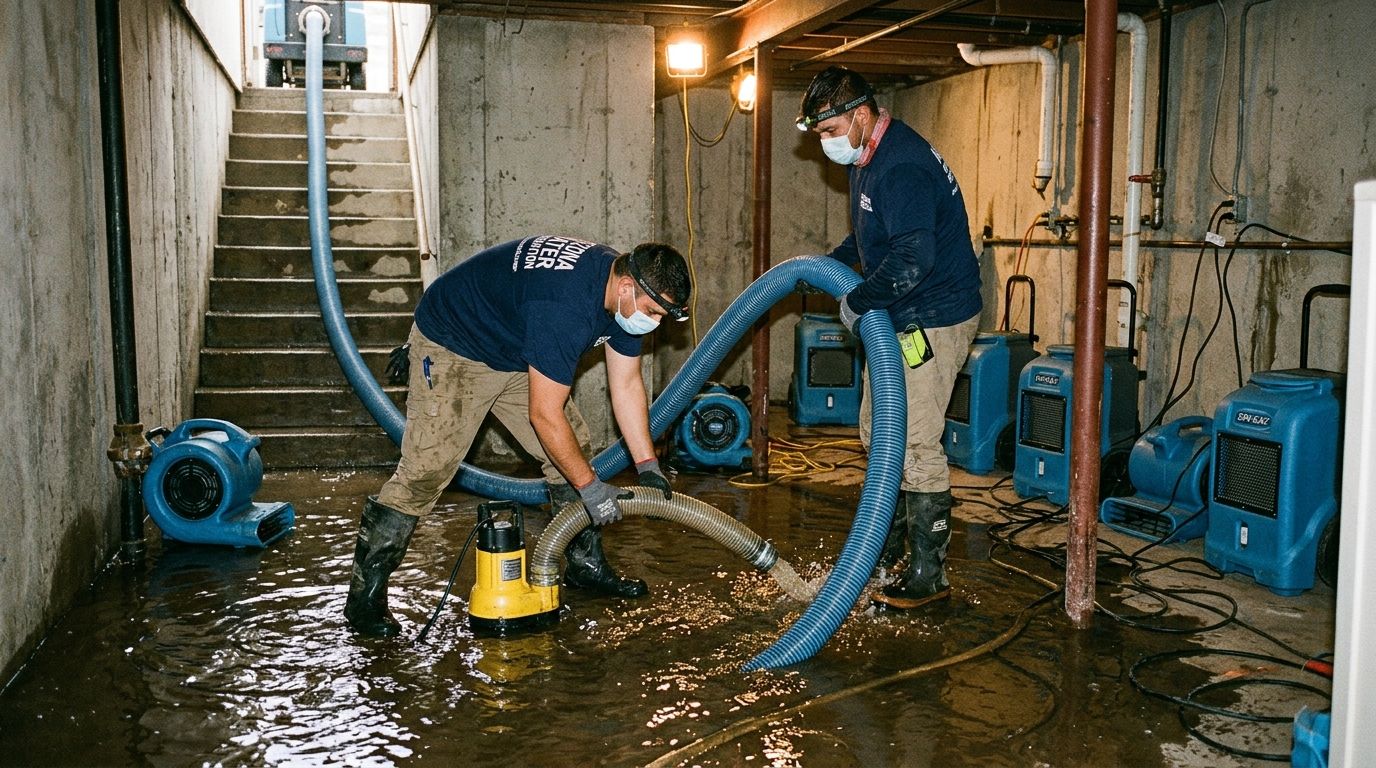
Professional basement water damage restoration is an engineering and environmental discipline adhering strictly to IICRC S500 protocols, not mere surface mopping. When structural plumbing failures strike in Maricopa County, certified emergency water extraction and thermal structural drying procedures must be deployed immediately. Whether triggered by high-pressure burst pipe emergencies, subfloor leaks, or commercial line ruptures, bound moisture rapidly penetrates concrete subfloors and wall framing. In the desert heat, delays trigger microbial proliferation requiring rapid mold remediation. Request damage assessment through our emergency assessment portal or request 30-minute dispatch across all Valley service areas.
Securing electrical feeds, inspecting load-bearing assemblies, and containing pathogens.
Stopping the intrusion source and erecting 6-mil plastic isolation containment airlocks.
31-HP truck-mount extraction, removing gallons exponentially faster than evaporation.
LGR dehumidifiers and HEPA air scrubbers driving grains per pound below 25 GPP.
Calibrated electronic pinless testing confirming baseline dry standards.
Catastrophic Mistakes Homeowners Make During Basement Floods
Property owners naturally try to act fast, but well-intentioned DIY measures frequently escalate structural damage or void insurance claims:
- Entering Standing Water Without Safety Isolation: Energized circuits cause fatal electrocution in flooded subterranean basements.
- Using Standard Household Wet/Dry Vacs: Inadequate lift capacity and unsealed exhausts spray airborne mold spores and bacteria throughout the home.
- Ignoring Saturated Drywall and Baseboards: Water trapped behind baseboards fosters toxic black mold colonies within 24 to 48 hours.
- Allowing Efflorescence to Accumulate on Concrete: Salt crystallization generates over 2,000 PSI of internal pressure, spalling and weakening foundation walls.
- Delaying Mitigation Waiting for Power Restoration: Every hour of standing water accelerates irreversible expansive soil movement beneath footings.
Damage Severity Classification & Contamination Matrix
Industry standards categorize property damage by contamination risk and drying difficulty. Review the matrix below to understand the technical protocols required:
Class 1: Localized Seepage & Cold Joint Infiltration (Minor Seep)
Source Examples: Perimeter stem wall weeping or hairline crack seepage discharging under 25 gallons
Hazards & Risks: Surface efflorescence, localized baseboard dampness, minor mold odor.
Certified Protocol: FLIR infrared mapping, crystalline seal, perimeter HEPA scrubbers, LGR dehumidifier array.
Class 2: Sump Pump Failure & Groundwater Backflow (Active Flood)
Source Examples: Sump failure during storm power outage discharging 100 to 500 gallons of ground runoff
Hazards & Risks: Finished drywall saturation, submerged carpet and pads, electrical short circuits in floor outlets.
Certified Protocol: Submersible trash pump dewatering, precision flood cuts, antimicrobial biocide application, high-velocity axial air drying.
Class 3: Catastrophic Plumbing Burst or Overland Monsoon Inundation (Severe Influx)
Source Examples: Pressurized supply line rupture or walkout stairwell storm overflow discharging 1,000+ gallons
Hazards & Risks: Submerged furnaces and water heaters, expansive clay soil heaving, whole-house microbial contamination.
Certified Protocol: Truck-mounted high-lift vacuum extraction, structural framing demolition, desiccant trailer desiccation, insurance claim assistance.
The Complete 6-Stage Restoration Roadmap
Our IICRC-certified crews execute a disciplined, scientific 6-stage protocol to stabilize and dry structural components:
Emergency Dispatch & Perimeter Isolation
30 to 60 minute arrival. Securing electrical shutoffs, evaluating structural loads, and erecting containment airlocks.
FLIR® Thermal Mapping & Baseline Scans
Infrared thermal scans detect trapped moisture behind walls and beneath concrete without invasive exploratory demolition.
High-Volume Bulk Extraction
31-HP truck-mount extraction units pump standing water away at hundreds of gallons per minute.
Controlled Selective Demolition
Precision flood cuts 12 to 24 inches above moisture lines, removing wet insulation and opening wall framing to dry airflow.
Thermodynamic Dehumidification
Industrial Low-Grain Refrigerant dehumidifiers pull deep trapped moisture from dense framing lumber and concrete slabs.
Antimicrobial Sanitization & Verification
EPA-registered botanical application (Benefect Decon 30) and calibrated moisture testing to issue an official dry certificate.


Specialized Equipment & Industrial Restoration Technology
Mitigating severe property damage requires industrial-grade technology capable of altering thermodynamic psychrometrics:
Truck-Mounted Extraction Rigs
31-HP engines producing 16+ inches Hg vacuum suction to evacuate bulk water rapidly into holding tanks.
Low-Grain Refrigerant Dryers
Pre-cooling heat-pipe systems driving ambient grains per pound below 25 GPP to draw deep trapped water out of framing.
HEPA Negative-Air Scrubbers
Hospital-grade 99.97% particulate filtration capturing microscopic fungal spores, soot, and biohazard aerosols.
FLIR® Thermal Scanners & Probes
Infrared thermography detecting evaporative cooling boundaries behind walls, combined with digital RF pinless scanners.

Professional Restoration vs. DIY Mitigation
Attempting DIY cleanup during a property disaster creates severe hidden liabilities:
- Trapped Moisture: Surface drywall dries while moisture inside cavities triggers hidden mold blooms.
- Pathogenic Risks: Category 2 & 3 water contains bio-contaminants standard cleaners fail to kill.
- Insurance Denial: Insurers require daily psychrometric logs; lack of data causes claim disputes.
Transparent Upfront Itemized Pricing
Valley Restoration Pros operates with complete transparency:
- Free On-Site Assessment: Complete physical inspection before work begins.
- Upfront Itemized Estimates: Detailed line items calculated via industry-standard Xactimate.
- Zero Surprise Billing: No hidden charges or unauthorized repairs.
Certified Basement Water Damage Restoration Field Documentation
Every response performed by Valley Restoration Pros is documented through photographic and thermographic records:
Comprehensive Basement Water Damage Restoration Technical Manual & Operational Standards
Exhaustive engineering protocols, psychrometric calculations, geological multipliers, and step-by-step restoration standards for Maricopa County properties:
Executive Emergency Abstract & Incident Overview
Subterranean water intrusion and basement flooding represent an acute, high-consequence structural crisis in the Greater Phoenix metropolitan area. While residential and commercial basements are relatively uncommon across the desert Southwest compared to Midwestern or Northeastern properties—primarily due to the pervasive presence of impenetrable, rock-hard caliche soil strata near the surface—finished and unfinished subterranean spaces exist in thousands of historic homes, luxury custom estates, and commercial facilities throughout Phoenix, Scottsdale, Paradise Valley, Tempe, and Mesa. When water penetrates these below-grade environments, the physics of fluid mechanics, hydrostatic pressure, and desert microclimates converge to create a catastrophic structural hazard.
Subterranean structures function as the lowest gravitational point of any building envelope. Consequently, when torrential summer monsoon rains overwhelm municipal storm drainage systems, when pressurized domestic plumbing lines fracture, or when sub-slab foundation piping ruptures, water rapidly cascades into the basement. Because basements lack natural gravity drains to the exterior and are enveloped by dense, impermeable clay soil, floodwater cannot naturally escape. Standing water accumulates rapidly, submerging mechanical systems, electrical switchgear, high-efficiency furnaces, water heaters, and structural perimeter framing. Immediate execution of certified emergency water extraction and industrial structural drying protocols is required within the first sixty minutes to prevent permanent foundation settlement, wall heaving, and severe microbial contamination.
Basement water damage in Greater Phoenix rarely involves clean water. Even when an intrusion originates from a clean domestic supply line, contact with unfinished concrete slabs, subterranean soil minerals, efflorescence salts, and stored biological contaminants rapidly degrades the fluid into Category 2 gray water or Category 3 black water under IICRC S500 benchmarks. When runoff infiltrates through foundation cold joints or foundation wall cracks during desert monsoon downpours, it brings surface pathogens, pesticides, heavy silt, and organic matter into the structure. Under Phoenix summer ambient conditions, where subterranean spaces trap ambient humidity and surface temperatures exceed 85°F, microbial amplification occurs with explosive speed. Toxic mold species including Stachybotrys chartarum and Aspergillus niger establish reproductive colonies within 24 to 48 hours. If your basement is experiencing active water infiltration, phone our emergency response command center immediately at (602) 847-9593.
Valley Restoration Pros serves as the premier 24/7 disaster mitigation authority across Phoenix, Scottsdale, Paradise Valley, Glendale, Peoria, Tempe, Mesa, and Chandler. Our master-certified IICRC restoration technicians arrive on-site within thirty to sixty minutes in fully stocked mobile extraction units. Equipped with high-capacity submersible trash pumps, industrial Low-Grain Refrigerant dehumidifiers, negative-air HEPA scrubbers, and penetrating moisture analyzers, we eliminate standing water, relieve subterranean hydrostatic pressure, and perform complete microbial mold remediation adhering to rigorous scientific standards.
Anatomy of the Failure & Subterranean Hydrodynamic Mechanics
Basement water intrusion in the Sonoran Desert is governed by subterranean soil mechanics, hydrostatic pressure gradients, and the physical degradation of below-grade concrete construction. Understanding the exact mechanical pathways through which water breaches subterranean building envelopes is vital for effective structural stabilization:
1. Foundation Cold Joint Infiltration & Hydrostatic Seepage
The primary architectural vulnerability in any cast concrete or masonry block basement is the structural “cold joint” (also termed the cove joint). During construction, concrete footings are poured first and allowed to cure. Subsequently, vertical foundation stem walls are cast atop the footing, followed by the pouring of the subterranean floor slab.
This multi-stage construction creates a microscopic mechanical seam between the vertical wall and horizontal slab. When monsoon cloudbursts saturate the upper soil layers, water percolates downward until it strikes impermeable caliche bedrock. Saturated soil creates immense lateral and vertical hydrostatic pressure against the basement envelope. Under this hydraulic head pressure, water seeks the path of least resistance, forcing its way through the cold joint seam, flooding the basement floor perimeter, and saturating baseboards and interior framing. For adjacent horizontal slab failures, review our specialized slab leak water damage restoration procedures.
2. Capillary Wicking & Salt Efflorescence Spalling
Cast concrete and cinder block stem walls are inherently porous materials riddled with millions of interconnected microscopic capillary pores. Under Laplace capillary pressure, liquid water in damp subterranean soil is drawn upward and inward through the concrete wall assembly against the pull of gravity.
In Greater Phoenix, municipal soil and groundwater contain extraordinary concentrations of dissolved calcium, magnesium, and sodium sulfates (averaging 18 grains per gallon). As moisture wicks to the interior wall surface and evaporates into the basement air, dissolved mineral salts crystallize behind and upon the concrete surface. This crystallization process, termed sub-efflorescence, generates internal mechanical pressures exceeding 2,000 pounds per square inch. This immense crystal expansion causes spalling, crumbling concrete, delaminating paint, and structural degradation of the basement wall matrix. For unexcavated foundation crawlspaces, explore our crawl space water damage restoration protocols.
3. Mechanical Sump Pump Failure & Desert Storm Power Outages
Basements equipped with interior perimeter drainage systems rely on mechanical sump pits and electric sump pumps to lift accumulated drainage water out of the subterranean level and discharge it away from the foundation.
During severe Phoenix monsoon storms, lightning strikes, high microburst winds, and knocked-down utility poles frequently trigger widespread electrical grid failures. Without dedicated dual-battery backup power systems, primary electric sump pumps fail precisely when exterior hydraulic influx reaches its peak. Rainwater fills the collection basin within minutes, overflowing the pit and flooding finished basements with hundreds of gallons of muddy, mineral-heavy ground runoff. For commercial elevator and lift pit inundations, consult our commercial elevator pit water extraction manual.
4. Pressurized Domestic Pipe Bursts & Water Heater Ruptures
In many Phoenix homes with basements, primary utility equipment—including 50-to-80-gallon commercial water heaters, water softeners, whole-house filtration skids, and main water shut-off manifolds—is consolidated within the subterranean utility room.
When extreme municipal water pressure surges, thermal expansion, or galvanic corrosion causes a copper water pipe or water heater storage tank to rupture, water discharges at full city pressure (60 to 80 PSI), releasing up to 10 to 15 gallons per minute. Because occupants rarely spend continuous time in utility basements during the workday or overnight, catastrophic plumbing breaches can discharge thousands of gallons of water before discovery. For pressurized pipe failures, review our burst pipe repair and water heater burst cleanup protocols.
Phoenix-Specific Climatic & Geological Multipliers
Subterranean water restoration in Maricopa County operates under radically distinct environmental physics compared to typical basement restoration across the United States. Four unique regional catalysts dramatically intensify basement property damage in the Phoenix area:
Expansive Caliche & Smectite Clay Soil Mechanics
The Phoenix Valley basin is composed of highly expansive clay soils interspersed with rock-like caliche strata (calcium carbonate cemented sediment). During prolonged dry seasons, the soil shrinks and develops deep subterranean fissures away from basement walls. When intense monsoon storms strike, surface runoff flows into these fissures, pooling directly against subterranean concrete walls. As the clay absorbs moisture, it expands up to 10% to 15% in volume, generating horizontal soil pressures exceeding 5,000 PSF against basement stem walls, deflecting concrete assemblies and forcing water through masonry cracks.
18 GPG Extreme Water Hardness & Efflorescence Crusts
Municipal tap water and native groundwater across Greater Phoenix carry mineral hardness ranging between 16 and 22 grains per gallon (GPG). When groundwater seeps through basement concrete, it leaches free calcium hydroxide from the concrete binder. Upon contacting atmospheric carbon dioxide inside the basement, it converts into insoluble calcium carbonate, forming heavy white, mineralized efflorescence crusts that permanently destroy paint bonds, dissolve adhesive layers beneath flooring, and pit concrete slab surfaces.
115°F Summer Heat & Subterranean Vapor Condensation
While Phoenix outdoor ambient temperatures routinely exceed 110°F to 115°F from June through September, subterranean basement walls and slabs remain significantly cooler (typically 70°F to 75°F) due to thermal earth coupling. When humid monsoon air or moisture from standing water enters the basement, the air quickly hits its subterranean dew point against cold concrete surfaces. Massive surface condensation “sweating” blankets the floor and perimeter walls, turning the entire subterranean level into a humid incubation chamber for toxic mold.
Flash Flood Storm Runoff & Inadequate Surface Slopes
Phoenix residential landscapes often feature minimal lot grading. Pre-monsoon haboob dust storms clog perimeter french drains and landscape yard grates with desert silt. When sudden microburst thunderstorms dump two inches of rain in thirty minutes, surface water ponds around window wells, walkout stairwells, and foundation walls. Runoff overflows window well copings, pouring hundreds of gallons of black floodwater directly into basement living quarters. For severe storm overland inundations, consult our monsoon storm flood cleanup manual.
Immediate Emergency First-Hour Protocol & Life-Safety Isolation
A flooded basement represents one of the most hazardous emergency environments in structural restoration. Entering standing subterranean water without professional safety equipment carries catastrophic risks of fatal electrocution, hazardous gas inhalation, and biohazard contamination. Adhere strictly to this safety isolation sequence within the first sixty minutes:
CRITICAL SAFETY WARNING: Subterranean Electrical & Atmospheric Hazards
NEVER enter a flooded basement if the electrical service panel is submerged or located in the basement, or if water has reached electrical outlets or submerged appliances. Water is an exceptional conductor of electricity; standing water energized by a submerged 120V or 240V circuit can cause instant paralysis and lethal cardiac arrest.
Additionally, submerged natural gas water heaters and furnaces can develop cracked pilot lines or vent flue blockages, displacing breathable oxygen with toxic carbon monoxide or explosive natural gas. If you suspect an electrical hazard or smell gas, evacuate the premises immediately and contact utility providers before professional mitigation crews arrive.
If your main electrical distribution breaker panel is located on the exterior of your home (as is standard in many Arizona properties), switch off all circuit breakers powering the basement level. If the panel is in the flooded basement, DO NOT approach it; request an emergency remote disconnect from your electrical utility.
If the water intrusion is caused by a ruptured plumbing pipe, water heater burst, or appliance line, immediately close your home’s main exterior water shut-off valve located near the street water meter box to stop continuous pressurized flooding.
Keep the interior door leading from the ground floor down to the basement firmly closed. This prevents humid, mold-spore-laden subterranean air from migrating upstairs into primary living areas via the building stack effect.
Call Valley Restoration Pros at (602) 847-9593. Our emergency crews arrive with truck-mounted high-lift vacuum extractors, heavy submersible dewatering pumps, and personal protective equipment (PPE) to safely access the space and begin extraction.
Advanced Industrial Equipment Specifications & Setup
Extracting deep standing water and desiccating subterranean concrete structures in Phoenix requires specialized, heavy-duty industrial restoration technology engineered specifically for confined spaces and dense masonry materials:
For finished basements with damaged hardwood or subfloor assemblies, we integrate floor drying mats that pull moisture directly through flooring layers. For detailed wood drying procedures, explore our hardwood floor water damage drying protocol. For appliance-related failures such as washing machine hose blowouts or water filter floods, review our appliance leak water damage standards.
IICRC S500 / S520 Step-by-Step Restoration Protocol
Our certified restoration process strictly adheres to the rigorous standards established by the Institute of Inspection, Cleaning and Restoration Certification (IICRC S500 Standard for Professional Water Damage Restoration and S520 Standard for Professional Mold Remediation):
Stage 1: Confined-Space Triage & Hydrostatic Moisture Mapping
Certified technicians conduct a multi-point safety inspection, testing atmospheric oxygen levels, combustible gas presence, and electrical de-energization. Using calibrated FLIR thermal radiometers and Tramex concrete moisture meters, we map the exact migration of water across concrete slabs, stem walls, and adjacent structural framing, recording baseline psychrometric conditions (ambient temperature, relative humidity, dew point, and grains per pound).
Stage 2: High-Volume Dewatering & Solids-Handling Extraction
Submersible trash pumps are deployed into lowest pooling basins to evacuate bulk standing water at rates up to 84 gallons per minute. Once liquid levels drop below one inch, truck-mounted extraction wands and weighted deep-extraction rovers extract water embedded within porous concrete, subflooring, and commercial carpets, removing 95% of total liquid mass within hours of arrival.
Stage 3: Containment Barrier Isolation & Controlled Structural Demolition
We erect heavy 6-mil polyethylene containment barriers with zippered airlocks at the head of the basement stairwell, establishing negative pressure with HEPA 500 air scrubbers. In finished basements, technicians execute precision “flood cuts” 12 to 24 inches above the highest moisture waterline, removing saturated drywall, wet fiberglass batt insulation, and waterlogged baseboards to expose stud cavities and foundation stem walls for unimpeded drying.
Stage 4: EPA-Registered Botanical Biocide Application & Salt Neutralization
All exposed concrete slabs, foundation stem walls, and structural wood framing are treated with EPA-registered botanical antimicrobials (Benefect Decon 30). This eliminates microbial pathogens, fungal mold hyphae, and bacteria without introducing toxic VOCs or synthetic chemicals into the home. Efflorescence salt deposits are mechanically brushed and chemically neutralized to prepare concrete surfaces for subsequent waterproofing.
Stage 5: Psychrometric Chamber Dehydration & Vortex Air Moving
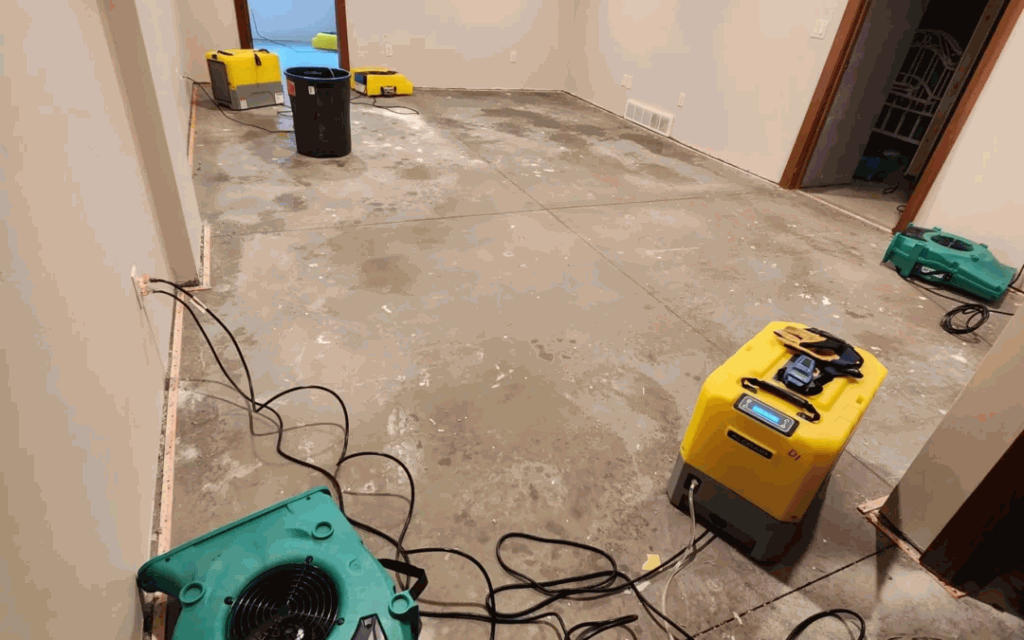
We install an engineered array of Low-Grain Refrigerant dehumidifiers and high-velocity axial air movers positioned in a 360-degree circular vortex pattern. This continuous high-velocity laminar airflow strips boundary layer moisture from concrete surfaces, while LGR dehumidifiers condense and pump out extracted moisture continuously, driving specific humidity down to rapid-drying thresholds.
Stage 6: Calibrated Verification & Crystalline Waterproofing Seal
Technicians conduct daily psychrometric logging, tracking moisture content in concrete and wood until materials reach verified baseline dry standards (wood framing below 10-12%, concrete below 4% moisture equivalent). Upon reaching equilibrium, negative-side crystalline waterproofing barriers (such as Xypex or Drylok) are applied along the cold joint and lower wall perimeter to prevent future capillary seepage.
Hyper-Local Phoenix Case Study: Encanto-Palmcroft Historic District Basement Flooding
During a severe late-August monsoon storm cell, 2.4 inches of torrential rain fell over Central Phoenix in under forty-five minutes. In the historic Encanto-Palmcroft neighborhood, an authentic 1938 Spanish Colonial Revival estate featuring a rare 1,400-square-foot finished subterranean basement suffered a catastrophic inundation.
A utility transformer failure knocked out neighborhood power, disabling the basement’s single AC-powered sump pump. Simultaneously, intense surface runoff ponded in the exterior walkout basement stairwell, breaching the bottom threshold. Over 1,200 gallons of storm runoff and foundation seepage flooded the finished basement, submerging custom oak cabinetry, drywall partitions, an audio-visual entertainment center, and original concrete slab under fourteen inches of muddy water.
Empirical Psychrometric Restoration Metrics & Drying Timeline:
- Initial Standing Water Depth: 14.5 inches across 1,400 square feet (estimated 1,250 gallons)
- Baseline Concrete Slab Moisture Content: 99% Relative Humidity / 6.2% CME (Total Saturation)
- Initial Basement Atmosphere: 78°F, 89% Relative Humidity (132 GPP Specific Humidity)
- Emergency Crew Arrival Time: 24 minutes from emergency dispatch call
- Equipment Deployed: 2 Tsurumi submersible trash pumps, 1 Sapphire 370SS truck-mount extractor, 3 Phoenix DryMAX XL LGR dehumidifiers, 12 axial air movers, 2 Dri-Eaz HEPA 500 scrubbers
- Standing Water Removal: 100% standing liquid evacuated within 1 hour and 45 minutes
- 24-Hour Progress Metric: 18-inch precision flood cuts performed; 6-mil containment established; atmospheric moisture reduced from 132 GPP to 52 GPP
- 72-Hour Equilibrium Dry Standard: Concrete slab moisture reduced to 3.1% CME; structural wood studs dried to 9.2% moisture content; zero mold proliferation detected in post-remediation air quality testing
- Total Mitigation & Drying Cost: $9,480 itemized via Xactimate®—approved without dispute by Chubb Insurance
“Having a finished basement in Phoenix is a true rarity, and seeing fourteen inches of muddy water in our historic Encanto home was terrifying. Valley Restoration Pros arrived in under twenty-five minutes with heavy industrial pumps. They worked through the night, saved our historic structural framing, and prevented toxic mold from taking hold. Their professionalism and insurance documentation were flawless!”
Pay-Per-Call Financial & Insurance Documentation Breakdown
Basement water intrusion creates sudden financial uncertainty for property owners. Understanding insurance claim coverage parameters, itemized restoration pricing, and carrier documentation requirements is critical for seamless claim approval. Valley Restoration Pros adheres to complete consumer transparency standards:
Our master-certified technicians perform an exhaustive thermal imaging survey, structural moisture assessment, and water category classification with zero initial cost and zero obligation.
We utilize Xactimate® pricing software—the universally accepted estimating platform utilized by 99% of property insurance carriers nationwide. Every line item is clearly defined at regional Maricopa County insurance-approved unit rates before restoration commences.
We supply your insurance adjuster with daily digital psychrometric dry logs, timestamped high-resolution photos, FLIR thermal scans, and equipment run-time logs, streamlining claims processing and preventing disputed payouts.
Coverage for basement water intrusions varies depending on the underlying source of water. Sudden plumbing failures (such as a ruptured pipe or water heater burst) are standard covered perils under comprehensive homeowner policies. In contrast, subterranean groundwater seepage or surface storm water runoff may require specific water backup endorsements or separate flood insurance policies. We assist property owners with precise cause-of-loss documentation to support valid claims.
We never make deceptive promises that insurance will pay 100% of costs without deductible responsibility, nor do we bill hidden fees. To review pricing estimates for your property, explore our free on-site damage assessment or connect with our team directly via our emergency dispatch hub.
Exhaustive Technical FAQ Section & Subterranean Restoration Science
Explore deep technical answers addressing the mechanics, soil physics, structural biology, and engineering behind basement water damage restoration in Phoenix, Arizona:
The Phoenix Valley basin features dense, impermeable caliche layers located two to five feet beneath the surface. When torrential monsoon downpours strike, surface water cannot easily permeate into deep underground aquifers; instead, it creates a temporary perched water table that builds intense lateral hydrostatic pressure against subterranean basement walls, forcing water through cold joints and microscopic concrete cracks.
That white residue is efflorescence—a crystalline deposit of calcium, magnesium, and sulfate salts left behind when mineral-laden groundwater evaporates off the concrete surface. Phoenix water averages an extreme 18 GPG hardness. When efflorescence forms beneath paint or within concrete pores (sub-efflorescence), its crystal growth generates over 2,000 PSI of internal force, causing concrete spalling and surface crumbling.
In the desert summer heat, basements trap ambient humidity, creating a microclimate where temperatures of 80°F to 85°F and relative humidity exceeding 75% are common. Under these ideal incubation conditions, opportunistic mold spores (such as Aspergillus, Penicillium, and Stachybotrys) germinate on damp drywall, baseboards, and carpet backing in as few as 24 to 48 hours.
Yes. Chronic or unmitigated basement water accumulation saturates the expansive smectite clay soil beneath footings and slabs. As clay expands and contracts with moisture fluctuations, it causes differential foundation settlement, slab heave, wall cracking, and structural door and window misalignment throughout the upper stories of the building.
Coverage depends on the proximate cause of loss. Sudden internal plumbing pipe bursts or water heater ruptures are standard covered perils. However, surface floodwater runoff entering from exterior storm deluges or sewer backup through basement floor drains typically requires a dedicated flood insurance policy or water backup rider. Valley Restoration Pros assists property owners with comprehensive Xactimate documentation to support insurance claims.
Commercial subterranean basements typically feature higher ceilings, complex mechanical rooms, fire sprinkler riser assemblies, and elevator pits. For large commercial facilities, we deploy mobile desiccant dehumidifier trailers generating up to 5,000 CFM of ultra-dry air. For commercial facility protocols, explore our commercial water damage restoration standards and fire sprinkler water damage cleanup procedures.
Sewer backflows represent Category 3 black water containing gross pathogen contamination, intestinal parasites, and biohazards. All porous materials submerged in sewage must be removed and bio-washed. For detailed sewage protocols, review our emergency sewage cleanup standards. For overhead water intrusions from upper levels, review our ceiling water damage restoration and roof leak water damage restoration manuals.
Subterranean Concrete Science & Hydrostatic Pressure Relief
Subterranean concrete engineering in the desert Southwest represents a unique discipline governed by fluid mechanics, soil physics, and material chemistry. When water accumulates outside an eight-foot subterranean concrete basement wall, the physical forces acting upon the structural envelope can be quantified using fundamental hydraulic equations:
1. Hydraulic Head Pressure Calculations (P = ρgh)
Hydrostatic pressure is directly proportional to the height of the saturated water table outside the foundation:
P = ρ × g × h = 62.4 lbs/ft³ × Depth in Feet
When severe monsoon storm runoff raises the subterranean water table to four feet above the basement floor slab, the static water pressure acting against the cold joint reaches 249.6 pounds per square foot. Across an eighty-linear-foot basement foundation perimeter, this translates to nearly 40,000 pounds of lateral hydraulic force pressing continuously against the concrete wall assembly. Any microscopic fissure or pore in the damp-proofing membrane will instantly become a pressurized conduit for fluid entry.
2. Darcy’s Law of Porous Fluid Flow Through Concrete
Water flow through a porous concrete matrix is governed by Darcy’s Law:
Q = (k × A × ΔP) / (μ × L)
Where Q is fluid discharge rate, k is concrete permeability coefficient, A is surface area, ΔP is hydrostatic pressure differential, μ is water dynamic viscosity, and L is wall thickness. In aging or poorly compacted concrete with higher permeability coefficients, water migration accelerates exponentially under elevated hydrostatic pressure differentials (ΔP). To permanently stop this fluid flow, technicians deploy negative-side crystalline waterproofing agents containing catalytic active chemicals that penetrate deep into concrete pores, reacting with calcium hydroxide to form insoluble dendritic crystalline complexes that permanently seal microscopic voids.
3. Engineered Hydrostatic Pressure Relief Systems
True long-term restoration requires eliminating the hydrostatic pressure head acting against the structure. Our engineering teams install internal perimeter sub-slab drainage channels (french drains) coupled with dual-pump sump basins.
Perforated drainage piping enveloped in non-woven geotextile filter fabric intercepts rising groundwater beneath the slab before it reaches the cold joint. Drainage channels route the water to a heavy-duty poly sump pit equipped with a primary 1/2-HP cast iron submersible pump and an independent 12-volt marine battery backup pump capable of evacuating 2,400 GPH during utility outages.
Deep Psychrometric Drying Dynamics in Subterranean Microclimates
Drying a subterranean basement in Greater Phoenix presents psychrometric conditions completely inverted from typical above-ground restoration. Understanding the thermodynamic interplay between temperature, specific humidity, and vapor pressure is essential for rapid, mold-free structural desiccation:
1. The Subterranean “Vapor Lock” Phenomenon
Because subterranean walls are coupled to 72°F earth while Phoenix outdoor air sits at 115°F, basements act as natural thermal heat sinks. When warm, moisture-laden outdoor air enters a basement, its relative humidity spikes dramatically as the air cools.
Without active mechanical dehumidification, the air inside a flooded basement rapidly saturates to 100% relative humidity. At this point, net evaporation halts completely—a state known as “vapor lock.” Liquid water remains trapped inside porous concrete and wood framing, creating an ideal breeding environment for microbial colonization. To break vapor lock, technicians deploy Low-Grain Refrigerant dehumidifiers that continuously lower specific humidity below 35 GPP, maintaining an aggressive vapor pressure differential between the wet materials and the surrounding air.
2. Concrete Vapor Emission Rate (MVER) & Internal Equilibrium
Standard moisture meters measuring electrical resistance only assess the top 1/4-inch of a concrete slab. However, a six-inch concrete basement floor slab holds substantial moisture deep within its crystalline structure.
We perform quantitative Moisture Vapor Emission Rate (MVER) testing under ASTM F1869 (anhydrous calcium chloride tests) and internal in-situ relative humidity testing under ASTM F2170 (drilled electronic probes). Drying continues until in-situ slab relative humidity falls below 75% to 80%, ensuring that newly installed floor coverings, luxury vinyl planks, or carpets will not suffer post-restoration adhesive breakdown or efflorescence spalling.
3. Air Changes per Hour (ACH) & Negative Pressure Balancing
In confined subterranean environments, air circulation must be carefully engineered to prevent stagnant microclimates in corners and wall cavities.
Our restoration protocols maintain 6 to 8 air changes per hour (ACH) across the entire subterranean envelope using high-velocity axial air movers. Simultaneously, HEPA 500 air filtration scrubbers exhaust approximately 10% of total airflow to the exterior, maintaining continuous negative pressure (-5 Pascals) to guarantee that fungal spores, concrete mineral particulates, and VOCs cannot escape upward into ground-floor living areas.
Verified Local Area Dispatch: Phoenix, AZ
Official Geo-Coordinates: 33.4484° N, -112.074° W • Maricopa County
Frequently Asked Questions: Certified Restorer Insights
Direct answers to the most critical technical, operational, and insurance questions Phoenix property owners ask:
Related Specialized Emergency Restoration Services
Explore specialized rapid-response mitigation protocols across Greater Phoenix and Maricopa County:
Valley-Wide Emergency Response Service Coverage
Our mobile restoration fleet is dispatched across the entire Phoenix metropolitan region, providing rapid 30 to 60 minute emergency response: