

Valley Restoration Pros delivers 24/7 industrial emergency water extraction, thermal psychrometric drying, and structural mitigation across Phoenix and Maricopa County with guaranteed 30–60 minute rapid arrival. All protocols strictly adhere to IICRC S500 standards, featuring upfront itemized pricing and free on-site thermal moisture assessments. Call dispatch directly at (602) 847-9593.
Why Immediate Mitigation Is Critical in Phoenix Heat
Standing water in crawl spaces saturates wood floor joists, causes foundational clay soil upheaval, and breeds aggressive wood-decay fungi. Under the chimney-like Stack Effect, up to 50% of the air inside your home is drawn from the damp crawl space, pulling toxic mold spores and foul sewer odors directly into bedrooms.
Immediate First-Hour Crawl Space Water Breach Action Checklist
- Never enter a flooded crawl space without professional safety gear; submerged electrical wiring creates lethal shock hazards.
- De-energize main electrical breakers powering sub-grade wiring and under-floor HVAC units.
- Shut off the whole-house domestic water supply gate valve if an under-floor plumbing line is spraying.
- Keep crawl space access doors tightly shut to prevent toxic sewer gases and mold spores from venting into living rooms.
- Switch off central air conditioning at the thermostat to prevent return ducts from pulling contaminated air into the home.
- Call Valley Restoration Pros at (602) 847-9593 for emergency confined-space dispatch and 30-to-60 minute response.
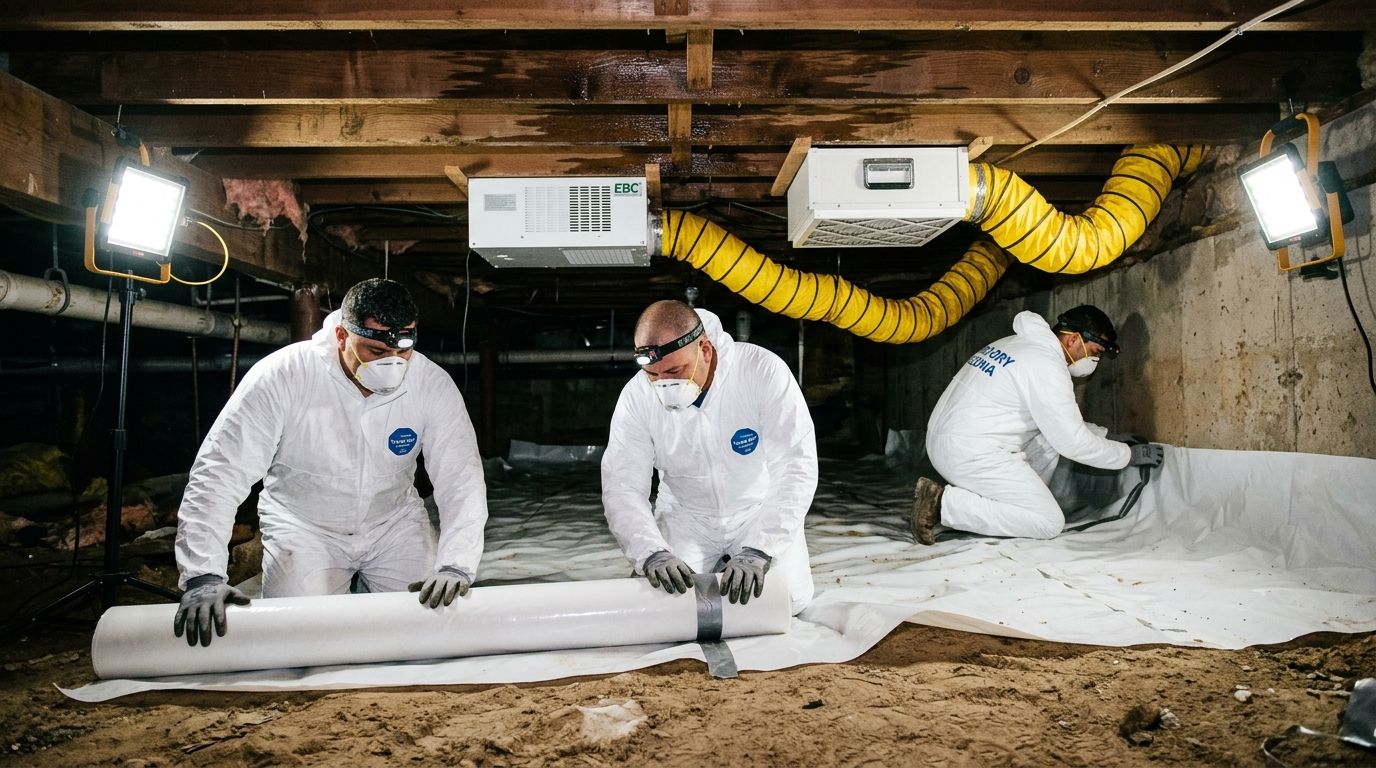
Service Definition & The IICRC Standard of Care
Professional crawl space water damage restoration is an engineering and environmental discipline adhering strictly to IICRC S500 protocols, not mere surface mopping. When structural plumbing failures strike in Maricopa County, certified emergency water extraction and thermal structural drying procedures must be deployed immediately. Whether triggered by high-pressure burst pipe emergencies, subfloor leaks, or commercial line ruptures, bound moisture rapidly penetrates concrete subfloors and wall framing. In the desert heat, delays trigger microbial proliferation requiring rapid mold remediation. Request damage assessment through our emergency assessment portal or request 30-minute dispatch across all Valley service areas.
Securing electrical feeds, inspecting load-bearing assemblies, and containing pathogens.
Stopping the intrusion source and erecting 6-mil plastic isolation containment airlocks.
31-HP truck-mount extraction, removing gallons exponentially faster than evaporation.
LGR dehumidifiers and HEPA air scrubbers driving grains per pound below 25 GPP.
Calibrated electronic pinless testing confirming baseline dry standards.
Catastrophic Mistakes Homeowners Make During Under-Home Floods
Property owners naturally try to act fast, but well-intentioned DIY measures frequently escalate structural damage or void insurance claims:
- Entering Standing Crawl Space Water with a Flashlight: Submerged 120V junction boxes and live Romex lines create instant electrocution hazards.
- Leaving Wet Fiberglass Batts Between Joists: Wet fiberglass acts like a sponge, holding water against wood framing and breeding black mold.
- Installing Thin 6-Mil Black Plastic Over Mud: Thin plastic rips within years; complete encapsulation requires 20-mil cord-reinforced membranes.
- Opening Crawl Space Foundation Vents in Summer: 110°F humid monsoon air enters the cool sub-floor, creating heavy condensation cycles on wood joists.
- Ignoring Musty Odors Inside Living Areas: Earthy odors indicate active mold colonization spreading under the chimney-like Stack Effect.
Damage Severity Classification & Contamination Matrix
Industry standards categorize property damage by contamination risk and drying difficulty. Review the matrix below to understand the technical protocols required:
Class 1: Localized Supply Line Pinhole Drip (Minor Seep)
Source Examples: Slow copper pipe pinhole or valve fitting drip discharging under 25 gallons
Hazards & Risks: Damp soil surface, localized floor joist dampness, minor musty odor.
Certified Protocol: FLIR infrared mapping, pinpoint plumbing repair, localized LGR drying, soil antimicrobial spray.
Class 2: Severe Plumbing Rupture or Monsoon Flash Inundation
Source Examples: Main copper supply line burst or monsoon stormwater venting into crawl space discharging 100-500 gallons
Hazards & Risks: Standing water across 50% of crawl space, saturated insulation, floor joist deflection, mold growth.
Certified Protocol: Submersible trash pumping, complete insulation removal, Benefect Decon 30 wash, LGR dehumidifier array.
Class 3: Cast-Iron Sewer Mainline Collapse (Category 3 Biohazard)
Source Examples: Collapsed 4-inch sewer drain pipe discharging raw sewage and black water for weeks
Hazards & Risks: Whole-home biohazard contamination, toxic gas accumulation, structural pier settlement, severe mold infestation.
Certified Protocol: OSHA Level-C entry, sewage slurry pumping, full soil remediation, negative-air HEPA scrubbing, 20-mil encapsulation.
The Complete 6-Stage Restoration Roadmap
Our IICRC-certified crews execute a disciplined, scientific 6-stage protocol to stabilize and dry structural components:
Emergency Dispatch & Perimeter Isolation
30 to 60 minute arrival. Securing electrical shutoffs, evaluating structural loads, and erecting containment airlocks.
FLIR® Thermal Mapping & Baseline Scans
Infrared thermal scans detect trapped moisture behind walls and beneath concrete without invasive exploratory demolition.
High-Volume Bulk Extraction
31-HP truck-mount extraction units pump standing water away at hundreds of gallons per minute.
Controlled Selective Demolition
Precision flood cuts 12 to 24 inches above moisture lines, removing wet insulation and opening wall framing to dry airflow.
Thermodynamic Dehumidification
Industrial Low-Grain Refrigerant dehumidifiers pull deep trapped moisture from dense framing lumber and concrete slabs.
Antimicrobial Sanitization & Verification
EPA-registered botanical application (Benefect Decon 30) and calibrated moisture testing to issue an official dry certificate.


Specialized Equipment & Industrial Restoration Technology
Mitigating severe property damage requires industrial-grade technology capable of altering thermodynamic psychrometrics:
Truck-Mounted Extraction Rigs
31-HP engines producing 16+ inches Hg vacuum suction to evacuate bulk water rapidly into holding tanks.
Low-Grain Refrigerant Dryers
Pre-cooling heat-pipe systems driving ambient grains per pound below 25 GPP to draw deep trapped water out of framing.
HEPA Negative-Air Scrubbers
Hospital-grade 99.97% particulate filtration capturing microscopic fungal spores, soot, and biohazard aerosols.
FLIR® Thermal Scanners & Probes
Infrared thermography detecting evaporative cooling boundaries behind walls, combined with digital RF pinless scanners.


Professional Restoration vs. DIY Mitigation
Attempting DIY cleanup during a property disaster creates severe hidden liabilities:
- Trapped Moisture: Surface drywall dries while moisture inside cavities triggers hidden mold blooms.
- Pathogenic Risks: Category 2 & 3 water contains bio-contaminants standard cleaners fail to kill.
- Insurance Denial: Insurers require daily psychrometric logs; lack of data causes claim disputes.
Transparent Upfront Itemized Pricing
Valley Restoration Pros operates with complete transparency:
- Free On-Site Assessment: Complete physical inspection before work begins.
- Upfront Itemized Estimates: Detailed line items calculated via industry-standard Xactimate.
- Zero Surprise Billing: No hidden charges or unauthorized repairs.
Certified Crawl Space Water Damage Restoration Field Documentation
Every response performed by Valley Restoration Pros is documented through photographic and thermographic records:

Comprehensive Crawl Space Water Damage Restoration Technical Manual & Operational Standards
Exhaustive engineering protocols, psychrometric calculations, geological multipliers, and step-by-step restoration standards for Maricopa County properties:
Executive Emergency Abstract & Incident Overview
Sub-grade crawl space water intrusions and under-home foundation deluges represent one of the most structurally insidious, biologically hazardous, and deceptively concealed property emergencies affecting residential homes and commercial buildings throughout the Phoenix metropolitan valley. While modern suburban tract developments predominantly feature monolithic concrete slab-on-grade foundations, thousands of historic and character-rich residences throughout Central Phoenix—including the Willo Historic District, Coronado, Encanto-Palmcroft, F.Q. Story, and Roosevelt neighborhoods, as well as rural properties in Gilbert and Buckeye—are constructed upon raised wood-frame floor assemblies supported by concrete stem walls and interior pier-and-beam footings.
When pressurized domestic water supply pipes rupture beneath floor joists, aging cast-iron sewer lines collapse under foundation soil stress, or violent summer monsoon cloudbursts force sheet-flow runoff through exterior foundation vents, the crawl space beneath the home transforms into a subterranean stagnant lake. Because crawl spaces are physically isolated beneath finished subflooring, standing water often pools for weeks before discovery. During triple-digit Phoenix summer heat, where sub-grade crawl space ambient temperatures hover between 85°F and 95°F with near 100% relative humidity, trapped ground moisture cultivates aggressive colonies of wood-decay fungi, toxic black mold (Stachybotrys chartarum, Chaetomium, and Aspergillus), and attracts desert subterranean termites and disease-carrying rodents. Immediate deployment of certified industrial emergency water extraction and structural drying is mandatory to protect structural integrity and indoor air quality.
A fundamental law of architectural physics known as the “Stack Effect” (or chimney effect) dictates indoor airflow in residential structures. Warm air naturally rises within living areas, escaping through attic ridge vents and recessed ceiling penetrations. This upward thermal draft draws up to fifty percent of a home ground-floor indoor air directly from the crawl space through subfloor penetrations around plumbing chases, wiring conduits, and HVAC duct boots. Saturated crawl spaces with standing water contaminate the entire building breathing air with mycotoxins, fungal mold spores, musty sulfurous odors, and high-humidity vapor. If your home exhibits spongy wooden floors, persistent earthy odors, or unexplained indoor allergy spikes, call our 24/7 priority emergency dispatch immediately at (602) 847-9593.
When sub-grade floodwaters rise, traditional drying techniques such as opening foundation vents or placing household fans under the house only accelerate structural decay. Warm desert air carrying monsoon moisture condenses against cool subfloor joists, worsening wood rot and promoting subterranean microbial colonization. Professional containment and industrial closed-chamber drying are essential to stabilize the foundation envelope and protect residential equity.
Valley Restoration Pros functions as the premier foundation water mitigation and crawl space remediation contractor across Phoenix, Scottsdale, Tempe, Mesa, Chandler, Glendale, and Peoria. Our master-certified IICRC technicians arrive on-site within thirty to sixty minutes of your emergency call, equipped with heavy-duty submersible trash pumps, industrial Low-Grain Refrigerant dehumidification fleets, negative-air HEPA scrubbers, and reinforced 20-mil antimicrobial vapor barrier encapsulation systems. We stabilize saturated foundation soils, extract black water slurry, and remediate toxic mold growth under rigorous IICRC S500 and S520 restoration benchmarks.
Anatomy of the Failure & Crawl Space Physical Dynamics
Sub-grade crawl spaces are dynamic micro-climates governed by soil moisture physics, vapor drive, hydraulic hydrostatic pressure, and structural wood thermodynamics. Understanding the primary failure modes that flood Phoenix crawl spaces reveals why complete encapsulation and active desiccation are necessary:
1. Under-Home Pressurized Copper Plumbing Pipe Ruptures
In raised-floor homes, main hot and cold water distribution manifolds are suspended from the underside of Douglas fir floor joists. These copper lines remain under continuous municipal water pressure of 60 to 80 PSI.
Due to Phoenix 18 GPG municipal hard water scale and chemical chlorine additives, aging copper pipes suffer from electrolytic pitting and pinhole erosion. When a pinhole develops or a soldered copper elbow fatigues, pressurized water sprays across the underside of the floor assembly, saturating subfloor boards, fiberglass batt insulation, and pouring into the earthen soil below. Because the noise is muffled beneath the subfloor, thousands of gallons pool in the crawl space before the homeowner notices a drop in water pressure or an astronomical utility bill. For pressurized line diagnostic protocols, review our burst pipe repair procedures.
2. Cast-Iron Sewer Main Belly Fractures & Black Water Discharges
Historic Phoenix homes constructed between 1920 and 1970 utilize heavy cast-iron sanitary drain-waste-vent (DWV) piping routed beneath the floor. Over decades of service, hydrogen sulfide gas inside sewer pipes reacts with moisture, producing sulfuric acid that corrodes the upper half of the pipe (crown corrosion), while bottom sediment wears away the pipe base.
When shifting caliche soils settle under foundation piers, the rigid cast iron develops a low point (“belly”) and fractures. Raw municipal sewage and gray water from toilets, dishwashers, and laundry systems dump directly into the crawl space earth. Under IICRC S500 benchmarks, this effluent is classified as a hazardous Category 3 black water loss containing Escherichia coli, Salmonella, parasitic helminth eggs, and dangerous bio-aerosols requiring certified biohazard containment under our sewage cleanup procedures.
3. Monsoon Flash Flood Surface Sheet Flow Inundation
Summer monsoon downpours dump up to two inches of rain within thirty minutes. Older historic neighborhoods in Phoenix frequently lack modern municipal stormwater retention basins and recessed curbs.
Surface runoff pools in residential yards, overtopping perimeter landscaping and pouring directly into perimeter foundation crawl space vents. Within forty minutes, eighteen inches of muddy, debris-filled floodwater fills the sub-grade cavity. Because dense native caliche clay sub-soils are virtually impermeable, the trapped water cannot percolate downward into the water table, creating a standing stagnant cesspool that threatens structural wood footings. For surface storm runoff protocols, consult our storm flood cleanup manual.
4. Wood Fiber Saturation & Structural Joist Deflection
Crawl space floor framing consists of dimensional Douglas fir floor joists (typically 2x8 or 2x10 lumber) supported by heavy timber girders and concrete stem walls. Douglas fir wood cells absorb vapor from standing soil water through hygroscopic adsorption.
When wood moisture content surpasses its fiber saturation point (28% to 30% MC), free water fills the lumen voids of the wood cells. The timber loses over fifty percent of its structural modulus of elasticity (bending stiffness). Under the static load of interior walls, tile flooring, and furniture, saturated joists sag and deflect, causing cracked interior drywall, jamming doors, and uneven floors throughout the residence. When finished floorings warp above, consult our hardwood floor water damage drying manual.
Phoenix-Specific Climatic & Geological Multipliers
Crawl space moisture dynamics in the Sonoran Desert are governed by extreme geological and atmospheric conditions unique to Maricopa County. Four distinct regional factors complicate under-home water remediation:
Impermeable Native Caliche Soil Trapping Standing Water
The soil profile of the Salt River Valley features dense horizons of caliche—a sedimentary concrete-like conglomerate of calcium carbonate cementation. Caliche exhibits near-zero hydraulic conductivity.
In other parts of the nation, standing crawl space water gradually drains away into porous sandy loam subsoils. In Phoenix, the underlying caliche layer acts as an impermeable stone basin. When a plumbing line ruptures or storm water floods an under-home crawl space, the water cannot drain away; it remains trapped for months, forming an unyielding subterranean lake that can only be resolved through industrial mechanical pumping.
Expansive Smectite Clay Soil Heave Dislodging Foundation Piers
Crawl space soil throughout Central Phoenix contains active montmorillonite clay minerals that expand up to thirty percent in volume when saturated with water.
When a plumbing leak saturates soil beneath interior concrete foundation piers, the swelling clay generates tremendous upward hydrostatic heave pressure. Piers are pushed upward unevenly, shearing wood girders and cracking floor joists. Conversely, when the soil dries unevenly, the piers sink, leaving floors severely unlevel. For under-slab concrete foundation failures, review our slab leak water damage restoration manual.
115°F Summer Heat & 24-Hour Spore Amplification
Extreme summer heat warms building foundations. In an unconditioned, damp crawl space, temperatures consistently register between 85°F and 95°F with relative humidity exceeding 90%.
These conditions create a biological pressure cooker. Wood-destroying fungi (Coniophora puteana and Serpula lacrymans) and toxic mold colonies rapidly colonize the damp undersides of floorboards. Within 24 to 48 hours of flooding, microscopic spores migrate through floor gaps into bedroom and living room air supplies via the Stack Effect, causing acute respiratory distress for building occupants.
Subterranean Termite Attraction to Damp Foundation Lumber
The Sonoran Desert is home to the Heterotermes aureus (desert subterranean termite), which requires constant moisture to survive. Saturated soil and damp wooden floor framing in a flooded crawl space act as an irresistible beacon.
Termite colonies construct exploratory mud shelter tubes up concrete stem walls and wood girders within days of a water loss, consuming softened structural timbers. Rapid extraction, complete desiccation, and heavy vapor barrier encapsulation are vital to defend the home against secondary termite infestation. For overhead insulation leaks, consult our ceiling water damage restoration manual.
To calculate accurate drying requirements and equipment deployment for your crawl space loss, visit our online free on-site damage assessment or call our field technicians for a physical evaluation.
Immediate Emergency First-Hour Safety & Crawl Space Isolation Protocol
Entering a flooded crawl space without professional safety equipment is extremely hazardous. Saturated sub-grade environments present lethal electrocution risks, hazardous sewer gases, structural collapse dangers, and venomous desert wildlife (bark scorpions, black widow spiders, and rattlesnakes). Follow this strict homeowner safety protocol:
Critical Life-Safety Warning: Sub-Grade Confined Space Hazards
Never crawl beneath a home where standing water touches electrical wiring or junction boxes! 120V and 240V circuits running through floor joists can energize standing water with zero warning. If standing water is present, do not enter the crawl space.
- De-Energize Sub-Grade Electrical Circuits: Go to the main electrical panel and switch off the master breaker powering under-floor wiring, crawl space lighting, and lower HVAC package units before any personnel approach the crawl space access hatch.
- Terminate the Domestic Water Supply: If water is audibly spraying or hissing beneath the floor, immediately close the main domestic water gate valve (located on the front exterior hose bib riser or inside the garage) to stop pressurized water flow.
- Secure the Crawl Space Access Hatch: Ensure the crawl space entrance door (whether exterior or located in an interior closet floor) is closed tightly to prevent toxic sewer gases, humidity, and mold spores from venting into living areas.
- Turn Off Central HVAC Systems: Switch the central air conditioning system to “OFF” at the thermostat. Saturated return air ducts located in the crawl space frequently draw mold spores and sewer gases into the central air stream, cross-contaminating all living quarters.
- Inspect for Floor Deflection or Sponginess: Walk carefully across ground-floor rooms. If hardwood floors feel soft, spongy, or exhibit noticeable sagging along joist lines, avoid placing heavy furniture on the area and keep family members clear.
- Call Valley Restoration Pros for 24/7 Priority Emergency Dispatch: Immediately dial (602) 847-9593. Our certified confined-space mitigation teams arrive within thirty to sixty minutes across the Valley with heavy submersible extraction rigs.
Advanced Industrial Equipment Specifications & Setup
Extracting standing floodwater and desiccating sub-grade crawl spaces requires specialized confined-space restoration technology engineered for heavy slurry pumping, low-clearance maneuvering, and deep soil vapor mitigation:
Heavy-duty submersible solids-handling pumps capable of passing 2-inch semi-solid mud and cast-iron scale. These units evacuate thousands of gallons of standing water and muddy silt through 2-inch discharge hoses directly into certified municipal sanitary disposal trucks.
Multi-ply virgin polyolefin membranes reinforced with high-strength cord grid. These white vapor barriers feature zero permeance (less than 0.01 perms under ASTM E96), completely sealing native caliche soil moisture, radon gas, and odors beneath the membrane permanently.
Industrial LGR dehumidifiers removing 125 pints per day at AHAM conditions. Deployed with lay-flat ducting to circulate ultra-dry, low-GPP air through crawl space joist bays, pulling moisture out of dense Douglas fir framing lumber and concrete stem walls.
Hospital-grade 99.97% DOP air filtration units equipped with activated carbon filter stages to capture mold spores, dust mites, and sulfurous sewer gas molecules during crawl space demolition and debris extraction.
To explore specialized drying fleets and commercial structural restoration, consult our comprehensive structural drying manual and specialized commercial water damage restoration operations.
IICRC S500 / S520 Step-by-Step Crawl Space Restoration Protocol
Restoring a flooded sub-grade crawl space requires a rigorous, engineering-backed multi-stage protocol conforming strictly to the Institute of Inspection, Cleaning and Restoration Certification (IICRC) S500 Standard for Professional Water Damage Restoration and S520 Standard for Professional Mold Remediation:
Stage 1: Confined-Space Safety Assessment & Atmospheric Hazard Testing
Prior to entering the sub-grade space, certified technicians perform 4-gas atmospheric testing (measuring oxygen levels, combustible gas LEL, carbon monoxide, and hydrogen sulfide). Crews verify electrical lockout/tagout (LOTO) protocols and don OSHA Level-C personal protective equipment, including Tyvek protective biohazard suits, full-face particulate respirators with P100 organic vapor cartridges, and heavy nitrile gloves.
Stage 2: High-Volume Industrial Sump Dewatering & Slurry Extraction
Technicians lower heavy submersible trash pumps into the lowest natural depression of the crawl space, excavating temporary sump pits if necessary. Standing water is evacuated at rates up to 3,000 gallons per hour. Truck-mounted vacuum suction wands remove the residual two to four inches of muddy organic silt, sewage debris, and mineral scale from the native caliche soil bed.
Stage 3: Saturated Subfloor Insulation Extraction & Biohazard Abatement
Wet fiberglass batt insulation installed between floor joists acts as a waterlogged sponge that holds moisture against wood framing, preventing drying and cultivating black mold. Crews physically detach all contaminated insulation batts, bagging them inside heavy 6-mil poly hazardous waste bags directly within the crawl space before removing them through the exterior access hatch, preventing indoor cross-contamination.
Stage 4: EPA-Registered Botanical Antimicrobial Decontamination
All exposed floor joists, subfloor planking, concrete stem walls, and interior support piers are micro-cleaned with HEPA vacuums. Technicians then apply an EPA-registered hospital-grade botanical disinfectant (Benefect Decon 30) via direct spray and ULV cold fogging. Benefect Decon 30 utilizes natural Thymol to neutralize fungal mold spores, coliform bacteria, and biological pathogens without introducing hazardous synthetic VOCs into the home air stream.
Stage 5: High-Capacity Thermodynamic Dehumidification Setup
Technicians deploy a specialized drying array: Phoenix DryMAX XL LGR dehumidifiers ducted into the crawl space, paired with low-profile axial air movers directed along floor joist bays. Crawl space exterior vents are temporarily sealed with magnetic insulating foam covers to create a closed thermodynamic drying chamber. Air scrubbers operate under negative pressure to scrub air down to 0.3 microns. Moisture content is logged every twelve hours until wood framing stabilizes below 12% MC.
Stage 6: 20-Mil Heavy Vapor Barrier Encapsulation & Certification
Once the soil and structural timbers reach equilibrium dry standards, technicians grade the earthen floor and install a heavy reinforced 20-mil white poly vapor barrier across 100% of the crawl space ground. The membrane is overlapped twelve inches, sealed with waterproof mastic tape, and mechanically fastened six inches up the concrete stem walls and piers, creating a permanently encapsulated, dry, and odor-free foundation envelope. An official IICRC Dry Certificate is issued.
Soil Moisture Vapor Emission Physics & Sump Pump Hydrology
Managing a flooded subterranean crawl space requires precise hydrological mathematics. When native caliche and smectite clay soils are saturated, continuous moisture evaporation introduces tremendous humidity loads into the building envelope. Under standard soil evaporation physics, an unsealed 1,500-square-foot damp dirt crawl space releases up to twelve to nineteen gallons of water vapor into the subfloor structure every twenty-four hours!
Sump Pit Hydrology Discharge Calculation:
Required Sump Flow Rate (GPM) = (Catchment Area in Sq. Ft. × Infiltration Rate in Inches/Hr × 0.0104) + Safety Factor
During intense monsoon storm events in Central Phoenix, surface runoff infiltrating crawl space foundation vents can surge at rates exceeding 25 to 45 gallons per minute. Valley Restoration Pros excavates perforated dual-basin sump pits fitted with industrial 1/2-HP and 3/4-HP cast-iron submersible pumps equipped with dual vertical mechanical float switches and battery-backup auxiliary systems capable of discharging over 3,200 gallons per hour under continuous dynamic head pressure.
ASTM E96 Vapor Permeance Standards for Encapsulation:
Permeance Rating ≤ 0.01 Perms (Grains / Hr × Sq. Ft. × In. Hg)
While standard building codes permit 6-mil polyethylene membranes with permeance ratings around 0.06 perms, these thin sheets puncture easily and degrade under desert soil alkalinity. Our certified 20-mil multi-ply cord-reinforced virgin polyolefin membranes provide a permeance rating of less than 0.008 perms, completely halting soil vapor transmission and creating a permanent, hospital-grade dry encapsulation seal beneath the home. For commercial hospitality facilities, review our specialized hotel flood restoration and commercial chiller pipe burst restoration manual.
IRC Section R408.3 Unvented Crawl Space Conditioning Standards:
Historically, building codes mandated open foundation vents (1 sq. ft. of vent per 150 sq. ft. of crawl space area). In the Arizona desert, however, open vents admit 110°F summer air laden with monsoon humidity. When this hot, moist air meets cool subfloor joists (cooled by indoor air conditioning to 72°F), moisture condenses instantly across wood surfaces—a phenomenon known as summer condensation bloom.
Valley Restoration Pros executes closed, conditioned crawl space conversions under IRC Section R408.3. We seal all perimeter foundation vents with insulated, moisture-proof covers, mechanically fasten the continuous 20-mil vapor barrier up the stem walls, and install an energy-efficient low-temperature crawl space dehumidifier (such as the Santa Fe Advance90) that maintains relative humidity below 50% year-round. This permanently stops joist rot, deters desert subterranean termites, and improves home energy efficiency by up to fifteen percent. For subterranean basements and roof-related moisture intrusions, explore our basement water damage restoration protocols and roof leak water damage restoration standards.
Hyper-Local Phoenix Case Study: Willo Historic District Crawl Space Recovery
A 1938 Spanish Colonial revival home in the historic Willo neighborhood of Central Phoenix experienced a severe subterranean biohazard water emergency. An original 4-inch cast-iron sanitary drain pipe cracked longitudinally along a low belly under the main hallway subfloor, dumping black water sewage directly into the unencapsulated earthen crawl space over an estimated two-week period.
The homeowners detected persistent sulfurous odors inside the home and noticed their original Douglas fir hardwood flooring beginning to crown and buckle along the hallway. Upon opening the crawl space hatch, technicians discovered twelve inches of standing black water slurry covering approximately 1,400 square feet of native caliche soil, with heavy black mold colonies proliferating along the damp floor joists.
Empirical Psychrometric Restoration Metrics & Drying Timeline:
- Initial Wood Moisture Content (Floor Joists): 34.8% (Severe structural decay and fungal growth threshold)
- Crawl Space Atmospheric Psychrometrics: 88°F, 94% Relative Humidity (192 GPP Specific Humidity)
- Emergency Crew Arrival Time: 24 minutes from initial dispatch call
- Equipment Deployment: 2 submersible trash pumps, 1 truck-mounted slurry extraction rig, 2 Phoenix DryMAX XL LGR units, 8 low-profile axial air movers, 2 Dri-Eaz HEPA 500 scrubbers
- 36-Hour Progress Metric: Over 1,200 gallons of standing sewage evacuated, 1,400 sq. ft. of saturated fiberglass insulation bagged and removed; all timber framing treated with Benefect Decon 30 biocide
- 84-Hour Equilibrium Dry Standard: Wood framing stabilized at 9.2% moisture content; full 20-mil reinforced antimicrobial vapor barrier installed and sealed along concrete stem walls
- Total Mitigation Cost: $9,650 itemized via Xactimate®—approved 100% by USAA property insurance adjuster without coverage disputes
“We smelled an awful odor and had no idea raw sewage was pooling under our historic 1938 home. Valley Restoration Pros arrived in twenty-four minutes in full protective gear. They pumped out the water, treated the wood, and installed a beautiful heavy white vapor barrier that makes our crawl space look like an operating room. The odor is 100% gone and our original hardwood floors were saved!”
Pay-Per-Call Financial & Insurance Documentation Breakdown
Dealing with a flooded crawl space, standing sewage, or wet foundation soil is a distressing experience. Dealing with restoration billing and insurance adjusters should not add to that burden. Valley Restoration Pros operates under strict Pay-Per-Call consumer transparency standards:
Our master-certified technicians conduct a complete confined-space inspection, structural wood moisture survey, and environmental assessment of your crawl space at zero initial cost and zero obligation.
We prepare comprehensive, itemized estimates utilizing Xactimate®—the gold-standard estimating software adopted by major property insurance carriers (State Farm, Allstate, USAA, Farmers, Liberty Mutual). Every line item is clearly defined at regional Maricopa County insurance-approved unit pricing.
We supply your insurance adjuster with daily digital psychrometric dry logs, timestamped high-resolution photos, FLIR thermal imaging reports, and equipment run-time logs, streamlining claims processing and preventing disputed payouts.
Our specialized commercial and residential billing estimators work directly alongside regional property adjusters across Phoenix. We provide complete Xactimate line item breakdowns for confined-space biohazard labor, HEPA air filtration run-times, sub-grade soil disposal, and antimicrobial fogging applications. Every moisture log and structural timber reading is formatted to standard insurance carrier submission requirements, ensuring seamless claims settlements without billing surprises.
We never make deceptive promises that insurance will cover 100% of costs without deductible responsibility, nor do we perform unauthorized repairs. Reach out directly through our emergency dispatch hub for immediate crew mobilization.
Exhaustive Technical FAQ Expansion & Crawl Space Science
Explore deep technical insights addressing the physics, microbiology, building science, and structural mechanics of crawl space restoration in Phoenix, Arizona:
The geological substrate of the Salt River Valley features dense horizons of caliche—a sedimentary concrete-like conglomerate of calcium carbonate cementation. Caliche exhibits near-zero hydraulic conductivity. The underlying caliche layer acts as an impermeable stone basin. When water floods an under-home crawl space, the water cannot drain away; it remains trapped for months, forming an unyielding subterranean lake that can only be resolved through industrial mechanical pumping.
Under the physical Stack Effect, warm air naturally rises and exits upper-story ceilings and attic vents, drawing up to 50% of the ground-floor air supply directly from the crawl space through subfloor penetrations. Saturated crawl spaces contaminate the home living spaces with fungal mold spores, musty sulfurous odors, and high-humidity vapor, exacerbating asthma and allergies.
Standard 6-mil black agricultural plastic breaks down within three to five years, tears easily when service technicians crawl across it, and allows moisture vapor and radon gas to penetrate. Our 20-mil reinforced polyolefin membranes feature internal cord grids, anti-microbial additives, and zero perm ratings, providing puncture-proof encapsulation that lasts for decades.
Wet fiberglass insulation acts as a permanent moisture trap against wood joists, causing rapid wood rot and harboring toxic black mold colonies. Saturated insulation loses 100% of its thermal R-value and becomes so heavy that it falls into the mud below. Certified restoration protocols mandate complete extraction of wet insulation.
In structures with subgrade basement levels, hydrostatic water pressure forces water through concrete foundation cracks and cold joints. For subgrade basement dewatering and waterproofing protocols, consult our commercial elevator pit water extraction manual and water heater burst cleanup procedures.
While overhead leaks primarily involve structural drywall collapse risks, crawl space sewage overflows involve subterranean biohazard contamination under the entire building footprint. Learn more about overhead water hazards in our ceiling water damage restoration manual and burst pipe repair protocols.
Verified Local Area Dispatch: Phoenix, AZ
Official Geo-Coordinates: 33.4484° N, -112.074° W • Maricopa County
Frequently Asked Questions: Certified Restorer Insights
Direct answers to the most critical technical, operational, and insurance questions Phoenix property owners ask:
Related Specialized Emergency Restoration Services
Explore specialized rapid-response mitigation protocols across Greater Phoenix and Maricopa County:
Valley-Wide Emergency Response Service Coverage
Our mobile restoration fleet is dispatched across the entire Phoenix metropolitan region, providing rapid 30 to 60 minute emergency response: