

Valley Restoration Pros delivers 24/7 industrial emergency water extraction, thermal psychrometric drying, and structural mitigation across Phoenix and Maricopa County with guaranteed 30–60 minute rapid arrival. All protocols strictly adhere to IICRC S500 standards, featuring upfront itemized pricing and free on-site thermal moisture assessments. Call dispatch directly at (602) 847-9593.
Why Immediate Mitigation Is Critical in Phoenix Heat
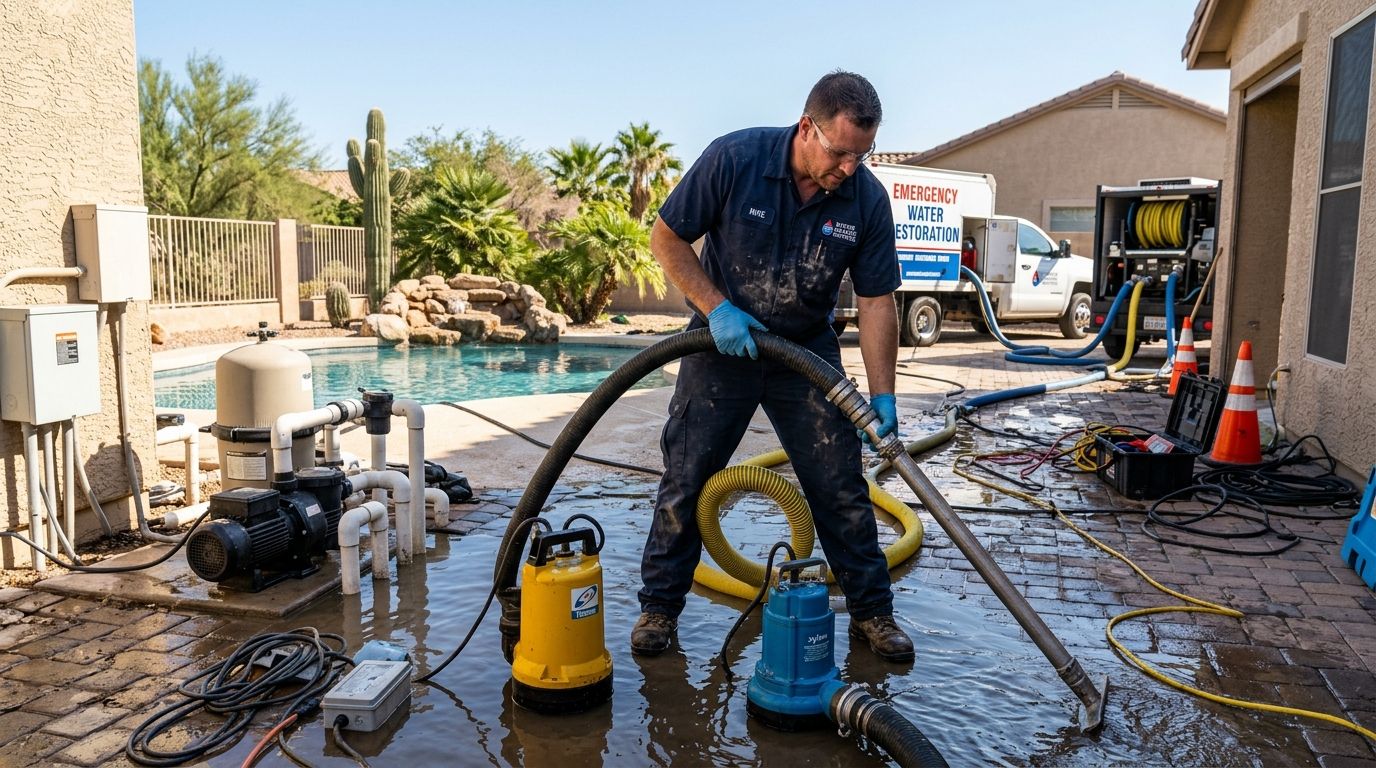
A ruptured 2-inch pool pump manifold or cracked PVC pressure line discharges up to 7,200 gallons per hour of chlorinated water. Unable to penetrate non-porous desert caliche soil, high-pressure floodwater inundates foundations, breaches sliding door thresholds, and saturates interior drywall, destroying flooring and fostering toxic mold within 24 to 36 hours.
Service Definition & The IICRC Standard of Care
Professional swimming pool pump pipe burst flood cleanup phoenix is an engineering and environmental discipline adhering strictly to IICRC S500 protocols, not mere surface mopping. When structural plumbing failures strike in Maricopa County, certified emergency water extraction and thermal structural drying procedures must be deployed immediately. Whether triggered by high-pressure burst pipe emergencies, subfloor leaks, or commercial line ruptures, bound moisture rapidly penetrates concrete subfloors and wall framing. In the desert heat, delays trigger microbial proliferation requiring rapid mold remediation. Request damage assessment through our emergency assessment portal or request 30-minute dispatch across all Valley service areas.
Securing electrical feeds, inspecting load-bearing assemblies, and containing pathogens.
Stopping the intrusion source and erecting 6-mil plastic isolation containment airlocks.
31-HP truck-mount extraction, removing gallons exponentially faster than evaporation.
LGR dehumidifiers and HEPA air scrubbers driving grains per pound below 25 GPP.
Calibrated electronic pinless testing confirming baseline dry standards.
The Complete 6-Stage Restoration Roadmap
Our IICRC-certified crews execute a disciplined, scientific 6-stage protocol to stabilize and dry structural components:
Emergency Dispatch & Perimeter Isolation
30 to 60 minute arrival. Securing electrical shutoffs, evaluating structural loads, and erecting containment airlocks.
FLIR® Thermal Mapping & Baseline Scans
Infrared thermal scans detect trapped moisture behind walls and beneath concrete without invasive exploratory demolition.
High-Volume Bulk Extraction
31-HP truck-mount extraction units pump standing water away at hundreds of gallons per minute.
Controlled Selective Demolition
Precision flood cuts 12 to 24 inches above moisture lines, removing wet insulation and opening wall framing to dry airflow.
Thermodynamic Dehumidification
Industrial Low-Grain Refrigerant dehumidifiers pull deep trapped moisture from dense framing lumber and concrete slabs.
Antimicrobial Sanitization & Verification
EPA-registered botanical application (Benefect Decon 30) and calibrated moisture testing to issue an official dry certificate.


Specialized Equipment & Industrial Restoration Technology
Mitigating severe property damage requires industrial-grade technology capable of altering thermodynamic psychrometrics:
Truck-Mounted Extraction Rigs
31-HP engines producing 16+ inches Hg vacuum suction to evacuate bulk water rapidly into holding tanks.
Low-Grain Refrigerant Dryers
Pre-cooling heat-pipe systems driving ambient grains per pound below 25 GPP to draw deep trapped water out of framing.
HEPA Negative-Air Scrubbers
Hospital-grade 99.97% particulate filtration capturing microscopic fungal spores, soot, and biohazard aerosols.
FLIR® Thermal Scanners & Probes
Infrared thermography detecting evaporative cooling boundaries behind walls, combined with digital RF pinless scanners.
Professional Restoration vs. DIY Mitigation
Attempting DIY cleanup during a property disaster creates severe hidden liabilities:
- Trapped Moisture: Surface drywall dries while moisture inside cavities triggers hidden mold blooms.
- Pathogenic Risks: Category 2 & 3 water contains bio-contaminants standard cleaners fail to kill.
- Insurance Denial: Insurers require daily psychrometric logs; lack of data causes claim disputes.
Transparent Upfront Itemized Pricing
Valley Restoration Pros operates with complete transparency:
- Free On-Site Assessment: Complete physical inspection before work begins.
- Upfront Itemized Estimates: Detailed line items calculated via industry-standard Xactimate.
- Zero Surprise Billing: No hidden charges or unauthorized repairs.
Certified Swimming Pool Pump Pipe Burst Flood Cleanup Phoenix Field Documentation
Every response performed by Valley Restoration Pros is documented through photographic and thermographic records:

Comprehensive Swimming Pool Pump Pipe Burst Flood Cleanup Phoenix Technical Manual & Operational Standards
Exhaustive engineering protocols, psychrometric calculations, geological multipliers, and step-by-step restoration standards for Maricopa County properties:
Executive Emergency Abstract: Swimming Pool Pump Line Rupture & Structural Inundation Recovery
Throughout Greater Phoenix and Maricopa County, residential and commercial swimming pools represent an indispensable lifestyle element and critical architectural feature. From Paradise Valley estates and Arcadia ranch homes to suburban developments in Scottsdale, Chandler, Gilbert, and Peoria, hundreds of thousands of properties maintain complex outdoor filtration and pumping stations. Operating under continuous desert conditions, these systems utilize high-horsepower variable-speed pumps circulating water at high velocity through extensive subterranean and surface-mounted PVC plumbing manifolds.
However, the intense combination of Phoenix's 18 to 25 grains per gallon (GPG) municipal water hardness, punishing 115°F summer ambient heat, ultraviolet solar radiation, and sudden hydraulic pressure transients transforms pool mechanical pads into catastrophic flood sources. High-pressure pool pumps pushing 50 to 80 PSI can discharge between 3,600 and 7,200 gallons per hour when a schedule 40 PVC fitting, check valve, filter canister, or return manifold shatters unexpectedly.
Because native Maricopa County caliche soil forms an impermeable subterranean barrier, uncontained pool floodwaters cannot percolate downward into the earth. Instead, thousands of gallons of chlorinated water sheet across hardscape decking, overwhelm drainage scuppers, back up against perimeter foundation stem walls, and penetrate through weep screeds, sliding patio door tracks, and exterior French doors into interior living quarters. Saturated carpets, engineered hardwood flooring, baseboards, and drywall wick chemical-laden pool water rapidly, creating an urgent indoor flood emergency.
Valley Restoration Pros operates a 24/7 Rapid Pool Equipment Deluge Response Team across Greater Phoenix. Mobilizing within thirty minutes, our IICRC certified technicians isolate damaged plumbing equipment, deploy high-volume submersible trash pumps, extract pooled indoor water using commercial truckmounted units, and initiate structural desiccation to protect residential foundations and living spaces from secondary fungal colonization.
Immediate Pool Equipment Deluge Action Protocol
- De-Energize Pool Sub-Panel Breakers Instantly: High-voltage 220V power feeds pool pumps, automated salt chlorinators, and gas heaters. Immediately flip the dedicated pool sub-panel breaker to eliminate catastrophic electrical arc and electrocution hazards.
- Close Suction & Return Isolation Valves: Rotate multi-port valves and Jandy NeverLube suction valves to the closed position to halt gravity-fed siphoning of pool water toward the fractured pipe break.
- Divert Surface Water Away from Home Foundation: Erect temporary earth berms, sandbags, or landscape barriers to prevent rushing pool water from penetrating door sills and exterior stucco weep screeds.
- Mobilize Emergency Structural Extraction Crews: Call our 24/7 Emergency Dispatch Center directly at (602) 847-9593 for immediate dispatch of industrial extraction units across the Valley.
Anatomy of Pool Plumbing Failures: Hydraulic Pressure & Degradation Physics
Swimming pool circulation systems operate under substantial hydraulic loads. A standard residential installation features 1.5 to 3.0 horsepower filtration pumps moving up to 100 gallons per minute through complex networks of valves, heaters, and filtration canisters. Understanding the mechanical failure points illustrates why pool pump floods occur with catastrophic suddenness:
PVC Photodegradation & Solar Embrittlement
Exposed Schedule 40 white PVC piping absorbs intense ultraviolet radiation on unshaded equipment pads. Over multiple seasons, UV rays degrade polyvinyl chloride polymer chains, causing severe chalking, discoloration, and structural brittleness. When subjected to routine operating pressures, brittle pipe walls rupture along longitudinal seams.
Water Hammer & Automated Actuator Valve Shocks
Automated pool control systems actuate motorized valves to switch between pool circulation, spa spillways, and water features. Rapid valve closures create severe hydraulic shockwaves known as water hammer. Dynamic pressure spikes exceeding 120 PSI fracture solvent-welded elbow joints, union collars, and pump discharge fittings.
Cartridge & DE Filter Tank Hydrostatic Ruptures
Mineral scale and desert dust load diatomaceous earth (DE) grids and pleated cartridge filters rapidly. Internal tank pressure climbs beyond safe operational thresholds (over 35 PSI). Clamping bands fatigue, or composite tank bell housings crack along belly bands, blasting hundreds of gallons per minute outward in an uncontrolled geyser.
Salt Chlorinator Cell & Chemical Outgassing Failures
Electrolytic salt chlorinator cells generate sodium hypochlorite through electrolysis. If water flow is restricted while the cell continues operating, trapped hydrogen gas and chlorine pockets produce aggressive pressure build-up. The plastic housing overheats, degrades, and explodes, discharging saline water continuously across the yard.
When high-velocity plumbing ruptures occur on residential properties, immediate deployment of certified burst pipe repair protocols and rapid water containment is essential to prevent interior structural deterioration.
Phoenix Desert Climatic Multipliers: 115°F Thermal Cycling, Caliche Soil & Extreme Hardness
The unforgiving environment of the Sonoran Desert introduces intense thermodynamic and geological factors that exacerbate pool pump pipe failures and compound the severity of interior property flooding:
1. 18 to 25 GPG Water Hardness Scaling & Flow Impedance
Municipal tap water delivered across Phoenix, Glendale, Mesa, and Scottsdale contains exceptionally high concentrations of calcium carbonate and magnesium sulfate. Continuous pool evaporation in the desert climate concentrates these minerals, driving Total Dissolved Solids (TDS) beyond 2,500 parts per million.
This mineral saturation precipitates thick scale on pump impellers, check valve flappers, and heat exchanger coils. Calcite accumulation restricts internal pipe diameters, driving up system operating head pressure and subjecting aged PVC plumbing joints to severe mechanical stress. This severe mineralization similarly threatens indoor appliances, as explained in our reverse osmosis water filter flood cleanup documentation.
2. 115°F Summer Temperatures & 160°F Equipment Pad Superheating
During Phoenix summer heatwaves, ambient air temperatures frequently surpass 115°F, causing bare concrete equipment slabs and dark plastic pool pump housings to reach 150°F to 160°F under relentless direct sunlight. Thermoplastic materials lose tensile strength at these elevated temperatures.
When cooler water surges through sun-baked pipes during automated pump activation, the resulting thermal shock induces micro-fissures along PVC solvent joints. Concurrently, high indoor temperatures rapidly accelerate bacterial and fungal propagation if discharged pool water breaches the home envelope. Review our advanced mitigation protocols in our mold remediation manual.
3. Impermeable Caliche Clay Soil & Sheet Surface Flooding
The native soil across the Salt River Valley consists largely of dense caliche—a hardpan layer cemented by calcium carbonate that acts like subterranean concrete. Water released from a ruptured pool line cannot seep quickly into the ground.
A severed 2-inch pool return pipe releases up to 100 gallons per minute. Blocked by subterranean caliche, this massive volume sheets across patios, traverses landscape gravel, and pushes against residential concrete stem walls. Water rises above foundation weep screeds and floods through door thresholds. Explore our specialized procedures for emergency water extraction to minimize building damage.
4. Sub-Slab Moisture Hydrodynamics & Tile Efflorescence
When pool water pools against exterior foundation footings, hydrostatic pressure forces moisture beneath the monolithic concrete slab. This water migrates horizontally through porous concrete pores via capillary action.
As this chemical-rich pool moisture evaporates upward through travertine, saltillo tile, or porcelain flooring, it dissolves subterranean mineral salts, creating destructive efflorescence crusts and unbonding thin-set mortars. For technical remediation of this subsurface condition, consult our authoritative overview of tile efflorescence sub-slab moisture drying and structural restoration.
Immediate First-Hour Emergency Protocol: Pad Isolation & Ingress Defense
The initial sixty minutes following a pool equipment rupture represent the critical operational window to contain water volume and safeguard the home interior:
Electrical Sub-Panel De-Energization
Locate the pool equipment sub-panel or main electrical service panel and switch off all circuit breakers labeled pool pump, booster pump, heater, salt cell, and lighting to prevent lethal voltage conduction through standing water.
Physical Valve Closure & Suction Cutoff
Manually close all skimmer, main drain, and cleaner suction valves. If the pool water level sits higher than the equipment pad, closing these valves stops continuous gravity siphoning of pool water through the shattered pipe.
Threshold Sandbagging & Water Redirection
Deploy sandbags, rolled heavy towels, or landscape barriers along exterior doors, patio sliding tracks, and garage entries. Cut emergency diversion trenches in perimeter landscape gravel to channel water toward street gutters.
Interior Vulnerable Asset Elevation
Elevate low-lying electronic devices, upholstered furniture, fine area rugs, and draperies off wet flooring. Place foil shields or plastic blocks under wooden furniture legs to halt chemical pool water absorption.
For commercial properties or large multi-unit residential communities suffering heavy exterior hydraulic breaks, explore our industrial capabilities in commercial water damage restoration and rapid facility stabilization.
Advanced Industrial Equipment Specifications: High-Volume Pumping & Desiccation Systems
Extracting thousands of gallons of pool water and completely drying saturated interior building materials demands high-capacity restoration technology:
Industrial Submersible Trash Pumps
Model: Tsurumi HS2.75S High-Head Debris Pumps
Pool equipment failures produce heavy outdoor flooding mixed with gravel, desert silt, and landscape mulch. Our industrial submersible pumps feature urethane vortex impellers that handle abrasive solids up to 1 inch in diameter, pumping massive volumes away from foundations to safe municipal drainage discharge points.
- Discharge Capacity: 53 gallons per minute (3,180 GPH) per unit
- Solids Handling: Up to 1-inch spherical semi-solids and silt
- Motor Rating: 1.0 HP heavy-duty continuous thermal overload motor
High-Vacuum Truckmount Extraction Units
Model: Sapphire Scientific 570 Truckmounted Extractors
When chlorinated water penetrates residential carpeting, tile grout, and hardwood flooring, standard wet vacs are wholly inadequate. Our vehicle-mounted extraction engines generate powerful negative pressure and airflow, extracting water trapped within carpet padding and masonry subfloors with deep vacuum extraction wands.
- Vacuum Blower: 450+ CFM positive displacement dual-lobe blower
- Lift Capacity: 15 inches of mercury (Hg) deep-seated water lift
- Extraction Rate: Up to 1,200 gallons per hour direct containment
Low-Grain Refrigerant (LGR) Dehumidifiers
Model: Phoenix 250 MAX & Dri-Eaz Revolution LGR Fleets
Low-Grain Refrigerant dehumidifiers engineered for the Southwest climate continue removing moisture efficiently even when ambient indoor temperatures approach 100°F. By depressing vapor pressure down into the teens of grains per pound (GPP), they extract deeply bound water from wall studs and concrete slabs.
- Water Removal: 145 pints per day at AHAM (80°F / 60% RH)
- Process Airflow: 365 CFM high-static ducted airflow
- Temperature Threshold: Engineered for operational stability to 125°F
Cavity Injection Drying & Thermal Imaging
Model: Injectidry Floor/Wall Systems & FLIR E8-XT Cameras
Pool floodwater wicking into baseboards enters concealed stud bays. We deploy calibrated Injectidry systems that force super-dry air directly into enclosed wall cavities beneath baseboards without tearing down undamaged drywall, verified continuously using high-resolution FLIR radiometric thermal cameras.
- Thermal Resolution: 320 × 240 true microbolometer sensor
- Cavity Pressure: Positive pressure vortex delivery across 48 ports
- Non-Invasive Verification: Pinless moisture detection via Tramex ME5
For facilities with complex multi-level underground architectures or mechanical basement spaces, explore our specialized procedures for subterranean parking garage flood extraction and high-head dewatering.
IICRC S500 / S520 Step-by-Step Restoration Protocol: Six-Stage Pool Inundation Workflow
Executing a scientifically disciplined restoration protocol guarantees that both visible surface water and concealed sub-slab moisture are completely eliminated:
Stage 1: Equipment Pad Mechanical Isolation & Perimeter Diversion
Our response crew secures the equipment pad, verifies full electrical lockout, mechanically isolates valves, and clamps ruptured PVC lines. We deploy high-head trash pumps and inflatable perimeter dams to halt exterior water migration toward the building envelope immediately.
Stage 2: Comprehensive Infrared Moisture Mapping & Psychrometric Baselines
Using FLIR radiometric thermal cameras and Tramex impedance moisture meters, technicians trace every path of water intrusion through sliding door tracks, baseboards, drywall partitions, and sub-slab concrete. We record dry standard moisture baselines in unaffected rooms to set precise target endpoints.
Stage 3: Deep Extraction & Water Claw Pad Vacuuming
We deploy truckmounted extraction systems paired with weighted sub-surface Water Claw extractors. This apparatus pulls pooled pool water directly through carpet backing and bonded padding, extracting up to 90% of physical water volume before dehumidification equipment is energized.
Stage 4: EPA-Registered Antimicrobial & Chemical Salt Neutralization
Because pool floodwater carries dissolved cyanuric acid, high chloramines, and landscape microbes from ground transit, it is treated as Category 2 graywater. We apply botanical antimicrobials (Benefect Decon 30) and specialized salt-neutralizing agents to prevent microbial growth and masonry efflorescence.
Stage 5: Industrial LGR Dehumidification & Airflow Vortex Optimization
We engineer balanced drying chambers using Phoenix 250 MAX LGR dehumidifiers and high-velocity centrifugal air movers positioned at 45-degree laminar angles. This configuration produces high vapor pressure differentials, evaporating moisture out of drywall and concrete slabs. For whole-structure drying methods, review our structural drying specifications.
Stage 6: Psychrometric Monitoring & Final Dry Standard Certification
Technicians document temperature, relative humidity, and structural moisture content (%MC) every 24 hours. When wood framing reaches equilibrium under 12% MC and concrete slabs match pre-loss baselines, we provide a complete IICRC-compliant Certificate of Structural Dryness for insurance closure.
Hyper-Local Case Study: Paradise Valley Estate Pool Pump Manifold Shatter
Incident Breakdown: Unchecked 65 PSI Deluge Breaching Custom Patio Sliders
On a mid-August Tuesday with ambient temperatures hitting 114°F, a 3.0-horsepower variable-speed pool pump activated at maximum 3,450 RPM for a scheduled water feature filtration cycle at a luxury residence near E Camelback Rd in Paradise Valley. Severe UV embrittlement and calcite scale had weakened an exposed 2-inch PVC pressure manifold. The fitting shattered violently under 65 PSI line pressure.
Over three hours while the homeowners were away, an estimated 14,000 gallons of chlorinated pool water flooded the equipment yard. Blocked by underlying caliche hardpan, floodwater rose 5 inches against the home's rear elevation, submerged the patio floor, and crested the threshold of 16-foot pocketing glass sliding doors. Water inundated 1,200 square feet of custom European white oak hardwood and imported Italian travertine tile.
Emergency Mitigation Milestones & Restoration Results
- Minute 28: Rapid On-Site Mobilization: Valley Restoration Pros emergency units arrived on site within 28 minutes. Technicians secured electrical breakers, clamped broken PVC piping, and placed sandbags along the patio sill.
- Hour 1 to 3: Exterior Dewatering & Surface Extraction: Deployed two Tsurumi submersible trash pumps to discharge pooled yard water to street storm drains, while Sapphire Scientific truckmounts extracted standing water from interior travertine floors.
- Hour 4 to 12: Precision Hardwood Vacuum Mat Setup: Installed industrial hardwood floor drying mats connected to negative pressure extractors, drawing water directly from beneath the oak planks without cupping. For specialized floor drying standards, see our hardwood floor water damage drying protocol.
- Hour 14 to 68: Closed-Loop Psychrometric Desorption: Deployed three Phoenix 250 MAX LGR dehumidifiers, twelve centrifugal air movers, and an Injectidry wall cavity system, dropping chamber humidity from 88 GPP down to 29 GPP.
- Hour 72: Structural Dry Standard Clearance: Oak flooring stabilized at 9.1% moisture content (matching dry standard baseline), stud cavities measured 8.5% MC, and sub-slab moisture tests verified complete remediation with zero mold formation. Over $65,000 in custom hardwood was preserved without replacement.
Verified Client Testimonial:
"When our pool pump shattered, thousands of gallons poured straight through our patio sliders and covered our custom white oak floors. Valley Restoration Pros arrived in under 30 minutes, stopped the flooding, pumped the yard dry, and set up hardwood vacuum drying mats that completely saved our floors from warping. Their upfront itemized pricing and comprehensive insurance documentation made a terrifying situation seamless to resolve."
— Dr. Julian & Claire R., Paradise Valley AZ
Transparent Upfront Itemized Pricing & Comprehensive Insurance Documentation
A major pool equipment flood is stressful and disorienting. Property owners deserve straightforward, transparent pricing without confusing promises or high-pressure tactics. Valley Restoration Pros adheres to strict customer transparency principles:
Free On-Site Damage Assessment
Our certified technicians perform a thorough on-site physical evaluation, including FLIR thermal moisture mapping and digital meter verification, completely free of charge before any work begins.
Transparent Upfront Itemized Pricing
We provide crystal-clear line-item estimates generated via Xactimate®—the gold-standard pricing software utilized by all major property insurance carriers—based on standardized regional Phoenix rates.
Zero Misleading Direct Billing Promises
We never make unrealistic claims that insurance will cover 100% of costs without deductible obligations. Policy terms, exclusions, and endorsements differ; we review your coverage realistically upfront.
Complete Claims Documentation Package
We equip your insurance adjuster with complete IICRC-compliant documentation: timestamped photos of shattered PVC fittings, infrared thermal scans, psychrometric moisture logs, and drying certificates.
To calculate estimated mitigation ranges for your property, explore our interactive free on-site assessment. To confirm service coverage across your specific municipality, browse our active regions in areas we serve, or connect with our dispatch office on our contact us page.
Frequently Asked Technical Questions: Swimming Pool Equipment Flood Remediation
In the majority of standard homeowner policies, sudden and accidental discharge of water resulting from a ruptured mechanical pipe or equipment manifold is a covered peril. However, repair of the pool plumbing pipe itself may be subject to maintenance exclusions, while the resultant structural damage to flooring, drywall, and baseboards is covered. We furnish comprehensive forensic photo evidence and psychrometric moisture documentation to support your claim.
Under IICRC S500 standards, swimming pool water inside the closed plumbing loop begins as Category 2 water due to treatment chemicals such as chlorine, cyanuric acid, and algaecides. The moment that water discharges across outdoor soil, gravel, lawn fertilizers, and pet waste before entering a home, it picks up substantial biological contaminants, transitioning into Category 2 graywater or Category 3 blackwater that requires EPA-registered antimicrobial treatment.
Yes, provided professional extraction begins before wood fibers undergo permanent cell wall collapse and cupping. We utilize specialized commercial vacuum drying mat systems that seal against hardwood surfaces, drawing trapped liquid through tongue-and-groove joints under high negative pressure. Paired with LGR dehumidification, this non-invasive approach regularly preserves high-value wood floors without requiring demolition.
The Phoenix metropolitan basin rests atop dense caliche soil—a subterranean sedimentary stratum cemented by calcium carbonate that possesses near-zero hydraulic conductivity. When thousands of gallons release rapidly, the ground cannot absorb it. Water sheets across the surface, ponding against foundation stem walls and penetrating door thresholds and stucco weep screeds.
When exterior floodwaters saturate the soil surrounding foundation footings, moisture travels beneath monolithic concrete slabs via capillary draw. We utilize deep structural desiccant dehumidifiers and directional air movers to extract bound moisture vapor through the slab, preventing secondary salt efflorescence and tile delamination.
On average, thorough structural drying requires 3 to 5 days (72 to 120 hours) of continuous industrial LGR dehumidification and vortex air movement. We verify dryness using calibrated pin and pinless moisture meters against pre-established dry standard baselines, ensuring framing studs and subfloors are completely stabilized before equipment removal.
Schedule 40 vs Schedule 80 PVC Physics: Hydraulic Shockwaves & Pressure Spikes
The overwhelming majority of residential swimming pool equipment pads in Maricopa County are plumbed using standard white Schedule 40 PVC. While cost-effective during original pool construction, Schedule 40 piping exhibits critical structural vulnerabilities when exposed to intense desert environments:
Tensile Strength Degradation Under Desert Thermal Cycling
Schedule 40 PVC is rated for a nominal pressure of 280 PSI at 73°F for a 2-inch diameter pipe. However, ASTM D1785 engineering standards dictate that for every 10°F increase above 73°F, PVC's allowable working pressure drops sharply. At 140°F—a surface temperature routinely exceeded on Phoenix concrete pool pads in midsummer—the pressure de-rating factor is 0.22, reducing the safe working threshold of Schedule 40 pipe down to roughly 61 PSI.
Schedule 80 dark gray PVC features substantially thicker pipe walls, offering a working pressure rating of 400 PSI at 73°F and maintaining nearly 90 PSI at 140°F. When high-horsepower variable-speed pumps ramp up, dynamic operating pressure combined with solar heat regularly pushes Schedule 40 fittings past their critical burst limit, leading to catastrophic longitudinal pipe ruptures.
The Mechanics of Hydraulic Water Hammer
When automated diverter valves or pool sweep actuators close suddenly while a 3.0 HP pump circulates 90 GPM, kinetic fluid energy cannot instantaneously dissipate. The moving column of water collides with the closed valve face, generating a reverse acoustic pressure wave that travels back through the manifold at over 4,000 feet per second.
This hydraulic shockwave spikes internal manifold pressure to 120-150 PSI for fractions of a second. Brittle, heat-weakened Schedule 40 elbows and slip couplings shear cleanly at the glue joints, unleashing hundreds of gallons of water per minute directly toward the home foundation. For related plumbing failures in multi-story residential structures, review our specialized ceiling water damage restoration procedures.
Chemical Decontamination: Chlorinated Pool Water & Salt System Residuals
A swimming pool pump flood introduces chemical complexities not encountered during standard domestic freshwater plumbing breaks. The water discharging into living areas carries active chemical compounds that interact aggressively with building finishes:
Sodium Hypochlorite & Fiber Bleaching
Free available chlorine (FAC) maintained at 2.0 to 5.0 ppm reacts rapidly with nylon and wool carpet fibers, hardwood finishes, and drywall dyes. Chlorine acts as a powerful oxidizer, stripping color and breaking down cellulose binders in subfloor underlayment within hours of immersion.
Saltwater Electrolytic Saline Saturation
Modern Phoenix pools frequently operate automated saltwater chlorine generators requiring sodium chloride concentrations between 3,000 and 3,500 ppm. When saltwater penetrates concrete slabs and drywall, salt crystals remain behind as water evaporates, attracting atmospheric moisture perpetually through hygroscopic action.
Cyanuric Acid & Algaecide Deposition
Pool water contains cyanuric acid (CYA) stabilizers and copper or quaternary ammonium algaecides. Ground transit dissolves surface garden chemicals and pet waste, creating a complex chemical slurry that demands hospital-grade botanical neutralization to ensure occupant safety.
Our remediation protocols include chemical rinsing and extraction agents that break down active chlorine residuals, neutralize mineral salts, and halt secondary degradation. Where pressurized residential tanks burst inside mechanical utility rooms, review our specialized water heater burst cleanup protocols.
Stem Wall Weep Screed Breaches & Foundation Caliche Saturation Dynamics
In typical Phoenix residential construction, the exterior wall framing consists of wood studs sheathed in gypsum or OSB, covered by two layers of Grade D weather-resistant barrier paper, and finished with exterior cementitious stucco. The bottom edge terminates at a galvanized metal weep screed located approximately 4 inches above outdoor grade:
The Mechanics of Weep Screed Water Ingress
The stucco weep screed is designed to allow moisture that enters the stucco cladding to drain out freely at the bottom. However, when thousands of gallons of pool water flood the backyard equipment area, standing water rises above the weep screed holes.
Hydrostatic head pressure forces pool water backward through the screed perforations, bypassing the moisture barrier and saturating the bottom sill plate (mudsill), anchor bolts, and lower drywall edges. Because the mudsill rests directly atop the concrete stem wall, water migrates horizontally into interior wall cavities, spreading undetected beneath baseboards across multiple adjoining rooms.
Caliche Layer Hydrostatic Containment
In normal geological conditions, floodwater would dissipate downward through granular subsoil. In Maricopa County, the presence of dense caliche hardpan 12 to 36 inches below the surface traps water in the upper soil strata, creating a perched water table directly against the residential foundation.
This persistent subterranean water reservoir exerts lateral hydrostatic pressure against concrete stem walls, accelerating moisture transmission into slab perimeters. For residential properties experiencing plumbing failures beneath building slabs, review our technical standards for slab leak water damage restoration and concrete diagnostics.
Sub-Slab Moisture Extraction & Tile Efflorescence Mitigation
Concrete is not a solid, impermeable barrier; it is a porous, capillary network composed of microscopic pores and micro-fissures. When flooded with chlorinated pool water, concrete slabs act like large sponges, absorbing moisture that later causes substantial flooring failure if not scientifically remediated:
The Efflorescence Cycle on Desert Tile & Stone
As pool water moves upward through the concrete slab and thin-set mortar beds toward finished tile flooring, it dissolves soluble free lime (calcium hydroxide) and sodium salts. When the water evaporates at the tile surface, these salts react with atmospheric carbon dioxide, converting into insoluble calcium carbonate crystals.
This crystal growth creates chalky white crusts across grout joints and stone surfaces. Over time, the expanding crystal pressure shears the bond between thin-set mortar and floor tiles, causing hollow sounding spots, tenting, and cracked tiles.
Deep Sub-Slab Desiccant Dewatering Strategies
Standard surface fans cannot pull deep moisture out of thick concrete slabs. Valley Restoration Pros deploys commercial desiccant dehumidifiers capable of delivering ultra-dry air at less than 15 GPP. This extreme dry air creates a powerful vapor pressure differential between the slab interior and the ambient environment.
Moisture vapor is continuously drawn to the surface and exhausted outdoors, restoring the slab to acceptable emission levels (under 3 lbs per 1,000 sq ft per 24 hours per ASTM F1869). For properties with sub-floor spaces, review our certified procedures for crawl space water damage restoration and foundation drying.
Emergency Property Owner Action Checklist & Equipment Pad Precautions
When an outdoor pool pump pipe ruptures, taking decisive, safe action while emergency restoration crews are in transit significantly reduces interior structural losses:
1. Avoid Standing Water Near Equipment
Never wade through standing water near the pool pad while breakers are energized. Pool sub-panels carry 220-volt current capable of delivering fatal electrical shocks through flooded concrete slabs.
2. Do Not Run Vacuum Cleaners in Pool Water
Never use domestic household vacuum cleaners or small shop vacs to extract flooded pool water. They lack GFCI protection, possess tiny holding capacities, and exhaust fine biological particulates into living areas.
3. Clear Drainage Weep Channels
If safe, clear landscape gravel, fallen palm fronds, and desert debris from outdoor deck drains and patio scuppers to facilitate natural gravity drainage toward the street before water crests door thresholds.
4. Document the Rupture with Timestamped Photos
Capture clear digital photos and video clips of the fractured PVC fitting, the water spray radius, high-water marks against exterior stucco, and interior moisture spread for your insurance adjuster dossier.
For domestic appliance malfunctions involving kitchen supply hoses, review our specialized restoration standards in appliance leak water damage recovery.
Variable-Speed Pump Pressures vs Multi-Port Valve Gasket Failures
Modern pool installations across Arizona incorporate energy-efficient variable-speed (VS) pumps. While highly effective at reducing electrical consumption, they introduce dynamic mechanical stresses that differ fundamentally from older single-speed systems:
Ramping Flow Velocities & Dynamic Surges
Variable-speed pumps programmatically ramp from low-speed skimming (1,200 RPM) to maximum clean-cycle velocity (3,450 RPM) within seconds. This rapid acceleration creates instantaneous mass flow surges that shock internal valve diverters and multi-port valve spider gaskets, displacing rubber seals and allowing pressurized water to blow out past valve stems.
Multi-Port Valve Spider Gasket Degradation
Inside the multi-port backwash valve, a spoke-shaped rubber spider gasket seals water flow between filter, backwash, rinse, and waste ports. Chlorine exposure and mineral scale harden the rubber over time. When torn under pressure, water constantly discharges through the waste line or spews from the valve clamp collar, flooding the yard continuously.
Impeller Housing Cavitation & Thermal Melting
If a skimmer basket fills with desert debris, water flow is choked off while the motor spins at high RPM. The trapped water inside the pump volute boils, reaching temperatures exceeding 180°F. The plastic pump strainer pot melts, the mechanical seal disintegrates, and pressurized water sprays continuously when flow is briefly restored.
For commercial hotels and resort properties managing extensive central mechanical chiller systems, explore our certified capabilities in commercial chiller pipe flood restoration and closed-loop mitigation.
Wood Stud Framing, Baseboard Infiltration & Drywall Saturation Dynamics
When flooded pool water crosses the building threshold, moisture does not simply rest on floor coverings. Gypsum drywall and structural framing materials absorb water aggressively through capillary wicking:
Capillary Wicking Height in Standard 1/2-Inch Drywall
Standard gypsum drywall features porous paper facings on both sides of a calcium sulfate dihydrate core. When exposed to 2 inches of standing water, the paper facing wicks moisture upward via capillary force, climbing 18 to 30 inches above finished floor height within 12 to 24 hours.
The gypsum core softens, loses structural cohesion, and becomes prime microbial fuel in the warm Arizona climate. Our technicians use pinless radio-frequency meters to map the precise height of the wicking boundary. Where drywall retains core integrity, high-velocity desiccant airflow can restore it; where delamination has occurred, clean flood cuts are performed 2 inches above the moisture line.
Mudsill Moisture Absorption & Stud Framing Swelling
The horizontal pressure-treated mudsill and vertical spruce-pine-fir (SPF) wall studs absorb moisture through end-grain pores. Wood framing with moisture content exceeding 16% MC begins swelling, warping interior door casings and popping drywall fasteners.
Left unmitigated, wood fiber moisture above 19% creates ideal germination conditions for wood-decay fungi and toxigenic molds. We deploy high-pressure cavity drying systems that circulate heated, dehumidified air directly through baseboard access penetrations, bringing wood framing below 12% MC without structural teardown. For rooftop water damage affecting ceilings and attics, review our protocols for swamp cooler roof leak water damage recovery.
Seasonal Temperature Fluctuations: Winter Radiational Freezes vs Summer Superheating
While Phoenix is renowned for relentless desert heat, pool plumbing systems experience destructive seasonal extremes at both ends of the thermometer throughout the year:
December - January Radiational Freezes
Clear desert winter nights cause rapid radiational cooling, dropping ground temperatures below 28°F across Mesa, Chandler, North Scottsdale, and Queen Creek. Water trapped in un-drained PVC pipe manifolds, chlorinator chambers, and pump drain plugs freezes solid. Expanding ice splits pipe walls longitudinally. When daytime temperatures rebound into the 60s, pressurized water discharges unchecked.
July - August Monsoon Microbursts & Silt
Severe summer haboobs and monsoon thunderstorms generate blinding dust storms followed by torrential rains. Desert silt and organic debris choke pool skimmers and filtration canisters. Sudden high-pressure pump dead-heading combined with 60 MPH wind vibrations fractures already-brittle PVC couplings on outdoor pads. Explore our emergency standards for storm flood cleanup across the Valley.
May - June Pre-Monsoon Superheating
During early summer when ambient humidity drops below 10% and sunshine is relentless, equipment pad concrete surfaces absorb maximum thermal radiation. Extreme temperature swings between blistering afternoon highs and cooler nights induce intense expansion-contraction cycling that fatigues adhesive solvent bonds.
Valley Restoration Pros maintains 24/7 readiness throughout all four seasons to handle catastrophic outdoor hydraulic failures. Where municipal sewage lines or storm drains back up during monsoon events, our crews execute rapid containment and antimicrobial sanitization to restore healthy indoor conditions.
Post-Mitigation Environmental Clearance, Moisture Mapping & ATP Verification
Because swimming pool floodwaters contain chemical disinfectants, landscape soil microbes, and desert bacteria, restoring a property to true dry standards requires scientific verification that goes far beyond visual appearance:
ATP Bioluminescence Surface Hygiene Testing
Technicians perform rapid adenosine triphosphate (ATP) bioluminescence swab testing on cleaned flooring surfaces, baseboard cavities, and door sill assemblies. ATP testing measures organic cellular matter in relative light units (RLUs). A post-sanitization RLU reading below 30 verifies that surface bio-contaminants and pool microbes have been eradicated to clinical sanitation thresholds.
This objective testing protocol provides homeowners and insurance adjusters with incontrovertible scientific evidence that living areas are hygienic and safe for occupancy.
Psychrometric Data Logging & Certificate of Structural Dryness
Throughout the drying lifecycle, our technicians record daily psychrometric data—including ambient temperature, relative humidity, dew point, grains per pound (GPP), and material moisture content (%MC). Equipment is only removed when structural framing and concrete slabs have verified return to pre-loss dry standard equilibrium.
Upon project completion, Valley Restoration Pros issues an official Certificate of Structural Dryness alongside a complete digital insurance package, securing your property's value and structural integrity.
Verified Local Area Dispatch: Phoenix, AZ
Official Geo-Coordinates: 33.4484° N, -112.074° W • Maricopa County
Related Specialized Emergency Restoration Services
Explore specialized rapid-response mitigation protocols across Greater Phoenix and Maricopa County:
Valley-Wide Emergency Response Service Coverage
Our mobile restoration fleet is dispatched across the entire Phoenix metropolitan region, providing rapid 30 to 60 minute emergency response: